
Minerva Laboratory on Gender Diversity and Gender Inequality
Minerva - Laboratory on Gender Diversity and Gender Inequality Sapienza University of Rome Diversity in Economics: Gender Differences in the Scientific Production Giulia Zacchia •
“field of economics is behind others in its progress on diversity concerns” Amanda Bayer and Cecilia Elena Rouse (2016) Which diversity? Diversity in economics profession Trends in gender differences in publication topics and habits of Italian academic economists in the last two decades Diversity in Economics Giulia Zacchia
Why Italy? Ø Persistent Vertical Segregation (in the last 14 years) Ø Less than 18% of full professors are women Ø More than 45% are assistant professors Ø The 2010 reform of the university system put stronger emphasis on standardized bibliometric methods mainly in economics (research quality/impact = citations) Ø Pluralism key element of economic thought in Italy - since World War II development of plurality of schools of economic thought Diversity in Economics Giulia Zacchia
Why Italy? A large scale experiment (804 profs - 24% women 12, 931 articles in Econlit 1991 -2014 - 18% women) to test how: Ø social context, mainly in terms of institutional changes, can affect the development of economic thought Is it pluralism at risk? risk Ø if women tend to be more exposed to those phenomena. Which are the consequences in terms of research field concentration and academic productivity differences Homologation? Diversity in Economics Giulia Zacchia
Main results Diversity in Economics Giulia Zacchia
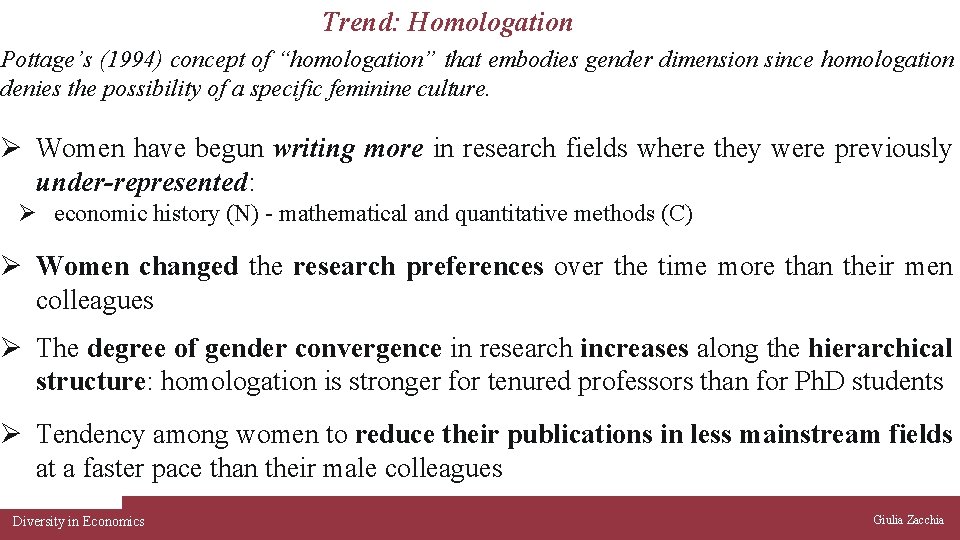
Trend: Homologation Pottage’s (1994) concept of “homologation” that embodies gender dimension since homologation denies the possibility of a specific feminine culture. Ø Women have begun writing more in research fields where they were previously under-represented: Ø economic history (N) - mathematical and quantitative methods (C) Ø Women changed the research preferences over the time more than their men colleagues Ø The degree of gender convergence in research increases along the hierarchical structure: homologation is stronger for tenured professors than for Ph. D students Ø Tendency among women to reduce their publications in less mainstream fields at a faster pace than their male colleagues Diversity in Economics Giulia Zacchia
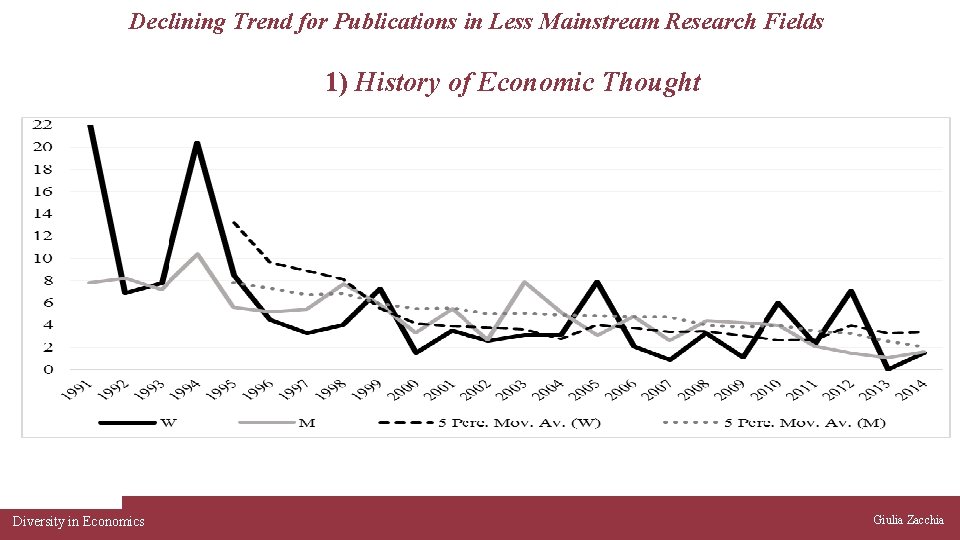
Declining Trend for Publications in Less Mainstream Research Fields 1) History of Economic Thought Diversity in Economics Giulia Zacchia
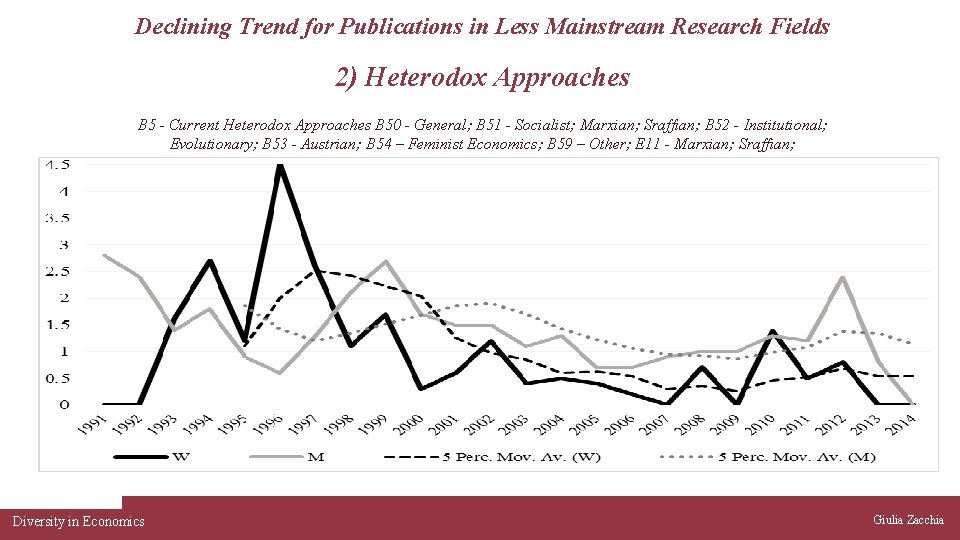
Declining Trend for Publications in Less Mainstream Research Fields 2) Heterodox Approaches B 5 - Current Heterodox Approaches B 50 - General; B 51 - Socialist; Marxian; Sraffian; B 52 - Institutional; Evolutionary; B 53 - Austrian; B 54 – Feminist Economics; B 59 – Other; E 11 - Marxian; Sraffian; Institutional; E 12 - Keynes; Keynesian; Post-Keynesian. Diversity in Economics Giulia Zacchia
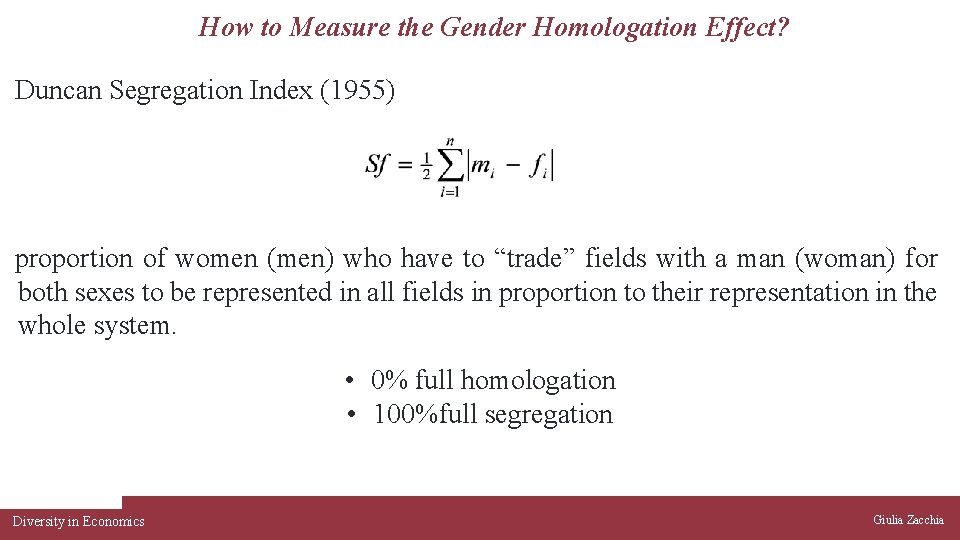
How to Measure the Gender Homologation Effect? Duncan Segregation Index (1955) proportion of women (men) who have to “trade” fields with a man (woman) for both sexes to be represented in all fields in proportion to their representation in the whole system. • 0% full homologation • 100%full segregation Diversity in Economics Giulia Zacchia
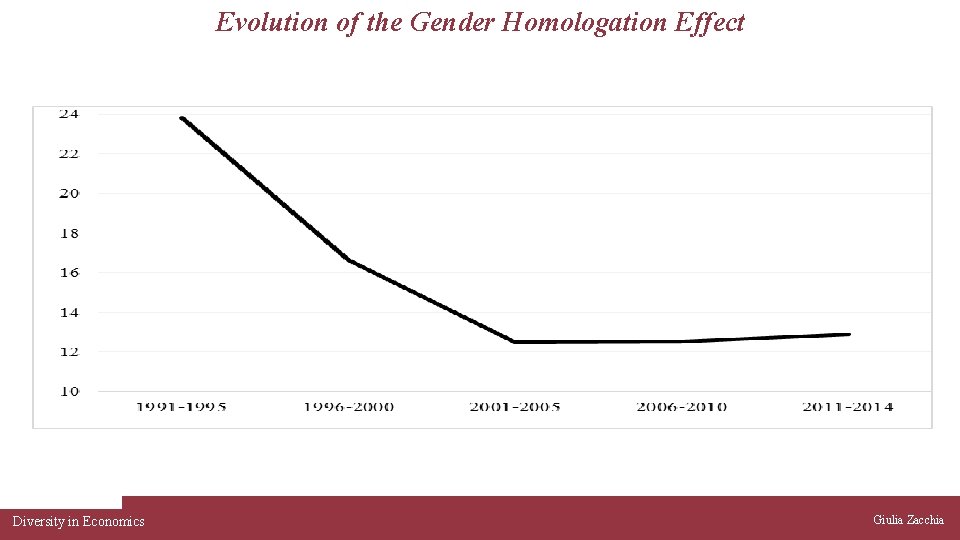
Evolution of the Gender Homologation Effect Diversity in Economics Giulia Zacchia
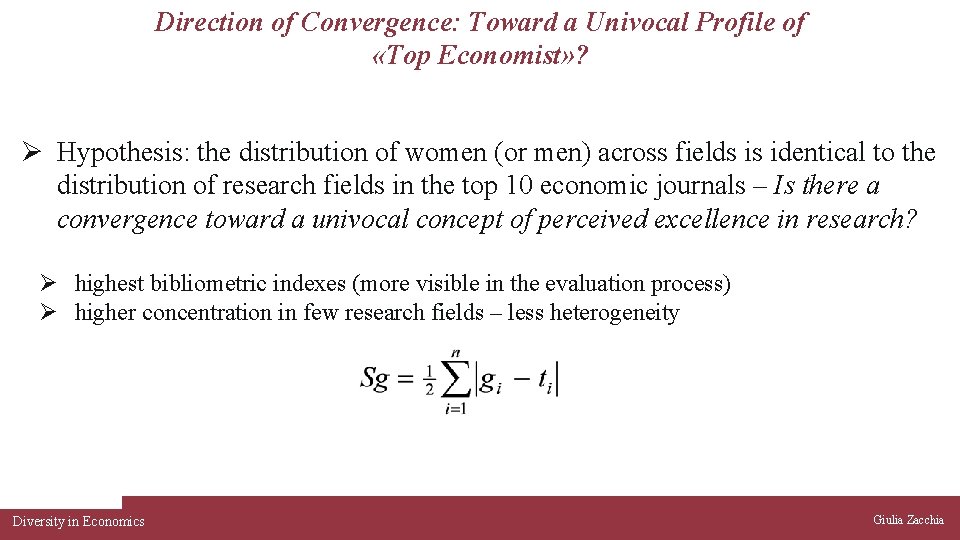
Direction of Convergence: Toward a Univocal Profile of «Top Economist» ? Ø Hypothesis: the distribution of women (or men) across fields is identical to the distribution of research fields in the top 10 economic journals – Is there a convergence toward a univocal concept of perceived excellence in research? Ø highest bibliometric indexes (more visible in the evaluation process) Ø higher concentration in few research fields – less heterogeneity Diversity in Economics Giulia Zacchia
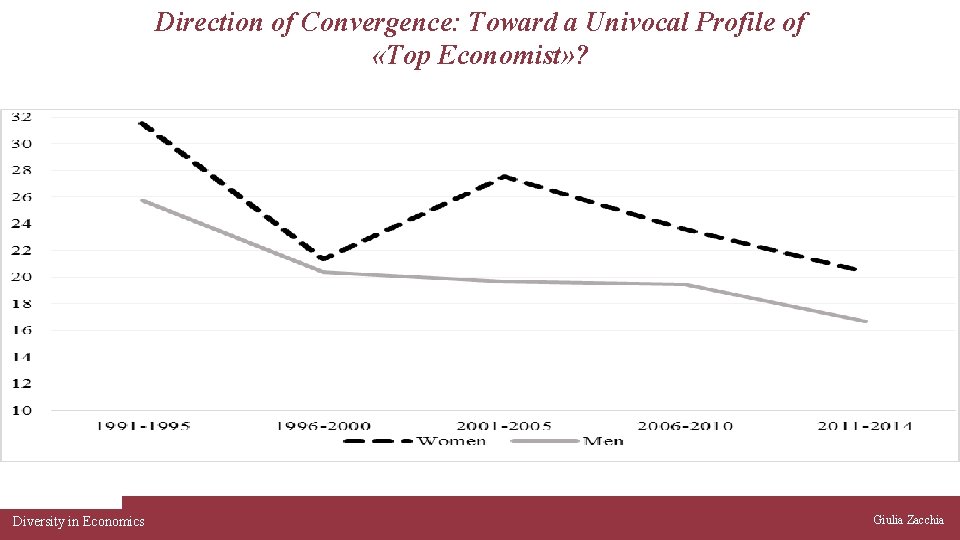
Direction of Convergence: Toward a Univocal Profile of «Top Economist» ? Diversity in Economics Giulia Zacchia
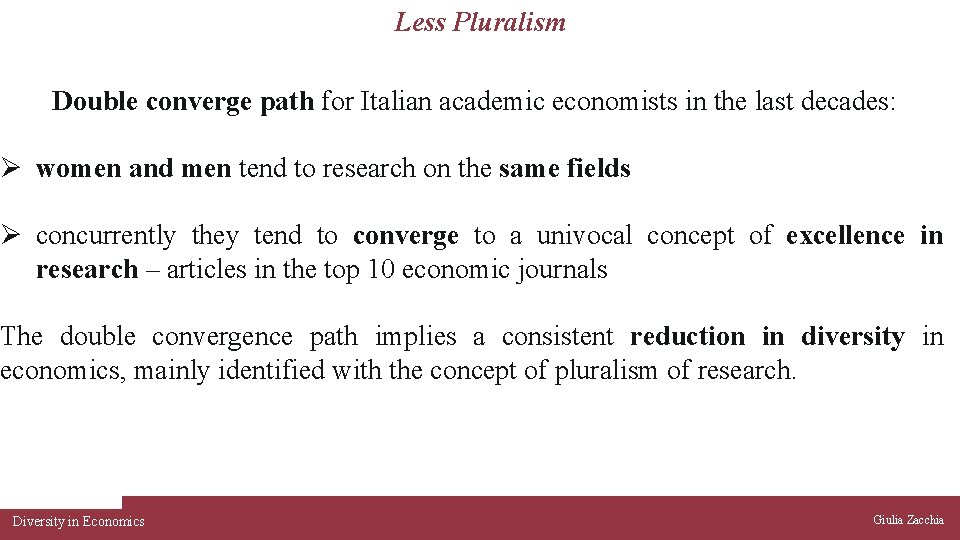
Less Pluralism Double converge path for Italian academic economists in the last decades: Ø women and men tend to research on the same fields Ø concurrently they tend to converge to a univocal concept of excellence in research – articles in the top 10 economic journals The double convergence path implies a consistent reduction in diversity in economics, mainly identified with the concept of pluralism of research. Diversity in Economics Giulia Zacchia
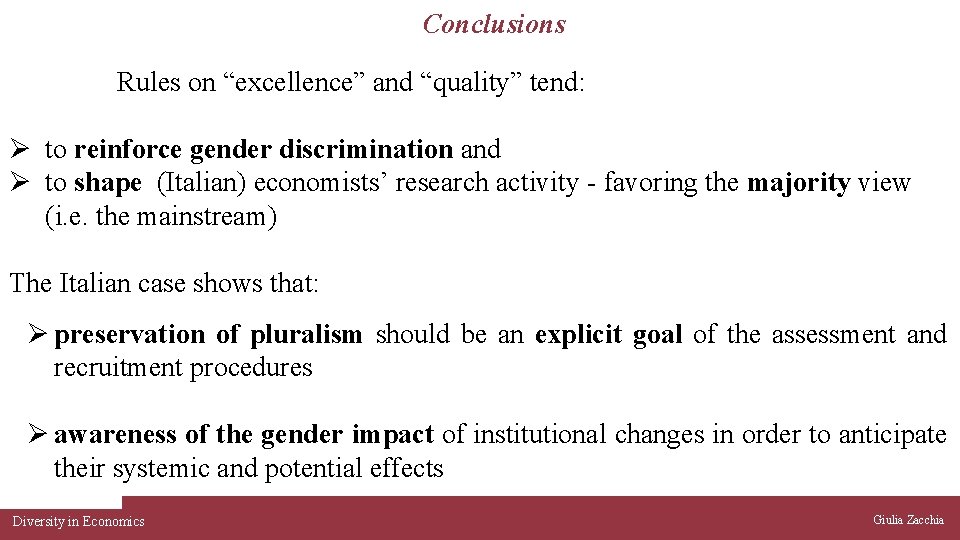
Conclusions Rules on “excellence” and “quality” tend: Ø to reinforce gender discrimination and Ø to shape (Italian) economists’ research activity - favoring the majority view (i. e. the mainstream) The Italian case shows that: Ø preservation of pluralism should be an explicit goal of the assessment and recruitment procedures Ø awareness of the gender impact of institutional changes in order to anticipate their systemic and potential effects Diversity in Economics Giulia Zacchia
Conclusions “do we appreciate being included, under these conditions after millennia, in a world conceived by others? ” Carla Lonzi, 1970 Diversity in Economics Giulia Zacchia

Thank you! giulia. zacchia@uniroma 1. it Diversity in Economics Giulia Zacchia
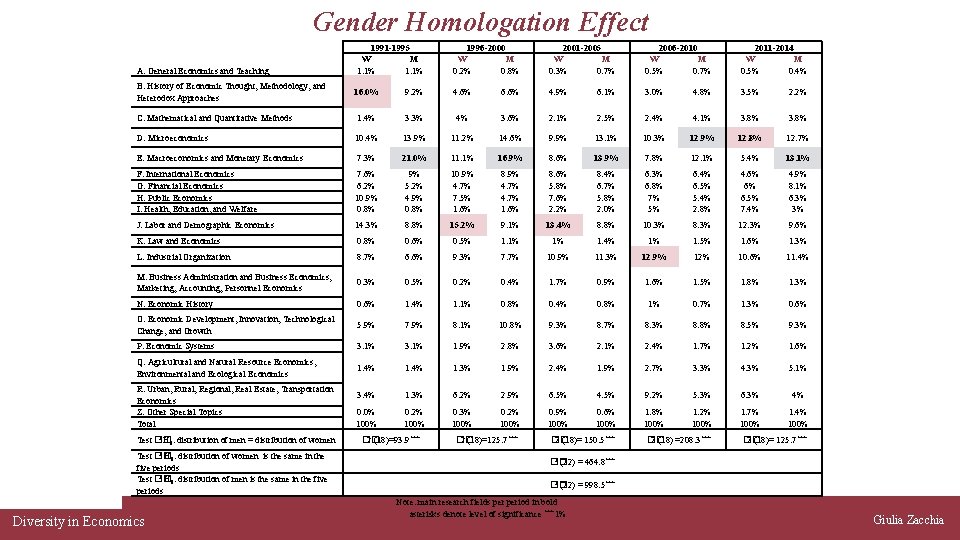
Gender Homologation Effect A. General Economics and Teaching B. History of Economic Thought, Methodology, and Heterodox Approaches 1991 -1995 W M 1. 1% 1996 -2000 W M 0. 2% 0. 8% 2001 -2005 W M 0. 3% 0. 7% 2006 -2010 W M 0. 5% 0. 7% 2011 -2014 W M 0. 5% 0. 4% 16. 0% 9. 2% 4. 6% 6. 6% 4. 9% 6. 1% 3. 0% 4. 8% 3. 5% 2. 2% C. Mathematical and Quantitative Methods 1. 4% 3. 3% 4% 3. 6% 2. 1% 2. 5% 2. 4% 4. 1% 3. 8% D. Microeconomics 10. 4% 13. 9% 11. 2% 14. 6% 9. 9% 13. 1% 10. 3% 12. 9% 12. 8% 12. 7% E. Macroeconomics and Monetary Economics 7. 3% 21. 0% 11. 1% 16. 9% 8. 6% 13. 9% 7. 8% 12. 1% 5. 4% 13. 1% F. International Economics G. Financial Economics H. Public Economics I. Health, Education, and Welfare 7. 6% 6. 2% 10. 9% 0. 8% 9% 5. 2% 4. 9% 0. 8% 10. 9% 4. 7% 7. 5% 1. 6% 8. 9% 4. 7% 1. 6% 8. 6% 5. 8% 7. 6% 2. 2% 8. 4% 6. 7% 5. 8% 2. 0% 6. 3% 6. 8% 7% 5% 6. 4% 6. 5% 5. 4% 2. 8% 4. 6% 6% 6. 5% 7. 4% 4. 9% 8. 1% 6. 3% 3% J. Labor and Demographic Economics 14. 3% 8. 8% 15. 2% 9. 1% 13. 4% 8. 8% 10. 3% 8. 3% 12. 3% 9. 6% K. Law and Economics 0. 8% 0. 6% 0. 5% 1. 1% 1% 1. 4% 1% 1. 5% 1. 6% 1. 3% L. Industrial Organization 8. 7% 6. 6% 9. 3% 7. 7% 10. 9% 11. 3% 12. 9% 12% 10. 6% 11. 4% M. Business Administration and Business Economics, Marketing, Accounting, Personnel Economics 0. 3% 0. 5% 0. 2% 0. 4% 1. 7% 0. 9% 1. 6% 1. 5% 1. 8% 1. 3% N. Economic History 0. 6% 1. 4% 1. 1% 0. 8% 0. 4% 0. 8% 1% 0. 7% 1. 3% 0. 6% O. Economic Development, Innovation, Technological Change, and Growth 5. 9% 7. 9% 8. 1% 10. 8% 9. 3% 8. 7% 8. 3% 8. 8% 8. 5% 9. 3% P. Economic Systems 3. 1% 1. 9% 2. 8% 3. 6% 2. 1% 2. 4% 1. 7% 1. 2% 1. 6% Q. Agricultural and Natural Resource Economics, Environmental and Ecological Economics 1. 4% 1. 3% 1. 9% 2. 4% 1. 9% 2. 7% 3. 3% 4. 3% 5. 1% 3. 4% 1. 3% 6. 2% 2. 9% 6. 5% 4. 5% 9. 2% 5. 3% 6. 3% 4% 0. 0% 100% 0. 2% 100% 0. 3% 100% 0. 2% 100% 0. 9% 100% 0. 6% 100% 1. 8% 100% 1. 2% 100% 1. 7% 100% 1. 4% 100% R. Urban, Rural, Regional, Real Estate, Transportation Economics Z. Other Special Topics Total 2 H : distribution of men = distribution of women Test �� 0 2 H : distribution of women is the same in the Test �� 0 five periods 2 H : distribution of men is the same in the five Test �� 0 periods Diversity in Economics �� 2 (18)=93. 9*** �� 2 (18)=125. 7*** �� 2 (18)= 150. 5*** �� 2 (18) =208. 3*** �� 2 (18)= 125. 7*** 2 (72) = 464. 8*** �� 2 (72) = 998. 5*** �� Note: main research fields period in bold asterisks denote level of significance *** 1% Giulia Zacchia
Top Journals Considered We consider the first 10 economic journals ranked in Kalaitzidakis et al. (2011): Ø Ø Ø Ø Ø Diversity in Economics American Economic Review; Quarterly Journal of Economics; Journal of Political Economy; Econometrica; Review of Economic Studies; Journal of Monetary Economics; Review of Economics and Statistics; Journal of Economic Perspectives; Journal of Economic Theory; The Economic Journal Giulia Zacchia
Status Quo Ø Under-representation of women in universities Ø misogyny - Alice Wu (dissertation University of California, Berkeley) Ø More competitive environment imposed by the growing pressure for audit and evaluation of public spending on higher education and research; Ø increasing use of metrics and quantitative indicators on different aspect of research (mainly based on citations); Ø “field of economics is behind others in its progress on diversity concerns” Amanda Bayer and Cecilia Elena Rouse (2016) Diversity in Economics Giulia Zacchia
- Slides: 19