
Minerals ROCK This presentation was made possible with
Minerals ROCK! This presentation was made possible with funding from the Promo. Science programme of NSERC ©Mc. Gill University 2010
Minerals Why are they important? ©Mc. Gill University 2010
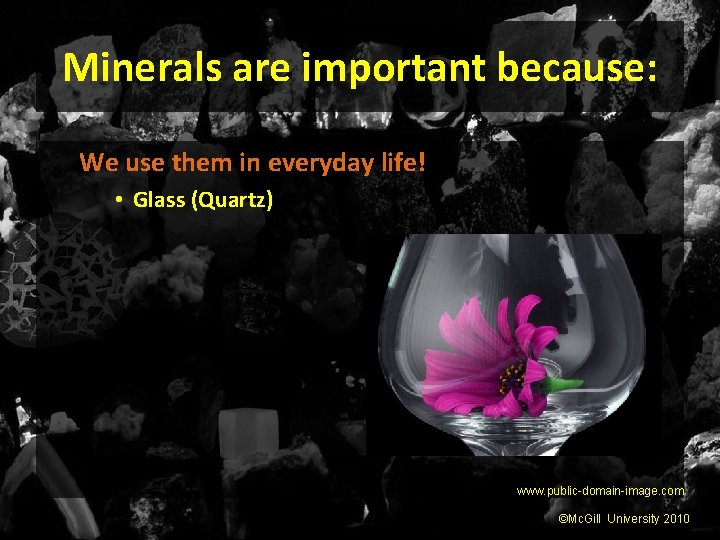
Minerals are important because: We use them in everyday life! • Glass (Quartz) www. public-domain-image. com ©Mc. Gill University 2010
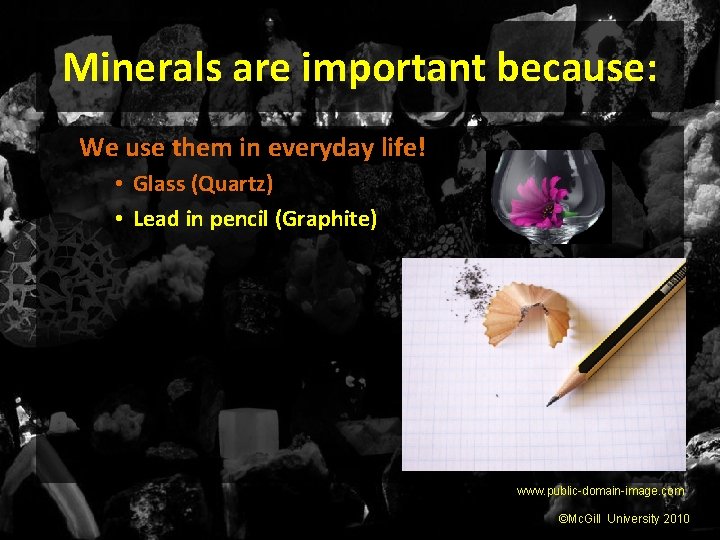
Minerals are important because: We use them in everyday life! • Glass (Quartz) • Lead in pencil (Graphite) www. public-domain-image. com ©Mc. Gill University 2010
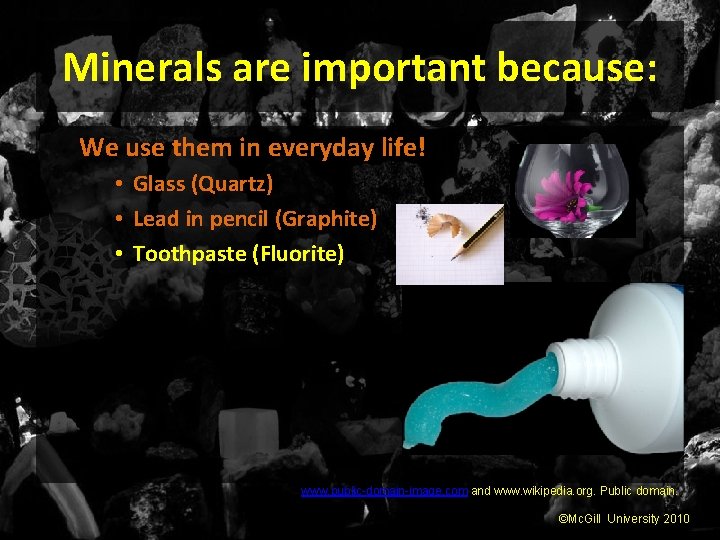
Minerals are important because: We use them in everyday life! • Glass (Quartz) • Lead in pencil (Graphite) • Toothpaste (Fluorite) www. public-domain-image. com and www. wikipedia. org. Public domain. ©Mc. Gill University 2010
Minerals are important because: We use them in everyday life! • • Glass (Quartz) Lead in pencil (Graphite) Toothpaste (Fluorite) Coins and wiring (Chalcopyrite, from which most copper metal is made) www. public-domain-image. com and www. wikipedia. org. Public domain. ©Mc. Gill University 2010

Minerals are important because: We use them in everyday life! Glass (Quartz) Lead in pencil (Graphite) Toothpaste (Fluorite) Coins and wiring (Chalcopyrite, from which most copper metal is made) • White paint (Rutile and Ilmenite) • • www. public-domain-image. com and www. wikipedia. org. Public domain. ©Mc. Gill University 2010
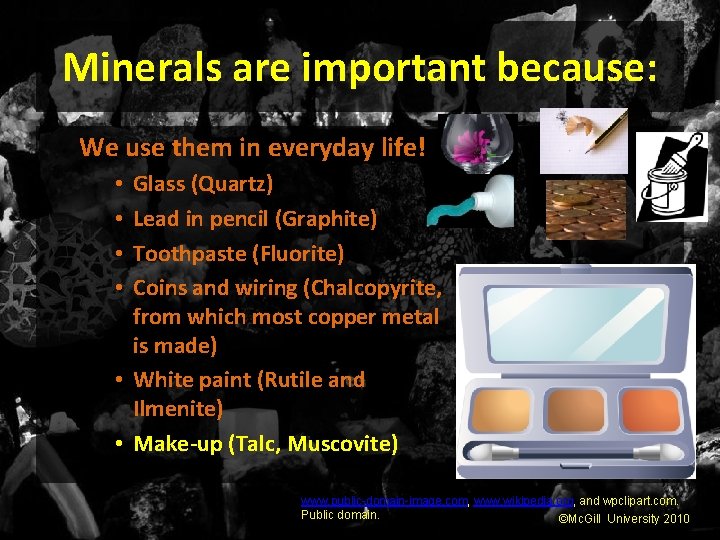
Minerals are important because: We use them in everyday life! Glass (Quartz) Lead in pencil (Graphite) Toothpaste (Fluorite) Coins and wiring (Chalcopyrite, from which most copper metal is made) • White paint (Rutile and Ilmenite) • Make-up (Talc, Muscovite) • • www. public-domain-image. com, www. wikipedia. org, and wpclipart. com. Public domain. ©Mc. Gill University 2010
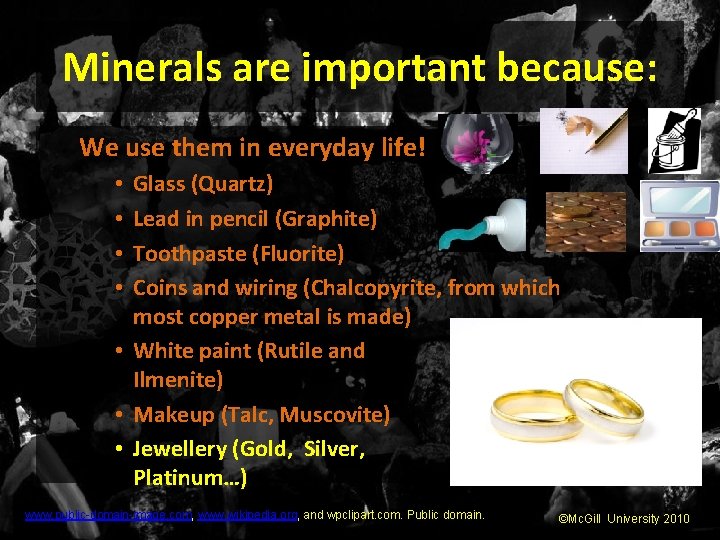
Minerals are important because: We use them in everyday life! Glass (Quartz) Lead in pencil (Graphite) Toothpaste (Fluorite) Coins and wiring (Chalcopyrite, from which most copper metal is made) • White paint (Rutile and Ilmenite) • Makeup (Talc, Muscovite) • Jewellery (Gold, Silver, Platinum…) • • www. public-domain-image. com, www. wikipedia. org, and wpclipart. com. Public domain. ©Mc. Gill University 2010
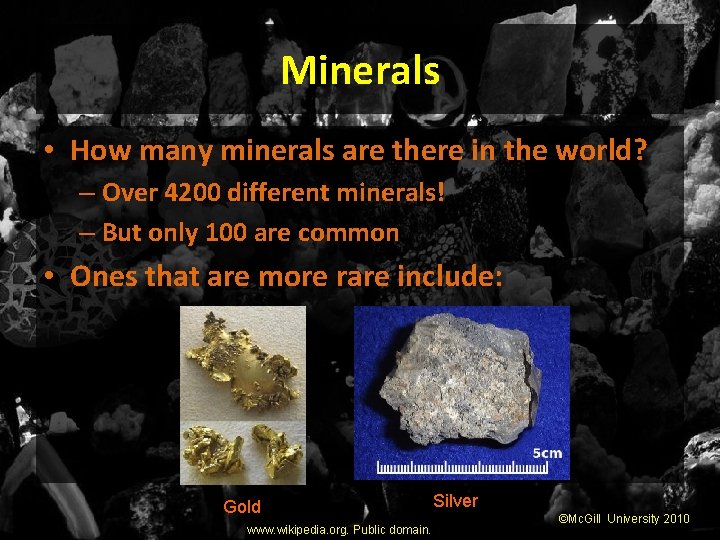
Minerals • How many minerals are there in the world? – Over 4200 different minerals! – But only 100 are common • Ones that are more rare include: Gold www. wikipedia. org. Public domain. Silver ©Mc. Gill University 2010
What is a mineral? • A mineral must have… – A crystalline structure – A definite chemical composition • A mineral must be… – Formed by geological processes – Inorganic – Solid ©Mc. Gill University 2010
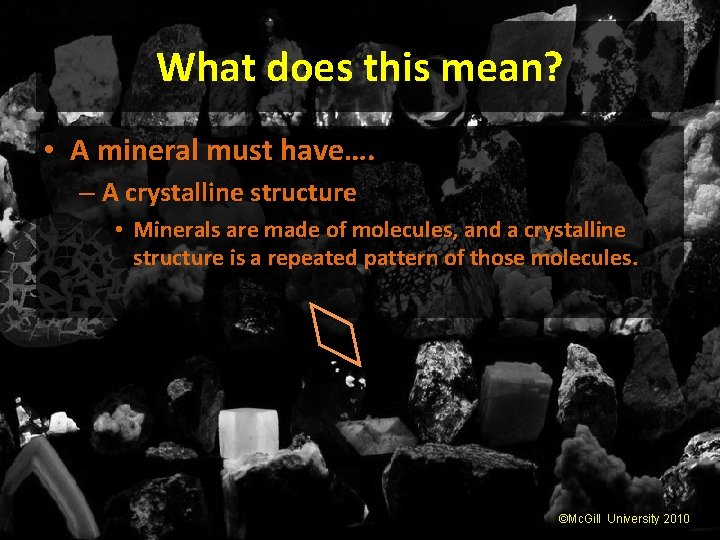
What does this mean? • A mineral must have…. – A crystalline structure • Minerals are made of molecules, and a crystalline structure is a repeated pattern of those molecules. ©Mc. Gill University 2010
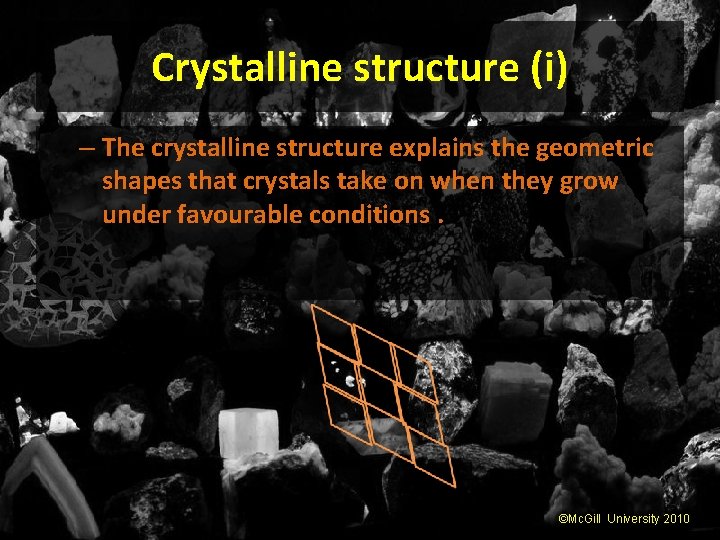
Crystalline structure (i) – The crystalline structure explains the geometric shapes that crystals take on when they grow under favourable conditions. ©Mc. Gill University 2010
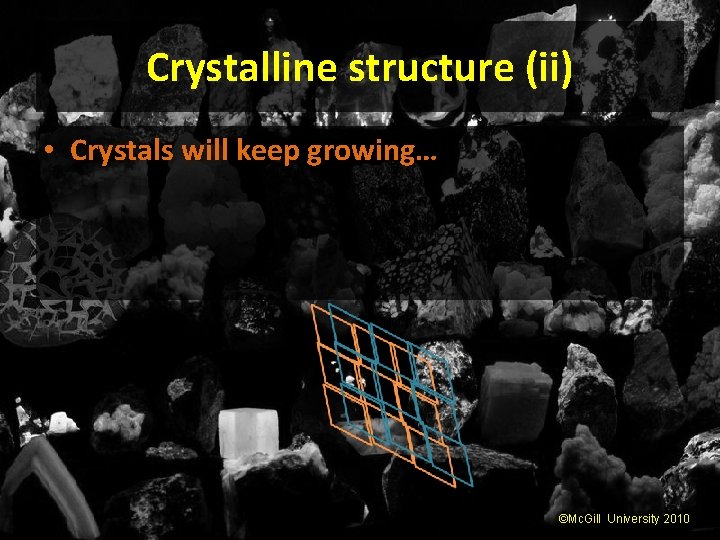
Crystalline structure (ii) • Crystals will keep growing… ©Mc. Gill University 2010
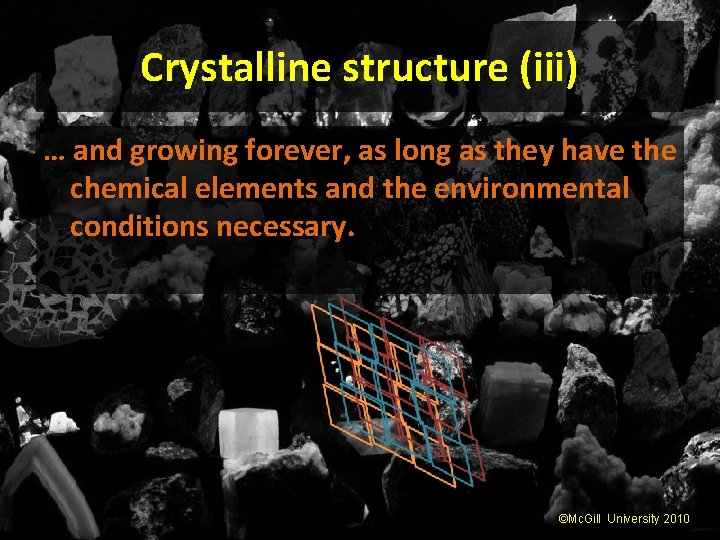
Crystalline structure (iii) … and growing forever, as long as they have the chemical elements and the environmental conditions necessary. ©Mc. Gill University 2010
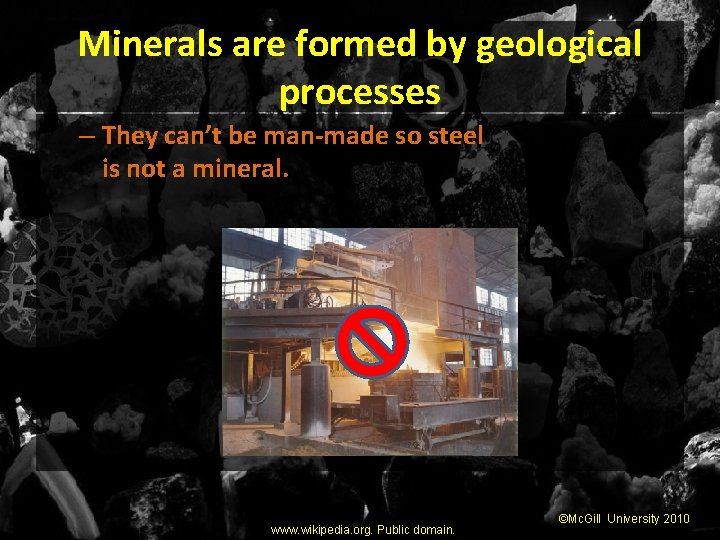
Minerals are formed by geological processes – They can’t be man-made so steel is not a mineral. www. wikipedia. org. Public domain. ©Mc. Gill University 2010
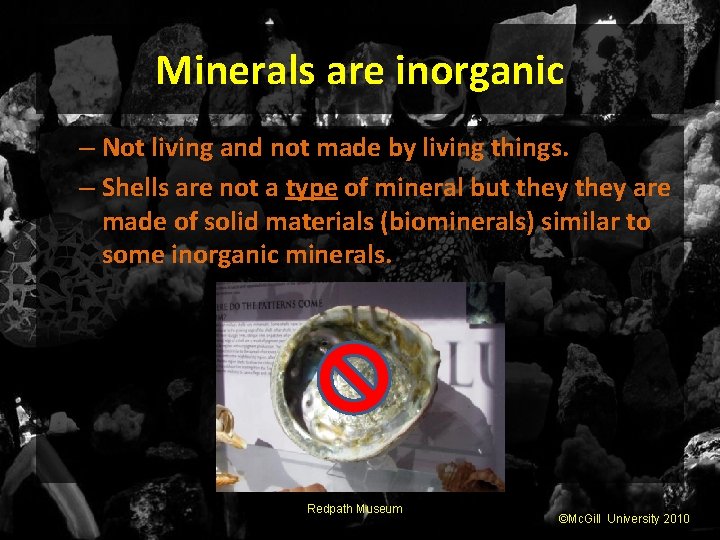
Minerals are inorganic – Not living and not made by living things. – Shells are not a type of mineral but they are made of solid materials (biominerals) similar to some inorganic minerals. Redpath Museum ©Mc. Gill University 2010
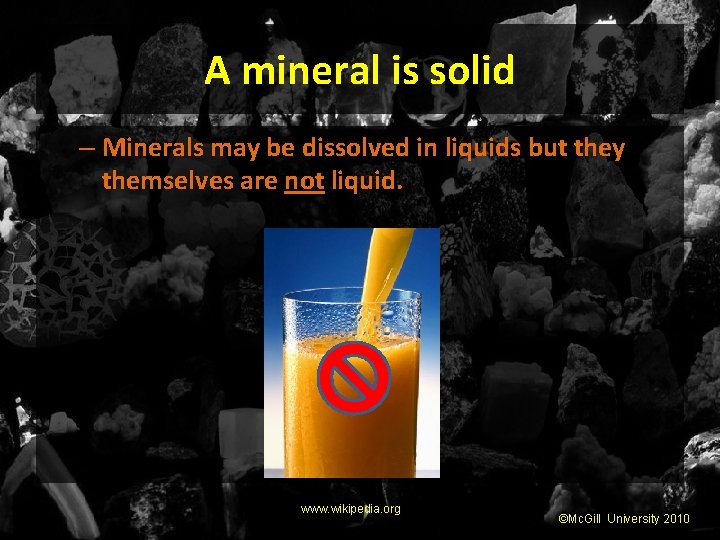
A mineral is solid – Minerals may be dissolved in liquids but they themselves are not liquid. www. wikipedia. org ©Mc. Gill University 2010
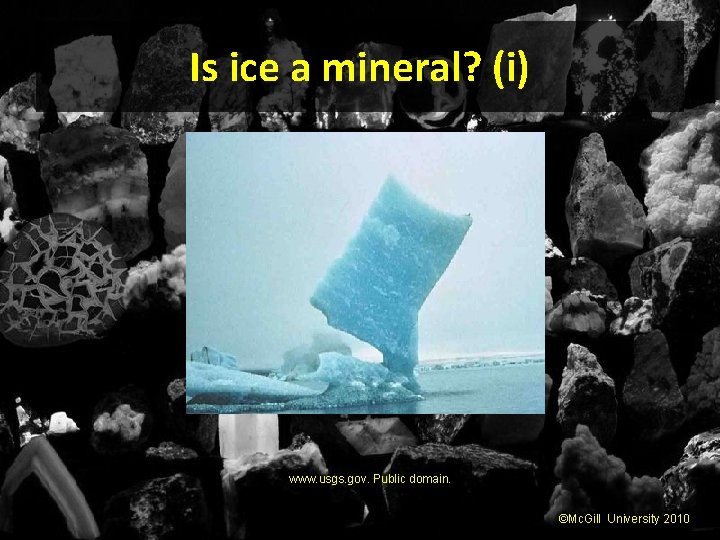
Is ice a mineral? (i) www. usgs. gov. Public domain. ©Mc. Gill University 2010
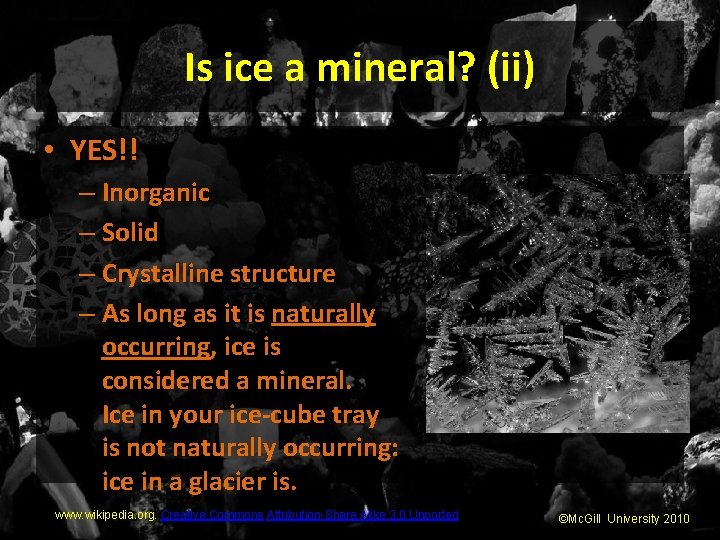
Is ice a mineral? (ii) • YES!! – Inorganic – Solid – Crystalline structure – As long as it is naturally occurring, ice is considered a mineral. Ice in your ice-cube tray is not naturally occurring: ice in a glacier is. www. wikipedia. org. Creative Commons Attribution-Share Alike 3. 0 Unported license ©Mc. Gill University 2010
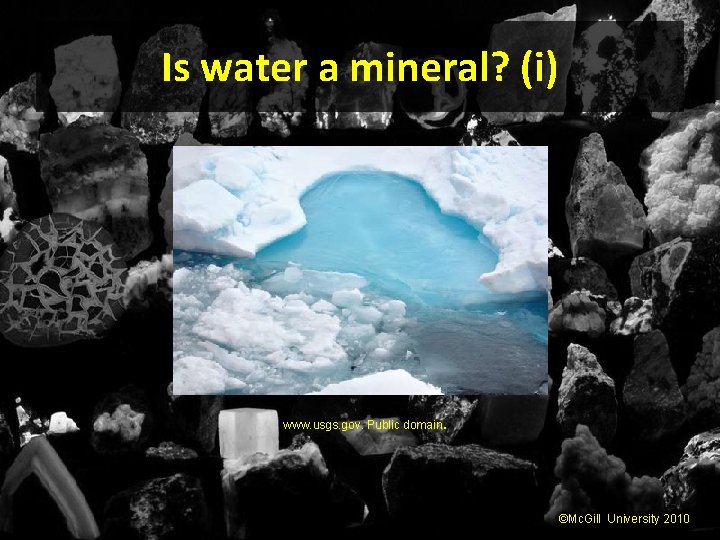
Is water a mineral? (i) www. usgs. gov. Public domain. ©Mc. Gill University 2010
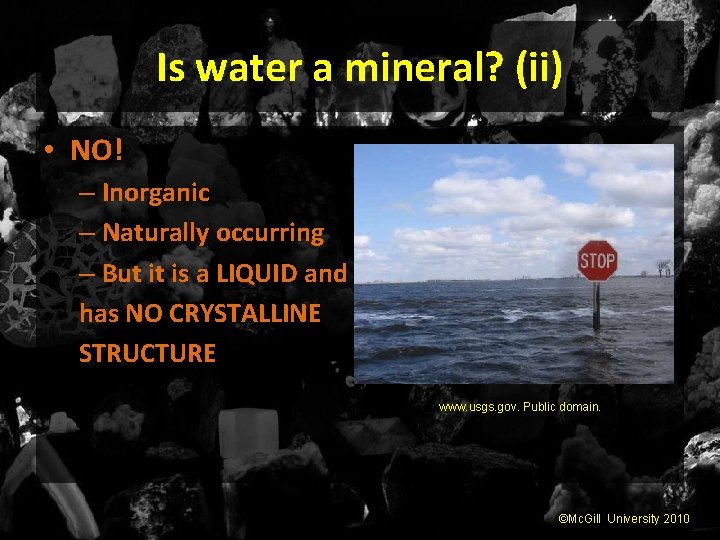
Is water a mineral? (ii) • NO! – Inorganic – Naturally occurring – But it is a LIQUID and has NO CRYSTALLINE STRUCTURE www. usgs. gov. Public domain. ©Mc. Gill University 2010
How are minerals formed? • Many minerals crystallize from liquids, principally magma/lava (molten rock), hot waters (e. g. , geysers), or oceans. • Others are formed when rocks are re-buried below the Earth’s surface and exposed to high pressure and temperature. The minerals become unstable and they exchange chemical elements. This forms new minerals. ©Mc. Gill University 2010
Why are minerals found in large quantities in some places and not others? • The Earth’s surface is made up of plates that move. “Plate tectonics” describe this motion. • Together with erosion, plate tectonics concentrate some of these elements in bodies of rocks that can be mined. • Plate tectonics are the Earth's giant "recycling engine“.
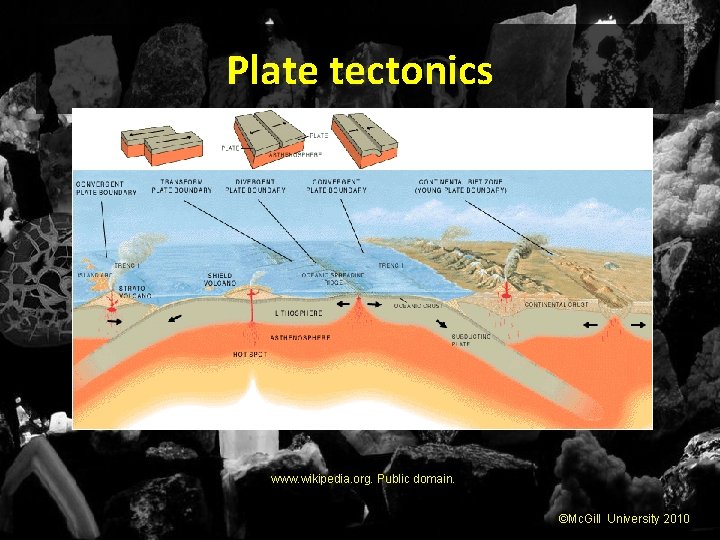
Plate tectonics www. wikipedia. org. Public domain. ©Mc. Gill University 2010
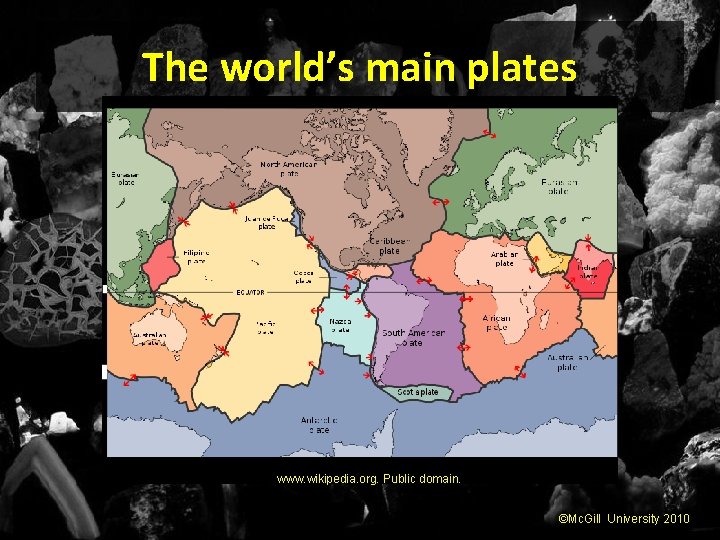
The world’s main plates www. wikipedia. org. Public domain. ©Mc. Gill University 2010
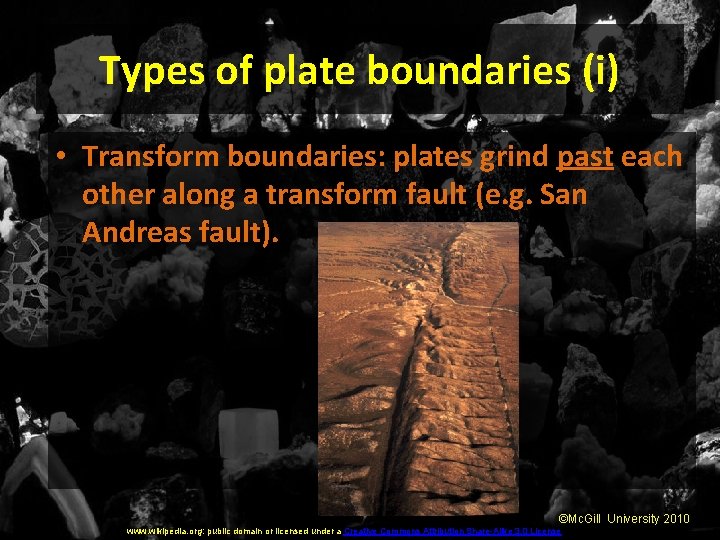
Types of plate boundaries (i) • Transform boundaries: plates grind past each other along a transform fault (e. g. San Andreas fault). ©Mc. Gill University 2010 www. wikipedia. org: public domain or licensed under a Creative Commons Attribution Share-Alike 3. 0 License
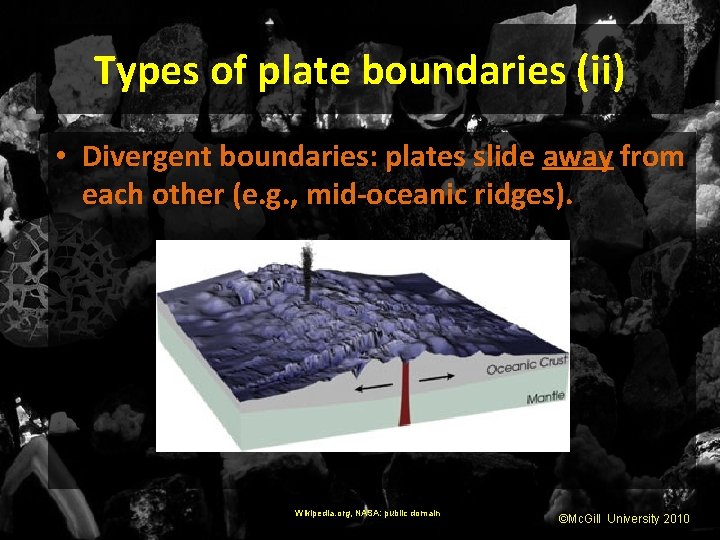
Types of plate boundaries (ii) • Divergent boundaries: plates slide away from each other (e. g. , mid-oceanic ridges). Wikipedia. org, NASA: public domain ©Mc. Gill University 2010
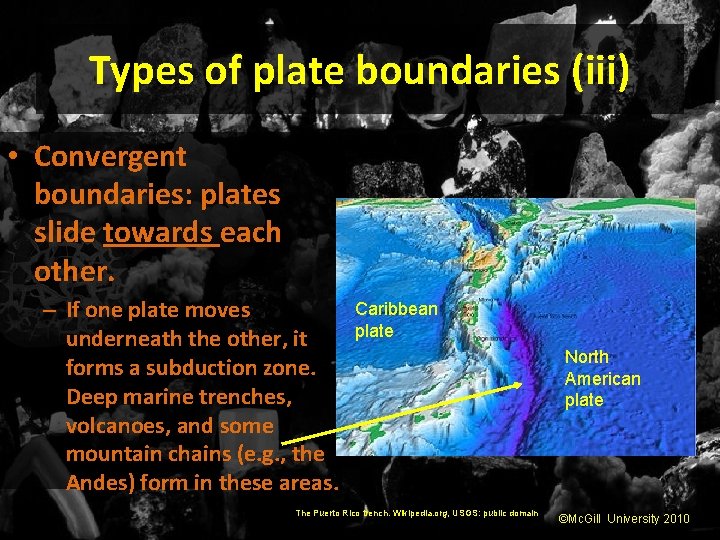
Types of plate boundaries (iii) • Convergent boundaries: plates slide towards each other. – If one plate moves underneath the other, it forms a subduction zone. Deep marine trenches, volcanoes, and some mountain chains (e. g. , the Andes) form in these areas. Caribbean plate The Puerto Rico trench. Wikipedia. org, USGS: public domain North American plate ©Mc. Gill University 2010
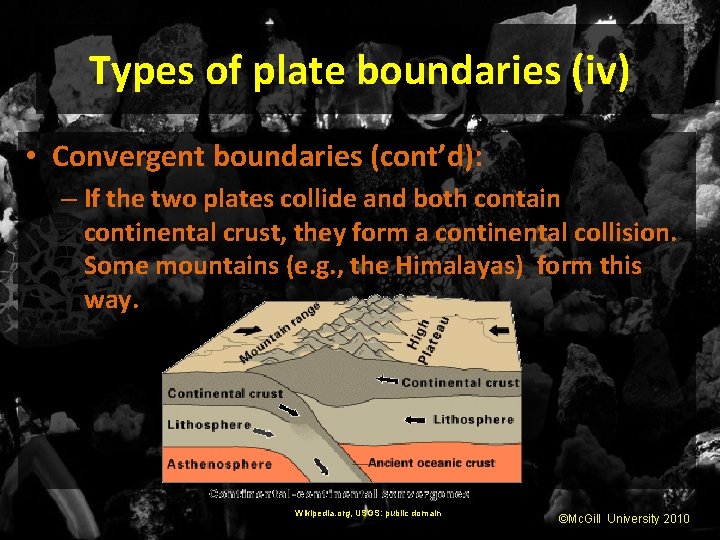
Types of plate boundaries (iv) • Convergent boundaries (cont’d): – If the two plates collide and both contain continental crust, they form a continental collision. Some mountains (e. g. , the Himalayas) form this way. Wikipedia. org, USGS: public domain ©Mc. Gill University 2010
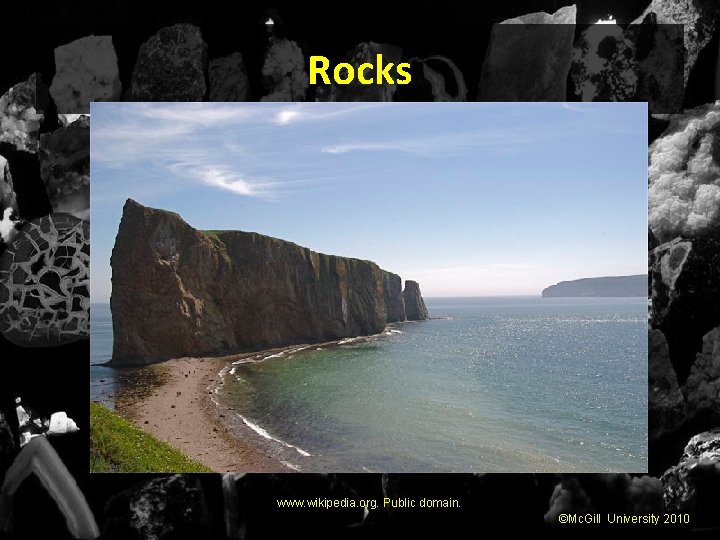
Rocks www. wikipedia. org. Public domain. ©Mc. Gill University 2010
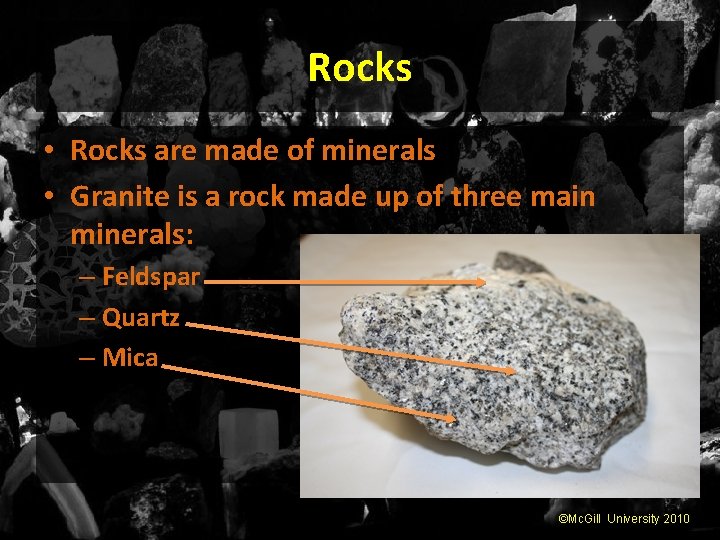
Rocks • Rocks are made of minerals • Granite is a rock made up of three main minerals: – Feldspar – Quartz – Mica ©Mc. Gill University 2010
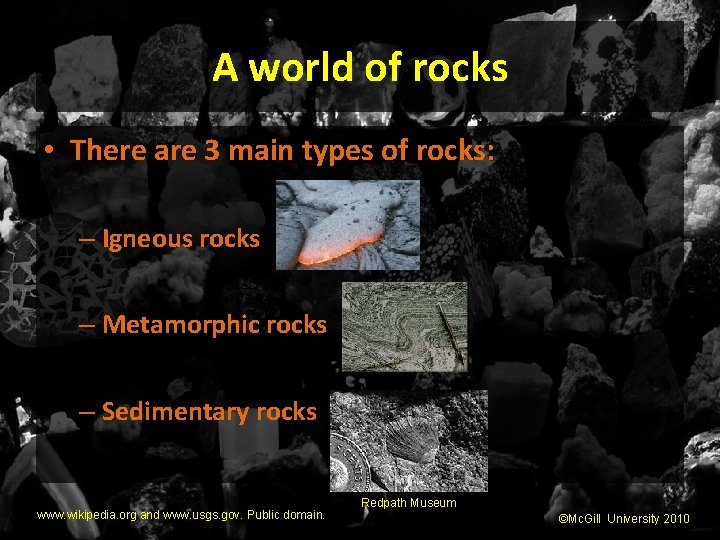
A world of rocks • There are 3 main types of rocks: – Igneous rocks – Metamorphic rocks – Sedimentary rocks www. wikipedia. org and www. usgs. gov. Public domain. Redpath Museum ©Mc. Gill University 2010
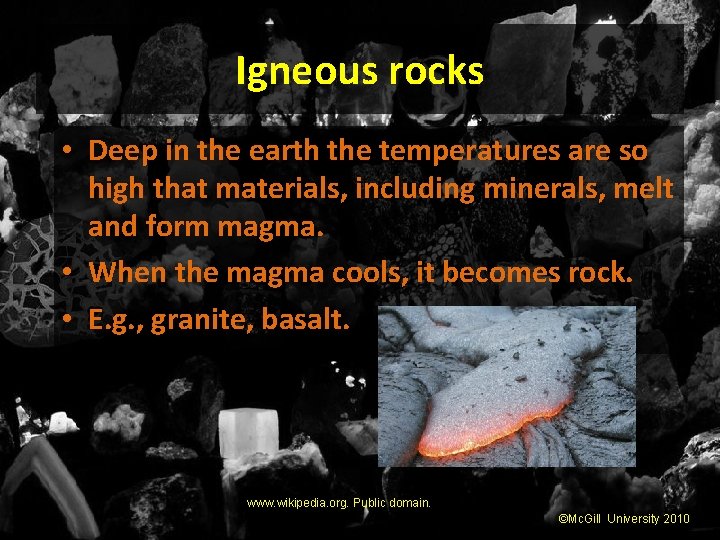
Igneous rocks • Deep in the earth the temperatures are so high that materials, including minerals, melt and form magma. • When the magma cools, it becomes rock. • E. g. , granite, basalt. www. wikipedia. org. Public domain. ©Mc. Gill University 2010
Metamorphic rocks (i) • When rocks are re-buried below the Earth’s surface and exposed to high pressure and temperature, the minerals become unstable and they exchange chemical elements. • This forms new minerals. This may also cause some grains to grow and others to shrink. ©Mc. Gill University 2010
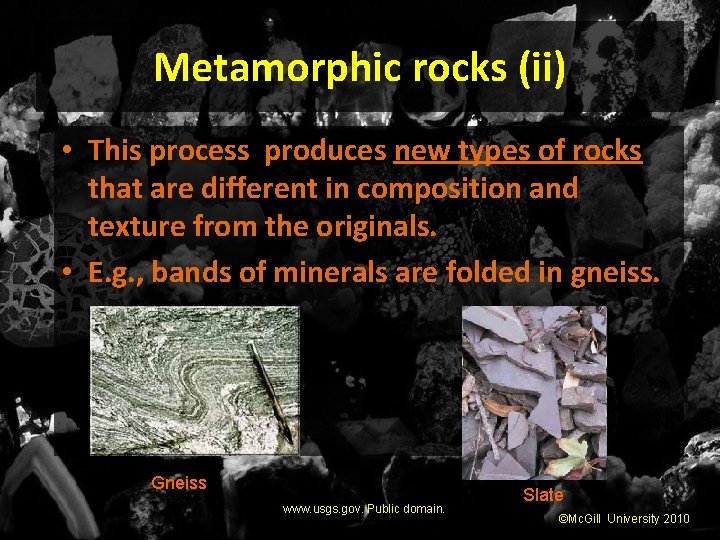
Metamorphic rocks (ii) • This process produces new types of rocks that are different in composition and texture from the originals. • E. g. , bands of minerals are folded in gneiss. Gneiss www. usgs. gov. Public domain. Slate ©Mc. Gill University 2010
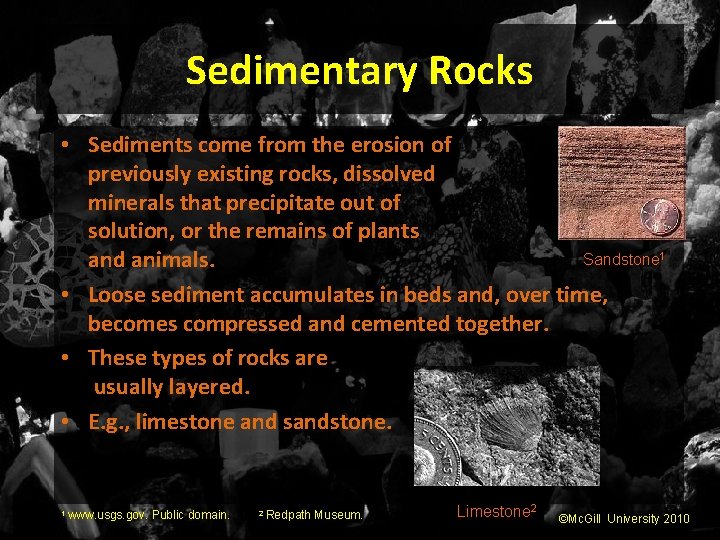
Sedimentary Rocks • Sediments come from the erosion of previously existing rocks, dissolved minerals that precipitate out of solution, or the remains of plants Sandstone 1 and animals. • Loose sediment accumulates in beds and, over time, becomes compressed and cemented together. • These types of rocks are usually layered. • E. g. , limestone and sandstone. 1 www. usgs. gov. Public domain. 2 Redpath Museum. Limestone 2 ©Mc. Gill University 2010
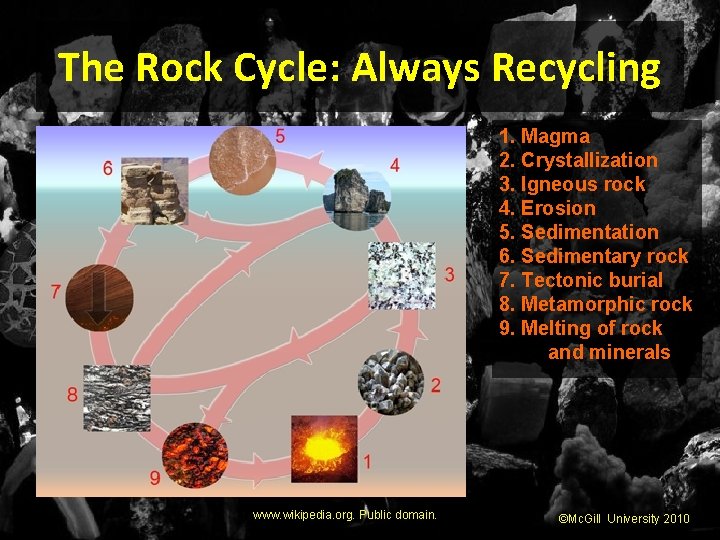
The Rock Cycle: Always Recycling 1. Magma 2. Crystallization 3. Igneous rock 4. Erosion 5. Sedimentation 6. Sedimentary rock 7. Tectonic burial 8. Metamorphic rock 9. Melting of rock and minerals www. wikipedia. org. Public domain. ©Mc. Gill University 2010
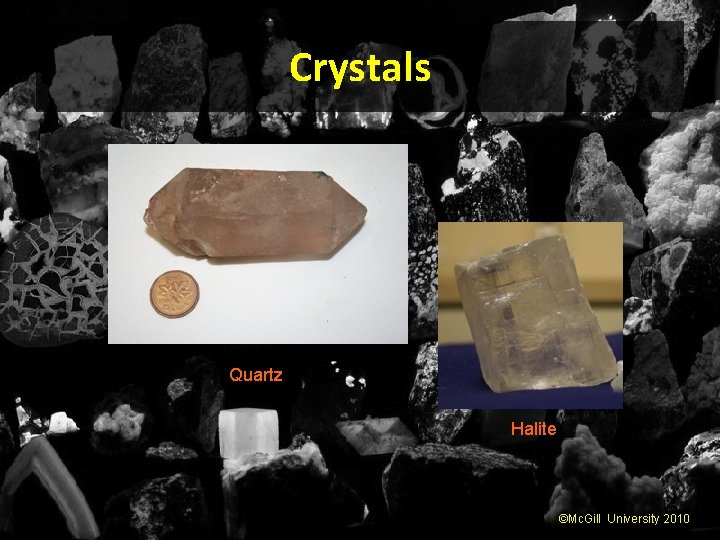
Crystals Quartz Halite ©Mc. Gill University 2010
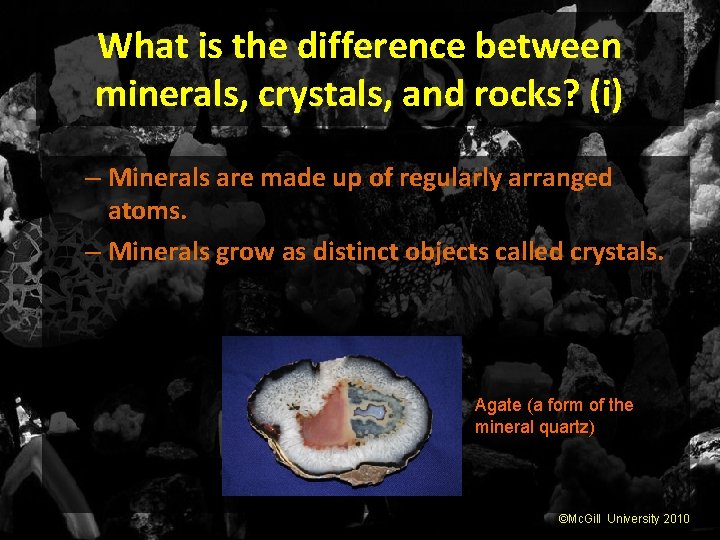
What is the difference between minerals, crystals, and rocks? (i) – Minerals are made up of regularly arranged atoms. – Minerals grow as distinct objects called crystals. Agate (a form of the mineral quartz) ©Mc. Gill University 2010
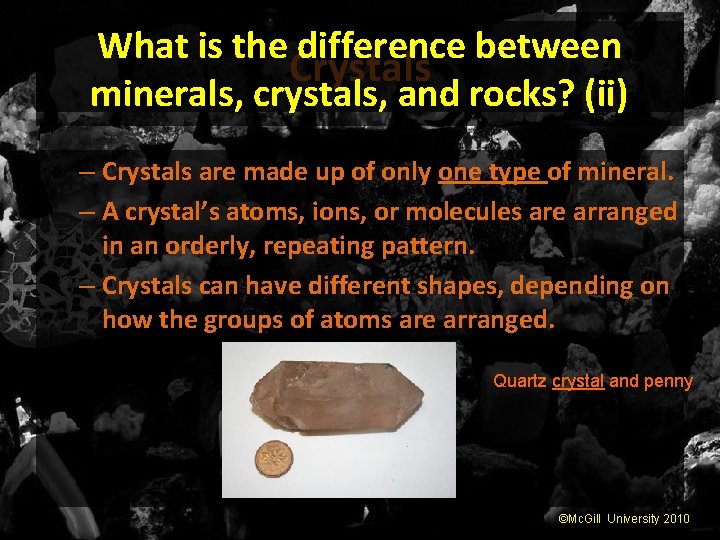
What is the difference between Crystals minerals, crystals, and rocks? (ii) – Crystals are made up of only one type of mineral. – A crystal’s atoms, ions, or molecules are arranged in an orderly, repeating pattern. – Crystals can have different shapes, depending on how the groups of atoms are arranged. Quartz crystal and penny ©Mc. Gill University 2010
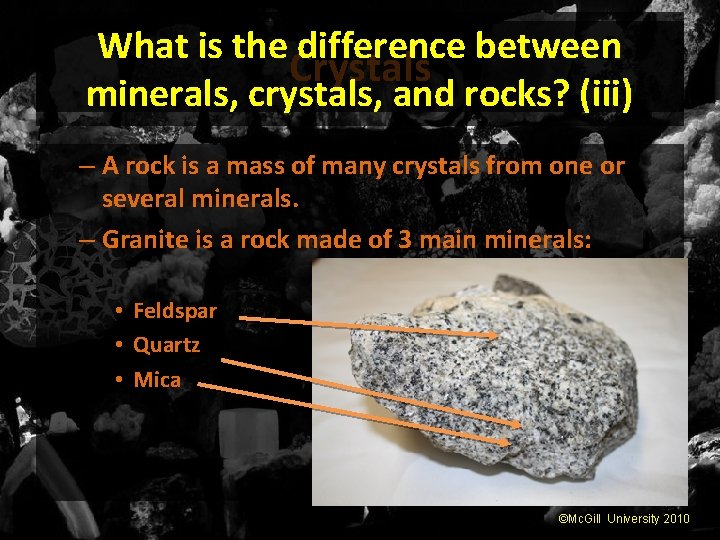
What is the difference between Crystals minerals, crystals, and rocks? (iii) – A rock is a mass of many crystals from one or several minerals. – Granite is a rock made of 3 main minerals: • Feldspar • Quartz • Mica ©Mc. Gill University 2010
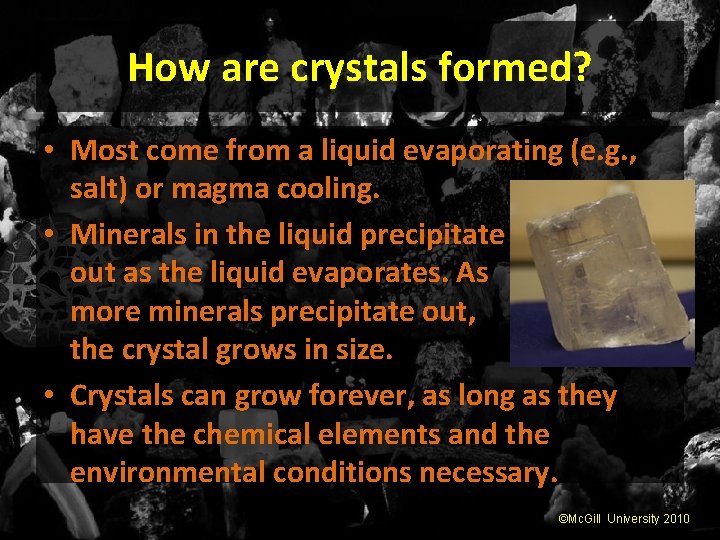
How are crystals formed? • Most come from a liquid evaporating (e. g. , salt) or magma cooling. • Minerals in the liquid precipitate out as the liquid evaporates. As more minerals precipitate out, the crystal grows in size. • Crystals can grow forever, as long as they have the chemical elements and the environmental conditions necessary. ©Mc. Gill University 2010
Mineral Identification (i) • The two most important properties that scientists use to identify minerals are: – chemical composition (e. g. , via microprobe analysis) – crystal structure (e. g. , via X-ray diffraction analysis), which is reflected in the mineral's crystal symmetry and shape ©Mc. Gill University 2010
Mineral Identification (ii) • Other properties that scientists use to help identify minerals include: – Colour – Luster (how the surface reflects light) – Streak (the mark it leaves on a ceramic plate) – Hardness – Magnetism – Crystal system (crystal shape and the way in which the crystals are arranged) ©Mc. Gill University 2010
Acknowledgments • Scientific consultation – Dr. Jeanne Paquette (Earth and Planetary Sciences) – Dr. Peter Tarassoff (Redpath Museum) • Concept, design, and production: – Jacky Farrell – Elizabeth Miazgy – This presentation was made possible with funding from the Promo. Science programme of NSERC ©Mc. Gill University 2010
- Slides: 46