
Minerals Review of Foldable Notes What is a
Minerals Review of Foldable Notes
What is a Mineral? • Formed by natural process. • Inorganic – are not made by a life • • process. Has a chemical composition. Crystalline solids – repeating pattern of atoms • ~ 4, 000 minerals on the Earth.
The Structure of Minerals • Crystal – is a solid. – In this solid form atoms are arranged in a repeating pattern. • 6 Major crystal systems (Figure 3, p. 10)
6 Crystal Systems • 1. Cubic – ex: Fluorite. • 2. Hexagonal – ex: Quartz. • 3. Tetragonal – ex: Zircon. • 4. Orthorhombic – ex: Barite. • 5. Monoclinic – ex: Orthoclase. • 6. Triclinic – ex: Rhodonite.

Crystal Formation • Crystals form 2 natural processes: – Magma – From Solution
Magma Crystals • Magma = melted rock. Cools when reaches Earth’s surface. • As magma cools – Atoms loose energy and its atoms move closer together.
• Slow Cooling Magma – Large crystals • Fast Cooling Magma – Small Crystals
Crystals in Solution • Water evaporates and leaves ions / minerals. • Occurs in a dry climate. • Ex: Salt water.
• Crystal formation in solution can occur if too much of a substance is dissolved in water. • Will form crystals in the solution. • This is called precipitation.
Mineral Composition and Groups • 98 % of Earth’s crust is composed of 90 naturally occurring elements. • 8 Common minerals of Earth’s crust – Oxygen, Silicon, Aluminum, Iron, Calcium, Sodium, Potassium, &Magnesium.
Silicates • Silicates – minerals that contain Silicon (Si), Oxygen (O), and usually 1 more element. • Silicon and Oxygen are the most abundant elements of the Earth’s crust.
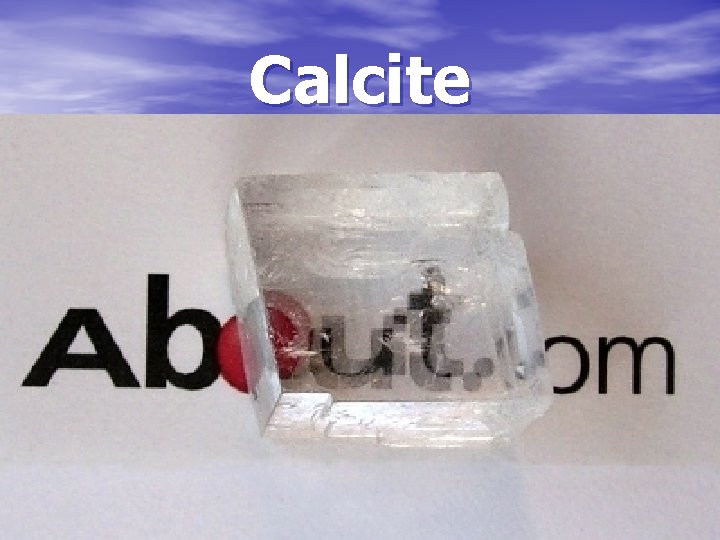
Calcite
- Slides: 12