
MINERALS OF THE EARTHS CRUST Chapter 5 Chapter



- Slides: 47
MINERALS OF THE EARTH’S CRUST Chapter 5
Chapter 5 Minerals of Earth’s Crust Standards SES 2 d. Associate specific plate tectonic settings with the production of particular groups of igneous and metamorphic rocks and mineral resources SES 3 d. Explain the processes that transport and deposit material in terrestrial and marine sedimentary basins, which result, over time, in sedimentary rock.
Chapter 5 Section 1 What Is a Mineral? Characteristics of Minerals �To be a mineral, a substance must have four characteristics: it must be inorganic—it cannot be made of or by living things; it must occur naturally—it cannot be man -made; it must be a crystalline solid; it must have a consistent chemical composition.
Chapter 5 Section 1 What Is a Mineral? Characteristics of Minerals, continued The diagram below shows the four characteristics of minerals.
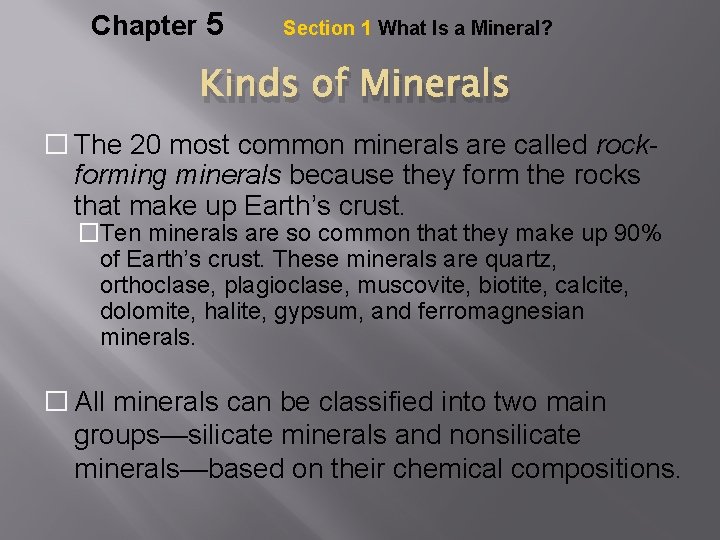
Chapter 5 Section 1 What Is a Mineral? Kinds of Minerals � The 20 most common minerals are called rockforming minerals because they form the rocks that make up Earth’s crust. �Ten minerals are so common that they make up 90% of Earth’s crust. These minerals are quartz, orthoclase, plagioclase, muscovite, biotite, calcite, dolomite, halite, gypsum, and ferromagnesian minerals. � All minerals can be classified into two main groups—silicate minerals and nonsilicate minerals—based on their chemical compositions.
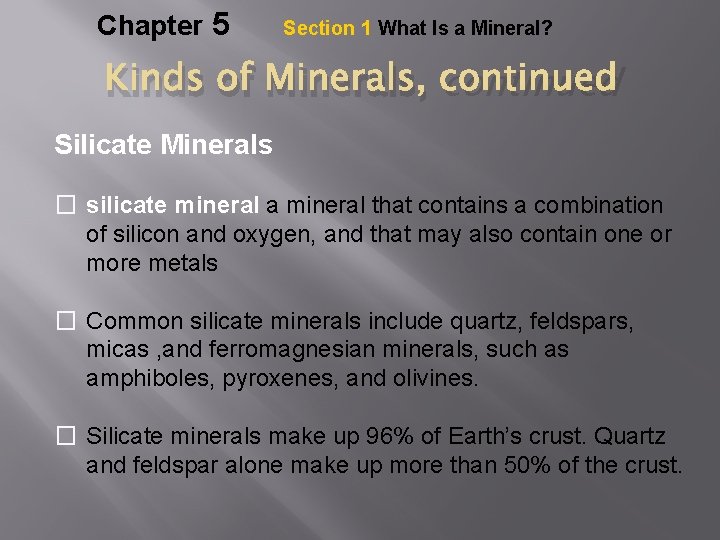
Chapter 5 Section 1 What Is a Mineral? Kinds of Minerals, continued Silicate Minerals � silicate mineral a mineral that contains a combination of silicon and oxygen, and that may also contain one or more metals � Common silicate minerals include quartz, feldspars, micas , and ferromagnesian minerals, such as amphiboles, pyroxenes, and olivines. � Silicate minerals make up 96% of Earth’s crust. Quartz and feldspar alone make up more than 50% of the crust.
Chapter 5 Section 1 What Is a Mineral? Kinds of Minerals, continued Nonsilicate Minerals � nonsilicate mineral a mineral that does not contain compounds of silicon and oxygen � Nonsilicate minerals comprise about 4% of Earth’s crust. � Nonsilicate minerals are organized into six major groups based on their chemical compositions. � The six major groups of nonsilicate minerals are carbonates, halides, native elements, oxides, sulfates, and sulfides.
Chapter 5 Section 1 What Is a Mineral? Crystalline Structure � Each type of mineral is characterized by a specific geometric arrangement of atoms, or its crystalline structure. � crystal a solid whose atoms, ions, or molecules are arranged in a regular, repeating pattern � One way that scientists study the structure of crystals is by using X rays that pass through a crystal and strike a photographic plate produce an image that shows the geometric arrangement of the atoms in the crystal.
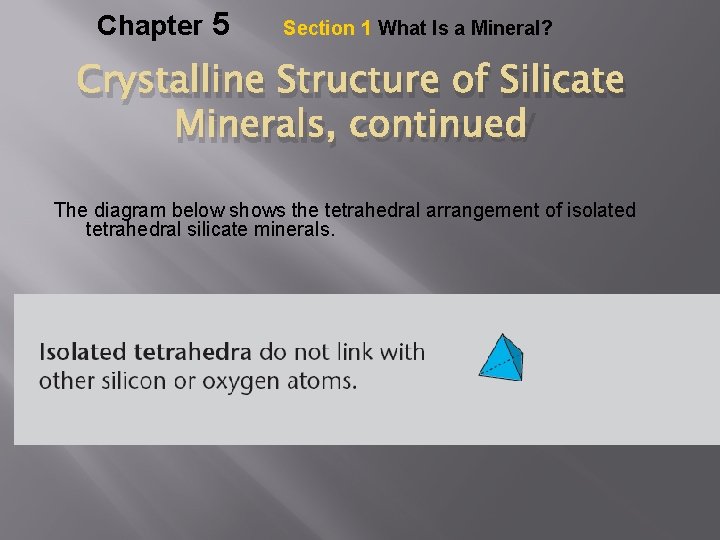
Chapter 5 Section 1 What Is a Mineral? Crystalline Structure of Silicate Minerals � Even though there are many kinds of silicate minerals, their crystalline structure is made up of the same basic building blocks—silicon-oxygen tetrahedra. � silicon-oxygen tetrahedron the basic unit of the structure of silicate minerals; a silicon ion chemically bonded to and surrounded by four oxygen ions Isolated Tetrahedral Silicates � In minerals that have isolated tetrahedra, only atoms other than silicon and oxygen atoms like silicon-oxygen tetrahedra together. � Olivine is an isolated tetrahedral silicate.
Chapter 5 Section 1 What Is a Mineral? Crystalline Structure of Silicate Minerals, continued The diagram below shows the tetrahedral arrangement of isolated tetrahedral silicate minerals.
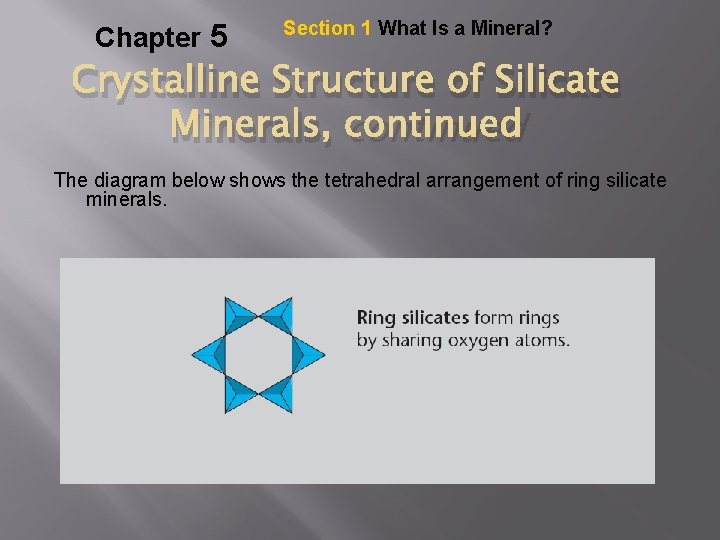
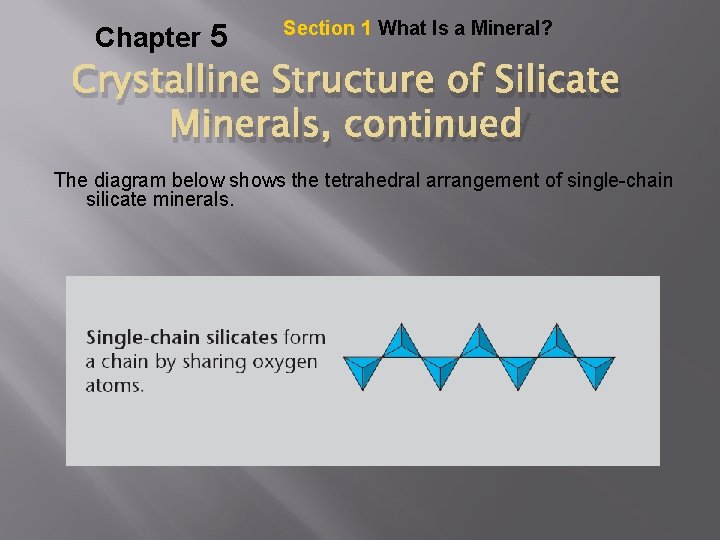
Chapter 5 Section 1 What Is a Mineral? Crystalline Structure of Silicate Minerals, continued Ring Silicates � Ring silicates form when shared oxygen atoms join the tetrahedra to form three-, four-, or six-sided rings. � Beryl and tourmaline are ring silicates. Single-Chain Silicates � In single-chain silicates, each tetrahedron is bonded to two others by shared oxygen atoms. � Most double-chain silicates are called pyroxenes.
Chapter 5 Section 1 What Is a Mineral? Crystalline Structure of Silicate Minerals, continued The diagram below shows the tetrahedral arrangement of ring silicate minerals.
Chapter 5 Section 1 What Is a Mineral? Crystalline Structure of Silicate Minerals, continued The diagram below shows the tetrahedral arrangement of single-chain silicate minerals.
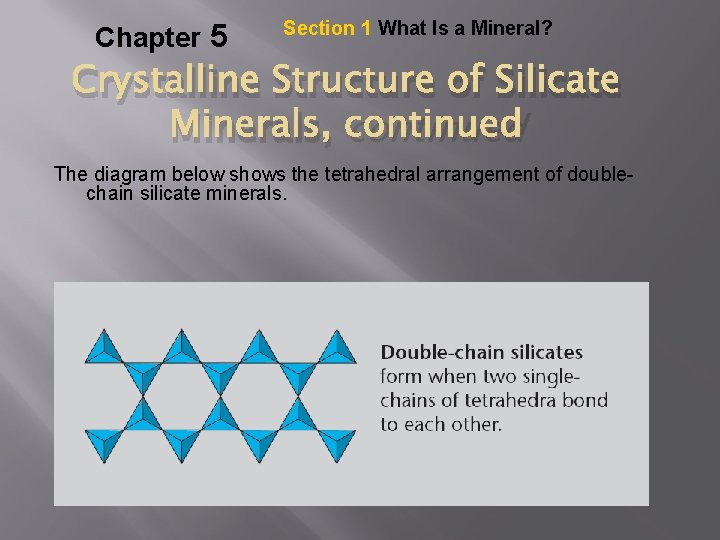
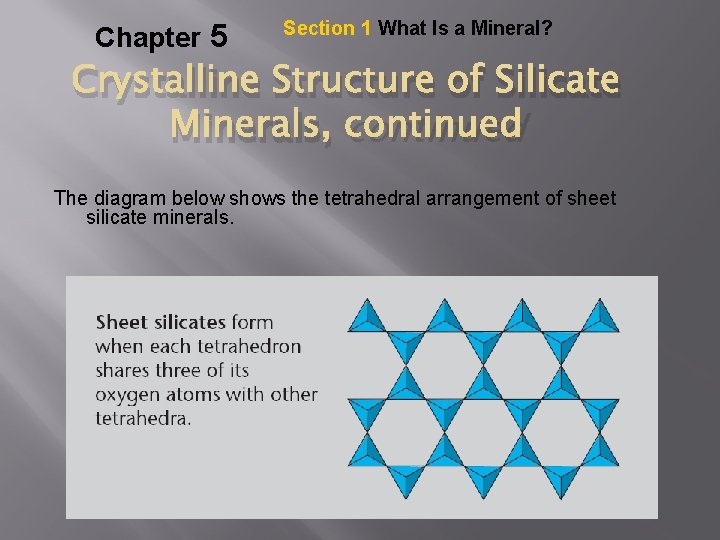
Chapter 5 Section 1 What Is a Mineral? Crystalline Structure of Silicate Minerals, continued Double-Chain Silicates � In double-chain silicates, two single chains of tetrahedra bond to each other. � Most double-chain silicates are called amphiboles. Sheet Silicates � In the sheet silicates, each tetrahedron shares three oxygen atoms with other tetrahedra. The fourth oxygen atom bonds with an atom of aluminum or magnesium, which joins the sheets together. � The mica minerals, such as muscovite and biotite, are sheet silicates.
Chapter 5 Section 1 What Is a Mineral? Crystalline Structure of Silicate Minerals, continued The diagram below shows the tetrahedral arrangement of doublechain silicate minerals.
Chapter 5 Section 1 What Is a Mineral? Crystalline Structure of Silicate Minerals, continued The diagram below shows the tetrahedral arrangement of sheet silicate minerals.
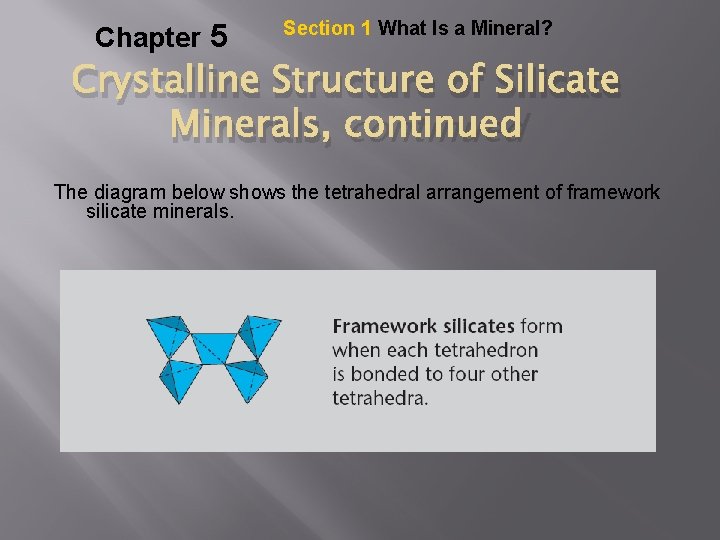
Chapter 5 Section 1 What Is a Mineral? Crystalline Structure of Silicate Minerals, continued Framework Silicates � In the framework silicates, each tetrahedron is bonded to four neighboring tetrahedra to form a threedimensional network. � Frameworks that contain only silicon-oxygen tetrahedra are the mineral quartz. � Other framework silicates contain some tetrahedra in which atoms of aluminum or other metals substitute for some of the silicon atoms. � Quartz and feldspars are framework silicates.
Chapter 5 Section 1 What Is a Mineral? Crystalline Structure of Silicate Minerals, continued The diagram below shows the tetrahedral arrangement of framework silicate minerals.
Chapter 5 Section 1 What Is a Mineral? Crystalline Structure of Nonsilicate Minerals � Because nonsilicate minerals have diverse chemical compositions, nonsilicate minerals display a vast variety of crystalline structures. � Common crystalline structures for nonsilicate minerals include cubes, hexagonal prisms, and irregular masses. � The structure of a nonsilicate crystal determines the mineral’s characteristics. � In the crystal structure called closest packing, each metal atom is surrounded by 8 to 12 other metal atoms that are as close to each other as the charges of the atomic nuclei will
Chapter 5 Section 2 Identifying Minerals Physical Properties of Minerals Color � While color is a property that is easily observed, it is unreliable for the identification of minerals. � The color of a mineral sample can be affected by the inclusion of impurities or by weathering processes. Streak � streak the color of a mineral in powdered form � Streak is more reliable than color for the identification of minerals. � Streak is determined by rubbing some of the mineral against an unglazed ceramic tile called a streak plate.
Chapter 5 Section 2 Identifying Minerals Physical Properties of Minerals, Luster continued � luster the way in which a mineral reflects light � A mineral is said to have a metallic luster if the mineral reflects light as a polished metal does. � All other minerals have nonmetallic luster. � There are several types of nonmetallic luster, including glassy, waxy, pearly, brilliant, and earthy.
Chapter 5 Section 2 Identifying Minerals Physical Properties of Minerals, continued Cleavage and Fracture � cleavage in geology, the tendency of a mineral to split along specific planes of weakness to form smooth, flat surfaces � fracture the manner in which a mineral breaks along either curved or irregular surfaces � Uneven or irregular fractures have rough surfaces. � Splintery or fibrous fractures look like a piece of broken wood. � Curved surfaces are conchoidal fractures.
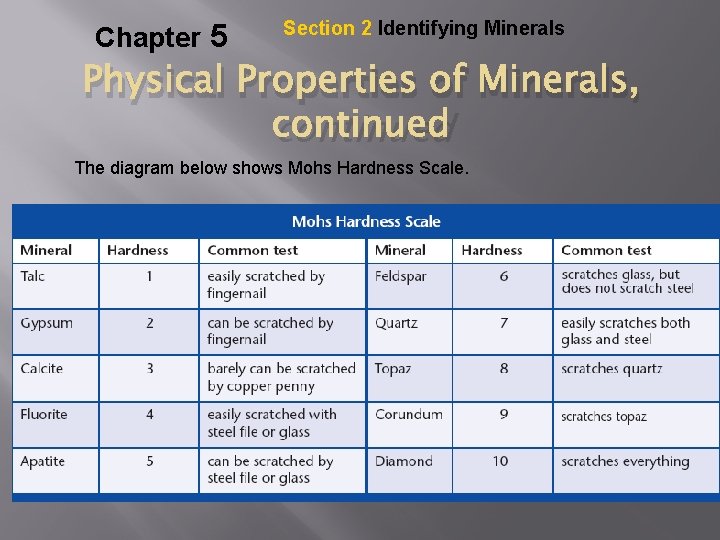
Chapter 5 Section 2 Identifying Minerals Physical Properties of Minerals, Hardness continued � The measure of the ability of a mineral to resist scratching is called hardness. Hardness does not mean “resistance to cleavage or fracture. ” � The hardness of a mineral can be determined by comparing the mineral to minerals of Mohs hardness scale. � Mohs hardness scale the standard scale against which the hardness of minerals is rated. � The strength of the bonds between the atoms that make up a mineral’s internal structure determines the hardness of a mineral.
Chapter 5 Section 2 Identifying Minerals Physical Properties of Minerals, continued The diagram below shows Mohs Hardness Scale.
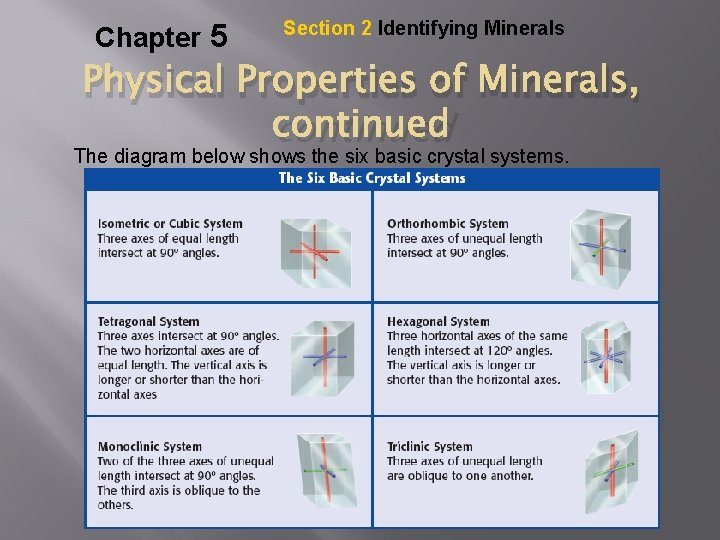
Chapter 5 Section 2 Identifying Minerals Physical Properties of Minerals, Crystal Shape continued � A mineral crystal forms in one of six basic shapes. � A certain mineral always has the same general shape because the atoms that form the mineral’s crystals always combine in the same geometric pattern. � The six basic crystal systems are the isometric or cubic system, the orthorhombic system, the tetragonal system, the hexagonal system, the monoclinic system, and the triclinic system.
Chapter 5 Section 2 Identifying Minerals Physical Properties of Minerals, continued The diagram below shows the six basic crystal systems.
Chapter 5 Section 2 Identifying Minerals Physical Properties of Minerals, Density continued � density the ratio of the mass of a substance to the volume of a substance; commonly expressed as grams per cubic centimeter for solids � The density of a mineral depends on the kinds of atoms in the mineral and on how closely the atoms are packed. density = mass volume
Chapter 5 Section 2 Identifying Minerals Special Properties of Minerals � A few minerals have some additional, special properties that can help identify those minerals. Fluorescence and Phosphorescence � The ability to glow under ultraviolet light is called fluorescence. � Fluorescent minerals absorb ultraviolet light and then produce visible light of various colors. � The property of some minerals to glow after the ultraviolet light is turned off is called phosphorescence.
Chapter 5 Section 2 Identifying Minerals Special Properties of Minerals, continued Chatoyancy and Asterism � In reflected light, some minerals display a silky appearance that is called chatoyancy, or the cat’s-eye effect. � A similar effect called asterism is the phenomenon in which a six-sided star appears when a mineral reflects light. Double Refraction � The property of some minerals, particularly some forms of calcite, to produce a double image of any object viewed through the mineral is called double refraction.
Chapter 5 Section 2 Identifying Minerals Special Properties of Minerals, Magnetism continued � Minerals that are attracted to magnets display the property of magnetism. These minerals may be magnetic themselves. � In general, nonsilicate minerals that contain iron are more likely to be magnetic than silicate minerals are. Radioactivity � The property known as radioactivity results as unstable nuclei decay over time into stable nuclei by releasing particles and energy. � A Geiger counter is used to detect the released particles and, thus, to identify minerals that are radioactive.
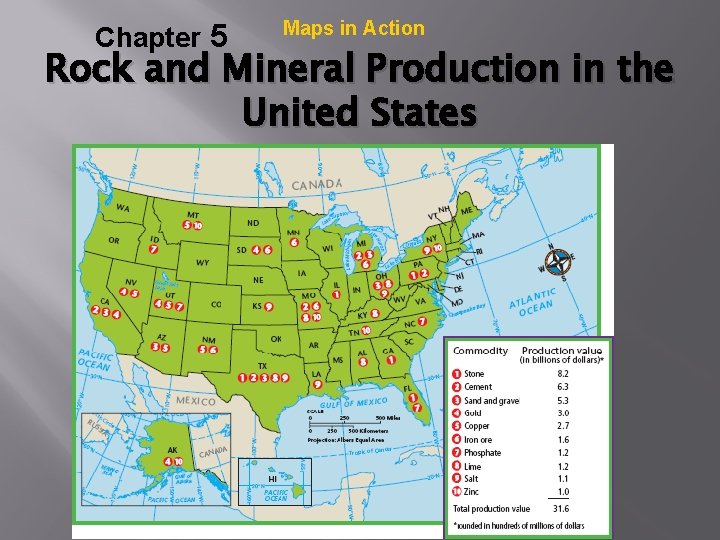
Chapter 5 Maps in Action Rock and Mineral Production in the United States
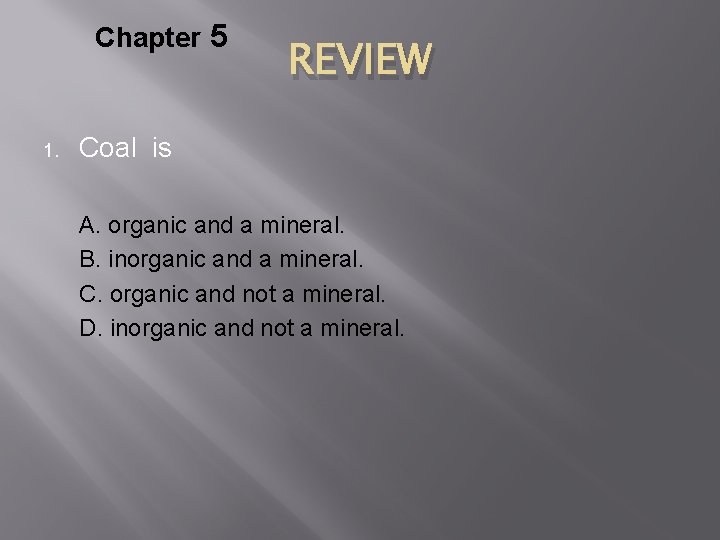
Chapter 5 1. REVIEW Coal is A. organic and a mineral. B. inorganic and a mineral. C. organic and not a mineral. D. inorganic and not a mineral.
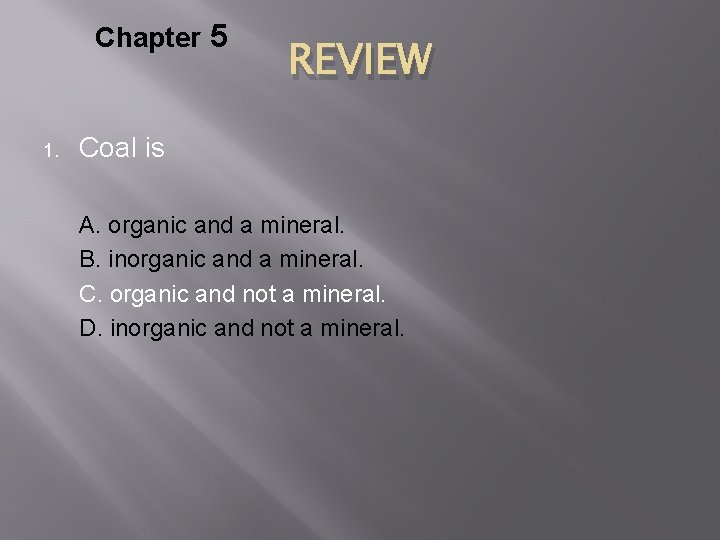
Chapter 5 1. REVIEW Coal is A. organic and a mineral. B. inorganic and a mineral. C. organic and not a mineral. D. inorganic and not a mineral.
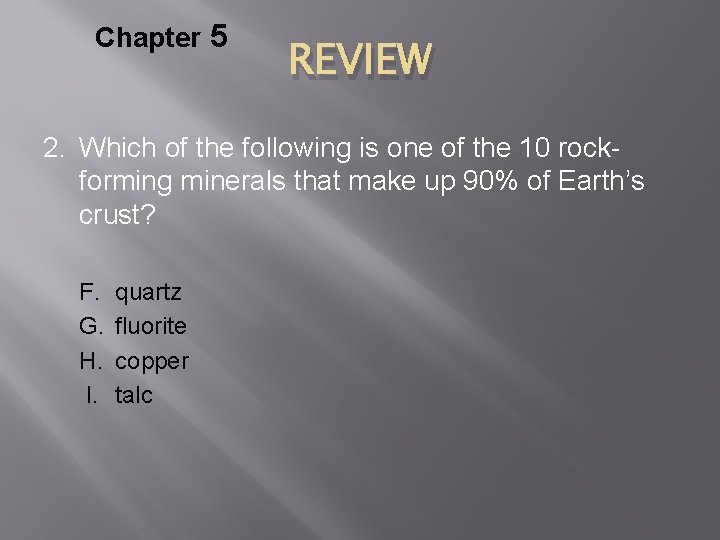
Chapter 5 REVIEW 2. Which of the following is one of the 10 rockforming minerals that make up 90% of Earth’s crust? F. G. H. I. quartz fluorite copper talc
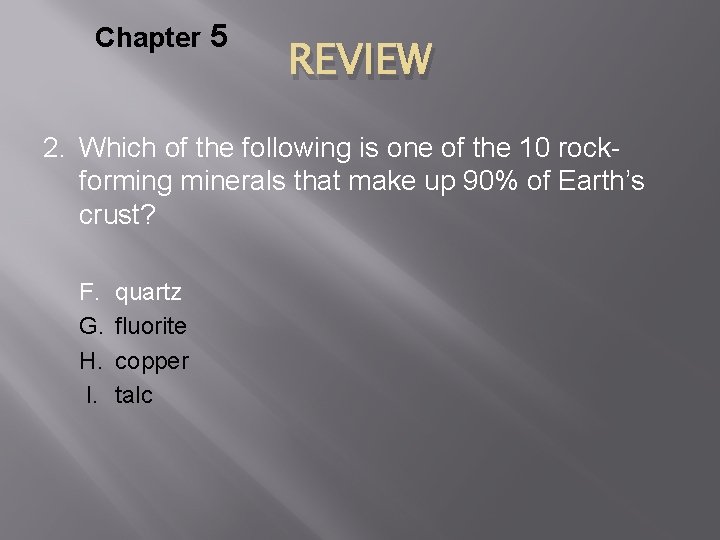
Chapter 5 REVIEW 2. Which of the following is one of the 10 rockforming minerals that make up 90% of Earth’s crust? F. G. H. I. quartz fluorite copper talc
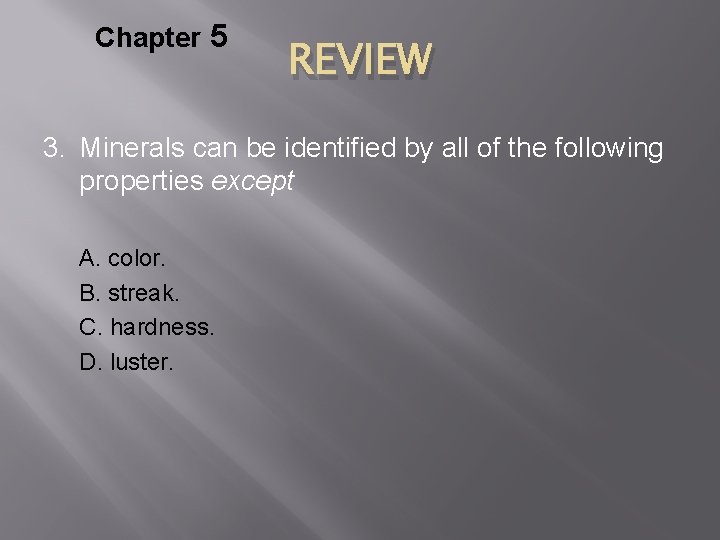
Chapter 5 REVIEW 3. Minerals can be identified by all of the following properties except A. color. B. streak. C. hardness. D. luster.
Chapter 5 REVIEW 3. Minerals can be identified by all of the following properties except A. color. B. streak. C. hardness. D. luster.
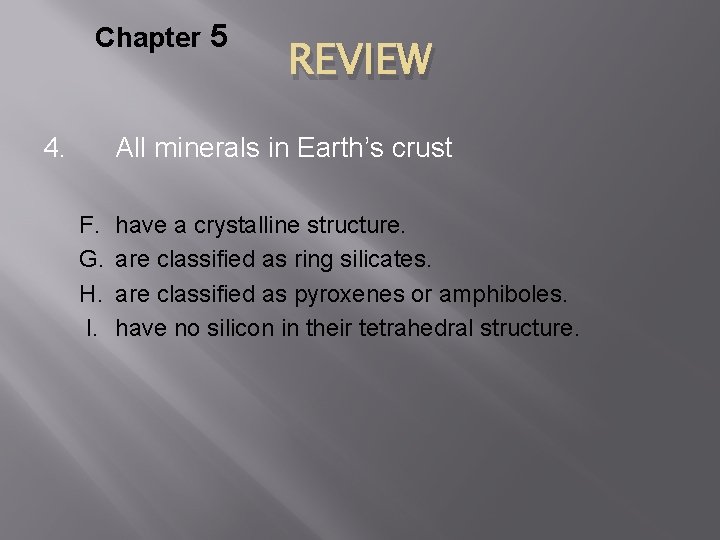
Chapter 5 4. REVIEW All minerals in Earth’s crust F. G. H. I. have a crystalline structure. are classified as ring silicates. are classified as pyroxenes or amphiboles. have no silicon in their tetrahedral structure.
Chapter 5 4. REVIEW All minerals in Earth’s crust F. G. H. I. have a crystalline structure. are classified as ring silicates. are classified as pyroxenes or amphiboles. have no silicon in their tetrahedral structure.
Chapter 5 REVIEW 5. Which mineral can be scratched by a fingernail that has a hardness of 2. 5 on the Mohs scale? A. diamond B. quartz C. topaz D. talc
Chapter 5 REVIEW 5. Which mineral can be scratched by a fingernail that has a hardness of 2. 5 on the Mohs scale? A. diamond B. quartz C. topaz D. talc
Chapter 5 REVIEW 6. Carbonates, halides, native elements, oxides, sulfates, and sulfides are classes of what mineral group?
Chapter 5 REVIEW 6. Carbonates, halides, native elements, oxides, sulfates, and sulfides are classes of what mineral group? nonsilicate minerals
Chapter 5 REVIEW 7. What mineral is made up of only the elements oxygen and silicon?
Chapter 5 REVIEW 7. What mineral is made up of only the elements oxygen and silicon? quartz
Chapter 5 REVIEW 8. What property is a mineral said to have when a person is able to view double images through it?
Chapter 5 REVIEW 8. What property is a mineral said to have when a person is able to view double images through it? double refraction