
Minerals Facts about Minerals A naturally occurring homogeneous
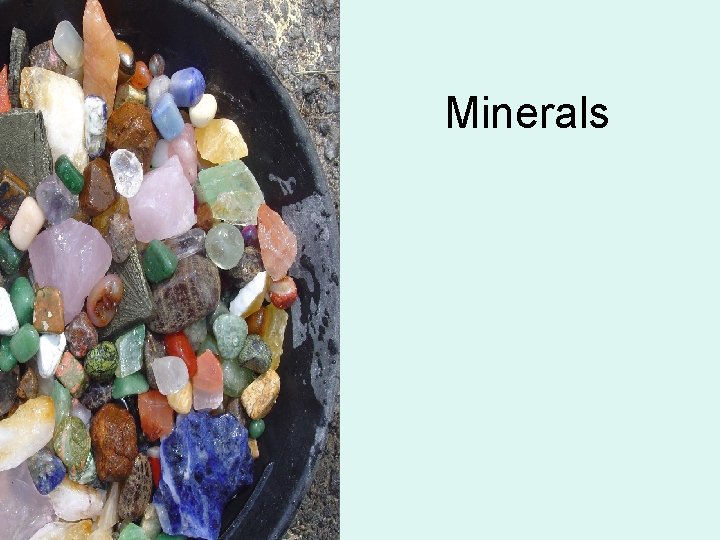
Minerals
Facts about Minerals • A naturally occurring homogeneous solid • Minerals can be elements • Minerals can be salts • Minerals can be silicates • The study of minerals is called mineralogy
Physical Properties of Minerals • Classifying minerals can be very complicated and expensive • However there also time-effective and affordable ways • There are 8 main properties that can be used to classify minerals
1. Crystal Structure --This refers to the arrangement of the atoms. X-ray diffraction is used to see these arrangements. Crystal structures can range from large and granular, to layered sheets, to microscopic crystals
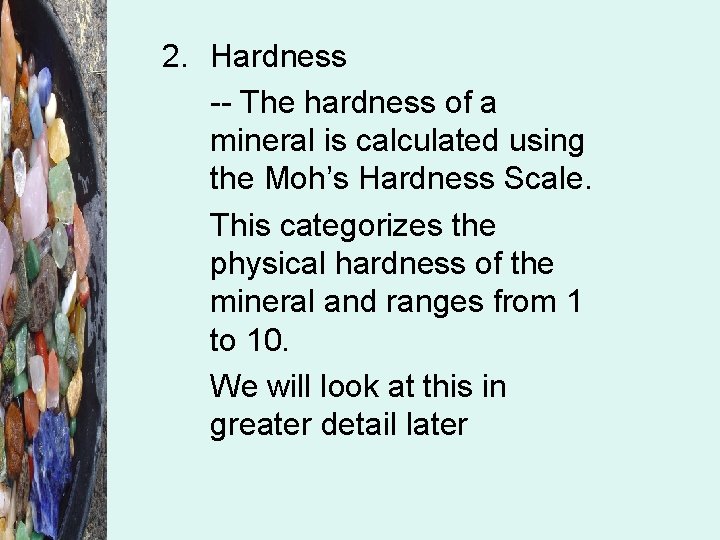
2. Hardness -- The hardness of a mineral is calculated using the Moh’s Hardness Scale. This categorizes the physical hardness of the mineral and ranges from 1 to 10. We will look at this in greater detail later

3. Lustre -- Refers to the way the mineral’s surface interacts to the light and can range from dull to glassy. There are three major categories of lustre: Metallic (Galena) Sub-Metallic (Hematite) Non-Metallic (Sulphur)
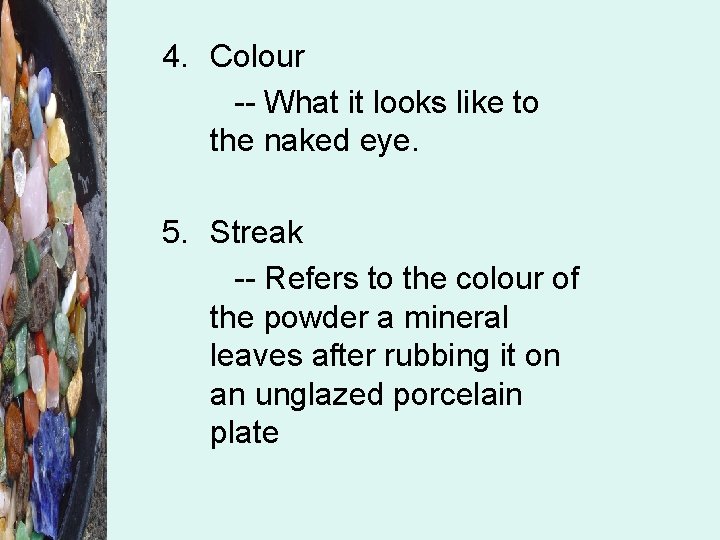
4. Colour -- What it looks like to the naked eye. 5. Streak -- Refers to the colour of the powder a mineral leaves after rubbing it on an unglazed porcelain plate
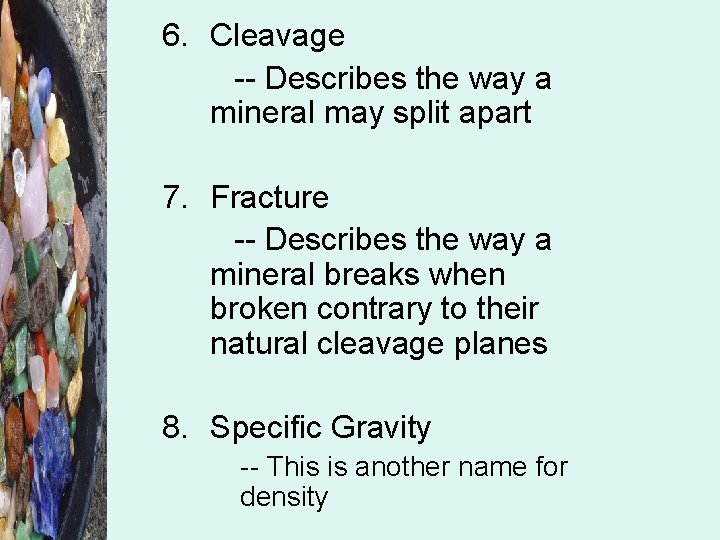
6. Cleavage -- Describes the way a mineral may split apart 7. Fracture -- Describes the way a mineral breaks when broken contrary to their natural cleavage planes 8. Specific Gravity -- This is another name for density
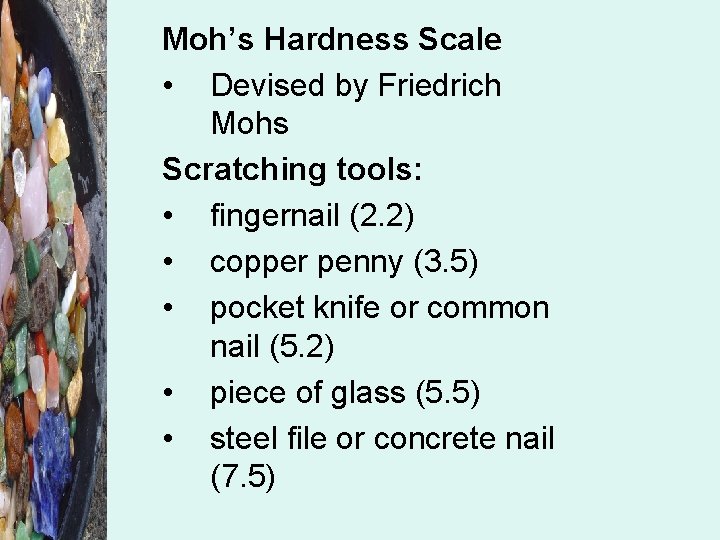
Moh’s Hardness Scale • Devised by Friedrich Mohs Scratching tools: • fingernail (2. 2) • copper penny (3. 5) • pocket knife or common nail (5. 2) • piece of glass (5. 5) • steel file or concrete nail (7. 5)
Notes for testing: • • Each mineral can scratch minerals with lower hardness ratings. Each mineral can scratch itself. Don’t press hard, normal scratching should do. Weathered surfaces are softer.
• • • Corners or edges of crystals are softer. Small pieces seem softer than large pieces. When you scratch, take a close look at the scratch line - which often looks white. Is it really a scratch or is it a powder line made from the tool you used because it was softer than the item you were trying to scratch?
- Slides: 11