
Minerals Characteristics and Identifications What is a Mineral
- Slides: 16
Minerals Characteristics and Identifications
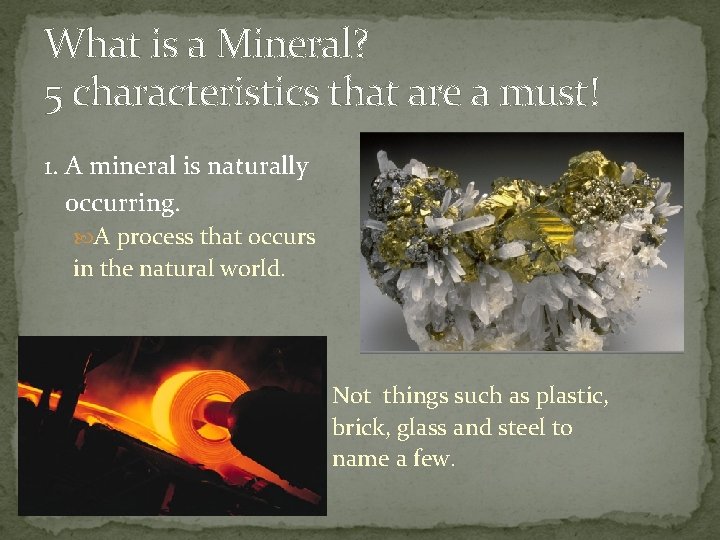
What is a Mineral? 5 characteristics that are a must! 1. A mineral is naturally occurring. A process that occurs in the natural world. Not things such as plastic, brick, glass and steel to name a few.
5 characteristic that are a must! 2. Inorganic 3. Solid Inorganic means it is not Always a solid and never was living Can’t be formed from material that was once part of a living thing. What is coal? Has Volume Has Shape Particles are packed tightly.
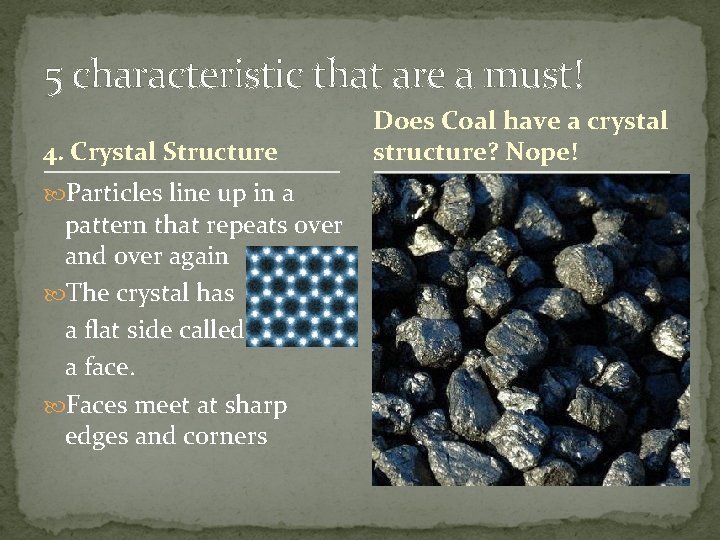
5 characteristic that are a must! 4. Crystal Structure Particles line up in a pattern that repeats over and over again The crystal has a flat side called a face. Faces meet at sharp edges and corners Does Coal have a crystal structure? Nope!
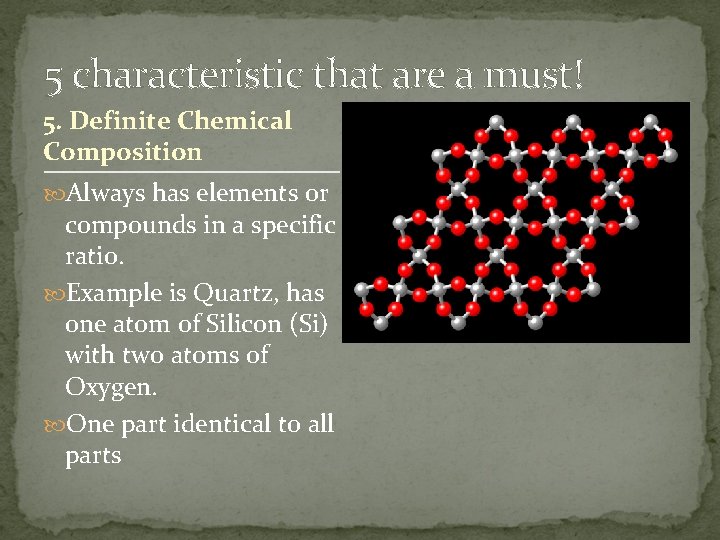
5 characteristic that are a must! 5. Definite Chemical Composition Always has elements or compounds in a specific ratio. Example is Quartz, has one atom of Silicon (Si) with two atoms of Oxygen. One part identical to all parts
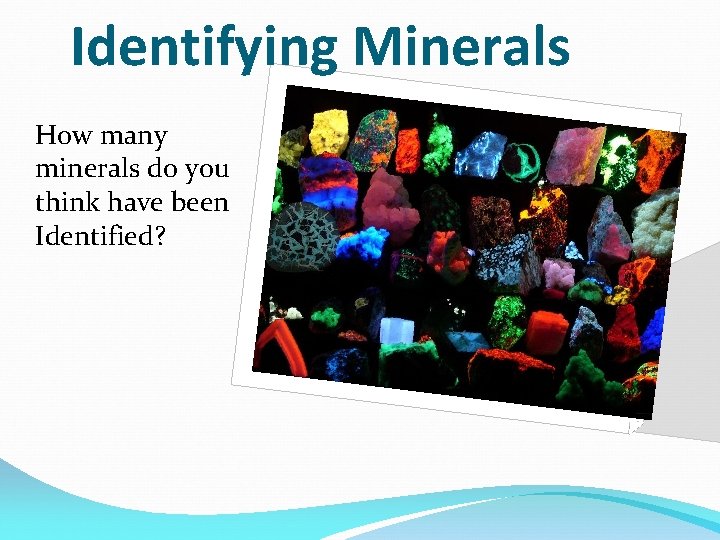
Identifying Minerals How many minerals do you think have been Identified?
Identifying Minerals You need to know 7 different characteristics Each mineral has a unique identity similar to a fingerprint. Each “fingerprint” can be identified using different characteristic properties When you have learned to recognize many of the properties of the minerals, you will be able to identify the common ones around you. Think about how you can use these to identify common minerals around your everyday life.
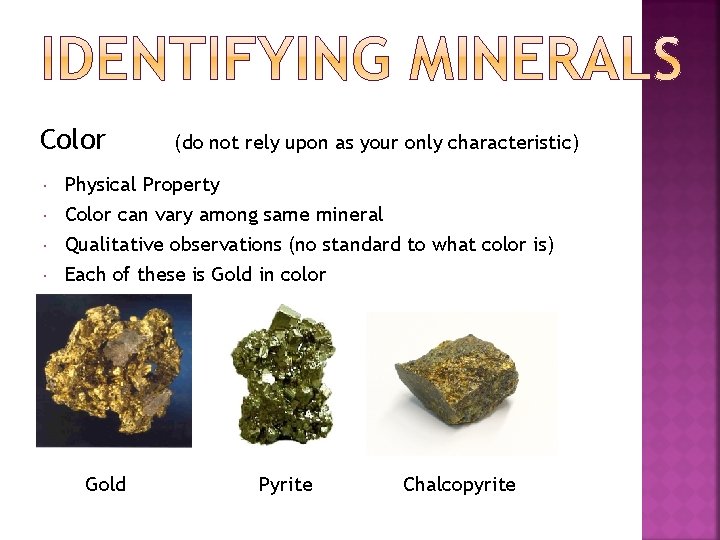
Color (do not rely upon as your only characteristic) Physical Property Color can vary among same mineral Qualitative observations (no standard to what color is) Each of these is Gold in color Gold Pyrite Chalcopyrite
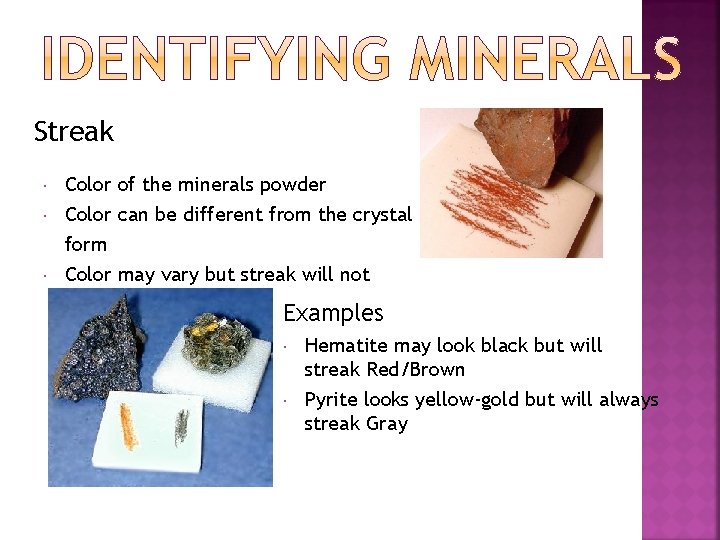
Streak Color of the minerals powder Color can be different from the crystal form Color may vary but streak will not Examples Hematite may look black but will streak Red/Brown Pyrite looks yellow-gold but will always streak Gray
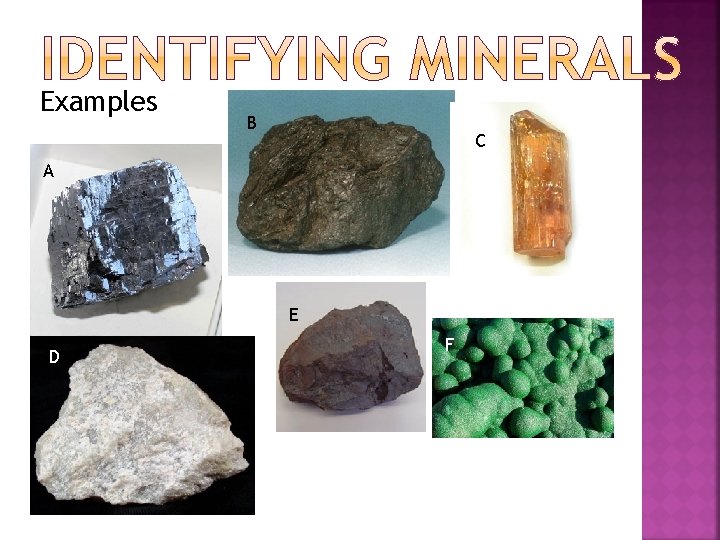
Luster How light reflects off the surface of the mineral. Minerals containing metal are often shiny and are called metallic. Other types of luster are Glassy, Waxy, Greasy, Pearly, Dull or Submetallic Silky and earthy. For our purposes, we’re just going to distinguish between two main types: metallic (shiny) and non-metallic (not shiny).
Examples B C A E D F
Density = Mass / Volume No matter how big the sample, density will remain the same
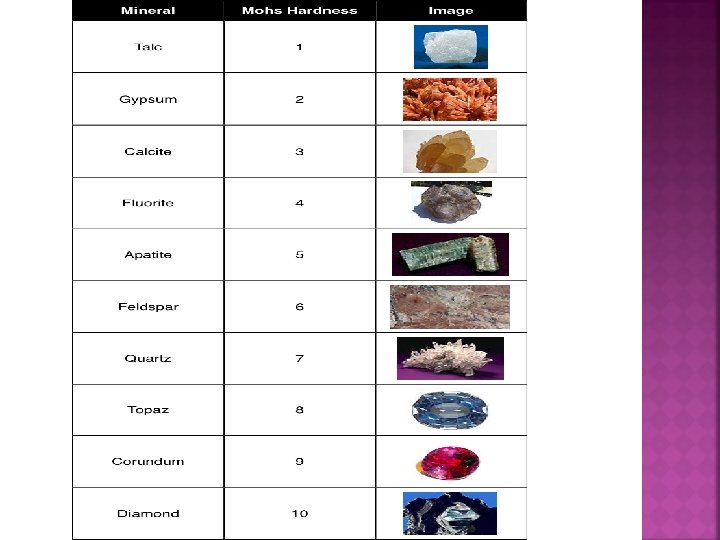
Hardness 1812 Friedrich Mohs, an Austrian Mineral Expert invented a test to describe the hardness of minerals Mohs Hardness Scale Ranks 10 minerals from softest to hardest. Uses the scratch test.
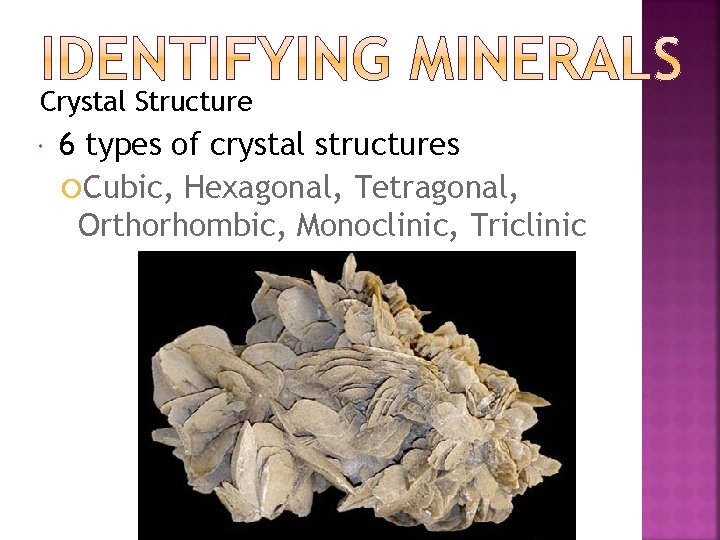
Crystal Structure 6 types of crystal structures Cubic, Hexagonal, Tetragonal, Orthorhombic, Monoclinic, Triclinic
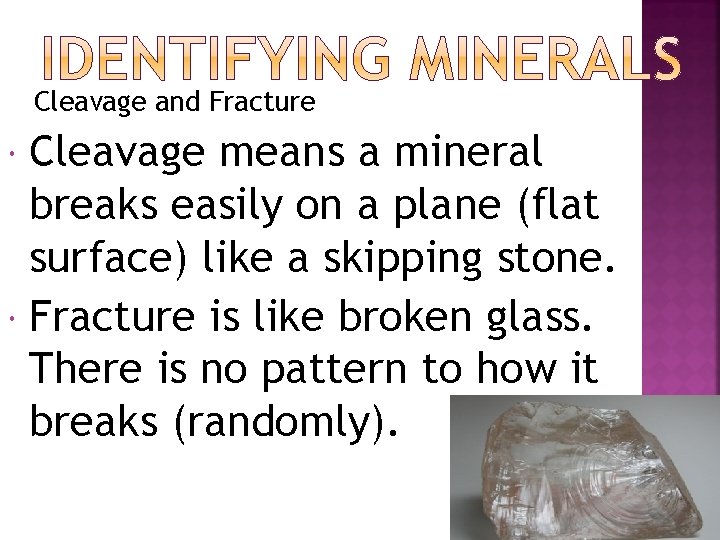
Cleavage and Fracture Cleavage means a mineral breaks easily on a plane (flat surface) like a skipping stone. Fracture is like broken glass. There is no pattern to how it breaks (randomly).