
MINERALS AND THEIR PROPERTIES WHAT IS A MINERAL
- Slides: 25
MINERALS AND THEIR PROPERTIES
WHAT IS A MINERAL? A MINERAL IS A: SOLID NATURALLY OCCURING (made up of elements) INORGANIC CRYSTAL SHAPE (unique to the mineral) CHEMICAL COMPOSITION (elements bond together to make a compound)
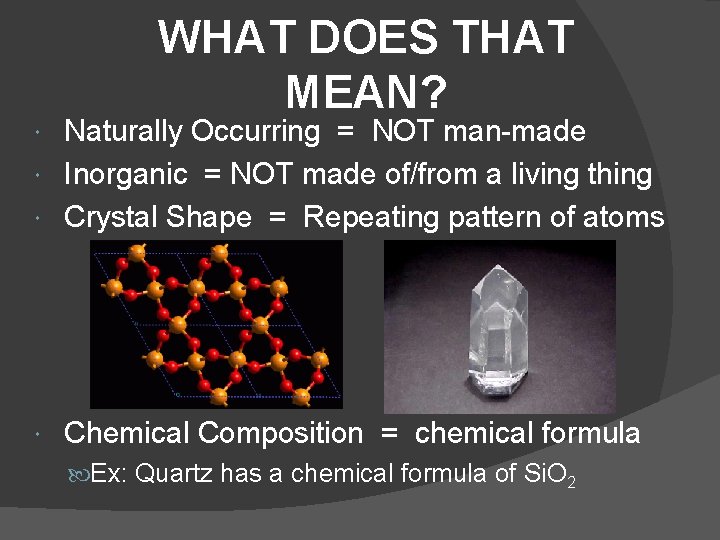
WHAT DOES THAT MEAN? Naturally Occurring = NOT man-made Inorganic = NOT made of/from a living thing Crystal Shape = Repeating pattern of atoms Chemical Composition = chemical formula Ex: Quartz has a chemical formula of Si. O 2
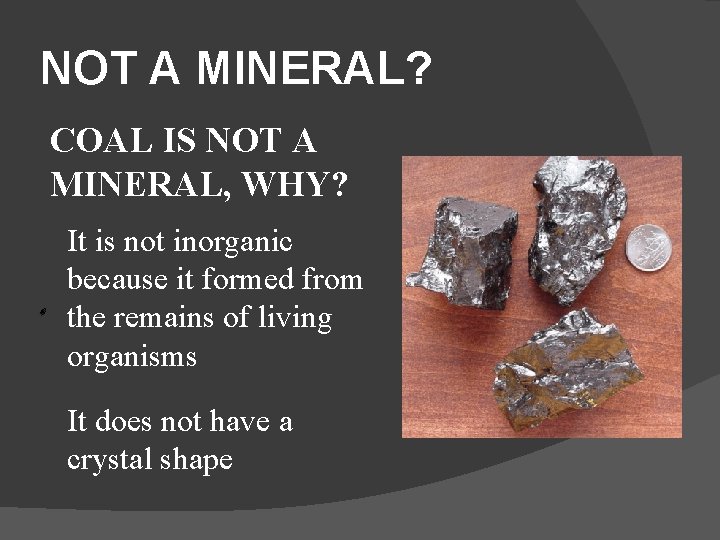
NOT A MINERAL? COAL IS NOT A MINERAL, WHY? It is not inorganic because it formed from the remains of living organisms It does not have a crystal shape
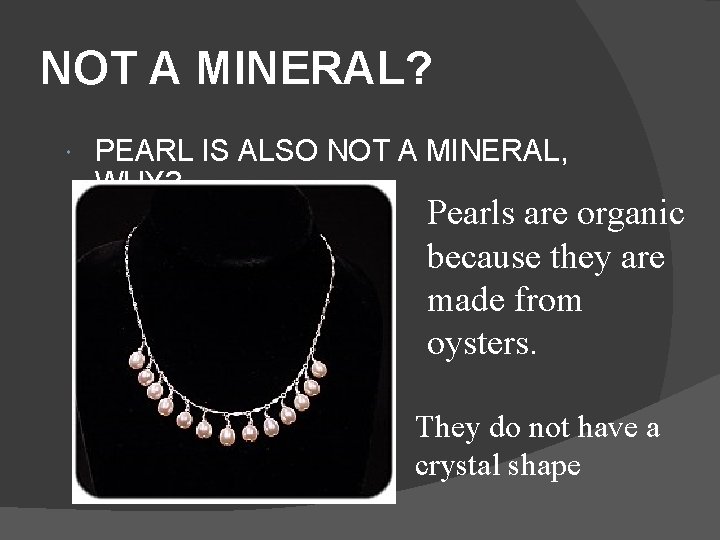
NOT A MINERAL? PEARL IS ALSO NOT A MINERAL, WHY? Pearls are organic because they are made from oysters. They do not have a crystal shape
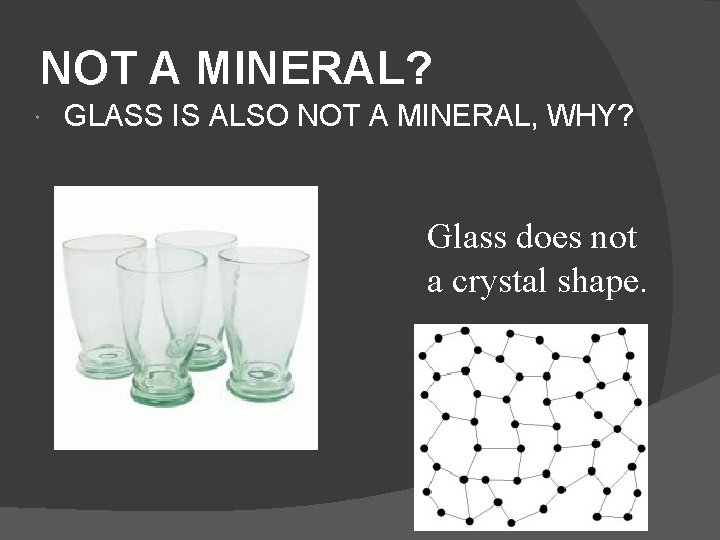
NOT A MINERAL? GLASS IS ALSO NOT A MINERAL, WHY? Glass does not a crystal shape.
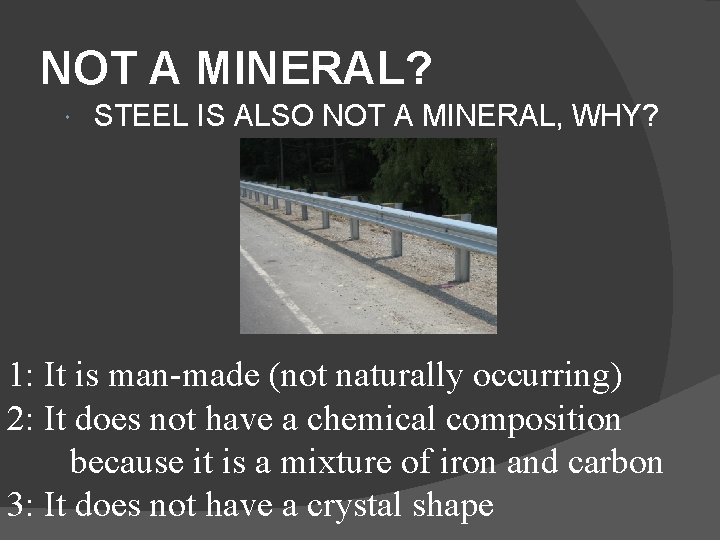
NOT A MINERAL? STEEL IS ALSO NOT A MINERAL, WHY? 1: It is man-made (not naturally occurring) 2: It does not have a chemical composition because it is a mixture of iron and carbon 3: It does not have a crystal shape
“Diamonds are Forever” Reading Before you Read: Review the definition of a mineral (SNICC) After you Read: Answer these questions: ○ Can the Life. Gem diamonds be considered true minerals? Explain your answer. ○ How are these diamonds different than diamonds mined out of the ground? ○ Would you want to use this company for yourself or for a relative?
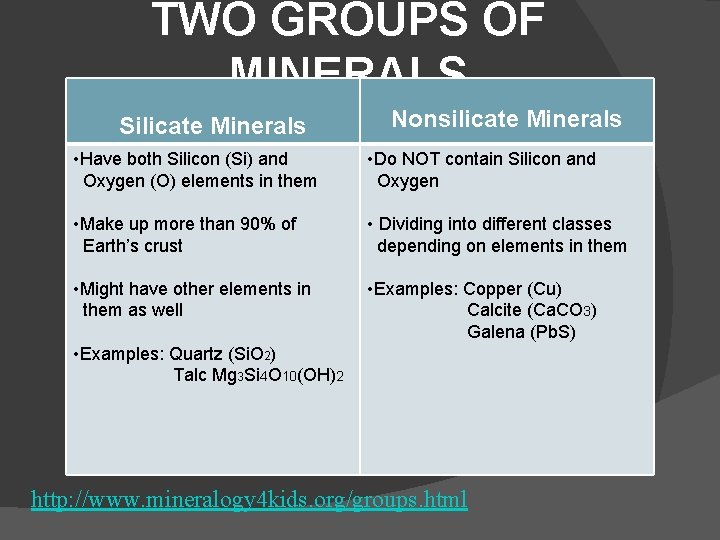
TWO GROUPS OF MINERALS Silicate Minerals Nonsilicate Minerals • Have both Silicon (Si) and Oxygen (O) elements in them • Do NOT contain Silicon and Oxygen • Make up more than 90% of Earth’s crust • Dividing into different classes depending on elements in them • Might have other elements in them as well • Examples: Copper (Cu) Calcite (Ca. CO 3) Galena (Pb. S) • Examples: Quartz (Si. O 2) Talc Mg 3 Si 4 O 10(OH)2 http: //www. mineralogy 4 kids. org/groups. html
What Are Properties of Minerals? ? ?
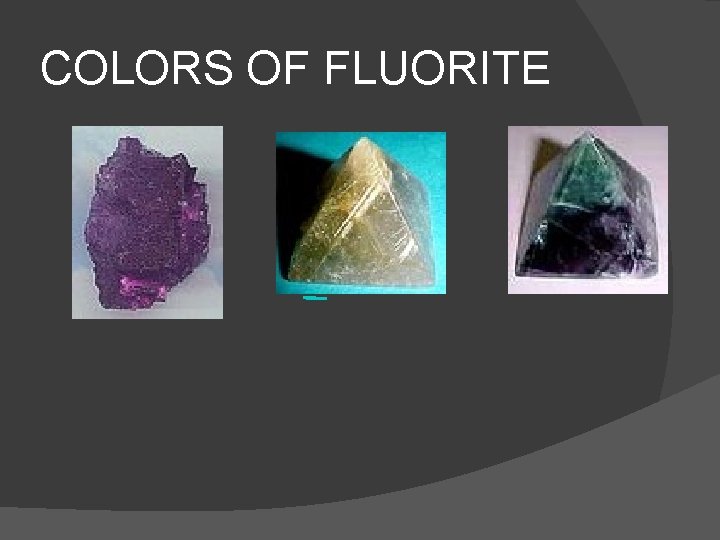
1. COLOR Not reliable due to: Impurities Many minerals have same color Some minerals have more than one color
COLORS OF FLUORITE
2. HARDNESS The ability of a mineral to resist being scratched. Relative to the hardness of other minerals and objects 2 scales Field hardness scale Moh’s hardness scale
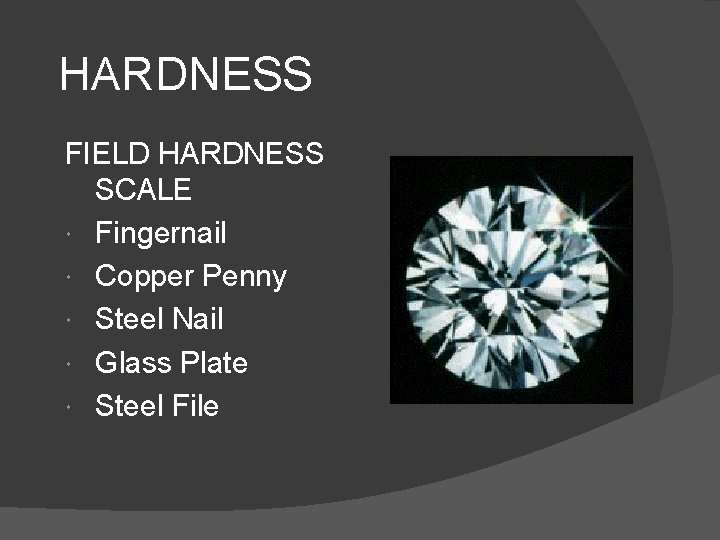
HARDNESS FIELD HARDNESS SCALE Fingernail Copper Penny Steel Nail Glass Plate Steel File
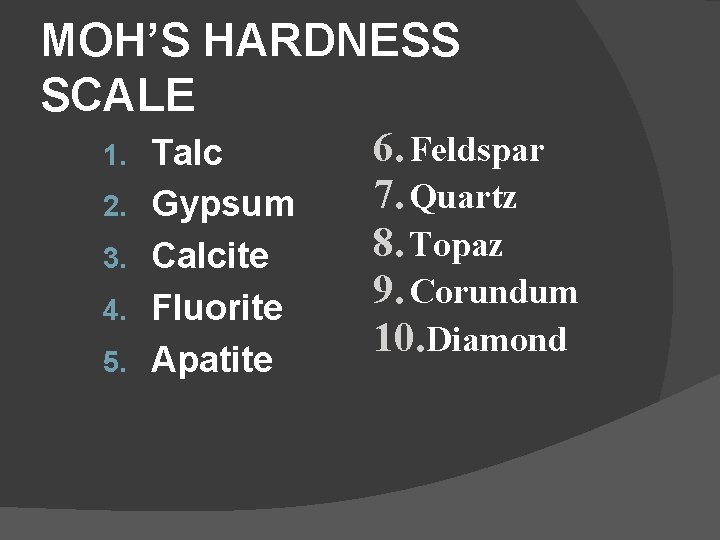
MOH’S HARDNESS SCALE 1. 2. 3. 4. 5. Talc Gypsum Calcite Fluorite Apatite 6. Feldspar 7. Quartz 8. Topaz 9. Corundum 10. Diamond
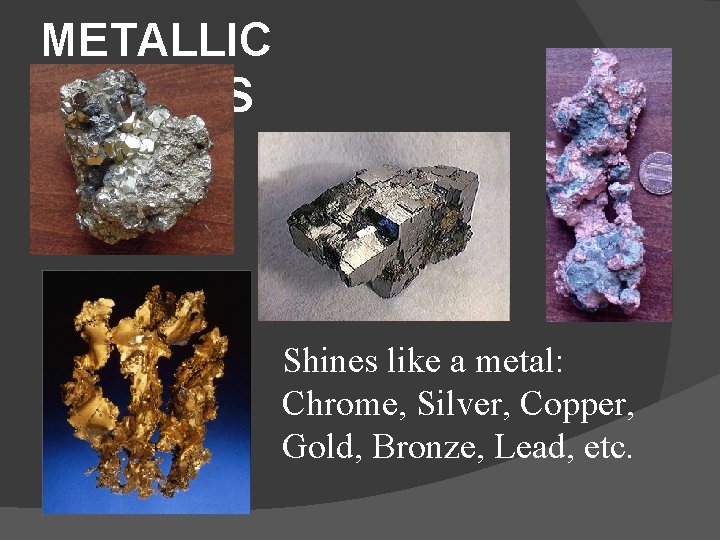
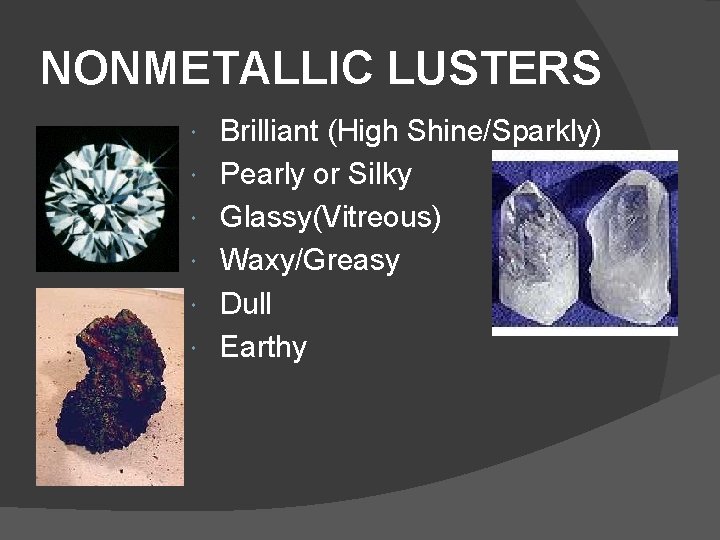
3. LUSTER The way a mineral reflects light Either Metallic or Nonmetallic Never described as “shiny” (that is what luster means)
METALLIC LUSTERS Shines like a metal: Chrome, Silver, Copper, Gold, Bronze, Lead, etc.
NONMETALLIC LUSTERS Brilliant (High Shine/Sparkly) Pearly or Silky Glassy(Vitreous) Waxy/Greasy Dull Earthy
4. STREAK Powdered residue left behind when rubbed across a porcelain tile Only works for minerals with a hardness less than 7 (tile=7) Streak may be different than outer color More consistent/reliable than color
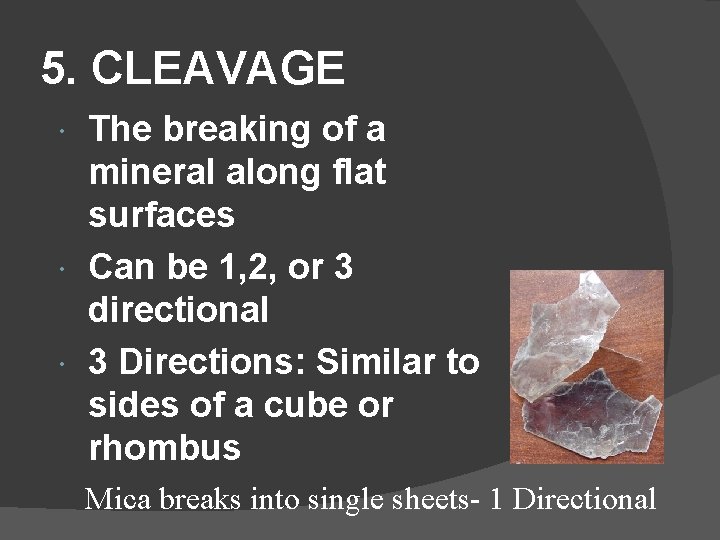
5. CLEAVAGE The breaking of a mineral along flat surfaces Can be 1, 2, or 3 directional 3 Directions: Similar to sides of a cube or rhombus Mica breaks into single sheets- 1 Directional
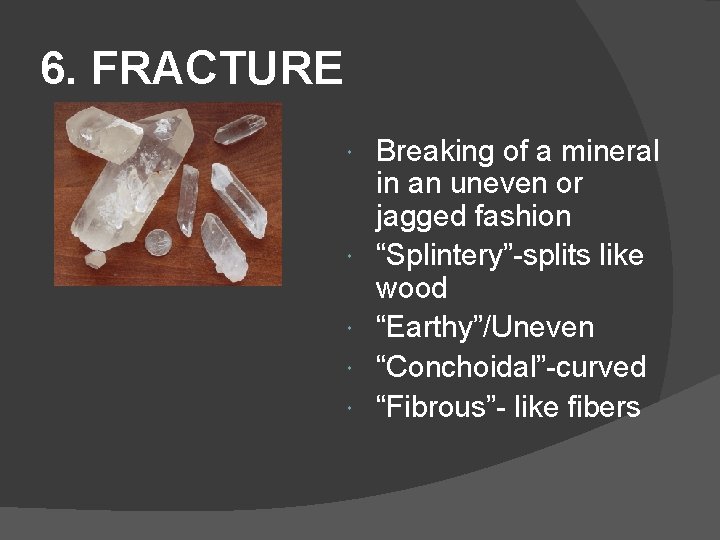
6. FRACTURE Breaking of a mineral in an uneven or jagged fashion “Splintery”-splits like wood “Earthy”/Uneven “Conchoidal”-curved “Fibrous”- like fibers
7. DENSITY = Mass per volume (g/m. L) Every mineral has its own unique density, regardless of its size ○ Ex: The density of any piece of gold will always be 19 g/m. L The density of any piece of silver will always be 10. 5 g/m. L
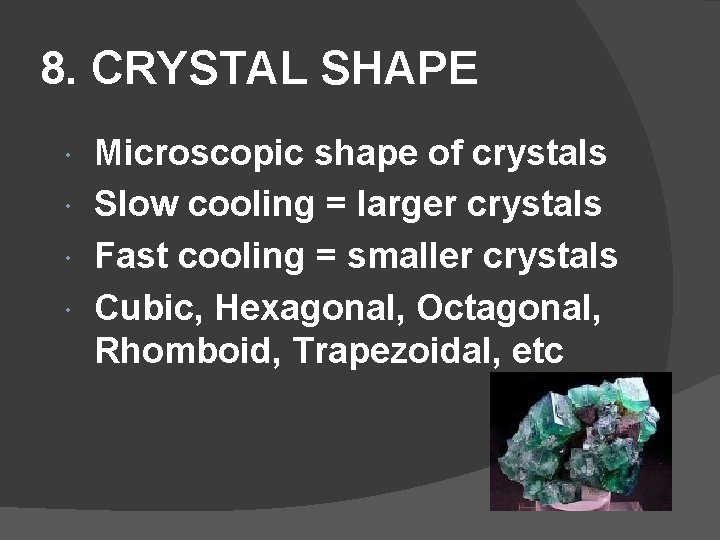
8. CRYSTAL SHAPE Microscopic shape of crystals Slow cooling = larger crystals Fast cooling = smaller crystals Cubic, Hexagonal, Octagonal, Rhomboid, Trapezoidal, etc
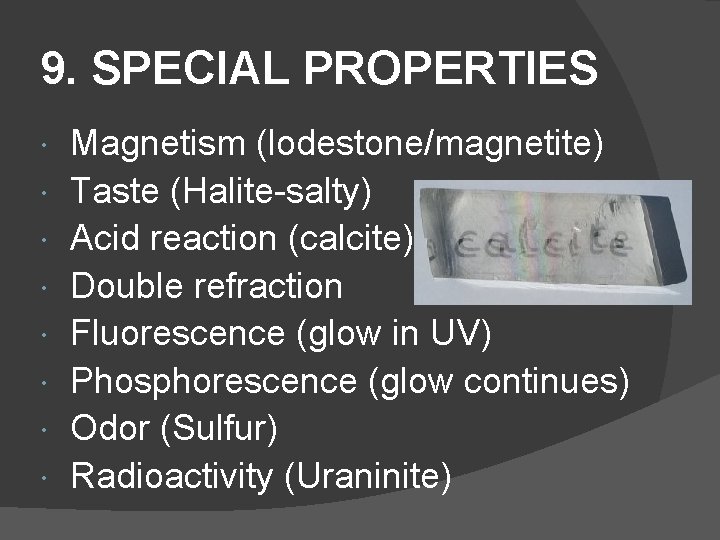
9. SPECIAL PROPERTIES Magnetism (lodestone/magnetite) Taste (Halite-salty) Acid reaction (calcite) Double refraction Fluorescence (glow in UV) Phosphorescence (glow continues) Odor (Sulfur) Radioactivity (Uraninite)
Science. Now Diamond Factory Video (click on “Watch Diamond Factory”)