
MINERALS AND ENERGY RESOURCES What is a Mineral
- Slides: 35
MINERALS AND ENERGY RESOURCES
What is a Mineral? • A mineral is a natural occurring solid having a crystal structure and a definite chemical composition. • They are natural chemical compounds, uniform in composition a structure and constituents of rocks and ores. • They are formed through various geological processes taking place in the Earth.
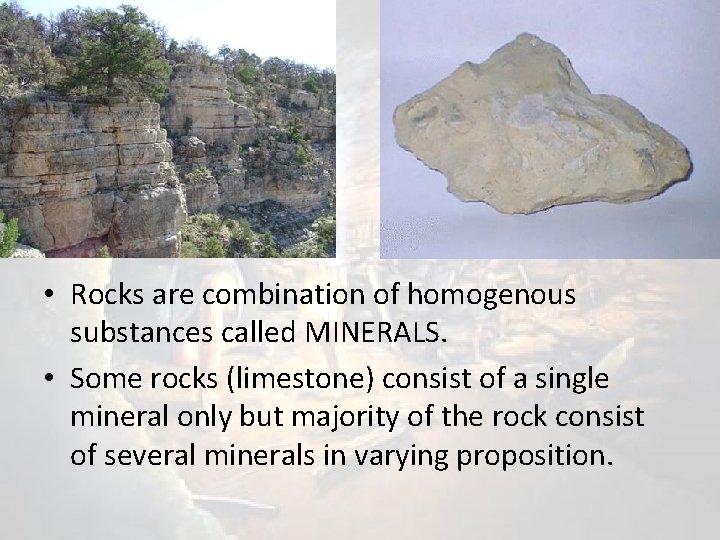
• Rocks are combination of homogenous substances called MINERALS. • Some rocks (limestone) consist of a single mineral only but majority of the rock consist of several minerals in varying proposition.
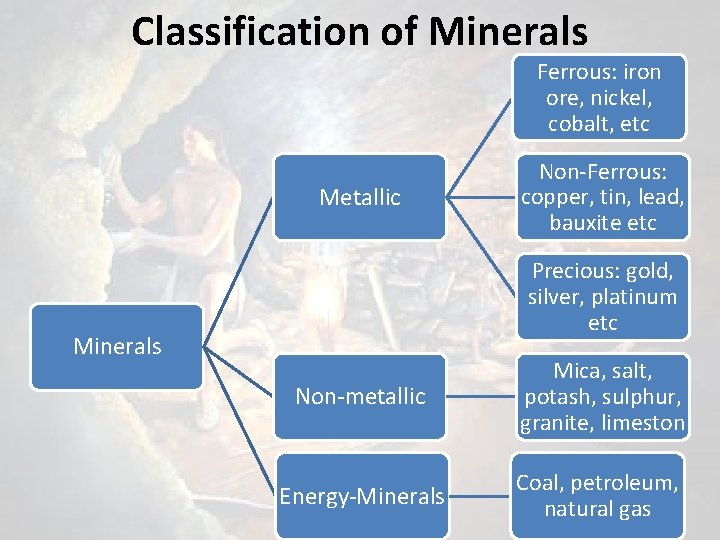
Classification of Minerals Ferrous: iron ore, nickel, cobalt, etc Metallic Non-Ferrous: copper, tin, lead, bauxite etc Precious: gold, silver, platinum etc Minerals Non-metallic Mica, salt, potash, sulphur, granite, limeston Energy-Minerals Coal, petroleum, natural gas
Where are these minerals found? • Minerals are usually found in ores (mixed with other elements). • The mineral content of the ore must be in sufficient concentration to make its extraction commercially viable. • The type of formation in which they are found determines the relative ease with which mineral ores may be mined.
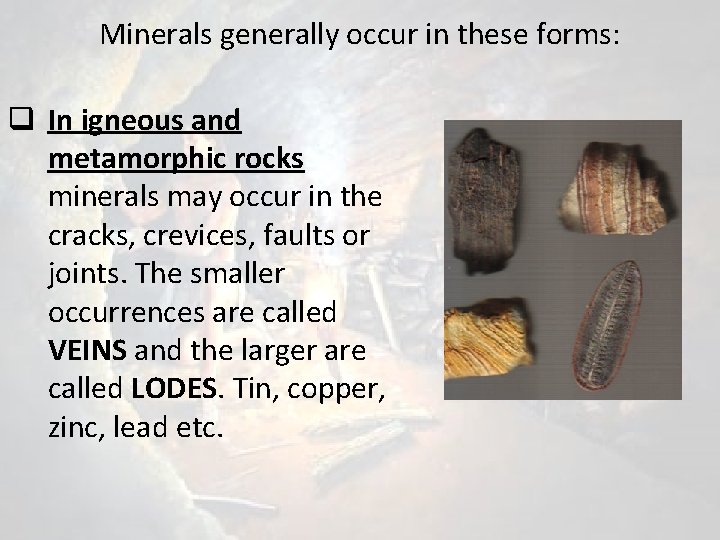
Minerals generally occur in these forms: q In igneous and metamorphic rocks minerals may occur in the cracks, crevices, faults or joints. The smaller occurrences are called VEINS and the larger are called LODES. Tin, copper, zinc, lead etc.
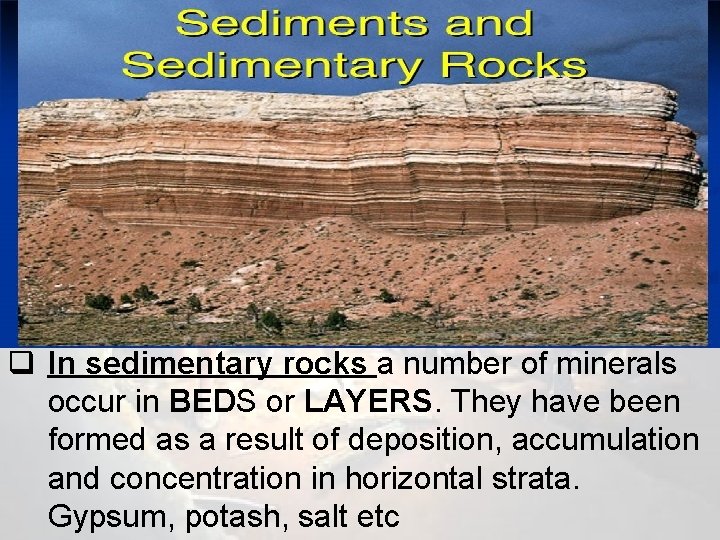
q In sedimentary rocks a number of minerals occur in BEDS or LAYERS. They have been formed as a result of deposition, accumulation and concentration in horizontal strata. Gypsum, potash, salt etc
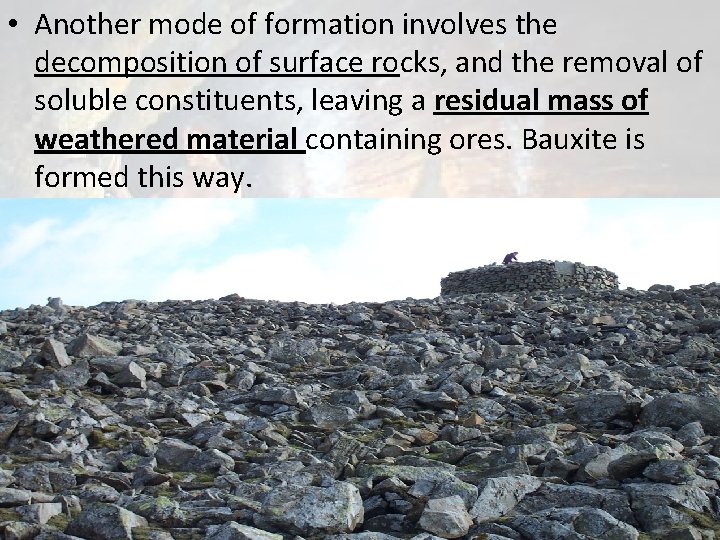
• Another mode of formation involves the decomposition of surface rocks, and the removal of soluble constituents, leaving a residual mass of weathered material containing ores. Bauxite is formed this way.
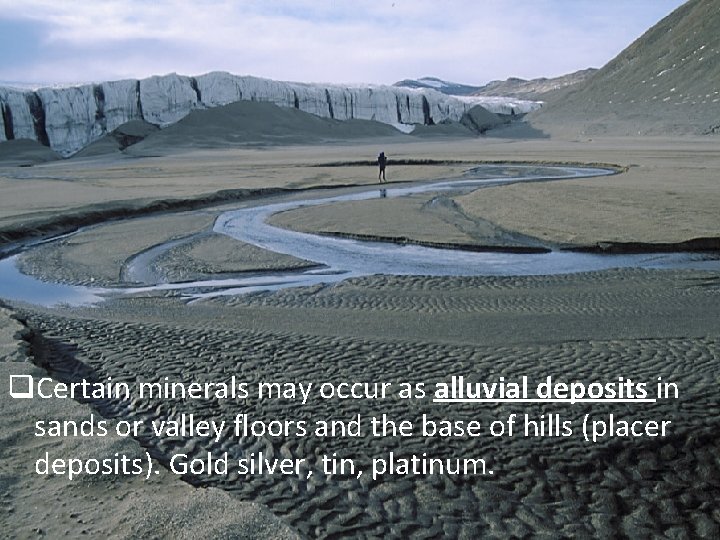
q. Certain minerals may occur as alluvial deposits in sands or valley floors and the base of hills (placer deposits). Gold silver, tin, platinum.
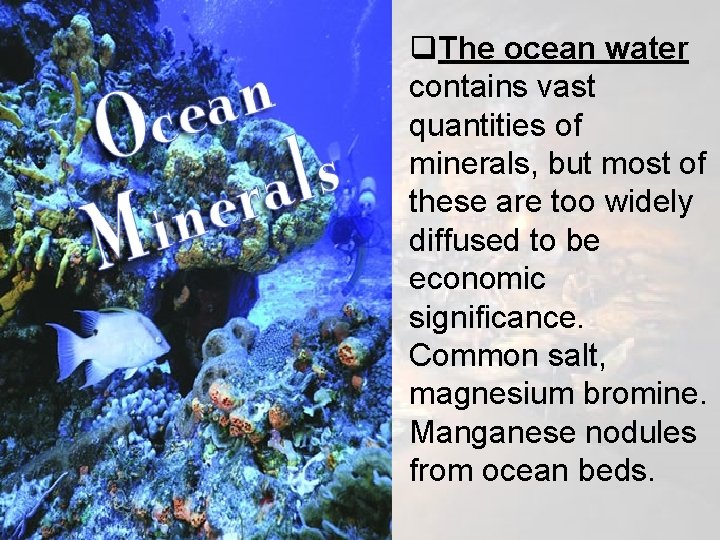
q. The ocean water contains vast quantities of minerals, but most of these are too widely diffused to be economic significance. Common salt, magnesium bromine. Manganese nodules from ocean beds.
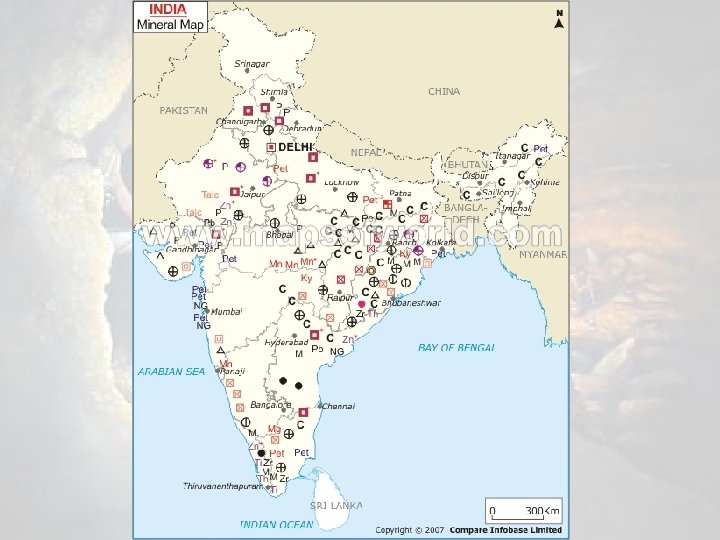
• Mineral resources are unevenly distributed in India. • Peninsular rocks contain most of the reserves of coal, metallic minerals, mica and many other non metallic minerals. • Petroleum deposits in sedimentary rocks of Gujarat and Assam • Non ferrous minerals in Rajasthan. These variations exist due to the differences in the geological structure, processes and time involved in the formation of minerals.
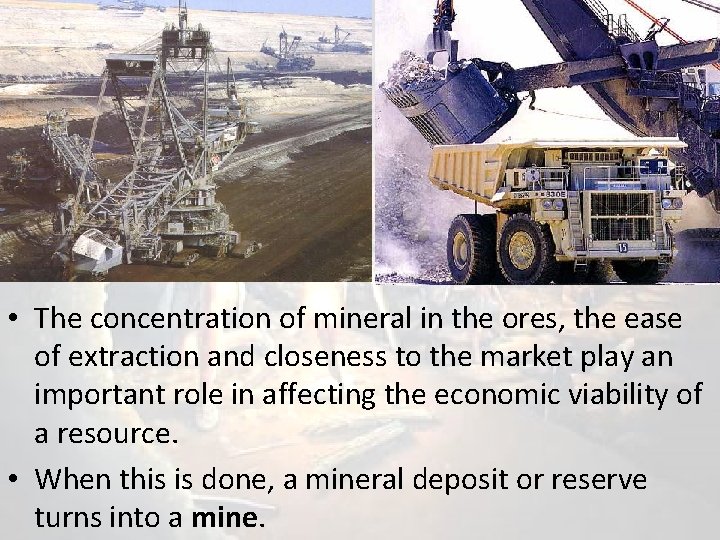
• The concentration of mineral in the ores, the ease of extraction and closeness to the market play an important role in affecting the economic viability of a resource. • When this is done, a mineral deposit or reserve turns into a mine.
Ferrous Minerals • Ferrous minerals account for about ¾ of the total value of production of metallic minerals. • They provide strong base for the development of metallurgical industries. • India exports substantial quantities of ferrous minerals after meeting her internal demands.
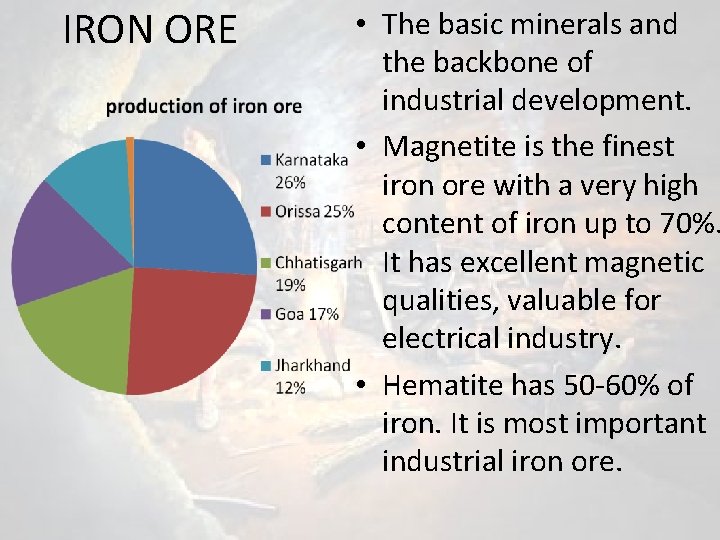
IRON ORE • The basic minerals and the backbone of industrial development. • Magnetite is the finest iron ore with a very high content of iron up to 70%. It has excellent magnetic qualities, valuable for electrical industry. • Hematite has 50 -60% of iron. It is most important industrial iron ore.
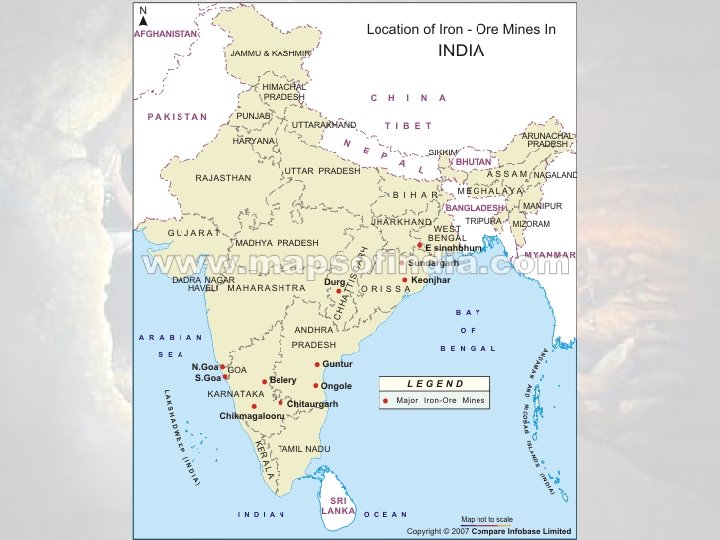
The major iron belts in India 1. Orissa-Jharkhand belt: high grade hematite ore in Badampahar mines in the Mayurbhanj and kendujhar districts. 2. Durg-Bastar-Chandrapur belt: lines in Chhattisgarh and Maharashtra. Very high grade hematite are found in Bailadila range of hills in the Bastar district of Chhattisgarh. Needed for steel making and is exported to Japan and South Korea via Vizag port.
The major iron belts in India 3. Bellary-Chitradurga-Chikmaglur-Tumkur belt in Karnataka: The Kudermukh mines (known to be one of the largest in the world) in Western Ghats are a 100% export unit. The ore is transported as slurry through a pipeline to a port near Mangalore. 4. Maharashtra-Goa belt: ores are not of very high quality, yet they are efficiently exploited. Iron ore is exported through Marmagao port.
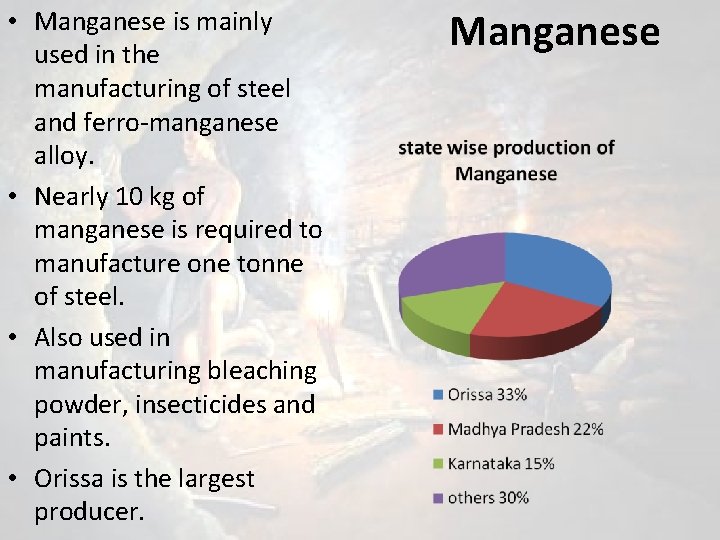
• Manganese is mainly used in the manufacturing of steel and ferro-manganese alloy. • Nearly 10 kg of manganese is required to manufacture one tonne of steel. • Also used in manufacturing bleaching powder, insecticides and paints. • Orissa is the largest producer. Manganese
Non - Ferrous Minerals • India’s reserves and production of non-ferrous minerals is not very satisfactory. • However, copper, bauxite, lead, zinc and gold play a vital role in a number of metallurgical, engineering and electrical industries.
COPPER • Being malleable (workable) and ductile (capable of being drawn out into wires) and a good conductor, copper is mainly used in electrical cables, electronics and chemical industries. • Balaghat mines in MP produces 52% of India's copper. • The Singhbhum (Jharkhand) and Khetri mines in Raj. are also famous.
• Though several ores contain aluminium, it is from bauxite, a clay like substance that alumina and later aluminium is obtained. • Bauxite deposits are formed by the decomposition of wide variety of rocks rich in aluminium silicates. BAUXITE
BAUXITE • Aluminium has strength of iron with extreme lightness, good conductivity and great malleability. • Bauxite deposits are found in Amarkantak plateau, Maikal hills and region of Bilaspur-katni. • Panchpatmali deposits in Koraput dist. (Orissa) produces 45% of India’s production.
Non-Metallic Minerals • Mica is a mineral made up of series of plates or leaves. • Mica can be clear, black, green, red yellow or brown. • Due to its excellent dielectric strength, low power loss factor, insulating properties and resistance to high voltage, it is one of the most indispensable • Mica deposits are found in Chhota Nagpur Plateau, Koderma Gaya – minerals used in electrical Hazaribagh belt (Jharkhand), and electronic industries. around Ajmer (Raj), Nellore belt (AP)
Rock Minerals • Limestone is found in association with rocks composed of calcium carbonates or calcium and magnesium carbonates. • It is found in sedimentary rocks of most geological formations. • Limestone is the basic raw material for the cement industry and essential for smelting iron ore in the blast furnace.
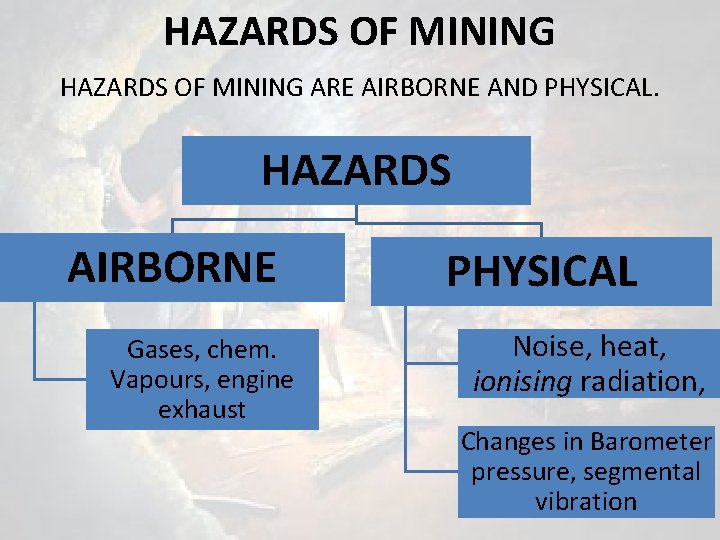
HAZARDS OF MINING ARE AIRBORNE AND PHYSICAL. HAZARDS AIRBORNE Gases, chem. Vapours, engine exhaust PHYSICAL Noise, heat, ionising radiation, Changes in Barometer pressure, segmental vibration
HAZARDS OF MINING • The dust and noxious fumes inhaled by mines make them vulnerable to pulmonary diseases. • The risk of collapsing mine roofs, inundation and fires in coalmines are a constant threat to miners. • The water sources in the region get contaminated due to mining. Dumping of waste and slurry leads to degradation of land, soil and increase in stream and river pollution.
Conservation of Minerals • The total volume of workable mineral deposits is 1% of the earth’s crust. • We are rapidly consuming mineral resources that required millions of years to be created and concentrated. • Mineral resources are therefore, finite and nonrenewable. • Continued extraction of ores leads to increasing cost as mineral extraction comes from greater depth along with decrease in quality. • Therefore, we need to conserve resources to last more longer.
Conservation of Minerals • Improved technologies need to be constantly evolved to allow use of low grade ores at low costs. • Recycling or metals, using scrap metals and other substitutes are steps in conserving our mineral resources for the future.
Energy resources Energy is needed to cook, to provide light and heat, to propel vehicles and to drive machinery. It can be generated from coal, petroleum, natural gas, uranium and from electricity. • Conventional sources: • Non Conventional Sources: firewood, cattle dung cake, Solar, wind, tidal, coal, petroleum, natural gas geothermal, biogas and electricity (hydel and atomic energy. thermal).
Conventional Source of Energy COAL: Most abundantly available fossil fuel. Used for Power Generation and meeting commercial energy requirement. • Coal is formed due to compression of plant material over millions of years. • Coal, therefore, is found in a variety of forms depending on the degrees of compression and depth of time of burial.
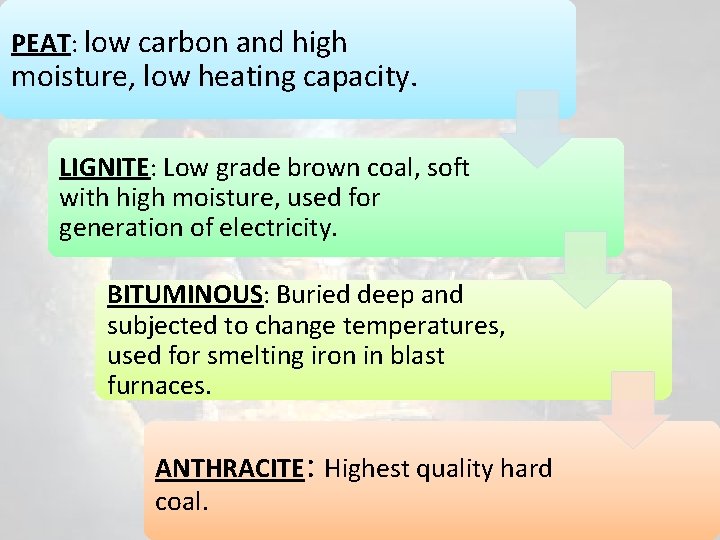
PEAT: low carbon and high moisture, low heating capacity. LIGNITE: Low grade brown coal, soft with high moisture, used for generation of electricity. BITUMINOUS: Buried deep and subjected to change temperatures, used for smelting iron in blast furnaces. ANTHRACITE: Highest quality hard coal.
In India, coal occurs in two main geological ages: i. Gondwana: a little over 200 million years in age, metallurgical coal. Located in Damodar valley, Jharia, Raniganj, Bokaro. ii. Tertiary deposits: about 55 million years old, occurs in Meghalaya, Assam, Arunachal Pradesh, Nagaland. Heavy industries and thermal power station are located on or near the coalfields as cost and problems of transportation becomes almost negligible.
Petroleum