
MINERAL IDENTIFICATION HAVE OUT YOUR REFERENCE TABLES FOR

MINERAL IDENTIFICATION HAVE OUT YOUR REFERENCE TABLES FOR THIS SECTION… AND FROM NOW ON… FOREVER…
PHYSICAL PROPERTIES Each mineral has specific properties that are a result of its chemical composition and its crystalline structure. There are SEVEN Physical Properties to determine the mineral type. LAST PAGE OF THE REFERENCE TABLE
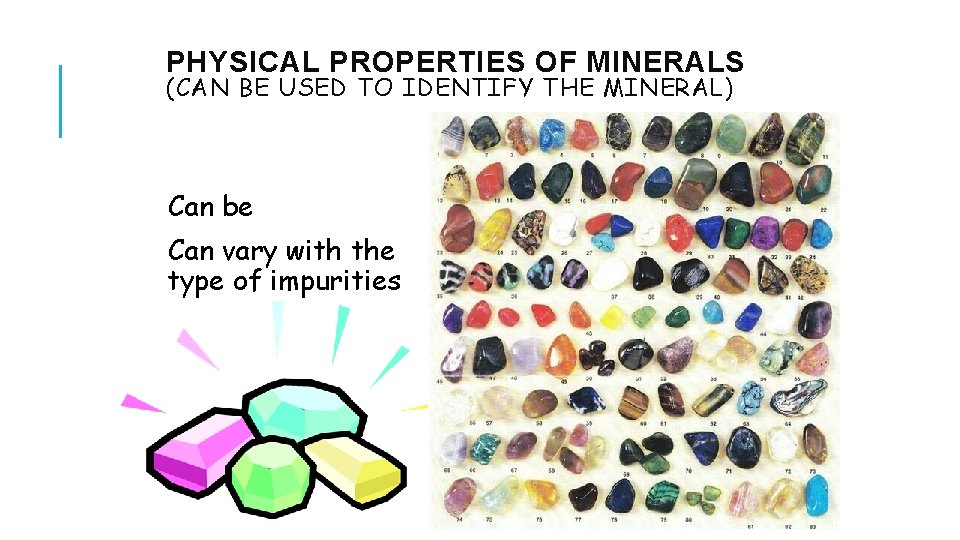
PHYSICAL PROPERTIES OF MINERALS (CAN BE USED TO IDENTIFY THE MINERAL) #1 - Color Can be misleading Can vary with the type of impurities
COLOR CHECK v. Find the Common Colors Column v. List two examples of minerals that are the same or similar colors…
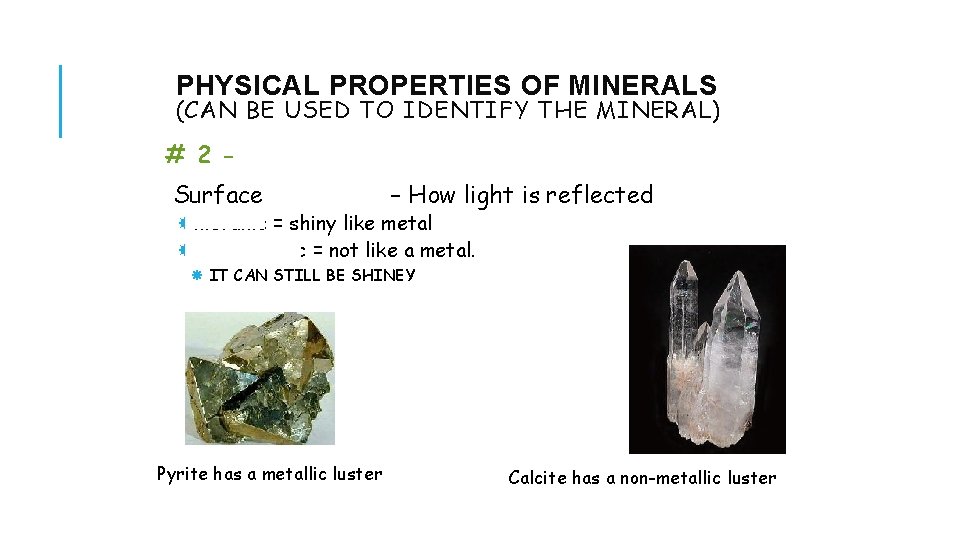
PHYSICAL PROPERTIES OF MINERALS (CAN BE USED TO IDENTIFY THE MINERAL) # 2 - Luster Surface reflection – How light is reflected metallic = shiny like metal non-metallic = not like a metal. IT CAN STILL BE SHINEY Pyrite has a metallic luster Calcite has a non-metallic luster
LUSTER CHECK v. Find the Luster Column v. What are the 2 main types of Luster? v. Identify the mineral that has a metallic luster, green black streak, and is brassy yellow… v. Identify the mineral that has a non-metallic luster, is yellow to amber in color, and is easily melted…
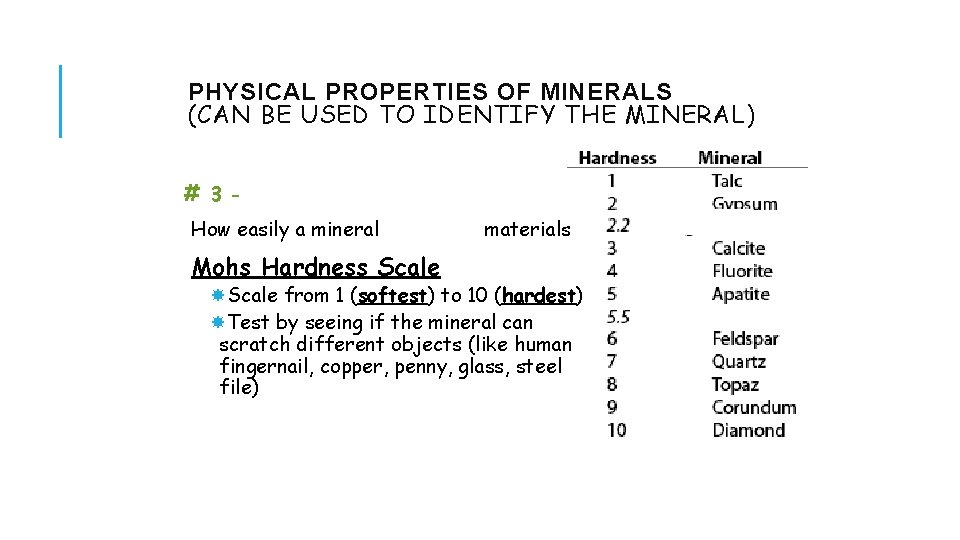
PHYSICAL PROPERTIES OF MINERALS (CAN BE USED TO IDENTIFY THE MINERAL) # 3 - Hardness How easily a mineral scratches materials Mohs Hardness Scale from 1 (softest) to 10 (hardest) Test by seeing if the mineral can scratch different objects (like human fingernail, copper, penny, glass, steel file)
HARDNESS CHECK v. Find the Hardness Column v. Using the Hardness Scale, list at least 2 examples of minerals that can be scratched by your fingernail. v. List two that would scratch glass
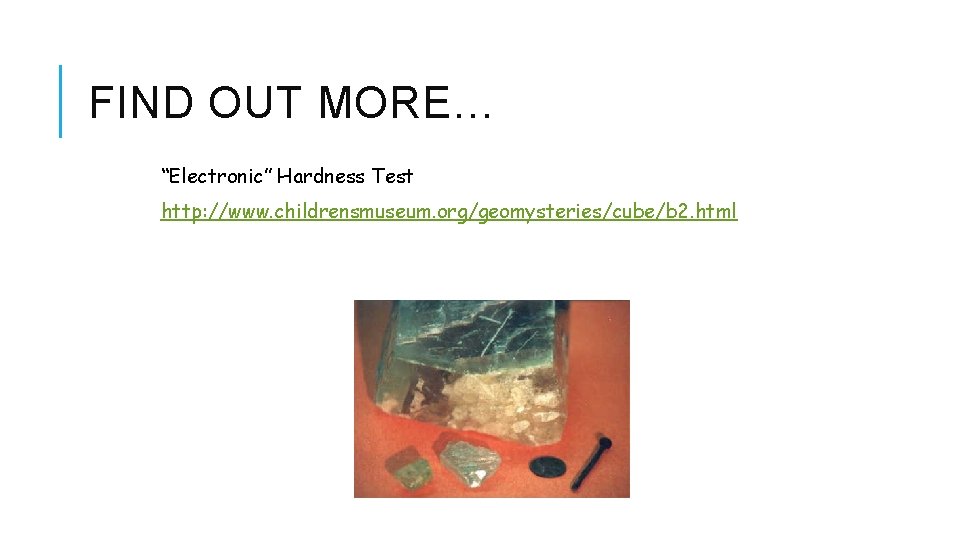
FIND OUT MORE… “Electronic” Hardness Test http: //www. childrensmuseum. org/geomysteries/cube/b 2. html
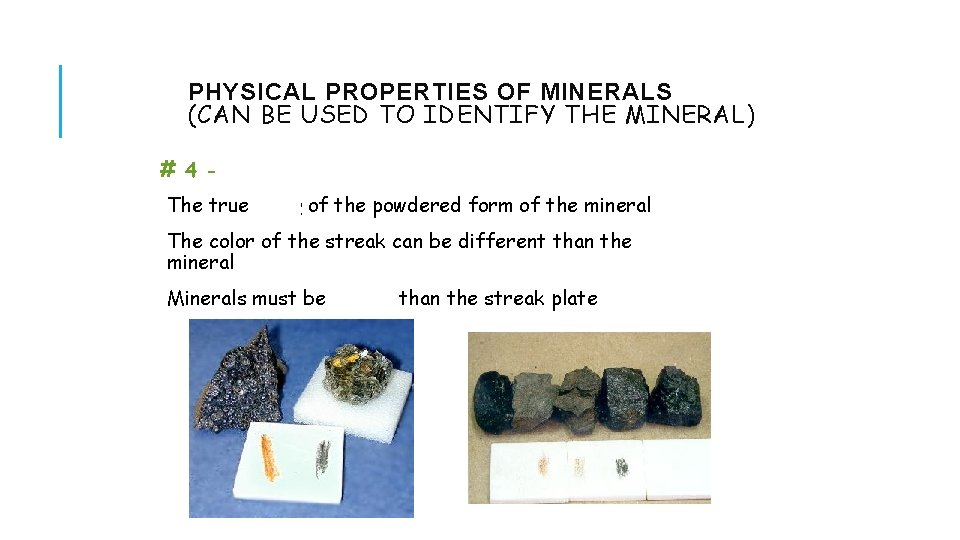
PHYSICAL PROPERTIES OF MINERALS (CAN BE USED TO IDENTIFY THE MINERAL) # 4 - Streak The true color of the powdered form of the mineral The color of the streak can be different than the mineral Minerals must be softer than the streak plate
STREAK – IN GENERAL v. Rub the mineral on a ceramic plate v. The color of the streak indicates 3 things – v. Metallic minerals usually have a dark streak v. Non-metallic minerals usually have a light streak v. Minerals harder than the streak plate will leave no streak. Why?
STREAK CHECK v. Find the Distinguishing Characteristics Column v. List at least 2 examples of minerals that have a Black Streak. v. What other characteristics could you use to identify minerals with the same color streak?
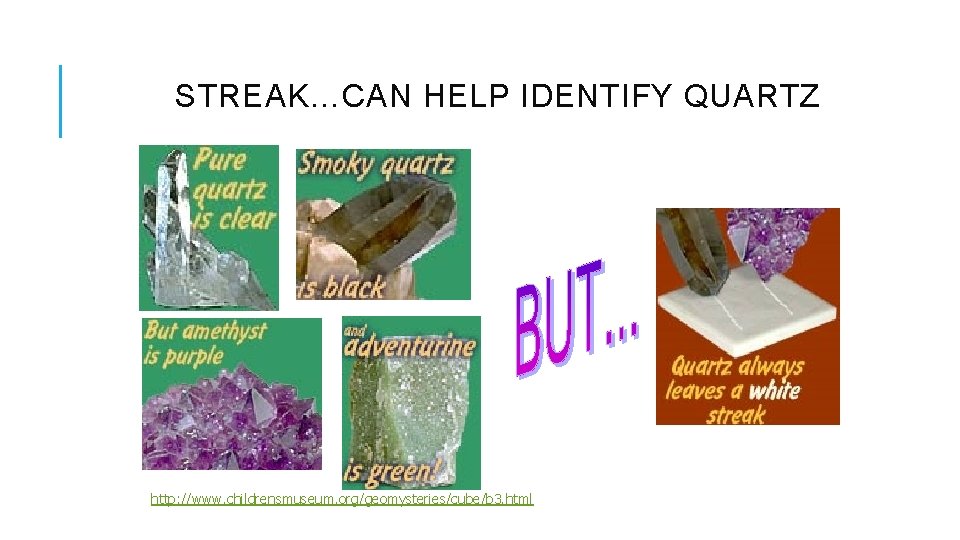
STREAK…CAN HELP IDENTIFY QUARTZ http: //www. childrensmuseum. org/geomysteries/cube/b 3. html
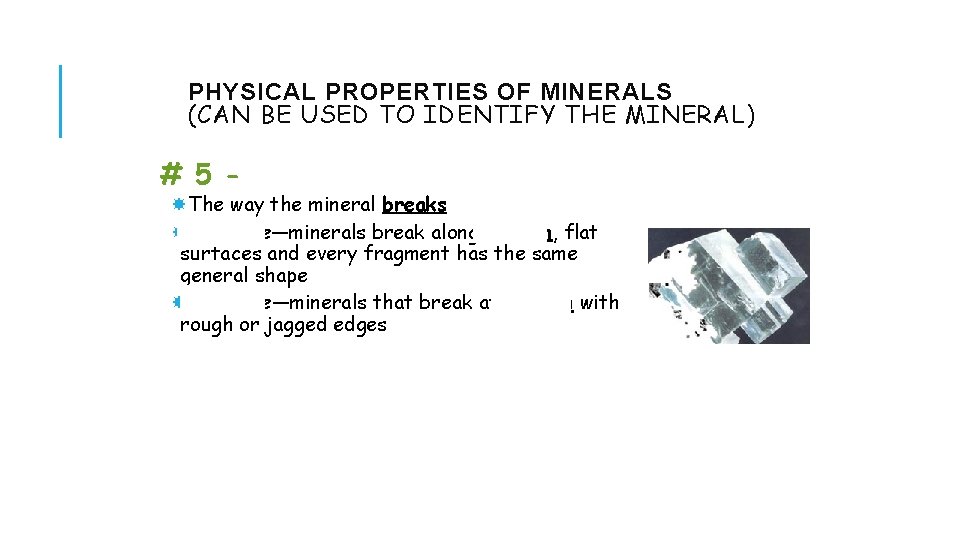
PHYSICAL PROPERTIES OF MINERALS (CAN BE USED TO IDENTIFY THE MINERAL) # 5 - Cleavage & Fracture The way the mineral breaks Cleavage—minerals break along smooth, flat surfaces and every fragment has the same general shape Fracture—minerals that break at random with rough or jagged edges
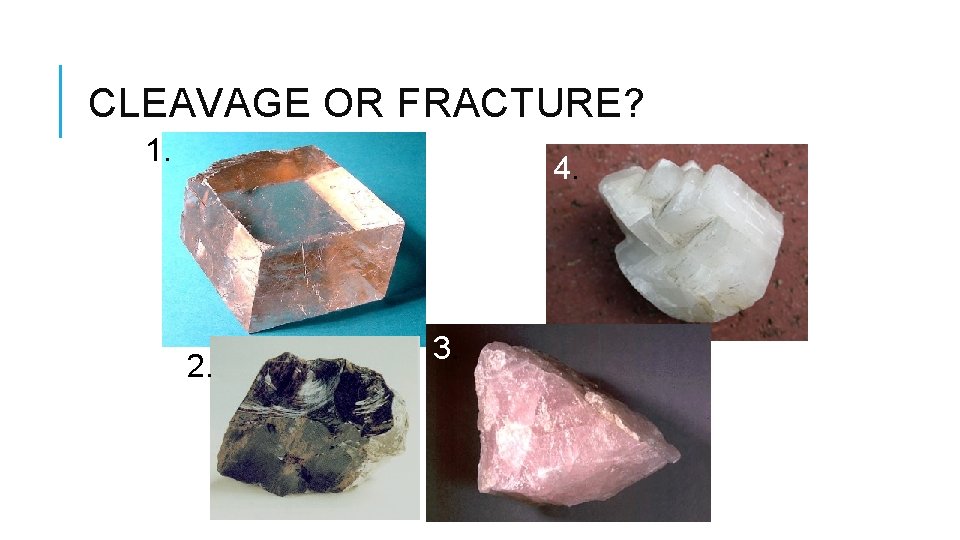
CLEAVAGE OR FRACTURE? 1. 4. 2. 3.
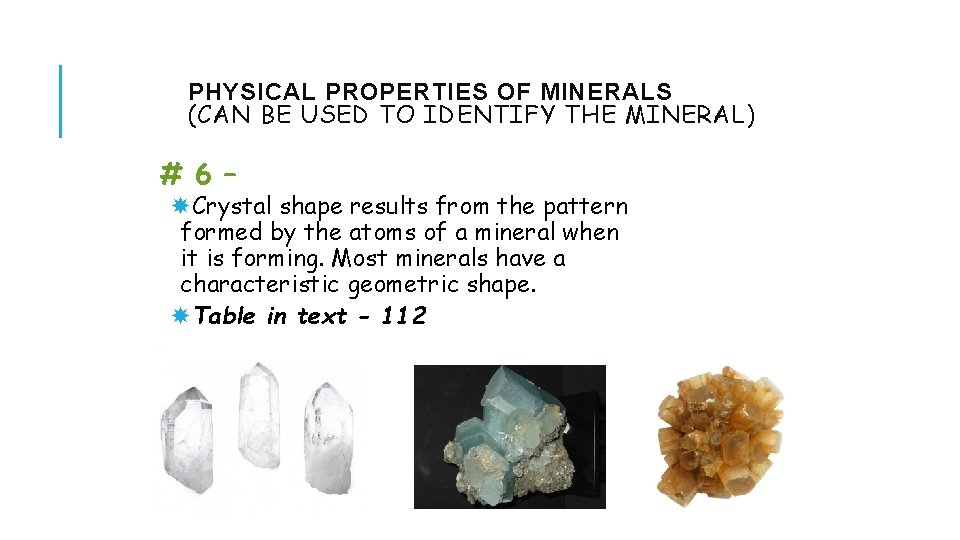
PHYSICAL PROPERTIES OF MINERALS (CAN BE USED TO IDENTIFY THE MINERAL) # 6 – Crystal Shape Crystal shape results from the pattern formed by the atoms of a mineral when it is forming. Most minerals have a characteristic geometric shape. Table in text - 112
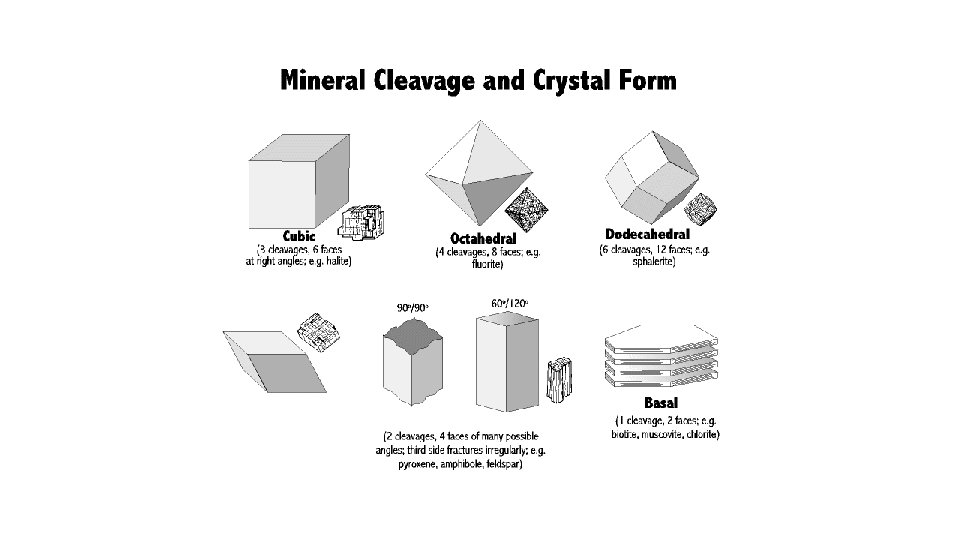
CRYSTAL SHAPE CHECK v. Find the Distinguishing Characteristics Column v. Identify two minerals that have a cubic crystal structure. v. Identify two minerals that have a rhombohedral crystal structure.
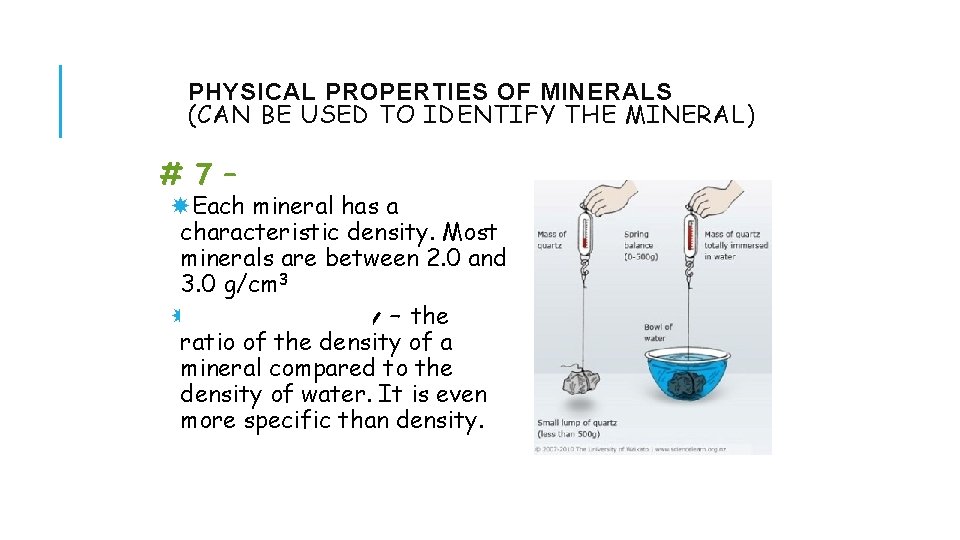
PHYSICAL PROPERTIES OF MINERALS (CAN BE USED TO IDENTIFY THE MINERAL) # 7 – Density Each mineral has a characteristic density. Most minerals are between 2. 0 and 3. 0 g/cm 3 Specific Gravity – the ratio of the density of a mineral compared to the density of water. It is even more specific than density.
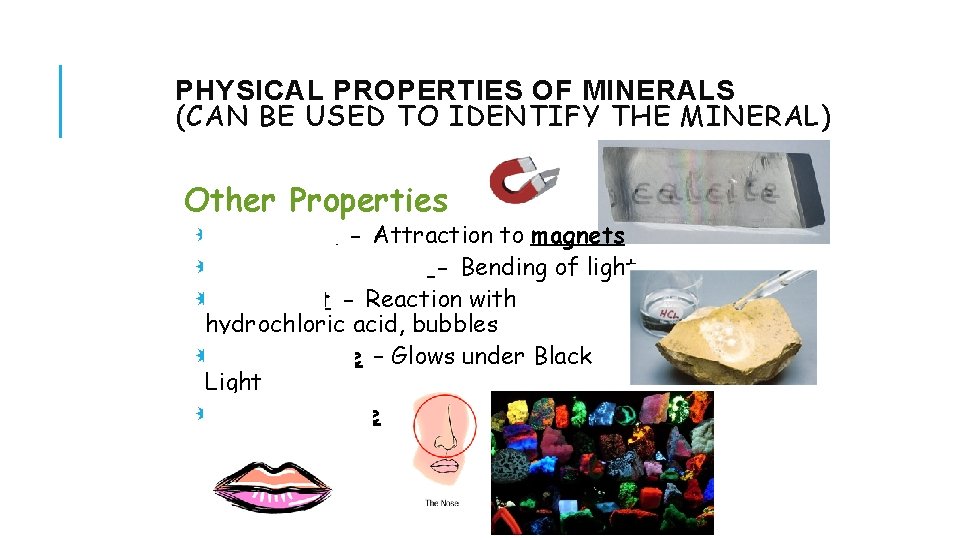
PHYSICAL PROPERTIES OF MINERALS (CAN BE USED TO IDENTIFY THE MINERAL) Other Properties Magnetism - Attraction to magnets Double Refraction - Bending of light Acid Test - Reaction with hydrochloric acid, bubbles Flourescence – Glows under Black Light Smell & Taste
- Slides: 20