
Mine dewatering for pit slope stability Concepts and
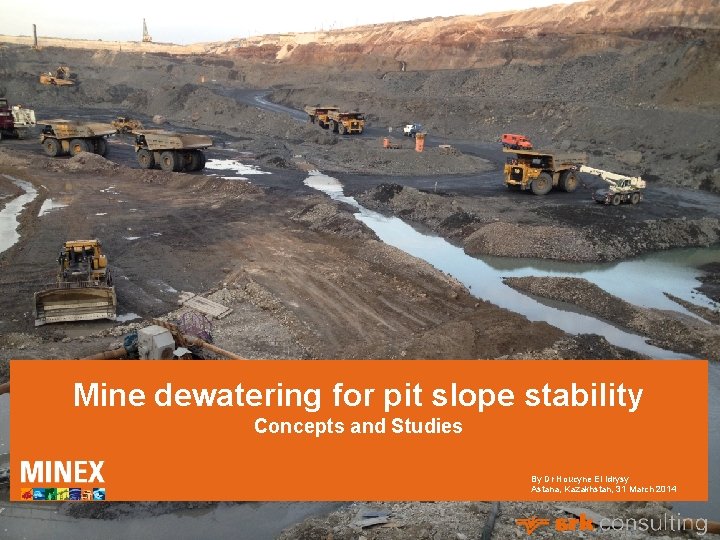
Mine dewatering for pit slope stability Concepts and Studies By Dr Houcyne El Idrysy Astana, Kazakhstan, 31 March 2014
Presentation Topics 1. Groundwater flow and pore pressure concepts 2. Hydrogeological conceptual models 3. Development of numerical groundwater models © SRK Consulting (UK) Ltd 2011. All rights reserved. 4. Optimisation of pit dewatering/depressurization and input into mine design 5. Design of pit dewatering/depressurization and monitoring 6. Conclusions Take Away Statement
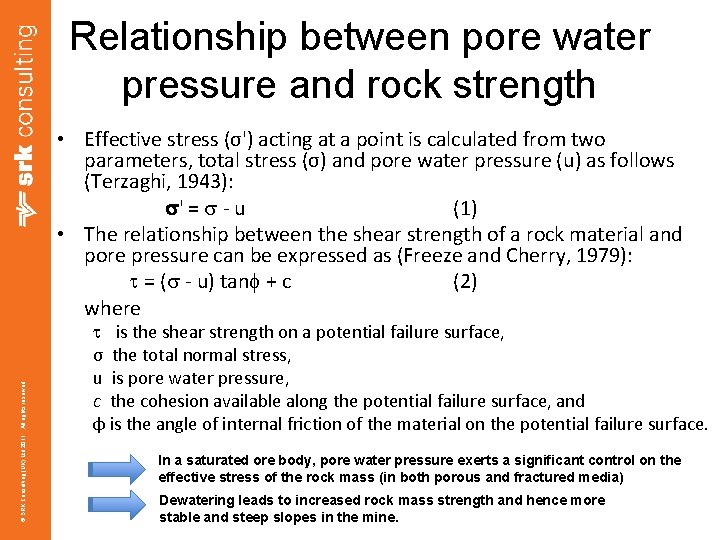
Relationship between pore water pressure and rock strength © SRK Consulting (UK) Ltd 2011. All rights reserved. • Effective stress (σ') acting at a point is calculated from two parameters, total stress (σ) and pore water pressure (u) as follows (Terzaghi, 1943): ' = - u (1) • The relationship between the shear strength of a rock material and pore pressure can be expressed as (Freeze and Cherry, 1979): = ( - u) tan + c (2) where is the shear strength on a potential failure surface, σ the total normal stress, u is pore water pressure, c the cohesion available along the potential failure surface, and φ is the angle of internal friction of the material on the potential failure surface. In a saturated ore body, pore water pressure exerts a significant control on the effective stress of the rock mass (in both porous and fractured media) Dewatering leads to increased rock mass strength and hence more stable and steep slopes in the mine.
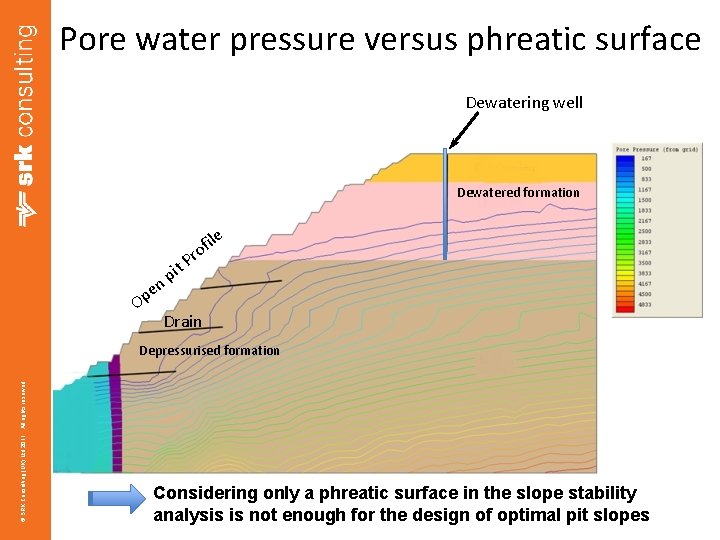
Pore water pressure versus phreatic surface Dewatering well Dewatered formation it p n e Op ile f o Pr Drain © SRK Consulting (UK) Ltd 2011. All rights reserved. Depressurised formation Considering only a phreatic surface in the slope stability analysis is not enough for the design of optimal pit slopes
Mine Dewatering/Depressurisation Study for Slope Optimisation and Design Objectives • Estimate potential inflows into the mine • Assess the ability and time to dewater/depressurise the pit • Design dewatering system to achieve stable slope and acceptable mining conditions • Prepare surface water control and flood protection if needed © SRK Consulting (UK) Ltd 2011. All rights reserved. Required tasks • • Regional and local numerical groundwater modelling Transient simulation of mine dewatering for the mine life Optimisation and design of mine dewatering system Surface water hydrology and flood risk assessment Take Away Statement
Approach to groundwater modelling for slope design input • Advanced modelling of pore pressure is not usually required for input to the analysis of a pit slope stability. © SRK Consulting (UK) Ltd 2011. All rights reserved. • It is required only when pore water pressure and groundwater regime are identified as controlling factors due to the geotechnical setting of the pit • Therefore, before embarking in an advanced modelling and simulation of pore pressure, assess if this is a controlling factor in the pit stability • When required, the process of interaction between both studies can be very complex but rewarding Take Away Statement
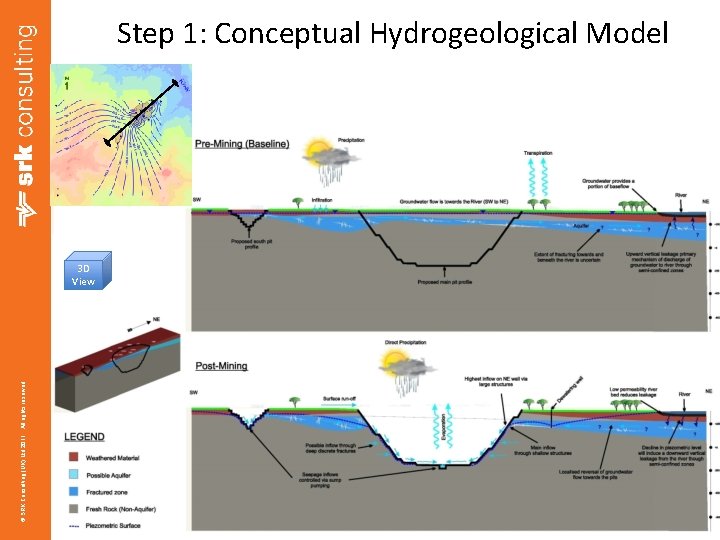
Step 1: Conceptual Hydrogeological Model © SRK Consulting (UK) Ltd 2011. All rights reserved. 3 D View Take Away Statement
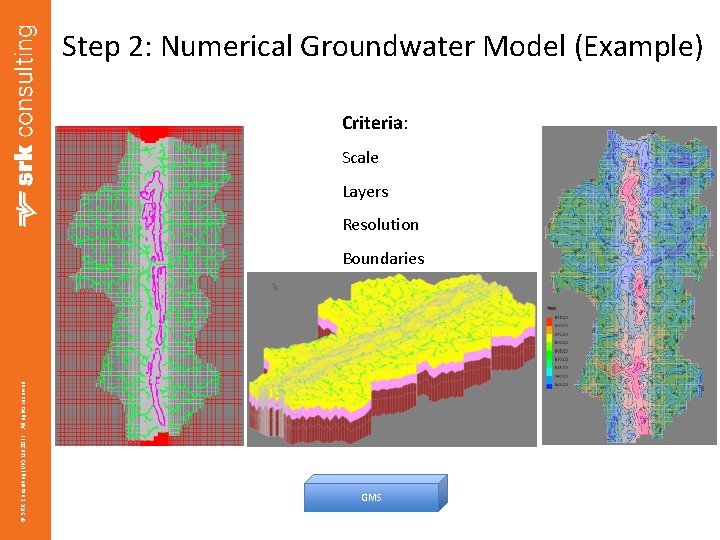
Step 2: Numerical Groundwater Model (Example) Criteria: Scale Layers Resolution © SRK Consulting (UK) Ltd 2011. All rights reserved. Boundaries GMS
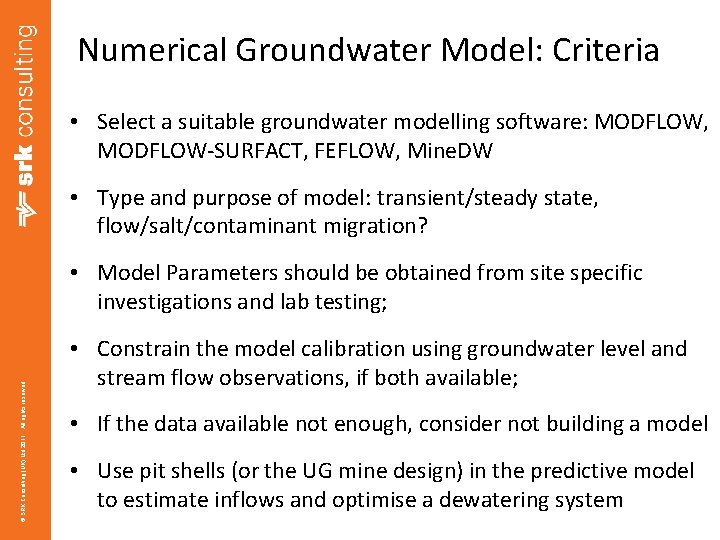
Numerical Groundwater Model: Criteria • Select a suitable groundwater modelling software: MODFLOW, MODFLOW-SURFACT, FEFLOW, Mine. DW • Type and purpose of model: transient/steady state, flow/salt/contaminant migration? © SRK Consulting (UK) Ltd 2011. All rights reserved. • Model Parameters should be obtained from site specific investigations and lab testing; • Constrain the model calibration using groundwater level and stream flow observations, if both available; • If the data available not enough, consider not building a model • Use pit shells (or the UG mine design) in the predictive model to estimate inflows and optimise a dewatering system
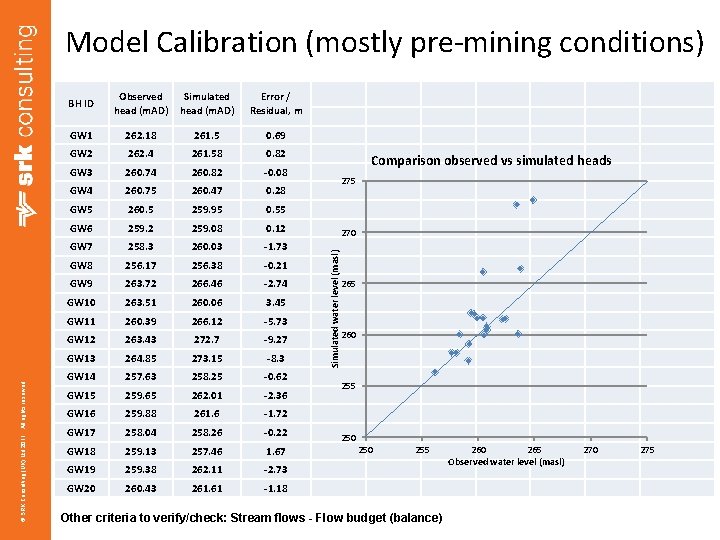
© SRK Consulting (UK) Ltd 2011. All rights reserved. Model Calibration (mostly pre-mining conditions) Observed head (m. AD) Simulated head (m. AD) Error / Residual, m GW 1 262. 18 261. 5 0. 69 GW 2 262. 4 261. 58 0. 82 GW 3 260. 74 260. 82 -0. 08 GW 4 260. 75 260. 47 0. 28 GW 5 260. 5 259. 95 0. 55 GW 6 259. 2 259. 08 0. 12 GW 7 258. 3 260. 03 -1. 73 GW 8 256. 17 256. 38 -0. 21 GW 9 263. 72 266. 46 -2. 74 GW 10 263. 51 260. 06 3. 45 GW 11 260. 39 266. 12 -5. 73 GW 12 263. 43 272. 7 -9. 27 GW 13 264. 85 273. 15 -8. 3 GW 14 257. 63 258. 25 -0. 62 GW 15 259. 65 262. 01 -2. 36 GW 16 259. 88 261. 6 -1. 72 GW 17 258. 04 258. 26 -0. 22 GW 18 259. 13 257. 46 1. 67 GW 19 259. 38 262. 11 -2. 73 GW 20 260. 43 261. 61 -1. 18 Comparison observed vs simulated heads 275 270 Simulated water level (masl) BH ID 265 260 255 250 255 Other criteria to verify/check: Stream flows - Flow budget (balance) 260 265 Observed water level (masl) 270 275
© SRK Consulting (UK) Ltd 2011. All rights reserved. Groundwater Model Sensitivity Analysis Take Away Statement
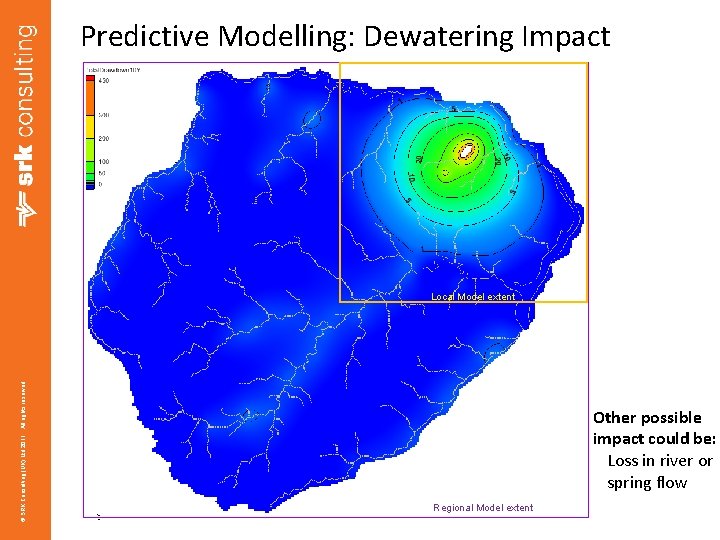
Predictive Modelling: Dewatering Impact © SRK Consulting (UK) Ltd 2011. All rights reserved. Local Model extent Other possible impact could be: Loss in river or spring flow Regional Model extent
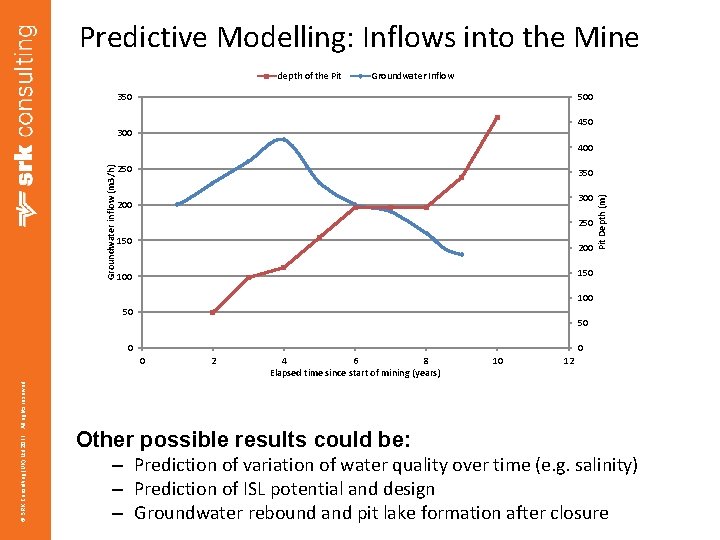
Predictive Modelling: Inflows into the Mine depth of the Pit Groundwater Inflow 350 500 450 300 250 150 200 Pit Depth (m) Groundwater inflow (m 3/h) 400 150 100 50 50 0 0 © SRK Consulting (UK) Ltd 2011. All rights reserved. 0 2 4 6 8 Elapsed time since start of mining (years) 10 12 Other possible results could be: – Prediction of variation of water quality over time (e. g. salinity) – Prediction of ISL potential and design – Groundwater rebound and pit lake formation after closure
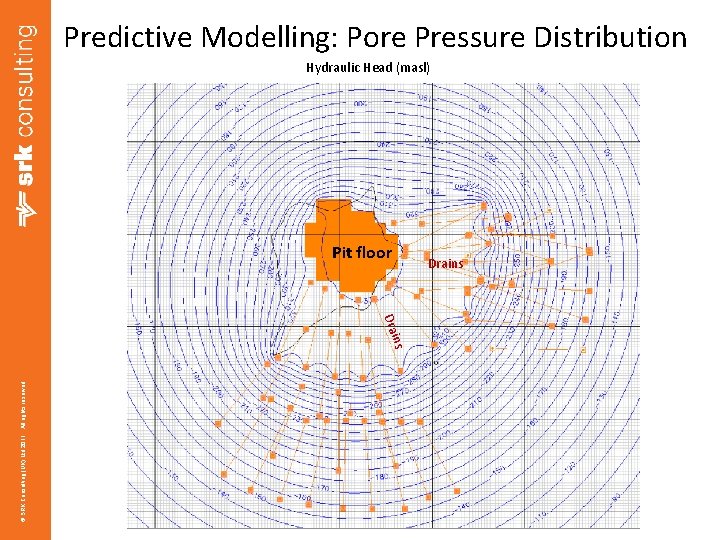
Predictive Modelling: Pore Pressure Distribution Hydraulic Head (masl) Pit floor © SRK Consulting (UK) Ltd 2011. All rights reserved. ns Drai Take Away Statement Drains
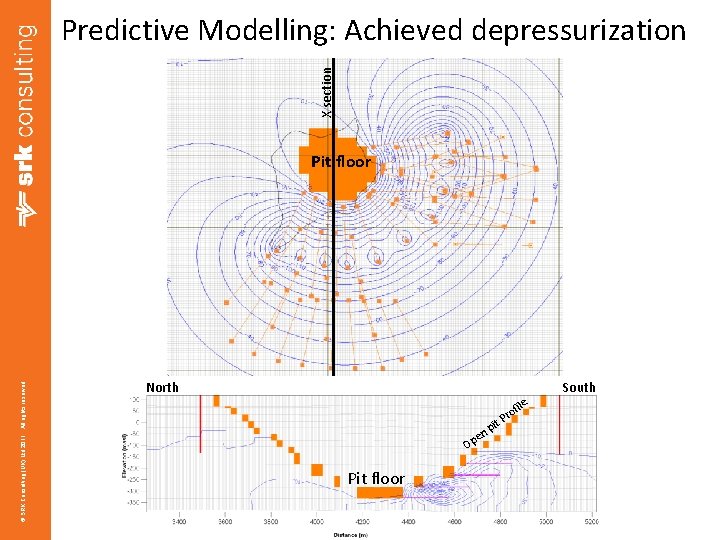
X section Predictive Modelling: Achieved depressurization © SRK Consulting (UK) Ltd 2011. All rights reserved. Pit floor North South pit n e Op Pit floor file o Pr
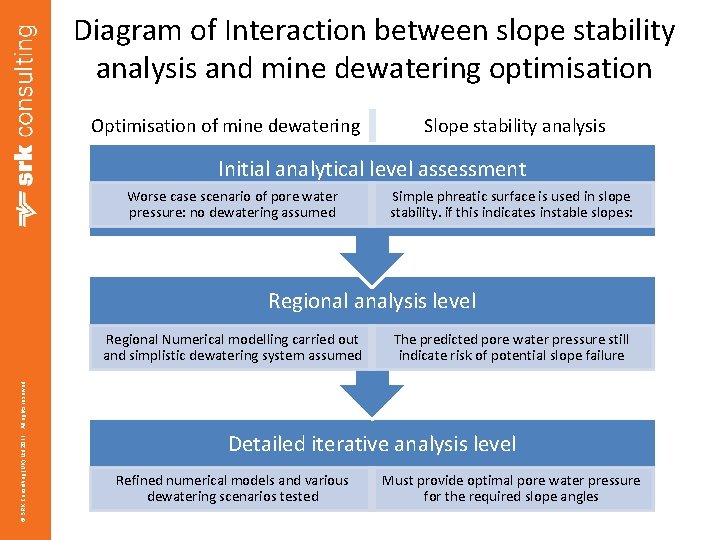
Diagram of Interaction between slope stability analysis and mine dewatering optimisation Optimisation of mine dewatering Slope stability analysis Initial analytical level assessment Worse case scenario of pore water pressure: no dewatering assumed Simple phreatic surface is used in slope stability. if this indicates instable slopes: Regional analysis level © SRK Consulting (UK) Ltd 2011. All rights reserved. Regional Numerical modelling carried out and simplistic dewatering system assumed The predicted pore water pressure still indicate risk of potential slope failure Detailed iterative analysis level Refined numerical models and various dewatering scenarios tested Must provide optimal pore water pressure for the required slope angles
Technologies for controlling pore water pressure in pit slopes • Vertical dewatering wells around and/or within the pit mine; • Wick drains in low permeability materials; • Passive vertical and sub-horizontal drains driven in to pit slopes or from existing underground workings; © SRK Consulting (UK) Ltd 2011. All rights reserved. • Drainage galleries installed below or behind the pit slope; • Blasting can theoretically reduce pore pressure around the blast hole, but the actual extent of this still remains unknown • Sequential planning of mine dewatering is important and, in cases, active dewatering may be required ahead of mining
Conclusions (I) • The challenges of mine dewatering for the objective of pit slope stability depends primarily on the geological structures, rock/soil mass properties and hydrogeological setting; • the level of detail of the groundwater modelling and optimisation for the purpose of providing input to pore water pressure analysis varies dramatically from one case to another © SRK Consulting (UK) Ltd 2011. All rights reserved. • Pit slope stability is more critical in low strength, low permeability saturated rock/soil masses in the proximity of the pit walls; • When pore water pressure is a controlling factor in pit stability, very advanced numerical modelling of pore pressure simulation and optimisation of dewatering/depressurisation systems are required, and vice versa • The optimisation of mine dewatering system must be carried out iteratively with the slope stability analysis to achieve optimal pit slope angles
Conclusions (II) Value should be added to a mine project by: • Opting for international best practices that bring up to date investigation and processing tools, and new design and analytical approaches; © SRK Consulting (UK) Ltd 2011. All rights reserved. • Accepting new design ideas: dewatering wells installation, flexible and cost effective planning; • Updating and Re-running coupled dewatering models and slope stability analysis during the mine development; and • Using monitoring data to keep close control on the dewatering system performance, and updating the models accordingly Take Away Statement

Thank you for your attention © SRK Consulting (UK) Ltd 2011. All rights reserved. Dr Houcyne El Idrysy Senior Hydrogeologist SRK Consulting hidrysy@srk. co. uk Take Away Statement
- Slides: 20