
Mindtools Computers as Mindtools for Schools Engaging Critical


- Slides: 10
Mindtools Computers as Mindtools for Schools: Engaging Critical Thinking Prepared by Tülin Haşlaman 1
What are mindtools? • Mindtools are computer- based tools and learning environments that have been adapted or developed to function as intellectual partners with the learner in order to engage and facilitate critical thinking and higher order learning 2
What is the difference between “technology as teacher” and “technology as partner” I am sorry but I could not find the answer of this question… 3
Students learn with technologies when; • Directly support the curriculum objectives being assessed • Provides opportunities for student collaboration • Adjusts for student ability and prior experience and provides feedback to the student and teacher about students performance or progress with the application. • Is integrated into the typical instructional day • Provides opportunities for students to design and implement projects that extend the curriculum content being assessed by a particular standardized test • Is used in environments where teachers, the school community , and school and district administrators support the use of techology. 4
Constructing computer-based concept maps engage learner in: • The reorganization of knowledge • Explicit descriptions of concepts and their interrelationships. • Deep processing of knowledge, which promotes better remembering and retrieval and ability of apply knowledge in new situations. • Relating new concepts to existing concepts and ideas, which improves understanding. • Spatial learning through spatial representations of concepts in areas of study. 5
What are sementic networks/concept maps? Sementic networks, also known as a concept map, are spatial representations of concepts and their interrelationships that are intended to represent knowledge structures that human store in their minds (Jonassen, Beissner, &Yacci, 1993) 6
Why do we need to use concept maps? • • • Structure is inherent in all knowledge, so understanding the structural foundations of any content domain improves comprehension. Structural knowledge is essential to recall and comprehension because organization of knowledge has been shown by research to be facilitated by organization. When learner study, they necessarily constructural knowledge along with declarative knowledge. Memory structures reflect the world; people naturally learn the underlying organizations of ideas while learning. Structural knowledge is essential to problem solving and procedural knowledge acquisition , so semantic networking will necessarily improve problem solving ability. 7
What are the sequence of activities will help you to integrate concept maps in your instruction? 1. Make a plan and set perspective for analyzing a domain. 2. Idendify important concepts. 3. Create, define and elaborate nodes. 4. Construct links and link concepts. 5. Continue to expand the net. 6. Students reflect on the process. 8
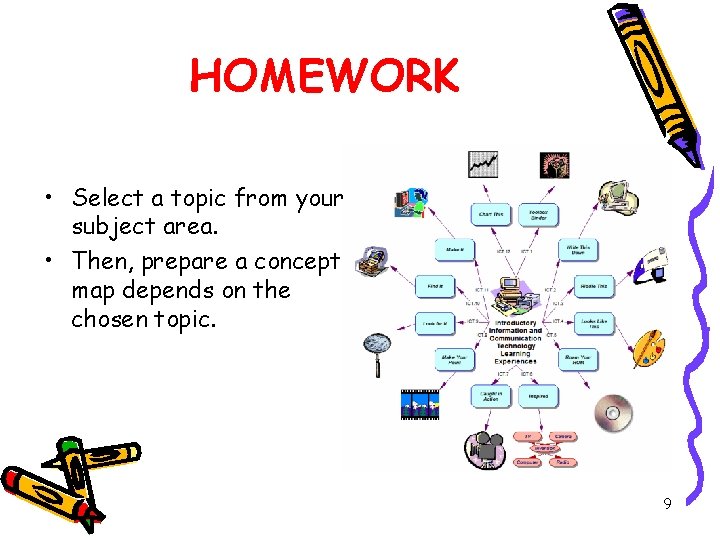
HOMEWORK • Select a topic from your subject area. • Then, prepare a concept map depends on the chosen topic. 9
Thank you for your efforts 10