
Mindfulness at End of Life Dr Michele Chaban
Mindfulness at End of Life Dr Michele Chaban MSW, RSW, Ph. D. Founding and Former Director, The Applied Mindfulness Meditation Program (AAMM-MIND) , University of Toronto. Founding and Former Director, Temmy Latner Center for Palliative Care, Family Counseling Program Mt Sinai Hospital, Toronto.
Welcome and Setting Our Intention • To encourage that mindfulness and mindfulness meditation can be integrated into end of life care ( a downstream practice). • To propose that mindfulness and mindfulness meditation is a contemplative practice applicable to life and which brings changes in life/mind/brain/health ( an upstream practice). • To explore the evidence based research of mindfulness and mindfulness meditation. • To suggest that mindfulness and mindfulness meditation is informed by both contemplative science and contemplative practices. • To propose how mindfulness and mindfulness meditation can be integrated into any tradition of belief and practice, as a mind-body, secular practice.
What we will be covering today • Learn about the applications of mindfulness and mindfulness meditation in the care of the seriously ill and dying. • Explore the meta cognitive skills of mindfulness and mindfulness meditation. • Identify the language of mindfulness and mindfulness meditation. • Identify and hold the challenges about the contemporary landscapes of mindfulness and mindfulness meditation. • Consider that mindfulness and mindfulness meditation practices can be used by any of us, as a preventive and interventive health initiative. • Practice 2 meditations to be used at the bedside of the dying, their family members and with professional caregivers
Mindfulness and Mindfulness Meditation at End of Life helps : -monitor and manage pain and distressing symptoms, -compliment and /or reduces pharmaload in some medications. - distinguish , regulate and monitor thoughts, emotions, body sensations, behavior, -reflect on our death thought systems, -reflect on our intra and inter personal relationships ( existential counseling), - reflect on attachment, striving, impermanence, dissolution, -prepare for non-ordinary states of consciousness which can accompany dying, -In conflict resolution and relational challenges, -cultivate discernment in decision making, -prepare and practice for dying, - bereaved survivors reconstitute their health and stability, - inter-professional teams deal with demands of care, PTSD/STSD , empathy fatigue, -can be used therapeutically and as a therapy.
To begin…. lets practice
To begin…. . a centering meditation • • • Take your most dignified stance…. Bring yourself home…wherever home may be in your body… Breathing In, I breath in Breathing out, I breath out Simply be here now…. feel yourself drop …into your body, • Now, leaving behind as you can, your enskulled brain, bring yourself to your senses…. what do you notice in the room ( sound, smell, sight, touch, taste) • Now listen to the bells…. until you cannot hear them any longer… • Set an intention for your day…what one thing would you like to see changed… • Gratitude for all that is… • Now, bring yourself back into the room….
Pause and reflect…what one thing did you notice?
What did we just experience? • We drove our attention…. first by trying to center ourselves, in a room full of others. • We brought ourselves home ( wherever home might be for you) , we anchored ourselves in our breath, we brought ourselves home to the 5 senses, then zooming in on our auditory sense…. we connected with the bell…until it was heard no more.
What did we just experience? • We zoomed in on ourselves, our bodies, shifted out of the enskulled brain into our embodied mind as a sense based mind, we focused on the bells, and the room at large. • Then as we combined attention and intention, we moved into attitudinal cultivation of gratitude.
This simple exercise combined three meta cognitive skills or components of mindfulness meditation practice. Those are : attention & intention & attitudes.
Mindfulness Meditation Attention + Intention + Attitudes of Gratitude/Loving Kindness etc.
Attention and Intention • The practice is your choosing how to drive your attention- first to centering your mind, by bringing yourself home. You get to decide where home is. This is an attentional shift, gathering of attention, a “zoom in” of self ( think camera lens). • Shifting awareness from enskulled brain ( thoughts) to sense based brain is an attentional shift ( building and broadening our attentional abilities). • Shifting from self to the room at large is an attentional shift ( zoom out). Think camera lens. • With each attentional shift your attentional focus was driven. Think camera-you choose what to focus on. • At base, this is a practice of developing and driving attentional abilities or the “attentional muscle”. Bulking up our attentional abilities. • Each attentional shift is driven by a new intention. As you chose what to focus on, your attention was driven by your intention, or the intention I helped you establish. • “where the attention goes, the energy flows” ( Dr Dan Siegel)
Distinguish : Attention and Intention
Knotting or Twinning Attention and Intention • In being attentive, we are intentional & Intention • In being intentional, we are attentional (Chaban & Klein)
Three Meta-cognitive skills of Mindfulness Meditation • Attention • Intention • Attitudes of gratitude or loving kindness etc.
Ruminating Mind… Worry is a prayer for what we don’t want.
What is Mindfulness and Mindfulness Meditation?
There are many views on what mindfulness and mindfulness meditation is…it depends on how you see it and how you use it.
Mindfulness and Mindfulness Meditation • Mindfulness and mindfulness meditation are an innate human capacity and potential which can arise in all of us naturally and can be enhanced through training either through contemplative meditative practices or secular mindfulness meditation training. (Chaban)
To begin…. always with beginner’s mind • Language matters…. • There is a difference between : -mindfulness, -mindfulness meditation - “mind”.
Mindfulness • Is a way of being in the world( an ontology), a way of seeing the world( phenomenology) , a way of knowing the world ( epistemology), a way of purposing ( teleology). Mindfulness can be something you live in 24/7 or it can be something you apply to life intermittently.
What is Mindfulness Meditation? “It is the awareness that emerges through paying attention on purpose, in the present moment, and nonjudgmentally to the unfolding of experience moment by moment. ” Jon Kabat-Zinn
W What is Mindfulness Meditation? hat is M “It is neither a belief, an ideology or a philosophy. Rather it is a coherent phenomenological description of the nature of mind, emotion, and suffering [with practices] aimed at systematically training and cultivating various aspects of mind and heart via the faculty of mindful attention. ” -Jon Karat Zinn (JKZ)
What is Mindfulness Meditation? Meditation is… “Meditation is a process of lightening up, of trusting the basic goodness of what we have and who we are, and of realizing that any wisdom that exists, exists in what we already have. We can lead our life so as to become more awake to who we are and what we’re doing rather than trying to improve or change or get rid of who we are or what we’re doing. ” -Pema Chödrön
What Mindfulness is not…. Mindfulness is not mind-lessness. It is not the emptying of mind. It is the cultivation of mind through a variety of methodologies developed over 2500 years of Buddhist practices and then researched by science.
Mind • Mind is how we cultivate and generate energy up through the body, how we monitor and manage it ( self-regulation or accelerator/ brake) , and then how we carry it throughout our body ( embodied), and then put it out into the world ( relational). ( AMM-MIND , Uof. T, adapted and adopted from Dr Dan Siegel, UCLA ).
Mindfulness and Mindfulness meditation is the product of 25 -30+ years of scientific testing on the nature and function of our mind. It is not the flavor of the month…not a trend but…it is contributing to the new neurosciences… We are in our early days….
The Relationship between Mindfulness, Mindfulness Meditation and Buddhism
Mindfulness and Mindfulness Meditation The primary research on mindfulness and mindfulness meditation is largely only possible because the dharma of Buddhism came to the west….
The dharma came to the west for many reasons and causes. One such cause was that China began the assume Tibet , based on the claim that Tibet was an ancestral land to China. This resulted in: a Tibetan genocide, the diaspora of the Tibetans from Tibet, HH the Dalai Lama seeking refuge in Dharmasala, India. This diaspora had Tibetans encounter the United Nations refugee camps, and then their seeking new homes in the west.
With the diaspora, His Holiness the Dalai Lama began a letter writing campaign to all the major politicians in the world. He also wrote to leading thinkers in the academic world. These letters led to dialogues with Oxford, Harvard and other academic circles.
Those academic circles responded by asking : what is it that Tibet has that is so important, that the world would in turn try to intervene for Tibet? What is it that Tibet has- that the world needs to import or preserve?
Tibet’s response to the question of : “what does Tibet have to offer the world that is important”? Mind Training! “Our understanding of the nature of mind which is based on 2500 years of our scientific and contemplative studies”.
HH the Dalai Lama told science to apply the rigors of science to what the Buddhists knew of mind , and if the Buddhists were wrong, they would change. Guess who had to change?
Western scientific studies on the nature of mind according to the Buddhists has resulted in a study of mindfulness and mindfulness meditation in the new neurosciences. The new neurosciences consider what is wired , is fired, together. The new neurosciences looks at the relationship between things and at neuroplasticity ( the brain is changeable through experience).
Even though mindfulness meditation is based on 2500 years of contemplative practice, it has only 2530 years of scientific study behind it. We are building on what has been and in our infancy of exploration according to western theories of mind.
The Scientists • Jon Kabat-Zinn ( molecular biologist, medical scientist, father of western mindfulness and mindfulness meditation). Jon created Mindfulness Based Stress Reduction (MBSR) • Richard “Richie” Davidson, first studies on changing our mind, change your brain. • Dan Siegel (UCLA psychiatrist) , prolific writer and teacher, mentor and clinician. • Sara Lazar ( Harvard psychologist, researcher). • Tania Singer, Ph. D, psychology, social neuroscientist, ( the difference between empathy and compassion)
The Buddhist Contemplatives • His Holiness the Dalai Lama, Dharmasala, India. • Thumpten Jinpa Phd ( compassion project), lives in Montreal, English translator to the Dalai Lama. • Thich Nhat Hahn (Plum Village, France, Blue Cliff, Deer Park in the US) Vietnamese Buddhist monk who walked with Martin Luther King, • Pema Chodron, Buddhist nun, Nova Scotia, Canada. • Jack Kornfield, Psychologist, contemplative, California. • Roshi Joan Halifax, Buddhist nun, Upaya, New Mexico • Tara Brach, Ph. D. Psychology.
The Hermeneutic of the Dharma coming to the west
The hermeneutics of mindfulness and mindfulness meditation • With the dharma coming to the west, with the diaspora of the Tibetan people to the west, with the meeting of minds caused by the conflict, with science’s dialoguing with contemplatives, we are experiencing a hermeneutical moment…where there is a knowledge exchange between buddhism and science and then into society and, a translating of dharma into a increasingly secular practice.
The hermeneutical process is challenging for … • some of the Buddhists who feel the dharma coming to the west means a watering down of its essence, • some Christians who feel that mindfulness meditation is Buddhism in disguise or “backdoor Buddhism”, • some of the scientists who feel mindfulness and mindfulness meditation is a subjective practice, which brings belief and practices into the world of scientific materialism , religion into science, the subjective into the objective world of science i. e. objectivity says what cannot be measured does not exist.
Proliferation of Mindfulness and Mindfulness Meditation • In the early 1990’s there were 100 papers to draw from in the field of Mindfulness and Mindfulness Meditation. • At last count, there was approximately 90 papers a month being published, or over a thousand a year.
What is this? • Shifting our ways of “knowing” from the enskulled brain to the embodied mind…in the west, we are at the beginning of studying “mind” through our technology and practices. • We are building and broadening perspectives, exercising more of our beingness to cultivate mind. The intention is whole brain use, whole beingness. • We exercise our brain and body to cultivate mind.
What is this for western science? • This is brain physio …. . brain exercises. • This is brain hygiene…. . • How we exercise our brain, cultivates mind. The number of repetitions –matters! • This is a public health initiative.
“Meditation has no Meditation and Life purpose unless it is grounded in real life. ” -Thomas Merton
The evidence based health benefits of mindfulness meditation
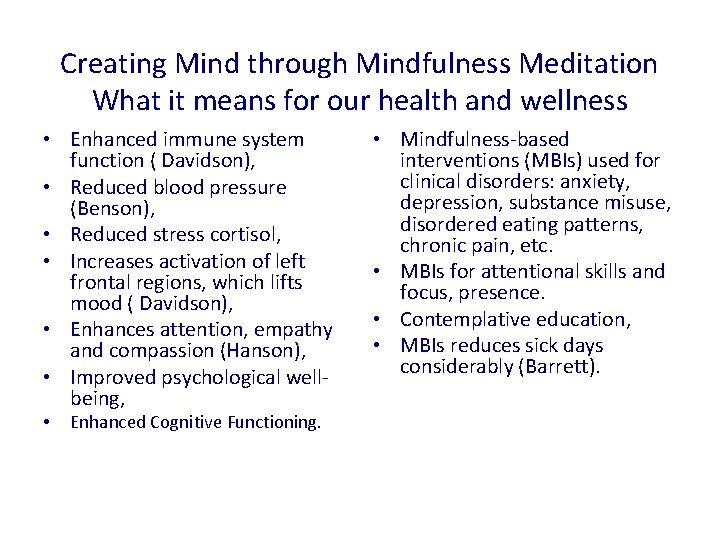
Creating Mind through Mindfulness Meditation What it means for our health and wellness • Enhanced immune system function ( Davidson), • Reduced blood pressure (Benson), • Reduced stress cortisol, • Increases activation of left frontal regions, which lifts mood ( Davidson), • Enhances attention, empathy and compassion (Hanson), • Improved psychological wellbeing, • Enhanced Cognitive Functioning. • Mindfulness-based interventions (MBIs) used for clinical disorders: anxiety, depression, substance misuse, disordered eating patterns, chronic pain, etc. • MBIs for attentional skills and focus, presence. • Contemplative education, • MBIs reduces sick days considerably (Barrett).
Why is Mindfulness Meditation so popular in South Western Ontario?
Jon Kabat-Zinn • Jon Kabat-Zinn has said there are 3 cities of mindfulness meditation in the world. • They are -London England ( U of London, Oxford) , -Boston, Massachusetts (Umass, Harvard, MIT), -Toronto, University of Toronto.
The Golden Horseshoe area is considered to be a hub of Mindfulness and Mindfulness Meditation in the world ( Universities of Toronto, Mc. Master, Laurier).
WHY? • Jon Kabat-Zinn taught in New York State ( Omega and NYC) and in Barre, Massachusetts in the late 1980’s and early 1990 s. • Many of us in southern Ontario, went south to study with him. • We then brought the practices back to southern Ontario.
Mindfulness at University of Toronto In the late 1980’s and early 1990’s there were 4 of us practicing mindfulness and mindfulness meditation in Toronto health care. It was a practice that seemed rare and marginal. This included : • Dr Zindel Siegel , psychologist/researcher who proposed Mindfulness Based Cognitive Therapy (MBCT) , • Dr Susan Abbey, psychiatrist, now Chief of Psychiatry at UHN , used Mindfulness Based Stress Reduction (MBSR) , • Dr Paul Kelly, psychologist using mindfulness practices for pain relief at UHN, • Dr Michele Chaban, social worker, mindfulness for pain and symptom management, practicing or preparing to die, grief and bereavement model, occupational wellness model for IP teams.
Why do we need a model of Contemplative End of Life Care?
Dying and Death in today’s health care system • Dying and death has become medicalized ( pharmacare and disease management). Originally, Hospice/palliative care/ end of life care sought integration not assimilation by health care. • Health Sciences has sought disease eradication for the sake of healthier people and longevity. What happens to the whole of us, when we primarily focus on disease eradication? • Health Science based its model of treating disease on a military model of conquering, beating disease. e. g. . “Cancer can be beaten”…but then what… • What happens to us when the illusion of our overcoming disease , dying and death dissipates…. 100% of us will be needing care for our dying and death.
Dying and Death in today’s health care system • With the medicalization of dying and death, slowly but progressively, care of the dying shifted primarily from an intent of compassion based care to interventions that avoid pain and suffering associated with dying and death. • It may be that we are less death avoidant and death denying and more death illiterate.
Contemporary models of Hospice/Palliative/End of Life care • Emphasis on pharma-care, function, disease burden and load. • Quantity of life seems to take precedence over quality of life… • Medically Assisted Dying (MAID)
Dying and Death in today’s health care system • The paradox in end of life care : while the H/P/EOLC focus became the alleviation of suffering in end of life care; another arm of medicine was increasing the levels of suffering by the extent of their treatment of disease and life extending treatment.
Dying and Death in today’s health care system • Diagnosis is a process not a moment ( time changed from a moment of recognizing you are dying to a protracted period of time where you are predictably but not necessarily imminently dying) • There is continuous monitoring and managing of disease which involves a lot of testing and treating ( Iatrogenic Suffering). • People are now living with diseases that were once terminal diseases, now chronic. This blurs the lines of living, dying and death. • People are living longer but dying has become more complex and in many ways harder.
Dying and Death in today’s health care system • We are using persons who are dying as research subjects in clinical trials to learn about life extension , experimenting with the limits of human life. Many will benefit from this suffering. • This “ask” for life extension is by health care consumers. • People chase after longevity at all costs , never realizing what this chase will do to their personhood, their family caregivers, their very being. This is an illiteracy.
Mindfulness Informed End of Life Care • Teaches practical contemplative skills which can be used by everyone to attend to suffering. • It is not hard to learn if you have a good teacher who gives you a good experience. • Can be integrated into any denominational practices because it is a practice of breath work, attention, intention + attitudes. “It is an innate human ability”.
Mindfulness and Mindfulness Meditation at End of Life helps : -monitor and manage pain and distressing symptoms, - distinguish , regulate and monitor thoughts, emotions, body sensations, behavior, - reflect on death thought systems, intra and inter personal relationships ( existential counseling), - reflect on attachment, striving, impermanence, dissolution, -prepare for non-ordinary states of consciousness, -In conflict resolution and relational wounds, -cultivate discernment in decision making, -prepare and practice for our dying, - bereaved survivors reconstitute their health and stability, - inter-professional teams deal with demands of care, PTSD/STSD , empathy fatigue, -can be used therapeutically and as a therapy.
3 Contemplative End of Life care programs in the GTA • Marco Mascarin, Buddhist chaplain, The Institute of Traditional Medicine (training death midwives/thanadoulas, mindfulness meditation based with a focus on anthropological views of dying and funerary preparations). • Andrew Blake, Buddhist chaplain, Sarana Institute ( mindfulness based compassion training in end of life). • Teri Henderson , MSW/RSW, and Uof. T Inter-professional team, University of Toronto, Mindfulness Informed End of Life care, on clinical approaches to end of life care/a unifying theory for thanatology/end of life care.
https: //learn. utoronto. ca/coursesprograms/businessprofessionals/certificates/mindfuln ess-informed-end-of-life-care
Dr Michele Chaban MSW, RSW, Ph. D. , University of Toronto, Mindfulness Informed End of Life Care, School of Continuing Studies. michele. chaban@utoronto. ca
Body Scan with meta
A: 1: 12: The Body Scan Thich Nhat Hahn’s Body Scan Goal: Smiling on each of the body’s parts and then on the whole. Tasks: -To be mindful of breath -To be mindful of body/regions of the body -To be mindfully mindful -To disentangle the body from thoughts and emotions we impose on it: a cleansing/purification, centering/decentering
The Body Scan • The body scan is a systematic movement of awareness, body part by body part, either from the top of one’s head to the tip of one’s toes or the reverse. • As each body part is engaged we bring the intention of loving kindness, equanimity, cherishment, gratitude, and releasing of all tension.
The Body Scan • Essentially we smile at the body part, wishing it well, promoting health, expressing gratitude for all that this body part has done for the whole. • We attempt to undo the attached clinging and grasping of our thoughts and emotions. • Typically, the body scan is done from a seated position or lying down.
Metta Meditation Practice : Metta Meditation (Loving-Kindness) Goals: • To create a beneficent environment in order to practice mindfulness, • To calm oneself within ones self, and with the community of meditators, • To tame one’s distractions.
Metta Meditation • Metta is often done in a series which includes : for self, for mentor, for beloved, for difficult persons, for all beings • The terms selected for use should be personal and heartfelt
Go safely , Go Gently, And May our Paths Cross Again…. . With Much Gratitude for our collective effort today.
- Slides: 71