
Mindful infrastructure as an enabler of innovation resilience
Mindful infrastructure as an enabler of innovation resilience behaviour in innovation teams Peter Oeij TNO & School of Management, Open University of The Netherlands with Steven Dhondt & Jeff Gaspersz IWOT 19 - International Workshop on Team Working September 7, 2015 Catholic University of Leuven, Belgium
1 Topic of presentation and research questions -Is innovation resilience behaviour present in innovation teams? -Does mindful infrastructure enable teams to have innovation resilience behaviour? -What kind of ‘variations’ of mindful infrastructure are present as a ‘strategy’ that is being applied?
2 Main results -Is mindful infrastructure present in innovation teams? > yes in 12 out of 18 teams -Does mindful infrastructure enable teams to have innovation resilience behaviour? > yes, the 12 teams report presence of IRB -What kind of ‘variations’ of mindful infrastructure are present as a ‘strategy’ that is being applied? > 8 implicit strategies are observed
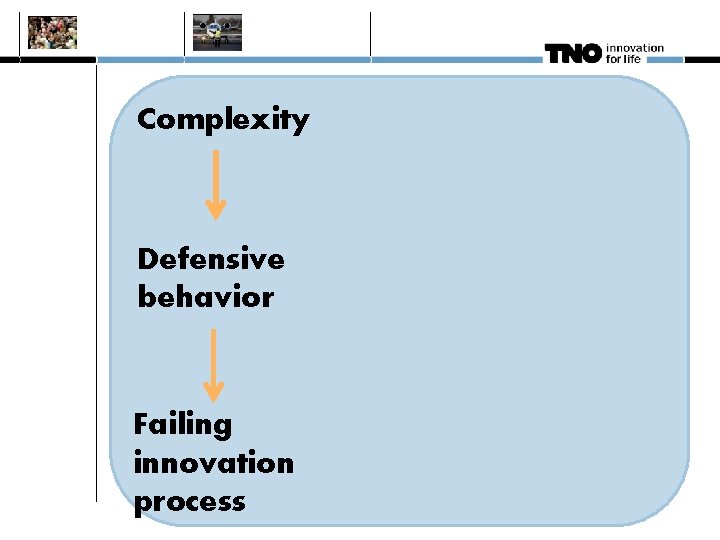
Complexity Defensive behavior Failing innovation process
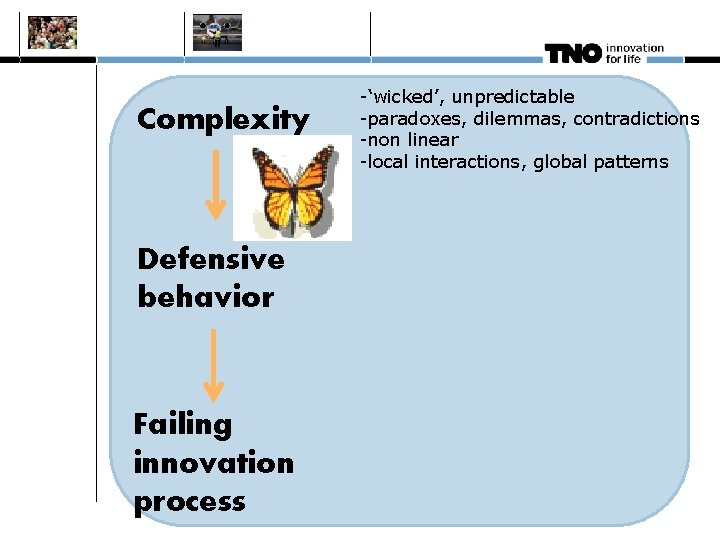
Complexity Defensive behavior Failing innovation process -‘wicked’, unpredictable -paradoxes, dilemmas, contradictions -non linear -local interactions, global patterns
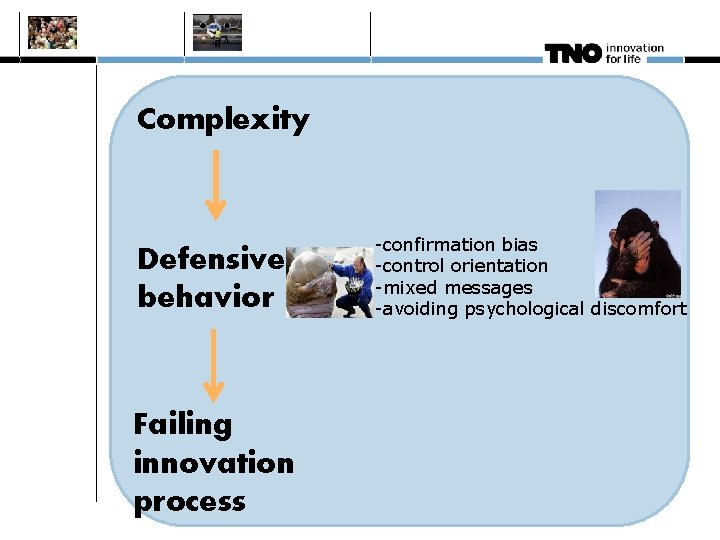
Complexity Defensive behavior Failing innovation process -confirmation bias -control orientation -mixed messages -avoiding psychological discomfort
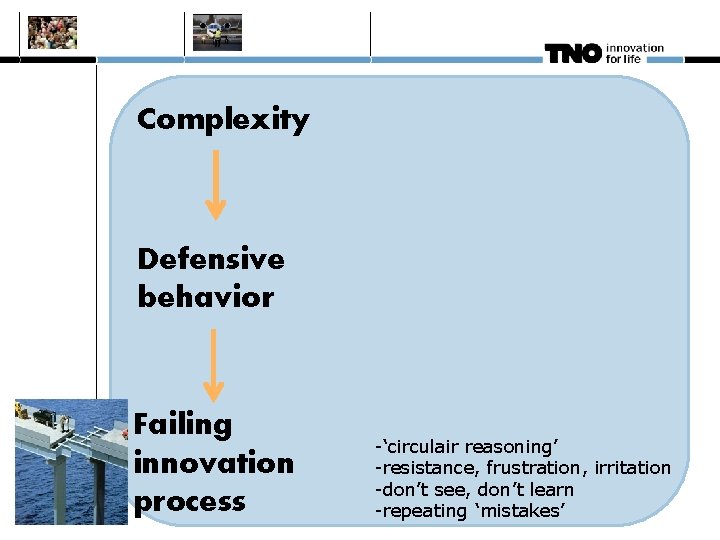
Complexity Defensive behavior Failing innovation process -‘circulair reasoning’ -resistance, frustration, irritation -don’t see, don’t learn -repeating ‘mistakes’
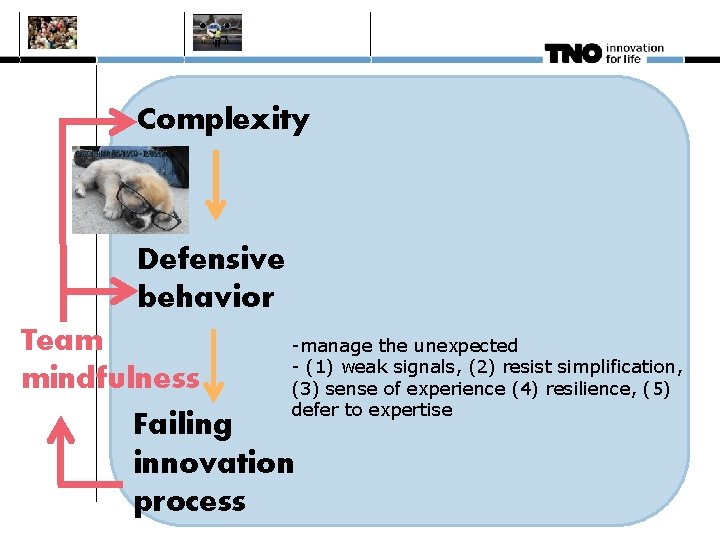
Complexity Defensive behavior Team -manage the unexpected - (1) weak signals, (2) resist simplification, mindfulness (3) sense of experience (4) resilience, (5) defer to expertise Failing innovation process
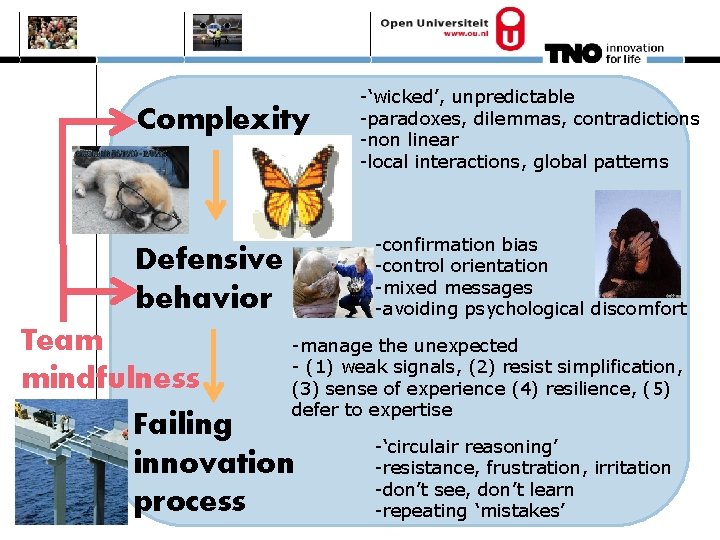
Complexity Defensive behavior -‘wicked’, unpredictable -paradoxes, dilemmas, contradictions -non linear -local interactions, global patterns -confirmation bias -control orientation -mixed messages -avoiding psychological discomfort Team -manage the unexpected - (1) weak signals, (2) resist simplification, mindfulness (3) sense of experience (4) resilience, (5) defer to expertise Failing -‘circulair reasoning’ innovation -resistance, frustration, irritation -don’t see, don’t learn process -repeating ‘mistakes’
9 ‘Mindful Infrastructure’ - The capacity of a team to anticipate ‘unexpected’ problems and the capacity to contain such problems (after Weick & Sutcliffe, 2007)
10 ‘Mindful Infrastructure’ - The capacity of a team to anticipate ‘unexpected’ problems and the capacity to contain such problems (after Weick & Sutcliffe, 2007) - Consisting of elements crucial for team performance in complex situations, namely: team safety behaviour, team learning behaviour; ‘paradoxical’ / complexity leadership, team voice / participative decision-making
11 ‘Innovation Resilience Behaviour’ - A set of team competencies (team capability) to make a team bounce back to the right track of the project once a team has taken/is taking an ineffective course with regard to its innovation goal (after Weick & Sutcliffe, 2007)
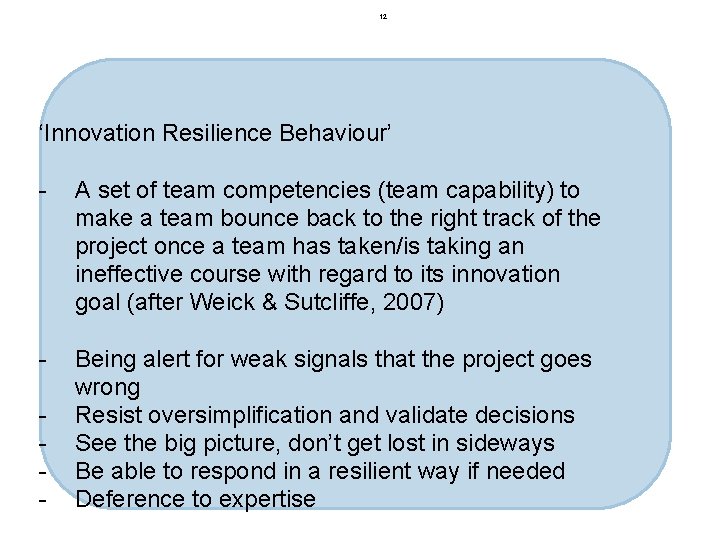
12 ‘Innovation Resilience Behaviour’ - A set of team competencies (team capability) to make a team bounce back to the right track of the project once a team has taken/is taking an ineffective course with regard to its innovation goal (after Weick & Sutcliffe, 2007) - Being alert for weak signals that the project goes wrong Resist oversimplification and validate decisions See the big picture, don’t get lost in sideways Be able to respond in a resilient way if needed Deference to expertise -
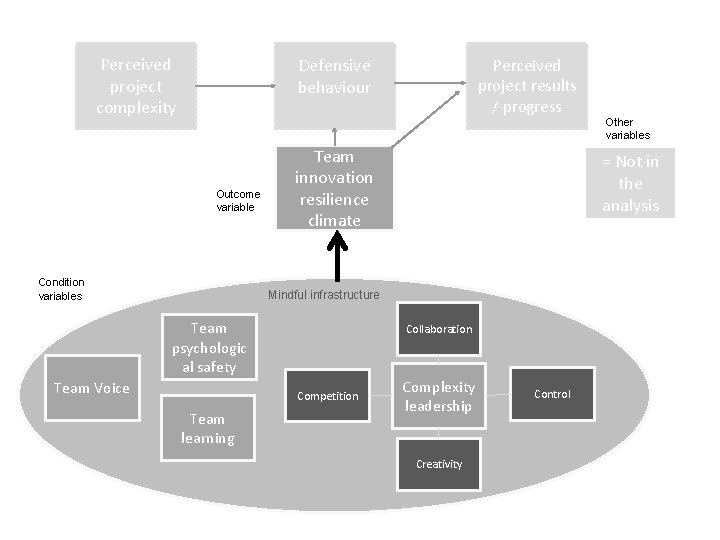
Perceived project complexity Defensive behaviour Outcome variable Condition variables Perceived project results / progress Team innovation resilience climate = Not in the analysis Mindful infrastructure Team psychologic al safety Team Voice Collaboration Competition Team learning Other variables Complexity leadership Creativity Control
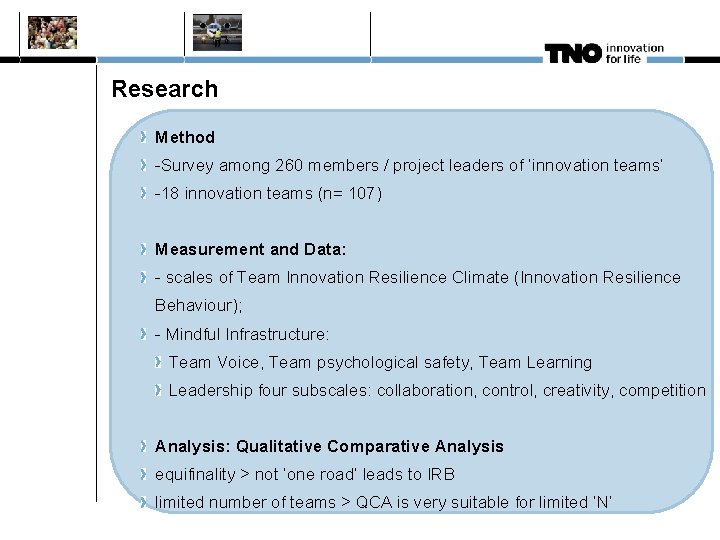
Research Method -Survey among 260 members / project leaders of ‘innovation teams’ -18 innovation teams (n= 107) Measurement and Data: - scales of Team Innovation Resilience Climate (Innovation Resilience Behaviour); - Mindful Infrastructure: Team Voice, Team psychological safety, Team Learning Leadership four subscales: collaboration, control, creativity, competition Analysis: Qualitative Comparative Analysis equifinality > not ‘one road’ leads to IRB limited number of teams > QCA is very suitable for limited ‘N’
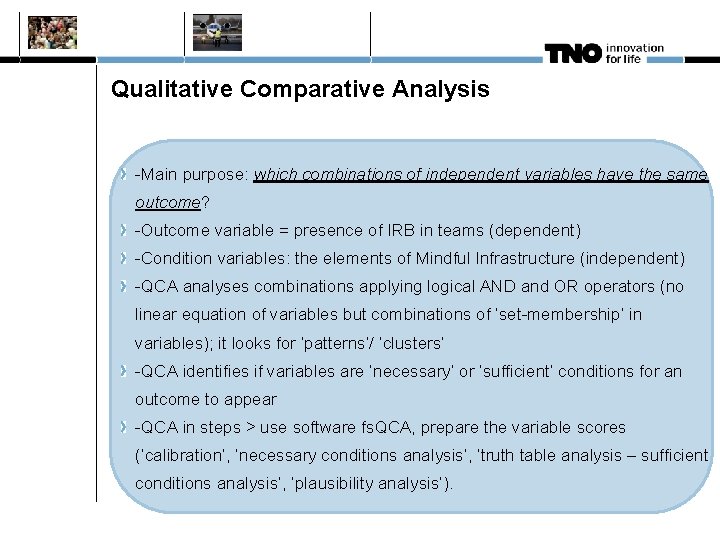
Qualitative Comparative Analysis -Main purpose: which combinations of independent variables have the same outcome? -Outcome variable = presence of IRB in teams (dependent) -Condition variables: the elements of Mindful Infrastructure (independent) -QCA analyses combinations applying logical AND and OR operators (no linear equation of variables but combinations of ‘set-membership’ in variables); it looks for ‘patterns’/ ‘clusters’ -QCA identifies if variables are ‘necessary’ or ‘sufficient’ conditions for an outcome to appear -QCA in steps > use software fs. QCA, prepare the variable scores (‘calibration’, ‘necessary conditions analysis’, ‘truth table analysis – sufficient conditions analysis’, ‘plausibility analysis’).
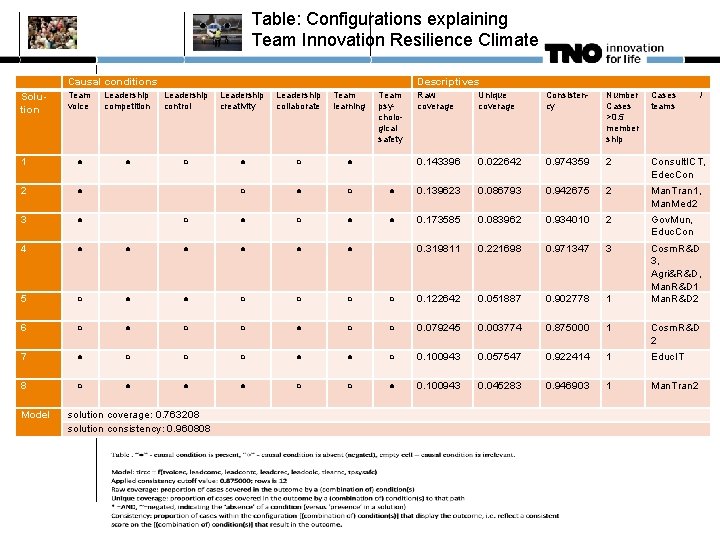
Table: Configurations explaining Team Innovation Resilience Climate Causal conditions Descriptives Team voice Leadership competition Leadership control Leadership creativity Leadership collaborate Team learning 1 ● ● ○ ● 2 ● ○ 3 ● ○ ● 4 ● ● ● 5 ○ ● ● ○ ○ ○ 6 ○ ● ○ ○ ● 7 ● ○ ○ ○ 8 ○ ● ● ● Solution Model solution coverage: 0. 763208 solution consistency: 0. 960808 Team psychological safety Raw coverage Unique coverage Consistency Number Cases >0. 5 member ship Cases teams / 0. 143396 0. 022642 0. 974359 2 Consult. ICT, Edec. Con ● 0. 139623 0. 086793 0. 942675 2 Man. Tran 1, Man. Med 2 ● 0. 173585 0. 083962 0. 934010 2 Gov. Mun, Educ. Con 0. 319811 0. 221698 0. 971347 3 ○ 0. 122642 0. 051887 0. 902778 1 Cosm. R&D 3, Agri&R&D, Man. R&D 1 Man. R&D 2 ○ ○ 0. 079245 0. 003774 0. 875000 1 Cosm. R&D 2 ● ● ○ 0. 100943 0. 057547 0. 922414 1 Educ. IT ○ ○ ● 0. 100943 0. 045283 0. 946903 1 Man. Tran 2
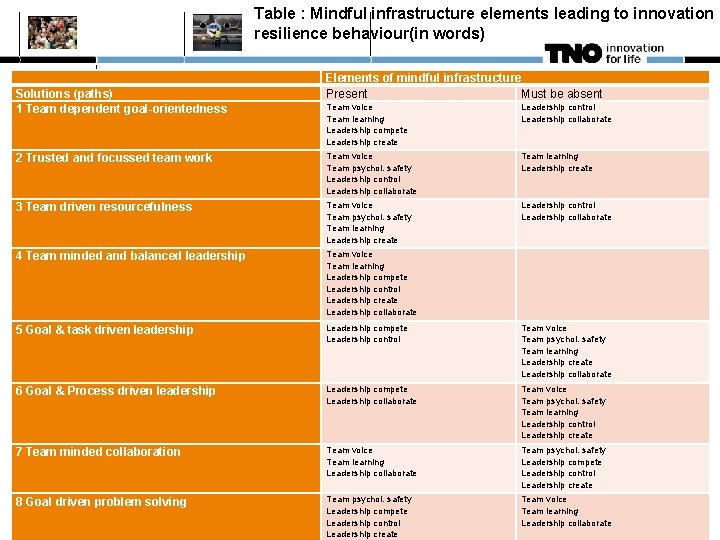
Table : Mindful infrastructure elements leading to innovation resilience behaviour(in words) Solutions (paths) 1 Team dependent goal-orientedness Elements of mindful infrastructure Present Must be absent Team voice Team learning Leadership compete Leadership create Leadership control Leadership collaborate 2 Trusted and focussed team work Team voice Team psychol. safety Leadership control Leadership collaborate Team learning Leadership create 3 Team driven resourcefulness Team voice Team psychol. safety Team learning Leadership create Leadership control Leadership collaborate 4 Team minded and balanced leadership Team voice Team learning Leadership compete Leadership control Leadership create Leadership collaborate 5 Goal & task driven leadership Leadership compete Leadership control Team voice Team psychol. safety Team learning Leadership create Leadership collaborate 6 Goal & Process driven leadership Leadership compete Leadership collaborate Team voice Team psychol. safety Team learning Leadership control Leadership create 7 Team minded collaboration Team voice Team learning Leadership collaborate Team psychol. safety Leadership compete Leadership control Leadership create 8 Goal driven problem solving Team psychol. safety Leadership compete Leadership control Leadership create Team voice Team learning Leadership collaborate
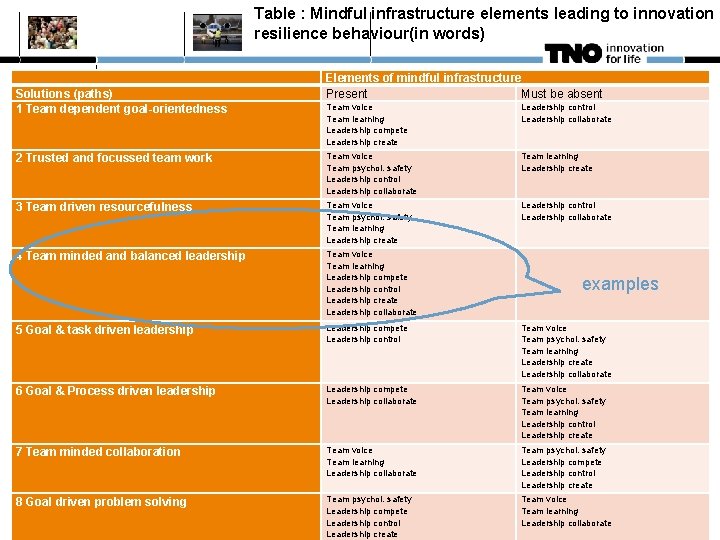
Table : Mindful infrastructure elements leading to innovation resilience behaviour(in words) Solutions (paths) 1 Team dependent goal-orientedness Elements of mindful infrastructure Present Must be absent Team voice Team learning Leadership compete Leadership create Leadership control Leadership collaborate 2 Trusted and focussed team work Team voice Team psychol. safety Leadership control Leadership collaborate Team learning Leadership create 3 Team driven resourcefulness Team voice Team psychol. safety Team learning Leadership create Leadership control Leadership collaborate 4 Team minded and balanced leadership Team voice Team learning Leadership compete Leadership control Leadership create Leadership collaborate examples 5 Goal & task driven leadership Leadership compete Leadership control Team voice Team psychol. safety Team learning Leadership create Leadership collaborate 6 Goal & Process driven leadership Leadership compete Leadership collaborate Team voice Team psychol. safety Team learning Leadership control Leadership create 7 Team minded collaboration Team voice Team learning Leadership collaborate Team psychol. safety Leadership compete Leadership control Leadership create 8 Goal driven problem solving Team psychol. safety Leadership compete Leadership control Leadership create Team voice Team learning Leadership collaborate
![Conclusions -1] There are different combinations of mindful infrastructure elements that can lead to](http://slidetodoc.com/presentation_image_h2/3f2a8b9f012f95a11e85aa9723aaedee/image-20.jpg "Conclusions -1] There are different combinations of mindful infrastructure elements that can lead to")
Conclusions -1] There are different combinations of mindful infrastructure elements that can lead to innovation resilience behaviour (equifinality) - 2] there are no ‘necessary’ conditions for IRB to emerge: there is choice for unique combinations - 3] there are no ‘sufficient’ conditions for IRB to emerge: there must be more than one condition present in conjunction with others [Therefore, QCA is a helpful technique to analyse such complex settings] The theoretical concepts of ‘resilience’ and ‘mindful semi-structure’ are applicable to the context of innovation management: it may help to enlarge insight on sense of urgency (competitiveness) and the quality of a team’s innovation process (alertness, semi-structure) to deal with ‘risk avoidance’ (defensiveness) and ‘critical incidents’ (recover in resilient ways).
Thank you for your attention! If you are interested to receive this presentation, please, be so kind to send me an email: peter. oeij@tno. nl [TNO, and Open University of the Netherlands] Steven Dhondt / TNO [NL] and Catholoc University Leuven [Belgium] Jeff Gaspersz / Neyenrode Business University, Breukelen [NL}
- Slides: 21