
Mind the class weight bias weighted maximum mean

Mind the class weight bias: weighted maximum mean discrepancy for unsupervised domain adaptation Hongliang Yan 2017/06/21
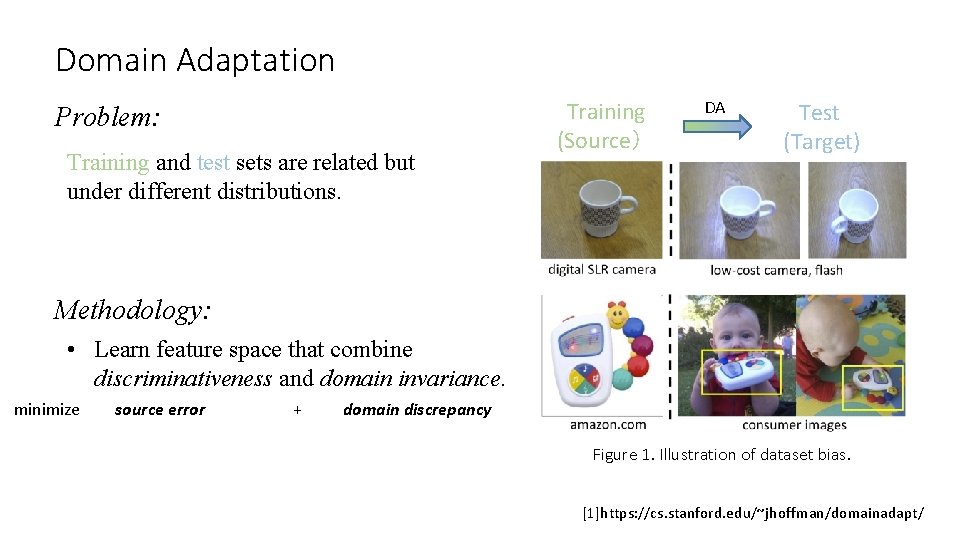
Domain Adaptation Problem: Training and test sets are related but under different distributions. Training (Source) DA Test (Target) Methodology: • Learn feature space that combine discriminativeness and domain invariance. minimize source error + domain discrepancy Figure 1. Illustration of dataset bias. [1]https: //cs. stanford. edu/~jhoffman/domainadapt/
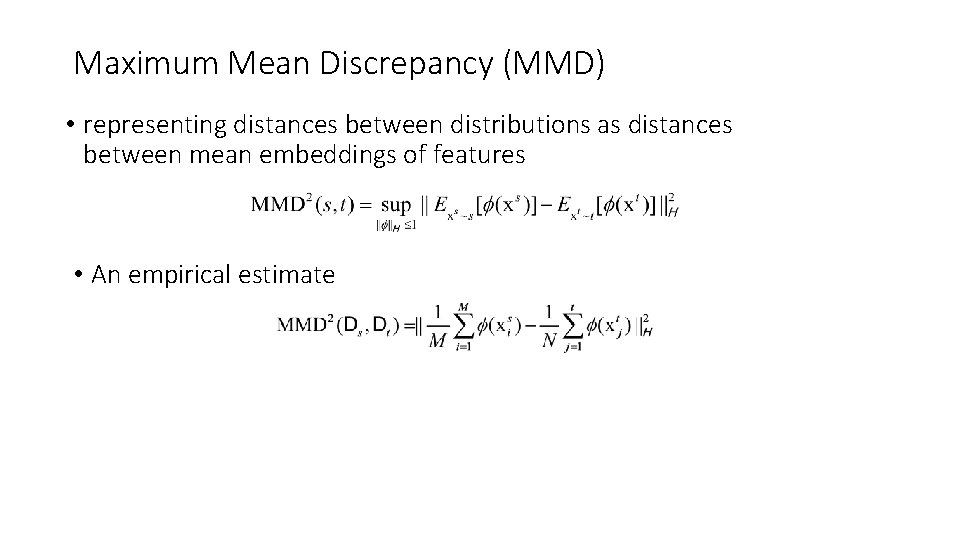
Maximum Mean Discrepancy (MMD) • representing distances between distributions as distances between mean embeddings of features • An empirical estimate
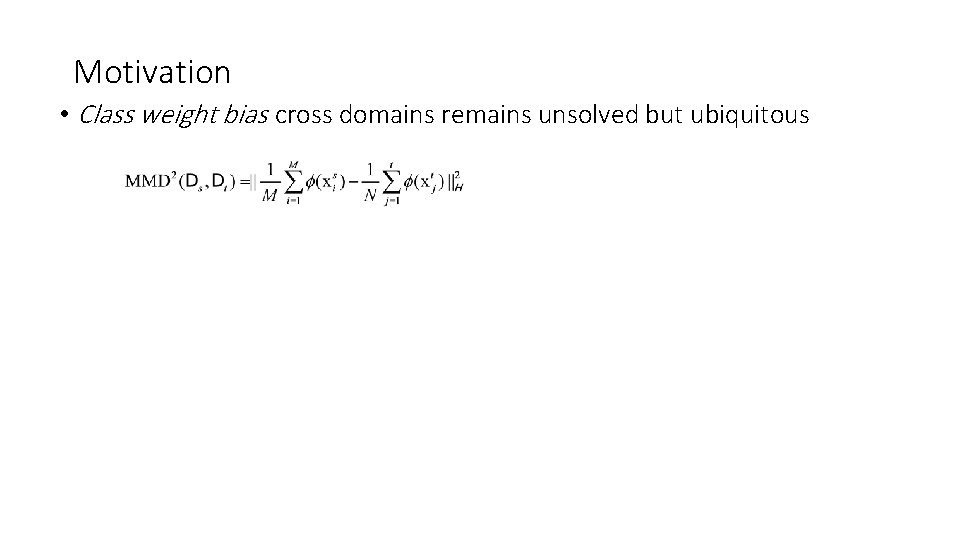
Motivation • Class weight bias cross domains remains unsolved but ubiquitous
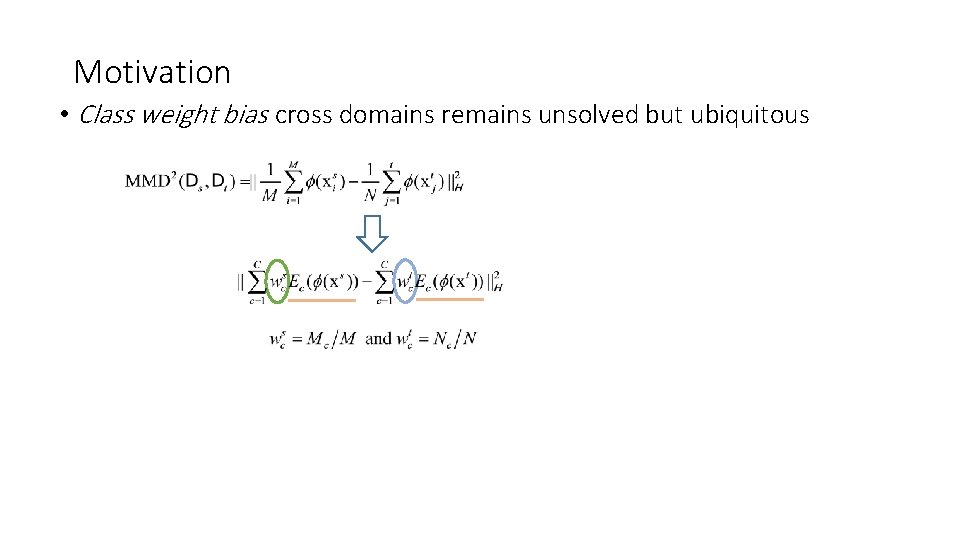
Motivation • Class weight bias cross domains remains unsolved but ubiquitous
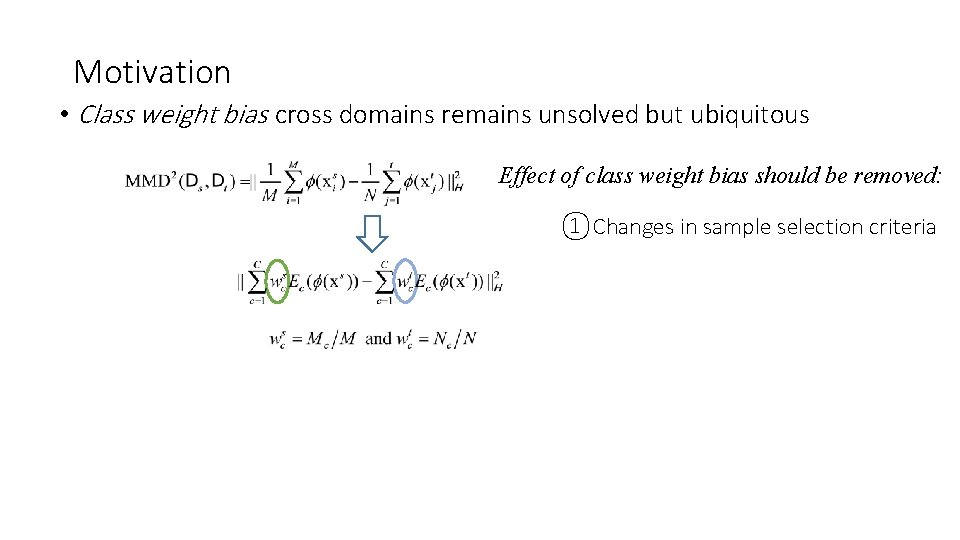
Motivation • Class weight bias cross domains remains unsolved but ubiquitous Effect of class weight bias should be removed: ①Changes in sample selection criteria
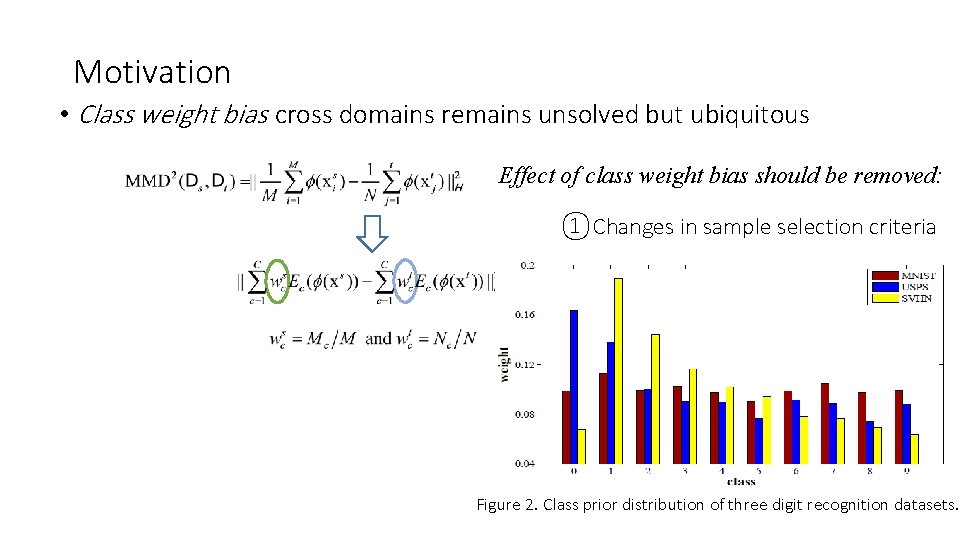
Motivation • Class weight bias cross domains remains unsolved but ubiquitous Effect of class weight bias should be removed: ①Changes in sample selection criteria Figure 2. Class prior distribution of three digit recognition datasets.
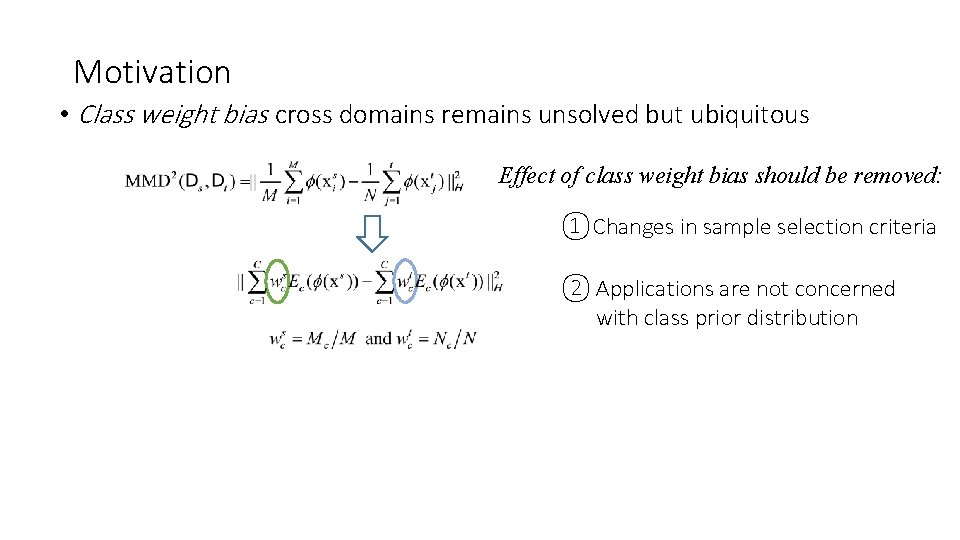
Motivation • Class weight bias cross domains remains unsolved but ubiquitous Effect of class weight bias should be removed: ①Changes in sample selection criteria ② Applications are not concerned with class prior distribution
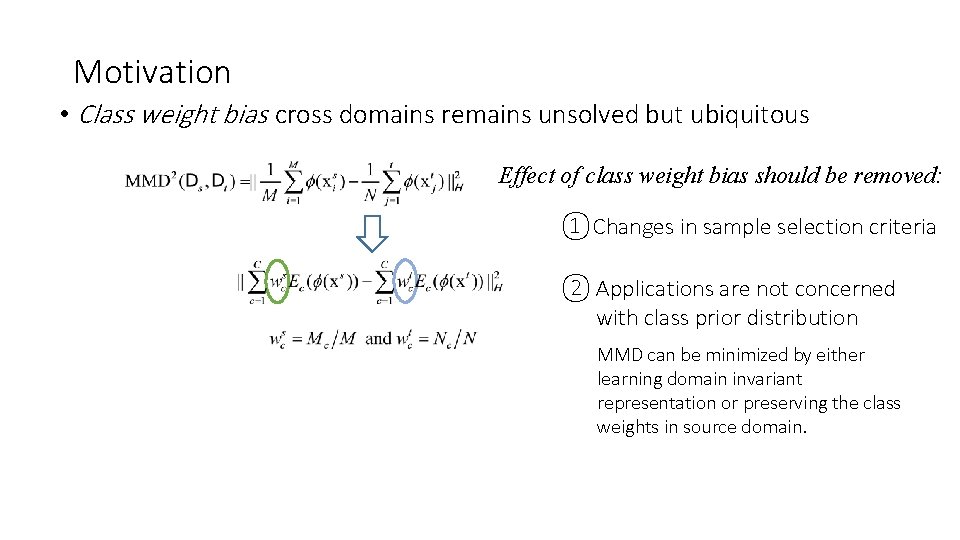
Motivation • Class weight bias cross domains remains unsolved but ubiquitous Effect of class weight bias should be removed: ①Changes in sample selection criteria ② Applications are not concerned with class prior distribution MMD can be minimized by either learning domain invariant representation or preserving the class weights in source domain.
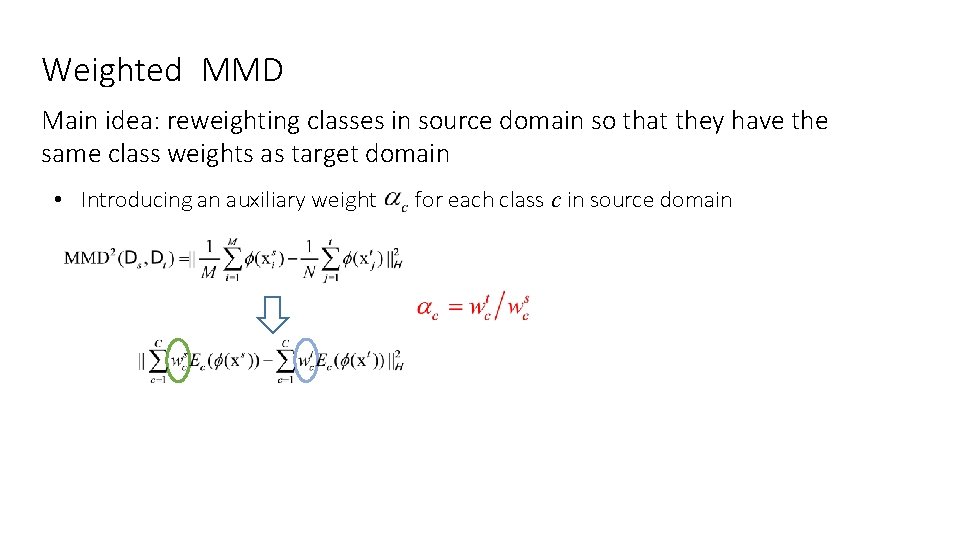
Weighted MMD Main idea: reweighting classes in source domain so that they have the same class weights as target domain • Introducing an auxiliary weight for each class c in source domain
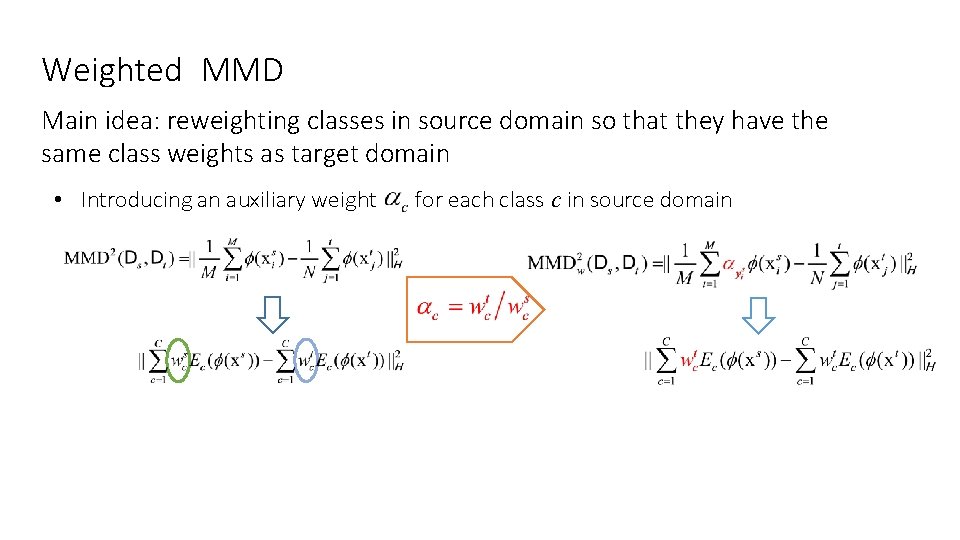
Weighted MMD Main idea: reweighting classes in source domain so that they have the same class weights as target domain • Introducing an auxiliary weight for each class c in source domain
![Weighted DAN 1. Replace MMD with weighted MMD item in DAN[4]: [4] Long M,](http://slidetodoc.com/presentation_image_h/1c3bc3c8a9d46d98f8002bb187c3de67/image-12.jpg "Weighted DAN 1. Replace MMD with weighted MMD item in DAN[4]: [4] Long M,")
Weighted DAN 1. Replace MMD with weighted MMD item in DAN[4]: [4] Long M, Cao Y, Wang J. Learning Transferable Features with Deep Adaptation Networks[J]. , 2015.
![Weighted DAN 1. Replace MMD with weighted MMD item in DAN[4]: [4] Long M,](http://slidetodoc.com/presentation_image_h/1c3bc3c8a9d46d98f8002bb187c3de67/image-13.jpg "Weighted DAN 1. Replace MMD with weighted MMD item in DAN[4]: [4] Long M,")
Weighted DAN 1. Replace MMD with weighted MMD item in DAN[4]: [4] Long M, Cao Y, Wang J. Learning Transferable Features with Deep Adaptation Networks[J]. , 2015.
![Weighted DAN 1. Replace MMD with Weighted MMD item in DAN[4]: 2. To further](http://slidetodoc.com/presentation_image_h/1c3bc3c8a9d46d98f8002bb187c3de67/image-14.jpg "Weighted DAN 1. Replace MMD with Weighted MMD item in DAN[4]: 2. To further")
Weighted DAN 1. Replace MMD with Weighted MMD item in DAN[4]: 2. To further exploit the unlabeled data in target domain, empirical risk is considered as semi-supervised model in [5]: [4] Long M, Cao Y, Wang J. Learning Transferable Features with Deep Adaptation Networks[J]. , 2015. [5] Amini, Massih-Reza, and Patrick Gallinari. "Semi-supervised logistic regression. " Proceedings of the 15 th European Conference on Artificial Intelligence. IOS Press, 2002.
![Optimization: an extension of CEM[6] Parameters to be estimated including three parts, i. e.](http://slidetodoc.com/presentation_image_h/1c3bc3c8a9d46d98f8002bb187c3de67/image-15.jpg "Optimization: an extension of CEM[6] Parameters to be estimated including three parts, i. e.")
Optimization: an extension of CEM[6] Parameters to be estimated including three parts, i. e. , The model is optimized by alternating between three steps : • E-step: Fixed W, estimating the class posterior probability of target samples: [7] Celeux, Gilles, and Gérard Govaert. "A classification EM algorithm for clustering and two stochastic versions. " Computational statistics & Data analysis 14. 3 (1992): 315 -332.
![Optimization: an extension of CEM[6] Parameters to be estimated including three parts, i. e.](http://slidetodoc.com/presentation_image_h/1c3bc3c8a9d46d98f8002bb187c3de67/image-16.jpg "Optimization: an extension of CEM[6] Parameters to be estimated including three parts, i. e.")
Optimization: an extension of CEM[6] Parameters to be estimated including three parts, i. e. , The model is optimized by alternating between three steps : • E-step: Fixed W, estimating the class posterior probability of target samples: • C-step: ① Assign the pseudo labels on target domain: ② update the auxiliary class-specific weights for source domain: is an indictor function which equals 1 if x = c, and equals 0 otherwise. [7] Celeux, Gilles, and Gérard Govaert. "A classification EM algorithm for clustering and two stochastic versions. " Computational statistics & Data analysis 14. 3 (1992): 315 -332.
![Optimization: an extension of CEM[6] Parameters to be estimated including three parts, i. e.](http://slidetodoc.com/presentation_image_h/1c3bc3c8a9d46d98f8002bb187c3de67/image-17.jpg "Optimization: an extension of CEM[6] Parameters to be estimated including three parts, i. e.")
Optimization: an extension of CEM[6] Parameters to be estimated including three parts, i. e. , The model is optimized by alternating between three steps : • M-step: Fixed and , updating W. The problem is reformulated as: The gradient of the three items is computable and W can be optimized by using a mini-batch SGD. [7] Celeux, Gilles, and Gérard Govaert. "A classification EM algorithm for clustering and two stochastic versions. " Computational statistics & Data analysis 14. 3 (1992): 315 -332.
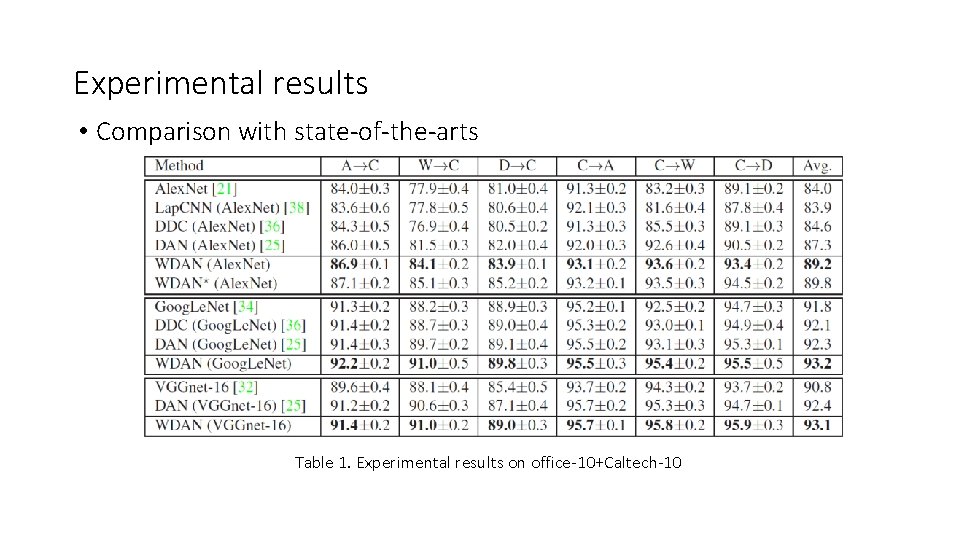
Experimental results • Comparison with state-of-the-arts Table 1. Experimental results on office-10+Caltech-10
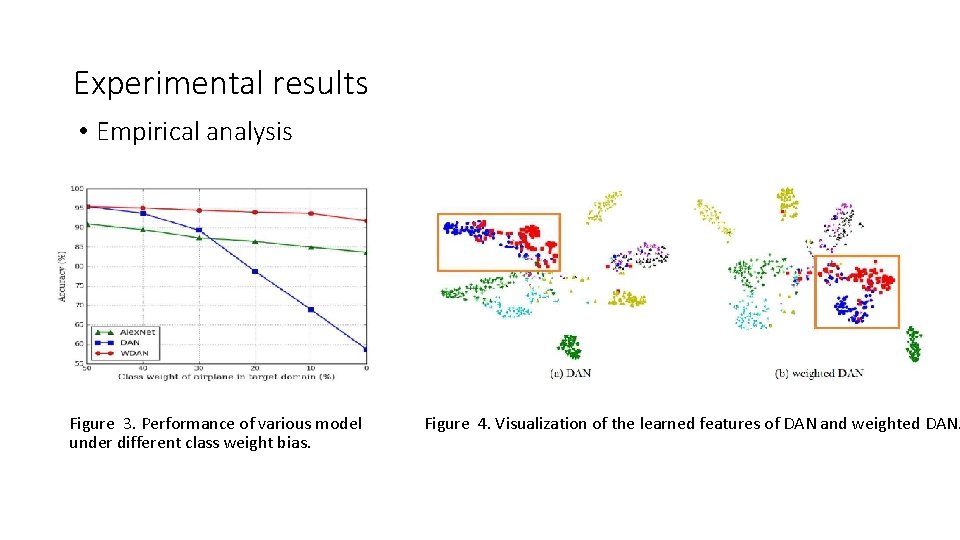
Experimental results • Empirical analysis Figure 3. Performance of various model under different class weight bias. Figure 4. Visualization of the learned features of DAN and weighted DAN.
Summary • Introduce class-specific weight into MMD to reduce the effect of class weight bias cross domains. • Develop WDAN model and optimize it in an CEM framework. • Weighted MMD can be applied to other scenarios where MMD is used for distribution distance measurement, e. g. , image generation

Thanks! Paper & code are available Paper: https: //arxiv. org/abs/1705. 00609 Code: https: //github. com/yhldhit/WMMD-Caffe
- Slides: 21