
Min Max Principle in Game Theory continued PARTH
![Min. Max principle • Loomi’s theorem can be restated as max min E[C(A, I)]](https://slidetodoc.com/presentation_image_h2/86a934ddcf79fb2d3b4c7c7598a861c5/image-5.jpg "Min. Max principle • Loomi’s theorem can be restated as max min E[C(A, I)]")
- Slides: 7
Min. Max Principle in Game Theory – continued…. PARTH
Min. Max principle • Consider a computation problem P • Let A be finite set of deterministic algorithms for solving P • Let I be set of all possible inputs of size n for P
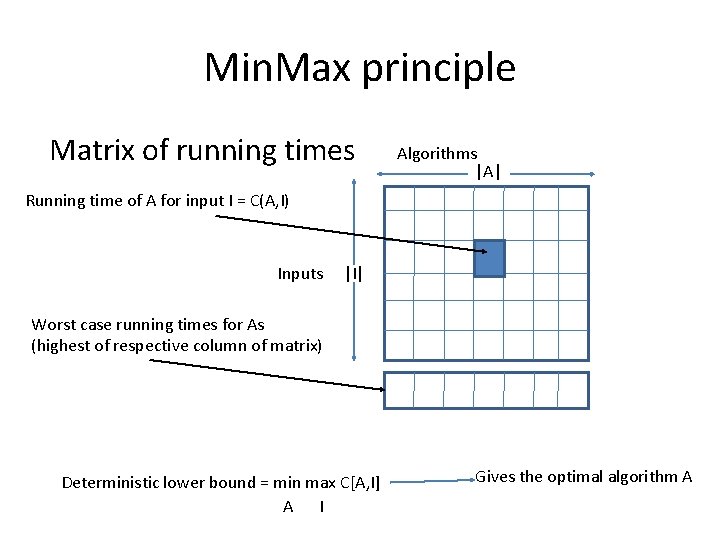
Min. Max principle Matrix of running times Algorithms |A| Running time of A for input I = C(A, I) Inputs |I| Worst case running times for As (highest of respective column of matrix) Deterministic lower bound = min max C[A, I] A I Gives the optimal algorithm A
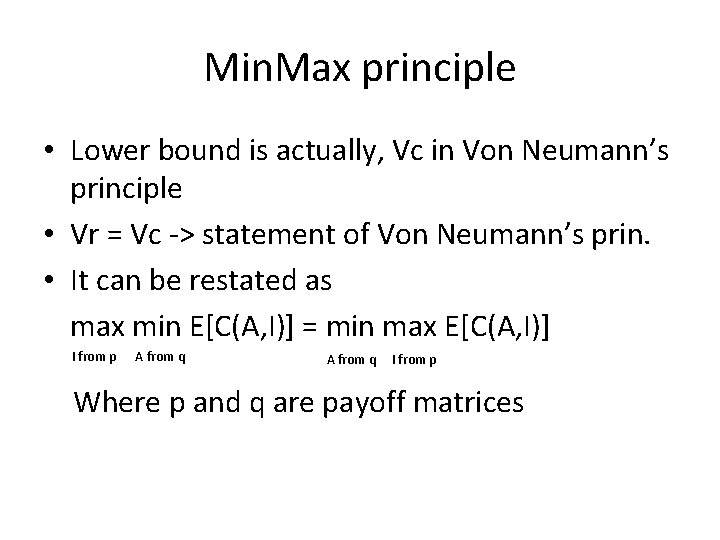
Min. Max principle • Lower bound is actually, Vc in Von Neumann’s principle • Vr = Vc -> statement of Von Neumann’s prin. • It can be restated as max min E[C(A, I)] = min max E[C(A, I)] I from p A from q I from p Where p and q are payoff matrices
Min. Max principle • Loomi’s theorem can be restated as max min E[C(A, I)] = min max E[C(A, I)] I from p A€A A from p I € I • Yao’s min max principle Take p on left and any distribution q on the right min E[C(A, I)] <= max E[C(A, I)] A€A I€I
Min. Max principle
AND-OR tree problem - revisited • Replace all AND and OR gates with equivalent combinations of NOR gates • For any Las Vegas algorithm, Exponential time >= n 0. 6… • Consider a distribution which sets each leaf independently • Leaf = 1 -> probability p Leaf = 0 -> otherwise