
MIMO for a mass market 3 TU course

- Slides: 17
MIMO for a mass market 3 TU course on MIMO Wireless Communication Jean-Paul Linnartz September 2006
MIMO for a mass market About the contents of the course • MIMO is an important trend that shapes the future of wireless communication systems • MIMO is a multidisciplinary topic • MIMO is being addressed in Delft, Eindhoven and Twente. 2
MIMO for a mass market Capita Selecta in Wireless Communication This course covers selected topics in Wireless Communications, including RF, information theory and software radio architectures. Yet the topics are not a random collection of faculty hobby horses, but are seen as important factors that push the limits of future systems: • One-chip radio, i. e. , combining RF and BB into one chip solution, requires an new multi disciplinary approach to mitigating the imperfections of analog (CMOS) circuits by digital signal processing. • To achieve an adequate link budget for high frequency, multi gigabit, adaptive combination of multiple antenna signals is required. • There are power-consumption limits to pushing to A/D Converter further to the antenna. High-rate MIMO signals would pose unacceptably high demands on power hungry A/D converters, unless signals are optimally preconditioned before digitization. • The ever increasing density of using the radio spectrum call for signal separation, interference cancellation and beam-steering. DSP algorithms can push performance and the insights from information theory increasing set the stage for innovation. • More intelligent spectrum access techniques (“cognitive radio”) require flexible processor platforms, adaptive front-ends, and new adaptive algorithm 3
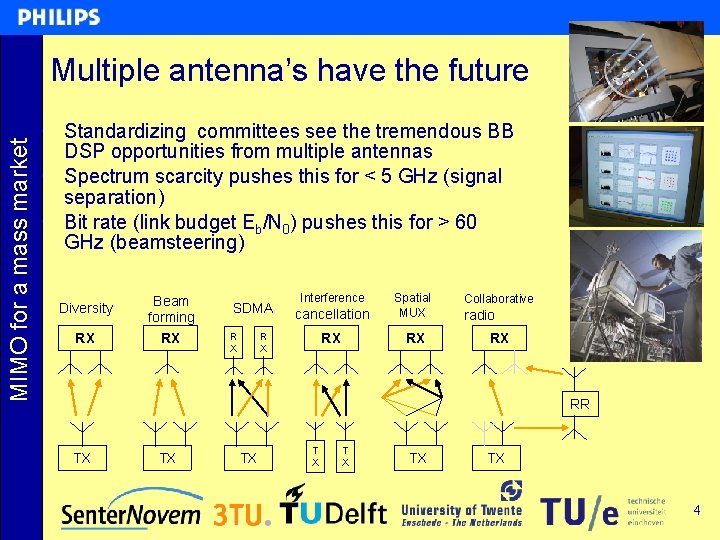
MIMO for a mass market Multiple antenna’s have the future • Standardizing committees see the tremendous BB DSP opportunities from multiple antennas • Spectrum scarcity pushes this for < 5 GHz (signal separation) • Bit rate (link budget Eb/N 0) pushes this for > 60 GHz (beamsteering) Diversity RX Beam forming RX SDMA R X Collaborative cancellation Spatial MUX RX RX RX Interference R X radio RR TX TX TX TX 4
MIMO for a mass market Organisation • • Offered in the context of 3 TU Centered around IOP project MIMO for a Mass Market Contributions from the 3 TUs and Philips Research Open for – Ph. D students of 3 TU – People involved in the MIMO 4 a. MM project – Others (masters) students, 3 TU and Philips employees: admission required – External people: admission and possibly participation fee 5
MIMO for a mass market 3 TU Grad Course in Wireless Systems • Venue: rotating between Eindhoven, Twente, Delft • Once every other week, 6 times(12 weeks) • Tentative dates: March 29 -30, April 12 -13, April 26 -27 (CRE at HTC), May 10 -11 (may vacation? ), May 14 -15, June 7 -8, June 2122 • • 6 lecture hours per day discussions to apply knowledge in a MIMO 4 a. MM project focus Credit points: tbd with EE Dept. at E, T, D Thursday and Friday 6
MIMO for a mass market 3 TU Grad Course in Wireless Systems Outline • Radio Propagation (1 Day, Jean-Paul Linnartz) • RF Design (1 Day, Peter Baltus) • RF imperfections, Adaptive and Dirty RF (1 day, Peter Baltus and Tim Schenk) • Adaptive systems (2 days, Jan Bergmans) • Signal Processing for Communications (2 days, Allejan van der Veen) • Modulation and ECC for MIMO channels (Harm Cronie) • Software Defined Radio (1 day, Kees Slump) • Information theory for fading channels (Frans willems) • MIMO testbed event, papers by AIOs 7
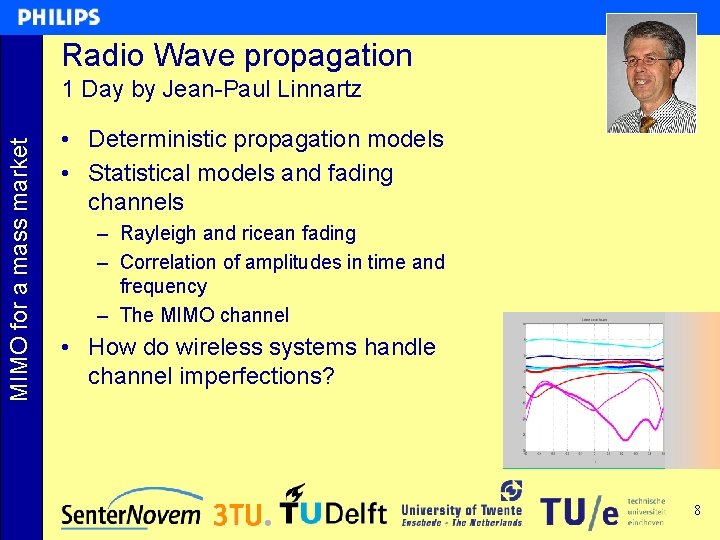
Radio Wave propagation MIMO for a mass market 1 Day by Jean-Paul Linnartz • Deterministic propagation models • Statistical models and fading channels – Rayleigh and ricean fading – Correlation of amplitudes in time and frequency – The MIMO channel • How do wireless systems handle channel imperfections? 8
Software Defined Radio MIMO for a mass market 1 day by Kees Slump • software defined radio • Radio system design – – Analog design AD conversion digital processor architecture Mapping of algorithms 9
RF design (RF for dummies ) MIMO for a mass market 1 day by Peter Baltus How to design a state-of-art MIMO RF frontend • • TX and RX architectures RF specifications and system design (I) RF specifications and system design (II) LNA circuit topologies and design Mixer circuit topologies and design Oscillator circuit topologies and design RF and IF filter topologies and design Transceiver implementation examples 10
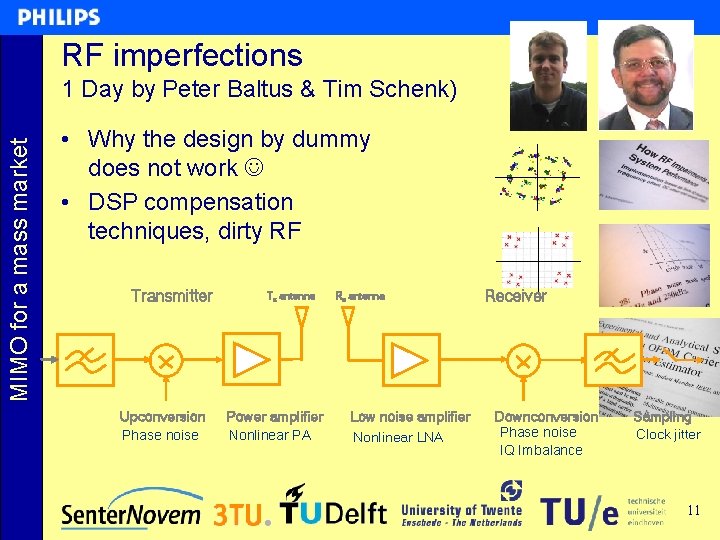
RF imperfections MIMO for a mass market 1 Day by Peter Baltus & Tim Schenk) • Why the design by dummy does not work • DSP compensation techniques, dirty RF Transmitter Upconversion Phase noise Tx antenna Power amplifier Nonlinear PA Rx antenna Low noise amplifier Nonlinear LNA Receiver Downconversion Phase noise IQ Imbalance Sampling Clock jitter 11
MIMO for a mass market Adaptive systems 2 Days by Jan Bergmans 1. Introduction. Examples of adaptive systems. 2. Design of adaptive signal processing systems. - Structure of adaptation schemes - Adaptive circuits, misadjustment estimators, adjustment circuits. 3. Maximum-likelihood parameter estimation and adaptation: - Maximum-likelihood parameter estimation, - Gradient-based least-squares estimation and compensation, - Worked examples: adaptive linear and table look-up filters, phase-locked loops, timing recovery. 4. Tracking behavior of adaptation loops. - Parameter-domain loop models, - Behavior of first-order loops, - Behavior of second-order loops, - Multi-parameter adaptation, simple regularization techniques. 5. Implementation of adaptation loops: algorithmic simplifications, impact of loop delays and analog artifacts. 6. Adaptive equalization and detection: a. Asynchronous adaptation; b. near-minimum-BER adaptation. 12
Signal Processing for Communications MIMO for a mass market 2 Days by Allejan van der Veen Techniques for signal separation and parameter estimation, using arrays of sensors, and applied to wireless communications. We start by deriving a signal processing model of the wireless channel. We then recall useful tools from linear algebra: QR, SVD, eigenvalue decompositions, projections. This gives us tools to discuss some more elementary receivers: the matched filter, the Wiener filter. Finally we discuss important applications: estimation of angles and delays using ESPRIT, adaptive space-time filters, the constant modulus algorithm. Day 1: 1. Introduction to wireless communication and array processing 2. Wireless channel model (Jakes model translated to matrices) 3. Linear algebra background (QR, SVD, eigenvalue decomposition) 4. OFDM and CDMA data models Day 2: 5. Channel equalization and spatial processing techniques (matched filters, Wiener filters) 6. Parameter estimation (MVDR, MUSIC, direction estimation, delay estimation, ESPRIT) 7. Adaptive filtering (LMS, RLS, CMA) 13
Information theory of fading channels MIMO for a mass market 1 day by Frans Willems • A) Multi-user Informatietheorie (total 4 uur) • B) Capacity of Wireless Channels (4 uur) – a) Typical sequences – b) Shannon’s Channel Coding Thm. , Source Coding Thm. , Rate-Distortion Thm. – c) Slepian-Wolf coding – d) Superposition Coding and the Broadcast Channel – e) Multiple-access Channel – f) Relay Channel – – – a) b) c) d) e) f) Capacity SISO AWGN Channel Waterfilling, freq. selective channels Channel state information at transmitter and/or receiver Rayleigh Fading, Average and Outage capacity Capacity MIMO AWGN Channel Writing on Dirty paper. 14
Modulation and ECC for MIMO channels MIMO for a mass market 1 or ½ day by Harm Cronie • Signaling techniques and detection for MIMO: – Uncoded transmission with ML detection, ZF filtering, MMSE filtering. – VBLAST, DBLAST. – The Alamouti Space-Time code. • Error-control coding for MIMO: – In general: bit-interleaved coded modulation and multi-level coding. – Sparse graph codes (simple intro to turbo codes and ldpc codes) – Iterative MIMO receivers (iterate between detector, channel estimator, synchronizer and code) – Analysis and Design with EXIT charts/Density evolution. 15
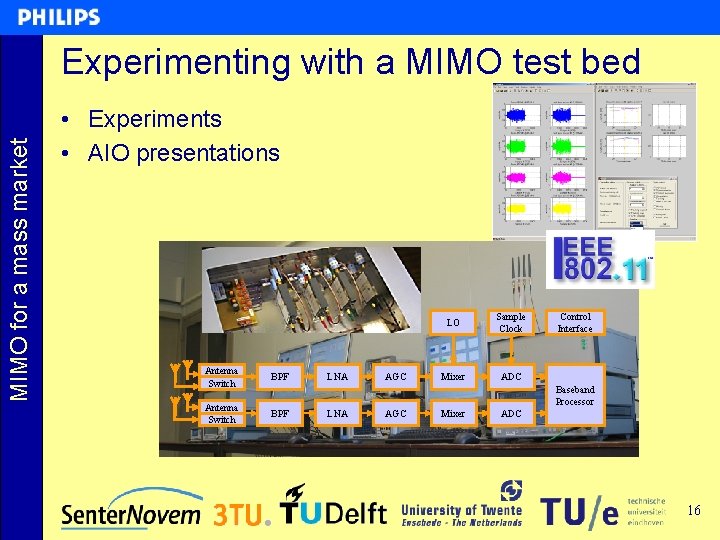
MIMO for a mass market Experimenting with a MIMO test bed • Experiments • AIO presentations Antenna Switch BPF LNA AGC LO Sample Clock Mixer ADC Control Interface Baseband Processor LNA AGC Mixer ADC 16
MIMO for a mass market • END 17