
MIMICKING COMPLEX SHOULDER MOTION USING A MULTIDOF ACTUATOR
- Slides: 1
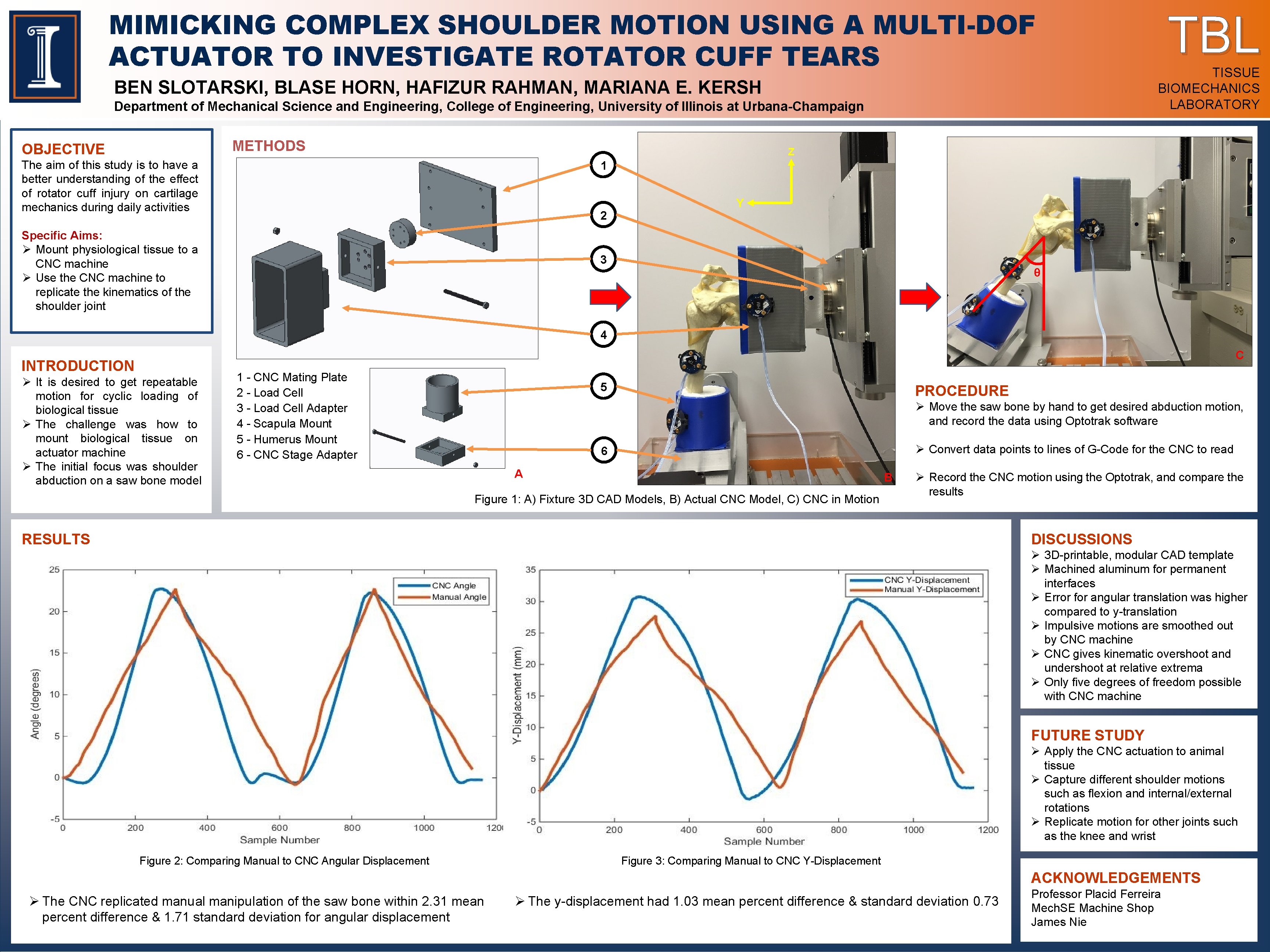
MIMICKING COMPLEX SHOULDER MOTION USING A MULTI-DOF ACTUATOR TO INVESTIGATE ROTATOR CUFF TEARS BEN SLOTARSKI, BLASE HORN, HAFIZUR RAHMAN, MARIANA E. KERSH Department of Mechanical Science and Engineering, College of Engineering, University of Illinois at Urbana-Champaign METHODS OBJECTIVE TBL TISSUE BIOMECHANICS LABORATORY Z The aim of this study is to have a better understanding of the effect of rotator cuff injury on cartilage mechanics during daily activities 1 2 Specific Aims: Ø Mount physiological tissue to a CNC machine Ø Use the CNC machine to replicate the kinematics of the shoulder joint Y 3 θ 4 C INTRODUCTION Ø It is desired to get repeatable motion for cyclic loading of biological tissue Ø The challenge was how to mount biological tissue on actuator machine Ø The initial focus was shoulder abduction on a saw bone model 1 - CNC Mating Plate 2 - Load Cell 3 - Load Cell Adapter 4 - Scapula Mount 5 - Humerus Mount 6 - CNC Stage Adapter 5 PROCEDURE Ø Move the saw bone by hand to get desired abduction motion, and record the data using Optotrak software Ø Convert data points to lines of G-Code for the CNC to read 6 A B Figure 1: A) Fixture 3 D CAD Models, B) Actual CNC Model, C) CNC in Motion Ø Record the CNC motion using the Optotrak, and compare the results RESULTS DISCUSSIONS Ø 3 D-printable, modular CAD template Ø Machined aluminum for permanent interfaces Ø Error for angular translation was higher compared to y-translation Ø Impulsive motions are smoothed out by CNC machine Ø CNC gives kinematic overshoot and undershoot at relative extrema Ø Only five degrees of freedom possible with CNC machine FUTURE STUDY Ø Apply the CNC actuation to animal tissue Ø Capture different shoulder motions such as flexion and internal/external rotations Ø Replicate motion for other joints such as the knee and wrist Figure 2: Comparing Manual to CNC Angular Displacement Figure 3: Comparing Manual to CNC Y-Displacement ACKNOWLEDGEMENTS Ø The CNC replicated manual manipulation of the saw bone within 2. 31 mean percent difference & 1. 71 standard deviation for angular displacement Ø The y-displacement had 1. 03 mean percent difference & standard deviation 0. 73 Professor Placid Ferreira Mech. SE Machine Shop James Nie