
Millimeter Wave Technology Team Triad Moniza Shaikh Radu

- Slides: 18
Millimeter Wave Technology Team Triad: Moniza Shaikh | Radu Bulgaru MSIT 413 - March 9 th 2013
AGENDA § What is Millimeter wave? § Propagation Characteristics § Bands & Licensing § Technical Overview § Applications 10/16/2021 Team Triad (minus 1) 2
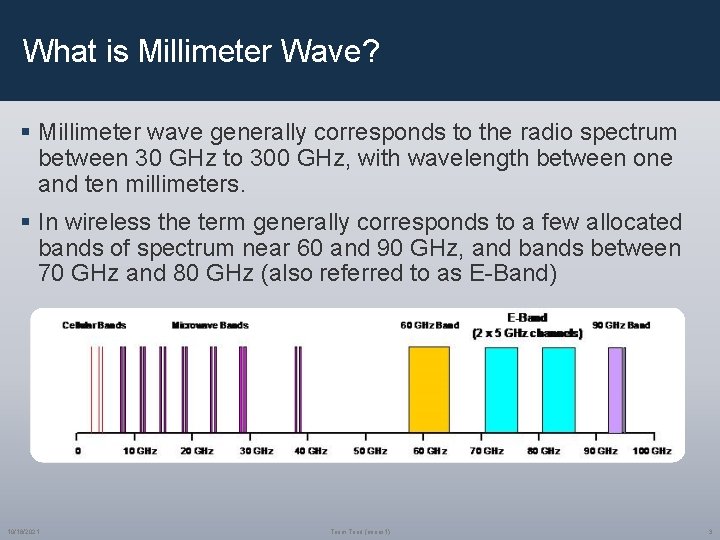
What is Millimeter Wave? § Millimeter wave generally corresponds to the radio spectrum between 30 GHz to 300 GHz, with wavelength between one and ten millimeters. § In wireless the term generally corresponds to a few allocated bands of spectrum near 60 and 90 GHz, and bands between 70 GHz and 80 GHz (also referred to as E-Band) 10/16/2021 Team Triad (minus 1) 3
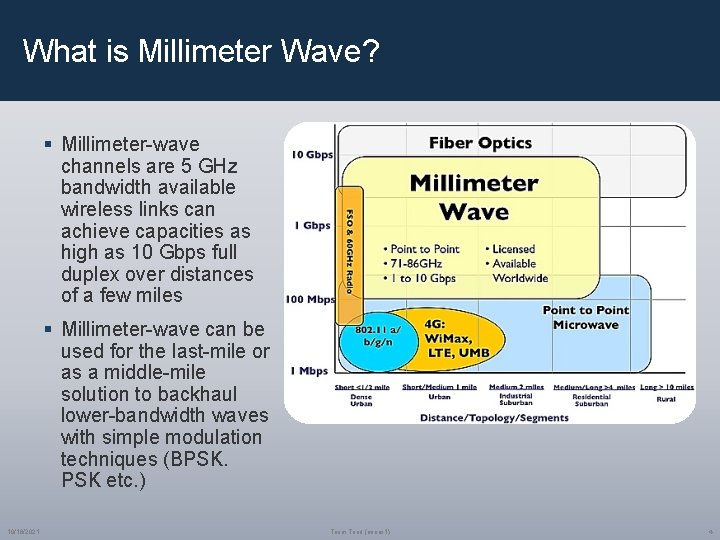
What is Millimeter Wave? § Millimeter-wave channels are 5 GHz bandwidth available wireless links can achieve capacities as high as 10 Gbps full duplex over distances of a few miles § Millimeter-wave can be used for the last-mile or as a middle-mile solution to backhaul lower-bandwidth waves with simple modulation techniques (BPSK. PSK etc. ) 10/16/2021 Team Triad (minus 1) 4
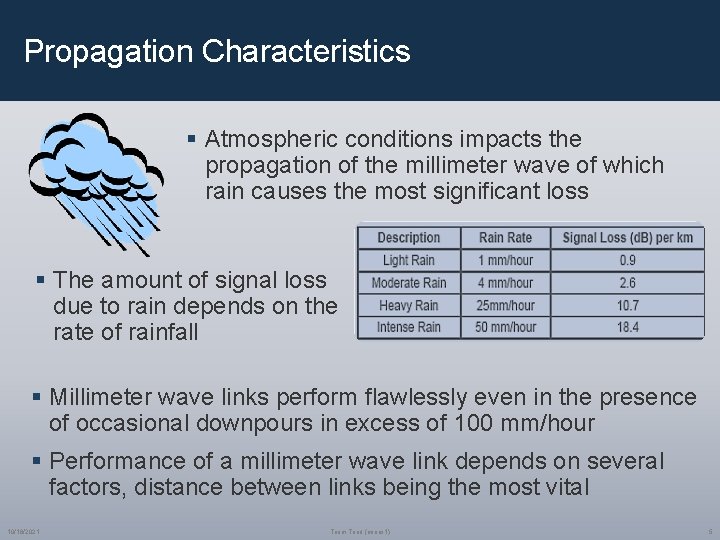
Propagation Characteristics § Atmospheric conditions impacts the propagation of the millimeter wave of which rain causes the most significant loss § The amount of signal loss due to rain depends on the rate of rainfall § Millimeter wave links perform flawlessly even in the presence of occasional downpours in excess of 100 mm/hour § Performance of a millimeter wave link depends on several factors, distance between links being the most vital 10/16/2021 Team Triad (minus 1) 5
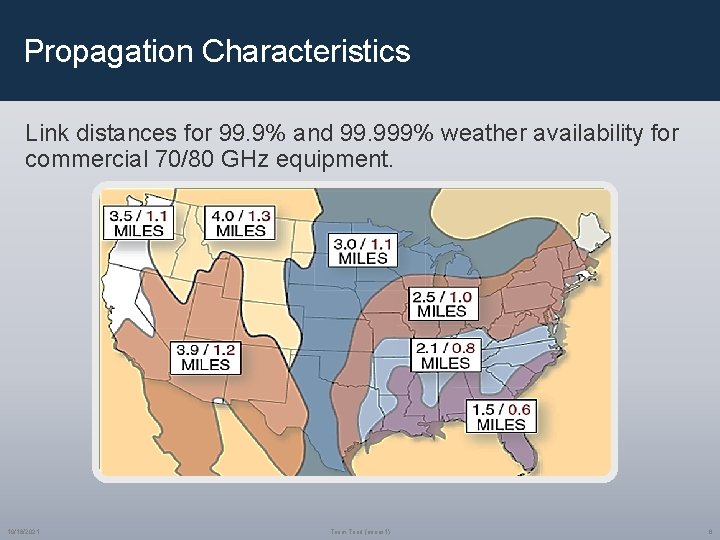
Propagation Characteristics Link distances for 99. 9% and 99. 999% weather availability for commercial 70/80 GHz equipment. 10/16/2021 Team Triad (minus 1) 6
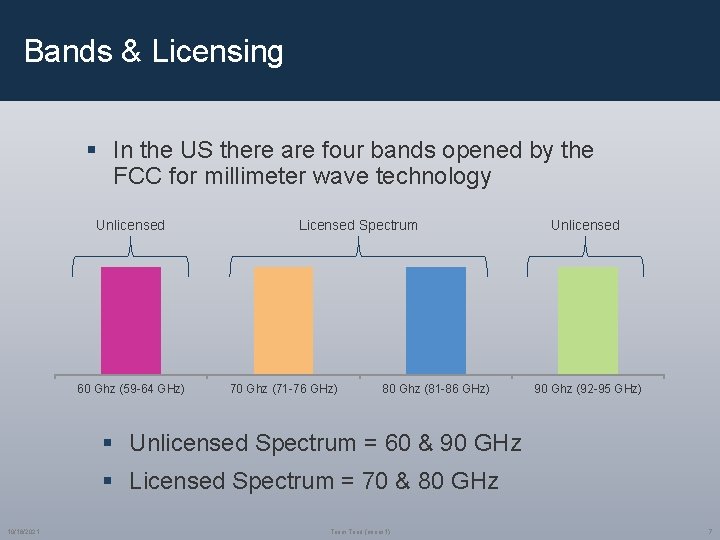
Bands & Licensing § In the US there are four bands opened by the FCC for millimeter wave technology Unlicensed 60 Ghz (59 -64 GHz) Licensed Spectrum 70 Ghz (71 -76 GHz) 80 Ghz (81 -86 GHz) Unlicensed 90 Ghz (92 -95 GHz) § Unlicensed Spectrum = 60 & 90 GHz § Licensed Spectrum = 70 & 80 GHz 10/16/2021 Team Triad (minus 1) 7
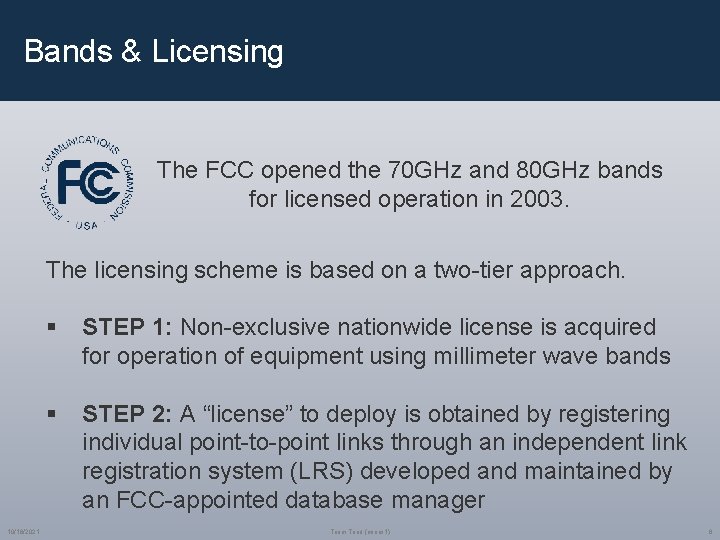
Bands & Licensing The FCC opened the 70 GHz and 80 GHz bands for licensed operation in 2003. The licensing scheme is based on a two-tier approach. 10/16/2021 § STEP 1: Non-exclusive nationwide license is acquired for operation of equipment using millimeter wave bands § STEP 2: A “license” to deploy is obtained by registering individual point-to-point links through an independent link registration system (LRS) developed and maintained by an FCC-appointed database manager Team Triad (minus 1) 8
Technical Overview: Millimeter Wave § Millimeter wave is the highest radio frequency band in practical use today 10/16/2021 Team Triad (minus 1) 9
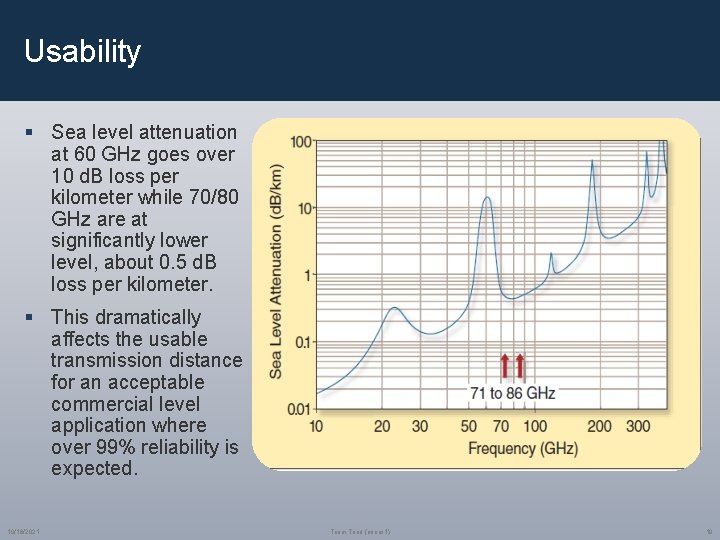
Usability § Sea level attenuation at 60 GHz goes over 10 d. B loss per kilometer while 70/80 GHz are at significantly lower level, about 0. 5 d. B loss per kilometer. § This dramatically affects the usable transmission distance for an acceptable commercial level application where over 99% reliability is expected. 10/16/2021 Team Triad (minus 1) 10
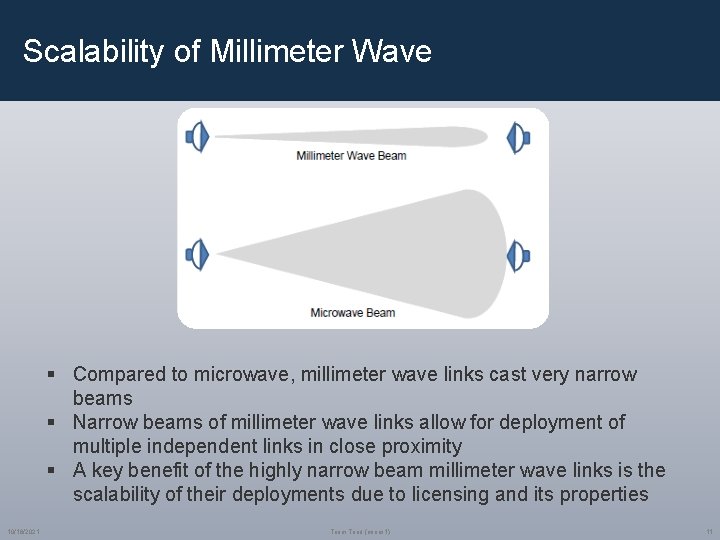
Scalability of Millimeter Wave § Compared to microwave, millimeter wave links cast very narrow beams § Narrow beams of millimeter wave links allow for deployment of multiple independent links in close proximity § A key benefit of the highly narrow beam millimeter wave links is the scalability of their deployments due to licensing and its properties 10/16/2021 Team Triad (minus 1) 11
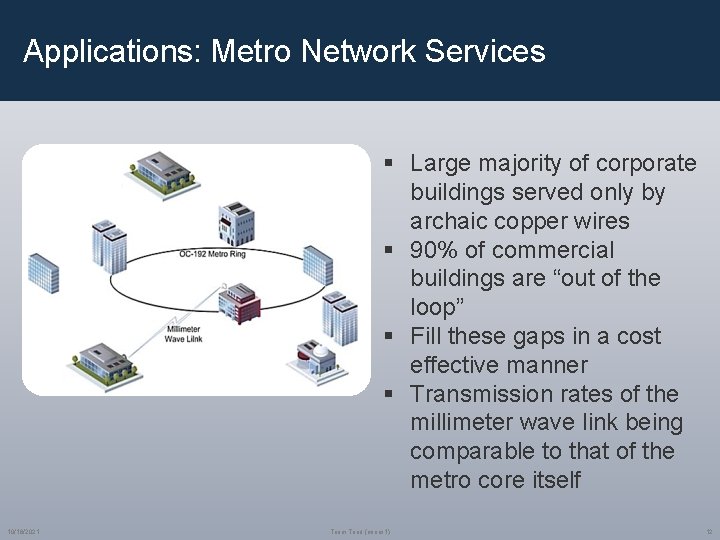
Applications: Metro Network Services § Large majority of corporate buildings served only by archaic copper wires § 90% of commercial buildings are “out of the loop” § Fill these gaps in a cost effective manner § Transmission rates of the millimeter wave link being comparable to that of the metro core itself 10/16/2021 Team Triad (minus 1) 12
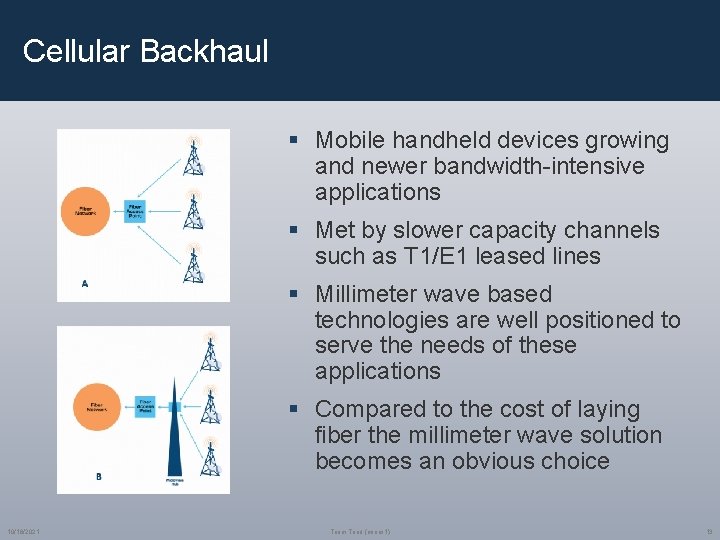
Cellular Backhaul § Mobile handheld devices growing and newer bandwidth-intensive applications § Met by slower capacity channels such as T 1/E 1 leased lines § Millimeter wave based technologies are well positioned to serve the needs of these applications § Compared to the cost of laying fiber the millimeter wave solution becomes an obvious choice 10/16/2021 Team Triad (minus 1) 13
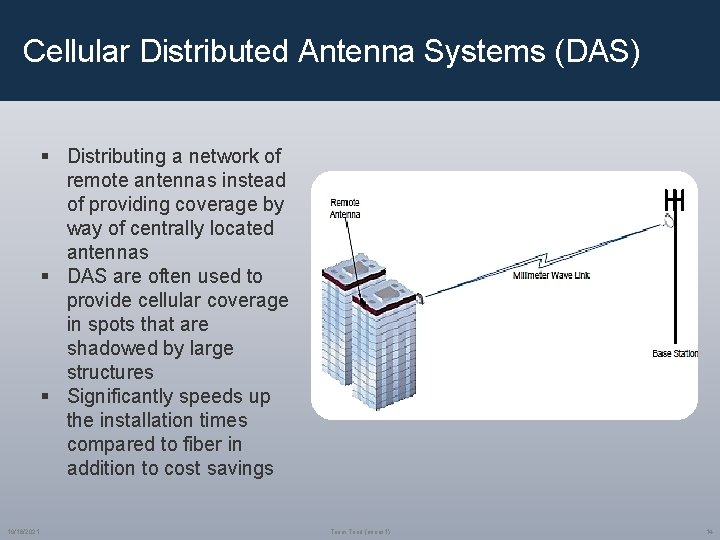
Cellular Distributed Antenna Systems (DAS) § Distributing a network of remote antennas instead of providing coverage by way of centrally located antennas § DAS are often used to provide cellular coverage in spots that are shadowed by large structures § Significantly speeds up the installation times compared to fiber in addition to cost savings 10/16/2021 Team Triad (minus 1) 14
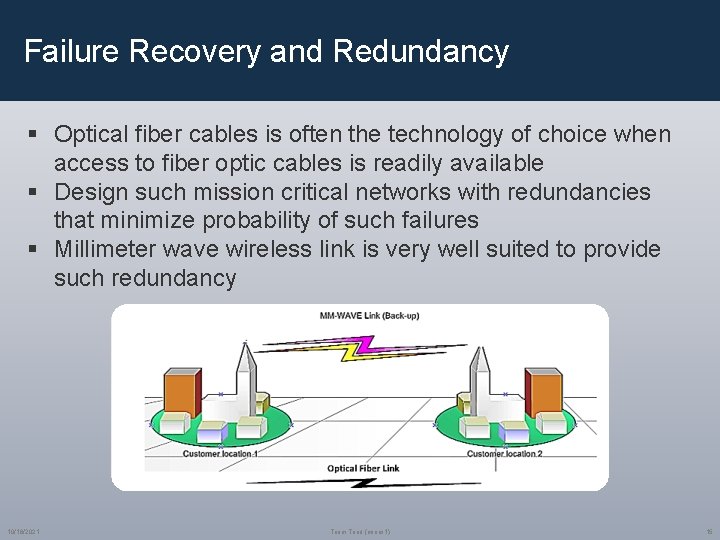
Failure Recovery and Redundancy § Optical fiber cables is often the technology of choice when access to fiber optic cables is readily available § Design such mission critical networks with redundancies that minimize probability of such failures § Millimeter wave wireless link is very well suited to provide such redundancy 10/16/2021 Team Triad (minus 1) 15
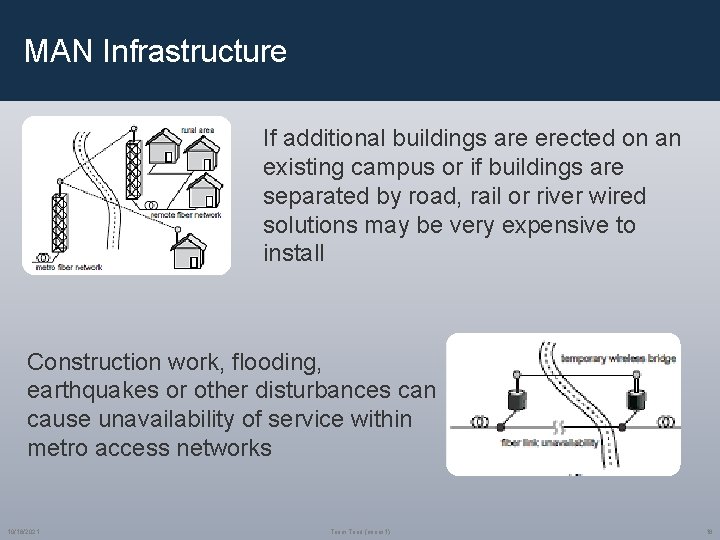
MAN Infrastructure If additional buildings are erected on an existing campus or if buildings are separated by road, rail or river wired solutions may be very expensive to install Construction work, flooding, earthquakes or other disturbances can cause unavailability of service within metro access networks 10/16/2021 Team Triad (minus 1) 16
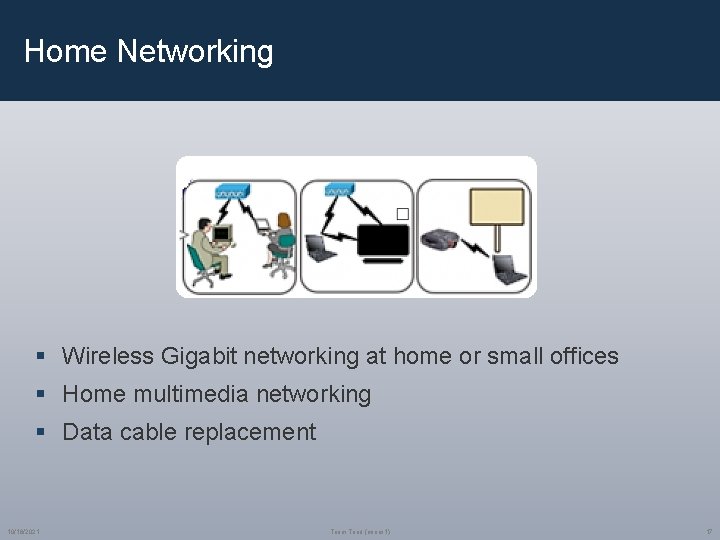
Home Networking § Wireless Gigabit networking at home or small offices § Home multimedia networking § Data cable replacement 10/16/2021 Team Triad (minus 1) 17
Questions? 10/16/2021 Team Triad (minus 1) 18