
Millimeter Wave Spectrum of IsoPropanol A MAEDA I
![Iso-Propanol • Iso-Propanol [(CH 3)2 CHOH] – One of the structural isomers of propanol](https://slidetodoc.com/presentation_image_h2/3aa9a71ac2e8fdaba85c7dc84f9e647a/image-2.jpg "Iso-Propanol • Iso-Propanol [(CH 3)2 CHOH] – One of the structural isomers of propanol")
![Distribution of Intensity Ratio & Relative Energy [Baskakov et al. (2006) HCOOH] Intensity ratio](https://slidetodoc.com/presentation_image_h2/3aa9a71ac2e8fdaba85c7dc84f9e647a/image-16.jpg "Distribution of Intensity Ratio & Relative Energy [Baskakov et al. (2006) HCOOH] Intensity ratio")
- Slides: 21
Millimeter Wave Spectrum of Iso-Propanol A. MAEDA, I. MEDVEDEV, E. HERBST and F. C. DE LUCIA Department of Physics, The Ohio State University
Iso-Propanol • Iso-Propanol [(CH 3)2 CHOH] – One of the structural isomers of propanol [C 3 H 7 OH]: N-propanol [CH 3 CH 2 OH] Iso-propanol [(CH 3)2 CHOH] – Three internal rotors: Two CH 3 tops One OH top – Two different structural conformers: Gauche & Trans Gauche • Astrochemical Interest • Spectroscopic Interest Trans
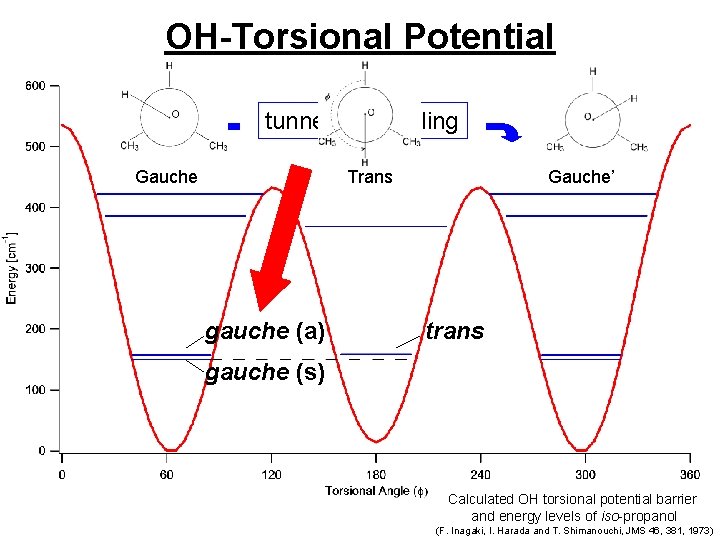
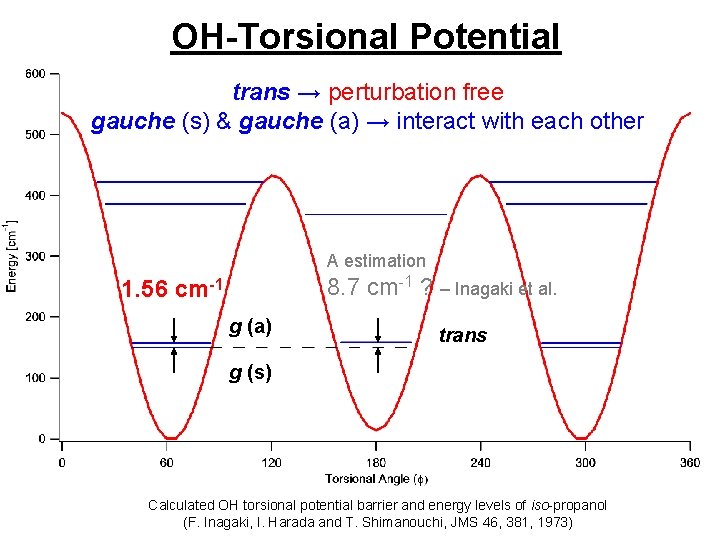
OH-Torsional Potential tunneling coupling Gauche Trans gauche (a) Gauche’ trans gauche (s) Calculated OH torsional potential barrier and energy levels of iso-propanol (F. Inagaki, I. Harada and T. Shimanouchi, JMS 46, 381, 1973)
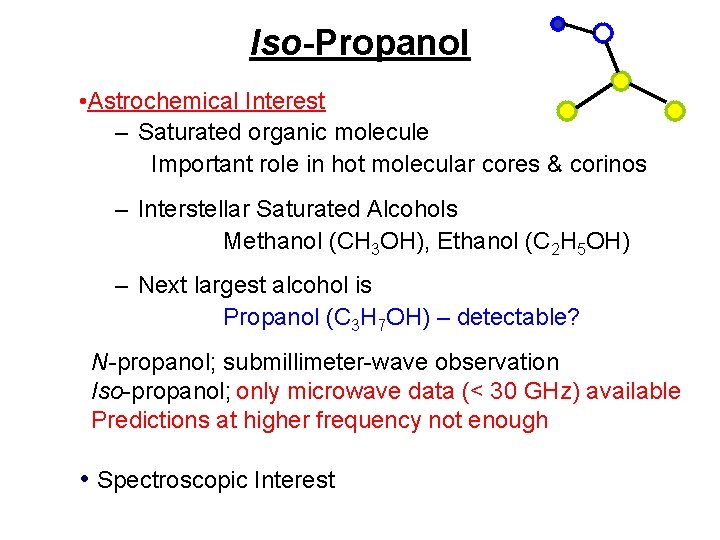
Iso-Propanol • Astrochemical Interest – Saturated organic molecule Important role in hot molecular cores & corinos – Interstellar Saturated Alcohols Methanol (CH 3 OH), Ethanol (C 2 H 5 OH) – Next largest alcohol is Propanol (C 3 H 7 OH) – detectable? N-propanol; submillimeter-wave observation Iso-propanol; only microwave data (< 30 GHz) available Predictions at higher frequency not enough • Spectroscopic Interest
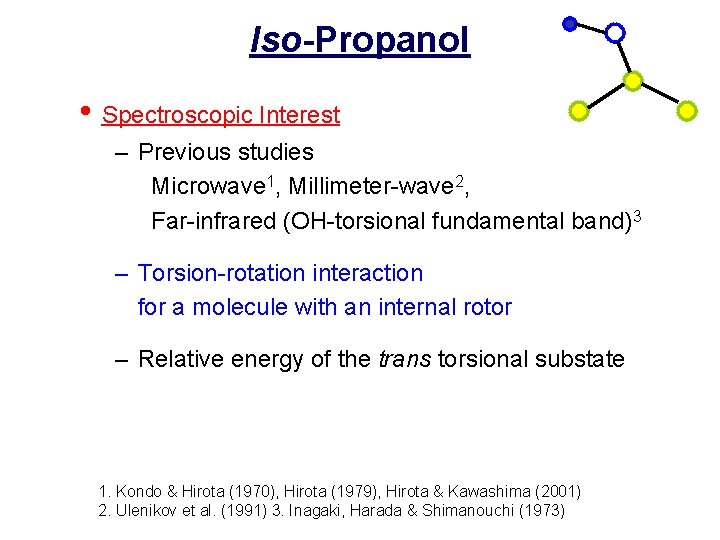
Iso-Propanol • Spectroscopic Interest – Previous studies Microwave 1, Millimeter-wave 2, Far-infrared (OH-torsional fundamental band)3 – Torsion-rotation interaction for a molecule with an internal rotor – Relative energy of the trans torsional substate 1. Kondo & Hirota (1970), Hirota (1979), Hirota & Kawashima (2001) 2. Ulenikov et al. (1991) 3. Inagaki, Harada & Shimanouchi (1973)
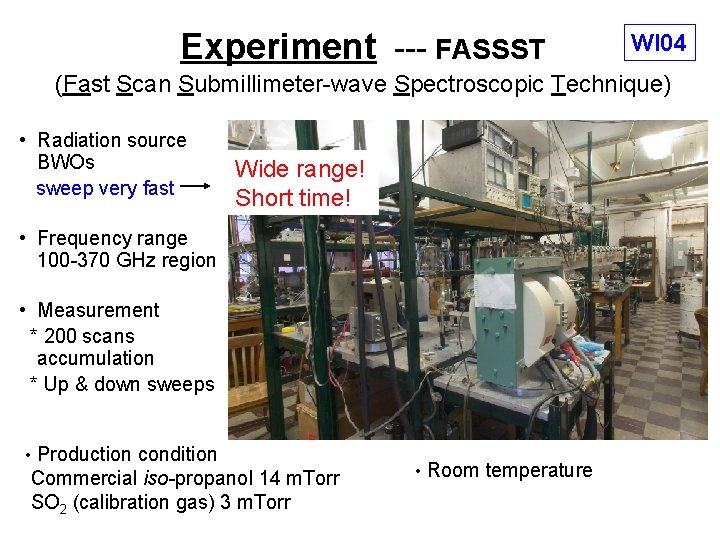
Experiment --- FASSST WI 04 (Fast Scan Submillimeter-wave Spectroscopic Technique) • Radiation source BWOs sweep very fast Wide range! Short time! • Frequency range 100 -370 GHz region • Measurement * 200 scans accumulation * Up & down sweeps • Production condition Commercial iso-propanol 14 m. Torr SO 2 (calibration gas) 3 m. Torr • Room temperature
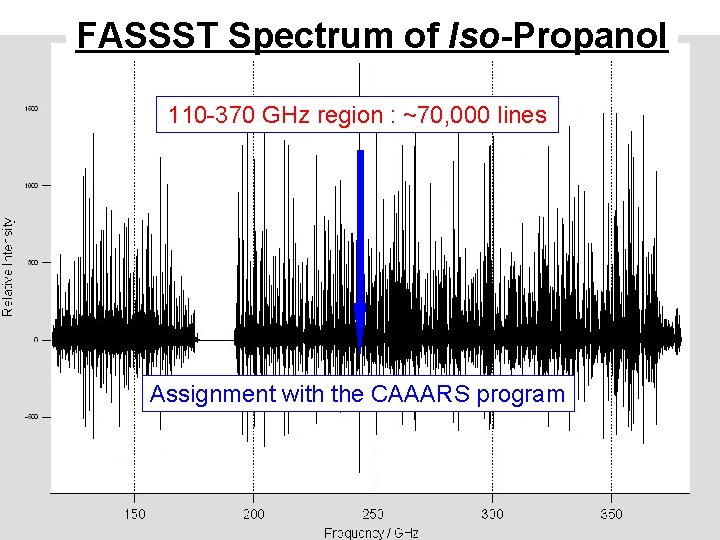
FASSST Spectrum of Iso-Propanol 110 -370 GHz region : ~70, 000 lines Assignment with the CAAARS program
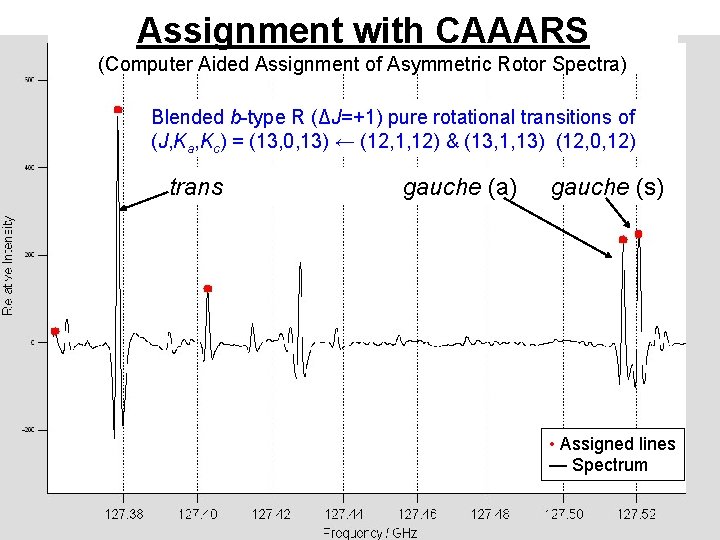
Assignment with CAAARS (Computer Aided Assignment of Asymmetric Rotor Spectra) Blended b-type R (ΔJ=+1) pure rotational transitions of (J, Ka, Kc) = (13, 0, 13) ← (12, 1, 12) & (13, 1, 13) (12, 0, 12) trans gauche (a) gauche (s) • Assigned lines — Spectrum
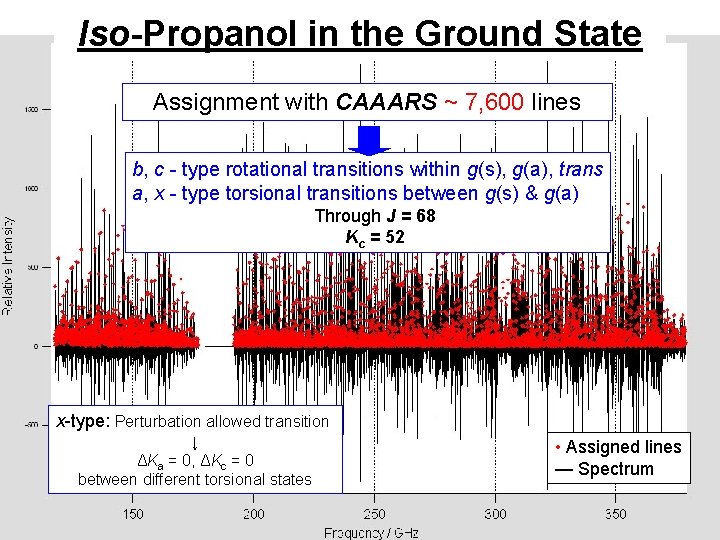
Iso-Propanol in the Ground State Assignment with CAAARS ~ 7, 600 lines b, c - type rotational transitions within g(s), g(a), trans a, x - type torsional transitions between g(s) & g(a) Through J = 68 Kc = 52 x-type: Perturbation allowed transition ↓ ΔKa = 0, ΔKc = 0 between different torsional states • Assigned lines — Spectrum
OH-Torsional Potential trans → perturbation free gauche (s) & gauche (a) → interact with each other A estimation 8. 7 cm-1 ? – Inagaki et al. 1. 56 cm-1 g (a) trans g (s) Calculated OH torsional potential barrier and energy levels of iso-propanol (F. Inagaki, I. Harada and T. Shimanouchi, JMS 46, 381, 1973)
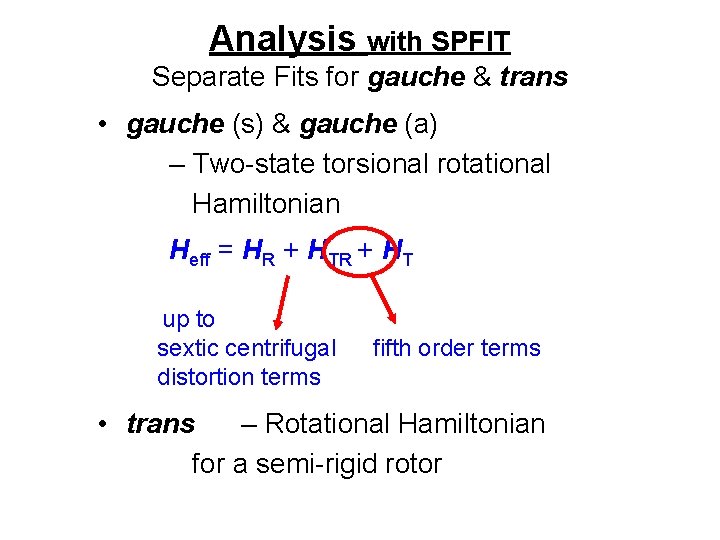
Analysis with SPFIT Separate Fits for gauche & trans • gauche (s) & gauche (a) – Two-state torsional rotational Hamiltonian Heff = HR + HT up to sextic centrifugal distortion terms fifth order terms • trans – Rotational Hamiltonian for a semi-rigid rotor
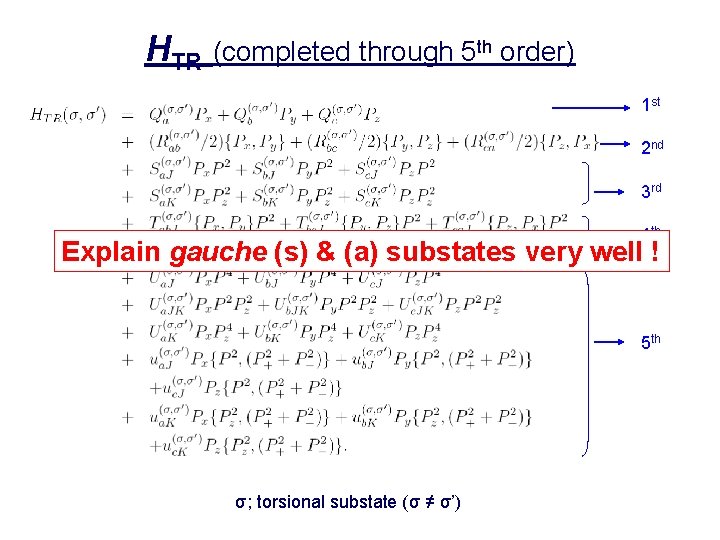
HTR (completed through 5 th order) 1 st 2 nd 3 rd 4 th Explain gauche (s) & (a) substates very well ! 5 th σ; torsional substate (σ ≠ σ’)
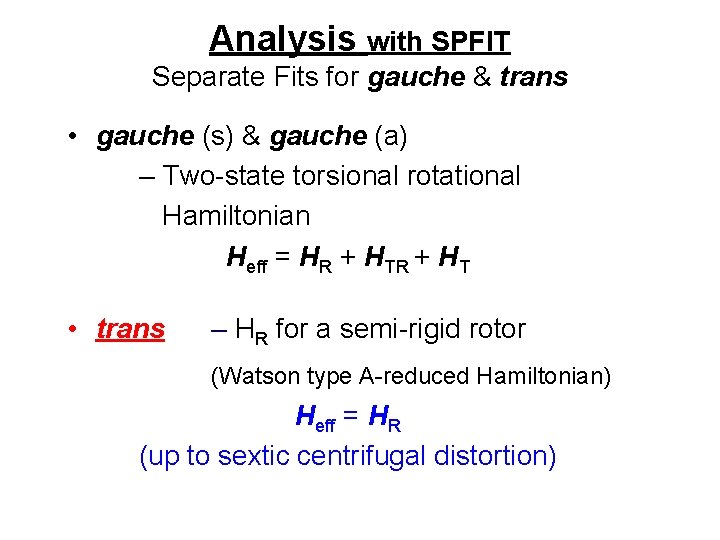
Analysis with SPFIT Separate Fits for gauche & trans • gauche (s) & gauche (a) – Two-state torsional rotational Hamiltonian Heff = HR + HT • trans – HR for a semi-rigid rotor (Watson type A-reduced Hamiltonian) Heff = HR (up to sextic centrifugal distortion)
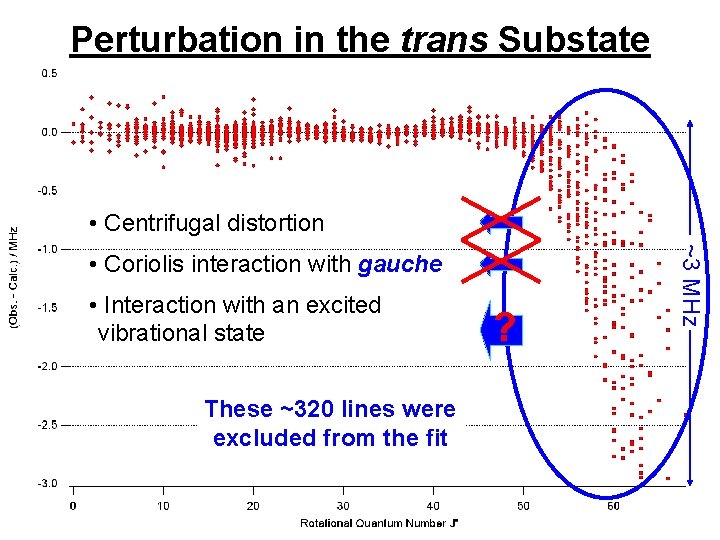
Perturbation in the trans Substate • Centrifugal distortion • Interaction with an excited vibrational state These ~320 lines were excluded from the fit ? ~3 MHz • Coriolis interaction with gauche
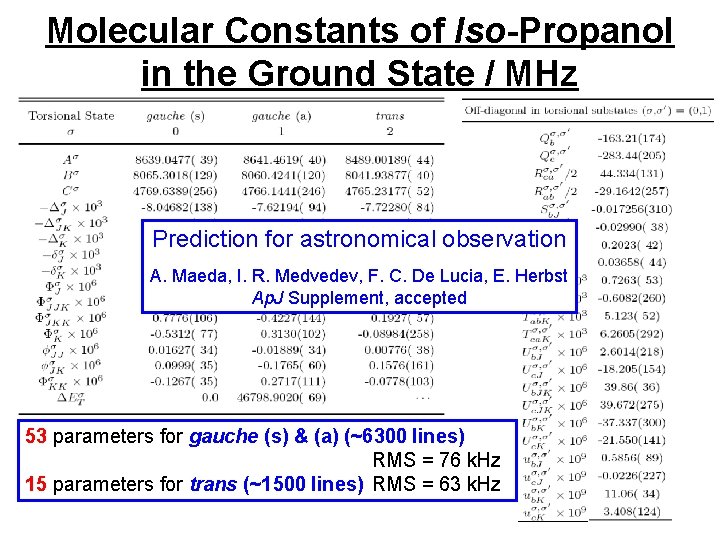
Molecular Constants of Iso-Propanol in the Ground State / MHz Prediction for astronomical observation A. Maeda, I. R. Medvedev, F. C. De Lucia, E. Herbst Ap. J Supplement, accepted 53 parameters for gauche (s) & (a) (~6300 lines) RMS = 76 k. Hz 15 parameters for trans (~1500 lines) RMS = 63 k. Hz
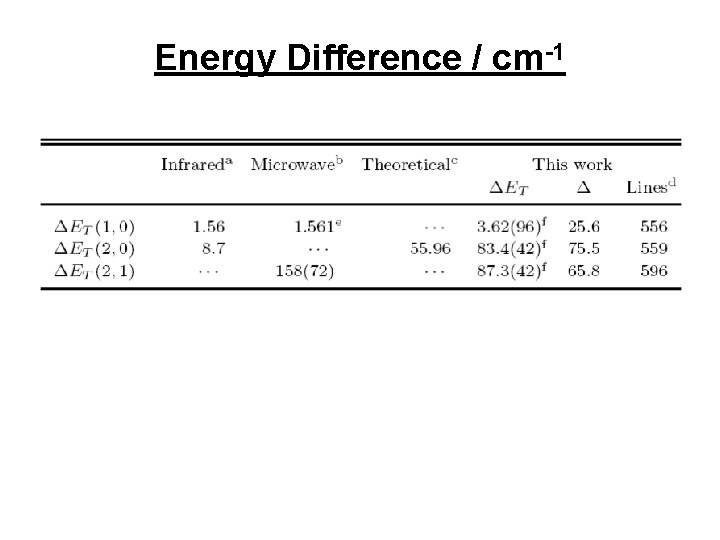
Distribution of Intensity Ratio & Relative Energy [Baskakov et al. (2006) HCOOH] Intensity ratio of identical rotational transitions in different torsional substates Mean ΔE(trans, g(s)) = 83 (42) cm-1 • Infrared study σ’, σ = torsional substates • Microwave 8. 7 cm-1 158 cm-1 Compared 559 lines • Theoretical calculation 55. 96 cm-1 in each trans & gauche (s)
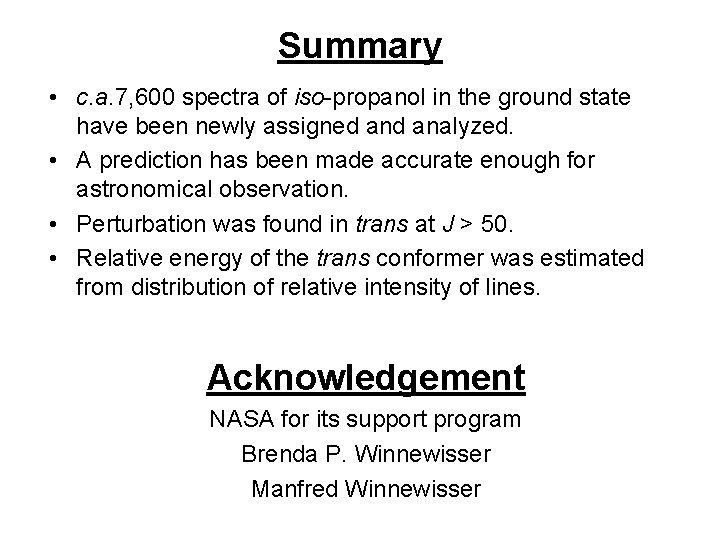
Summary • c. a. 7, 600 spectra of iso-propanol in the ground state have been newly assigned analyzed. • A prediction has been made accurate enough for astronomical observation. • Perturbation was found in trans at J > 50. • Relative energy of the trans conformer was estimated from distribution of relative intensity of lines. Acknowledgement NASA for its support program Brenda P. Winnewisser Manfred Winnewisser
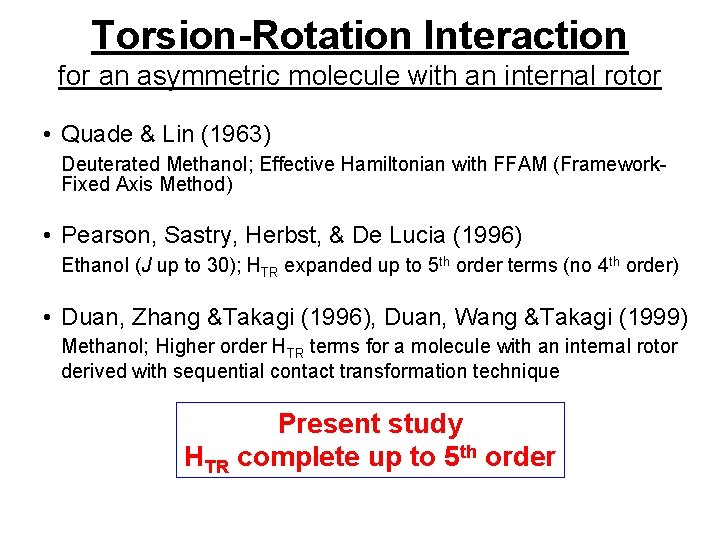
Torsion-Rotation Interaction for an asymmetric molecule with an internal rotor • Quade & Lin (1963) Deuterated Methanol; Effective Hamiltonian with FFAM (Framework. Fixed Axis Method) • Pearson, Sastry, Herbst, & De Lucia (1996) Ethanol (J up to 30); HTR expanded up to 5 th order terms (no 4 th order) • Duan, Zhang &Takagi (1996), Duan, Wang &Takagi (1999) Methanol; Higher order HTR terms for a molecule with an internal rotor derived with sequential contact transformation technique Present study HTR complete up to 5 th order
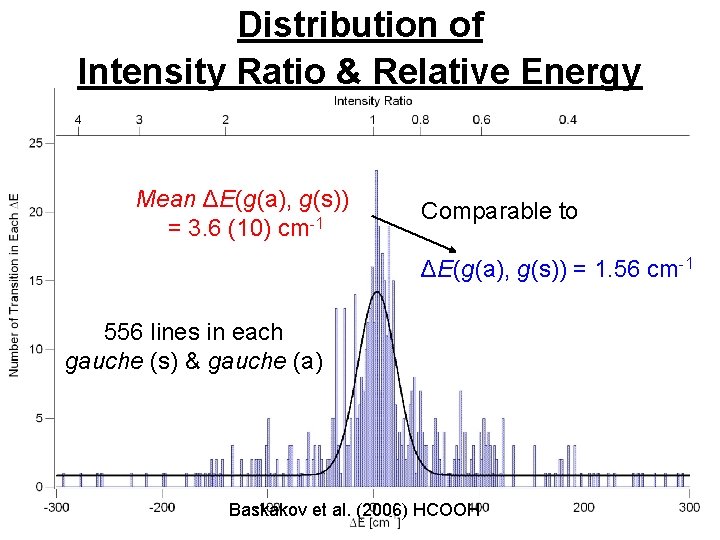
Distribution of Intensity Ratio & Relative Energy Mean ΔE(g(a), g(s)) = 3. 6 (10) cm-1 Comparable to ΔE(g(a), g(s)) = 1. 56 cm-1 556 lines in each gauche (s) & gauche (a) Baskakov et al. (2006) HCOOH
Energy Difference / cm-1
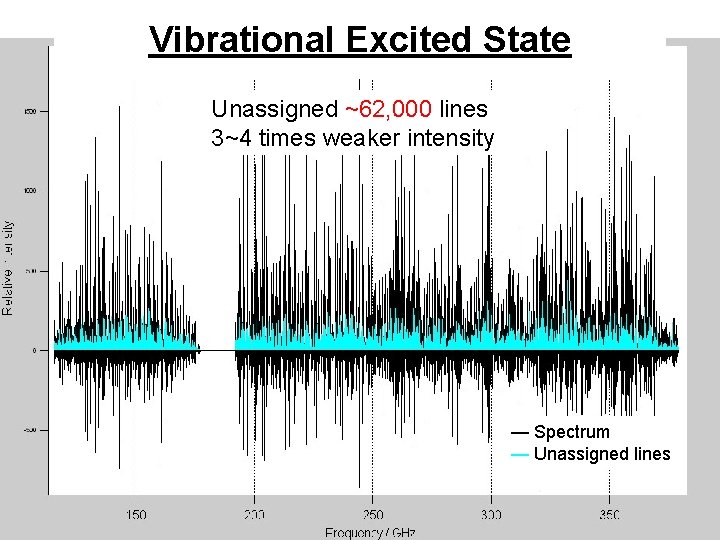
Vibrational Excited State Unassigned ~62, 000 lines 3~4 times weaker intensity — Spectrum — Unassigned lines