
Miller Indices The orientation of a surface or
- Slides: 8
Miller Indices • • • The orientation of a surface or a crystal plane may be defined by considering how the plane (or indeed any parallel plane) intersects the main crystallographic axes of the solid. a set of numbers which quantify the intercepts and thus may be used to uniquely identify the plane or surface. A cubic crystal is considered here one having a cubic unit cell with dimensions a x a ) will be considered.
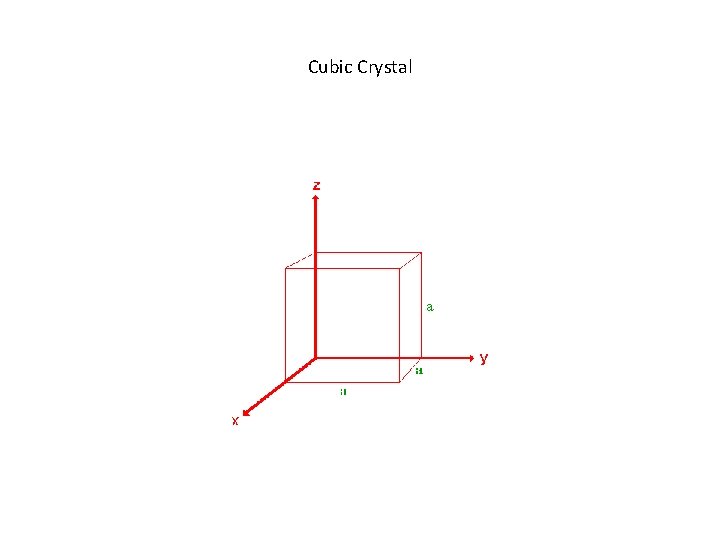
Cubic Crystal
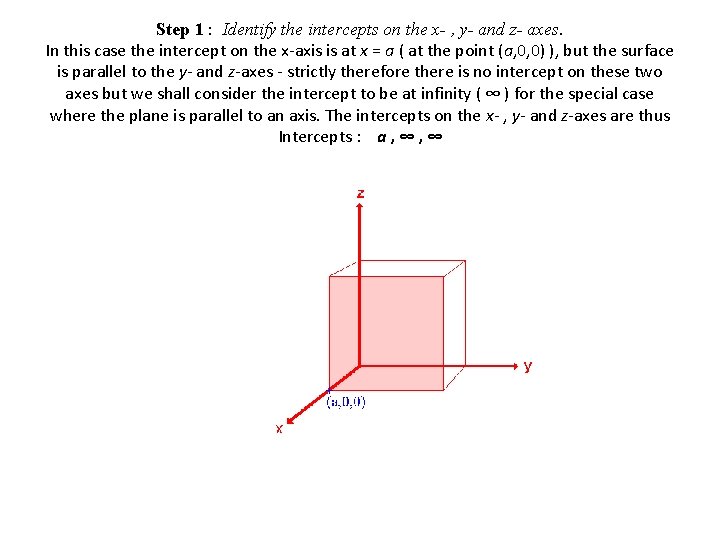
Step 1 : Identify the intercepts on the x- , y- and z- axes. In this case the intercept on the x-axis is at x = a ( at the point (a, 0, 0) ), but the surface is parallel to the y- and z-axes - strictly therefore there is no intercept on these two axes but we shall consider the intercept to be at infinity ( ∞ ) for the special case where the plane is parallel to an axis. The intercepts on the x- , y- and z-axes are thus Intercepts : a , ∞
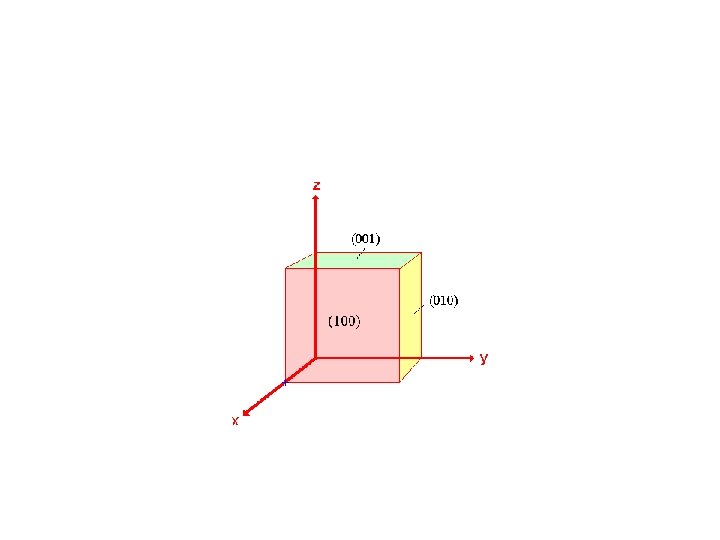
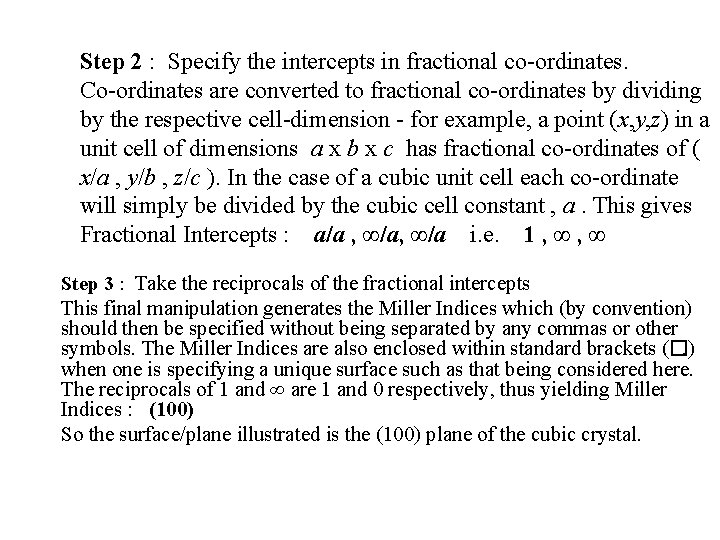
Step 2 : Specify the intercepts in fractional co-ordinates. Co-ordinates are converted to fractional co-ordinates by dividing by the respective cell-dimension - for example, a point (x, y, z) in a unit cell of dimensions a x b x c has fractional co-ordinates of ( x/a , y/b , z/c ). In the case of a cubic unit cell each co-ordinate will simply be divided by the cubic cell constant , a. This gives Fractional Intercepts : a/a , ∞/a i. e. 1 , ∞ Step 3 : Take the reciprocals of the fractional intercepts This final manipulation generates the Miller Indices which (by convention) should then be specified without being separated by any commas or other symbols. The Miller Indices are also enclosed within standard brackets (�. ) when one is specifying a unique surface such as that being considered here. The reciprocals of 1 and ∞ are 1 and 0 respectively, thus yielding Miller Indices : (100) So the surface/plane illustrated is the (100) plane of the cubic crystal.
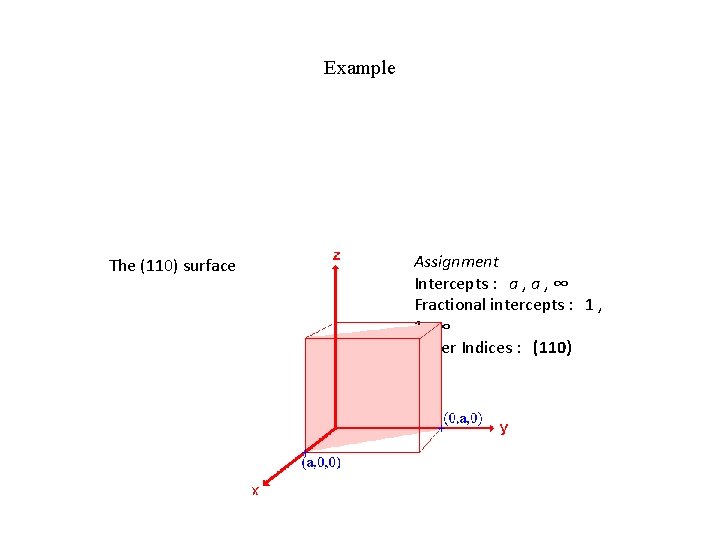
Example The (110) surface Assignment Intercepts : a , ∞ Fractional intercepts : 1 , 1, ∞ Miller Indices : (110)
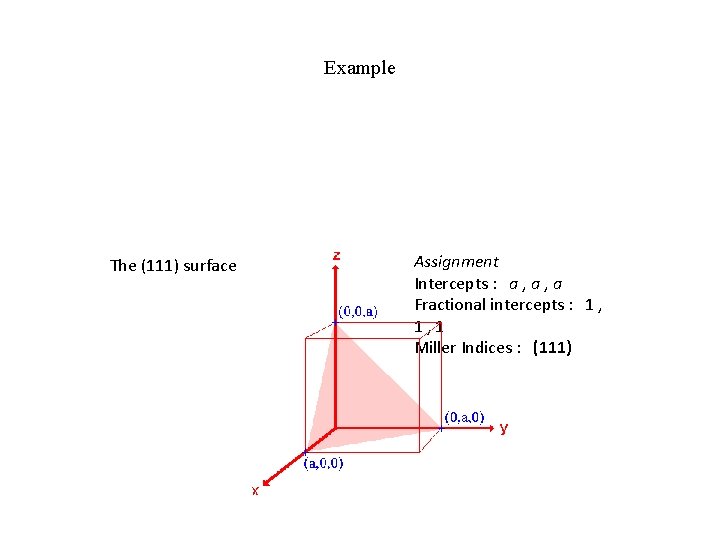
Example The (111) surface Assignment Intercepts : a , a Fractional intercepts : 1 , 1, 1 Miller Indices : (111)
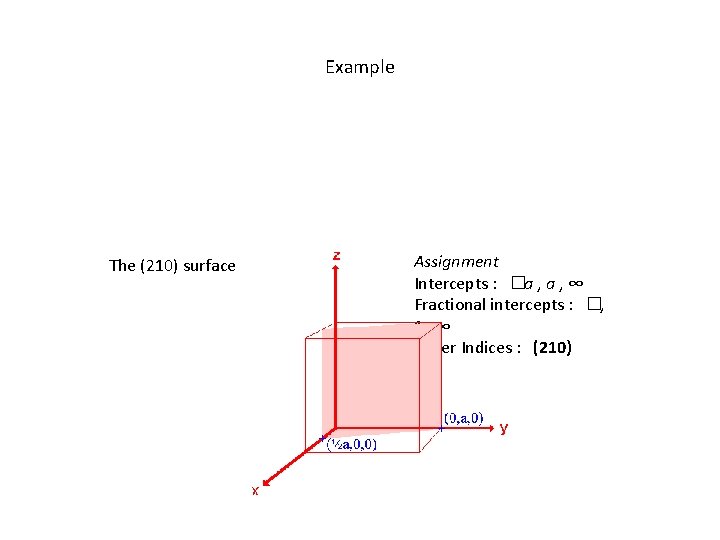
Example The (210) surface Assignment Intercepts : �a , ∞ Fractional intercepts : �, 1, ∞ Miller Indices : (210)