
Millennium Development Goals The link and contribution of
Millennium Development Goals: The link and contribution of DSD to the MDGs Presentation To the Portfolio Committee on Social Development 29 May 2012 1
Outline 1. 2. 3. 4. 5. Introduction and background DSD’s contribution to MDGs Budgetary allocations 2011/12/ 13/14 Collaboration with other Departments Challenges 2

Background The Millennium Declaration • In September 2000, the world’s leaders signed the Millennium Declaration at the Millennium Summit • The Millennium Declaration promotes basic human rights such as the right to education, health, water, security, and shelter • Millennium Development Goals (MDGs), act as guidelines and indicators for measuring levels of development • Characteristics of MDGs: • Time-bound goals • Quantifiable targets • Internationally agreed upon indicators 3
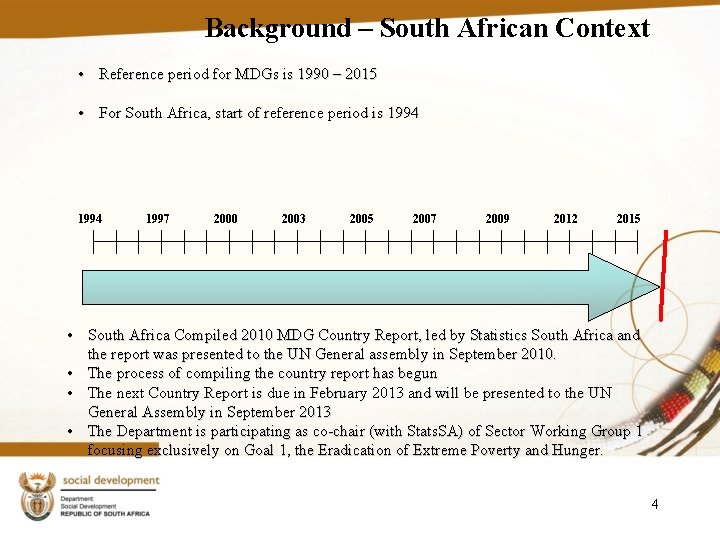
Background – South African Context • Reference period for MDGs is 1990 – 2015 • For South Africa, start of reference period is 1994 1997 2000 2003 2005 2007 2009 2012 2015 • South Africa Compiled 2010 MDG Country Report, led by Statistics South Africa and the report was presented to the UN General assembly in September 2010. • The process of compiling the country report has begun • The next Country Report is due in February 2013 and will be presented to the UN General Assembly in September 2013 • The Department is participating as co-chair (with Stats. SA) of Sector Working Group 1 focusing exclusively on Goal 1, the Eradication of Extreme Poverty and Hunger. 4
Department of Social Development (DSD) link to MDGs • The Department’s mandate enables it to contribute - directly or indirectly –to Goals 1, 2, 3, and 6 and 8 as well. • The Department works with a number of key government Departments in the implementation of MDGs. • The DSD mandate covers a wide spectrum of interventions, some of its work cannot be measured by the indicators -both domestic and international- developed for the MDGs. Examples of this includes work on Early Childhood Development services as the focus is on primary education. • The presentation is based mainly on the DSD draft annual report 2011/2012 and differs slightly from previous MDG presentations made to the Portfolio Committee. 5
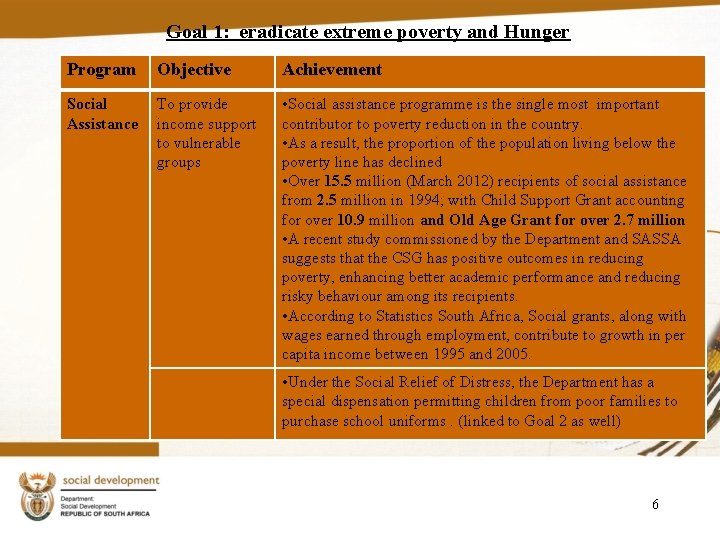
Goal 1: eradicate extreme poverty and Hunger Program Objective Achievement Social Assistance To provide income support to vulnerable groups • Social assistance programme is the single most important contributor to poverty reduction in the country. • As a result, the proportion of the population living below the poverty line has declined • Over 15. 5 million (March 2012) recipients of social assistance from 2. 5 million in 1994; with Child Support Grant accounting for over 10. 9 million and Old Age Grant for over 2. 7 million • A recent study commissioned by the Department and SASSA suggests that the CSG has positive outcomes in reducing poverty, enhancing better academic performance and reducing risky behaviour among its recipients. • According to Statistics South Africa, Social grants, along with wages earned through employment, contribute to growth in per capita income between 1995 and 2005. • Under the Social Relief of Distress, the Department has a special dispensation permitting children from poor families to purchase school uniforms. (linked to Goal 2 as well) 6

Goal 1: Eradicate Extreme Poverty and Hunger Program Objective Achievement (Community Development/ Sustainable livelihoods) Provision of food security and production programmes (sustainable livelihoods) • In December 2011, the Department started the Food for All campaign which will continue to be rolled out in the current financial year. • The campaign forms part of the implementation of our efforts to eradicate extreme poverty and is based on Brazil’s Zero Hunger model. • To this effect we developed a Zero Hunger Strategy and more than 1 049 566 individuals benefitted from the DSD food production and distribution initiatives implemented through Soup kitchens, Food Banks, Drop-in centres and Food Gardens. • This has made a notable contribution to the reduction of hunger and malnutrition for those who benefitted the Food Bank initiatives. • Recent research suggests that the CSG contributes to improving the nutrition levels of children between the ages of 0 -2 years 7
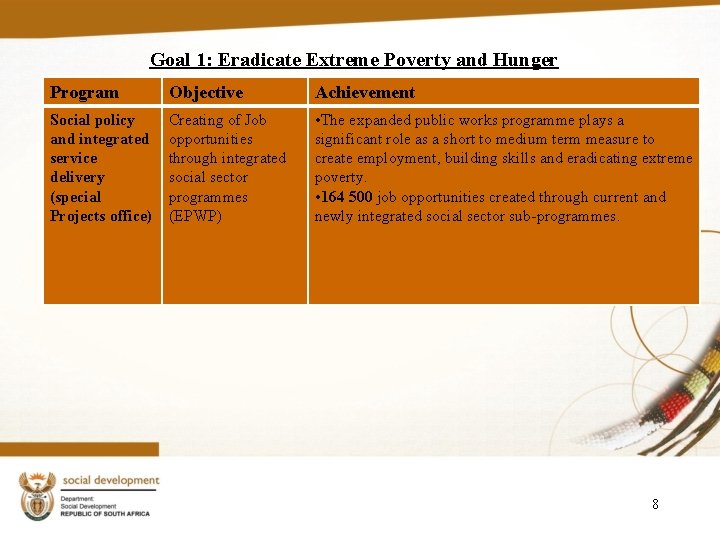
Goal 1: Eradicate Extreme Poverty and Hunger Program Objective Achievement Social policy and integrated service delivery (special Projects office) Creating of Job opportunities through integrated social sector programmes (EPWP) • The expanded public works programme plays a significant role as a short to medium term measure to create employment, building skills and eradicating extreme poverty. • 164 500 job opportunities created through current and newly integrated social sector sub-programmes. 8
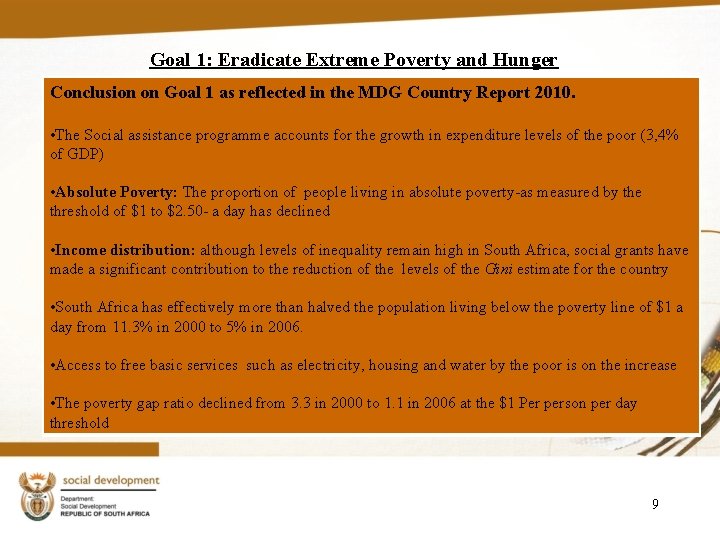
Goal 1: Eradicate Extreme Poverty and Hunger Conclusion on Goal 1 as reflected in the MDG Country Report 2010. • The Social assistance programme accounts for the growth in expenditure levels of the poor (3, 4% of GDP) • Absolute Poverty: The proportion of people living in absolute poverty-as measured by the threshold of $1 to $2. 50 - a day has declined • Income distribution: although levels of inequality remain high in South Africa, social grants have made a significant contribution to the reduction of the levels of the Gini estimate for the country • South Africa has effectively more than halved the population living below the poverty line of $1 a day from 11. 3% in 2000 to 5% in 2006. • Access to free basic services such as electricity, housing and water by the poor is on the increase • The poverty gap ratio declined from 3. 3 in 2000 to 1. 1 in 2006 at the $1 Per person per day threshold 9
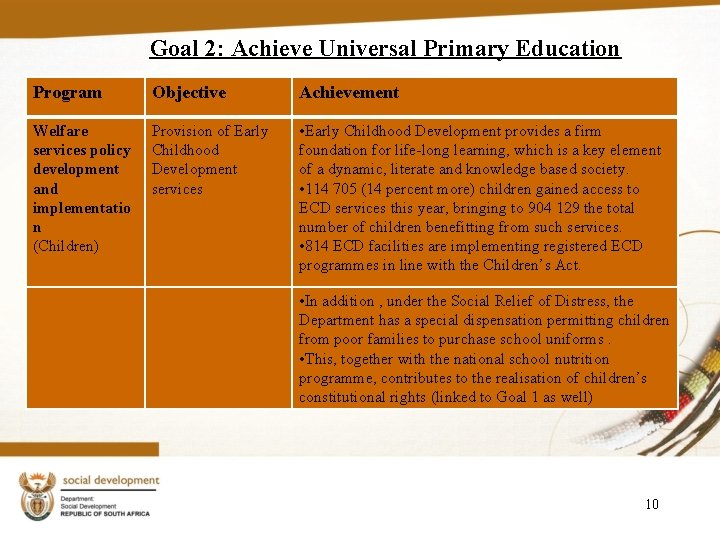
Goal 2: Achieve Universal Primary Education Program Objective Achievement Welfare services policy development and implementatio n (Children) Provision of Early Childhood Development services • Early Childhood Development provides a firm foundation for life-long learning, which is a key element of a dynamic, literate and knowledge based society. • 114 705 (14 percent more) children gained access to ECD services this year, bringing to 904 129 the total number of children benefitting from such services. • 814 ECD facilities are implementing registered ECD programmes in line with the Children’s Act. • In addition , under the Social Relief of Distress, the Department has a special dispensation permitting children from poor families to purchase school uniforms. • This, together with the national school nutrition programme, contributes to the realisation of children’s constitutional rights (linked to Goal 1 as well) 10
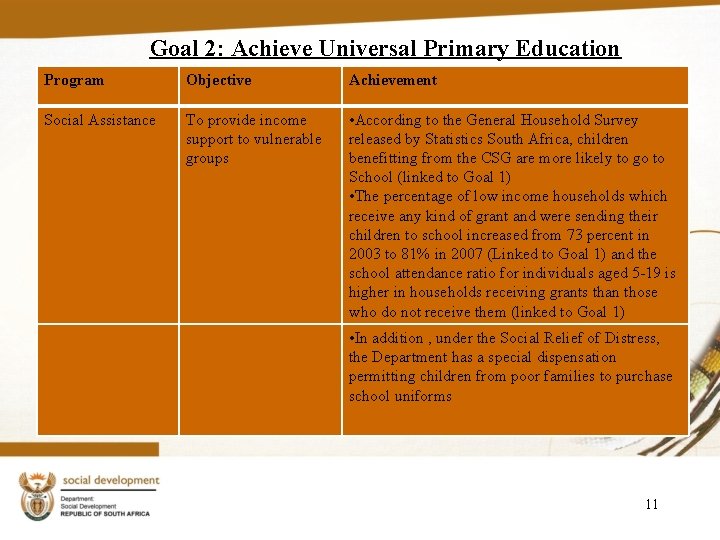
Goal 2: Achieve Universal Primary Education Program Objective Achievement Social Assistance To provide income support to vulnerable groups • According to the General Household Survey released by Statistics South Africa, children benefitting from the CSG are more likely to go to School (linked to Goal 1) • The percentage of low income households which receive any kind of grant and were sending their children to school increased from 73 percent in 2003 to 81% in 2007 (Linked to Goal 1) and the school attendance ratio for individuals aged 5 -19 is higher in households receiving grants than those who do not receive them (linked to Goal 1) • In addition , under the Social Relief of Distress, the Department has a special dispensation permitting children from poor families to purchase school uniforms 11
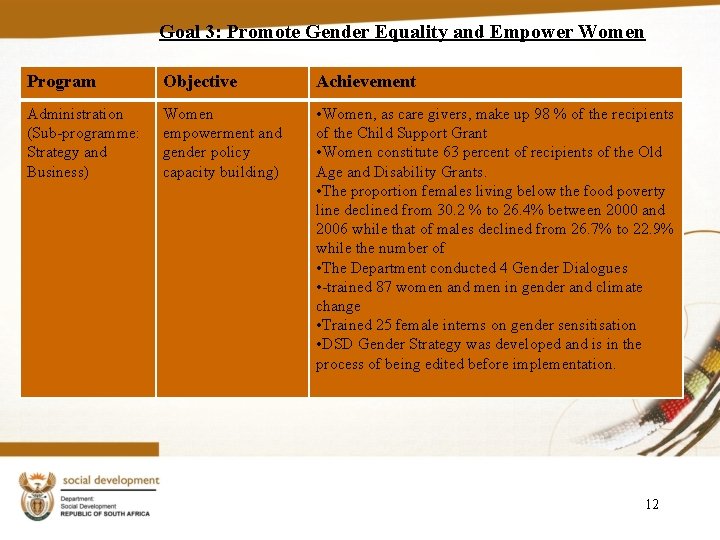
Goal 3: Promote Gender Equality and Empower Women Program Objective Achievement Administration (Sub-programme: Strategy and Business) Women empowerment and gender policy capacity building) • Women, as care givers, make up 98 % of the recipients of the Child Support Grant • Women constitute 63 percent of recipients of the Old Age and Disability Grants. • The proportion females living below the food poverty line declined from 30. 2 % to 26. 4% between 2000 and 2006 while that of males declined from 26. 7% to 22. 9% while the number of • The Department conducted 4 Gender Dialogues • -trained 87 women and men in gender and climate change • Trained 25 female interns on gender sensitisation • DSD Gender Strategy was developed and is in the process of being edited before implementation. 12
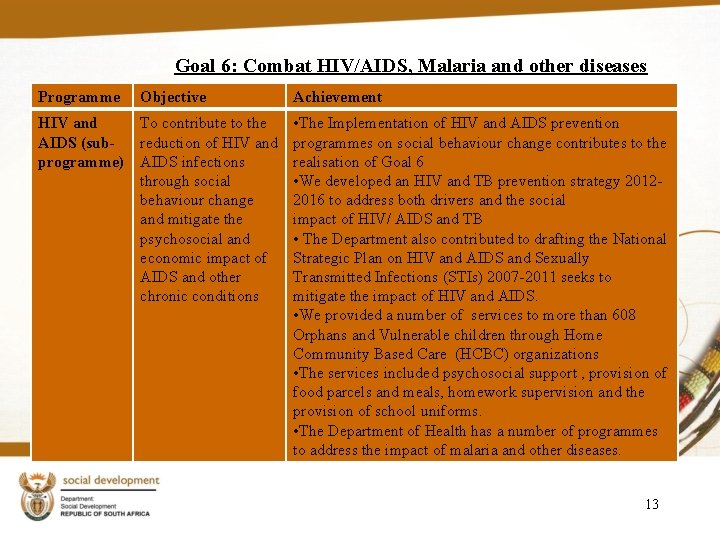
Goal 6: Combat HIV/AIDS, Malaria and other diseases Programme Objective HIV and To contribute to the AIDS (subreduction of HIV and programme) AIDS infections through social behaviour change and mitigate the psychosocial and economic impact of AIDS and other chronic conditions Achievement • The Implementation of HIV and AIDS prevention programmes on social behaviour change contributes to the realisation of Goal 6 • We developed an HIV and TB prevention strategy 20122016 to address both drivers and the social impact of HIV/ AIDS and TB • The Department also contributed to drafting the National Strategic Plan on HIV and AIDS and Sexually Transmitted Infections (STIs) 2007 -2011 seeks to mitigate the impact of HIV and AIDS. • We provided a number of services to more than 608 Orphans and Vulnerable children through Home Community Based Care (HCBC) organizations • The services included psychosocial support , provision of food parcels and meals, homework supervision and the provision of school uniforms. • The Department of Health has a number of programmes to address the impact of malaria and other diseases. 13
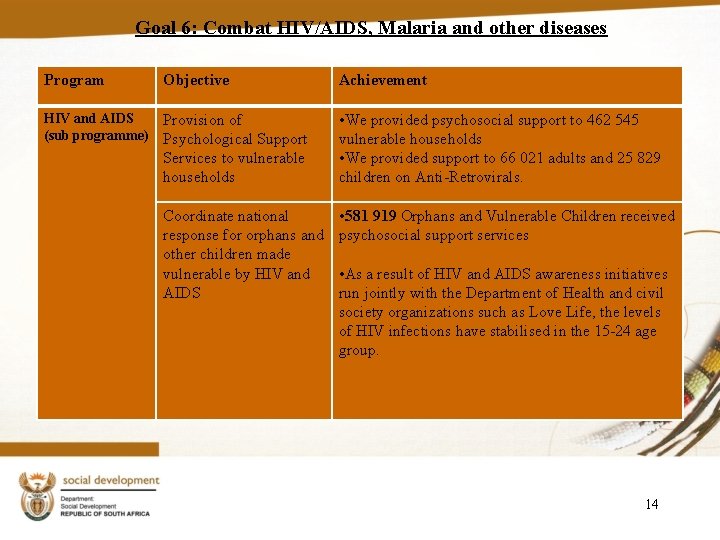
Goal 6: Combat HIV/AIDS, Malaria and other diseases Program Objective Achievement HIV and AIDS (sub programme) Provision of Psychological Support Services to vulnerable households • We provided psychosocial support to 462 545 vulnerable households • We provided support to 66 021 adults and 25 829 children on Anti-Retrovirals. Coordinate national response for orphans and other children made vulnerable by HIV and AIDS • 581 919 Orphans and Vulnerable Children received psychosocial support services • As a result of HIV and AIDS awareness initiatives run jointly with the Department of Health and civil society organizations such as Love Life, the levels of HIV infections have stabilised in the 15 -24 age group. 14
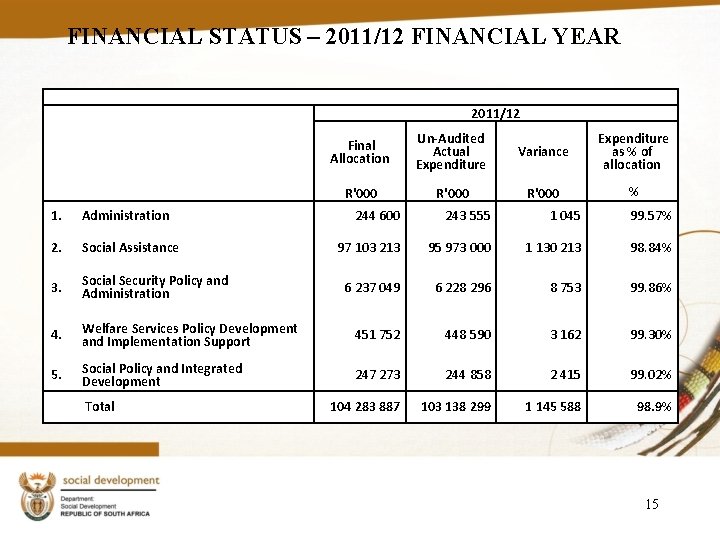
FINANCIAL STATUS – 2011/12 FINANCIAL YEAR 2011/12 1. Administration 2. Social Assistance 3. Social Security Policy and Administration 4. 5. Final Allocation Un-Audited Actual Expenditure Variance Expenditure as % of allocation R'000 % 244 600 243 555 1 045 99. 57% 97 103 213 95 973 000 1 130 213 98. 84% 6 237 049 6 228 296 8 753 99. 86% Welfare Services Policy Development and Implementation Support 451 752 448 590 3 162 99. 30% Social Policy and Integrated Development 247 273 244 858 2 415 99. 02% 104 283 887 103 138 299 1 145 588 98. 9% Total 15
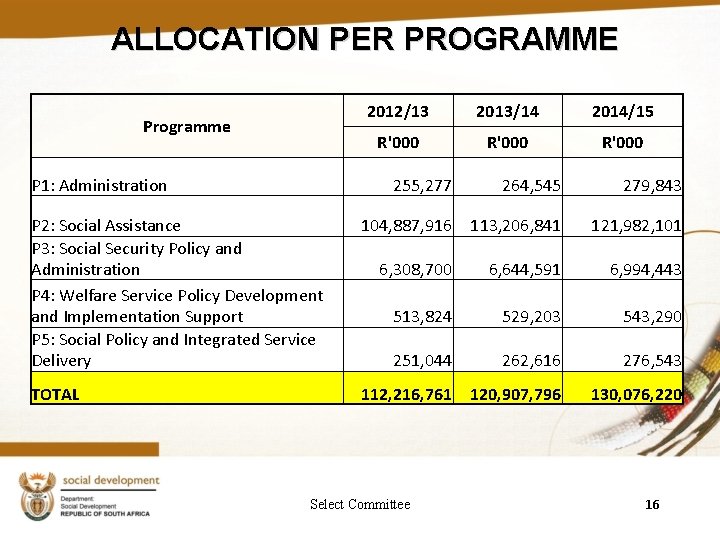
ALLOCATION PER PROGRAMME Programme P 1: Administration 2012/13 2013/14 2014/15 R'000 255, 277 264, 545 279, 843 P 2: Social Assistance P 3: Social Security Policy and Administration P 4: Welfare Service Policy Development and Implementation Support P 5: Social Policy and Integrated Service Delivery 104, 887, 916 113, 206, 841 121, 982, 101 6, 308, 700 6, 644, 591 6, 994, 443 513, 824 529, 203 543, 290 251, 044 262, 616 276, 543 TOTAL 112, 216, 761 120, 907, 796 130, 076, 220 Select Committee 16
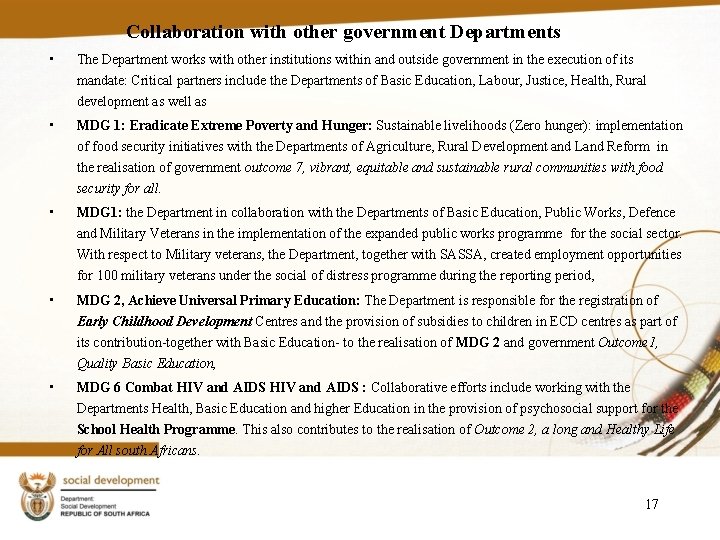
Collaboration with other government Departments • The Department works with other institutions within and outside government in the execution of its mandate: Critical partners include the Departments of Basic Education, Labour, Justice, Health, Rural development as well as • MDG 1: Eradicate Extreme Poverty and Hunger: Sustainable livelihoods (Zero hunger): implementation of food security initiatives with the Departments of Agriculture, Rural Development and Land Reform in the realisation of government outcome 7, vibrant, equitable and sustainable rural communities with food security for all. • MDG 1: the Department in collaboration with the Departments of Basic Education, Public Works, Defence and Military Veterans in the implementation of the expanded public works programme for the social sector. With respect to Military veterans, the Department, together with SASSA, created employment opportunities for 100 military veterans under the social of distress programme during the reporting period, • MDG 2, Achieve Universal Primary Education: The Department is responsible for the registration of Early Childhood Development Centres and the provision of subsidies to children in ECD centres as part of its contribution-together with Basic Education- to the realisation of MDG 2 and government Outcome 1, Quality Basic Education, • MDG 6 Combat HIV and AIDS : Collaborative efforts include working with the Departments Health, Basic Education and higher Education in the provision of psychosocial support for the School Health Programme. This also contributes to the realisation of Outcome 2, a long and Healthy Life for All south Africans. 17
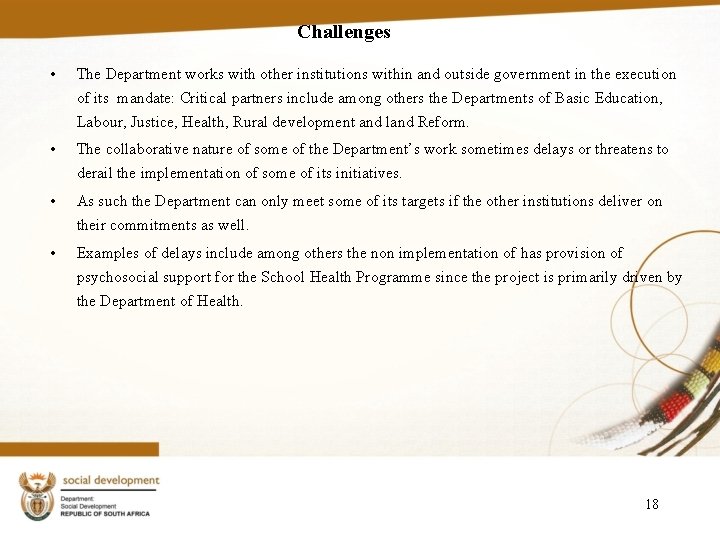
Challenges • The Department works with other institutions within and outside government in the execution of its mandate: Critical partners include among others the Departments of Basic Education, Labour, Justice, Health, Rural development and land Reform. • The collaborative nature of some of the Department’s work sometimes delays or threatens to derail the implementation of some of its initiatives. • As such the Department can only meet some of its targets if the other institutions deliver on their commitments as well. • Examples of delays include among others the non implementation of has provision of psychosocial support for the School Health Programme since the project is primarily driven by the Department of Health. 18
Thank You 19
- Slides: 19