
Mill and Calender Safety Presenters Name 1272020 1


- Slides: 30
Mill and Calender Safety Presenters Name 12/7/2020 1
Agenda General Overview of Mill Operation Video Stopping Distances Other Safety Requirements Calender Safety Mill Rescue Video Overview of Rescue Procedures Accident Scenario Mill Emergency Kit Summary and Questions 12/7/2020 2
General Overview of Mill l Personnel Safety n Paramount issue in mill/calender operation n Must be operated with care and respect for the hazards that a mill poses n No substitute for proper training in safety operation n Continuous training required for safety awareness 12/7/2020 3
l Lighting Good lighting is essential n Lighting installations should be planned with care to avoid shadows and glare n 12/7/2020 4
l Ventilation Certain polymer stocks in use today produce noxious or irritating smoke and fumes when milled or calendared. n Consider this factor and provide adequate exhaust ventilation n Such equipment usually takes the form of a ventilation hood or enclosure located over the machinery n 12/7/2020 5
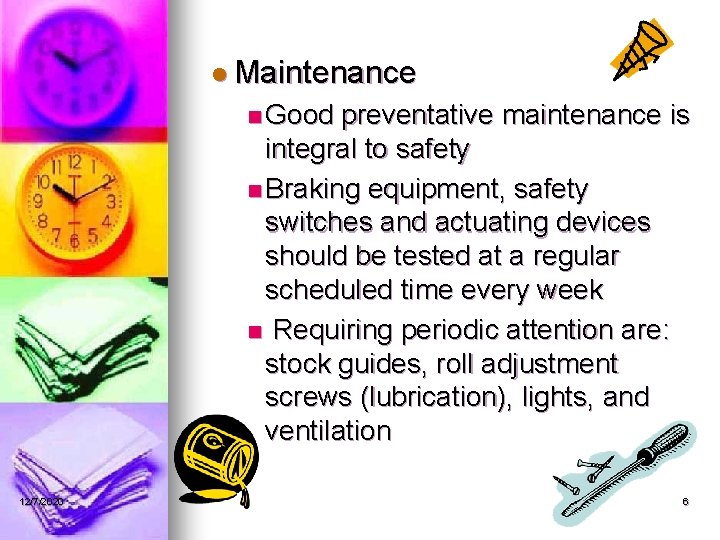
l Maintenance n Good preventative maintenance is integral to safety n Braking equipment, safety switches and actuating devices should be tested at a regular scheduled time every week n Requiring periodic attention are: stock guides, roll adjustment screws (lubrication), lights, and ventilation 12/7/2020 6
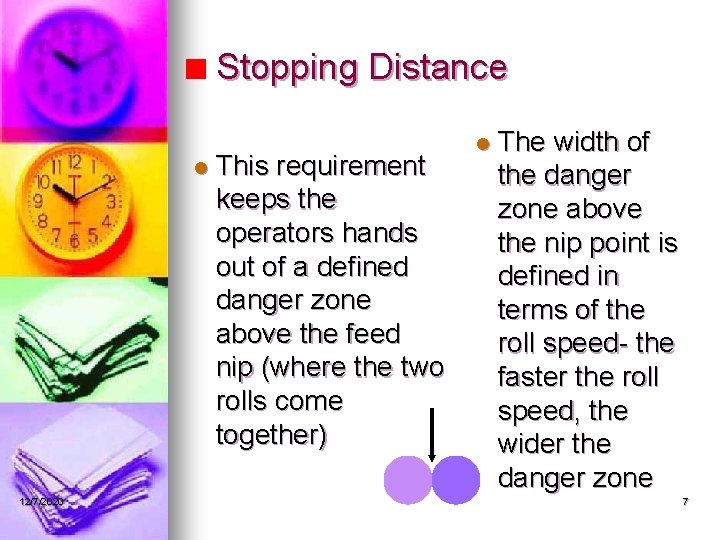
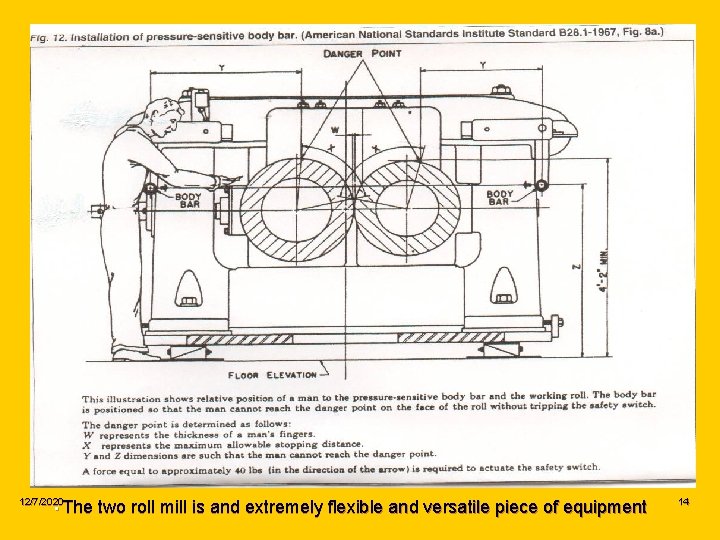
Stopping Distance l 12/7/2020 This requirement keeps the operators hands out of a defined danger zone above the feed nip (where the two rolls come together) l The width of the danger zone above the nip point is defined in terms of the roll speed- the faster the roll speed, the wider the danger zone 7
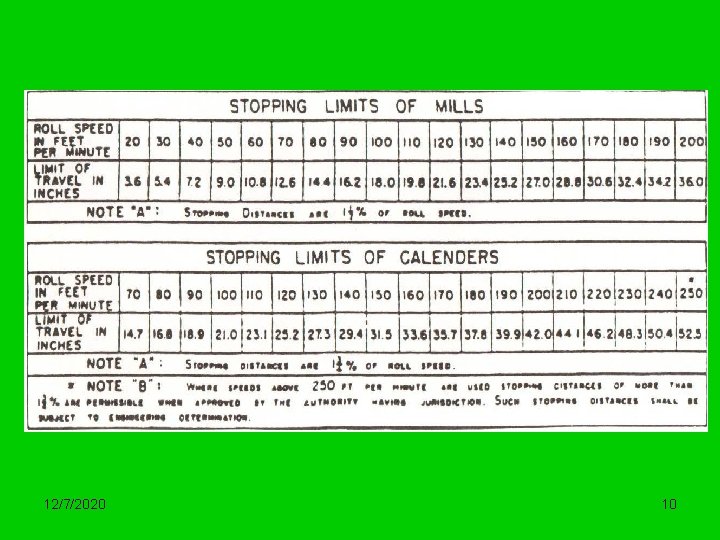
l Workers fail to realize that more people are injured on the small lab-scale mills than the larger process mills because the work area is closer to the nip point l Mills and calenders must meet certain minimum stopping distances, measured in travel of surface of the roll after the safety stop has been actuated 12/7/2020 8
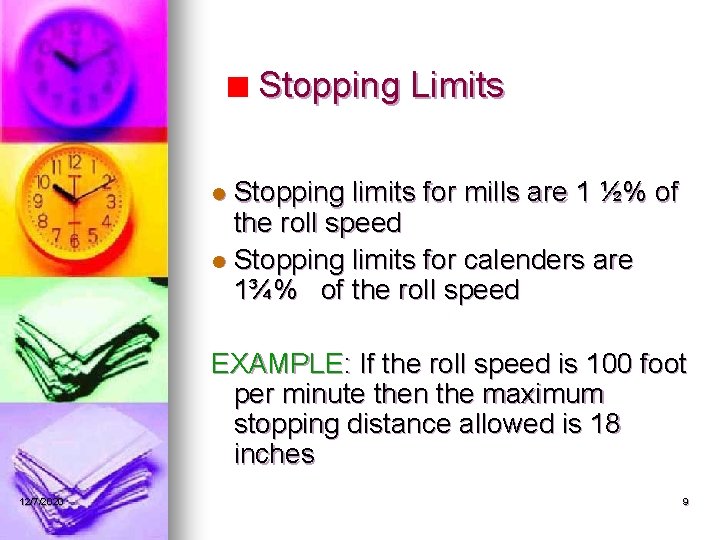
Stopping Limits Stopping limits for mills are 1 ½% of the roll speed l Stopping limits for calenders are 1¾% of the roll speed l EXAMPLE: If the roll speed is 100 foot per minute then the maximum stopping distance allowed is 18 inches 12/7/2020 9
12/7/2020 10
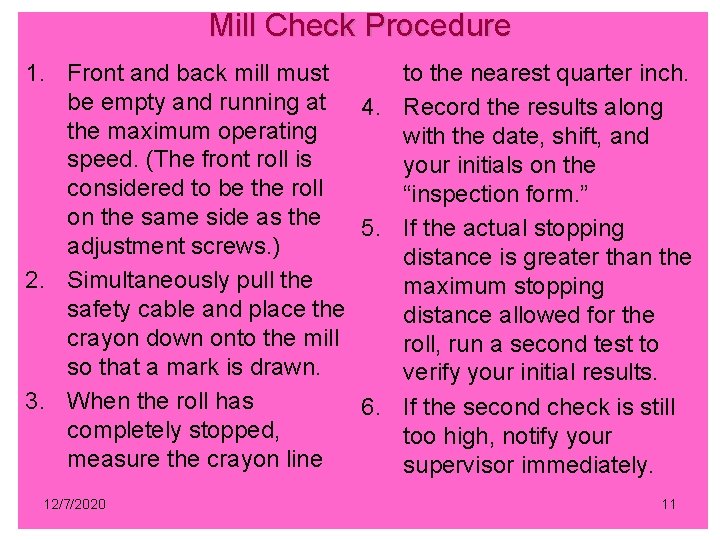
Mill Check Procedure 1. Front and back mill must to the nearest quarter inch. be empty and running at 4. Record the results along the maximum operating with the date, shift, and speed. (The front roll is your initials on the considered to be the roll “inspection form. ” on the same side as the 5. If the actual stopping adjustment screws. ) distance is greater than the 2. Simultaneously pull the maximum stopping safety cable and place the distance allowed for the crayon down onto the mill roll, run a second test to so that a mark is drawn. verify your initial results. 3. When the roll has 6. If the second check is still completely stopped, too high, notify your measure the crayon line supervisor immediately. 12/7/2020 11
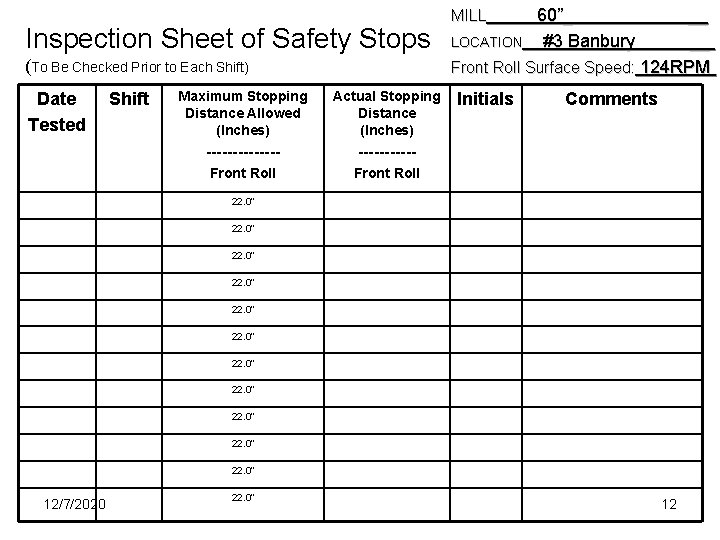
Inspection Sheet of Safety Stops (To Be Checked Prior to Each Shift) Date Tested Shift Maximum Stopping Distance Allowed (Inches) Actual Stopping Distance (Inches) ------- Front Roll __ LOCATION __ Front Roll Surface Speed: 124 RPM MILL Initials 60”_ #3 Banbury Comments 22. 0” 22. 0” 12/7/2020 22. 0” 12
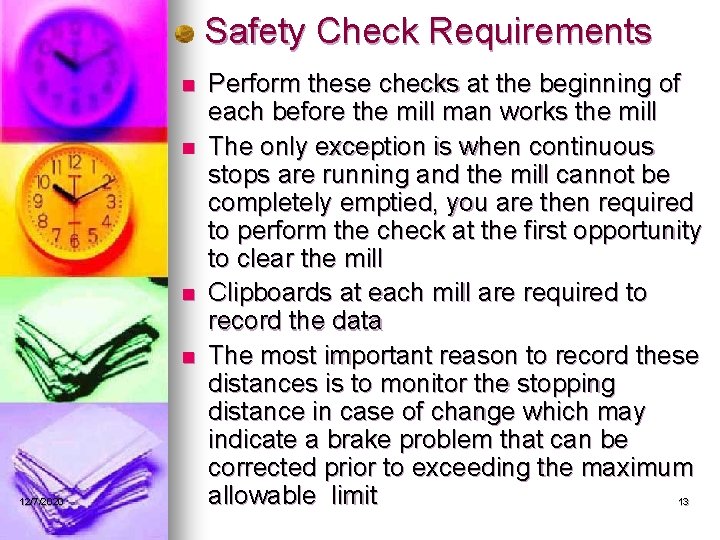
Safety Check Requirements n n 12/7/2020 Perform these checks at the beginning of each before the mill man works the mill The only exception is when continuous stops are running and the mill cannot be completely emptied, you are then required to perform the check at the first opportunity to clear the mill Clipboards at each mill are required to record the data The most important reason to record these distances is to monitor the stopping distance in case of change which may indicate a brake problem that can be corrected prior to exceeding the maximum allowable limit 13
12/7/2020 • The two roll mill is and extremely flexible and versatile piece of equipment 14
Other Safety Requirements l l 12/7/2020 Install mills so the distance from the surface the operator stands upon is not less than 50 inches below the top of the rolls to meet requirements Install body bars on both sides of the mill, arranging the bars so the operator cannot reach in to the danger zone without pressing hard enough at the body bar to trip the emergency stop switch at no more than 40 pounds of pressure. Be certain that the bars work reliably with both inward and upward pressure. 15
l l 12/7/2020 Make sure the body bar will not bounce and reset itself Operators come in many shapes and sizes, make certain that the short ones are not working under or inside the bar. If the operator happens to be a former basketball center, check to be positive that he can NOT reach the danger zone Danger Zone 16
In general, emergency stop devices, including body bars, pull cables, and emergency stop push buttons, must be of the maintained position type (requiring that they be manually reset before the equipment can be restarted) l Such switches should be double-pole and should break both the hat and the neutral side of the run circuit l 12/7/2020 l The use of pull cables in conjunction with body bars is strongly recommended 17
Emergency stop devices must be retested on a regular basis l Plant personnel should be schooled to avoid misuse or abuse of the emergency stop system l A routine stop should be made using the normal stop button on the operators control station to avoid undue wear and tear l General guarding is also a safety requirement; all gearing should be enclosed with guards to prevent unauthorized personnel from putting hands or other objects into the gear mesh l 12/7/2020 18
Calender Safety The problem of protecting calenders is considered different from that of protecting mills l The accident exposure is greater due to increased number of bites l Guarding the point wear stock feeds into the calender is extremely difficult n Hazards are greatly reduced by employing feed conveyors, preferably an oscillating type n Stock tables located just below and close to the face of the rolls also reduces exposure l 12/7/2020 19
Calender Safety Controls A safety trip rod or cable is needed across each pair of in-running rolls extending the length of the rolls. It must be readily accessible and operate whether pushed or pulled. l A safety trip rod or cable must be connected to the safety trip at the end of the face of the rolls. They must be located no more than 12 inches out from the rolls, not less than 2 inches form the calender frame and extend within 6 inches of the floor. l 12/7/2020 20
A calender installed so operators can’t reach through, over, under, or around the roll bite or be caught between the rolls or an adjacent object are not required to have safety devices. l Again, all trip and emergency switches require manual resetting. l 12/7/2020 21
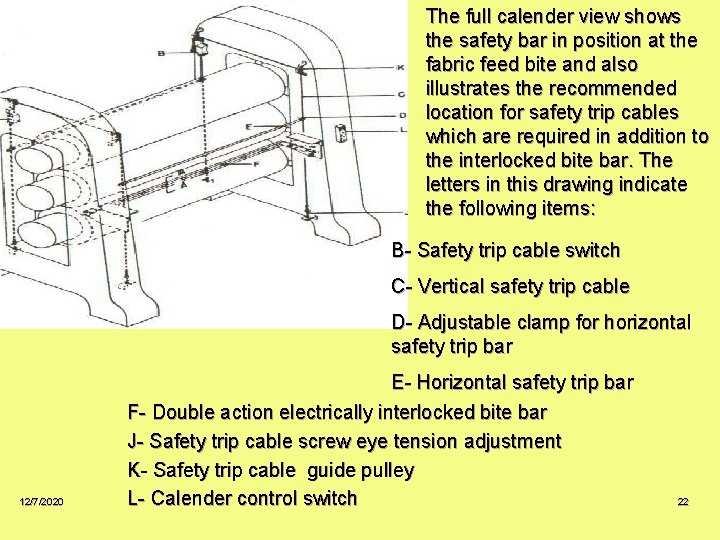
The full calender view shows the safety bar in position at the fabric feed bite and also illustrates the recommended location for safety trip cables which are required in addition to the interlocked bite bar. The letters in this drawing indicate the following items: B- Safety trip cable switch C- Vertical safety trip cable D- Adjustable clamp for horizontal safety trip bar 12/7/2020 E- Horizontal safety trip bar F- Double action electrically interlocked bite bar J- Safety trip cable screw eye tension adjustment K- Safety trip cable guide pulley L- Calender control switch 22
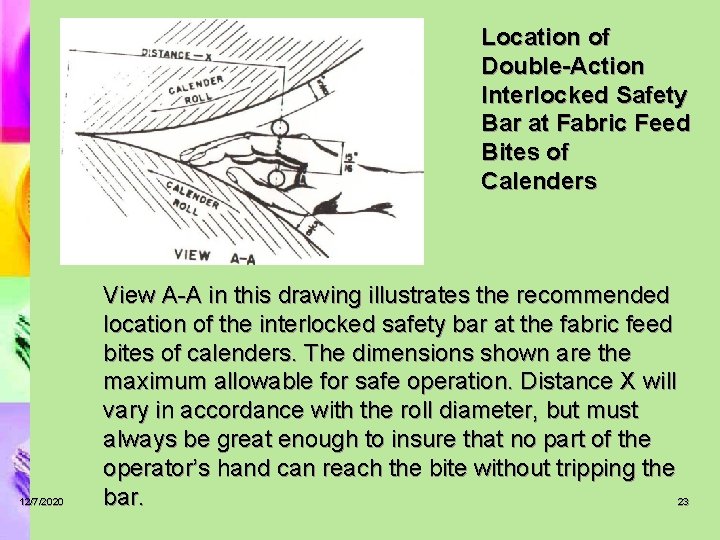
Location of Double-Action Interlocked Safety Bar at Fabric Feed Bites of Calenders 12/7/2020 View A-A in this drawing illustrates the recommended location of the interlocked safety bar at the fabric feed bites of calenders. The dimensions shown are the maximum allowable for safe operation. Distance X will vary in accordance with the roll diameter, but must always be great enough to insure that no part of the operator’s hand can reach the bite without tripping the bar. 23
Accident Scenario Accident in the Mill Room 12/7/2020 24
12/7/2020 George is an experienced mill operator at BWC Rubber Company. While at his work station milling rubber, George’s arm is caught in the mill. George activates the safety cable but his arm is pulled into the mill up to his shoulder before the mill stops rotating. 25
George screams for help. John, hears George and quickly responds to the sound of his voice. John calls for additional help and retrieves a blanket form the mill rescue box. John then places the blanket between the hot mill roll and George. 12/7/2020 26
Other employees quickly arrive to George’s work station and retrieve tools from the mill rescue box. One of the mill rescue team members, Steve, climbs below the mill to cut away the rubber. The other rescue team workers open to crack the mill and begin to free George from the rolls. They utilize pry bars to separate the rolls and hooks to pull the rubber out from between the mill rolls. 12/7/2020 27
Mill Emergency Kit l l l l l 12/7/2020 Thermal blanket Rubber knives Flashlights Pry bars 2 Sledge hammers 2 Wedges Rubber hooks Clean rag Mill gloves l l 2 Porta-power pumps (hydraulic pumps) Blood-born pathogen kit First Aid Kit Latex gloves 28
Summary and Questions 12/7/2020 29
12/7/2020 30