
Military Readiness Challenges in the Contemporary Security Landscape

- Slides: 15
Military Readiness Challenges in the Contemporary Security Landscape With a focus on: Military Readiness and Security Sector Governance and Development/Reform Dr. Albrecht Schnabel, DCAF, Switzerland Colombo Defense Seminar 2019 Colombo, Sri Lanka, 30 August 2019
Main Message Continuous security sector development/reform (SSD/R) along good governance principles – in other words adjustment to changing internal and external security environments – is crucial to military preparedness
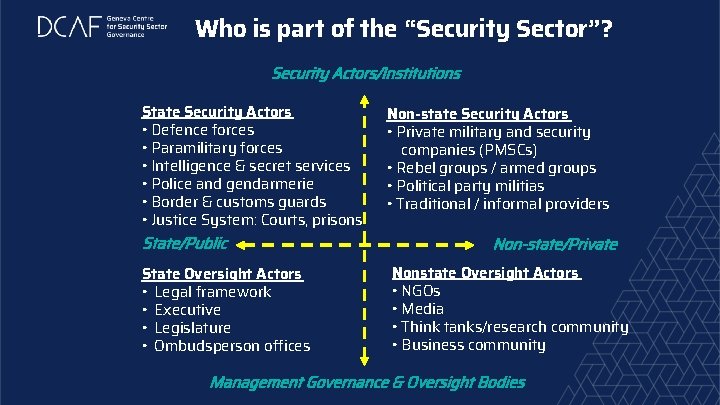
Who is part of the “Security Sector”? Security Actors/Institutions State Security Actors • Defence forces • Paramilitary forces • Intelligence & secret services • Police and gendarmerie • Border & customs guards • Justice System: Courts, prisons State/Public State Oversight Actors • Legal framework • Executive • Legislature • Ombudsperson offices Non-state Security Actors • Private military and security companies (PMSCs) • Rebel groups / armed groups • Political party militias • Traditional / informal providers Non-state/Private Nonstate Oversight Actors • NGOs • Media • Think tanks/research community • Business community Management Governance & Oversight Bodies
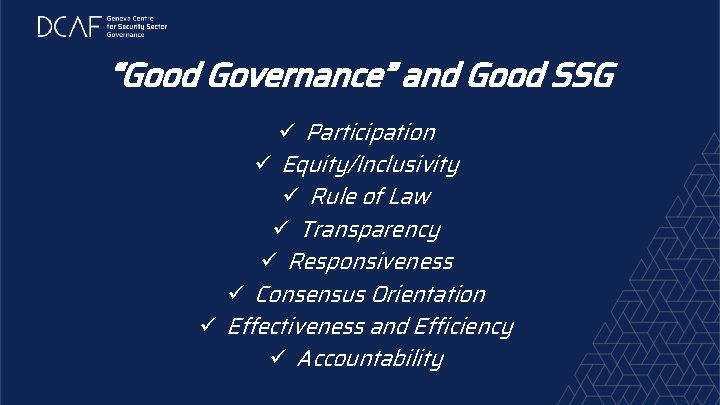
“Good Governance” and Good SSG ü Participation ü Equity/Inclusivity ü Rule of Law ü Transparency ü Responsiveness ü Consensus Orientation ü Effectiveness and Efficiency ü Accountability
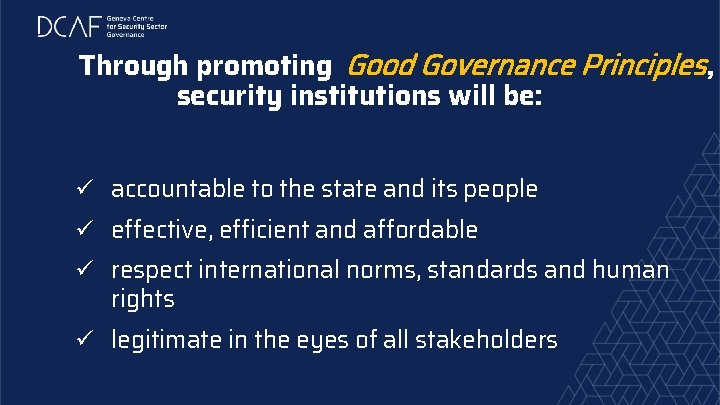
Through promoting Good Governance Principles, security institutions will be: ü accountable to the state and its people ü effective, efficient and affordable ü respect international norms, standards and human rights ü legitimate in the eyes of all stakeholders
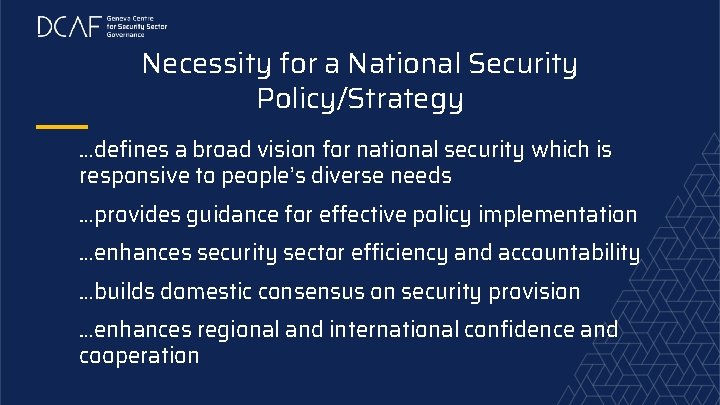
Necessity for a National Security Policy/Strategy …defines a broad vision for national security which is responsive to people’s diverse needs …provides guidance for effective policy implementation …enhances security sector efficiency and accountability …builds domestic consensus on security provision …enhances regional and international confidence and cooperation
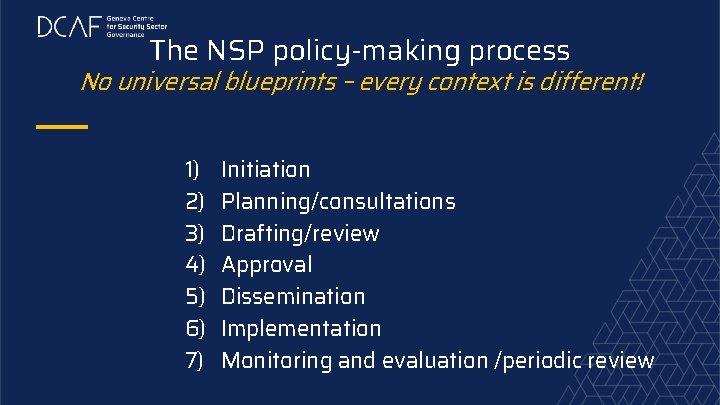
The NSP policy-making process No universal blueprints – every context is different! 1) 2) 3) 4) 5) 6) 7) Initiation Planning/consultations Drafting/review Approval Dissemination Implementation Monitoring and evaluation /periodic review
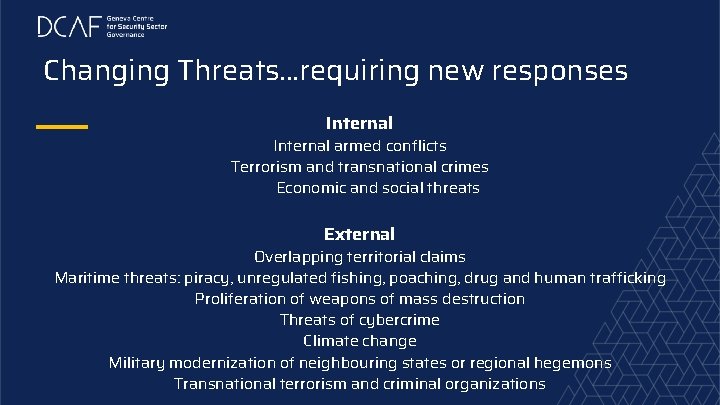
Changing Threats. . . requiring new responses Internal armed conflicts Terrorism and transnational crimes Economic and social threats External Overlapping territorial claims Maritime threats: piracy, unregulated fishing, poaching, drug and human trafficking Proliferation of weapons of mass destruction Threats of cybercrime Climate change Military modernization of neighbouring states or regional hegemons Transnational terrorism and criminal organizations
How to meet new threats and remain optimally prepared? ü Revising defence objectives and capabilities to keep up with developing threats – in today’s security environment a constant challenge in all countries! ü Informed by national objectives on security, foreign policy, and budget, a defence policy and periodic reviews allow defence forces to meet new security challenges.
Who carries out defence reform? ü Civilian ministries (or departments) of defence are best placed to carry out defence reforms. But the ministry must have appropriate civilian and military expertise to manage a complex process. ü A comprehensive process will consider both national and international actors, as well as both public and private institutions with a role in the defence sector.
Asia-Pacific Security Sector Governance Network Ø New DCAF initiative with regional and national partner insitutions working on security sector governance promotion in the Asia-Pacific region – South Asia, Southeast Asia and East Asia. Ø National SSG Working Groups Ø Regional and Asia-Pacific-wide Forums
Goals of the Network Initiative ü Creation of useful platform for academics and practitioners in the region to meet at national, subregional and regional levels to share experiences on SSG and SSD/R issues. ü Meaningful contributions to ongoing national SSD/R initiatives and in identifying and developing new ones.
Summary – Take Aways • Military preparedness requires constant re-assessments and re-adjustment to new security realities. • A thorough security sector review as starting point to analyse relationship between threats and preparedness. • Providing security as a public service requires coordination across full range of security sector actors, including those providing management and oversight. • Important are threat and response analyses through an inclusive process, based on a national security policy and strategy!
. . . Summary – Take Aways • Examine the suitability to meet new threat environments by the current security system and response mechanisms. • Continuously invest in making responses compatible with prevalent threats – and to secure public and parliamentary support for the measures that are necessary to take. • Importance of regional solutions; and to invest in mainstreaming good security sector governance throughout the security sector.
Thank you for your attention!