
MILITARY DECISIONMAKING PROCESS IN PEACE SUPPORT OPERATIONS MAJ




- Slides: 71
MILITARY DECISION-MAKING PROCESS IN PEACE SUPPORT OPERATIONS MAJ Stasys VILKINAS (LT)
CONTENT • • MDMP? MDMP step by step IPB Continuation of MDMP step by step Work in syndicates Seminar in the group My sum-up
REFERENCE • • US FM 5 -0, The Operations Process, 2010 US ADP 3 -0, Unified Land Operations, 2011 US FM 2 -0. 13 / MCRP 2 -3 A, IPB/B, 2009 Lieutenant Colonel W. J. Cojocar, „Adaptive Leadership in the Military Decision Making Process“, US ACAC UK MOD JWP 3 -50, 2 nd Edition, The Military Contribution To Peace Support Operations, 2004 NATO AJP-3. 4. 1, Peace Support Operations, 2001 Major J. D. Nawoichyk, „MDMP: One Tool in the Commander’s Tool Chest“, ALMC Art R. J. , Waltz K. N. The use of force: Military power and International politics, New York: Rowman & Littlefied Publishers, INC. , 2004
WHY ? In April 1999 during the NATO in Washington D. C. , our nations committed their forces to defend the peace and stability in our regions and periphery.
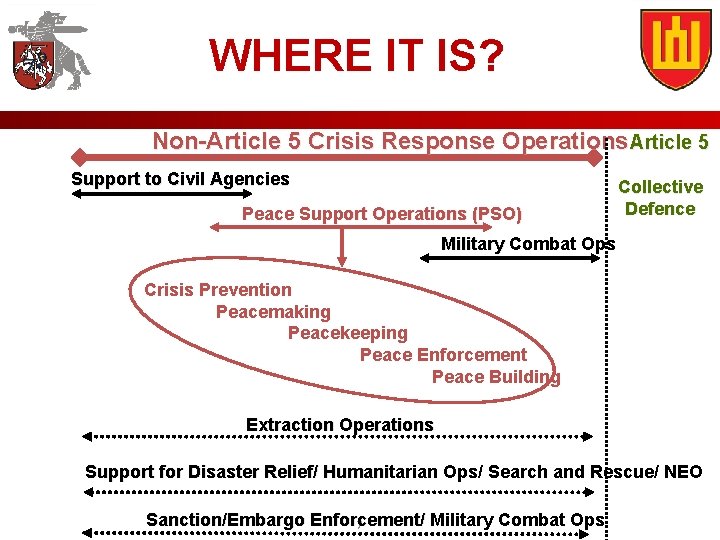
WHAT IT MEANS ? Military operations: • Article 5 Collective Defence Operations • non-Article 5 Crisis Response Operations (CRO including the PSO)
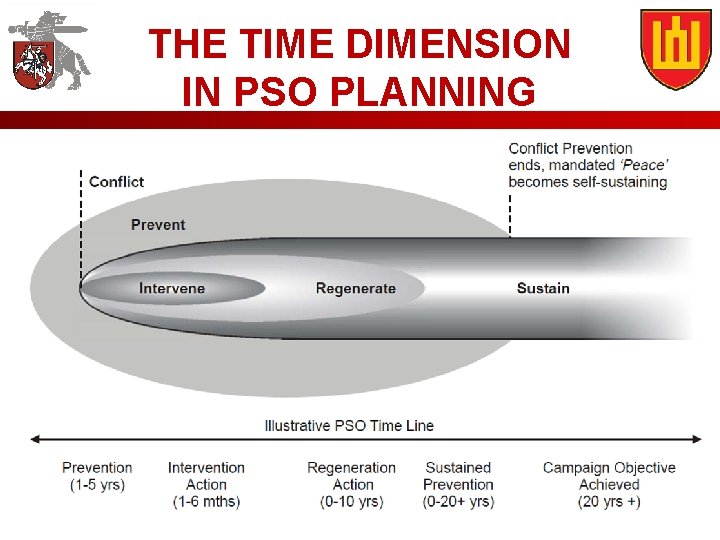
THE TIME DIMENSION IN PSO PLANNING
WHERE IT IS? Non-Article 5 Crisis Response Operations Article 5 Support to Civil Agencies Peace Support Operations (PSO) Collective Defence Military Combat Ops Crisis Prevention Peacemaking Peacekeeping Peace Enforcement Peace Building Extraction Operations Support for Disaster Relief/ Humanitarian Ops/ Search and Rescue/ NEO Sanction/Embargo Enforcement/ Military Combat Ops 7
MDMP 2020 -11 -27 8
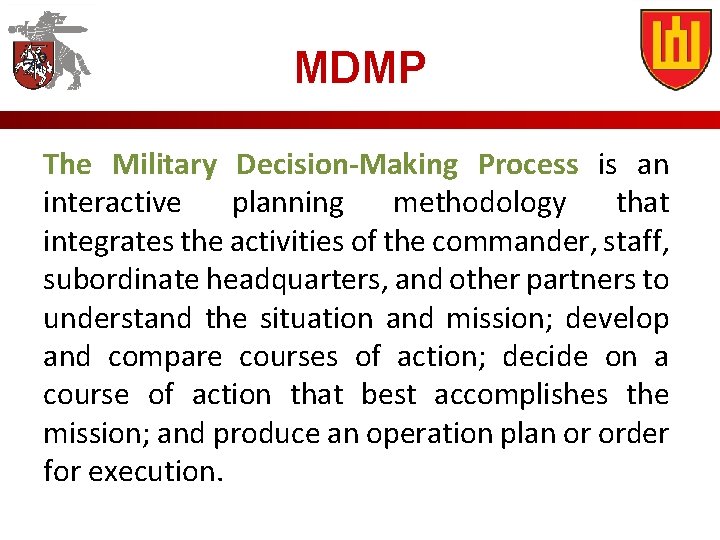
MDMP The Military Decision-Making Process is an interactive planning methodology that integrates the activities of the commander, staff, subordinate headquarters, and other partners to understand the situation and mission; develop and compare courses of action; decide on a course of action that best accomplishes the mission; and produce an operation plan or order for execution.
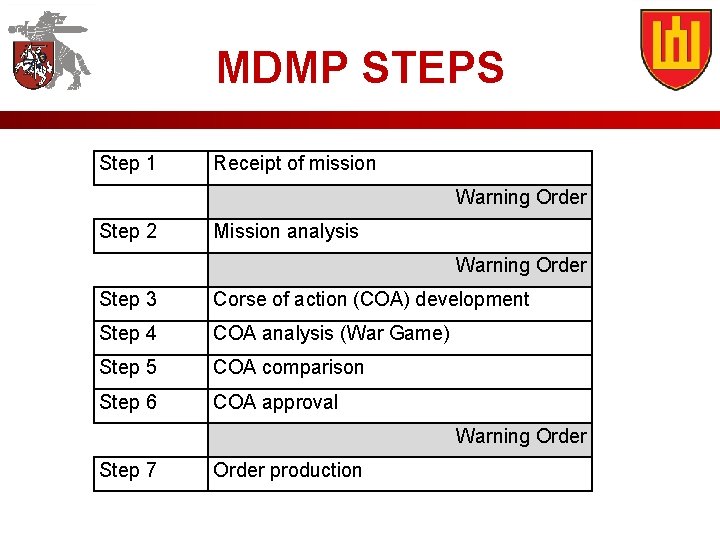
MDMP STEPS Step 1 Receipt of mission Warning Order Step 2 Mission analysis Warning Order Step 3 Corse of action (COA) development Step 4 COA analysis (War Game) Step 5 COA comparison Step 6 COA approval Warning Order Step 7 Order production
1 st STEP • Purpose of the Receipt of mission – “to alert all participants of the pending planning requirements, determine the amount of time available for planning and preparation, and decide on a planning approach, including guidance on design and how to abbreviate the MDMP, if required”
RECEIPT OF MISSION Alert staff members and informs about the pending planning requirements. • The staff members gathers the tools needed to perform the planning. • • Each staff member updated their running estimate. • The commander and staff conduct an initial assessment of time and resources available. • The commander issue guidance. • The last task is to issue a Warning Order (WARNO).
GATHER THE TOOLS • Appropriate manuals. • All documents related to the mission and area of operations (AO), including the higher headquarters’ OPLAN and OPORD, maps and terrain products, and operational graphics. • Higher headquarters’ and other organizations’ intelligence and assessment products. • Estimates and products of other military and civilian agencies and organizations. • Both their own and the higher headquarters’ SOPs. • Current running estimates. • Any design products, including the design concept.
RECEIPT OF MISSION • Alert staff members and informs about the pending planning requirements. • The staff members gathers the tools needed to perform the planning. • Each staff member updated their running estimate. • The commander and staff conduct an initial assessment of time and resources available. • The commander issue guidance. • The last task is to issue a Warning Order (WARNO).
GUIDANCE • • Initial time allocations. A decision to initiate design or go straight into the MDMP. How to abbreviate the MDMP, if required. Necessary coordination to perform, including liaison officers to exchange. Authorized movements and any reconnaissance and surveillance to initiate. Collaborative planning times and locations. Initial information requirements (IRs). Additional staff tasks
RECEIPT OF MISSION • Alert staff members and informs about the pending planning requirements. • The staff members gathers the tools needed to perform the planning. • Each staff member updated their running estimate. • The commander and staff conduct an initial assessment of time and resources available. • The commander issue guidance. • The last task is to issue a Warning Order (WARNO).
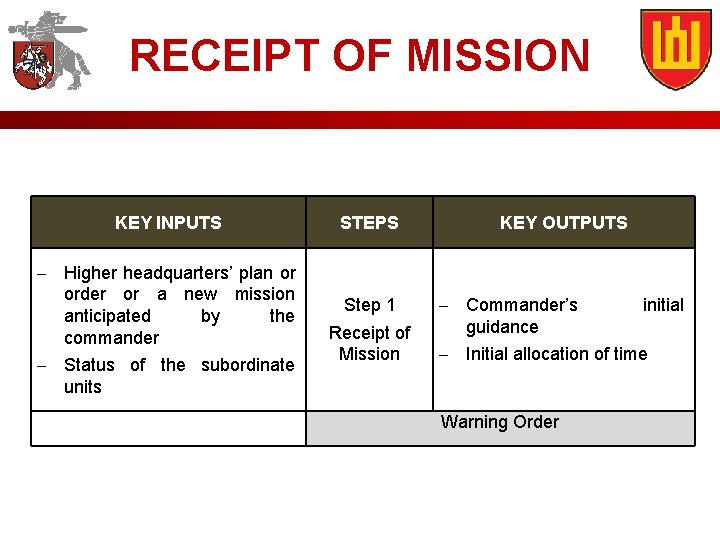
RECEIPT OF MISSION KEY INPUTS Higher headquarters’ plan or order or a new mission anticipated by the commander Status of the subordinate units STEPS KEY OUTPUTS Step 1 Commander’s initial guidance Initial allocation of time Receipt of Mission Warning Order
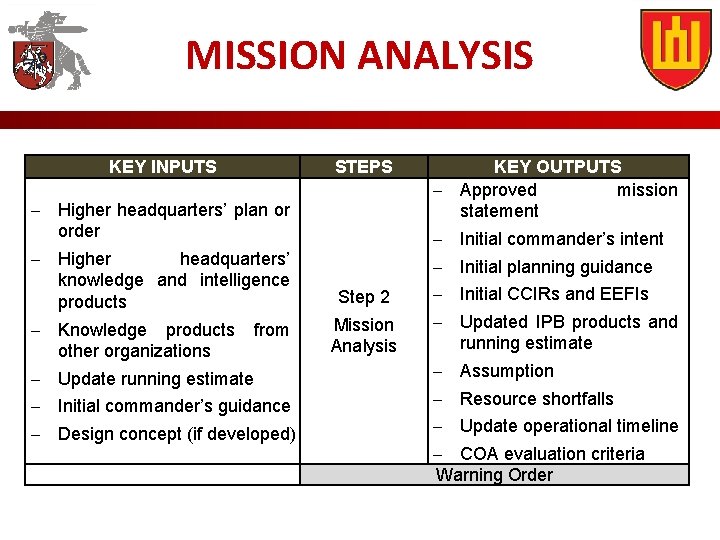
2 nd STEP • Purpose of the Mission analysis – To gather, analyze, and synthesize available information to understand the current conditions and of the operational environment.
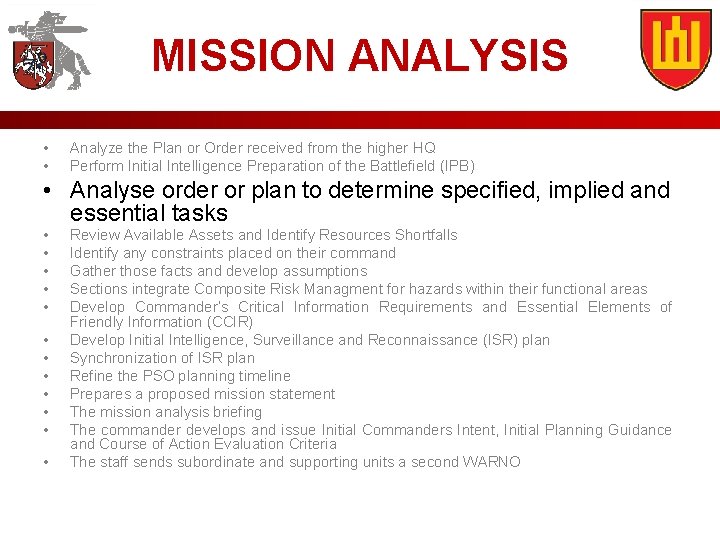
MISSION ANALYSIS • Analyze the Plan or Order received from the higher HQ • • • • Perform Initial Intelligence Preparation of the Battlefield (IPB) Analyse order or plan to determine specified, implied and essential tasks Review Available Assets and Identify Resources Shortfalls Identify any constraints placed on their command Gather those facts and develop assumptions Sections integrate Composite Risk Managment for hazards within their functional areas Develop Commander’s Critical Information Requirements and Essential Elements of Friendly Information (CCIR) Develop Initial Intelligence, Surveillance and Reconnaissance (ISR) plan Synchronization of ISR plan Refine the PSO planning timeline Prepares a proposed mission statement The mission analysis briefing The commander develops and issue Initial Commanders Intent, Initial Planning Guidance and Course of Action Evaluation Criteria The staff sends subordinate and supporting units a second WARNO
ANALYZE THE PLAN OR ORDER • The higher headquarters’— – – – Commander’s intent. Mission. Concept of operations. Available assets. Timeline. • The missions of adjacent, supporting, and supported units and their relationships to the higher headquarters’ plan. • The missions of interagency, intergovernmental, and nongovernmental organizations that work in the operational areas. • Their assigned area of operations.
MISSION ANALYSIS • Analyze the Plan or Order received from the higher HQ • Perform Initial Intelligence Preparation of the Battlefield (IPB) • • • • Analyse order or plan to determine specified, implied and essential tasks Review Available Assets and Identify Resources Shortfalls Identify any constraints placed on their command Gather those facts and develop assumptions Sections integrate Composite Risk Managment for hazards within their functional areas Develop Commander’s Critical Information Requirements and Essential Elements of Friendly Information (CCIR) Develop Initial Intelligence, Surveillance and Reconnaissance (ISR) plan Synchronization of ISR plan Refine the PSO planning timeline Prepares a proposed mission statement The mission analysis briefing The commander develops and issue Initial Commanders Intent, Initial Planning Guidance and Course of Action Evaluation Criteria The staff sends subordinate and supporting units a second WARNO
INTELLIGENCE PREPARATION OF THE BATTLEFIELD (IPB) 2020 -11 -27 22
IPB INTELLIGENCE PREPARATION OF THE BATTLEFIELD – a systematic, continuous process of analyzing the threat and environment in a specific geographic area. It is designed to support staff estimates and military decision making.
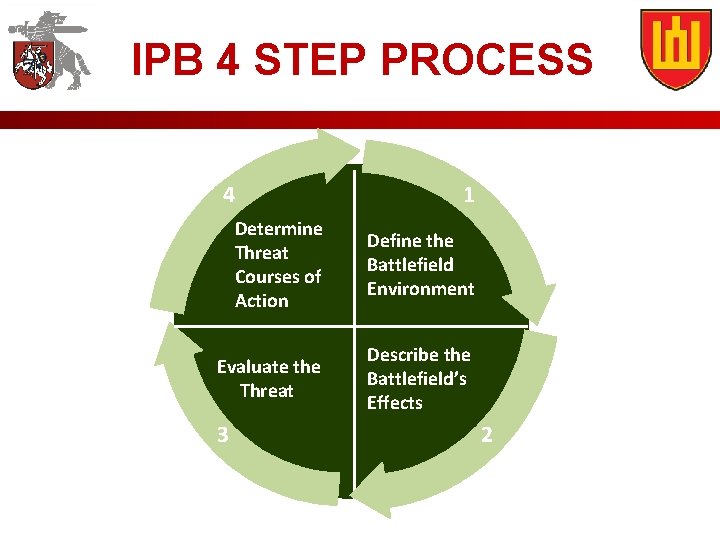
IPB 4 STEP PROCESS 4 1 Determine Threat Courses of Action Define the Battlefield Environment Evaluate the Threat Describe the Battlefield’s Effects 3 2
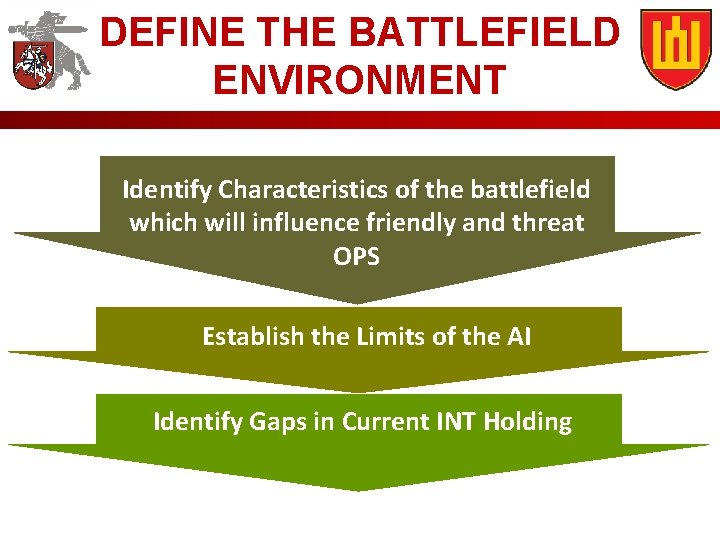
DEFINE THE BATTLEFIELD ENVIRONMENT Identify Characteristics of the battlefield which will influence friendly and threat OPS Establish the Limits of the AI Identify Gaps in Current INT Holding
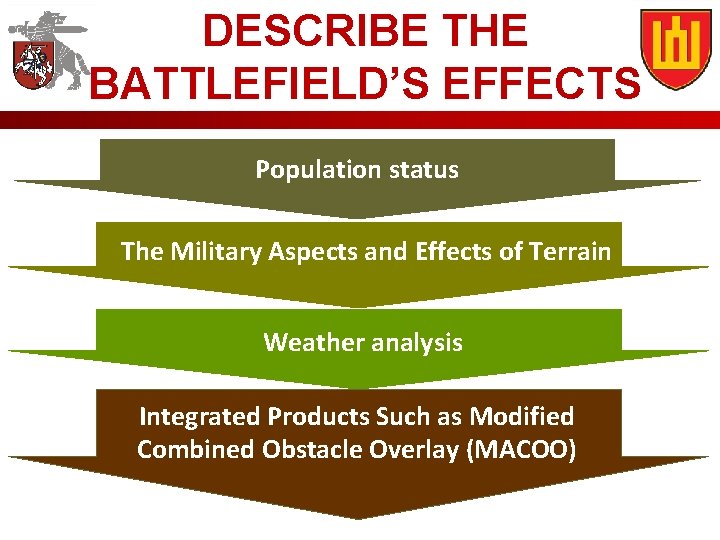
DESCRIBE THE BATTLEFIELD’S EFFECTS Population status The Military Aspects and Effects of Terrain Weather analysis Integrated Products Such as Modified Combined Obstacle Overlay (MACOO)
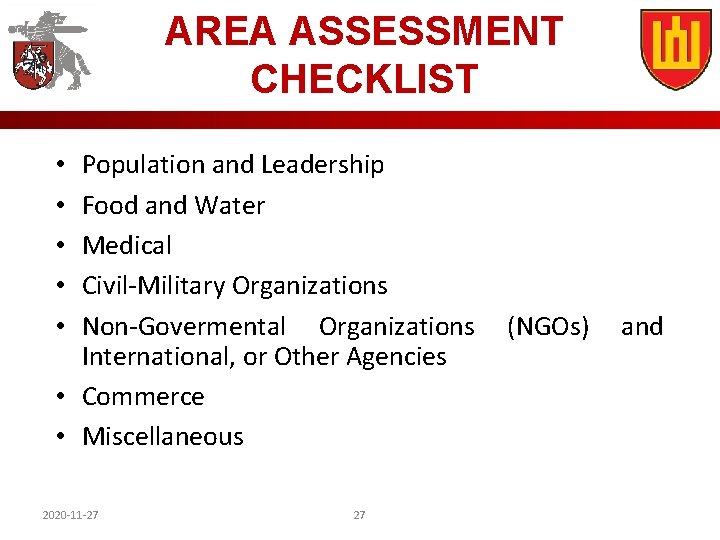
AREA ASSESSMENT CHECKLIST Population and Leadership Food and Water Medical Civil-Military Organizations Non-Govermental Organizations International, or Other Agencies • Commerce • Miscellaneous • • • 2020 -11 -27 27 (NGOs) and
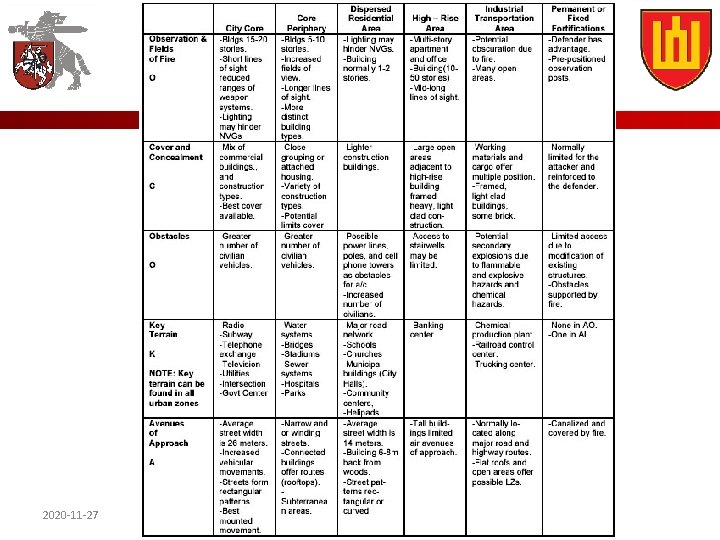
2020 -11 -27 28
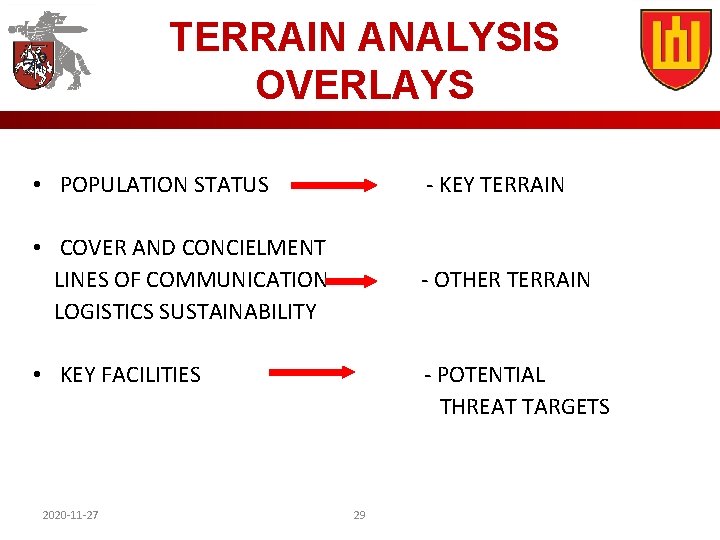
TERRAIN ANALYSIS OVERLAYS • POPULATION STATUS - KEY TERRAIN • COVER AND CONCIELMENT LINES OF COMMUNICATION LOGISTICS SUSTAINABILITY - OTHER TERRAIN • KEY FACILITIES 2020 -11 -27 - POTENTIAL THREAT TARGETS 29
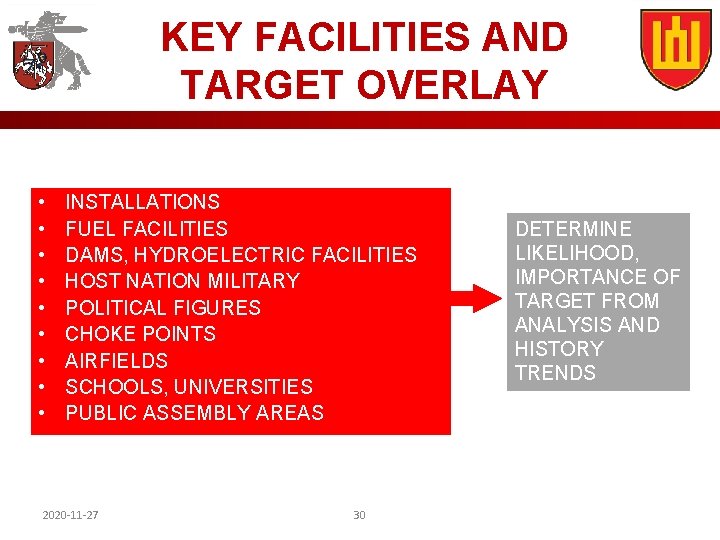
KEY FACILITIES AND TARGET OVERLAY • • • INSTALLATIONS FUEL FACILITIES DAMS, HYDROELECTRIC FACILITIES HOST NATION MILITARY POLITICAL FIGURES CHOKE POINTS AIRFIELDS SCHOOLS, UNIVERSITIES PUBLIC ASSEMBLY AREAS 2020 -11 -27 30 DETERMINE LIKELIHOOD, IMPORTANCE OF TARGET FROM ANALYSIS AND HISTORY TRENDS
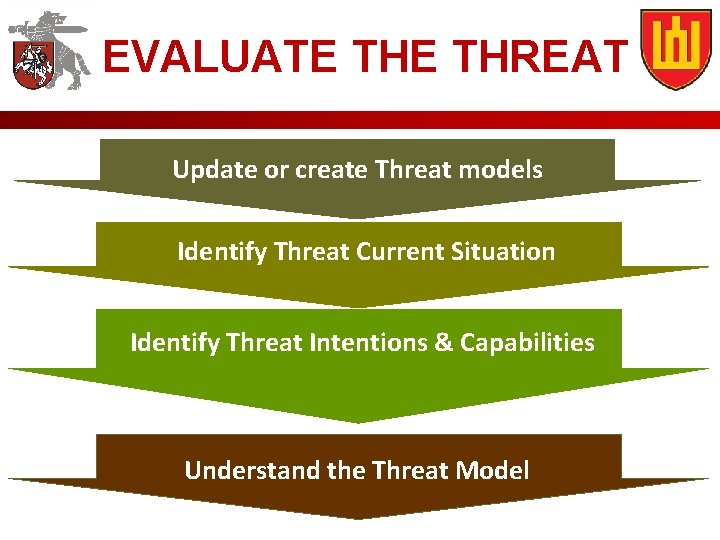
EVALUATE THREAT Update or create Threat models Identify Threat Current Situation Identify Threat Intentions & Capabilities Understand the Threat Model
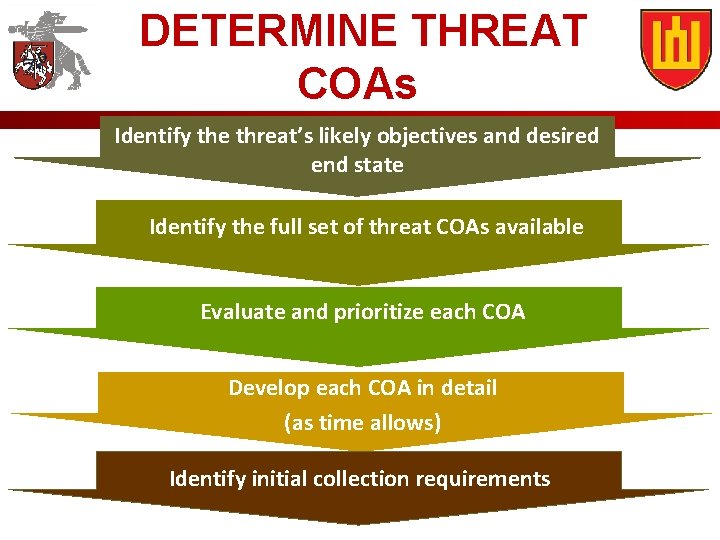
DETERMINE THREAT COAs Identify the threat’s likely objectives and desired end state Identify the full set of threat COAs available Evaluate and prioritize each COA Develop each COA in detail (as time allows) Identify initial collection requirements
MISSION ANALYSIS • • Analyze the Plan or Order received from the higher HQ Perform Initial Intelligence Preparation of the Battlefield (IPB) • Analyse order or plan to determine specified, implied and essential tasks • • • Review Available Assets and Identify Resources Shortfalls Identify any constraints placed on their command Gather those facts and develop assumptions Sections integrate Composite Risk Managment for hazards within their functional areas Develop Commander’s Critical Information Requirements and Essential Elements of Friendly Information (CCIR) Develop Initial Intelligence, Surveillance and Reconnaissance (ISR) plan Synchronization of ISR plan Refine the PSO planning timeline Prepares a proposed mission statement The mission analysis briefing The commander develops and issue Initial Commanders Intent, Initial Planning Guidance and Course of Action Evaluation Criteria The staff sends subordinate and supporting units a second WARNO
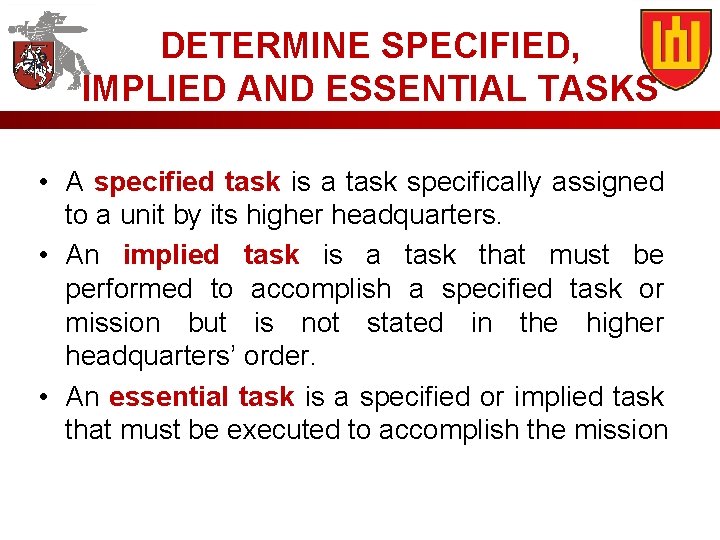
DETERMINE SPECIFIED, IMPLIED AND ESSENTIAL TASKS • A specified task is a task specifically assigned to a unit by its higher headquarters. • An implied task is a task that must be performed to accomplish a specified task or mission but is not stated in the higher headquarters’ order. • An essential task is a specified or implied task that must be executed to accomplish the mission
MISSION ANALYSIS • • • Analyze the Plan or Order received from the higher HQ Perform Initial Intelligence Preparation of the Battlefield (IPB) Analyse order or plan to determine specified, implied and essential tasks • • Review Available Assets and Identify Resources Shortfalls Identify any constraints placed on their command Gather those facts and develop assumptions Sections integrate Composite Risk Managment for hazards within their functional areas Develop Commander’s Critical Information Requirements and Essential Elements of Friendly Information (CCIR) • • Develop Initial Intelligence, Surveillance and Reconnaissance (ISR) plan Synchronization of ISR plan Refine the PSO planning timeline Prepares a proposed mission statement The mission analysis briefing The commander develops and issue Initial Commanders Intent, Initial Planning Guidance and Course of Action Evaluation Criteria The staff sends subordinate and supporting units a second WARNO
MISSION ANALYSIS • • • Analyze the Plan or Order received from the higher HQ Perform Initial Intelligence Preparation of the Battlefield (IPB) Analyse order or plan to determine specified, implied and essential tasks Review Available Assets and Identify Resources Shortfalls Identify any constraints placed on their command Gather those facts and develop assumptions Sections integrate Composite Risk Managment for hazards within their functional areas Develop Commander’s Critical Information Requirements and Essential Elements of Friendly Information (CCIR) Develop Initial Intelligence, Surveillance and Reconnaissance (ISR) plan • Synchronization of ISR plan • • • Refine the PSO planning timeline Prepares a proposed mission statement The mission analysis briefing The commander develops and issue Initial Commanders Intent, Initial Planning Guidance and Course of Action Evaluation Criteria The staff sends subordinate and supporting units a second WARNO
ISR SYNCHRONIZATION ACCOMPLISHES • Identifies requirements and intelligence gaps. • Evaluates available assets (internal and external) to collect information. • Determines gaps in the use of those assets. • Recommends those ISR assets controlled by the organization to collect on the IRs. • Submits RFIs for adjacent and higher collection support. • The G-2 (S-2) submits information gathered during ISR synchronization to the G-3 (S-3) for integration and development of the ISR plan.
MISSION ANALYSIS • • Analyze the Plan or Order received from the higher HQ Perform Initial Intelligence Preparation of the Battlefield (IPB) Analyse order or plan to determine specified, implied and essential tasks Review Available Assets and Identify Resources Shortfalls Identify any constraints placed on their command Gather those facts and develop assumptions Sections integrate Composite Risk Managment for hazards within their functional areas Develop Commander’s Critical Information Requirements and Essential Elements of Friendly Information (CCIR) • Develop Initial Intelligence, Surveillance and Reconnaissance (ISR) plan • • • Synchronization of ISR plan Refine the PSO planning timeline Prepares a proposed mission statement The mission analysis briefing The commander develops and issue Initial Commanders Intent, Initial Planning Guidance and Course of Action Evaluation Criteria The staff sends subordinate and supporting units a second WARNO
INITIAL ISR PLAN • Develop the ISR plan by developing— – The ISR tasking matrix. – The ISR overlay. – The ISR scheme of support. • Issue order (warning, operation, or fragmentary order).
MISSION ANALYSIS • • • Analyze the Plan or Order received from the higher HQ Perform Initial Intelligence Preparation of the Battlefield (IPB) Analyse order or plan to determine specified, implied and essential tasks Review Available Assets and Identify Resources Shortfalls Identify any constraints placed on their command Gather those facts and develop assumptions Sections integrate Composite Risk Managment for hazards within their functional areas Develop Commander’s Critical Information Requirements and Essential Elements of Friendly Information (CCIR) Synchronization of ISR plan Develop Initial Intelligence, Surveillance and Reconnaissance (ISR) plan • Refine the PSO planning timeline • Prepares a proposed mission statement • • • The mission analysis briefing The commander develops and issue Initial Commanders Intent, Initial Planning Guidance and Course of Action Evaluation Criteria The staff sends subordinate and supporting units a second WARNO
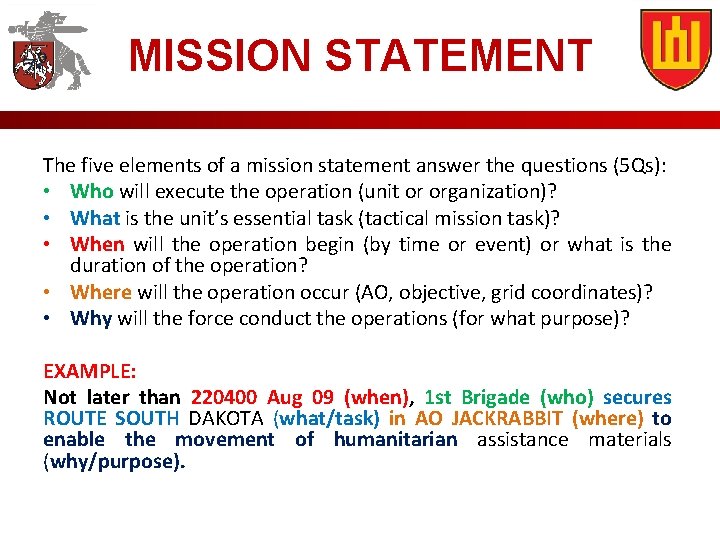
MISSION STATEMENT The five elements of a mission statement answer the questions (5 Qs): • Who will execute the operation (unit or organization)? • What is the unit’s essential task (tactical mission task)? • When will the operation begin (by time or event) or what is the duration of the operation? • Where will the operation occur (AO, objective, grid coordinates)? • Why will the force conduct the operations (for what purpose)? EXAMPLE: Not later than 220400 Aug 09 (when), 1 st Brigade (who) secures ROUTE SOUTH DAKOTA (what/task) in AO JACKRABBIT (where) to enable the movement of humanitarian assistance materials (why/purpose).
MISSION ANALYSIS • • • Analyze the Plan or Order received from the higher HQ Perform Initial Intelligence Preparation of the Battlefield (IPB) Analyse order or plan to determine specified, implied and essential tasks Review Available Assets and Identify Resources Shortfalls Identify any constraints placed on their command Gather those facts and develop assumptions Sections integrate Composite Risk Managment for hazards within their functional areas Develop Commander’s Critical Information Requirements and Essential Elements of Friendly Information (CCIR) Synchronization of ISR plan Develop Initial Intelligence, Surveillance and Reconnaissance (ISR) plan Refine the PSO planning timeline Prepares a proposed mission statement • The mission analysis briefing • The commander develops and issue Initial Commanders Intent, Initial Planning Guidance and Course of Action Evaluation Criteria • The staff sends subordinate and supporting units a second WARNO
MISSION ANALYSIS KEY INPUTS Higher headquarters’ plan or order Higher headquarters’ knowledge and intelligence products Knowledge products from other organizations Update running estimate Initial commander’s guidance Design concept (if developed) STEPS Step 2 Mission Analysis KEY OUTPUTS Approved mission statement Initial commander’s intent Initial planning guidance Initial CCIRs and EEFIs Updated IPB products and running estimate Assumption Resource shortfalls Update operational timeline COA evaluation criteria Warning Order
3 rd STEP • Purpose of the COA development – to generate options for follow-on analysis and comparison that satisfy the commander’s intent and planning guidance
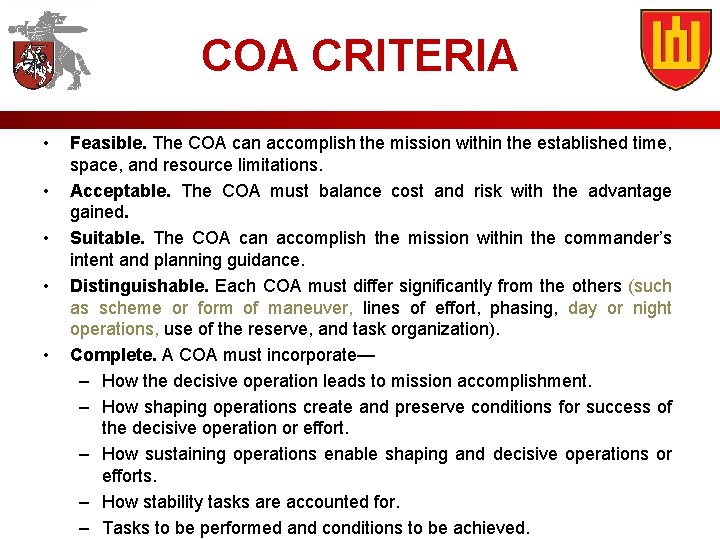
COA CRITERIA • • • Feasible. The COA can accomplish the mission within the established time, space, and resource limitations. Acceptable. The COA must balance cost and risk with the advantage gained. Suitable. The COA can accomplish the mission within the commander’s intent and planning guidance. Distinguishable. Each COA must differ significantly from the others (such as scheme or form of maneuver, lines of effort, phasing, day or night operations, use of the reserve, and task organization). Complete. A COA must incorporate— – How the decisive operation leads to mission accomplishment. – How shaping operations create and preserve conditions for success of the decisive operation or effort. – How sustaining operations enable shaping and decisive operations or efforts. – How stability tasks are accounted for. – Tasks to be performed and conditions to be achieved.
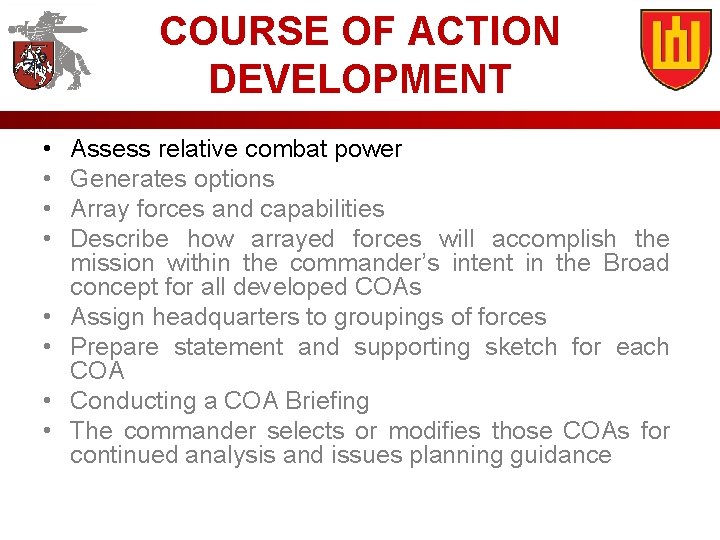
COURSE OF ACTION DEVELOPMENT • • Assess relative combat power Generates options Array forces and capabilities Describe how arrayed forces will accomplish the mission within the commander’s intent in the Broad concept for all developed COAs Assign headquarters to groupings of forces Prepare statement and supporting sketch for each COA Conducting a COA Briefing The commander selects or modifies those COAs for continued analysis and issues planning guidance
ANALYZING FORCE FOR COMBAT POWER • Friendly capabilities that pertain to the operation. • The types of operations possible from both friendly and enemy perspectives. • How and where the enemy may be vulnerable. • How and where friendly forces are vulnerable. • Additional resources that may be required to execute the mission. • How to allocate existing resources
COURSE OF ACTION DEVELOPMENT • • Assess relative combat power Generates options Array forces and capabilities Describe how arrayed forces will accomplish the mission within the commander’s intent in the Broad concept for all developed COAs Assign headquarters to groupings of forces Prepare statement and supporting sketch for each COA Conducting a COA Briefing The commander selects or modifies those COAs for continued analysis and issues planning guidance
THE COA SKETCH The COS includes the array of generic forces and control measures: • • • The unit and subordinate unit boundaries. Unit movement formations (but not subordinate unit formations). The line of departure, or line of contact and phase lines, if used. Reconnaissance and security graphics. Ground air axes of advance. Assembly areas, battle positions, strong points, engagement areas, and objectives. Obstacle control measures and tactical mission graphics. Fire support coordination and airspace control measures. Main effort. Location of command posts and critical information systems (INFOSYS) nodes. Enemy known or template locations. Population concentrations.
COURSE OF ACTION DEVELOPMENT • • Assess relative combat power Generates options Array forces and capabilities Describe how arrayed forces will accomplish the mission within the commander’s intent in the Broad concept for all developed COAs Assign headquarters to groupings of forces Prepare statement and supporting sketch for each COA Conducting a COA Briefing The commander selects or modifies those COAs for continued analysis and issues planning guidance
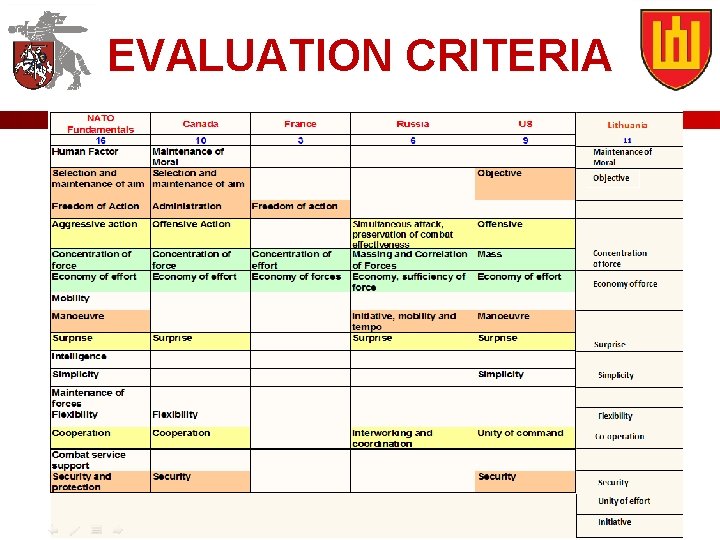
EVALUATION CRITERIA
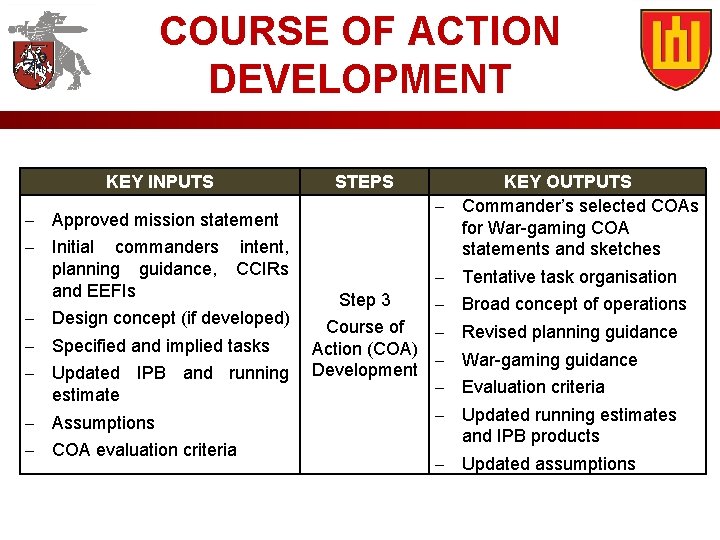
COURSE OF ACTION DEVELOPMENT KEY INPUTS Approved mission statement Initial commanders intent, planning guidance, CCIRs and EEFIs Design concept (if developed) Specified and implied tasks Updated IPB and running estimate Assumptions COA evaluation criteria STEPS KEY OUTPUTS Commander’s selected COAs for War-gaming COA statements and sketches Step 3 Course of Action (COA) Development Tentative task organisation Broad concept of operations Revised planning guidance War-gaming guidance Evaluation criteria Updated running estimates and IPB products Updated assumptions
4 th STEP • Purpose of the COA analysis and war-gaming – is to enables commander and staff to „identify difficulties or coordination problems as well as probable consequences of planned actions for each COA being considered“
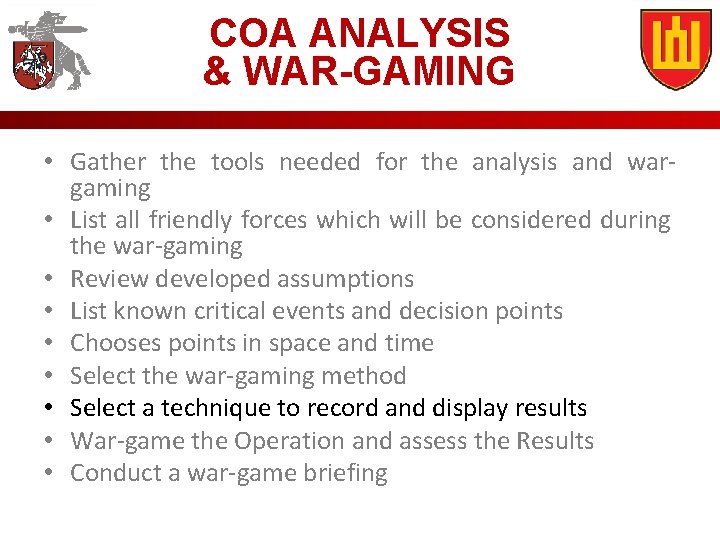
COA ANALYSIS & WAR-GAMING • Gather the tools needed for the analysis and wargaming • List all friendly forces which will be considered during the war-gaming • Review developed assumptions • List known critical events and decision points • Chooses points in space and time • Select the war-gaming method • Select a technique to record and display results • War-game the Operation and assess the Results • Conduct a war-game briefing
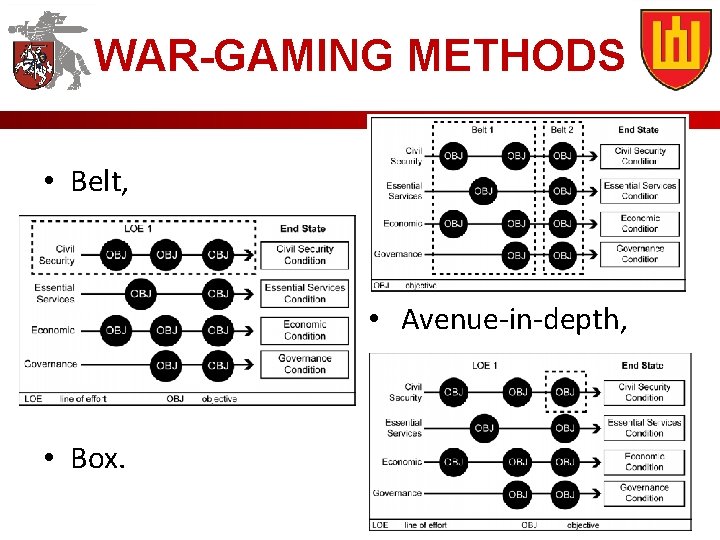
WAR-GAMING METHODS • Belt, • Avenue-in-depth, • Box.
COA ANALYSIS & WAR-GAMING • Gather the tools needed for the analysis and wargaming • List all friendly forces which will be considered during the war-gaming • Review developed assumptions • List known critical events and decision points • Chooses points in space and time • Select the war-gaming method • Select a technique to record and display results • War-game the Operation and assess the Results • Conduct a war-game briefing
TECHNIQUES • The synchronization matrix technique • The sketch note technique
THE WAR-GAME WORK SHEET Units and assigned tasks. Expected all adversary actions and reactions. Friendly and neutral counteractions and assets. Total assets needed for the task. Estimated time to accomplish the task. The decision point tied to executing the task (space or time). • CCIRs. • Control measures. • Remarks. • • •
COA ANALYSIS &WAR-GAMING • Gather the tools needed for the analysis and wargaming • List all friendly forces which will be considered during the war-gaming • Review developed assumptions • List known critical events and decision points • Chooses points in space and time • Select the war-gaming method • Select a technique to record and display results • War-game the Operation and assess the Results • Conduct a war-game briefing
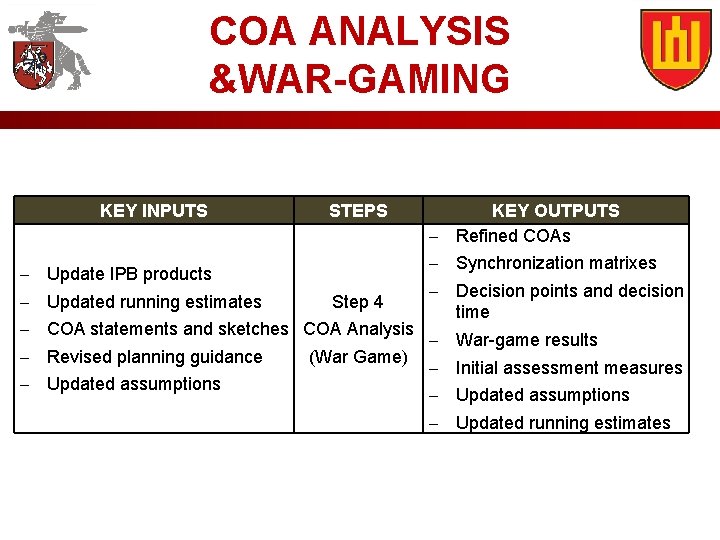
COA ANALYSIS &WAR-GAMING KEY INPUTS STEPS KEY OUTPUTS Refined COAs Synchronization matrixes Decision points and decision Updated running estimates Step 4 time COA statements and sketches COA Analysis War-game results Revised planning guidance (War Game) Initial assessment measures Updated assumptions Updated running estimates Update IPB products
5 th STEP • Purpose of the COA comparison – to identify the strengths and weaknesses of friendly COAs, enable their selecting with the highest probability of mission success
COA COMPARISON • Analysis and evaluating the advantages and disadvantages of each COA from the perspective of all staff members • Generalize key outputs and recommendations for commander in order for him to make the best decisions • Conduct a COA decision briefing
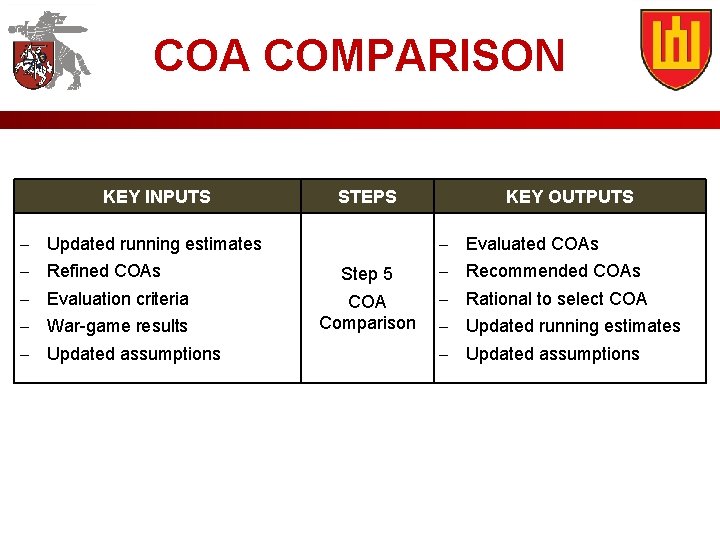
COA COMPARISON KEY INPUTS STEPS Updated running estimates Refined COAs Evaluation criteria War-game results Updated assumptions Step 5 COA Comparison KEY OUTPUTS Evaluated COAs Recommended COAs Rational to select COA Updated running estimates Updated assumptions
6 th STEP • Purpose of the COA approval – step is for commander to make a decision which COA will be used to accomplish the mission
COA APPROVAL • • • Issue final planning guidance CCIRs Commanders intent (if needed) Issue the risk commander accepts Issues a WARNO NOTE: During this step commander might decide to modify or give to the staff the entire different COA.
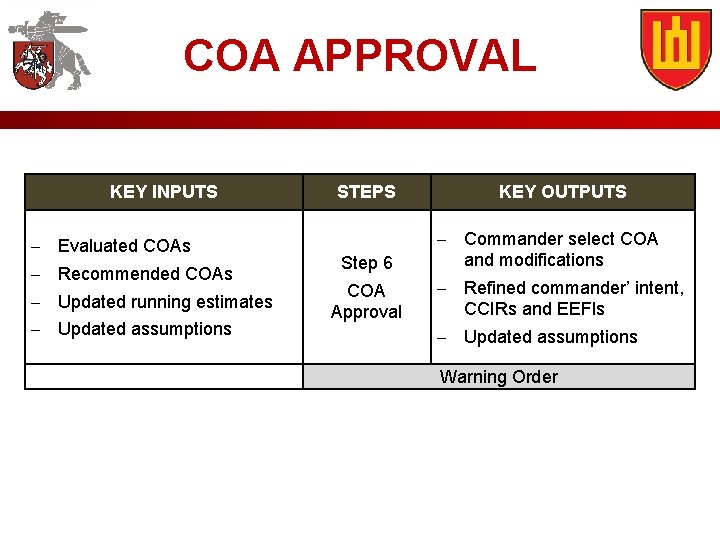
COA APPROVAL KEY INPUTS Evaluated COAs Recommended COAs Updated running estimates Updated assumptions STEPS Step 6 COA Approval KEY OUTPUTS Commander select COA and modifications Refined commander’ intent, CCIRs and EEFIs Updated assumptions Warning Order
7 th STEP • Purpose of the order production – to prepare the plan or order by turning the selected COA into a clear, concise concept of operation and required supporting information
ORDER PRODUCTION • Before the staff delivers order the commander will review and approve it unless he have delegated that authority • The commander and staff conduct confirmation briefings with subordinates immediately afterwards
2020 -11 -27 69
TASKS • Analyze the briefing and paper information within the syndicate • Prepare 5 questions for discussion • To bring for discussion: Specified task and at least 2 x implied tasks Essential task List of players for the operation (who, why) Commanders guidance for the Main and Supporting Efforts What capabilities You need for operation (can be the TASORG) – Evaluation criteria selection and why – Comparison of TLP (or national TLP ecvivalent) and MDMP – – –