
Military Contribution to Soft Power A comparative Analysis
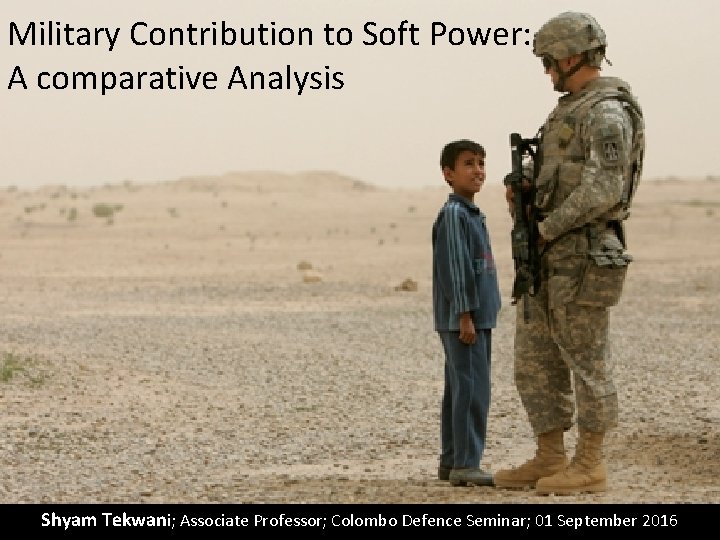
Military Contribution to Soft Power: A comparative Analysis Shyam Tekwani; Associate Professor; Colombo Defence Seminar; 01 September 2016
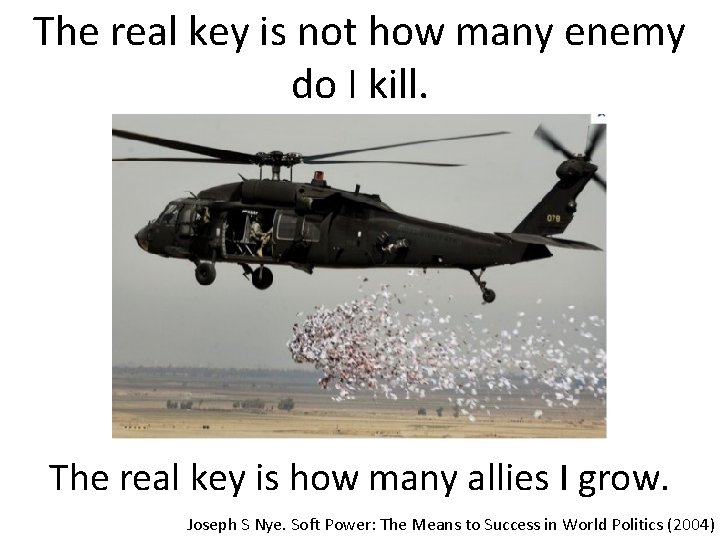
The real key is not how many enemy do I kill. The real key is how many allies I grow. Joseph S Nye. Soft Power: The Means to Success in World Politics (2004)
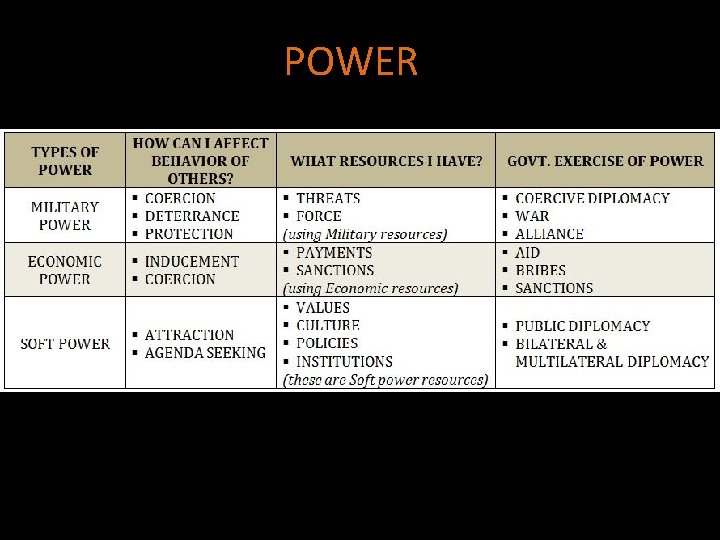
POWER
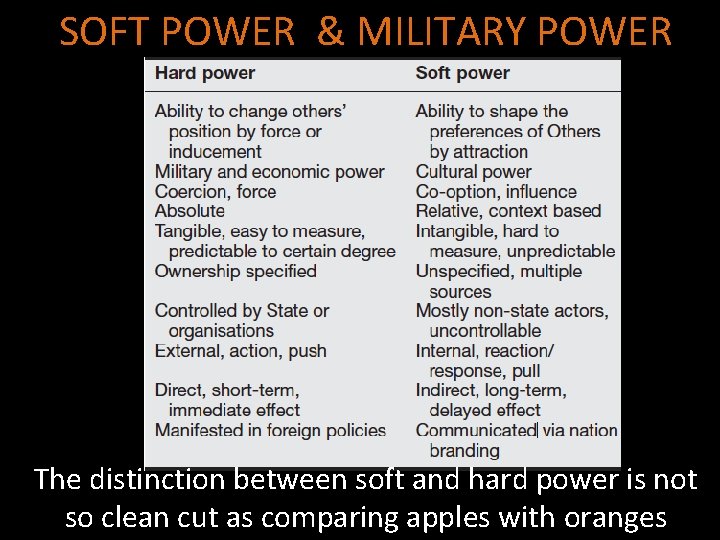
SOFT POWER & MILITARY POWER The distinction between soft and hard power is not so clean cut as comparing apples with oranges
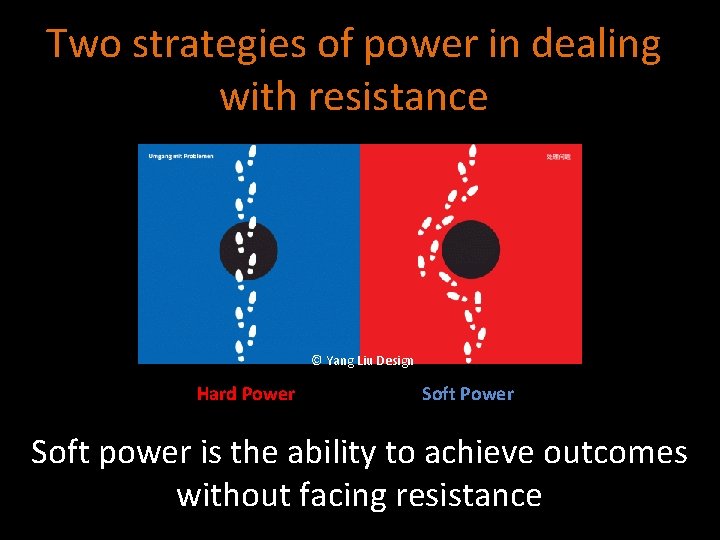
Two strategies of power in dealing with resistance © Yang Liu Design Hard Power Soft power is the ability to achieve outcomes without facing resistance
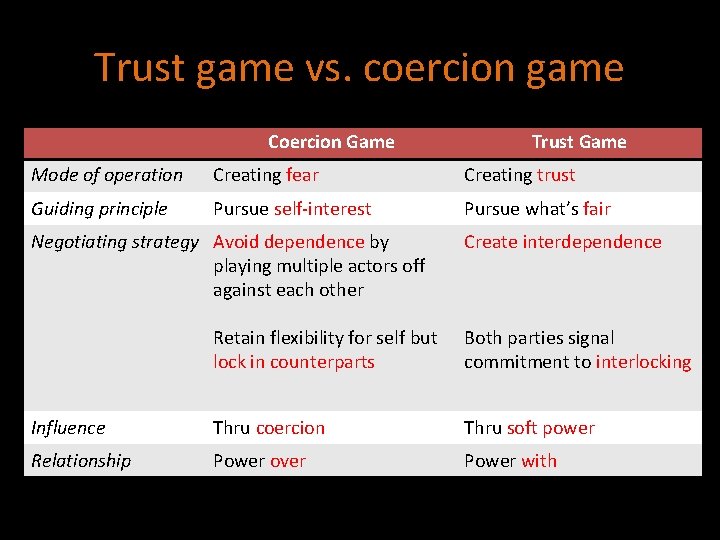
Trust game vs. coercion game Coercion Game Trust Game Mode of operation Creating fear Creating trust Guiding principle Pursue self-interest Pursue what’s fair Negotiating strategy Avoid dependence by playing multiple actors off against each other Create interdependence Retain flexibility for self but lock in counterparts Both parties signal commitment to interlocking Influence Thru coercion Thru soft power Relationship Power over Power with
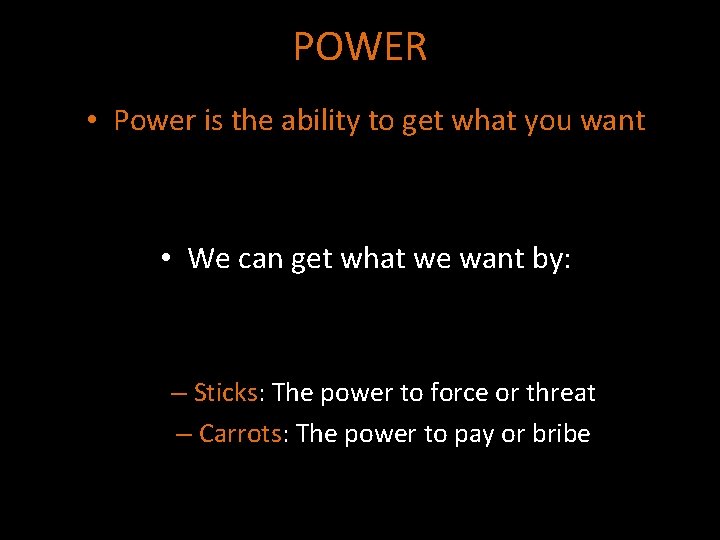
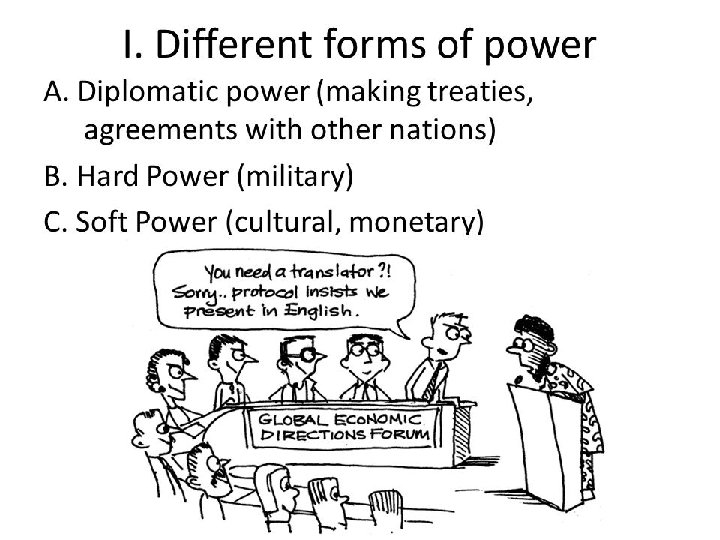
POWER • Power is the ability to get what you want • We can get what we want by: – Sticks: The power to force or threat – Carrots: The power to pay or bribe
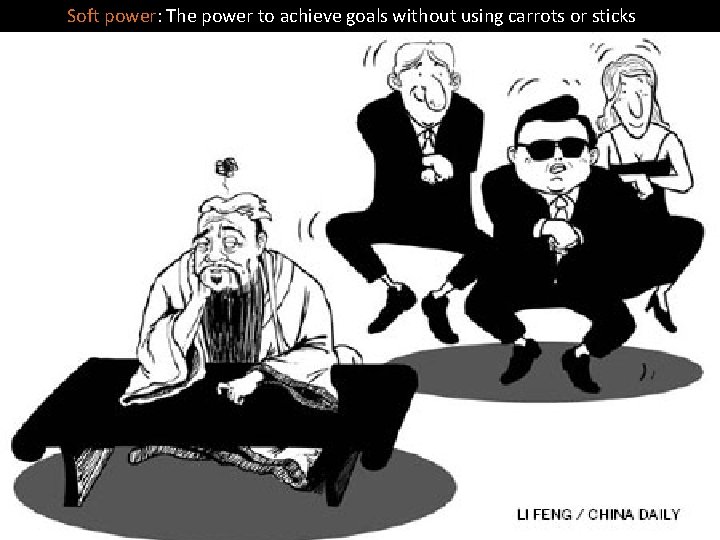
Soft power: The power to achieve goals without using carrots or sticks
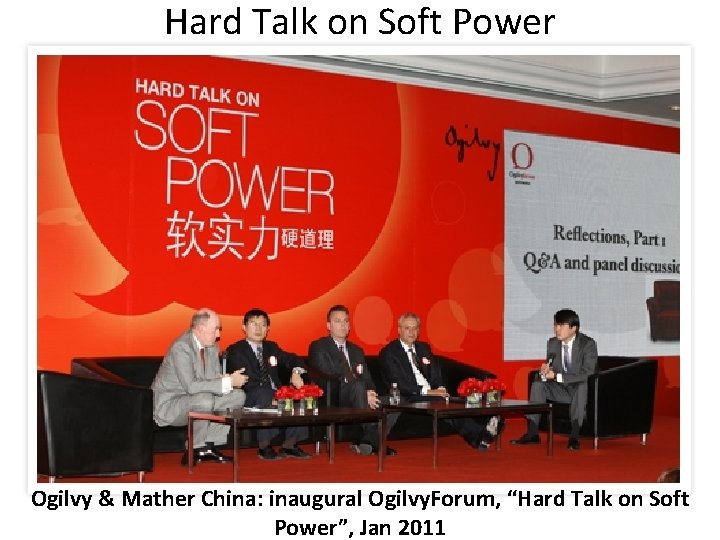
Hard Talk on Soft Power Ogilvy & Mather China: inaugural Ogilvy. Forum, “Hard Talk on Soft Power”, Jan 2011
Hard Talk on Soft Power • Ogilvy executives explained that the concept of soft power is very closely linked to that of nation branding • A brand is a combination of hard and soft attributes • The harder they are, the more rational; the softer they are, the more emotional • And soft power is hugely dependent on emotion
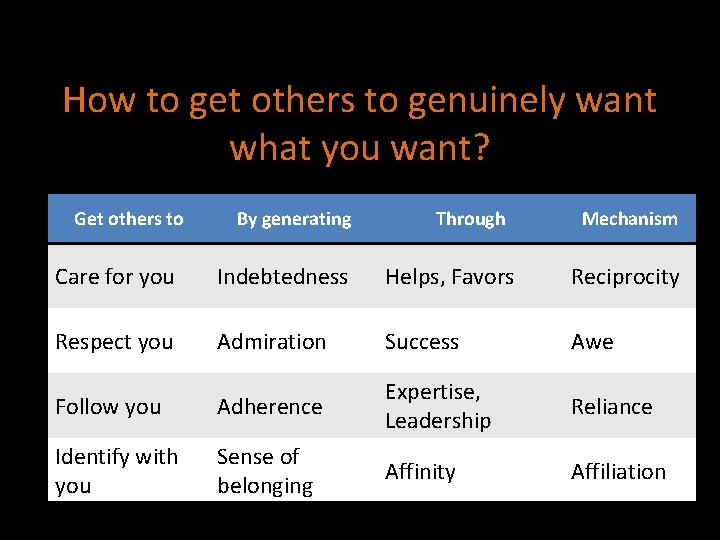
How to get others to genuinely want what you want? Get others to By generating Through Mechanism Care for you Indebtedness Helps, Favors Reciprocity Respect you Admiration Success Awe Follow you Adherence Expertise, Leadership Reliance Identify with you Sense of belonging Affinity Affiliation

The limits of powers Type of power Ultimate source Limitation Hard power Half hard power Half soft power Soft power Force Payments Structures Virtues Detrimental to cooperation Costs increase over time (sometimes exponentially) Ineffective in conflict Takes time to get results (sometimes very long)
Smart power • An effective strategy is often a combination of soft power and hard power elements Example: U. S. Burma policy • Sanctions alone did not work well • But sanctions combined with engagement seem to help make progress • Engagement alone would not cause the junta to change
History lessons • Among the greatest empires of East Asia in the past, the most coercive ones were the most successful in the short run but also the most short-lived • The highest longevity tends to be awarded to those empires that knew how to blend an optimal mix of coercive and cooptive methods of government • All attempts at uniting Europe through conquest ended unsuccessfully. • The most successful process of European unification owes much of its success to the core group’s abilities to pay and attract
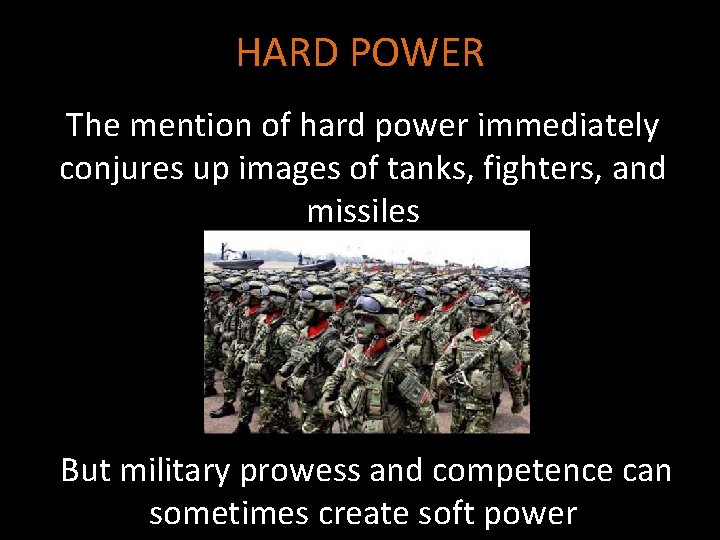
HARD POWER The mention of hard power immediately conjures up images of tanks, fighters, and missiles But military prowess and competence can sometimes create soft power
HARD POWER: MILITARY Military force is hard power, but the military also can generate soft power and also be used as an effective soft power resource In recent years military engagement programmes have increasingly been recognised as having particular utility for strategic purposes; with former or potential adversaries, but also countries that are considered important in securing the national interest
Military Power The tools of delivery range from traditional international military and educational training, to humanitarian relief Military-to-military cooperation and training programs, for example, can establish transnational networks that enhance a country’s soft power
Military Power When it attracts others by doing its job well, when it engages in military to military education and training, when it provides relief after a tsunami or earthquake, the military contributes to a country’s soft power
HARD POWER • It is far more common for hard instruments of power to be used for soft power purposes then vice versa • In fact, the United States has often used its military power for soft power ends. In rare instances, this is done in sweeping ways such as when the U. S. used its military superiority after WWII to transform Japan and Germany into democratic states
HARD POWER • Originally this was done through pure coercion, but eventually the Japanese and German populations came to accept democratic values (and U. S. leadership) as legitimate
HARD POWER • More frequently, the U. S. military is used more subtly for soft power ends • For instance, after the devastating 2004 Indian Ocean tsunami, U. S. naval assets allowed the U. S. to be one of the first organizations on the scene helping in the rescue effort
HARD POWER • The same was true after the disasters in Japan • This undoubtedly made the U. S. in general, and the U. S. military’s presence in the region in particular, more attractive in the eyes of local populations who benefitted significantly from them being there
HARD POWER • Similarly, when the U. S. military is used to fight piracy or uphold freedom of navigation in international waters, it is using both soft and hard power • It is using hard power towards the pirates and whichever party is threatening free navigation, by coercing or forcing them to seize their actions…
HARD POWER …. . but it is using soft power towards other populations who view the U. S. military’s presence in their neighborhood as legitimate thanks to these actions, and are attracted to the U. S. for its commitment to uphold freedom of navigation
HARD POWER As Osama bin Laden has said, people are attracted to a strong horse rather than a weak horse A well-run military can be a source of admiration The impressive job of the U. S. military in providing humanitarian relief after the Indian Ocean tsunami and the South Asian earthquake in 2005 helped restore the attractiveness of the United States
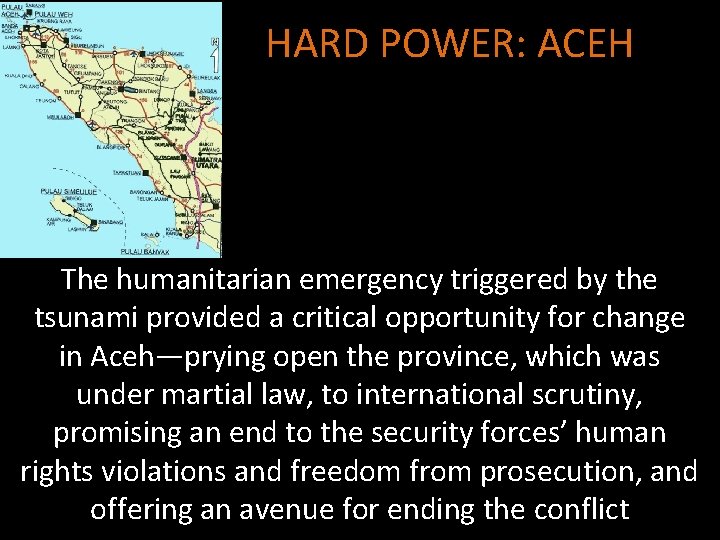
HARD POWER: ACEH The humanitarian emergency triggered by the tsunami provided a critical opportunity for change in Aceh—prying open the province, which was under martial law, to international scrutiny, promising an end to the security forces’ human rights violations and freedom from prosecution, and offering an avenue for ending the conflict
HARD POWER: ACEH The military’s tight grip over Aceh slipped in the aftermath of the tsunami For one, its system of control was largely washed away—military and police stations were destroyed or damaged, and many documents relating to martial law, including mandatory identity cards, were lost
HARD POWER: ACEH Although hardliners were pressing to bar foreign relief personnel from Aceh, the huge scale of the catastrophe made the need for massive international assistance irrefutable The tsunami shifted the political dynamic quite decisively, as it brought increased international attention. ” With the eyes of the world trained on Aceh, both the government and the rebels were anxious to seize the high moral ground and not to be seen as sabotaging the peace process
HARD POWER: ACEH Several donors, including Germany and Japan, made it clear to both sides that they expected progress in the peace negotiations so that reconstruction could proceed unimpeded From January to July 2005, five negotiation rounds took place in Helsinki, and an agreement was reached quickly and signed on August 15, 2005
HARD POWER: MISUSE Of course, misuse of military resources can also undercut soft power The Soviets had a great deal of soft power in the years after World War II, but they destroyed it by the way they used their hard power against Hungary and Czechoslovakia
HARD POWER: MISUSE Brutality and indifference to just war principles of discrimination and proportionality can also destroy legitimacy
HARD POWER: MISUSE The efficiency of the initial U. S. military invasion of Iraq in 2003 created admiration in some sections of the world, but that soft power was undercut by the subsequent inefficiency of the occupation and the scenes of mistreatment of prisoners at Abu Ghraib
IN CONCLUSION • Force is not the only ultimate source of power. Other ultimate sources of power include payments, structures, and virtues • Hard power and soft power are two strategies to deal with resistance: – Hard power: face and overcome resistance – Soft power: avert or avoid resistance • Hard power and soft power have limitations • Smart power is the combination of soft power and hard power in an effective strategy
IN CONCLUSION An increasingly complex security environment now requires a flexible policy response that may require both hard and soft power instruments; …. . successful outcomes in international affairs is likely to be achieved through a combination of hard and soft power
- Slides: 35