
Military Aircraft Systems Weapon Types Definitions Lecture One



- Slides: 27
Military Aircraft Systems Weapon Types & Definitions Lecture One
Military Aircraft Systems Guided vs Unguided Weapons can either be guided or unguided. Guided weapons are those in which the path of the projectile can be modified after it has been fired or launched, giving increased accuracy and range. Unguided weapons rely on being aimed before launch/firing.
Military Aircraft Systems Guided vs Unguided Advantages of Guided Weapon: • Increased Range means 'stand-off' ability – can attack from out of range of enemy defences. • Less chance of collateral damage (hitting civilians) • Less chance of friendly fire (hitting friendly forces) • Fewer weapons needed to destroy a target, meaning more targets can be engaged, or less time spent over the target.
Military Aircraft Systems Guided vs Unguided Guided weapon accuracy is measured in terms of Circular Error Probable (CEP) This is the distance from the target centre in which 50% of weapons would be expected to hit. Target CEP Weapon Strikes
Military Aircraft Systems Guided vs Unguided weapons only have two advantages, both related to their simplicity: • Unguided Weapons cost less and are cheaper than the guided equivalent. • Unguided Weapons are smaller due to their simplicity. Guidance systems take up space, so it is not possible to fit them into small projectiles, such as shells or small rockets.
Military Aircraft Systems Weapon Terminology Projectiles (other than those fired by guns) are sorted into the following categories: • Missiles – powered, guided: Ballistic Missiles – arc through the air. Cruise Missiles – fly direct to target. • Rockets – powered, unguided. • Bombs – unpowered, guided or unguided. • Mines – lay in wait, either laid or scattered. • Torpedoes – powered through water. • Depth Charges – underwater bombs.
Military Aircraft Systems Weapon Terminology have motors that burn for a short period of time compared to their flight, and they travel on a ballistic trajectory. Ballistic Missiles
Military Aircraft Systems Weapon Terminology Cruise Missiles are in essence small, pilotless aircraft, which fly directly to the target. The engine will tend to operate up until impact.
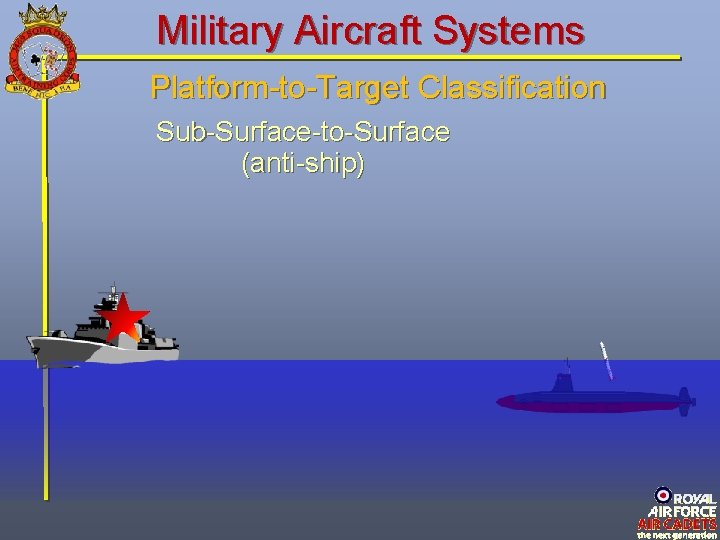
Military Aircraft Systems Platform-to-Target Classification Weapons are further categorised by the environment in which their platform and target operate. • Air – any aircraft • Surface – which may be the surface of the water, with ground referring to non-maritime targets. • Sub-Surface – submarines Many weapons have related types with a differing launch platform; for example the Harpoon anti-ship missile has air-to-surface, surface-to-surface and sub-surface-to-surface versions.
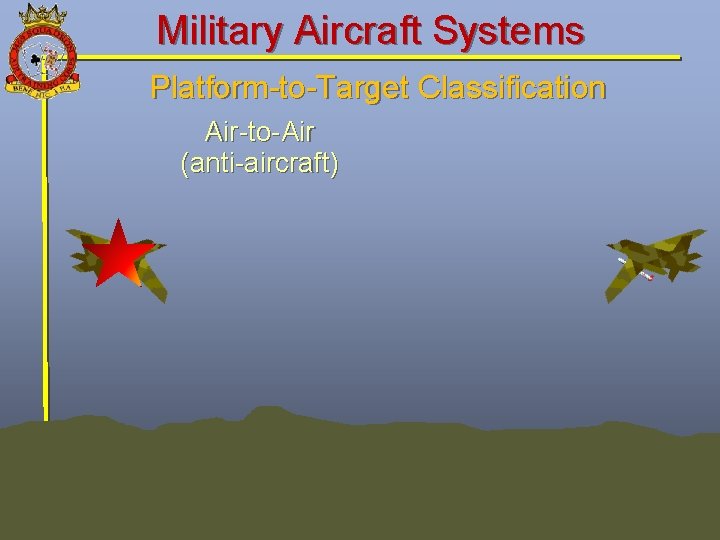
Military Aircraft Systems Platform-to-Target Classification Air-to-Air (anti-aircraft)
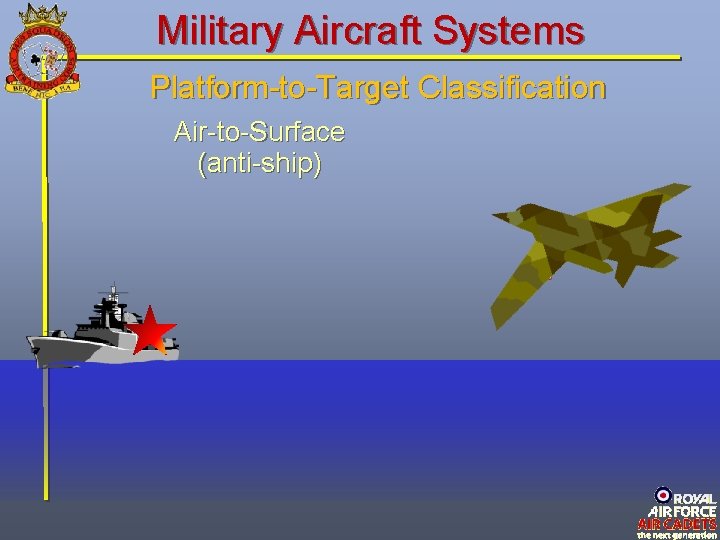
Military Aircraft Systems Platform-to-Target Classification Air-to-Surface (anti-ship)
Military Aircraft Systems Platform-to-Target Classification Sub-Surface-to-Surface (anti-ship)
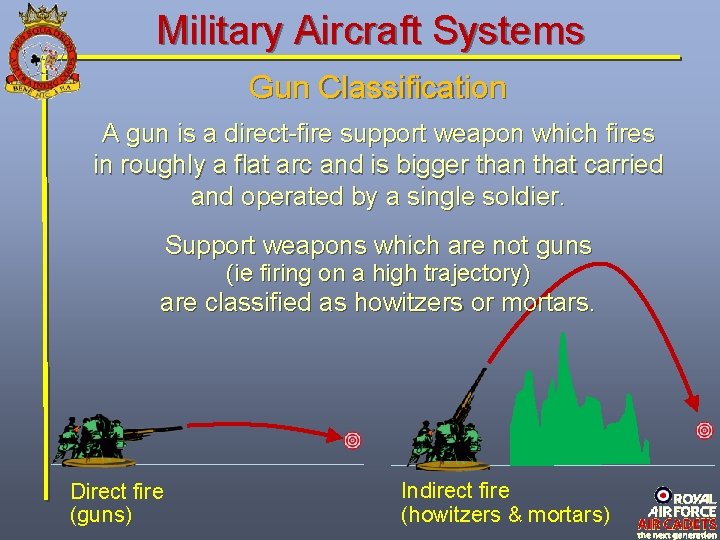
Military Aircraft Systems Gun Classification A gun is a direct-fire support weapon which fires in roughly a flat arc and is bigger than that carried and operated by a single soldier. Support weapons which are not guns (ie firing on a high trajectory) are classified as howitzers or mortars. Direct fire (guns) Indirect fire (howitzers & mortars)
Military Aircraft Systems Gun Classification Guns are also classified if they fire shells or bullets; A Shell is a projectile large enough to carry a payload (such as explosives or incendiaries) A Bullet is a projectile which does not carry a payload. There also further sub-divisions: • Cannon. A shell-firing gun • Auto-Cannon. Which is mechanically loaded. rather than by a human operator • Machine Gun. Bullet-firing & loaded mechanically.
Military Aircraft Systems Warheads Most projectile weapons use one of two types of energy to damage or destroy their targets: • Kinetic Energy (KE). The simplest method uses the speed and mass of the projectile to inflict damage. • Chemical Energy used in the form of an explosive or incendiary to damage the target.
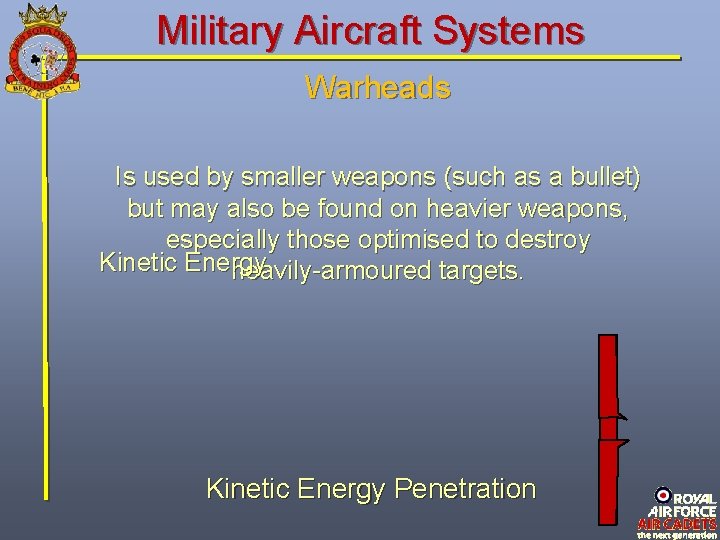
Military Aircraft Systems Warheads Is used by smaller weapons (such as a bullet) but may also be found on heavier weapons, especially those optimised to destroy Kinetic Energy heavily-armoured targets. Kinetic Energy Penetration
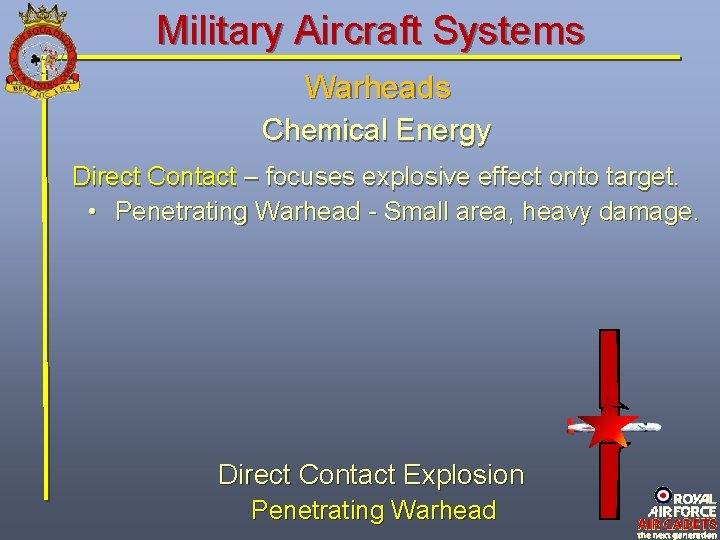
Military Aircraft Systems Warheads Chemical Energy Direct Contact – focuses explosive effect onto target. • Penetrating Warhead - Small area, heavy damage. Direct Contact Explosion Penetrating Warhead
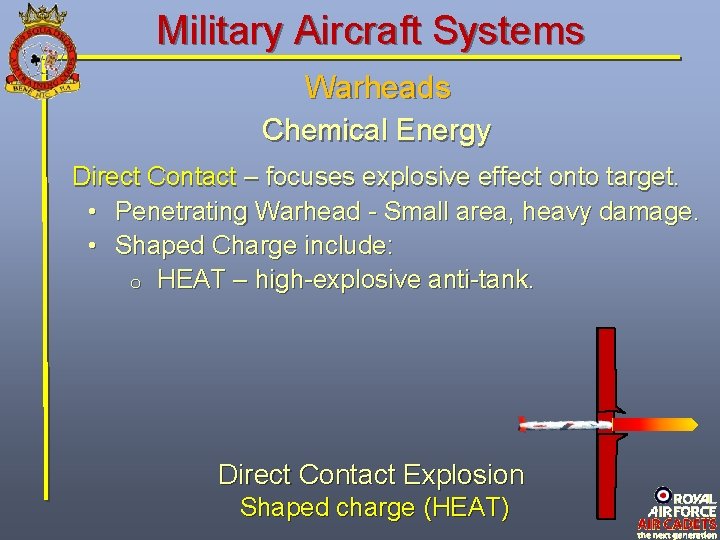
Military Aircraft Systems Warheads Chemical Energy Direct Contact – focuses explosive effect onto target. • Penetrating Warhead - Small area, heavy damage. • Shaped Charge include: o HEAT – high-explosive anti-tank. Direct Contact Explosion Shaped charge (HEAT)
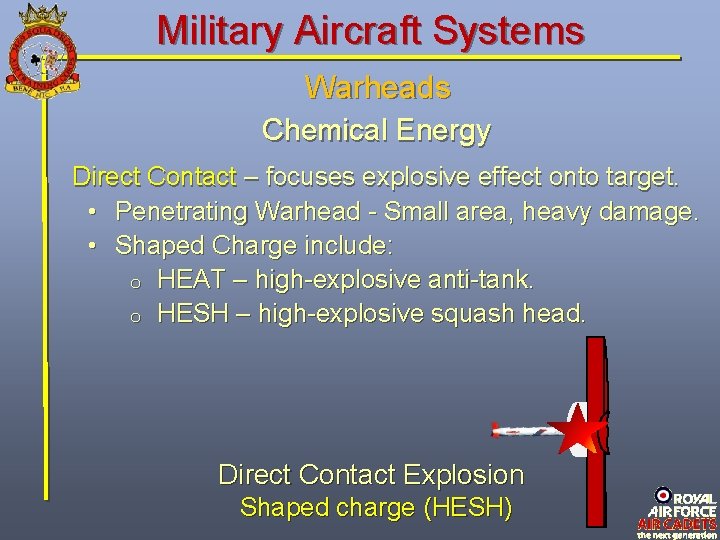
Military Aircraft Systems Warheads Chemical Energy Direct Contact – focuses explosive effect onto target. • Penetrating Warhead - Small area, heavy damage. • Shaped Charge include: o HEAT – high-explosive anti-tank. o HESH – high-explosive squash head. Direct Contact Explosion Shaped charge (HESH)
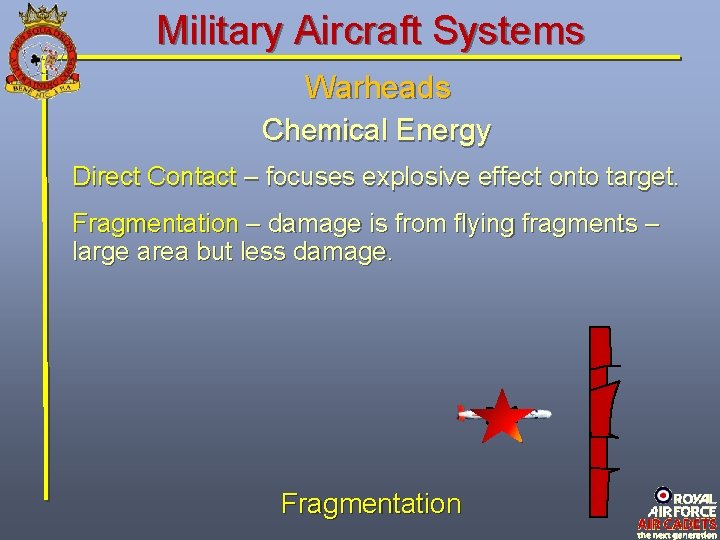
Military Aircraft Systems Warheads Chemical Energy Direct Contact – focuses explosive effect onto target. Fragmentation – damage is from flying fragments – large area but less damage. Fragmentation
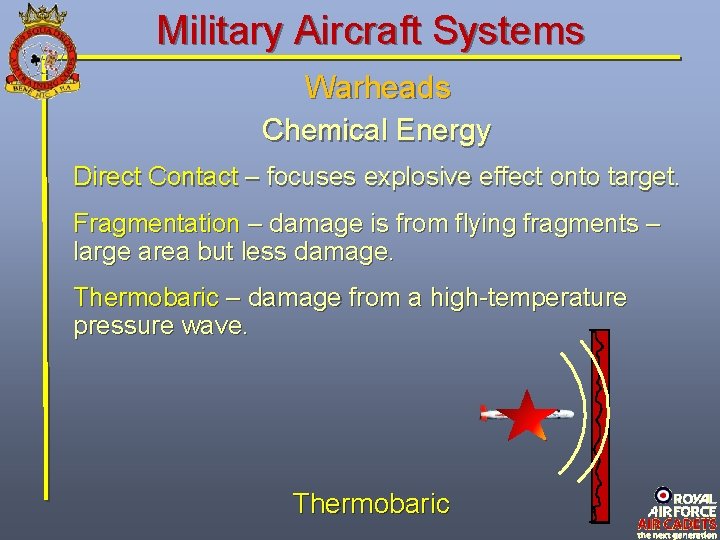
Military Aircraft Systems Warheads Chemical Energy Direct Contact – focuses explosive effect onto target. Fragmentation – damage is from flying fragments – large area but less damage. Thermobaric – damage from a high-temperature pressure wave. Thermobaric
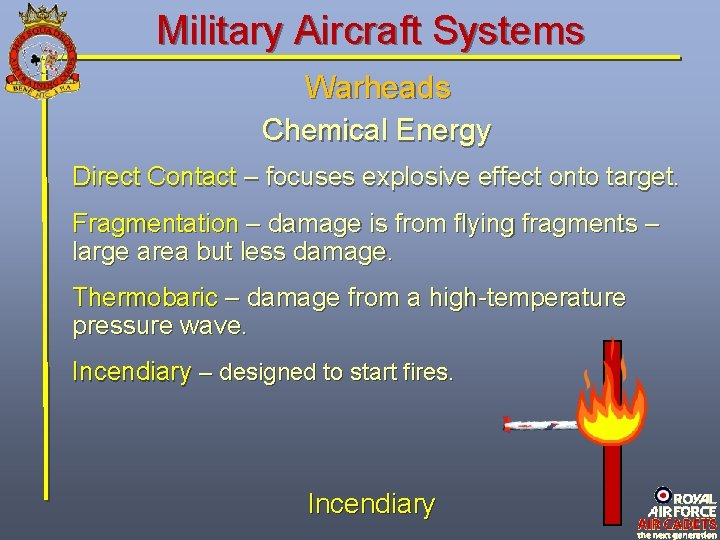
Military Aircraft Systems Warheads Chemical Energy Direct Contact – focuses explosive effect onto target. Fragmentation – damage is from flying fragments – large area but less damage. Thermobaric – damage from a high-temperature pressure wave. Incendiary – designed to start fires. Incendiary
Military Aircraft Systems Warheads Chemical Energy Direct Contact – focuses explosive effect onto target. Fragmentation – damage is from flying fragments – large area but less damage. Thermobaric – damage from a high-temperature pressure wave. Incendiary – designed to start fires. Submunition – warhead splits into multiple warheads. (can be any of the above types)
Check of Understanding Which of these is not an advantage of guided weapons over unguided weapons? Can be used closer to friendly forces Smaller size due to simplicity Fewer weapons are needed to attack a target Lower collateral damage
Check of Understanding What other characteristic does the increase in accuracy that comes from guiding a weapon tend to improve? Range Flight Ceiling Motor Efficiency Warhead Size
Check of Understanding Which of these is an advantage of unguided weapons over guided weapons? High accuracy Low collateral damage Long range Low cost
Military Aircraft Systems End of Presentation