
Military Aircraft Systems Weapon Guidance and Propulsion Lecture


- Slides: 41
Military Aircraft Systems Weapon Guidance and Propulsion Lecture Two
Guidance and Propulsion Navigation vs Homing A weapon can either navigate to a location or it can seek out and follow (homing) until it hits. There advantages and disadvantages of both: NAVIGATION: Doesn’t require line of sight. Usually doesn’t emit energy or rely on the target to do so. Can't be used against a moving target unless it can be continually updated. HOMING: Generally requires line of sight. Can be used against a moving target as it follows the target.
Guidance and Propulsion Fire and Forget Some guidance requires input from an outside source, others are entirely self-sufficient after launch. Those which are entirely self-sufficient after launch are known as 'fire-and-forget‘ weapons. Primary and Terminal Guidance Some long range weapons use accurate but short-ranged guidance systems for the final moments of their flight – known as terminal guidance. These weapons will also need a guidance system suitable for the earlier stages – the primary or mid-course guidance.
Guidance and Propulsion Navigation Systems TERCOM and TERPROM (Terrain Contour Matching & Terrain Profile Matching) match their surroundings to an on-board map. These systems are self-contained and very accurate, but are very expensive and they broadcast a signal which can give the target warning of the attack.
Guidance and Propulsion Navigation Systems TERCOM and TERPROM (Terrain Contour Matching & Terrain Profile Matching) match their surroundings to an on-board map. Inertial Navigation Systems (INS) use an autopilot to keep the weapon flying on an axis and cannot be jammed. INS systems are entirely self-contained, they create no emissions and requires no external input, but the use of dead-reckoning means that accuracy reduces with range.
Guidance and Propulsion Navigation Systems TERCOM and TERPROM (Terrain Contour Matching & Terrain Profile Matching) match their surroundings to an on-board map. Inertial Navigation Systems (INS) use an autopilot to keep the weapon flying on an axis. Satellite Guided Systems use satellites to triangulate their positions in space, rather than homing on to a target. Types include Galileo, GPS and GLOSNASS. (Global Navigation Satellite System) They give no emissions but rely on signals which can be jammed.
Guidance and Propulsion Navigation Systems TERCOM and TERPROM (Terrain Contour Matching & Terrain Profile Matching) match their surroundings to an on-board map. Inertial Navigation Systems (INS) use an autopilot to keep the weapon flying on an axis. Satellite Guided Systems use satellites to triangulate their positions in space. Command Line Of Sight (CLOS) systems are remote-controlled by an operator (manual) or a computer (semi-automatic) Unlike other navigated weapons, CLOS weapons are not fire-and-forget.
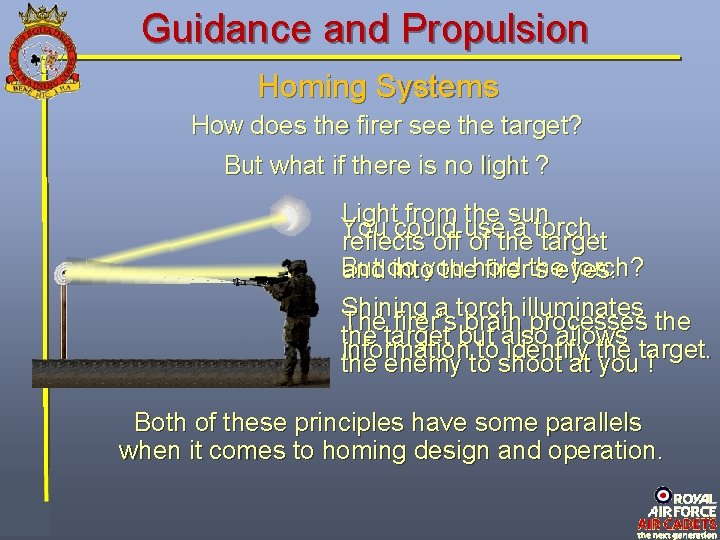
Guidance and Propulsion Homing Systems How does the firer see the target? But what if there is no light ? Light from the sun You could use a torch. reflects off of the target But theeyes. torch? and do intoyou thehold firer’s Shining a torch illuminates The firer’s brain processes the target but also allows information to identify the target. the enemy to shoot at you ! Both of these principles have some parallels when it comes to homing design and operation.
Guidance and Propulsion Homing Systems All homing-on-target weapons rely on a form of energy. Heat (Infra Red) Visible light (Laser) Radio waves (Radar) Acoustic (Sonar) And there are three basic types of missile homing: Passive Homing Semi Active Homing
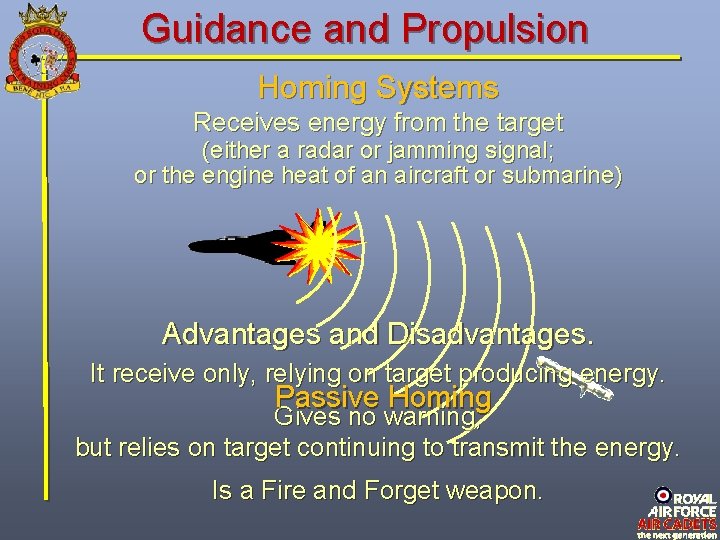
Guidance and Propulsion Homing Systems Receives energy from the target (either a radar or jamming signal; or the engine heat of an aircraft or submarine) Advantages and Disadvantages. It receive only, relying on target producing energy. Passive Homing Gives no warning, but relies on target continuing to transmit the energy. Is a Fire and Forget weapon.
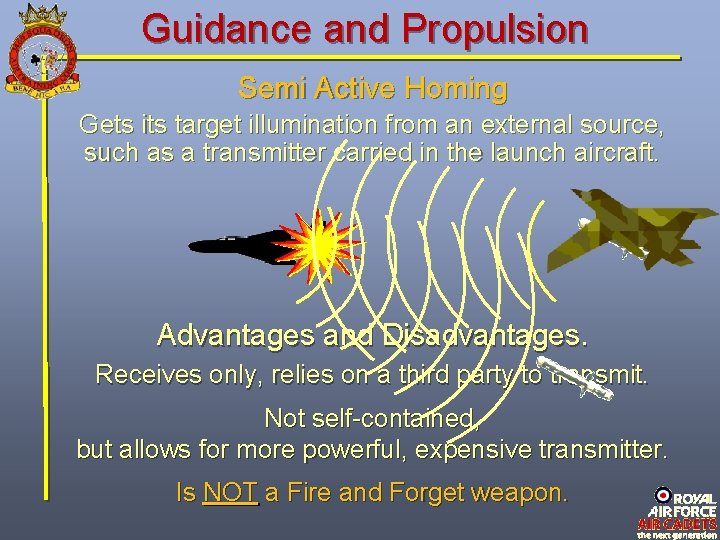
Guidance and Propulsion Semi Active Homing Gets its target illumination from an external source, such as a transmitter carried in the launch aircraft. Advantages and Disadvantages. Receives only, relies on a third party to transmit. Not self-contained, but allows for more powerful, expensive transmitter. Is NOT a Fire and Forget weapon.
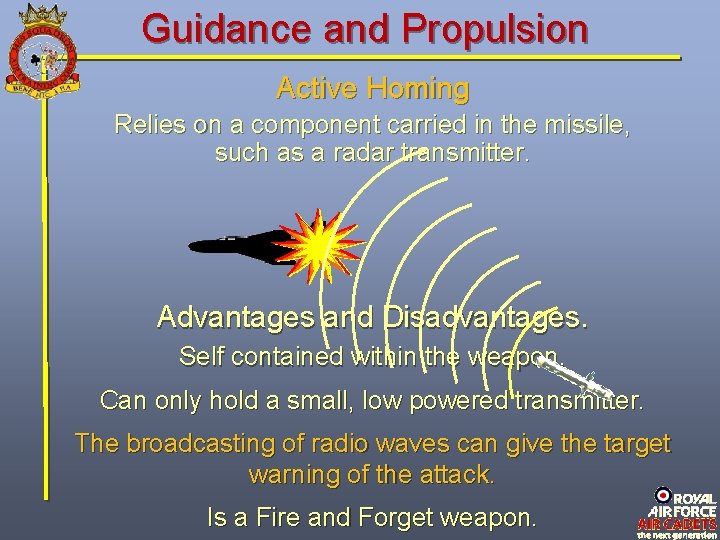
Guidance and Propulsion Active Homing Relies on a component carried in the missile, such as a radar transmitter. Advantages and Disadvantages. Self contained within the weapon. Can only hold a small, low powered transmitter. The broadcasting of radio waves can give the target warning of the attack. Is a Fire and Forget weapon.
Guidance and Propulsion Homing Systems In theory all combinations could be used, but in practice most homing systems use one of the following combinations: • Passive Infra Red • Semi-active Laser • All types of radar (active, semi-active and passive) • Passive and Active Sonar
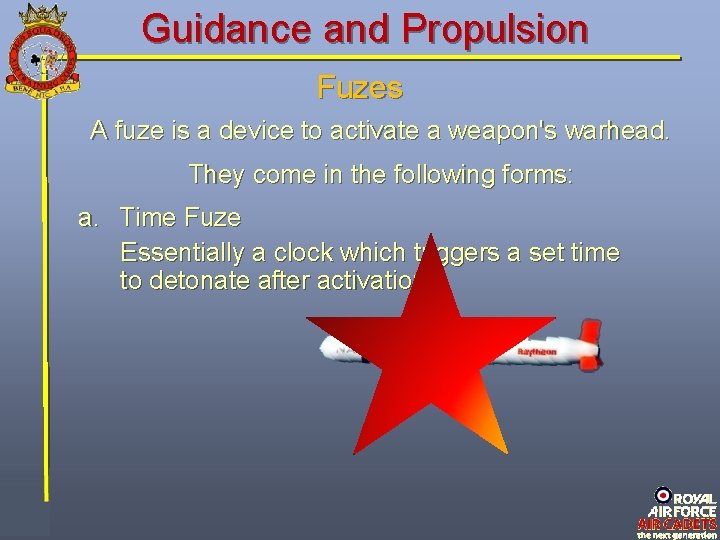
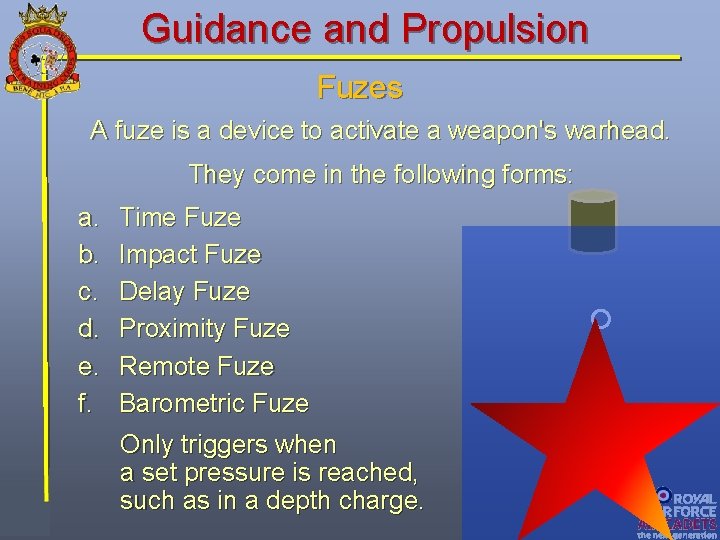
Guidance and Propulsion Fuzes A fuze is a device to activate a weapon's warhead. They come in the following forms: a. Time Fuze Essentially a clock which triggers a set time to detonate after activation.
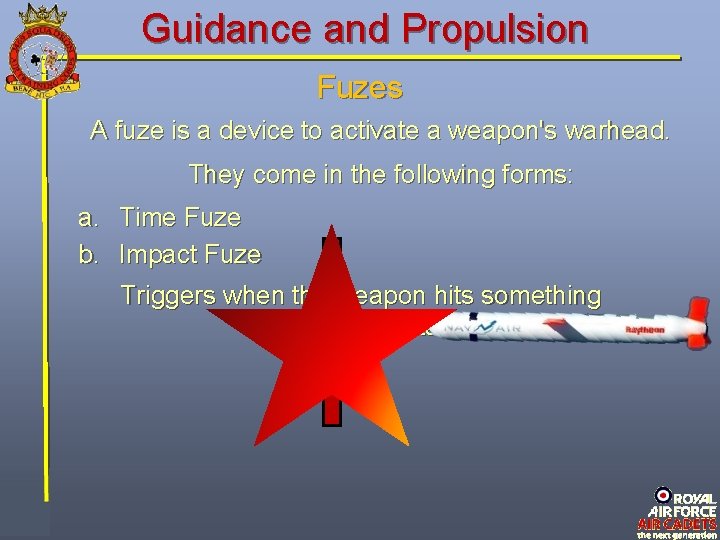
Guidance and Propulsion Fuzes A fuze is a device to activate a weapon's warhead. They come in the following forms: a. Time Fuze b. Impact Fuze Triggers when the weapon hits something (hopefully the target !)
Guidance and Propulsion Fuzes A fuze is a device to activate a weapon's warhead. They come in the following forms: a. b. c. Time Fuze Impact Fuze Delay Fuze A combination of an impact and a time fuze in order to trigger after the weapon has struck – to allow the weapon to penetrate deeper into the target before exploding.
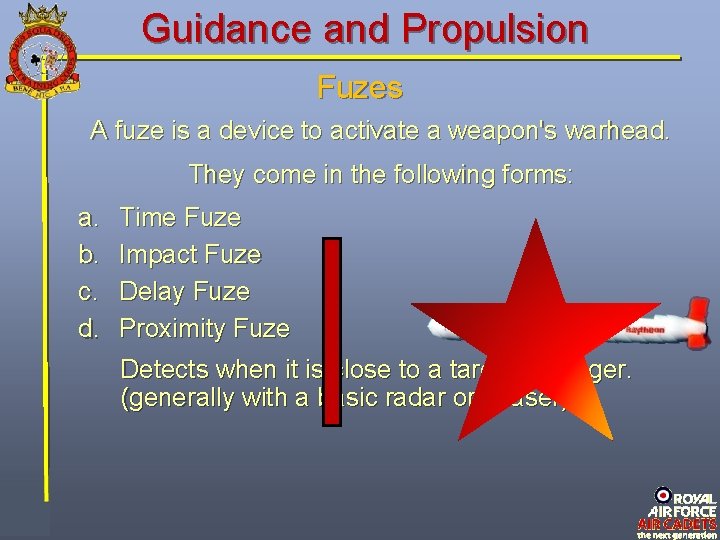
Guidance and Propulsion Fuzes A fuze is a device to activate a weapon's warhead. They come in the following forms: a. b. c. d. Time Fuze Impact Fuze Delay Fuze Proximity Fuze Detects when it is close to a target to trigger. (generally with a basic radar or a laser)
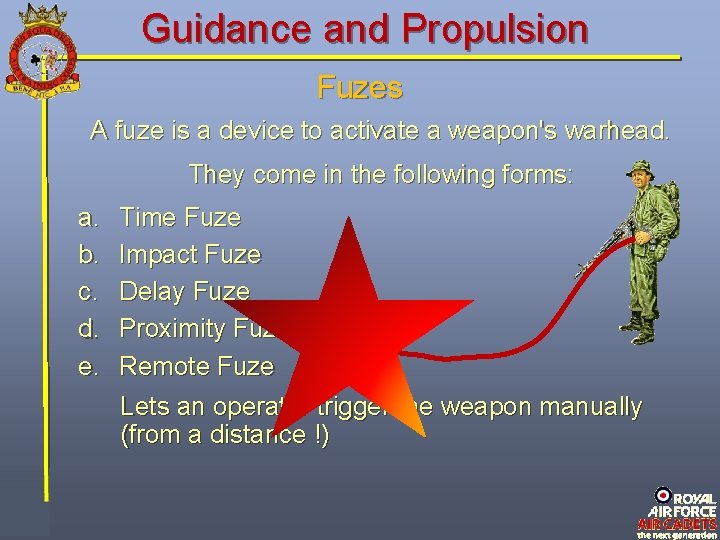
Guidance and Propulsion Fuzes A fuze is a device to activate a weapon's warhead. They come in the following forms: a. b. c. d. e. Time Fuze Impact Fuze Delay Fuze Proximity Fuze Remote Fuze Lets an operator trigger the weapon manually (from a distance !)
Guidance and Propulsion Fuzes A fuze is a device to activate a weapon's warhead. They come in the following forms: a. b. c. d. e. f. Time Fuze Impact Fuze Delay Fuze Proximity Fuze Remote Fuze Barometric Fuze Only triggers when a set pressure is reached, such as in a depth charge.
Guidance and Propulsion Powered vs Unpowered The main advantages of powered weapons are: • They can engage scattered targets • They can stay out of range of defences • They have extra kinetic energy for destructive effect (especially at low level or low launch speed) Advantages of Unpowered weapons - like bombs - are: • They are cheaper because they don’t need the extra weight and complexity of an engine. • A greater number can be carried on an aircraft.
Guidance and Propulsion Powerplants Important factors when choosing the propulsion system for a missile include: • Cost (the weapon is after all a disposable item) • Speed and acceleration • Weight • Frontal area – important for aerodynamics • Safety & Maintenance – a missile engine should be able to sit for a long period with minimal attention. • Power generation – weapon will need a battery if the motor cannot provide this
Guidance and Propulsion Powerplants • Pulse jet. A simple but obsolete engine. Used in early missiles such as the German V-1. • Ram jet. High fuel consumption. Good for supersonic flight which is useful for overcoming the defences of a surface target. Ram jet engines use atmospheric oxygen so can carry more fuel and have longer range than similar rocket-powered ones.
Guidance and Propulsion Powerplants • Turbo jet. A common choice for cruise missiles, it is fairly simple with a low frontal area. • Turbo fan. More efficient with a greater frontal area. Mostly used on very long range cruise missiles. The great advantage of turbojet & turbofan engines over other sorts of missile propulsion Is that their high efficiency gives long range.
Guidance and Propulsion Powerplants Jet-engined weapons use atmospheric oxygen so can carry more fuel and have longer range than similar rocket-powered ones. • Pulse jet. A simple engine used in early missiles. • Turbo jet. A common choice for cruise missiles, it is fairly simple with a low frontal area. • Turbo fan. More efficient with a greater frontal area. Mostly used on very long range cruise missiles. • Ram jet. High fuel consumption. Good for supersonic flight which is useful for overcoming the defences of a surface target.
Guidance and Propulsion Powerplants Torpedoes use a number of powerplants, either to drive a propeller or in some cases using a rocket to directly move the torpedo. Common types include: • Electric motor with battery • Jet engine (turbo shaft) with on-board oxygen supply or monopropellant (fuel and oxidiser combined) • Internal combustion engine with an on-board oxygen supply or monopropellant • Rocket
Guidance and Propulsion Flight Controls Any guided weapon must also have some means of manipulating its direction. Just like an aircraft has control surfaces (ailerons, elevators and rudders) so do missiles. Cruise missiles have wings and control surfaces similar to an aircraft although they may omit the rudder or ailerons. Ballistic missiles are generally steered by the use of fins sticking out into the airflow at the rear of the weapon.
Check of Understanding Which of the following is not an advantage of semi-active radar guidance over active radar guidance? Because the transmitter is not destroyed, it can be made more complex A more powerful transmitter can be used as it is not reliant on batteries The lack of a transmitter makes the weapon lighter The weapon can be launched in 'fire-and-forget' mode
Check of Understanding Which of these is not a fire-and-forget guidance system? Passive Infra Red Active Radar Semi-active Radar Passive Radar
Check of Understanding Which system creates no emissions and requires no external input? TERPROM GPS INS CLOS
Check of Understanding Which of these navigation systems becomes less accurate with range? GPS TERPROM INS TERCOM
Check of Understanding Which of these systems cannot be jammed? GPS Active Radar INS TERPROM
Check of Understanding What engine type would normally power a short-range anti-tank missile? Solid Rocket Motor Ramjet Liquid Fuelled Rocket Turbojest
Check of Understanding Which of the following is not a type of fuze? Proximity Semi-active Barometric Impact
Check of Understanding What is an advantage of a ramjet engine over a solid rocket motor? The lack of moving parts makes the ramjet simpler and cheaper to produce Ramjets operate more effectively at high altitude Using atmospheric oxygen means that more fuel can be carried, giving longer range Lack of an air intake and lower frontal area means less drag
Check of Understanding A delay fuse consists of a combination of two types of fuze - what are they? Impact and Time Barometric and Time Proximity and Time Remote and Time
Check of Understanding Which of these is an advantage of turbojet and turbofan engines over other sorts of missile propulsion? Simplicity leading to lower cost High efficiency giving long range Not needing atmospheric oxygen allows high-altitude operation High thrust giving high acceleration
Check of Understanding What type of weapon uses wings and control surfaces like a conventional aircraft? Torpedoes Cruise Missiles Rockets Ballistic Missiles
Check of Understanding Which of these guidance systems would not normally be found in passive form? Sonar Infra Red Laser Radar
Check of Understanding Which of these systems navigates a weapon to a location in space, rather than homing on to a target? Radar GPS Laser Infra Red
Check of Understanding What is a disadvantage of the active radar guidance system of the AMRAAM Radar-guided missiles have a shorter range than infra-red-guided weapons Active radar guidance is not fire-and-forget Broadcasting radio waves can give the target warning of the attack Radar-guided missiles can be decoyed by flares
Military Aircraft Systems End of Presentation