
Military Aerospace Programmable Logic Devices Conference MAPLD Session
Military & Aerospace Programmable Logic Devices Conference (MAPLD) Session E: PLD Based System Architectures 9/3/09 Design of a Radiation Tolerant Computing System Based on a Many-Core FPGA Architecture Presenter: Dr. Brock J. La. Meres Authors: Dr. Brock J. La. Meres, Erwin Dunbar, Pat Kujawa, David Racek, Anthony Thomason, Colin Tilleman and Clint Gauer Department of Electrical and Computer Engineering Montana State University Bozeman, MT
Acknowledgements • This work was supported by: Montana Space Grant Consortium (NASA EPSCo. R) http: //spacegrant. montana. edu NASA Exploration Systems Mission Directorate “Higher Education Program” http: //education. ksc. nasa. gov/esmdspacegrant/ • Special thanks to our project mentors from NASA’s Advanced Avionics & Processor Systems (AAPS) Project Dr. Robert E. Ray Marshall Space Flight Center Reconfigurable Computing Task Dr. Andrew S. Keys Marshall Space Flight Center AAPS Project Manager Dr. Michael A. Johnson Goddard Space Flight Center High Performance Processor Task “Design of a Radiation Tolerant Computing System Based on a Many-Core FPGA Architecture” 2
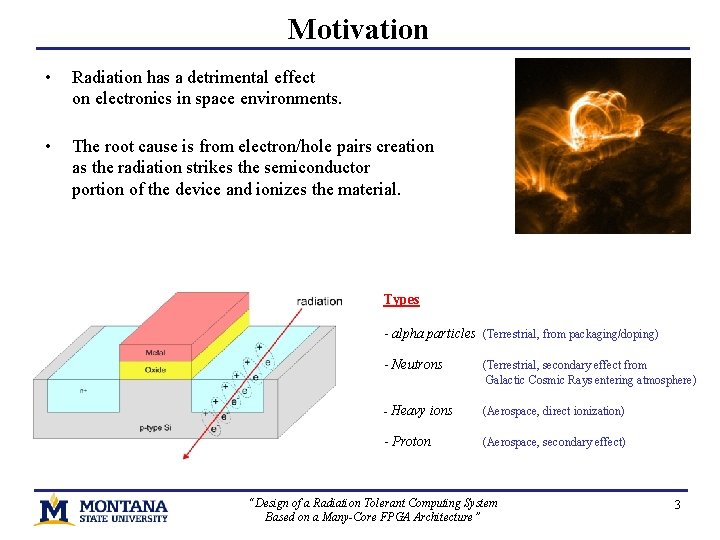
Motivation • Radiation has a detrimental effect on electronics in space environments. • The root cause is from electron/hole pairs creation as the radiation strikes the semiconductor portion of the device and ionizes the material. Types - alpha particles (Terrestrial, from packaging/doping) - Neutrons (Terrestrial, secondary effect from Galactic Cosmic Rays entering atmosphere) - Heavy ions (Aerospace, direct ionization) - Proton (Aerospace, secondary effect) “Design of a Radiation Tolerant Computing System Based on a Many-Core FPGA Architecture” 3
Motivation • Two types of failures mechanics are induced by radiation 1) Total Ionizing Dose (TID) • The cumulative, long term ionizing damage to the device materials • Caused by low energy protons & electrons 2) Single Event Effects (SEE) • Transient spikes caused by Heavy Ions and protons • Can be both destructive & non-destructive “Design of a Radiation Tolerant Computing System Based on a Many-Core FPGA Architecture” 4
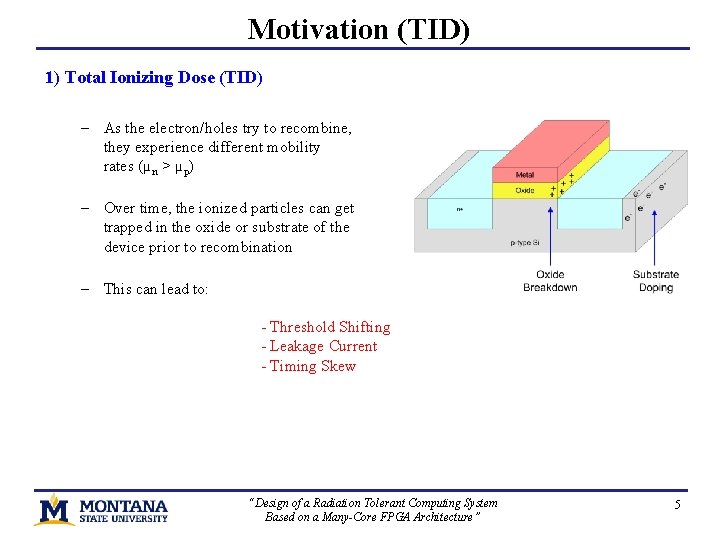
Motivation (TID) 1) Total Ionizing Dose (TID) – As the electron/holes try to recombine, they experience different mobility rates (µn > µp) – Over time, the ionized particles can get trapped in the oxide or substrate of the device prior to recombination – This can lead to: - Threshold Shifting - Leakage Current - Timing Skew “Design of a Radiation Tolerant Computing System Based on a Many-Core FPGA Architecture” 5
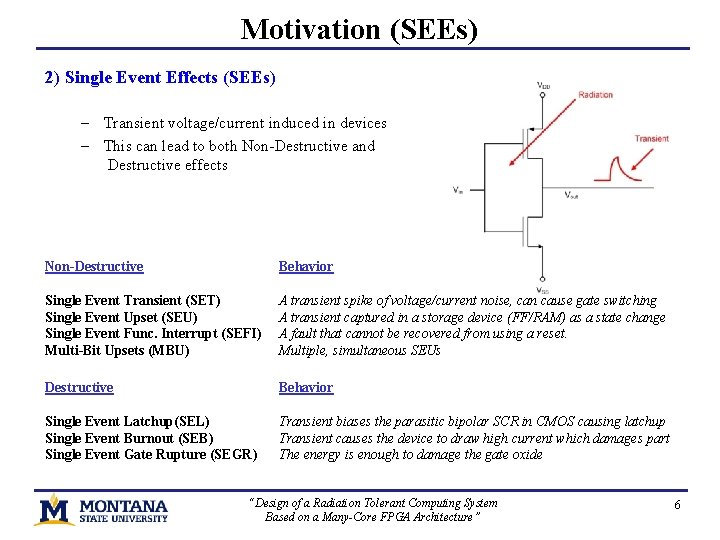
Motivation (SEEs) 2) Single Event Effects (SEEs) – Transient voltage/current induced in devices – This can lead to both Non-Destructive and Destructive effects Non-Destructive Behavior Single Event Transient (SET) Single Event Upset (SEU) Single Event Func. Interrupt (SEFI) Multi-Bit Upsets (MBU) A transient spike of voltage/current noise, can cause gate switching A transient captured in a storage device (FF/RAM) as a state change A fault that cannot be recovered from using a reset. Multiple, simultaneous SEUs Destructive Behavior Single Event Latchup(SEL) Single Event Burnout (SEB) Single Event Gate Rupture (SEGR) Transient biases the parasitic bipolar SCR in CMOS causing latchup Transient causes the device to draw high current which damages part The energy is enough to damage the gate oxide “Design of a Radiation Tolerant Computing System Based on a Many-Core FPGA Architecture” 6
Mitigation of TIDs 1) Current Mitigation Techniques (TID) - Parts can be “hardened” to TID through: - layout techniques (sizing of Qcrit, enclosed layout) - guard rings - substrate doping - redundant circuitry - Parts are specified in terms of: - “the amount of energy that can be tolerated by ionizing particles before the part performance is out of spec” - units are given in krad (Si), typically 300 krad+ - Shielding Does Help - low energy protons/electrons can be stopped at the expense of weight “Design of a Radiation Tolerant Computing System Based on a Many-Core FPGA Architecture” 7
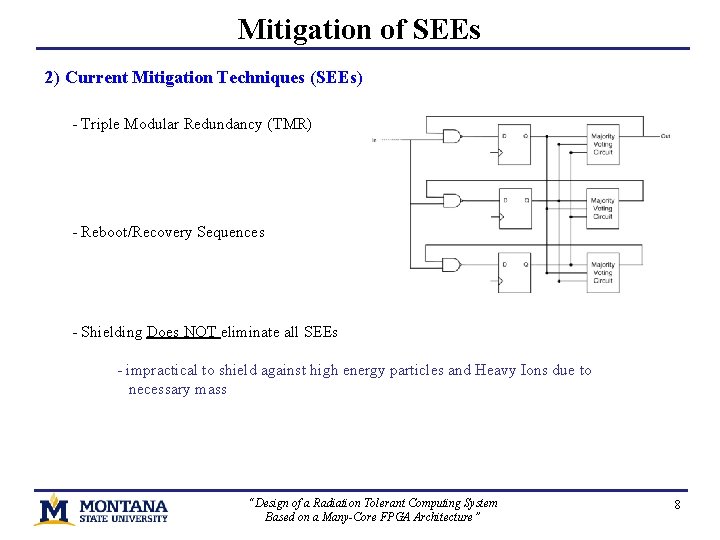
Mitigation of SEEs 2) Current Mitigation Techniques (SEEs) - Triple Modular Redundancy (TMR) - Reboot/Recovery Sequences - Shielding Does NOT eliminate all SEEs - impractical to shield against high energy particles and Heavy Ions due to necessary mass “Design of a Radiation Tolerant Computing System Based on a Many-Core FPGA Architecture” 8
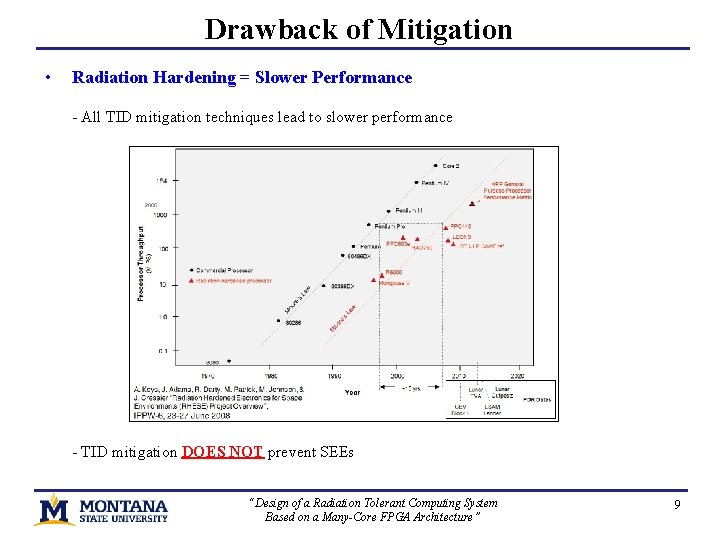
Drawback of Mitigation • Radiation Hardening = Slower Performance - All TID mitigation techniques lead to slower performance - TID mitigation DOES NOT prevent SEEs “Design of a Radiation Tolerant Computing System Based on a Many-Core FPGA Architecture” 9
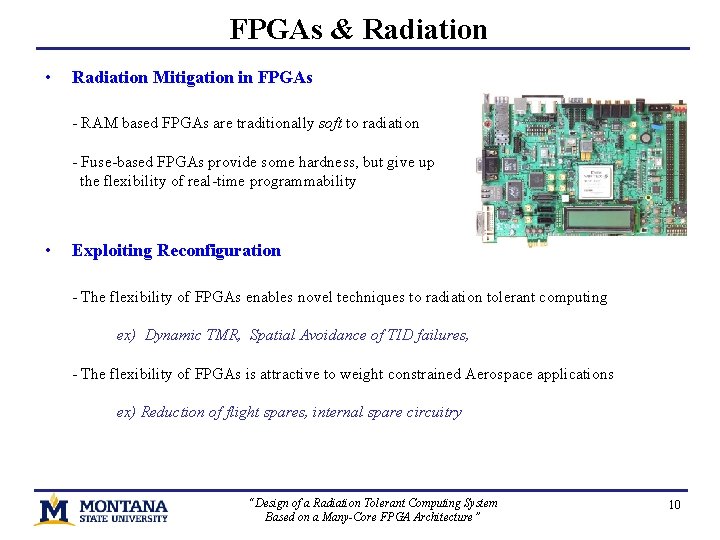
FPGAs & Radiation • Radiation Mitigation in FPGAs - RAM based FPGAs are traditionally soft to radiation - Fuse-based FPGAs provide some hardness, but give up the flexibility of real-time programmability • Exploiting Reconfiguration - The flexibility of FPGAs enables novel techniques to radiation tolerant computing ex) Dynamic TMR, Spatial Avoidance of TID failures, - The flexibility of FPGAs is attractive to weight constrained Aerospace applications ex) Reduction of flight spares, internal spare circuitry “Design of a Radiation Tolerant Computing System Based on a Many-Core FPGA Architecture” 10

FPGAs as a Solution? • Field Programmable Gate Arrays - FPGAs have followed Moore’s Law and now yield comparable processing power to ASICs LUT X LUT X X X X X LUT “Design of a Radiation Tolerant Computing System Based on a Many-Core FPGA Architecture” 11
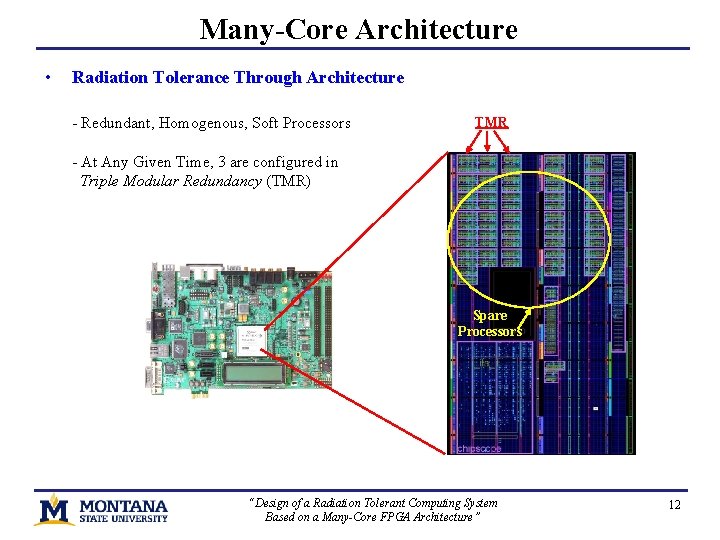
Many-Core Architecture • Radiation Tolerance Through Architecture - Redundant, Homogenous, Soft Processors TMR - At Any Given Time, 3 are configured in Triple Modular Redundancy (TMR) Spare Processors “Design of a Radiation Tolerant Computing System Based on a Many-Core FPGA Architecture” 12
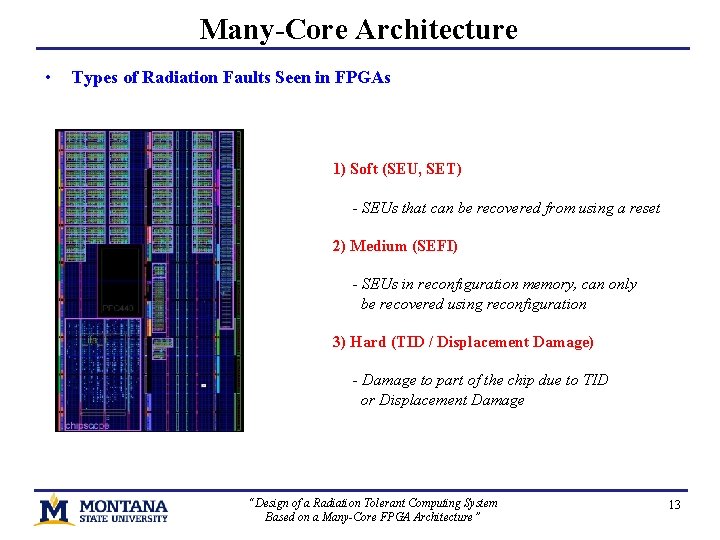
Many-Core Architecture • Types of Radiation Faults Seen in FPGAs 1) Soft (SEU, SET) - SEUs that can be recovered from using a reset 2) Medium (SEFI) - SEUs in reconfiguration memory, can only be recovered using reconfiguration 3) Hard (TID / Displacement Damage) - Damage to part of the chip due to TID or Displacement Damage “Design of a Radiation Tolerant Computing System Based on a Many-Core FPGA Architecture” 13
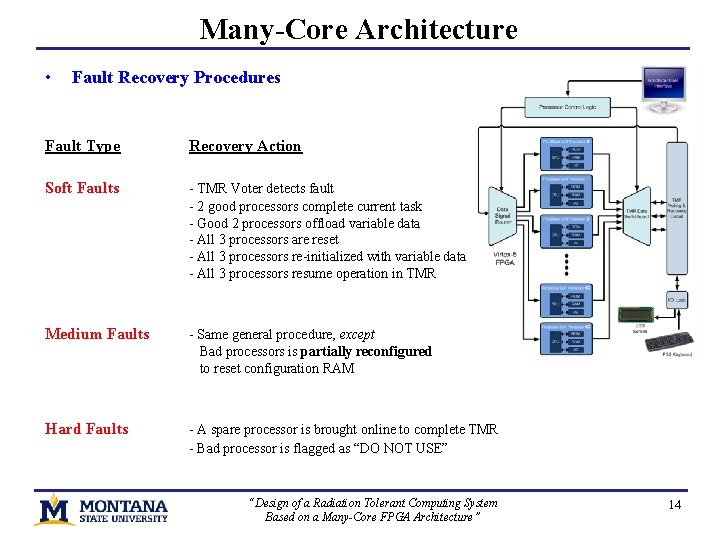
Many-Core Architecture • Fault Recovery Procedures Fault Type Recovery Action Soft Faults - TMR Voter detects fault - 2 good processors complete current task - Good 2 processors offload variable data - All 3 processors are reset - All 3 processors re-initialized with variable data - All 3 processors resume operation in TMR Medium Faults - Same general procedure, except Bad processors is partially reconfigured to reset configuration RAM Hard Faults - A spare processor is brought online to complete TMR - Bad processor is flagged as “DO NOT USE” “Design of a Radiation Tolerant Computing System Based on a Many-Core FPGA Architecture” 14
Many-Core Architecture • Advantages of this Approach 1) SEUs mitigated using traditional TMR 2) Partial Reconfiguration technique increases hardness of RAM-based FPGAs 3) Spatial avoidance of damaged regions of FPGA extend system lifetime 4) Logical approach can be applied to RHBD FPGA fabrics (SIRF, etc…) for increased radiation immunity “Design of a Radiation Tolerant Computing System Based on a Many-Core FPGA Architecture” 15
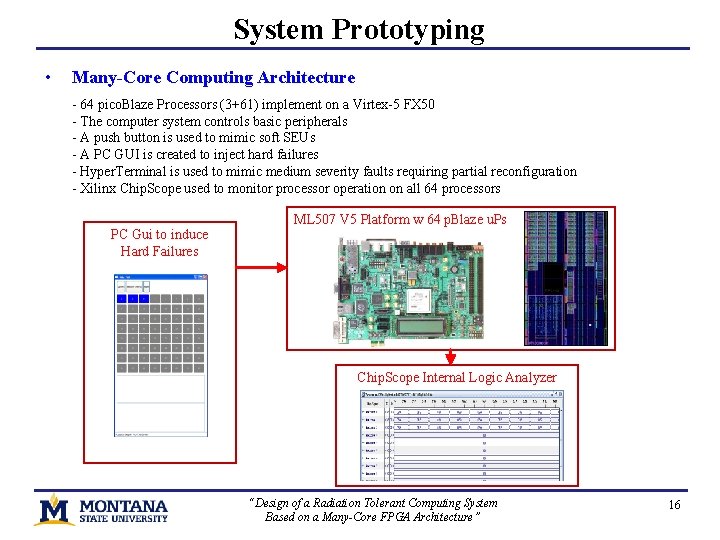
System Prototyping • Many-Core Computing Architecture - 64 pico. Blaze Processors (3+61) implement on a Virtex-5 FX 50 - The computer system controls basic peripherals - A push button is used to mimic soft SEUs - A PC GUI is created to inject hard failures - Hyper. Terminal is used to mimic medium severity faults requiring partial reconfiguration - Xilinx Chip. Scope used to monitor processor operation on all 64 processors PC Gui to induce Hard Failures ML 507 V 5 Platform w 64 p. Blaze u. Ps Chip. Scope Internal Logic Analyzer “Design of a Radiation Tolerant Computing System Based on a Many-Core FPGA Architecture” 16
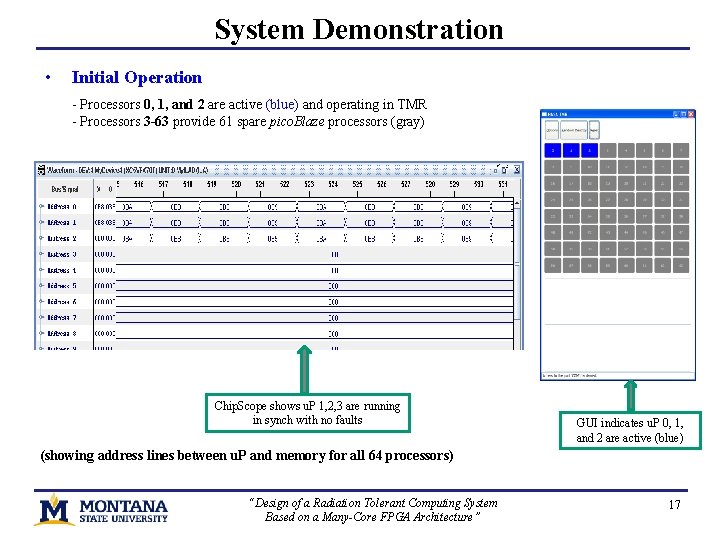
System Demonstration • Initial Operation - Processors 0, 1, and 2 are active (blue) and operating in TMR - Processors 3 -63 provide 61 spare pico. Blaze processors (gray) Chip. Scope shows u. P 1, 2, 3 are running in synch with no faults GUI indicates u. P 0, 1, and 2 are active (blue) (showing address lines between u. P and memory for all 64 processors) “Design of a Radiation Tolerant Computing System Based on a Many-Core FPGA Architecture” 17
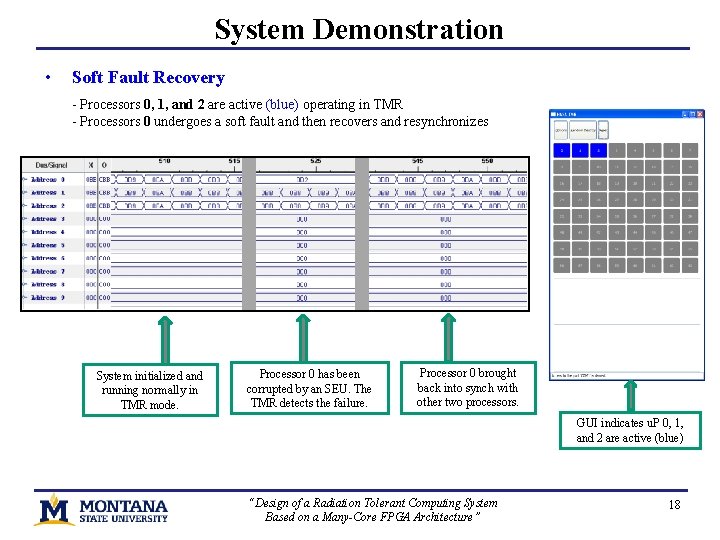
System Demonstration • Soft Fault Recovery - Processors 0, 1, and 2 are active (blue) operating in TMR - Processors 0 undergoes a soft fault and then recovers and resynchronizes System initialized and running normally in TMR mode. Processor 0 has been corrupted by an SEU. The TMR detects the failure. Processor 0 brought back into synch with other two processors. GUI indicates u. P 0, 1, and 2 are active (blue) “Design of a Radiation Tolerant Computing System Based on a Many-Core FPGA Architecture” 18
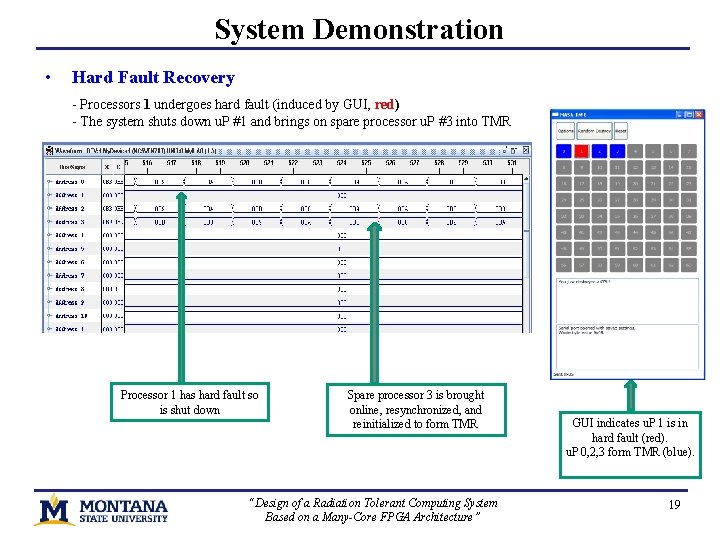
System Demonstration • Hard Fault Recovery - Processors 1 undergoes hard fault (induced by GUI, red) - The system shuts down u. P #1 and brings on spare processor u. P #3 into TMR Processor 1 has hard fault so is shut down Spare processor 3 is brought online, resynchronized, and reinitialized to form TMR “Design of a Radiation Tolerant Computing System Based on a Many-Core FPGA Architecture” GUI indicates u. P 1 is in hard fault (red). u. P 0, 2, 3 form TMR (blue). 19
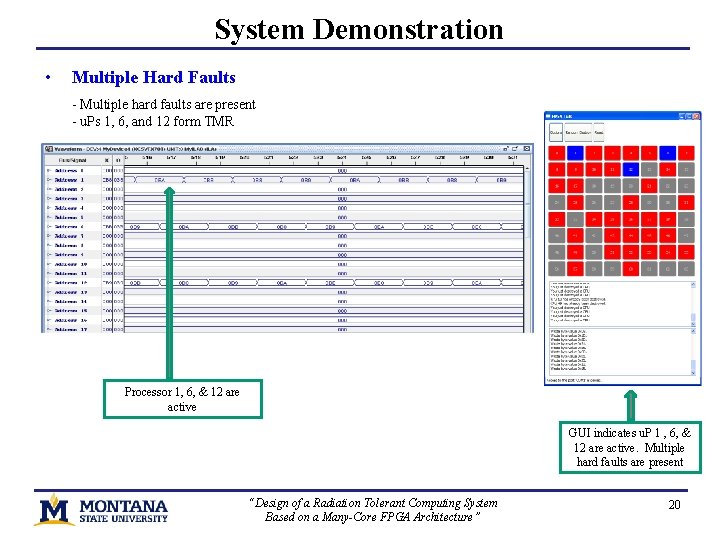
System Demonstration • Multiple Hard Faults - Multiple hard faults are present - u. Ps 1, 6, and 12 form TMR Processor 1, 6, & 12 are active GUI indicates u. P 1 , 6, & 12 are active. Multiple hard faults are present “Design of a Radiation Tolerant Computing System Based on a Many-Core FPGA Architecture” 20
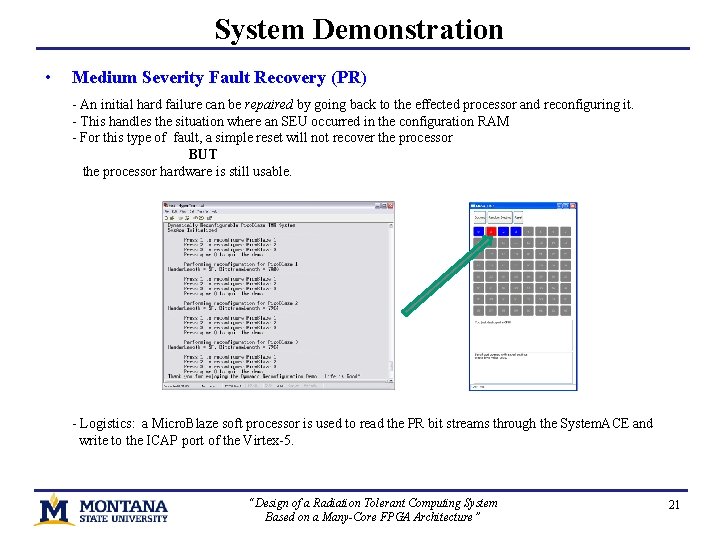
System Demonstration • Medium Severity Fault Recovery (PR) - An initial hard failure can be repaired by going back to the effected processor and reconfiguring it. - This handles the situation where an SEU occurred in the configuration RAM - For this type of fault, a simple reset will not recover the processor BUT the processor hardware is still usable. - Logistics: a Micro. Blaze soft processor is used to read the PR bit streams through the System. ACE and write to the ICAP port of the Virtex-5. “Design of a Radiation Tolerant Computing System Based on a Many-Core FPGA Architecture” 21
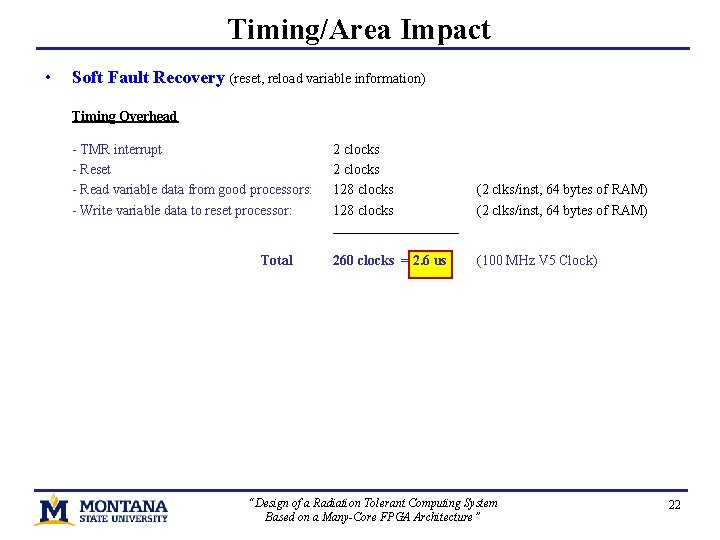
Timing/Area Impact • Soft Fault Recovery (reset, reload variable information) Timing Overhead - TMR interrupt - Reset - Read variable data from good processors: - Write variable data to reset processor: Total 2 clocks 128 clocks _________ 260 clocks = 2. 6 us (2 clks/inst, 64 bytes of RAM) (100 MHz V 5 Clock) “Design of a Radiation Tolerant Computing System Based on a Many-Core FPGA Architecture” 22
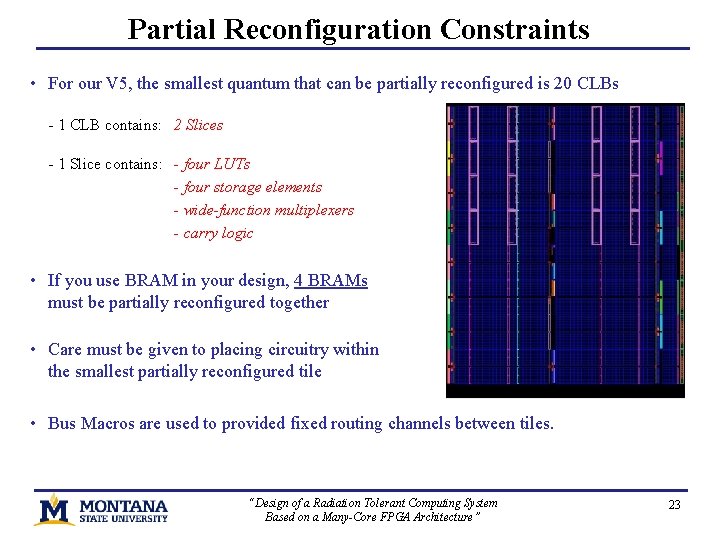
Partial Reconfiguration Constraints • For our V 5, the smallest quantum that can be partially reconfigured is 20 CLBs - 1 CLB contains: 2 Slices - 1 Slice contains: - four LUTs - four storage elements - wide-function multiplexers - carry logic • If you use BRAM in your design, 4 BRAMs must be partially reconfigured together • Care must be given to placing circuitry within the smallest partially reconfigured tile • Bus Macros are used to provided fixed routing channels between tiles. “Design of a Radiation Tolerant Computing System Based on a Many-Core FPGA Architecture” 23
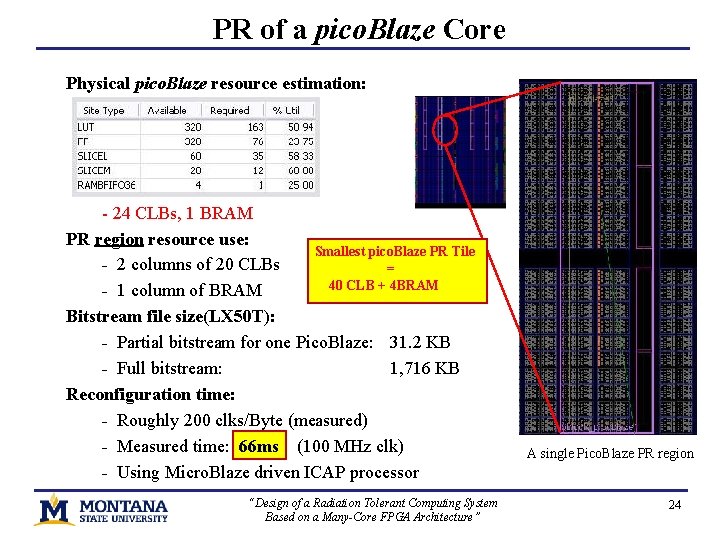
PR of a pico. Blaze Core Physical pico. Blaze resource estimation: - 24 CLBs, 1 BRAM PR region resource use: Smallest pico. Blaze PR Tile - 2 columns of 20 CLBs = 40 CLB + 4 BRAM - 1 column of BRAM Bitstream file size(LX 50 T): - Partial bitstream for one Pico. Blaze: 31. 2 KB - Full bitstream: 1, 716 KB Reconfiguration time: - Roughly 200 clks/Byte (measured) - Measured time: 66 ms (100 MHz clk) - Using Micro. Blaze driven ICAP processor “Design of a Radiation Tolerant Computing System Based on a Many-Core FPGA Architecture” A single Pico. Blaze PR region 24
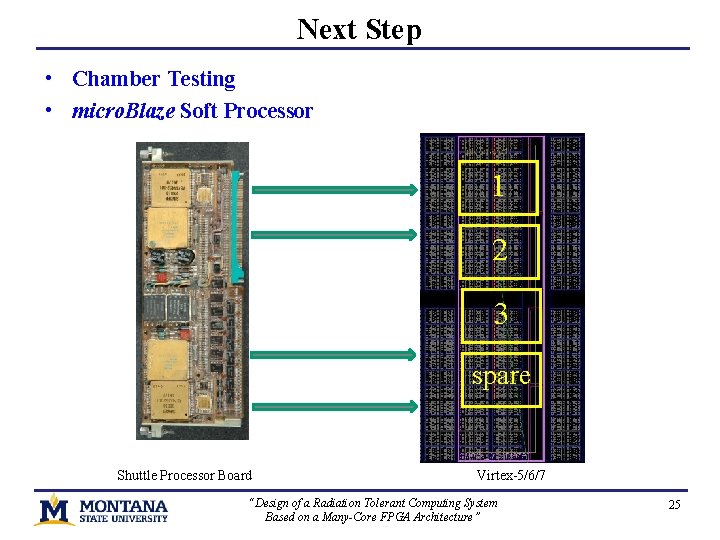
Next Step • Chamber Testing • micro. Blaze Soft Processor 1 2 3 spare Shuttle Processor Board Virtex-5/6/7 “Design of a Radiation Tolerant Computing System Based on a Many-Core FPGA Architecture” 25
Future Work Questions? “Design of a Radiation Tolerant Computing System Based on a Many-Core FPGA Architecture” 26
- Slides: 26