
Milgrams Experiment How far are you willing to
- Slides: 21
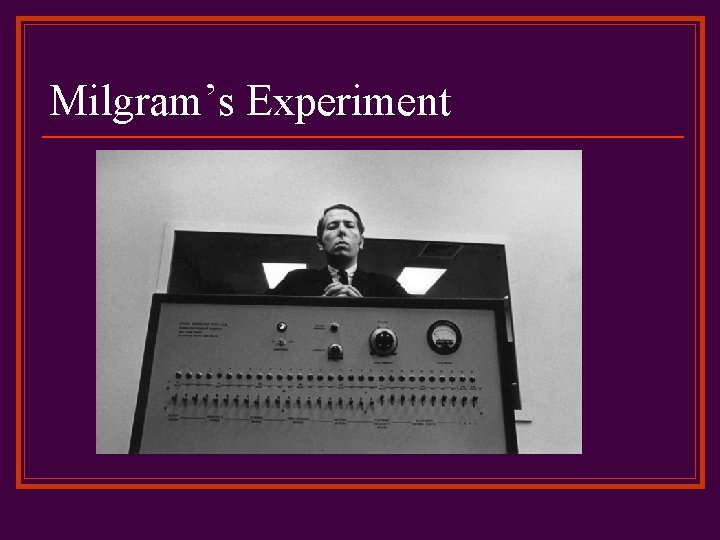
Milgram’s Experiment
How far are you willing to obey? n n n n A friend A teacher A policeman A man in a lab coat The headmaster A stranger A man in an army uniform A sports coach n n n n Miss lessons Hit a stranger Hand over money Lie on the pavement Steal something Stand on one leg Kill a stranger
Obedience n A type of social influence n n To act in response to a direct order from a figure with perceived authority. Who in our society has perceived authority (i. e. who’s orders would you follow without question? )
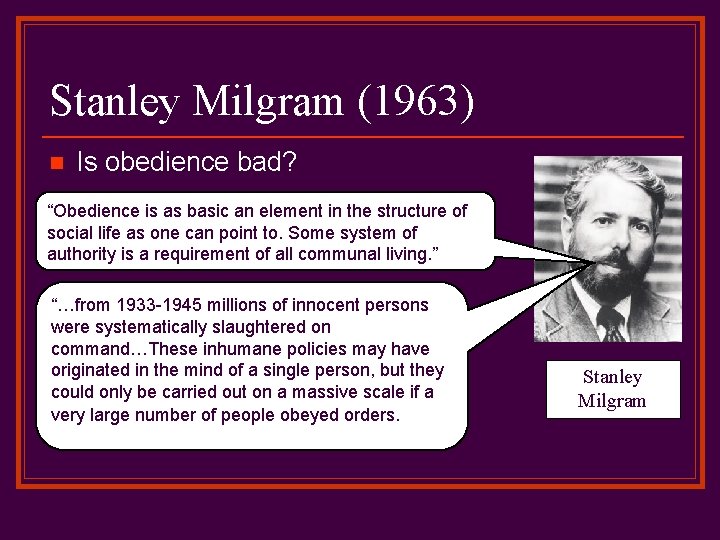
Stanley Milgram (1963) n Is obedience bad? “Obedience is as basic an element in the structure of social life as one can point to. Some system of authority is a requirement of all communal living. ” “…from 1933 -1945 millions of innocent persons were systematically slaughtered on command…These inhumane policies may have originated in the mind of a single person, but they could only be carried out on a massive scale if a very large number of people obeyed orders. Stanley Milgram
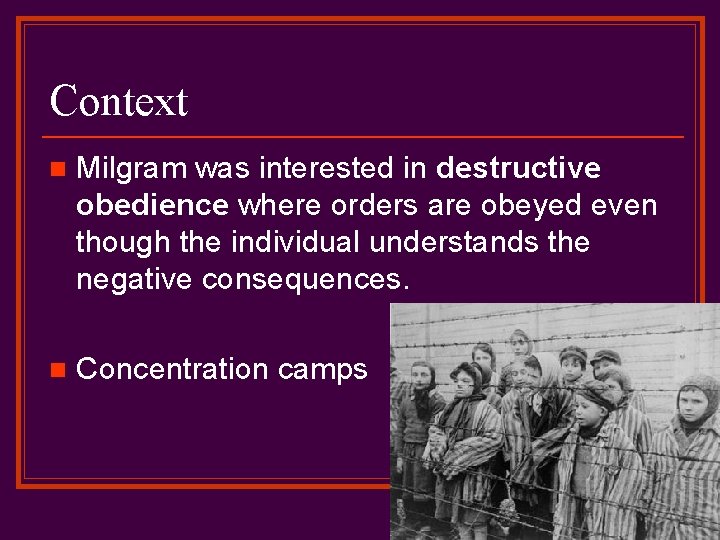
Context n Milgram was interested in destructive obedience where orders are obeyed even though the individual understands the negative consequences. n Concentration camps
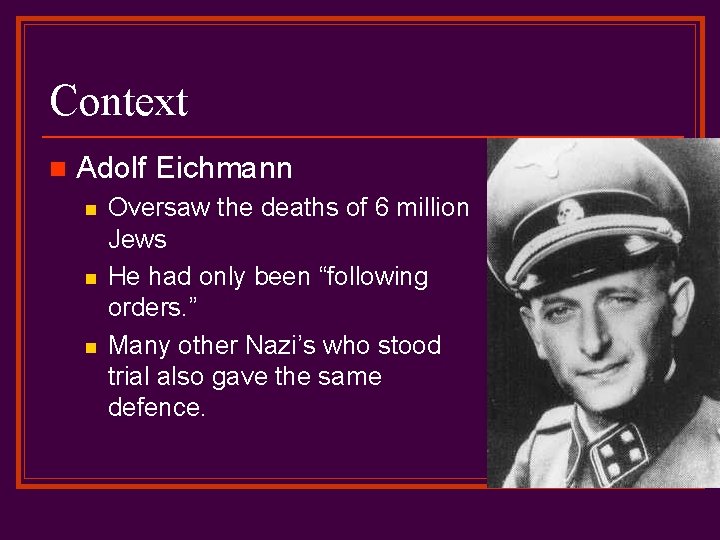
Context n Adolf Eichmann n Oversaw the deaths of 6 million Jews He had only been “following orders. ” Many other Nazi’s who stood trial also gave the same defence.
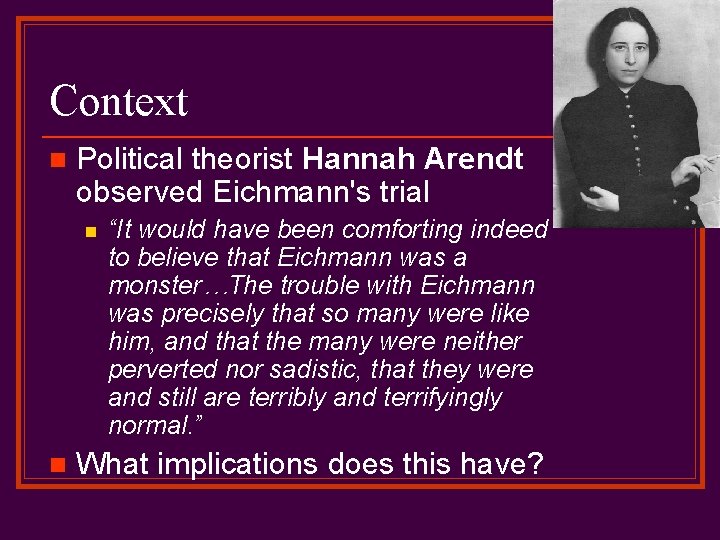
Context n Political theorist Hannah Arendt observed Eichmann's trial n n “It would have been comforting indeed to believe that Eichmann was a monster…The trouble with Eichmann was precisely that so many were like him, and that the many were neither perverted nor sadistic, that they were and still are terribly and terrifyingly normal. ” What implications does this have?
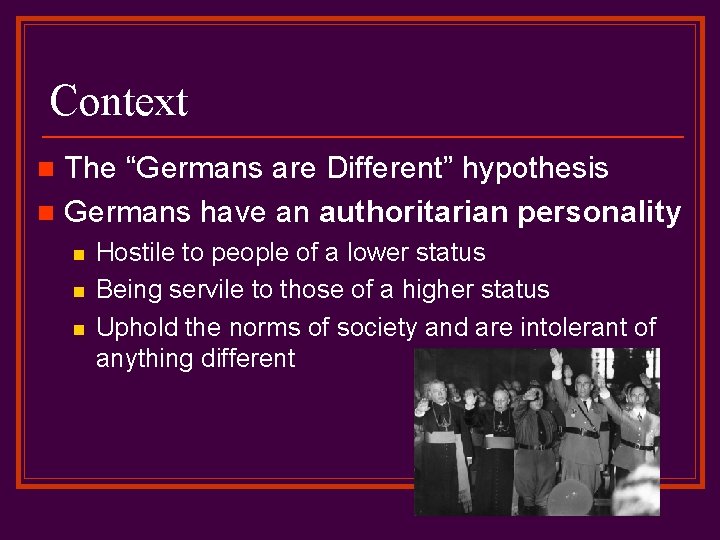
Context The “Germans are Different” hypothesis n Germans have an authoritarian personality n n Hostile to people of a lower status Being servile to those of a higher status Uphold the norms of society and are intolerant of anything different
Aims n Milgram wanted to test the “Germans are different” hypothesis. n n He believed obedience could be explained by situational, rather than dispositional factors. By creating a controlled environment, he could assess obedience. He could then alter variables to see what effect they had on obedience.
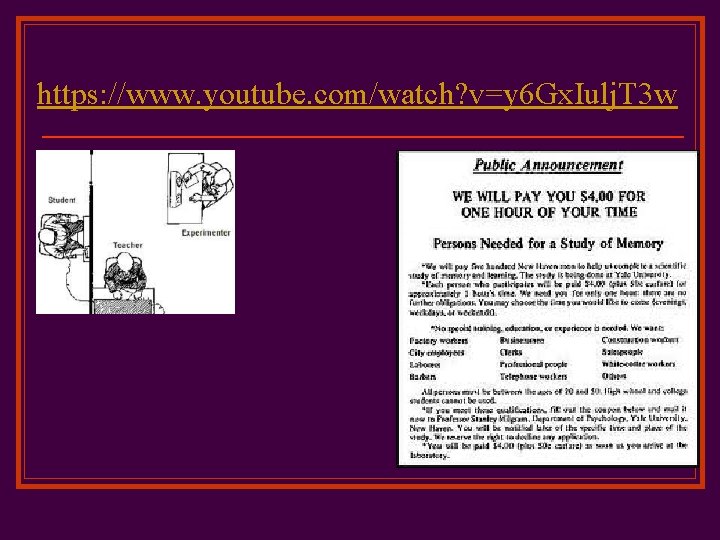
n n Procedure: Volunteers were recruited for a lab experiment investigating “learning” (re: ethics: deception). Participants were 40 males, aged between 20 and 50, whose jobs ranged from unskilled to professional. At the beginning of the experiment they were introduced to another participant, who was actually a confederate of the experimenter (Milgram). They drew straws to determine their roles – leaner or teacher – although this was fixed and the confederate always ended to the learner. There was also an “experimenter” dressed in a white lab coat, played by an actor (not Milgram). The “learner” (Mr. Wallace) was strapped to a chair in another room with electrodes. After he has learned a list of word pairs given him to learn, the "teacher" tests him by naming a word and asking the learner to recall its partner/pair from a list of four possible choices.
https: //www. youtube. com/watch? v=y 6 Gx. Iulj. T 3 w
n n n The teacher is told to administer an electric shock every time the learner makes a mistake, increasing the level of shock each time. There were 30 switches on the shock generator marked from 15 volts (slight shock) to 450 (danger – severe shock). The learner gave mainly wrong answers (on purpose) and for each of these the teacher gave him an electric shock. When the teacher refused to administer a shock and turned to the experimenter for guidance, he was given the standard instruction /order (consisting of 4 prods): Prod 1: please continue. Prod 2: the experiment requires you to continue. Prod 3: It is absolutely essential that you continue. Prod 4: you have no other choice but to continue.
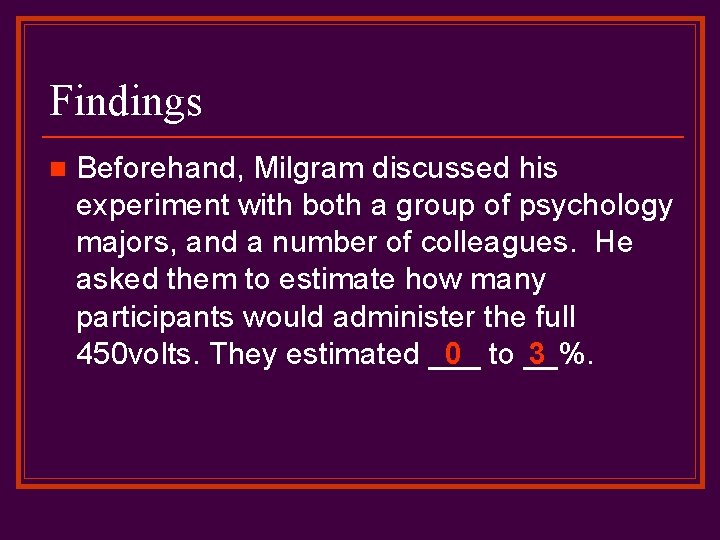
Findings n Beforehand, Milgram discussed his experiment with both a group of psychology majors, and a number of colleagues. He asked them to estimate how many participants would administer the full 450 volts. They estimated ___ to __%. 0 3
Let’s watch n Predictions? n https: //www. youtube. com/watch? v=f. CVl. I_4 GZQ
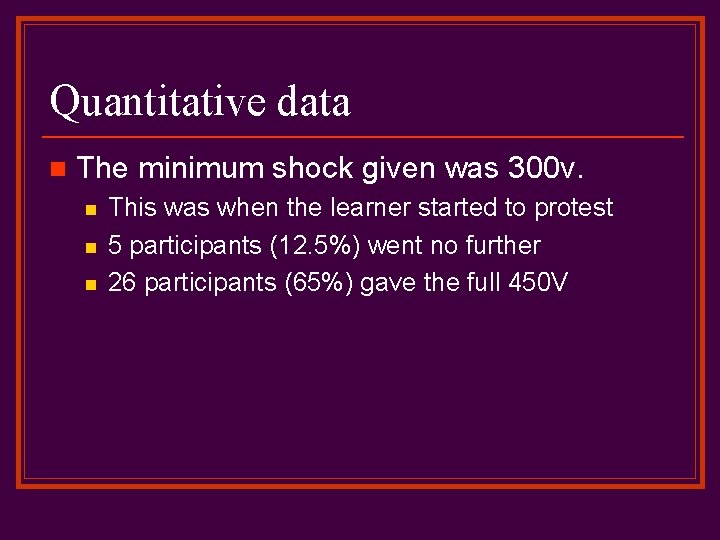
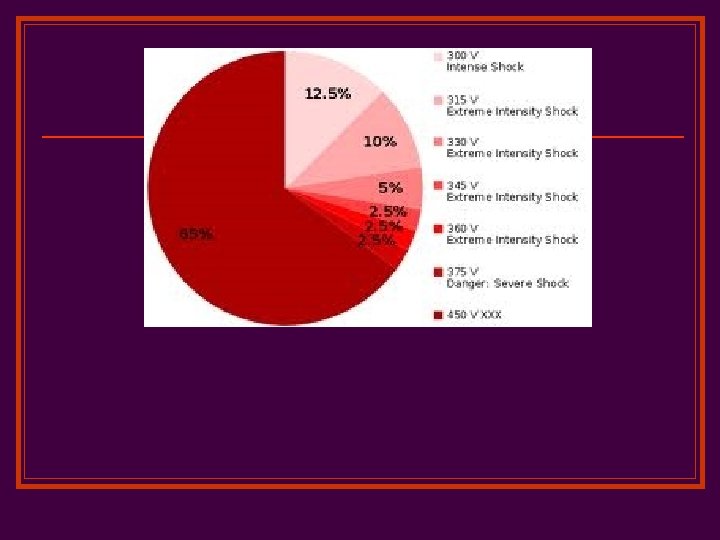
Quantitative data n The minimum shock given was 300 v. n n n This was when the learner started to protest 5 participants (12. 5%) went no further 26 participants (65%) gave the full 450 V
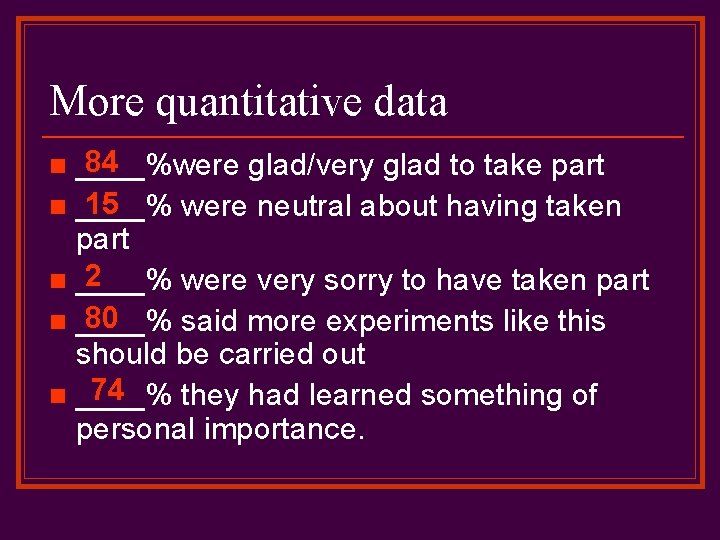
More quantitative data 84 ____%were glad/very glad to take part 15 n ____% were neutral about having taken part 2 n ____% were very sorry to have taken part 80 n ____% said more experiments like this should be carried out 74 n ____% they had learned something of personal importance. n
Conclusions n What is the main conclusion? n n Ordinary people are shockingly obedient to destructive orders. In certain situations, people would kill a stranger The situation caused people do be highly obedient. Emotional consequences
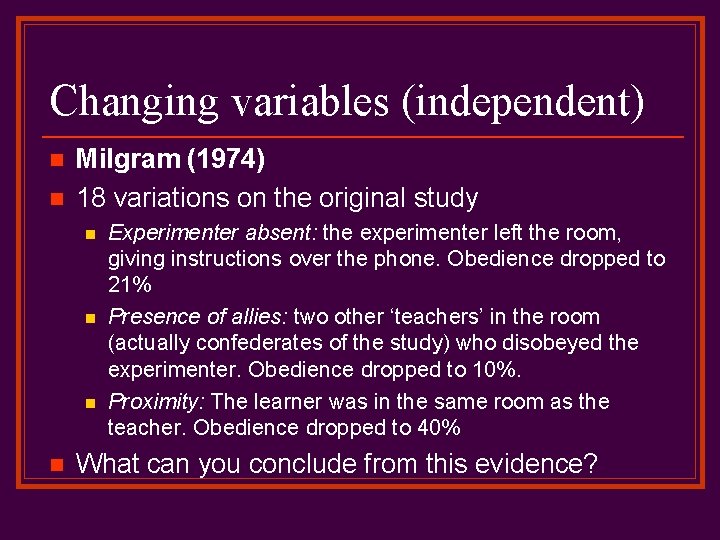
Changing variables (independent) n n Milgram (1974) 18 variations on the original study n n Experimenter absent: the experimenter left the room, giving instructions over the phone. Obedience dropped to 21% Presence of allies: two other ‘teachers’ in the room (actually confederates of the study) who disobeyed the experimenter. Obedience dropped to 10%. Proximity: The learner was in the same room as the teacher. Obedience dropped to 40% What can you conclude from this evidence?
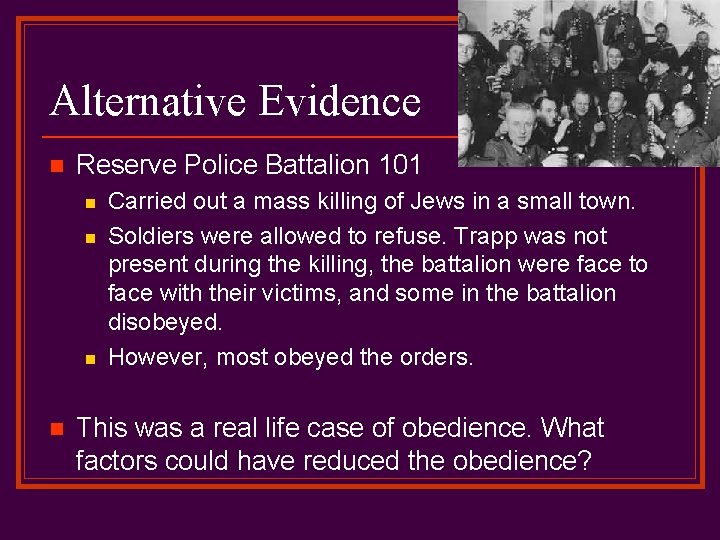
Alternative Evidence n Reserve Police Battalion 101 n n Carried out a mass killing of Jews in a small town. Soldiers were allowed to refuse. Trapp was not present during the killing, the battalion were face to face with their victims, and some in the battalion disobeyed. However, most obeyed the orders. This was a real life case of obedience. What factors could have reduced the obedience?
Response n Purpose: n 1) What was the purpose of Milgram’s study? What was he trying to find out? n 2) What was the dependent variable of his experiment? 3) What did he hypothesize would happen? What theory around German disposition was he trying to disprove? n n Procedure: n n 4) How did he conduct the experiment? Who were three people involved? And what was each person’s role? Results: n n 5) What did he find? 6) After manipulating some factors in the study, what did he find reduced disobedience?