
Milgram 1963 Unit 2 Background Aims Milgram wanted

Milgram (1963) Unit 2
Background & Aims • Milgram wanted to answer the question of why Nazis appeared so willing to obey orders and murder millions of people • Milgram understood that obedience was an important part of life but wanted to see if people would still obey authority even when their orders were unjust • He created a situation that allowed him to measure the process of obedience where the command required destructive behaviour
Methodology • Controlled observation conducted in a lab environment • Volunteer Sample: - 40 males aged between 20 -50 - Range of different jobs and educational backgrounds - Responding to a newspaper advert asking for volunteers to take part in a study on memory and learning - They were paid $4. 50 for attending
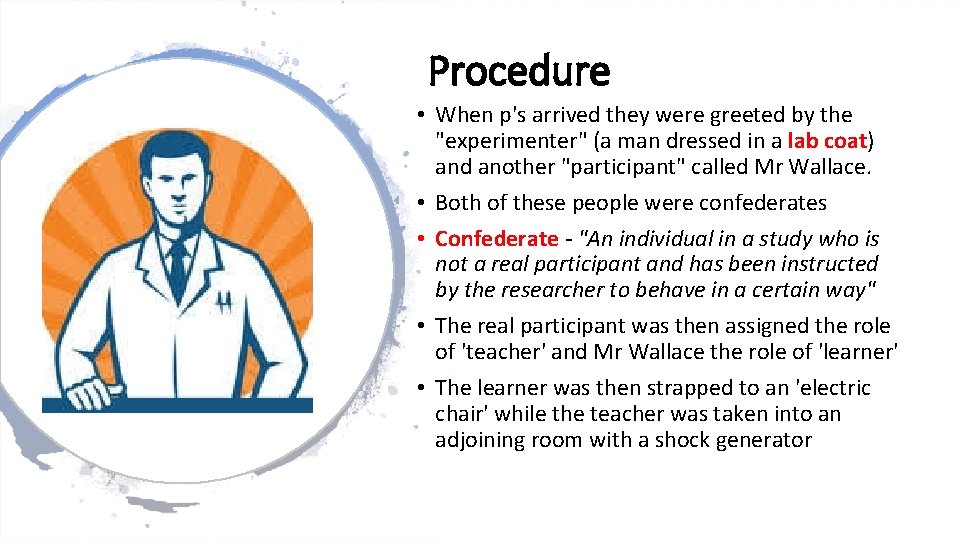
Procedure • When p's arrived they were greeted by the "experimenter" (a man dressed in a lab coat) and another "participant" called Mr Wallace. • Both of these people were confederates • Confederate - "An individual in a study who is not a real participant and has been instructed by the researcher to behave in a certain way" • The real participant was then assigned the role of 'teacher' and Mr Wallace the role of 'learner' • The learner was then strapped to an 'electric chair' while the teacher was taken into an adjoining room with a shock generator

The Shock Generator
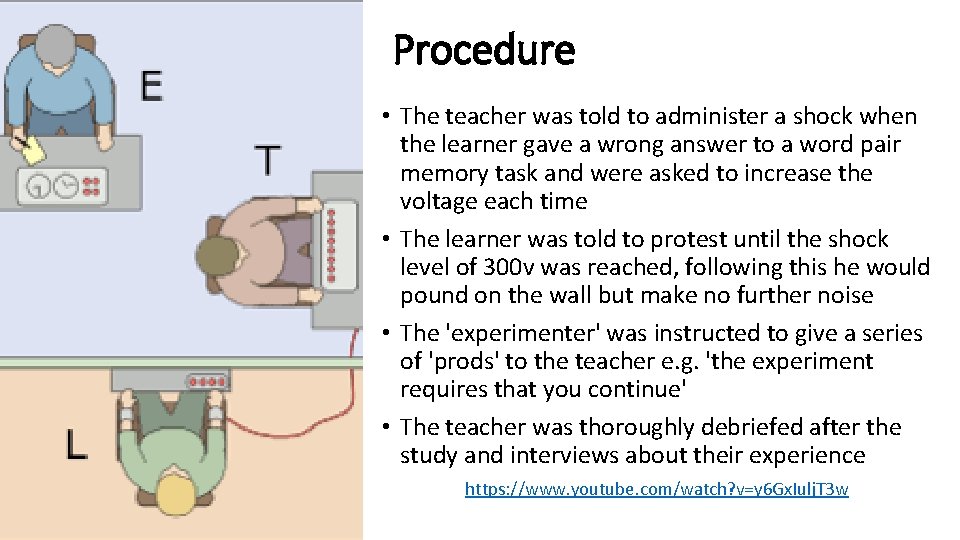
Procedure • The teacher was told to administer a shock when the learner gave a wrong answer to a word pair memory task and were asked to increase the voltage each time • The learner was told to protest until the shock level of 300 v was reached, following this he would pound on the wall but make no further noise • The 'experimenter' was instructed to give a series of 'prods' to the teacher e. g. 'the experiment requires that you continue' • The teacher was thoroughly debriefed after the study and interviews about their experience https: //www. youtube. com/watch? v=y 6 Gx. Iulj. T 3 w
Findings • All participants went up to 300 volts • At this point only 5 out of the 40 participants (12. 5%) refused to continue • Before the experiment a group of psychology students estimated that between 0 -3% of participants would administer the full 450 volts (they were wrong!) • A total of 26 out of 40 participants (65%) administered the full 450 volts • Many subjects showed signs of nervousness e. g. sweating, stuttering, biting their nails, nervous laughter • Three participants had full blown uncontrollable seizures, one so bad the experiment had to be stopped
Conclusions • Milgram suggested the following explanations for obedience: - Prestigious location provided authority (Yale University) - P's assumed experimenter had a worthy purpose - P's assumed discomfort was minimal and temporary - P's experienced conflict between harming someone and obeying legitimate authority - P's felt obliged due to providing voluntary consent to take part - P's weren't sure how to behave as they were unable to discuss their actions with others

Evaluation • What are the strengths and limitations of the study being conducted in a lab? • What issues do you think there are with the sample used in the study? • What ethical issues were involved? Were any of these dealt with? How? • Is there a chance that participants realised that the shocks weren't real? (this would affect the internal validity of the study) • Following interviews Milgram reported that 75% of p's strongly believed that the shocks were real
Example Exam Questions Milgram’s (1963) ‘Behavioral study of Obedience’ used a volunteer (self-selected) sample. (Describe one advantage and one disadvantage of the use of selfselected sampling in Milgram’s study. [4] 'Milgram's study is an example of very unethical but highly insightful research'. Discuss the extent to which you agree with this statement [12]
- Slides: 10