
Mike Rother Toyota Kata 1 Copyright Information You













- Slides: 40
© Mike Rother Toyota Kata 1
Copyright Information You may use any slides from this presentation, which are copyrighted under a Creative Commons Attribution license. The only requirement is to note the source on each slide you use, for instance by including “By Mike Rother” somewhere on the slide. © Mike Rother Toyota Kata 2
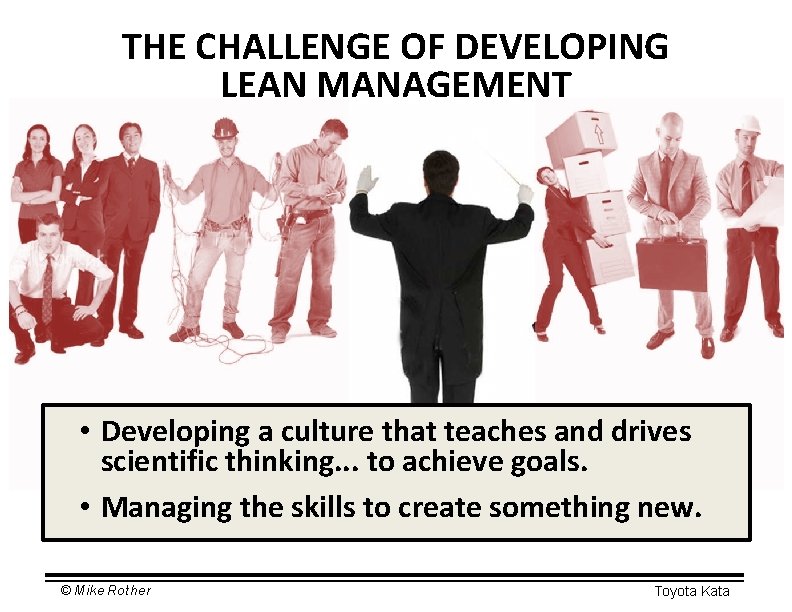
THE CHALLENGE OF DEVELOPING LEAN MANAGEMENT • Developing a culture that teaches and drives scientific thinking. . . to achieve goals. • Managing the skills to create something new. © Mike Rother Toyota Kata
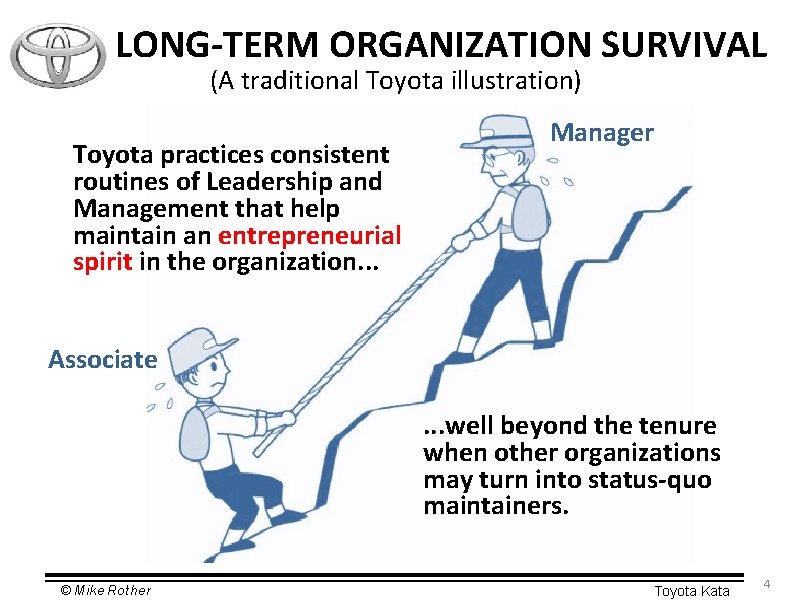
LONG-TERM ORGANIZATION SURVIVAL (A traditional Toyota illustration) Toyota practices consistent routines of Leadership and Management that help maintain an entrepreneurial spirit in the organization. . . Manager Associate. . . well beyond the tenure when other organizations may turn into status-quo maintainers. © Mike Rother Toyota Kata 4
LET'S START WITH SOME BACKGROUND The TK Research (2004 - 2009) -- Two Questions -1. What are the unseen managerial routines and thinking that lie behind Toyota’s success with continuous improvement and adaptation? 2. How can other companies develop similar routines and thinking in their organizations? © Mike Rother Toyota Kata 5
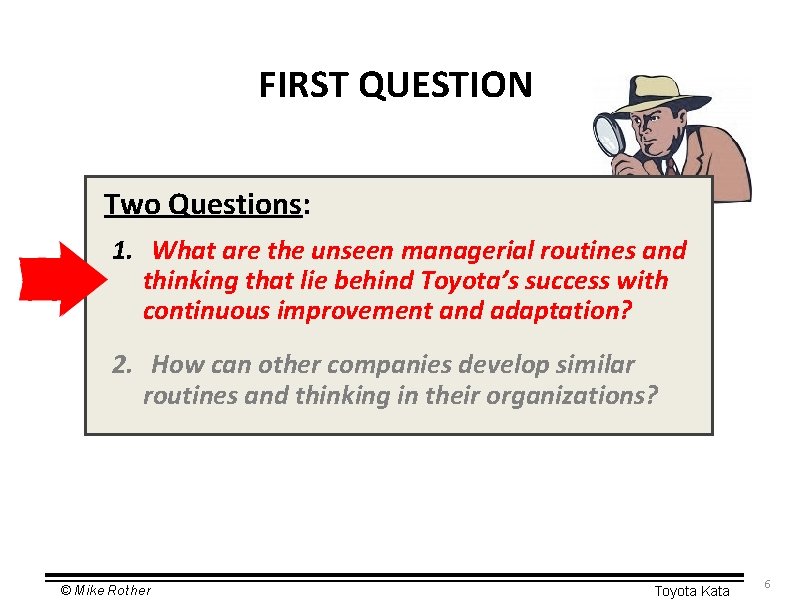
FIRST QUESTION Two Questions: 1. What are the unseen managerial routines and thinking that lie behind Toyota’s success with continuous improvement and adaptation? 2. How can other companies develop similar routines and thinking in their organizations? © Mike Rother Toyota Kata 6
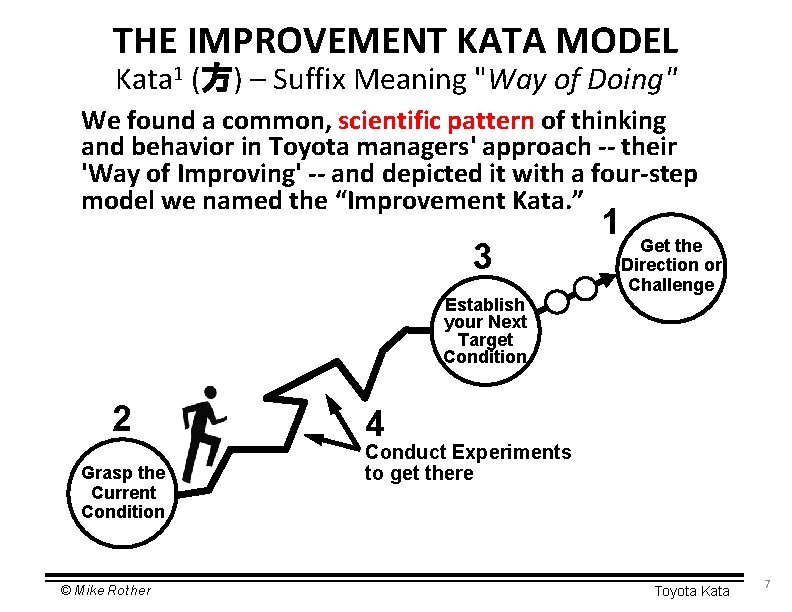
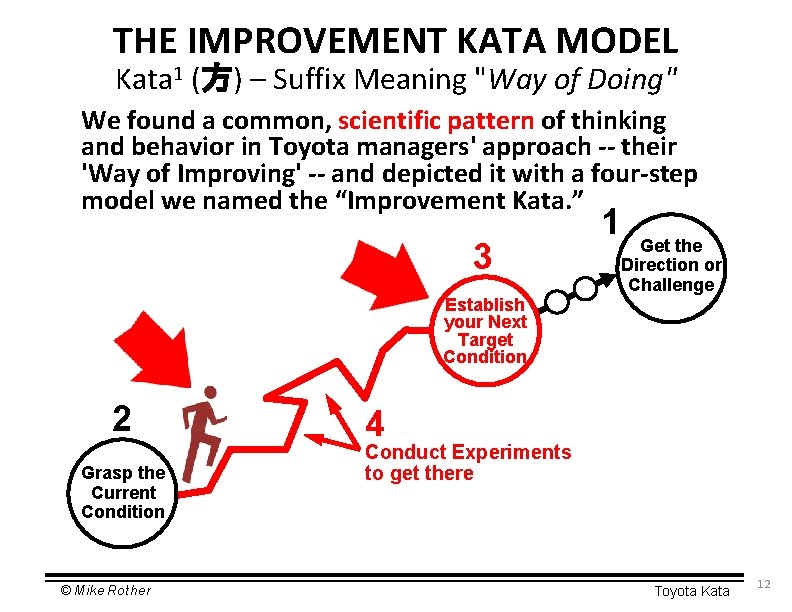
THE IMPROVEMENT KATA MODEL Kata 1 (方) – Suffix Meaning "Way of Doing" We found a common, scientific pattern of thinking and behavior in Toyota managers' approach -- their 'Way of Improving' -- and depicted it with a four-step model we named the “Improvement Kata. ” 3 1 Get the Direction or Challenge Establish your Next Target Condition 2 Grasp the Current Condition © Mike Rother 4 Conduct Experiments to get there Toyota Kata 7
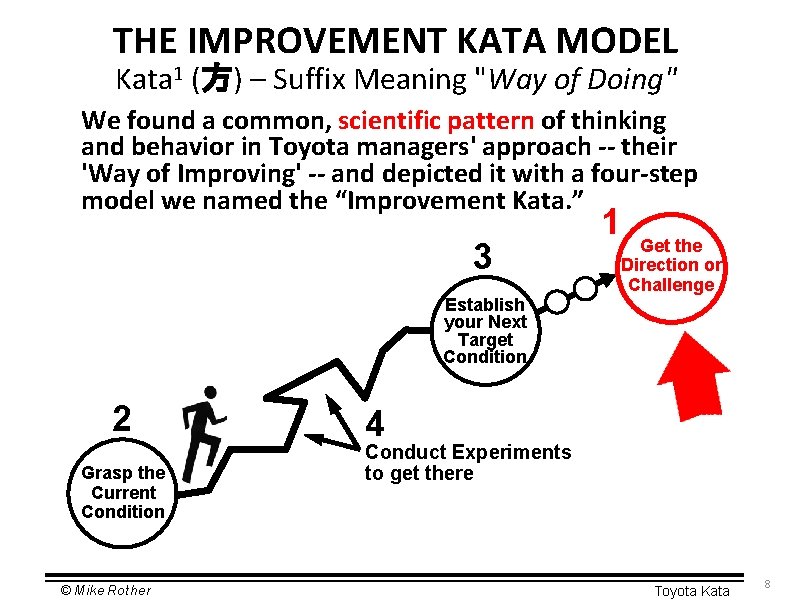
THE IMPROVEMENT KATA MODEL Kata 1 (方) – Suffix Meaning "Way of Doing" We found a common, scientific pattern of thinking and behavior in Toyota managers' approach -- their 'Way of Improving' -- and depicted it with a four-step model we named the “Improvement Kata. ” 3 1 Get the Direction or Challenge Establish your Next Target Condition 2 Grasp the Current Condition © Mike Rother 4 Conduct Experiments to get there Toyota Kata 8
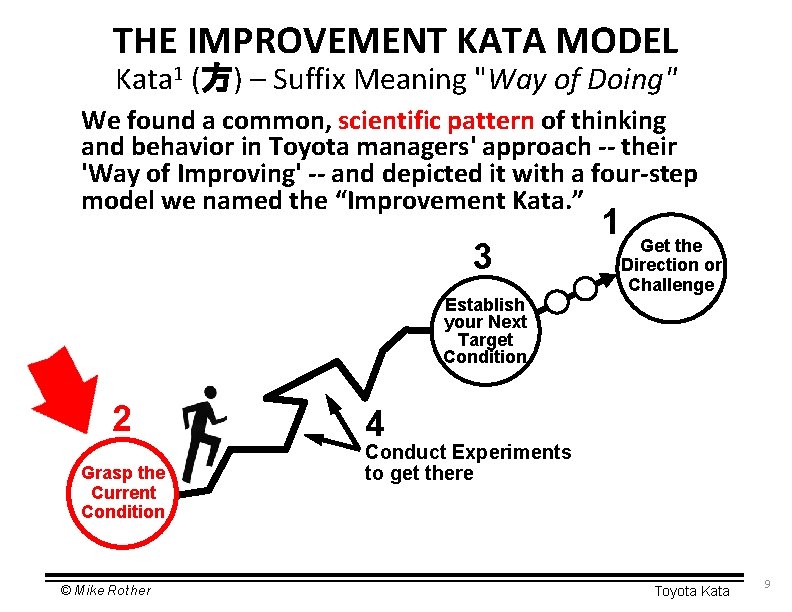
THE IMPROVEMENT KATA MODEL Kata 1 (方) – Suffix Meaning "Way of Doing" We found a common, scientific pattern of thinking and behavior in Toyota managers' approach -- their 'Way of Improving' -- and depicted it with a four-step model we named the “Improvement Kata. ” 3 1 Get the Direction or Challenge Establish your Next Target Condition 2 Grasp the Current Condition © Mike Rother 4 Conduct Experiments to get there Toyota Kata 9
THE IMPROVEMENT KATA MODEL Kata 1 (方) – Suffix Meaning "Way of Doing" We found a common, scientific pattern of thinking and behavior in Toyota managers' approach -- their 'Way of Improving' -- and depicted it with a four-step model we named the “Improvement Kata. ” 3 1 Get the Direction or Challenge Establish your Next Target Condition 2 Grasp the Current Condition © Mike Rother 4 Conduct Experiments to get there Toyota Kata 10
THE IMPROVEMENT KATA MODEL Kata 1 (方) – Suffix Meaning "Way of Doing" We found a common, scientific pattern of thinking and behavior in Toyota managers' approach -- their 'Way of Improving' -- and depicted it with a four-step model we named the “Improvement Kata. ” 3 1 Get the Direction or Challenge Establish your Next Target Condition 2 Grasp the Current Condition © Mike Rother 4 Conduct Experiments to get there Toyota Kata 11
THE IMPROVEMENT KATA MODEL Kata 1 (方) – Suffix Meaning "Way of Doing" We found a common, scientific pattern of thinking and behavior in Toyota managers' approach -- their 'Way of Improving' -- and depicted it with a four-step model we named the “Improvement Kata. ” 3 1 Get the Direction or Challenge Establish your Next Target Condition 2 Grasp the Current Condition © Mike Rother 4 Conduct Experiments to get there Toyota Kata 12
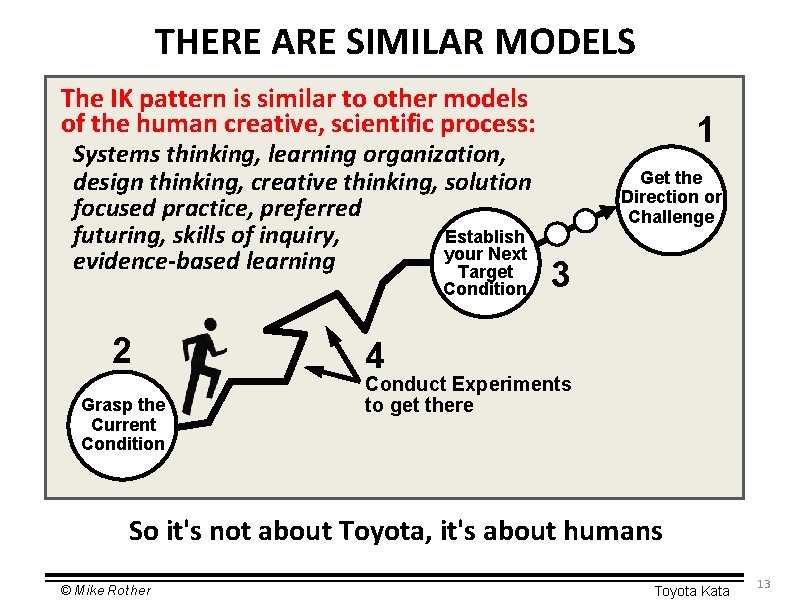
THERE ARE SIMILAR MODELS The IK pattern is similar to other models of the human creative, scientific process: Systems thinking, learning organization, design thinking, creative thinking, solution focused practice, preferred futuring, skills of inquiry, Establish your Next evidence-based learning Target Condition 2 Grasp the Current Condition 1 Get the Direction or Challenge 3 4 Conduct Experiments to get there So it's not about Toyota, it's about humans © Mike Rother Toyota Kata 13
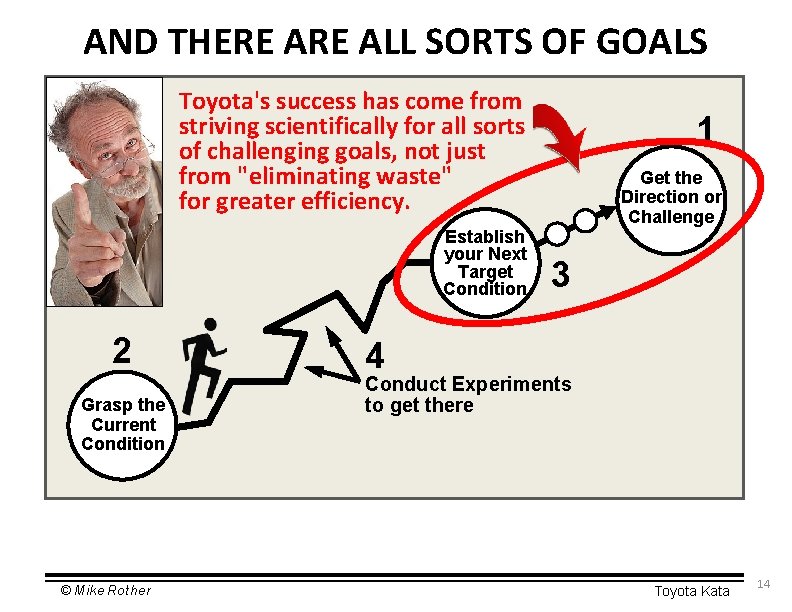
AND THERE ALL SORTS OF GOALS Toyota's success has come from striving scientifically for all sorts of challenging goals, not just from "eliminating waste" for greater efficiency. Establish your Next Target Condition 2 Grasp the Current Condition © Mike Rother 1 Get the Direction or Challenge 3 4 Conduct Experiments to get there Toyota Kata 14
THE IMPROVEMENT KATA MODEL Kata 1 (方) – Suffix Meaning "Way of Doing" 3 1 Get the Direction or Challenge Establish your Next Target Condition 2 Grasp the Current Condition © Mike Rother 4 Conduct Experiments to get there Toyota Kata 15
THERE'S ALSO A COACHING KATA A way of coaching. Toyota's Master-Apprentice style teaching approach is like training in sports and music. Coach (Manager) Learner Together the Improvement Kata and Coaching Kata make up a management approach © Mike Rother Toyota Kata 16
IT'S ABOUT DEVELOPING CAPABILITY Toyota managers teach their people a scientific mindset - a Meta Skill -- that can be applied to any objective, thereby creating an effective, shared way of working throughout the organization. Once an organization has such capability, you can introduce nearly any challenge. © Mike Rother Toyota Kata 17
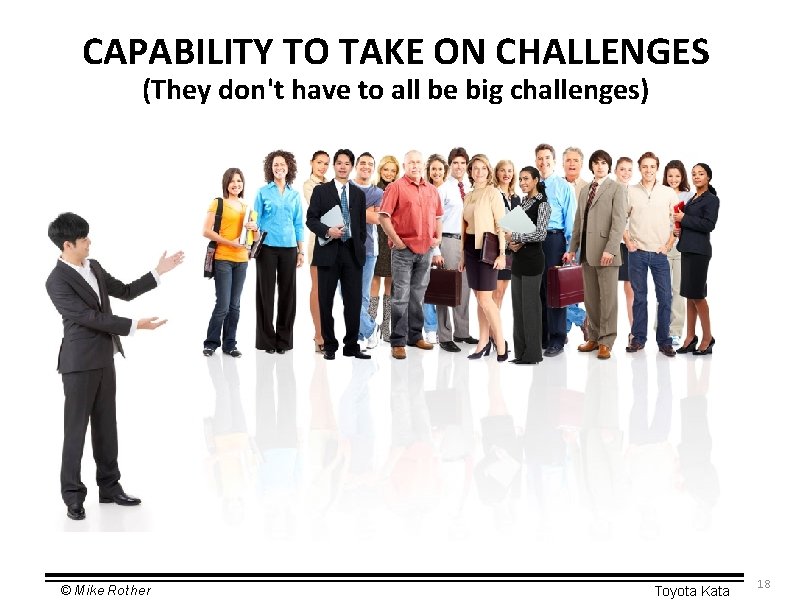
CAPABILITY TO TAKE ON CHALLENGES (They don't have to all be big challenges) © Mike Rother Toyota Kata 18
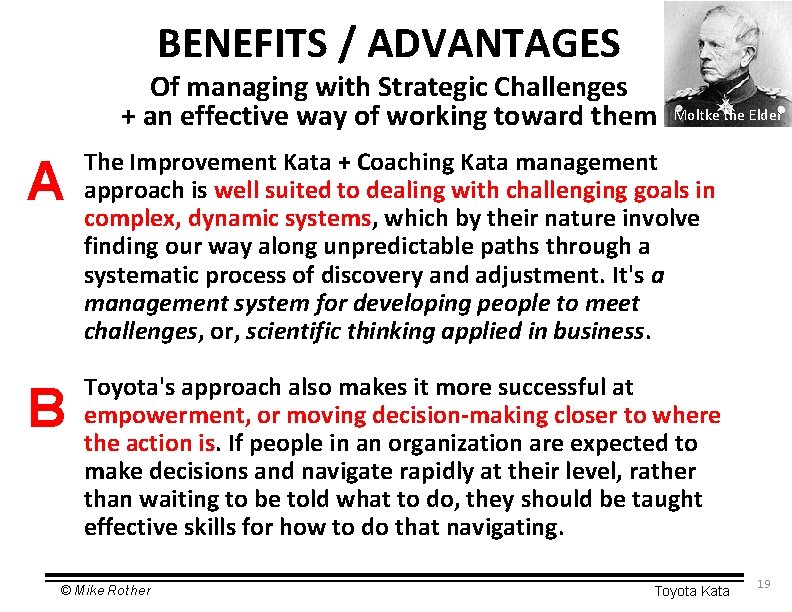
BENEFITS / ADVANTAGES Of managing with Strategic Challenges + an effective way of working toward them Moltke the Elder A The Improvement Kata + Coaching Kata management approach is well suited to dealing with challenging goals in complex, dynamic systems, which by their nature involve finding our way along unpredictable paths through a systematic process of discovery and adjustment. It's a management system for developing people to meet challenges, or, scientific thinking applied in business. B Toyota's approach also makes it more successful at empowerment, or moving decision-making closer to where the action is. If people in an organization are expected to make decisions and navigate rapidly at their level, rather than waiting to be told what to do, they should be taught effective skills for how to do that navigating. © Mike Rother Toyota Kata 19
BUT THERE IS A PROBLEM No matter how good it is, just explaining a model doesn't generate new ways of thinking and acting. Hoping to create different behavior by explaining or trying to convince generally doesn't work. © Mike Rother Toyota Kata 20
THIS BRINGS US TO THE SECOND QUESTION Two Questions: 1. What are the unseen managerial routines and thinking that lie behind Toyota’s success with continuous improvement and adaptation? 2. How can other companies develop similar routines and thinking in their organizations? © Mike Rother Toyota Kata 21
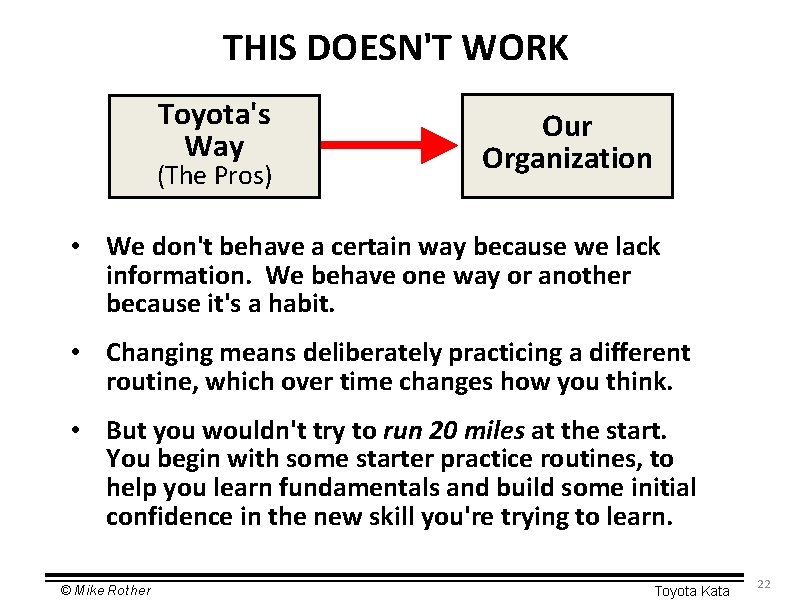
THIS DOESN'T WORK Toyota's Way (The Pros) Our Organization • We don't behave a certain way because we lack information. We behave one way or another because it's a habit. • Changing means deliberately practicing a different routine, which over time changes how you think. • But you wouldn't try to run 20 miles at the start. You begin with some starter practice routines, to help you learn fundamentals and build some initial confidence in the new skill you're trying to learn. © Mike Rother Toyota Kata 22
DEVELOPING YOUR OWN WAY Begin with some basic practice routines to learn some fundamental skills, then evolve to suit your organization as proficiency is developed Toyota's Way © Mike Rother Our Organization's Way Expert Proficient Competent Advanced Beginner Novice Each person may start at a different point and advance at different rates. Toyota Kata 23
VIDEO – How Skill Development Works https: //www. youtube. com/watch? v=cf. AQ 8 o. JIGo. A Available on the IK/CK You. Tube Channel © Mike Rother Toyota Kata 24
THE ROLE OF PRACTICE ROUTINES Kata 2 (型 or 形) – Meaning "Form" Kata are also basic practice routines that help you adopt new ways of acting and thinking. This is where brain science comes in © Mike Rother Toyota Kata 25
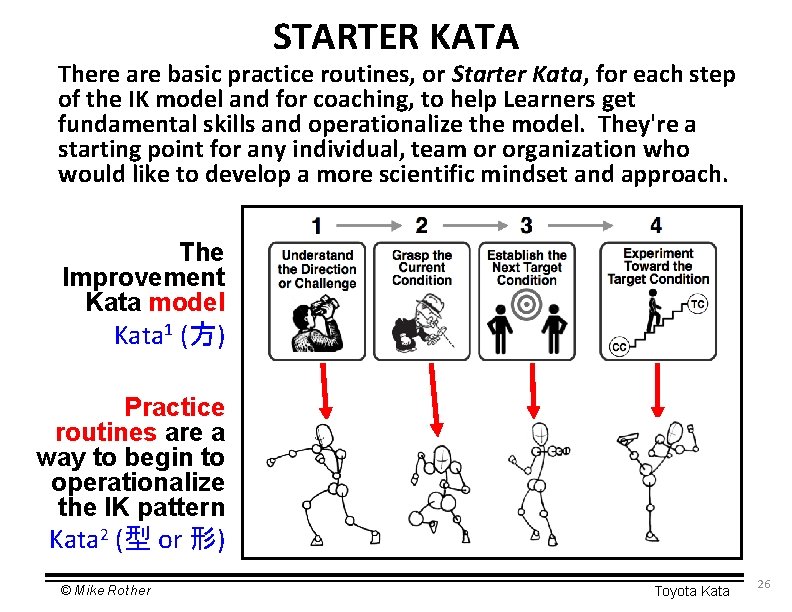
STARTER KATA There are basic practice routines, or Starter Kata, for each step of the IK model and for coaching, to help Learners get fundamental skills and operationalize the model. They're a starting point for any individual, team or organization who would like to develop a more scientific mindset and approach. The Improvement Kata model Kata 1 (方) Practice routines are a way to begin to operationalize the IK pattern Kata 2 (型 or 形) © Mike Rother Toyota Kata 26
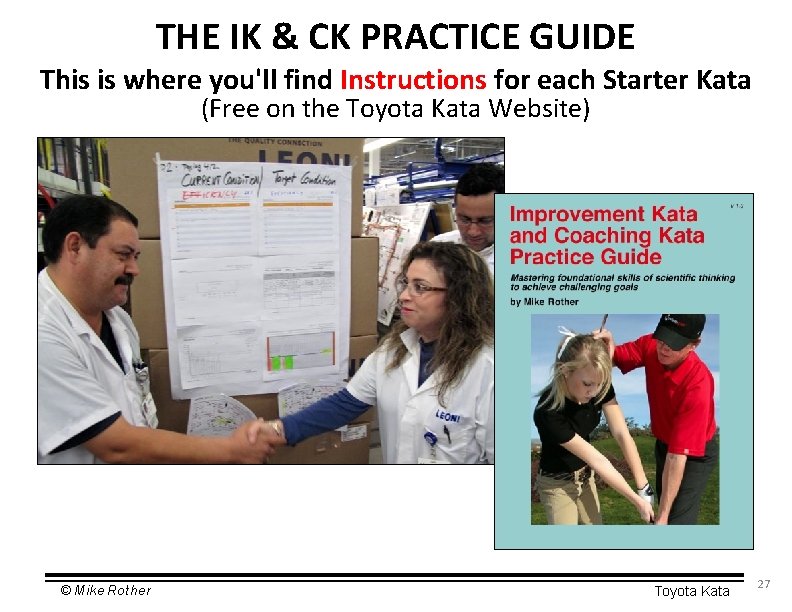
THE IK & CK PRACTICE GUIDE This is where you'll find Instructions for each Starter Kata (Free on the Toyota Kata Website) © Mike Rother Toyota Kata 27
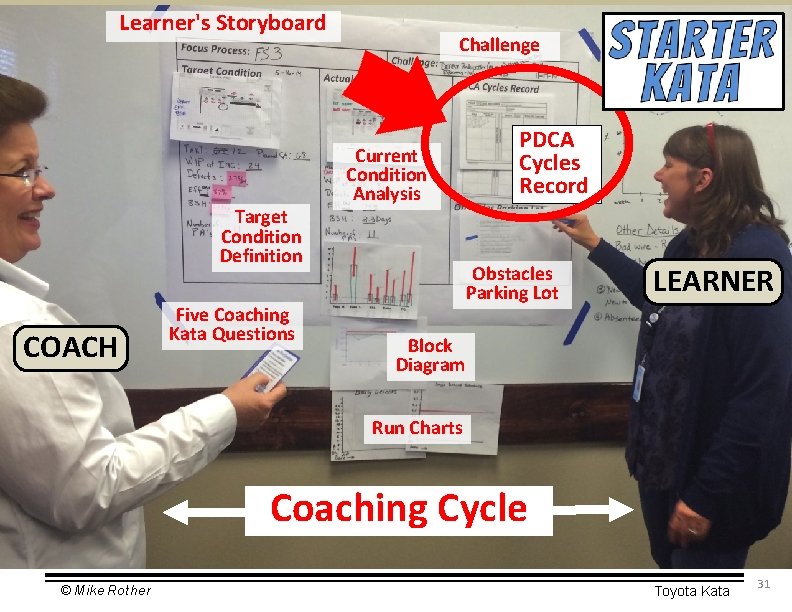
Learner's Storyboard Target Condition Definition COACH Five Coaching Kata Questions Challenge PDCA Cycles Record Current Condition Analysis Obstacles Parking Lot LEARNER Block Diagram Run Charts Coaching Cycle © Mike Rother Toyota Kata 28
HOW LONG DO YOU PRACTICE STARTER KATA RELIGIOUSLY? Practice doesn't have such discrete stages, but it helps depict your progression (1) FOLLOW: Start by repeating each practice routine without modification, so you can absorb its fundamental pattern. (2) DETACH: Once the basic patterns get habitual and you understand the 'why' behind them, you'll start to adapt them. (3) FLUENCY: At this stage your actions become natural. You can create your own approaches to fit different circumstances, while sticking to basic underlying 'why' principles. © Mike Rother Toyota Kata 29
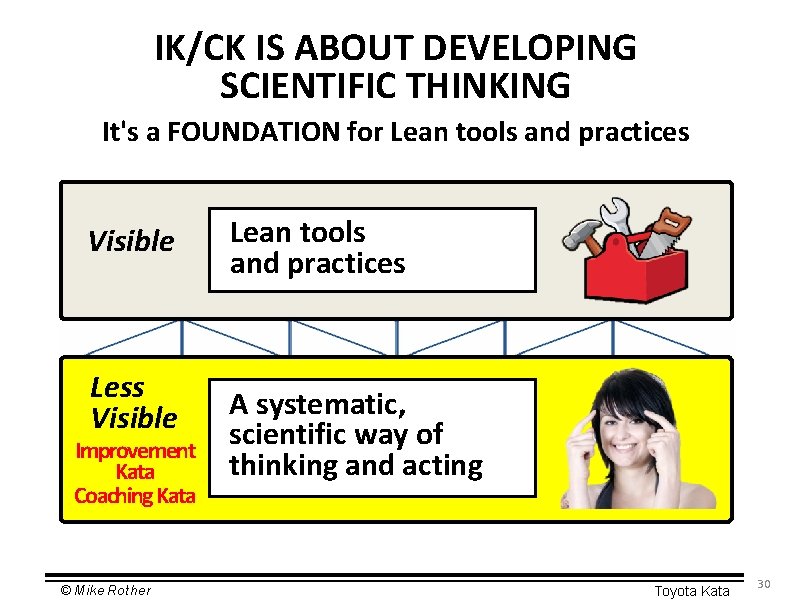
IK/CK IS ABOUT DEVELOPING SCIENTIFIC THINKING It's a FOUNDATION for Lean tools and practices Visible Less Visible Improvement Kata Coaching Kata © Mike Rother Lean tools and practices A systematic, scientific way of thinking and acting Toyota Kata 30
Learner's Storyboard Target Condition Definition COACH Five Coaching Kata Questions Challenge Current Condition Analysis PDCA Cycles Record Obstacles Parking Lot LEARNER Block Diagram Run Charts Coaching Cycle © Mike Rother Toyota Kata 31
LEARNER COACH Five Coaching Kata Questions © Mike Rother Toyota Kata 32
THAT TRADITIONAL TOYOTA ILLUSTRATION MANAGER LEARNER © Mike Rother Toyota Kata 33
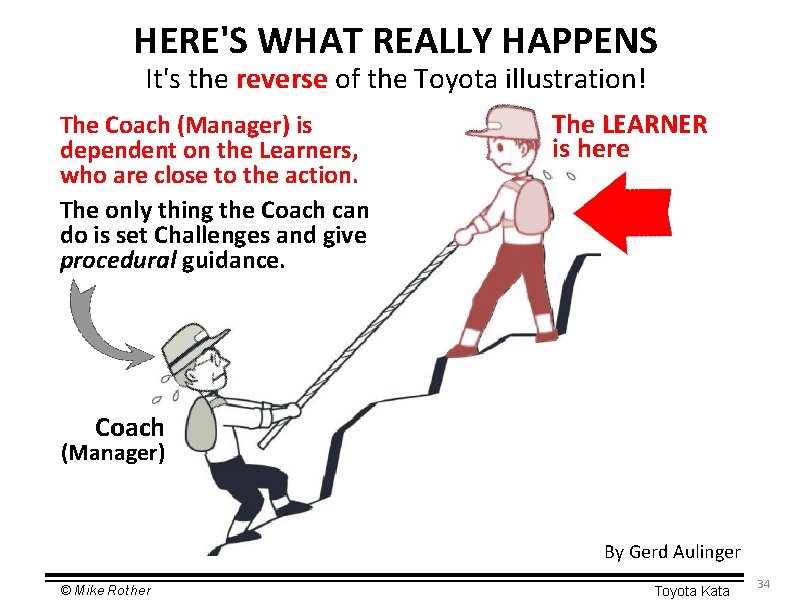
HERE'S WHAT REALLY HAPPENS It's the reverse of the Toyota illustration! The Coach (Manager) is dependent on the Learners, who are close to the action. The only thing the Coach can do is set Challenges and give procedural guidance. The LEARNER is here Coach (Manager) By Gerd Aulinger © Mike Rother Toyota Kata 34
© Mike Rother Toyota Kata 35
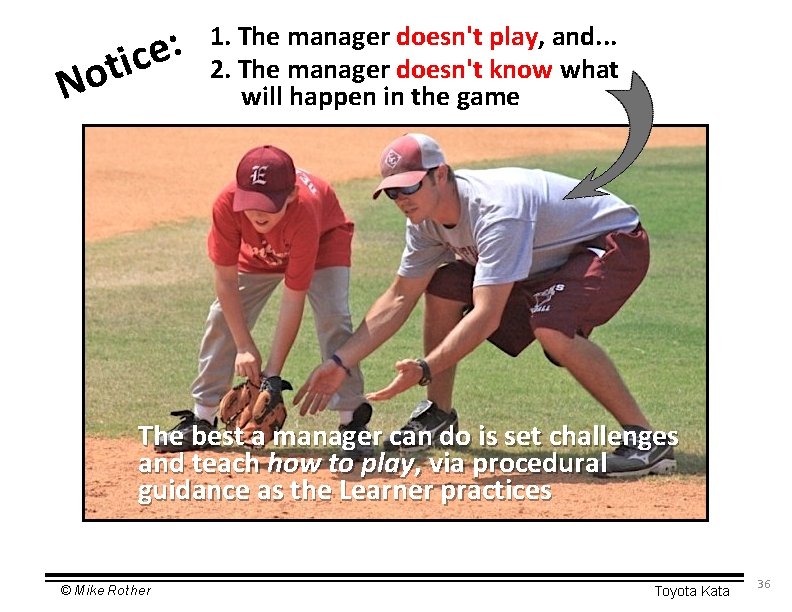
No : e c ti 1. The manager doesn't play, and. . . 2. The manager doesn't know what will happen in the game The best a manager can do is set challenges and teach how to play, via procedural guidance as the Learner practices © Mike Rother Toyota Kata 36
WHAT THE IMPROVEMENT KATA AND COACHING KATA ARE ABOUT Scientific Thinking Pattern + Deliberate Practice (Kata) © Mike Rother Toyota Kata 37
WHAT THE IMPROVEMENT KATA AND COACHING KATA ARE ABOUT Scientific Thinking Pattern + Deliberate Practice (Kata) Making Scientific Thinking a Skill that Can be Learned by Anyone © Mike Rother Toyota Kata 38
© Mike Rother Toyota Kata 39
© Mike Rother Toyota Kata 40