
Mike Chappell School of Engineering Warwick Engineering in
- Slides: 5
Mike Chappell School of Engineering Warwick Engineering in Biomedicine WEB
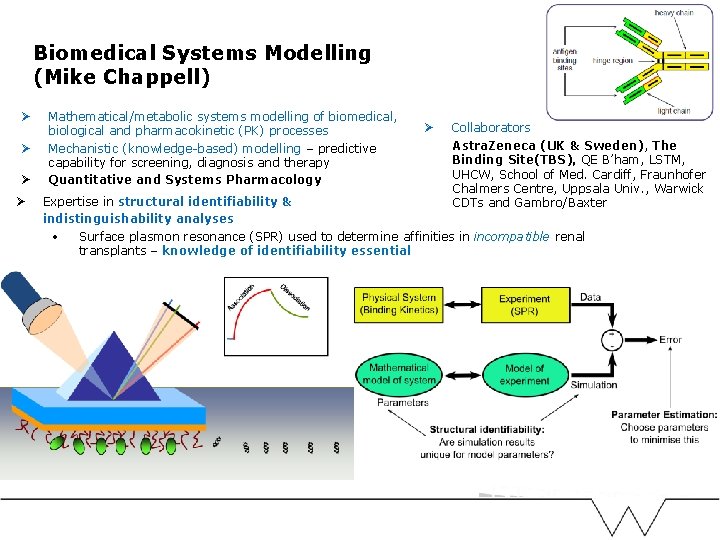
Biomedical Systems Modelling (Mike Chappell) Ø Ø Mathematical/metabolic systems modelling of biomedical, biological and pharmacokinetic (PK) processes Mechanistic (knowledge-based) modelling – predictive capability for screening, diagnosis and therapy Quantitative and Systems Pharmacology Ø Collaborators Astra. Zeneca (UK & Sweden), The Binding Site(TBS), QE B’ham, LSTM, UHCW, School of Med. Cardiff, Fraunhofer Chalmers Centre, Uppsala Univ. , Warwick CDTs and Gambro/Baxter Expertise in structural identifiability & indistinguishability analyses • Surface plasmon resonance (SPR) used to determine affinities in incompatible renal transplants – knowledge of identifiability essential
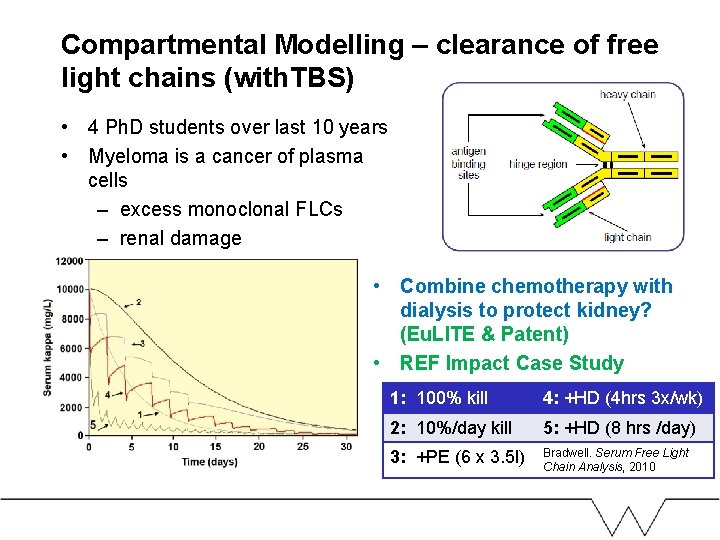
Compartmental Modelling – clearance of free light chains (with. TBS) • 4 Ph. D students over last 10 years • Myeloma is a cancer of plasma cells – excess monoclonal FLCs – renal damage • Combine chemotherapy with dialysis to protect kidney? (Eu. LITE & Patent) • REF Impact Case Study 1: 100% kill 4: +HD (4 hrs 3 x/wk) 2: 10%/day kill 5: +HD (8 hrs /day) 3: +PE (6 x 3. 5 l) Bradwell. Serum Free Light Chain Analysis, 2010
Warwick/Astra. Zeneca (AZ) Collaborations • • • IMPACT (Innovative Modelling for Pharmacological Advances through Collaborative Training) in collaboration with Astra. Zeneca (Mölndal, Sweden & Alderley Park/Cambridge) and associate partners - EU, Marie Curie People ITN European Industrial Doctorate (EID) scheme(€ 1. 467 M) “Structural Identifiability and Indistinguishability Analysis as Tools for Quantitative and Systems Toxicology” supporting the replacement, reduction and refinement (3 Rs) of animal use. Funded by the NC 3 Rs/EPSRC (£ 245 K) Modelling the kinetics of BCRP/hepatic transporters and associated inhibitors – (MRC Capacity Building Studentship + AZ top-up) Modelling and control of glucose-insulin dynamics (Type 2 diabetes) – (AZ funded Ph. D studentship) Mechanistic modelling of in vitro transporter data to improve translational modelling of the transporter-mediated human pharmacokinetics and DDI predictions (BBSRC Case Award with AZ, began February 2015)
Quantitative and Systems Pharmacology (QSP) • • • Systems pharmacology - an emerging discipline, which connects systems biology (i. e. genomics, proteomics, and metabolomics) to quantitative pharmacology (i. e. mechanism-based PKPD modelling) to obtain fundamental insights in the interactions between drugs and diseases. Recently, interest in this field has increased substantially. It is seen as a novel scientific approach to the design of (complex) therapeutic interventions to modify disease processes. Now have an EPSRC funded national network QSP-UK in this area that also includes all of the major pharma companies based in the UK ans associated SMEs. Networkshops planned: - Surrey (5 th-7 th September 2016) - Warwick (September 2017) - Reading (July 2018) See: http: //www. maths-in-medicine. org/qsp-uk/