
Migratory patterns of Indigenous Peoples in the Caribbean
Migratory patterns of Indigenous Peoples in the Caribbean Ms. Nicholson Caribbean History
Key term: � Indigenous-originating and living or occurring naturally in an area or environment. � Migration- is the movement by people from one place to another with the intention of settling in the new location. � Nomad- a member of a people that travels from place to find fresh pasture for its animals and has no permanent home. � Amerindian-coined in the beginning of the twentieth century, is a generic term for all of the aboriginal inhabitants of the Americas.
Key Ideas: �During the Ice Age, humans relied on hunting and gathering their food to survive. �They were nomadic because the animals they hunted moved around in search of food. �The people of Beringia probably followed and hunted caribou, mammoth and deer across the plains. �Humans also depended on animals for their clothing and shelter, camping in animal skin tents as they travelled across Beringia.

Three Main Groups of Indigenous Peoples of the Caribbean in 1492 � The main groups of the Amerindians who were found were (a) the Mayans and (b) the Kalinagos and the Tainos. � The word ‘Arawak’ was the language spoken by an Amerindian group, which included the Lucayans, Borequinos, and the main group who gave themselves the name ‘Tainos’, which came from the ‘Taíno’, meaning ‘peace’ or ‘men of the ‘good’. � The language of the Kalinagos, on the other hand, was called ‘Cariban’. ‘Carib’, the name given by the Europeans to the Kalinagos, is the word from which the word ‘Caribbean’ comes.

South American home of the Tainos and the Kalinagos �The Tainos and the Kalinagos lived in South America. �The Tainos probably occupied almost all of the northern part of South America. �The Kalinagos, on the other hand, probably lived on lands between the Amazon and the Guiana’s.
Migratory routes of the Tainos and Kalinagos � The Tainos migrated in a north-easterly direction to Venezuela and then into the Lesser Antilles, moving up the chain of islands until they entered the Greater Antilles. � The Kalinagos arrived at the Gulf of Paria from where they took to the sea. They moved up the chain of the Leeward Islands, pushing out the Arawaks. � They Tainos in Trinidad resisted the Kalinagos, and so continued to occupy all but the north-western part of that island which the Kalinagos occupied. By the time the Spanish had arrived, the Kalinagos had reached eastern Puerto Rico.
Areas, other than South America, from which Amerindians could have migrated directly to the Caribbean �The Amerindians who had settled on the North American continent, in Florida, could have moved from Florida into the southern islands of the Caribbean, including Trinidad. �Those in Central America could have also moved directly to the Caribbean.
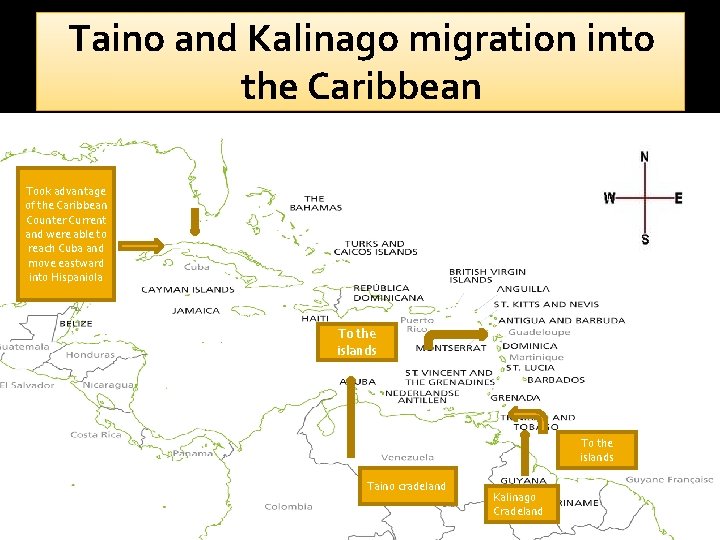
Taino and Kalinago migration into the Caribbean Took advantage of the Caribbean Counter Current and were able to reach Cuba and move eastward into Hispaniola To the islands Taino cradeland Kalinago Cradeland

Reasons Amerindians migrated into the Caribbean from South America � The Tainos arrived first, between the first and seventh centuries A. D. , reached Jamaica about 1, 000 A. D. The Kalinagos arrived the Tainos, and were still arriving when Columbus came to the region. The following are possible reasons for their migration: � Migration was an integral part of their culture; a practice cultivated and passed on by their ancestors. � The population had outgrown the available food resources in their homeland, and it was becoming more difficult to feed everyone, so there was the need to find new lands.

Reasons Amerindians migrated into the Caribbean from South America �The Amerindians were a seafaring people and they could have accidentally discovered any one of the islands on one of the expeditions, and opted to migrate there on the premise that it was ideal for the creation of settlements. �The Tainos might have seen the islands as a place for refuge from the Kalinagos and the Kalinagos might have migrated in search of new preys/prey, or in pursuit of the Tainos. �Migration was integral part of their culture; a practice cultivated and passed on by their ancestors.

Aspects of the culture of the Indigenous Peoples which allowed them to travel easily through the region �Canoeing, �Seafaring, �Familiarity with the Caribbean maritime environment, �Coastal trading activities and �Warfare
- Slides: 11