
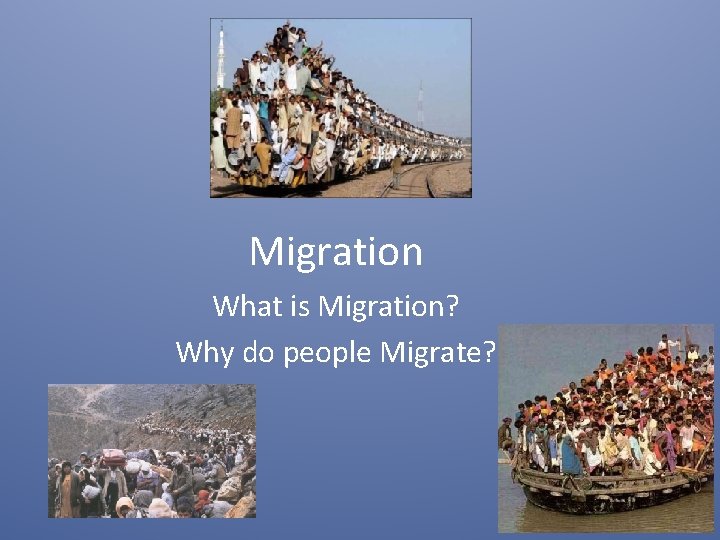
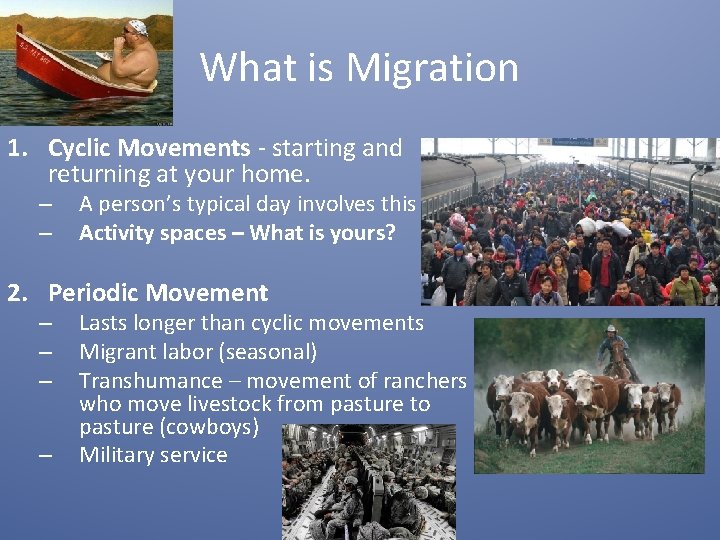
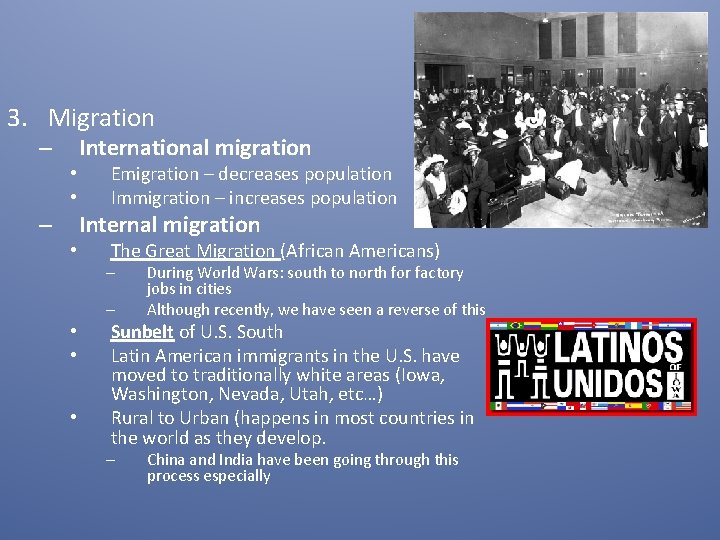
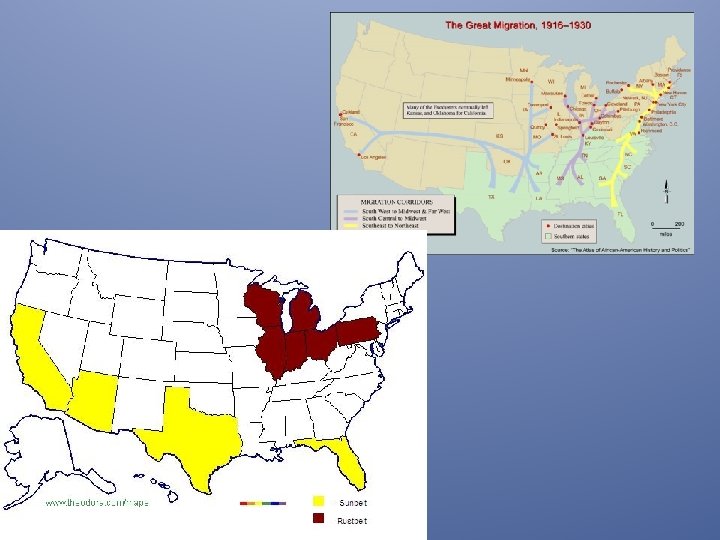
Migration What is Migration Why do people Migrate
- Slides: 7
Migration What is Migration? Why do people Migrate?
What is Migration 1. Cyclic Movements - starting and returning at your home. – – A person’s typical day involves this Activity spaces – What is yours? 2. Periodic Movement – – Lasts longer than cyclic movements Migrant labor (seasonal) Transhumance – movement of ranchers who move livestock from pasture to pasture (cowboys) Military service
3. Migration – • • – • International migration Emigration – decreases population Immigration – increases population Internal migration The Great Migration (African Americans) – – • • • During World Wars: south to north for factory jobs in cities Although recently, we have seen a reverse of this Sunbelt of U. S. South Latin American immigrants in the U. S. have moved to traditionally white areas (Iowa, Washington, Nevada, Utah, etc…) Rural to Urban (happens in most countries in the world as they develop. – China and India have been going through this process especially
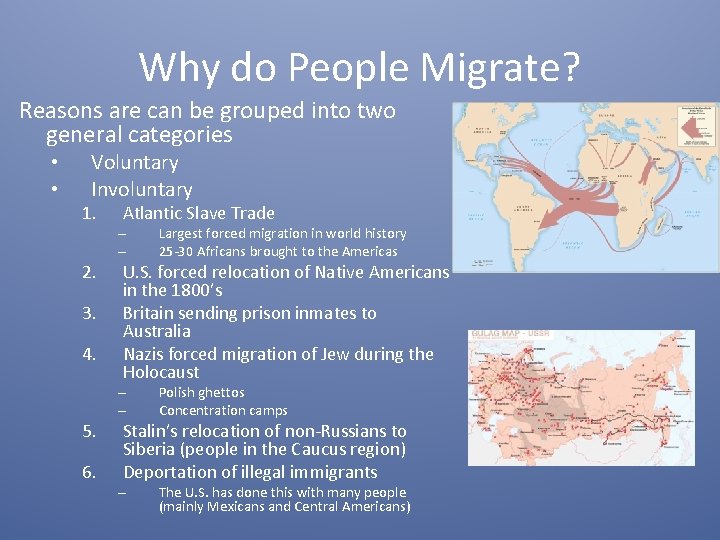
Why do People Migrate? Reasons are can be grouped into two general categories • • Voluntary Involuntary 1. 2. 3. 4. Atlantic Slave Trade – – U. S. forced relocation of Native Americans in the 1800’s Britain sending prison inmates to Australia Nazis forced migration of Jew during the Holocaust – – 5. 6. Largest forced migration in world history 25 -30 Africans brought to the Americas Polish ghettos Concentration camps Stalin’s relocation of non-Russians to Siberia (people in the Caucus region) Deportation of illegal immigrants – The U. S. has done this with many people (mainly Mexicans and Central Americans)
Voluntary Migration While people migrate for many reasons, Ernst Ravenstein (geographer) used a gravity model to show that it depended largely on the distance from the origin to the destination. Ravenstein also pointed out some other interesting laws of migration that still hold true today about who migrates and where. 1. 2. 3. 4. 5. 6. Every migration generates a counter-migration. Most migrants move short distances Migrants who move long distances tend to go to big cities. Urban residents are less likely than rural residents to migrate Single people are much more likely to move than families Men are more likely to move than women
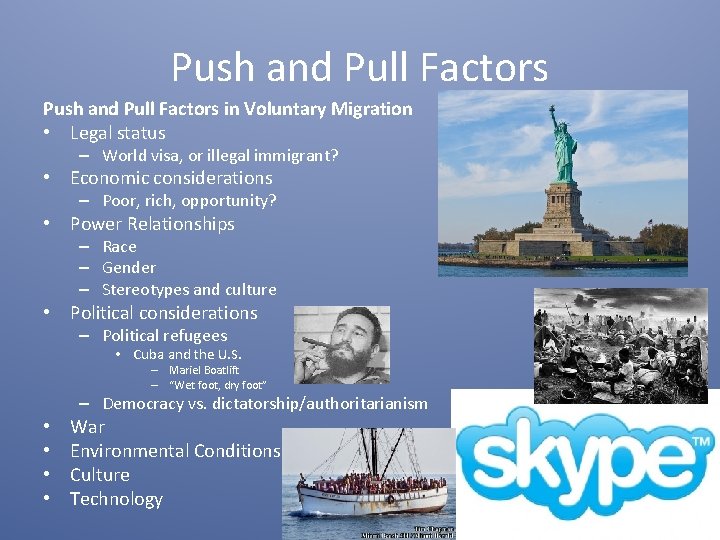
Push and Pull Factors in Voluntary Migration • Legal status – World visa, or illegal immigrant? • Economic considerations – Poor, rich, opportunity? • Power Relationships – Race – Gender – Stereotypes and culture • Political considerations – Political refugees • Cuba and the U. S. – Mariel Boatlift – “Wet foot, dry foot” – Democracy vs. dictatorship/authoritarianism • • War Environmental Conditions Culture Technology