
MIGRATION Migration the movement of people from one


- Slides: 19
MIGRATION
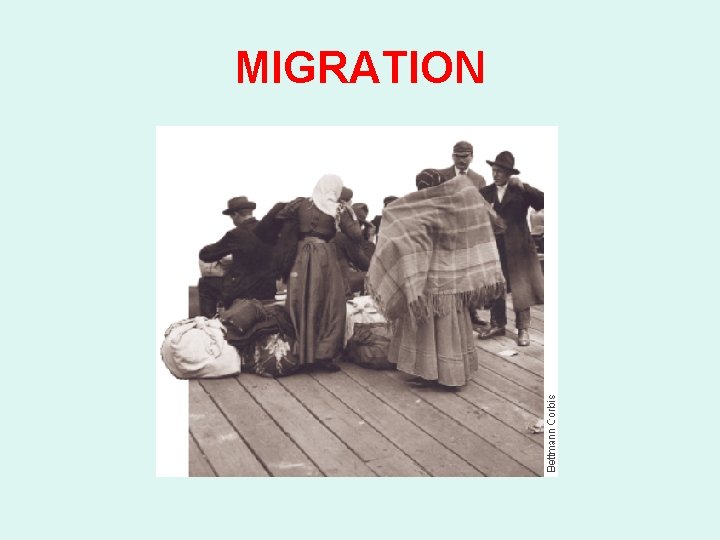
Migration • the movement of people from one place or region to another
Immigrants • people who move into one country from another
1 -What are “Push” factors? • Difficulties that force people to leave
2 -What are “Pull” factors? • Factors that attract a person to a new country
3 -How do push and pull factors explain people’s decision to migrate? • Push: – – war poverty starvation oppression • Pull: – job opportunities – freedom – chance for a better life
4 -Explain voluntary migration today and provide examples. – The movement of people by their own choice • Examples: – In some countries, such as Vietnam and Central American countries, wars have made life dangerous and difficult. – In China, Vietnam, and Cuba, governments limit people’s freedom. These problems push people to leave.
5 -Explain involuntary migration and provide examples. – People are forced to move • Examples: – During the early 1800 s, the British sent prisoners to Australia to serve their sentences. – War forces people to migrate to escape death or serious danger. – The transatlantic slave trade.
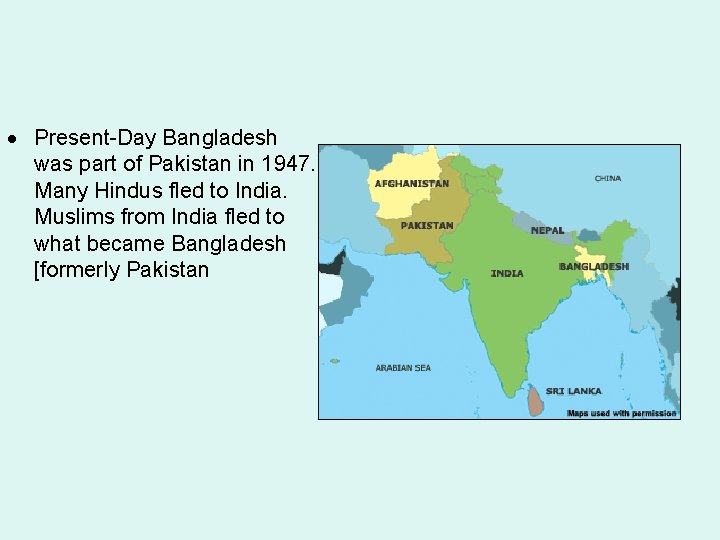
6 -Look at the “Migration in South Asia” map on page 69 and respond to the following: • a. What caused the migration of Muslims and Hindus in Southeast Asia in 1947? • At the end of British colonial rule in 1947, most of South Asia was divided along religious lines into two countries: – India had a Hindu majority – Pakistan was mainly Muslim
6 -Look at the “Migration in South Asia” map on page 69 and respond to the following: • Fearing religious discrimination and violence, Muslims from India and Hindus from Pakistan fled across the new borders: – Pakistanis to Europe, North America or India. • In 1947 when India and Pakistan were separated: 5. 4 million Hindus and Sikhs fled from Pakistan to India. 6. 6 Muslims fled to Pakistan • Hundreds of thousands South Asians left for SE Asia, Australia and the Pacific Islands.
6 -Look at the “Migration in South Asia” map on page 69 and respond to the following: • b. Do you think this migration was voluntary or involuntary? EXPLAIN
Present-Day Bangladesh was part of Pakistan in 1947. Many Hindus fled to India. Muslims from India fled to what became Bangladesh [formerly Pakistan
Urbanization • the movement of people to cities, and the growth of cities
Rural • located in the countryside
Urban • located in cities and towns
7 -Look at the “World Urban and Rural Populations” chart on page 70 and respond to the following: • a. What is the general trend in population movement since 1800? – Toward Urban movement • b. What percent of the world’s people lived in cities in 1800? – 2 -3% • c. Based on information from the chart, how do you think the world’s rural and urban population will compare in 2050? – Urban greater than rural
8 -Explain the urbanization of cities and suburbs • The growth of industry during the 1800 s pulled people from the countryside to cities. • They hoped for jobs in factories and offices.
9 -What are the causes and effects of urbanization? • cause growth of industry; hope for jobs in factories and offices • effect More people move to the city; population of cities grow; fewer people in rural areas
10 -Explain how the population of urban areas is changing in Africa, Asia and Latin America. • Their populations are growing rapidly