
Migration data in Asia Jasmine Trang Ha The




- Slides: 24
Migration data in Asia Jasmine Trang Ha The 2 nd Asian Population Forum, Shanghai, China, 11 -12 October 2019
We need good migration data • Migration is a major source of demographic and social change for countries in Asia • Ability to study this change requires good data 2
What do we need to know? • Numbers and characteristics of persons changing their country of residence (migration flow) • Motivations for migrating from one country to another • Impacts on the sending and/or receiving country • Role of migration policies 3
Challenge of measuring migration flow in Asia • • • Hardly any information available Inconsistent definitions of migration No clear benchmark No regional agency overseeing statistics No multi-/bilateral exchange on migration statistics Contains very large heterogeneous countries (China, India, Indonesia) that are rapidly changing 4
Immigrant population (stock) data • Number of persons currently residing outside their country of birth at a particular point in time. • Most abundant migration data available • Measured in nearly all population censuses • Does not reveal when migrants arrived / departed or the size of migration flows • Usually available for 5 -year or 10 -year interval (not annual) 5
Migration flows • Number of people moving within a specified period of time • Change in the country of usual residence • Required for assessing contribution to demographic change and understanding / developing policies • Less abundant • Inconsistent definitions 6
Three main definitions of migration • Place of birth – Useful for determining how immigrant population stocks change • Citizenship – Required for keeping track of persons who need permission to enter and remain in the country • Previous / next country of residence – Useful for understanding where people migrate, how these patterns differ from other countries, and how they contribute to population redistribution • Difficult to combine and compare flows using different definitions 7
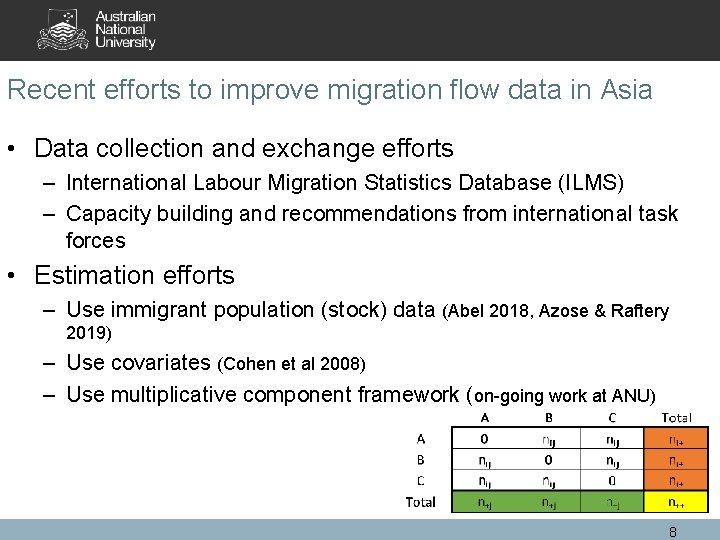
Recent efforts to improve migration flow data in Asia • Data collection and exchange efforts – International Labour Migration Statistics Database (ILMS) – Capacity building and recommendations from international task forces • Estimation efforts – Use immigrant population (stock) data (Abel 2018, Azose & Raftery 2019) – Use covariates (Cohen et al 2008) – Use multiplicative component framework (on-going work at ANU) 8
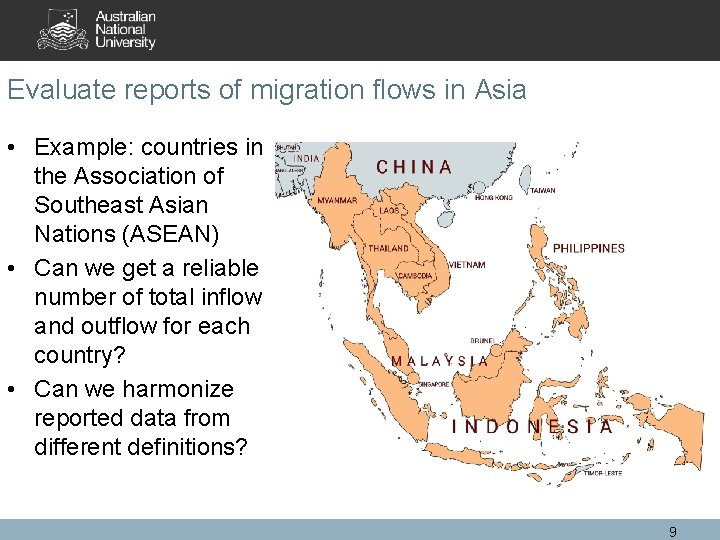
Evaluate reports of migration flows in Asia • Example: countries in the Association of Southeast Asian Nations (ASEAN) • Can we get a reliable number of total inflow and outflow for each country? • Can we harmonize reported data from different definitions? 9
Available migration inflow data in ASEAN countries Brunei Indonesia Cambodia Laos Myanmar Malaysia Philippines Singapore Thailand Viet Nam Labour Asylum 2014 -16 2000 -16 2012 2014 -16 2000 -16 2001 -16 2000 -16 BRN IDN 2009 -14 C KHM 2008 B LAO MMR MYS 2007 -14 C PHL 1980 -2014 C SGP THA 2006 -15 C VNM 2005 -15 C 2014 -16 Student Permanent Nationals 2011 -16 2010 -15 R Total 2008 B 2011 -16 2007 -14 C 2011 -15 2011 -16 2007 -15 R 10
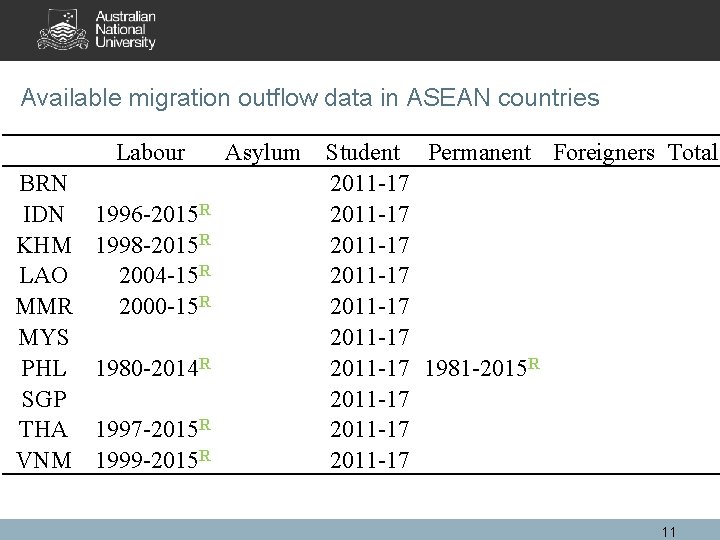
Available migration outflow data in ASEAN countries Labour BRN IDN KHM LAO MMR MYS PHL SGP THA VNM 1996 -2015 R 1998 -2015 R 2004 -15 R 2000 -15 R 1980 -2014 R 1997 -2015 R 1999 -2015 R Asylum Student Permanent Foreigners Total 2011 -17 2011 -17 1981 -2015 R 2011 -17 11
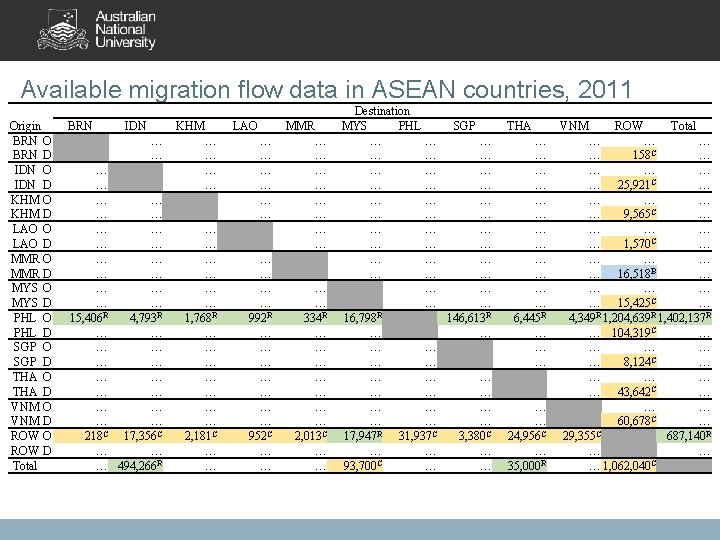
Available migration flow data in ASEAN countries, 2011 Origin BRN O BRN D IDN O IDN D KHM O KHM D LAO O LAO D MMR O MMR D MYS O MYS D PHL O PHL D SGP O SGP D THA O THA D VNM O VNM D ROW O ROW D Total BRN IDN … … … … … … R 15, 406 4, 793 R … … … … C 218 17, 356 C … … … 494, 266 R KHM … … … … … 1, 768 R … … … … 2, 181 C … … LAO … … … … … 992 R … … … … 952 C … … MMR … … … … … 334 R … … … … 2, 013 C … … Destination MYS PHL SGP … … … … … … … … … … R 16, 798 146, 613 R … … … … … … … R C 17, 947 31, 937 3, 380 C … … … C 93, 700 … … THA VNM ROW Total … … … 6, 445 R … … … 24, 956 C … 35, 000 R … … 158 C … … C … 25, 921 … … C … 9, 565 … … … 1, 570 C … … B … 16, 518 … … … 15, 425 C … R R 4, 349 1, 204, 639 1, 402, 137 R … 104, 319 C … … C … 8, 124 … … … 43, 642 C … … … C 60, 678 … C 29, 355 687, 140 R … … C 12 … 1, 062, 040
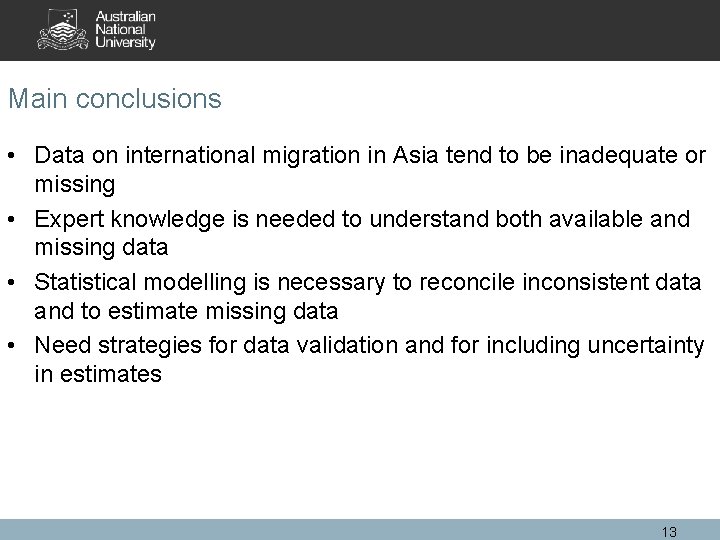
Main conclusions • Data on international migration in Asia tend to be inadequate or missing • Expert knowledge is needed to understand both available and missing data • Statistical modelling is necessary to reconcile inconsistent data and to estimate missing data • Need strategies for data validation and for including uncertainty in estimates 13
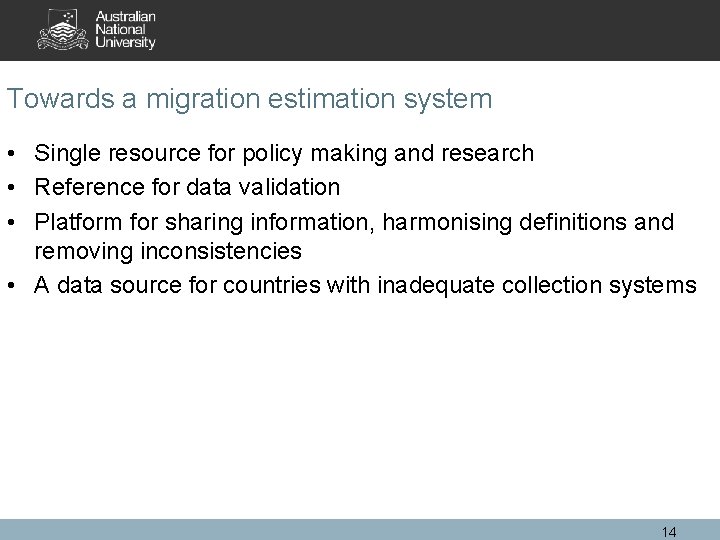
Towards a migration estimation system • Single resource for policy making and research • Reference for data validation • Platform for sharing information, harmonising definitions and removing inconsistencies • A data source for countries with inadequate collection systems 14
Thank you! • Comment/question: jasmine. ha@anu. edu. au • On-going research is funded by the Australian Research Council as part of the ‘overcoming the problems of inconsistent migration data in the Asia Pacific’ Discovery Projects (DP 170102468) • Collaborative work with James Raymer, Juliet Pietsch, Hanlin Shang, Qing Guan at ANU, Guy Abel (Shanghai University) and Arkadiusz Wiśniowski (University of Manchester) 15
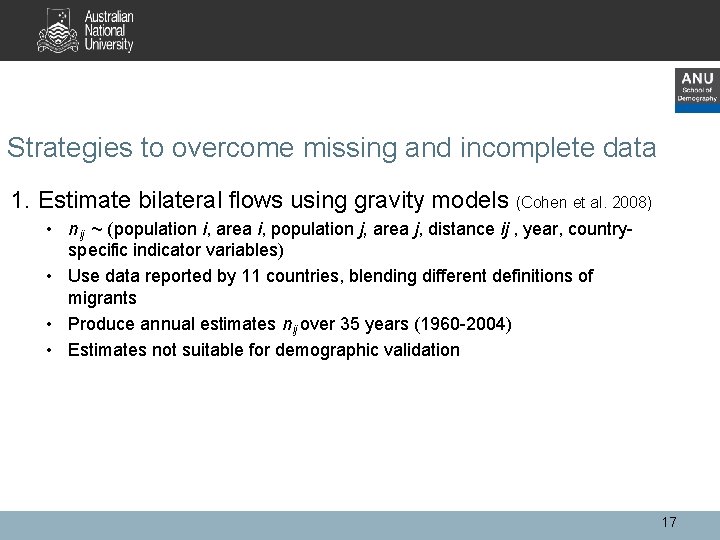
Strategies to overcome missing and incomplete data 1. Estimate bilateral flows using gravity models (Cohen et al. 2008) • nij ~ (population i, area i, population j, area j, distance ij , year, countryspecific indicator variables) • Use data reported by 11 countries, blending different definitions of migrants • Produce annual estimates nij over 35 years (1960 -2004) • Estimates not suitable for demographic validation 17
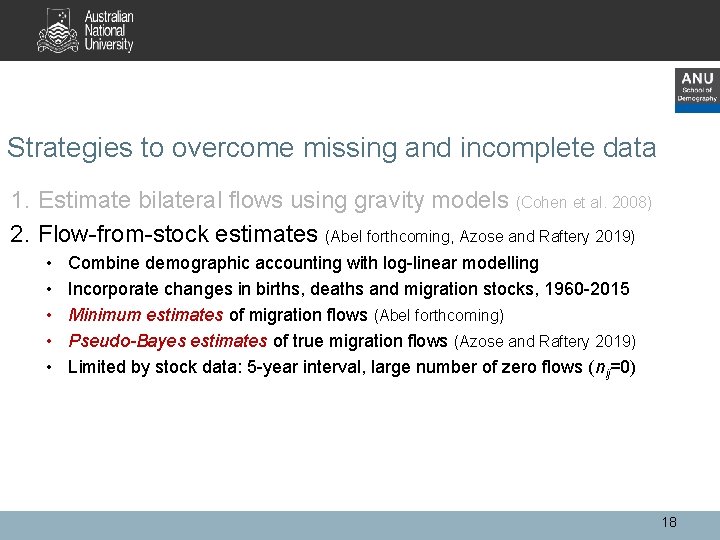
Strategies to overcome missing and incomplete data 1. Estimate bilateral flows using gravity models (Cohen et al. 2008) 2. Flow-from-stock estimates (Abel forthcoming, Azose and Raftery 2019) • • • Combine demographic accounting with log-linear modelling Incorporate changes in births, deaths and migration stocks, 1960 -2015 Minimum estimates of migration flows (Abel forthcoming) Pseudo-Bayes estimates of true migration flows (Azose and Raftery 2019) Limited by stock data: 5 -year interval, large number of zero flows (nij=0) 18
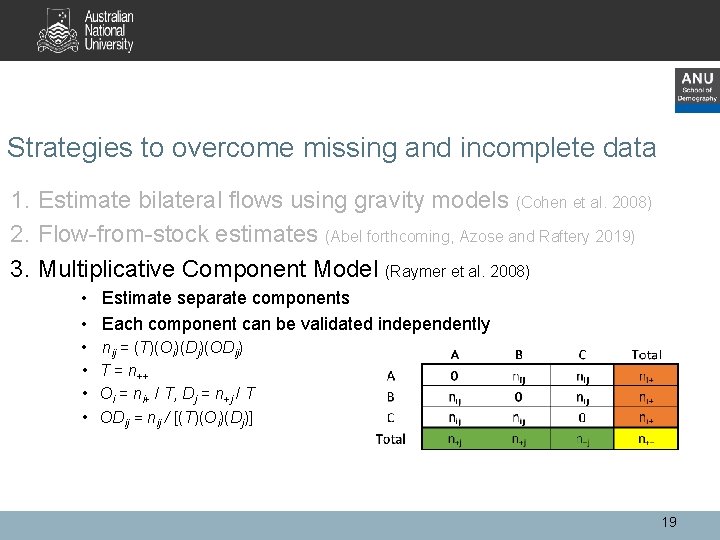
Strategies to overcome missing and incomplete data 1. Estimate bilateral flows using gravity models (Cohen et al. 2008) 2. Flow-from-stock estimates (Abel forthcoming, Azose and Raftery 2019) 3. Multiplicative Component Model (Raymer et al. 2008) • Estimate separate components • Each component can be validated independently • • nij = (T)(Oi)(Dj)(ODij) T = n++ Oi = ni+ / T, Dj = n+j / T ODij = nij / [(T)(Oi)(Dj)] 19
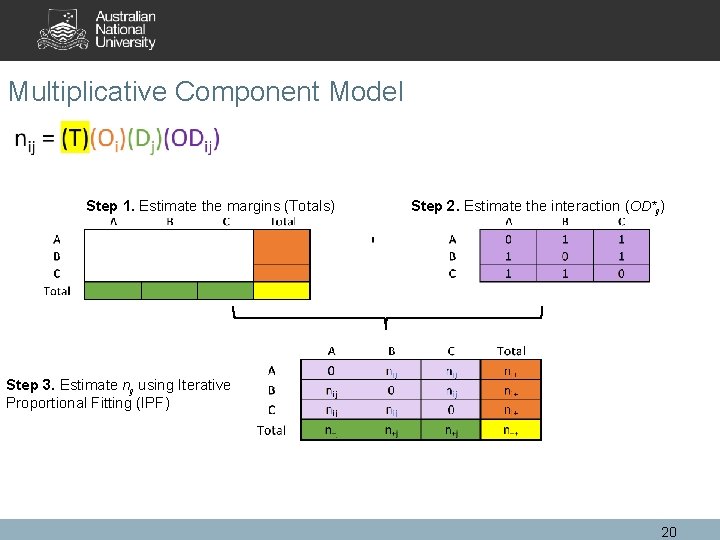
Multiplicative Component Model Step 1. Estimate the margins (Totals) Step 2. Estimate the interaction (OD*ij) Step 3. Estimate nij using Iterative Proportional Fitting (IPF) 20
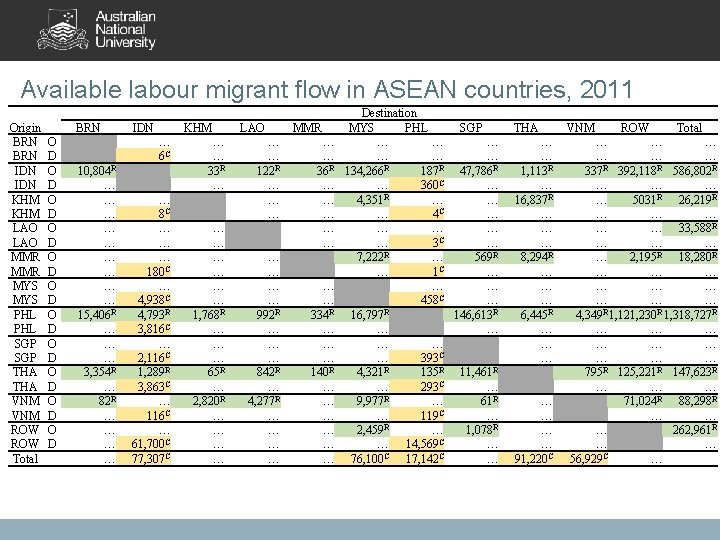
Available labour migrant flow in ASEAN countries, 2011 Origin BRN O BRN D IDN O IDN D KHM O KHM D LAO O LAO D MMR O MMR D MYS O MYS D PHL O PHL D SGP O SGP D THA O THA D VNM O VNM D ROW O ROW D Total BRN IDN 10, 804 R … … … … … 15, 406 R … … … 3, 354 R … 82 R … … … 6 C … 8 C … … … 180 C … 4, 938 C 4, 793 R 3, 816 C … 2, 116 C 1, 289 R 3, 863 C … 116 C … 61, 700 C 77, 307 C KHM … … 33 R … … … … 1, 768 R … … … 65 R … 2, 820 R … … LAO … … 122 R … … … … 992 R … … … 842 R … 4, 277 R … … MMR … … 36 R … … … … 334 R … … … 140 R … … … Destination MYS PHL SGP … … … 134, 266 R 187 R 47, 786 R … 360 C … R 4, 351 … … C … 4 … … … 3 C … R 7, 222 … 569 R C … 1 … … … C 458 … 16, 797 R 146, 613 R … … … … C … 393 R R R 4, 321 135 11, 461 … 293 C … R 9, 977 … 61 R C … 119 … R 2, 459 … 1, 078 R … 14, 569 C … 76, 100 C 17, 142 C … THA VNM ROW Total … … 1, 113 R … 16, 837 R … … … 8, 294 R … … … 6, 445 R … … … … 91, 220 C … … … 337 R 392, 118 R 586, 802 R … … 5031 R 26, 219 R … … … 33, 588 R … … … R … 2, 195 18, 280 R … … … … … 4, 349 R 1, 121, 230 R 1, 318, 727 R … … … … … R R 795 125, 221 147, 623 R … … … R 71, 024 88, 298 R … … … 262, 961 R … … 56, 929 C … 21
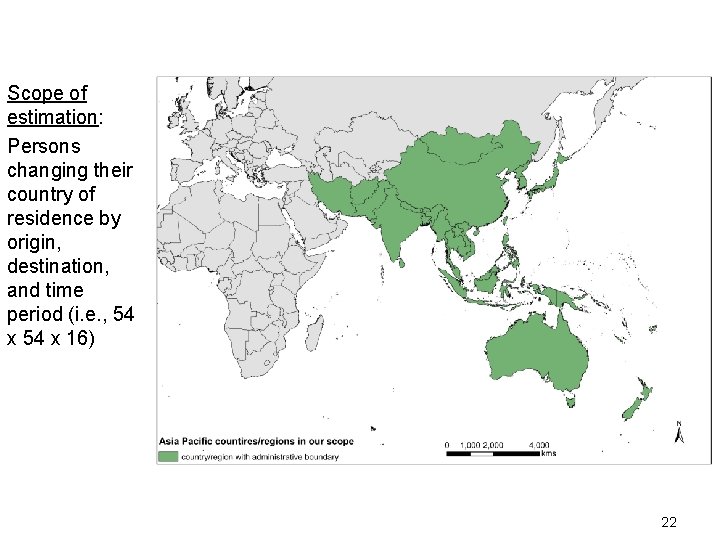
Scope of estimation: Persons changing their country of residence by origin, destination, and time period (i. e. , 54 x 16) 22
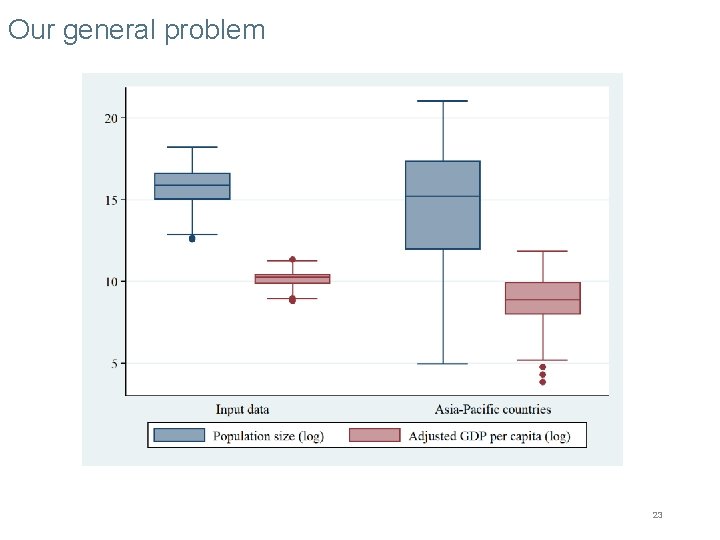
Our general problem 23
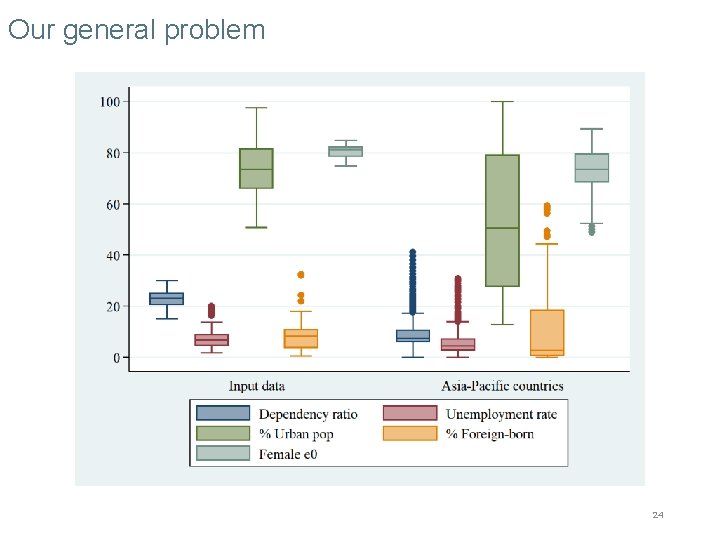
Our general problem 24