
MIGRATION AND IMMIGRATION DURING THE TIMES OF PANDEMIC



- Slides: 43
MIGRATION AND IMMIGRATION DURING THE TIMES OF PANDEMIC Policy training for CSSW COVID-19 Action Plan Neeraj Kaushal Mashura Akilova Megan Curran
Objectives: ■ Participants will learn about the impact of COVID 19 (and the resulting border closures and economic lockdowns) on various immigrant, and displaced populations in the US and globally. ■ Participants will learn about the effects of border closures and restrictions on mobility, nationally and internationally, on sending and receiving countries. ■ Participants will learn about policies to protect the immigrant, and displaced groups in future pandemic situations, followed by the recommendations for improving immigration policies post COVID 19
GLOBAL MOBILITY
COVID 19 and Global Migration ■ Migrants within and outside of the closed borders ■ Closed borders and economies of – Remittance-dependent countries – Migrant-dependent industries in host societies ■ Nativism vs. Globalism vs. Humanitarianism
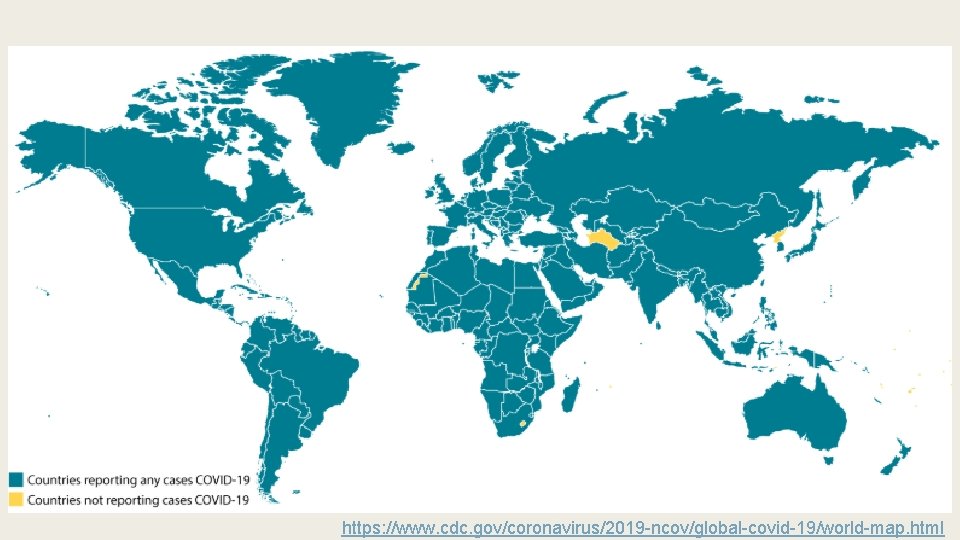
https: //www. cdc. gov/coronavirus/2019 -ncov/global-covid-19/world-map. html
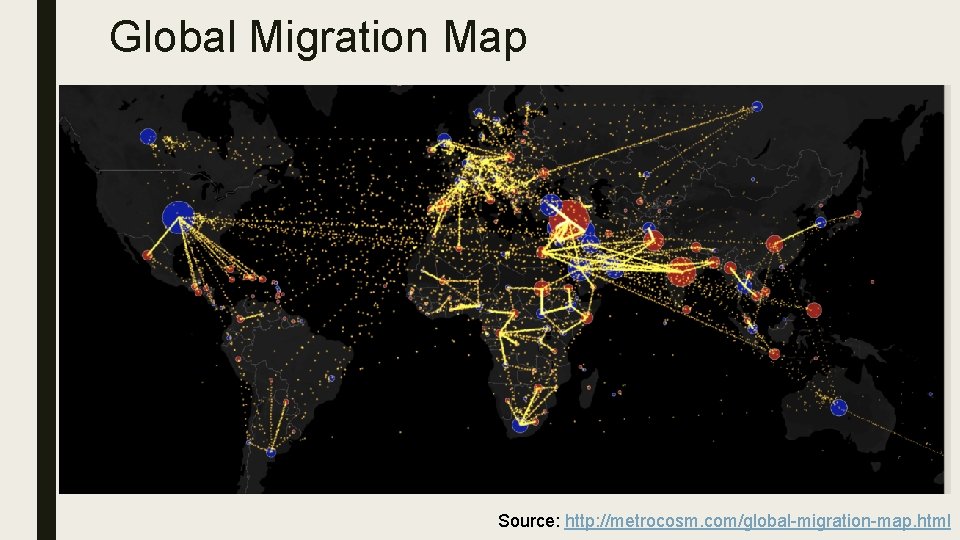
Global Migration Map Source: http: //metrocosm. com/global-migration-map. html
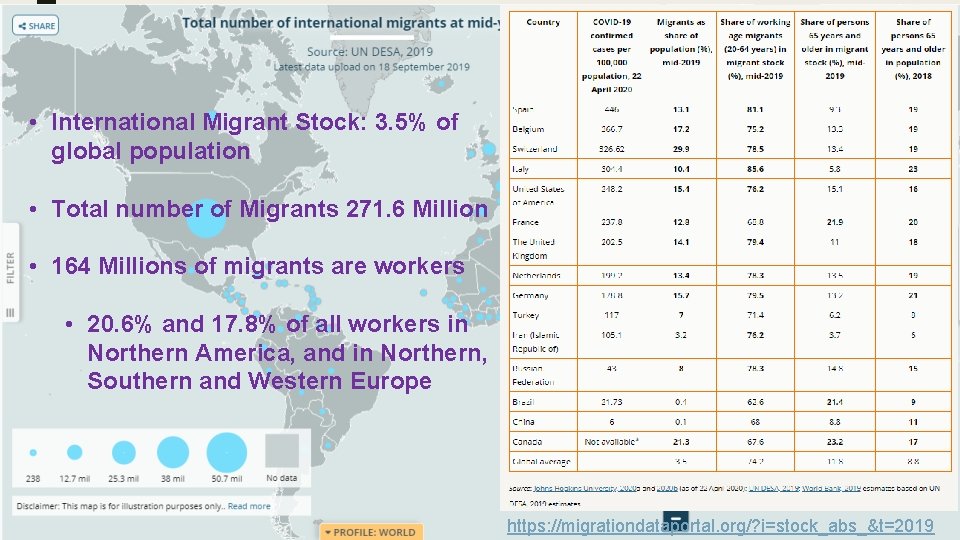
• International Migrant Stock: 3. 5% of global population • Total number of Migrants 271. 6 Million • 164 Millions of migrants are workers • 20. 6% and 17. 8% of all workers in Northern America, and in Northern, Southern and Western Europe https: //migrationdataportal. org/? i=stock_abs_&t=2019
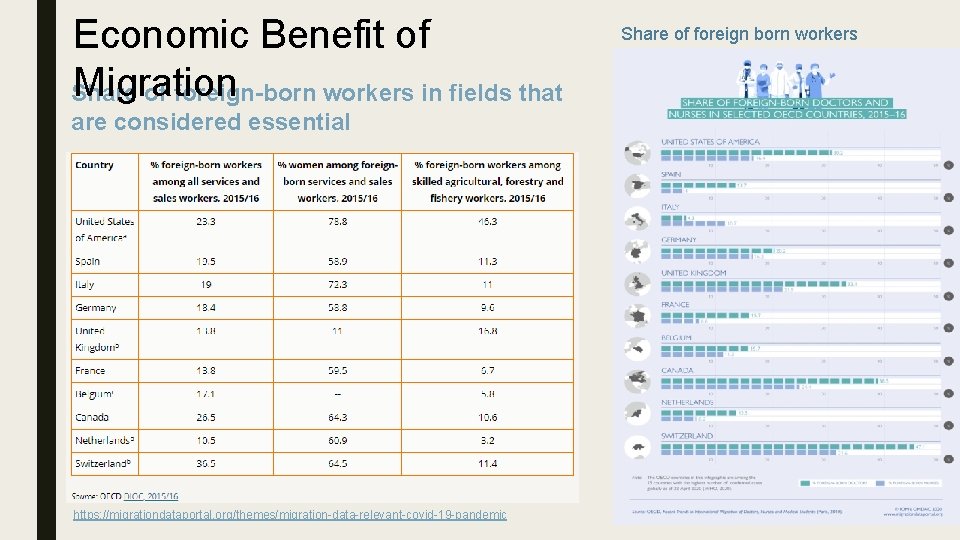
Economic Benefit of Migration Share of foreign-born workers in fields that are considered essential https: //migrationdataportal. org/themes/migration-data-relevant-covid-19 -pandemic Share of foreign born workers
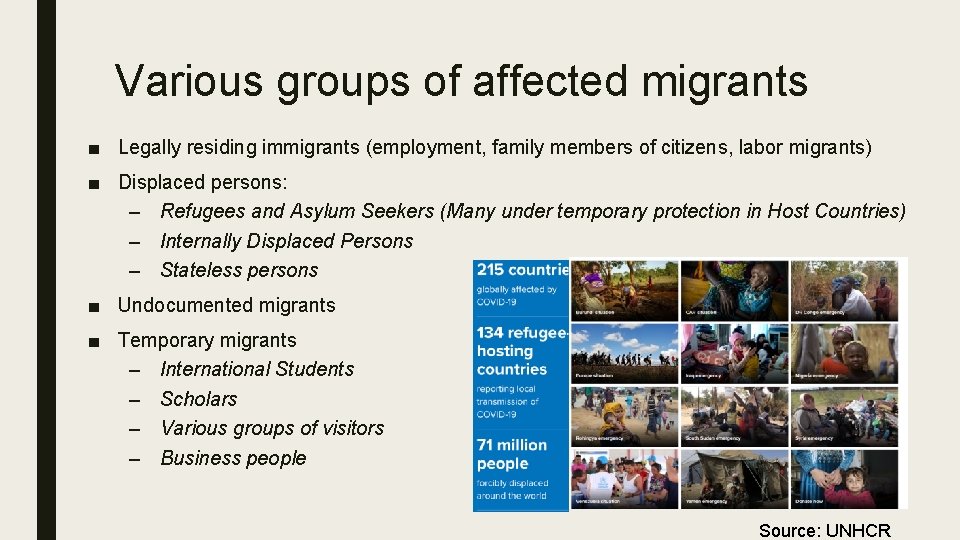
Various groups of affected migrants ■ Legally residing immigrants (employment, family members of citizens, labor migrants) ■ Displaced persons: – Refugees and Asylum Seekers (Many under temporary protection in Host Countries) – Internally Displaced Persons – Stateless persons ■ Undocumented migrants ■ Temporary migrants – International Students – Scholars – Various groups of visitors – Business people Source: UNHCR
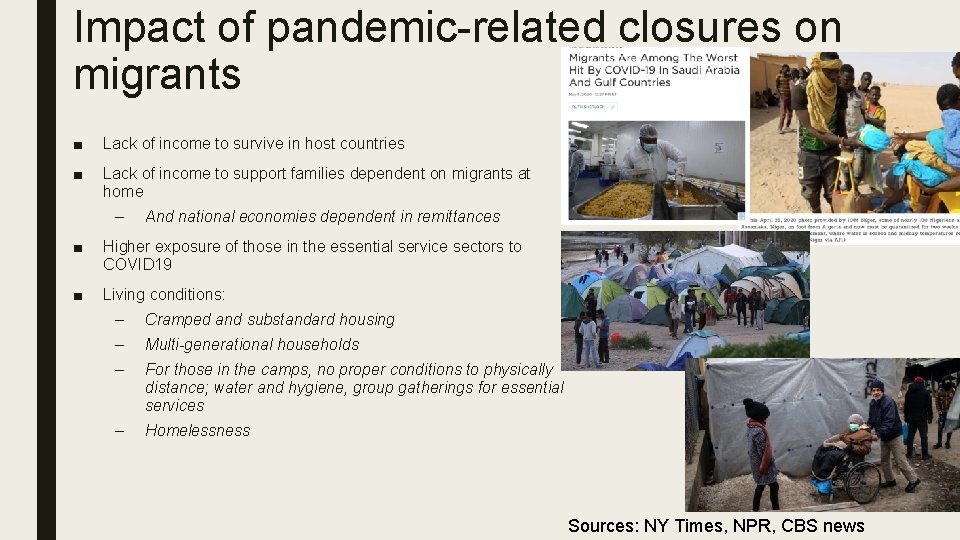
Impact of pandemic-related closures on migrants ■ Lack of income to survive in host countries ■ Lack of income to support families dependent on migrants at home – And national economies dependent in remittances ■ Higher exposure of those in the essential service sectors to COVID 19 ■ Living conditions: – Cramped and substandard housing – Multi-generational households – For those in the camps, no proper conditions to physically distance; water and hygiene, group gatherings for essential services – Homelessness Sources: NY Times, NPR, CBS news
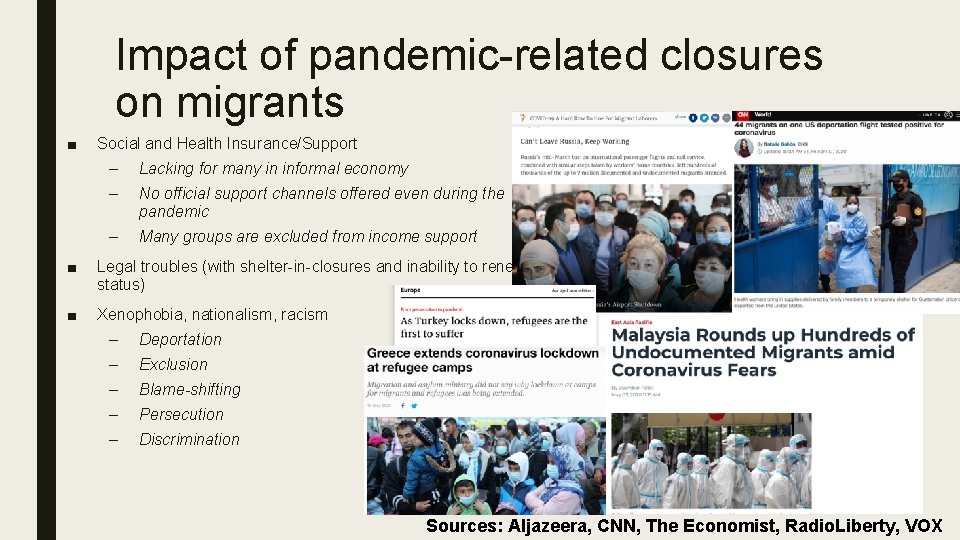
Impact of pandemic-related closures on migrants ■ Social and Health Insurance/Support – Lacking for many in informal economy – No official support channels offered even during the pandemic – Many groups are excluded from income support ■ Legal troubles (with shelter-in-closures and inability to renew status) ■ Xenophobia, nationalism, racism – Deportation – Exclusion – Blame-shifting – Persecution – Discrimination Sources: Aljazeera, CNN, The Economist, Radio. Liberty, VOX
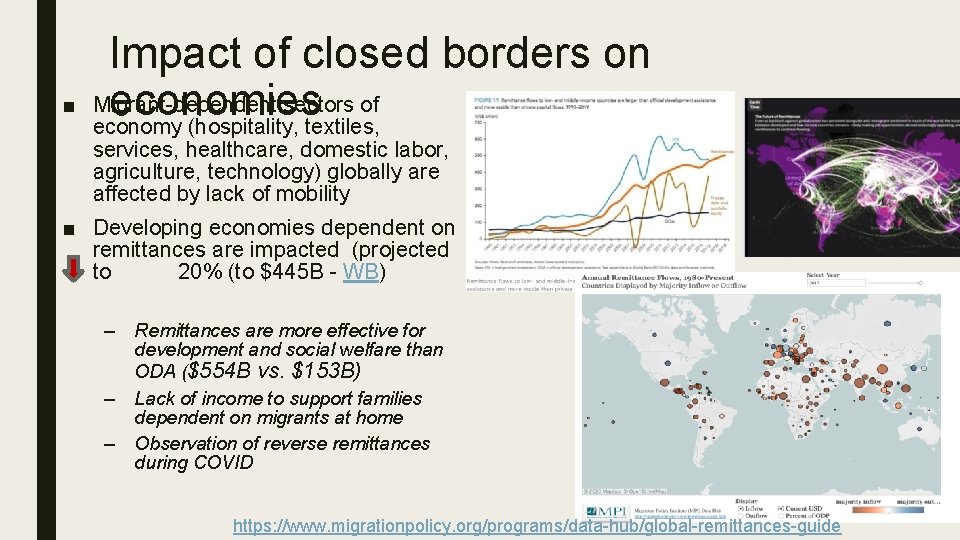
■ Impact of closed borders on Migrant-dependent sectors of economies economy (hospitality, textiles, services, healthcare, domestic labor, agriculture, technology) globally are affected by lack of mobility ■ Developing economies dependent on remittances are impacted (projected to 20% (to $445 B - WB) – Remittances are more effective for development and social welfare than ODA ($554 B vs. $153 B) – Lack of income to support families dependent on migrants at home – Observation of reverse remittances during COVID https: //www. migrationpolicy. org/programs/data-hub/global-remittances-guide
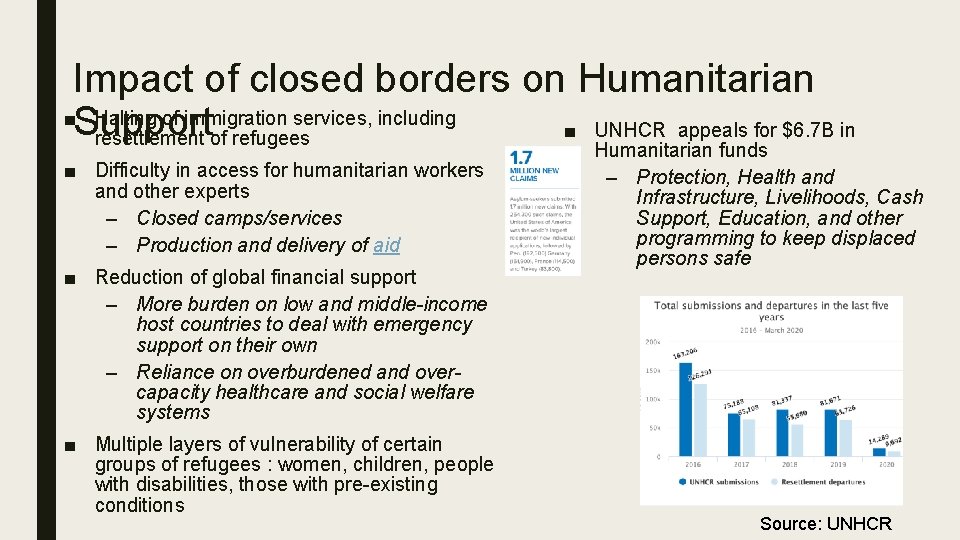
Impact of closed borders on Humanitarian ■Support Halting of immigration services, including ■ UNHCR appeals for $6. 7 B in resettlement of refugees ■ Difficulty in access for humanitarian workers and other experts – Closed camps/services – Production and delivery of aid ■ Reduction of global financial support – More burden on low and middle-income host countries to deal with emergency support on their own – Reliance on overburdened and overcapacity healthcare and social welfare systems ■ Multiple layers of vulnerability of certain groups of refugees : women, children, people with disabilities, those with pre-existing conditions Humanitarian funds – Protection, Health and Infrastructure, Livelihoods, Cash Support, Education, and other programming to keep displaced persons safe Source: UNHCR
UNITED STATES
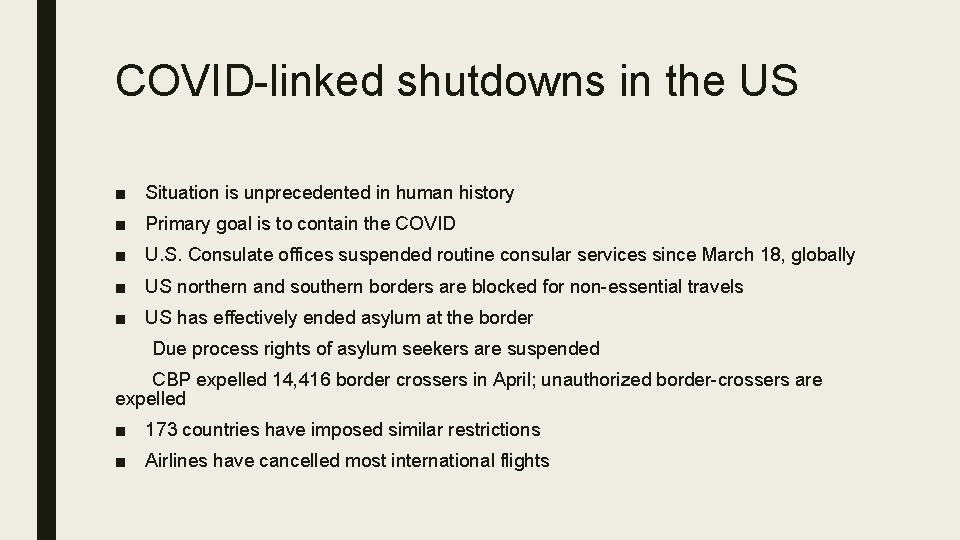
COVID-linked shutdowns in the US ■ Situation is unprecedented in human history ■ Primary goal is to contain the COVID ■ U. S. Consulate offices suspended routine consular services since March 18, globally ■ US northern and southern borders are blocked for non-essential travels ■ US has effectively ended asylum at the border Due process rights of asylum seekers are suspended CBP expelled 14, 416 border crossers in April; unauthorized border-crossers are expelled ■ 173 countries have imposed similar restrictions ■ Airlines have cancelled most international flights
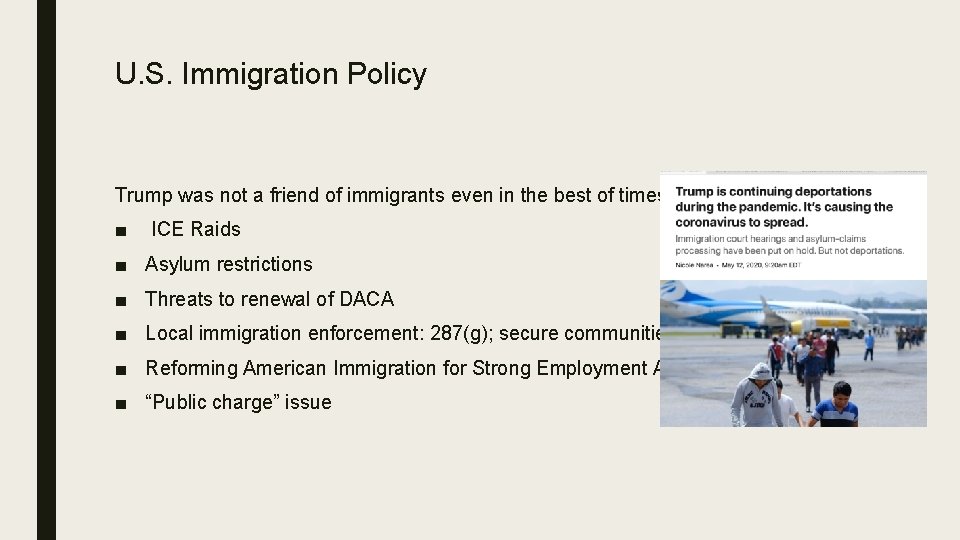
U. S. Immigration Policy Trump was not a friend of immigrants even in the best of times… ■ ICE Raids ■ Asylum restrictions ■ Threats to renewal of DACA ■ Local immigration enforcement: 287(g); secure communities ■ Reforming American Immigration for Strong Employment Act ■ “Public charge” issue
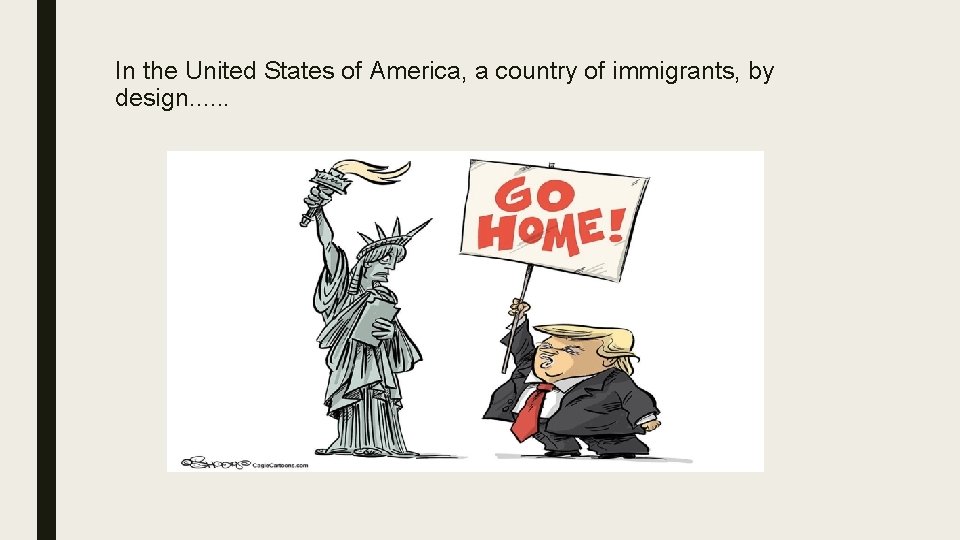
In the United States of America, a country of immigrants, by design. . .
“Public charge” during COVID ■ What is Public charge? ■ Chilling effect of public charge ■ Implications of public charge during COVID ■ Public charge rule Feb 24, 2020 ■ New notice on USCIS website: “USCIS encourages all those, including aliens, with symptoms that resemble Coronavirus Disease 2019 (Covid-19) (fever, cough, shortness of breath) to seek necessary medical treatment or preventive services. Such treatment or preventive services will not negatively affect any alien as part of a future Public Charge analysis. ” ■ Will the announcement reduce the chilling effect?
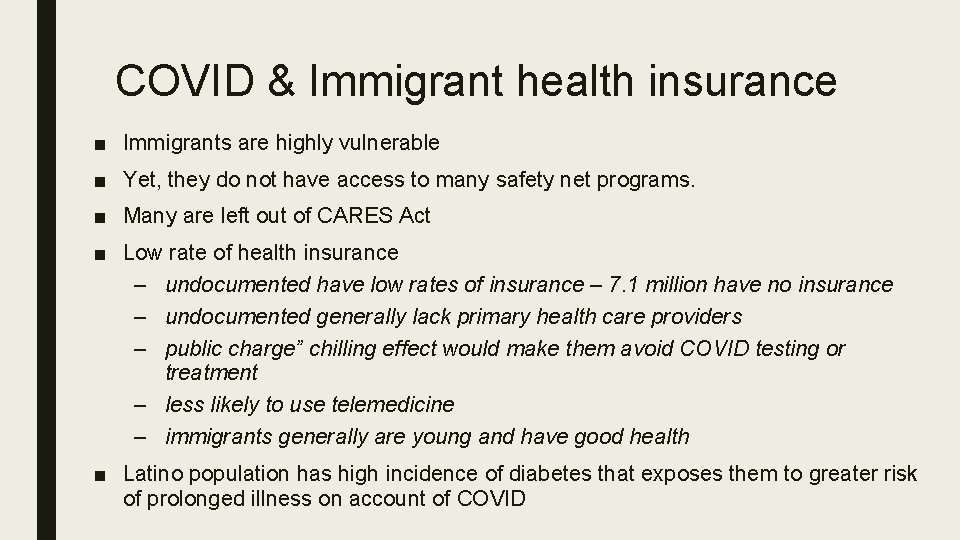
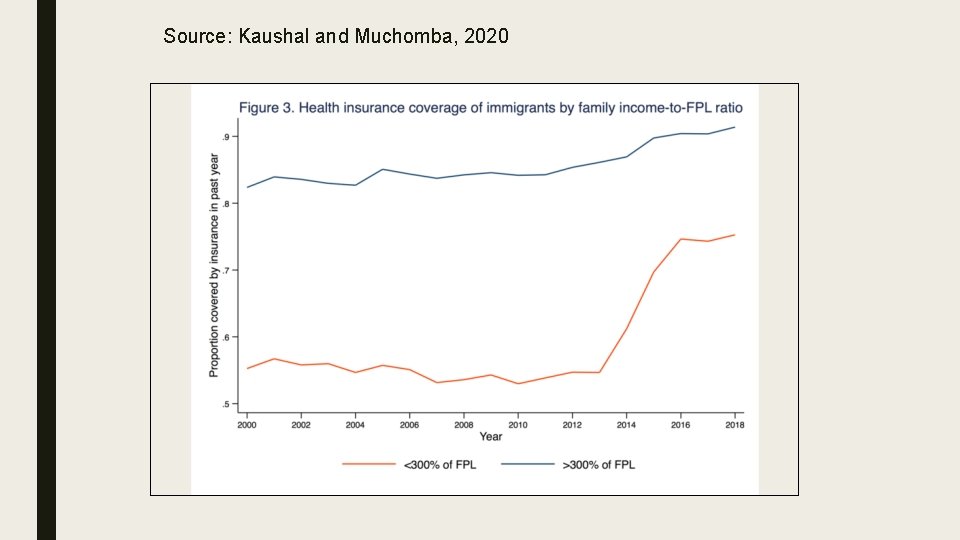
COVID & Immigrant health insurance ■ Immigrants are highly vulnerable ■ Yet, they do not have access to many safety net programs. ■ Many are left out of CARES Act ■ Low rate of health insurance – undocumented have low rates of insurance – 7. 1 million have no insurance – undocumented generally lack primary health care providers – public charge” chilling effect would make them avoid COVID testing or treatment – less likely to use telemedicine – immigrants generally are young and have good health ■ Latino population has high incidence of diabetes that exposes them to greater risk of prolonged illness on account of COVID
Source: Kaushal and Muchomba, 2020
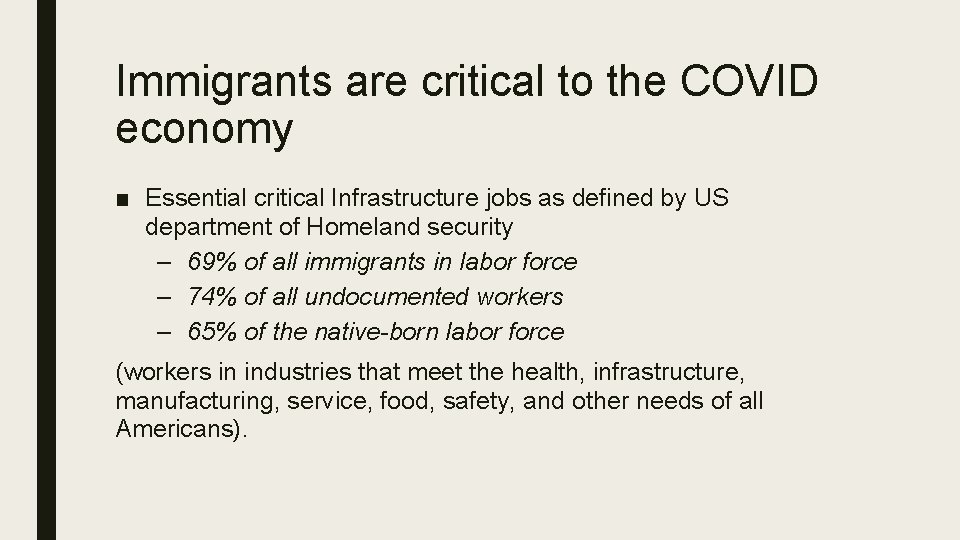
Immigrants are critical to the COVID economy ■ Essential critical Infrastructure jobs as defined by US department of Homeland security – 69% of all immigrants in labor force – 74% of all undocumented workers – 65% of the native-born labor force (workers in industries that meet the health, infrastructure, manufacturing, service, food, safety, and other needs of all Americans).
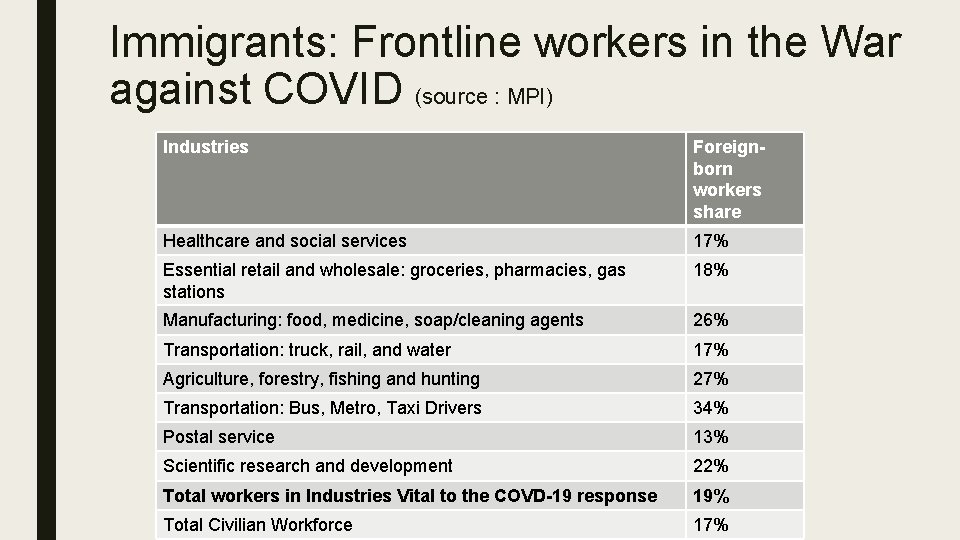
Immigrants: Frontline workers in the War against COVID (source : MPI) Industries Foreignborn workers share Healthcare and social services 17% Essential retail and wholesale: groceries, pharmacies, gas stations 18% Manufacturing: food, medicine, soap/cleaning agents 26% Transportation: truck, rail, and water 17% Agriculture, forestry, fishing and hunting 27% Transportation: Bus, Metro, Taxi Drivers 34% Postal service 13% Scientific research and development 22% Total workers in Industries Vital to the COVD-19 response 19% Total Civilian Workforce 17%
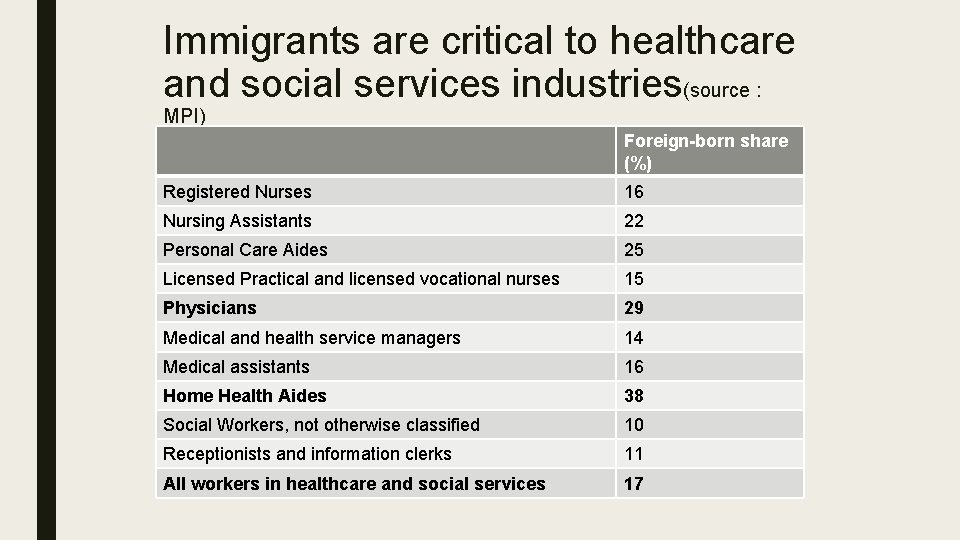
Immigrants are critical to healthcare and social services industries(source : MPI) Foreign-born share (%) Registered Nurses 16 Nursing Assistants 22 Personal Care Aides 25 Licensed Practical and licensed vocational nurses 15 Physicians 29 Medical and health service managers 14 Medical assistants 16 Home Health Aides 38 Social Workers, not otherwise classified 10 Receptionists and information clerks 11 All workers in healthcare and social services 17
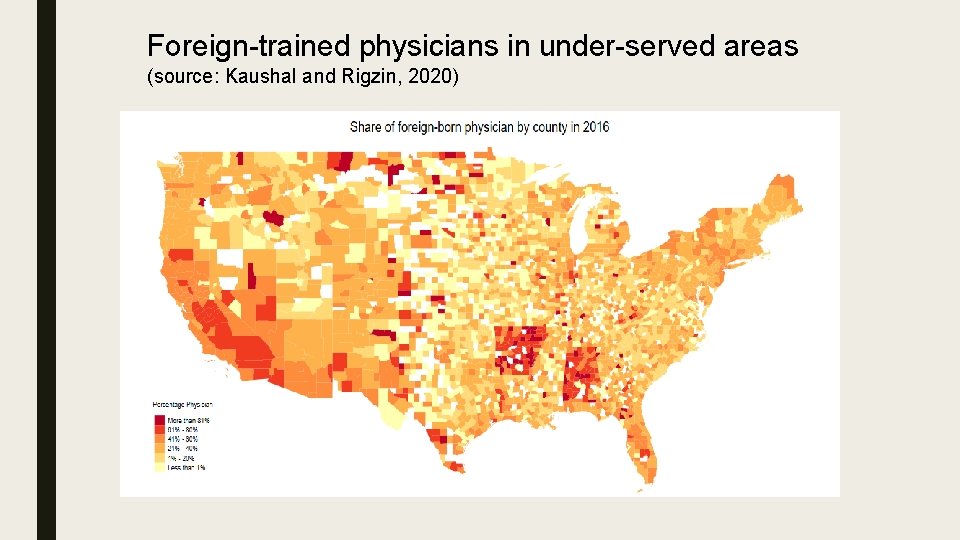
Foreign-trained physicians in under-served areas (source: Kaushal and Rigzin, 2020)
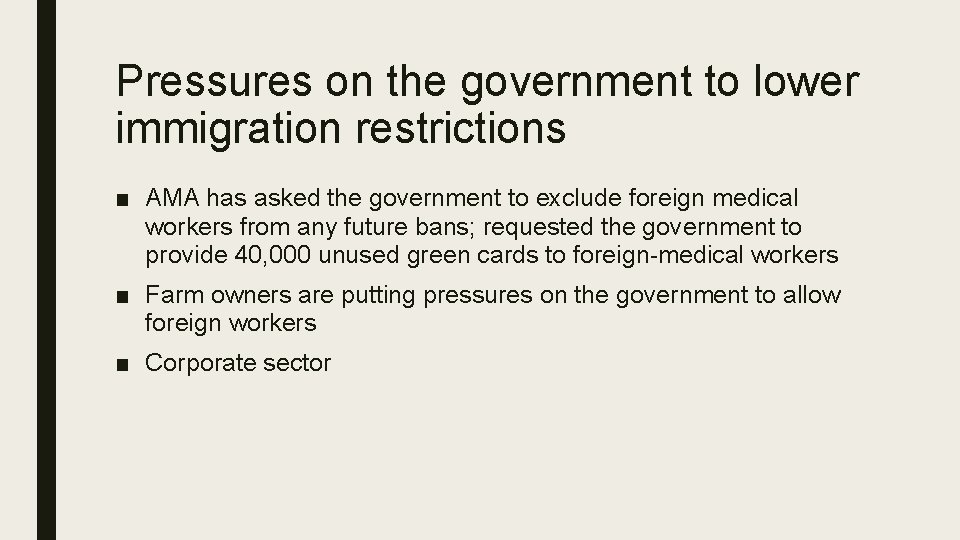
Pressures on the government to lower immigration restrictions ■ AMA has asked the government to exclude foreign medical workers from any future bans; requested the government to provide 40, 000 unused green cards to foreign-medical workers ■ Farm owners are putting pressures on the government to allow foreign workers ■ Corporate sector
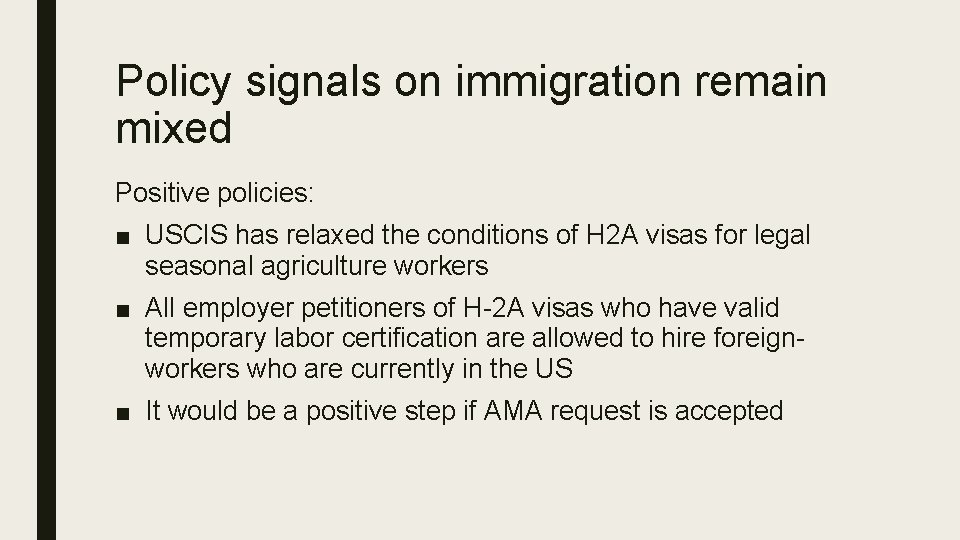
Policy signals on immigration remain mixed Positive policies: ■ USCIS has relaxed the conditions of H 2 A visas for legal seasonal agriculture workers ■ All employer petitioners of H-2 A visas who have valid temporary labor certification are allowed to hire foreignworkers who are currently in the US ■ It would be a positive step if AMA request is accepted
Mixed signals ■ Restrict immigration – suspend issuance of new green cards for 60 days. – Using emergency measures to restrict entry ■ Public charge announcement – Feb 24, 2020
Effect of lockdown ■ Economy has cratered ■ Immigration has come to a halt ■ Short term effect: fall in seasonal workers (farm labor), business travelers, student travelers, remittances. ■ Long term effect: rising nativism; pressure on countries to restrict immigration ■ Growing instances of racism and xenophobia
Economic impacts ■ Economies/industries dependent on migrant workers will suffer ■ Enormous consequences for post-COVID recovery ■ Move towards de-globalization ■ Rising nativism
Federal response to date ■ 3 main COVID-19 relief packages passed so far: – Coronavirus Preparedness & Response Supplemental Appropriations Act (March 6) – Families First Coronavirus Response Act (March 18) – Coronavirus Aid, Relief, and Economic Security (CARES) Act (March 27) ■ Families First Act & CARES Act = various forms of income support for families, including: – – – COVID-19 testing for the uninsured (Families First) Paid sick and family leave (Families First) Food assistance (Families First) Unemployment insurance (CARES Act) Emergency cash stimulus payment (aka ‘recovery rebate’) (CARES Act)
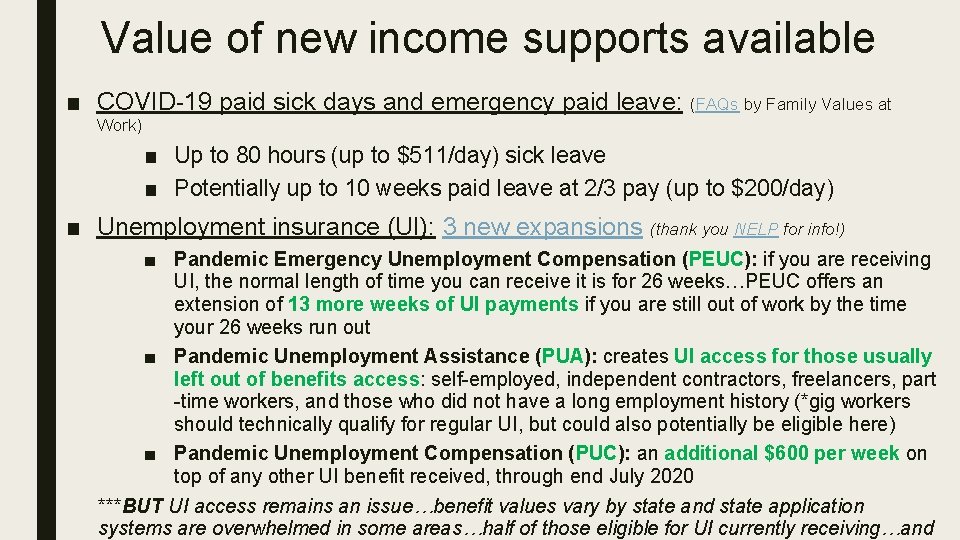
Value of new income supports available ■ COVID-19 paid sick days and emergency paid leave: (FAQs by Family Values at Work) ■ Up to 80 hours (up to $511/day) sick leave ■ Potentially up to 10 weeks paid leave at 2/3 pay (up to $200/day) ■ Unemployment insurance (UI): 3 new expansions (thank you NELP for info!) ■ Pandemic Emergency Unemployment Compensation (PEUC): if you are receiving UI, the normal length of time you can receive it is for 26 weeks…PEUC offers an extension of 13 more weeks of UI payments if you are still out of work by the time your 26 weeks run out ■ Pandemic Unemployment Assistance (PUA): creates UI access for those usually left out of benefits access: self-employed, independent contractors, freelancers, part -time workers, and those who did not have a long employment history (*gig workers should technically qualify for regular UI, but could also potentially be eligible here) ■ Pandemic Unemployment Compensation (PUC): an additional $600 per week on top of any other UI benefit received, through end July 2020 ***BUT UI access remains an issue…benefit values vary by state and state application systems are overwhelmed in some areas…half of those eligible for UI currently receiving…and
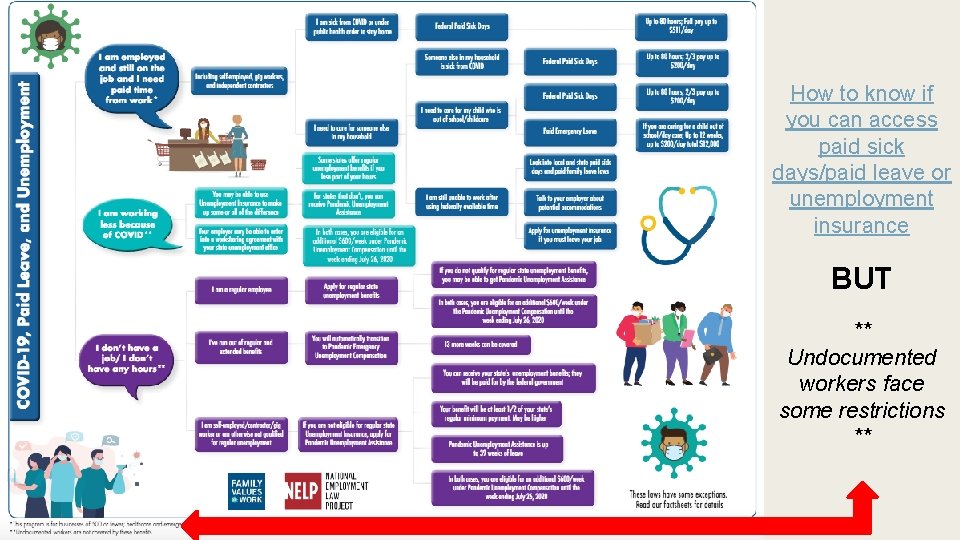
How to know if you can access paid sick days/paid leave or unemployment insurance BUT ** Undocumented workers face some restrictions **
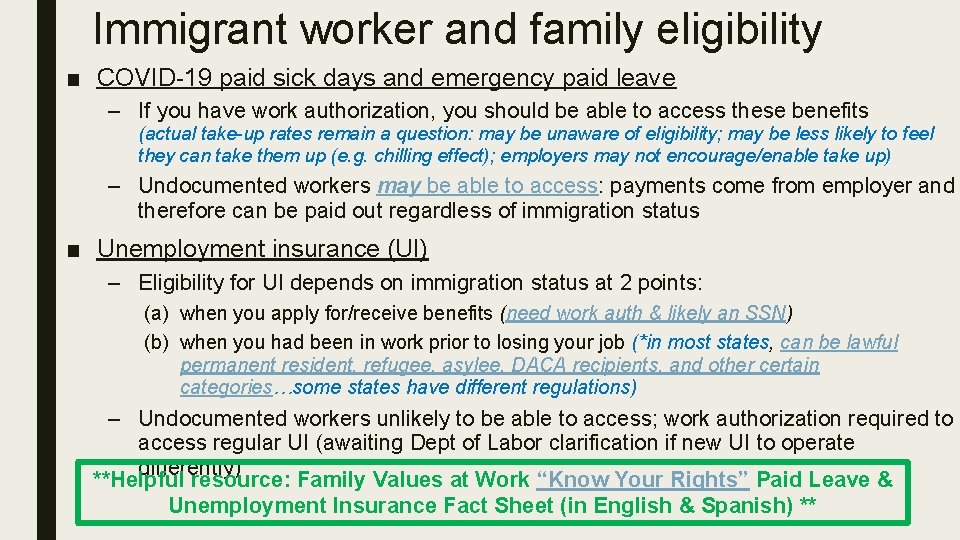
Immigrant worker and family eligibility ■ COVID-19 paid sick days and emergency paid leave – If you have work authorization, you should be able to access these benefits (actual take-up rates remain a question: may be unaware of eligibility; may be less likely to feel they can take them up (e. g. chilling effect); employers may not encourage/enable take up) – Undocumented workers may be able to access: payments come from employer and therefore can be paid out regardless of immigration status ■ Unemployment insurance (UI) – Eligibility for UI depends on immigration status at 2 points: (a) when you apply for/receive benefits (need work auth & likely an SSN) (b) when you had been in work prior to losing your job (*in most states, can be lawful permanent resident, refugee, asylee, DACA recipients, and other certain categories…some states have different regulations) – Undocumented workers unlikely to be able to access; work authorization required to access regular UI (awaiting Dept of Labor clarification if new UI to operate differently) **Helpful resource: Family Values at Work “Know Your Rights” Paid Leave & Unemployment Insurance Fact Sheet (in English & Spanish) **
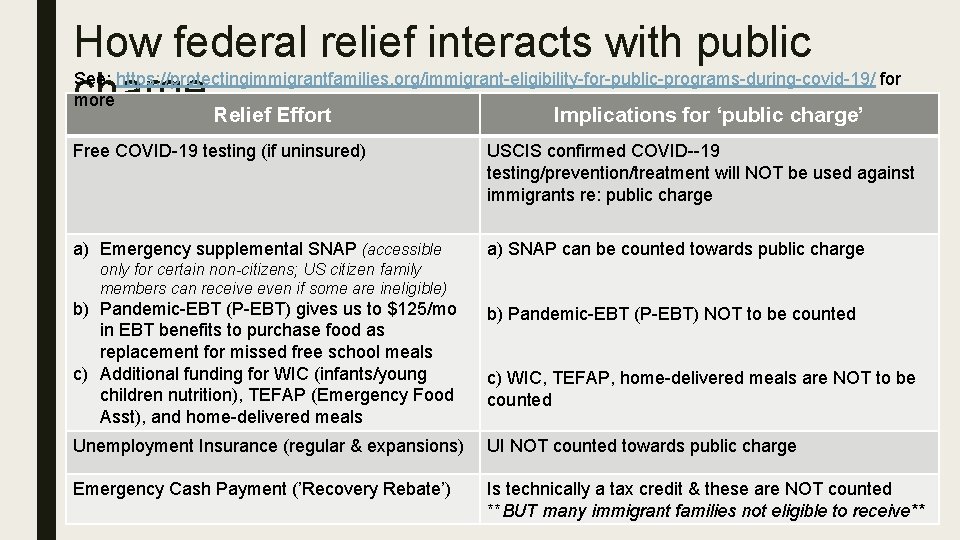
How federal relief interacts with public See: https: //protectingimmigrantfamilies. org/immigrant-eligibility-for-public-programs-during-covid-19/ for charge more Relief Effort Implications for ‘public charge’ Free COVID-19 testing (if uninsured) USCIS confirmed COVID--19 testing/prevention/treatment will NOT be used against immigrants re: public charge a) Emergency supplemental SNAP (accessible a) SNAP can be counted towards public charge only for certain non-citizens; US citizen family members can receive even if some are ineligible) b) Pandemic-EBT (P-EBT) gives us to $125/mo in EBT benefits to purchase food as replacement for missed free school meals c) Additional funding for WIC (infants/young children nutrition), TEFAP (Emergency Food Asst), and home-delivered meals b) Pandemic-EBT (P-EBT) NOT to be counted Unemployment Insurance (regular & expansions) UI NOT counted towards public charge Emergency Cash Payment (’Recovery Rebate’) Is technically a tax credit & these are NOT counted **BUT many immigrant families not eligible to receive** c) WIC, TEFAP, home-delivered meals are NOT to be counted
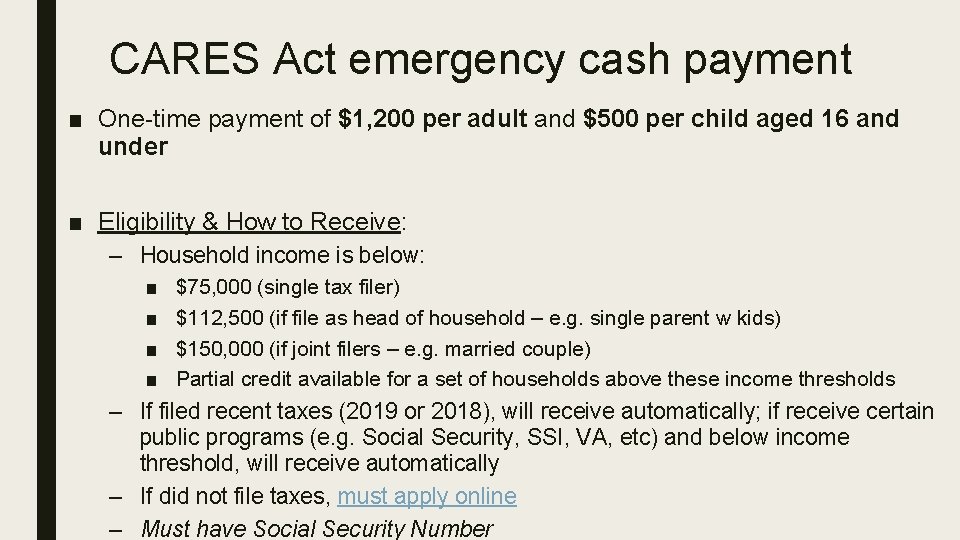
CARES Act emergency cash payment ■ One-time payment of $1, 200 per adult and $500 per child aged 16 and under ■ Eligibility & How to Receive: – Household income is below: ■ ■ $75, 000 (single tax filer) $112, 500 (if file as head of household – e. g. single parent w kids) $150, 000 (if joint filers – e. g. married couple) Partial credit available for a set of households above these income thresholds – If filed recent taxes (2019 or 2018), will receive automatically; if receive certain public programs (e. g. Social Security, SSI, VA, etc) and below income threshold, will receive automatically – If did not file taxes, must apply online – Must have Social Security Number
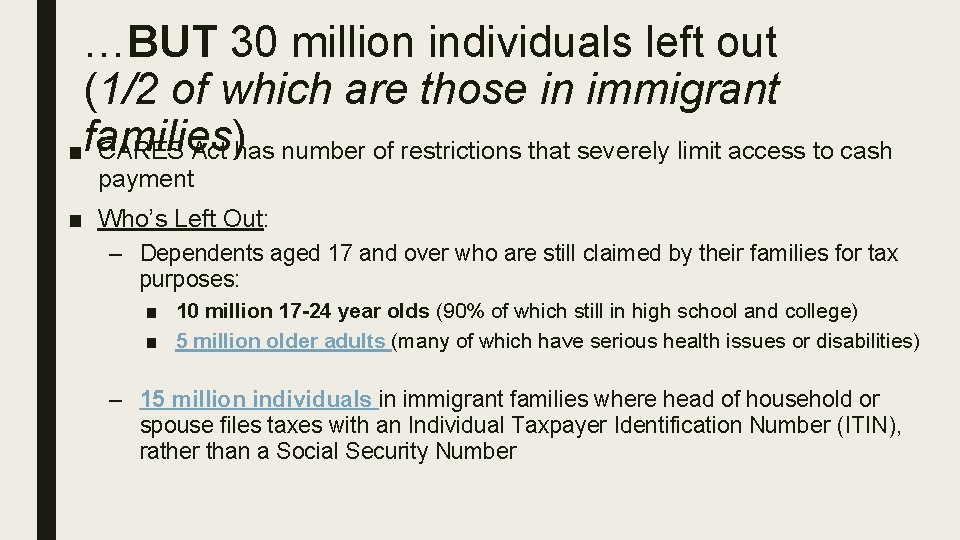
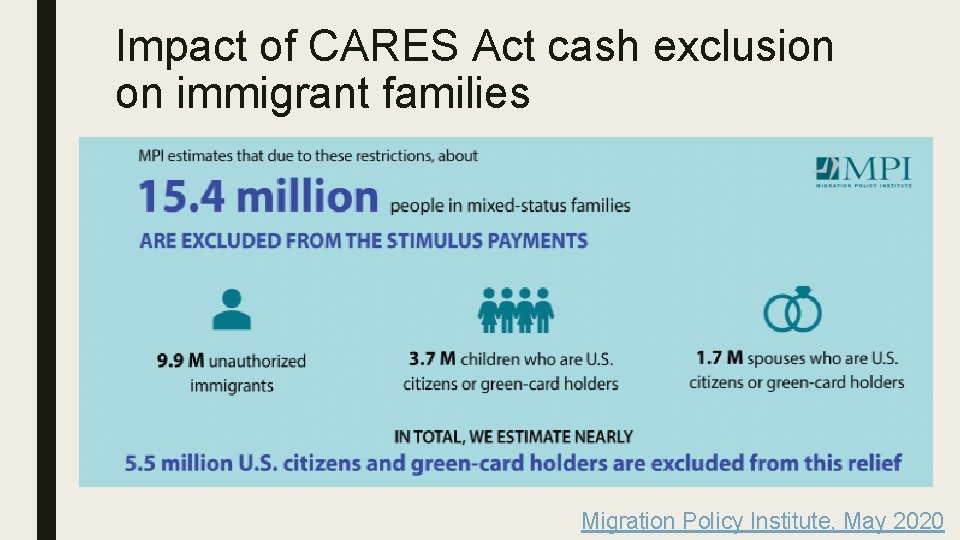
…BUT 30 million individuals left out (1/2 of which are those in immigrant ■families) CARES Act has number of restrictions that severely limit access to cash payment ■ Who’s Left Out: – Dependents aged 17 and over who are still claimed by their families for tax purposes: ■ 10 million 17 -24 year olds (90% of which still in high school and college) ■ 5 million older adults (many of which have serious health issues or disabilities) – 15 million individuals in immigrant families where head of household or spouse files taxes with an Individual Taxpayer Identification Number (ITIN), rather than a Social Security Number
Impact of CARES Act cash exclusion on immigrant families Migration Policy Institute, May 2020
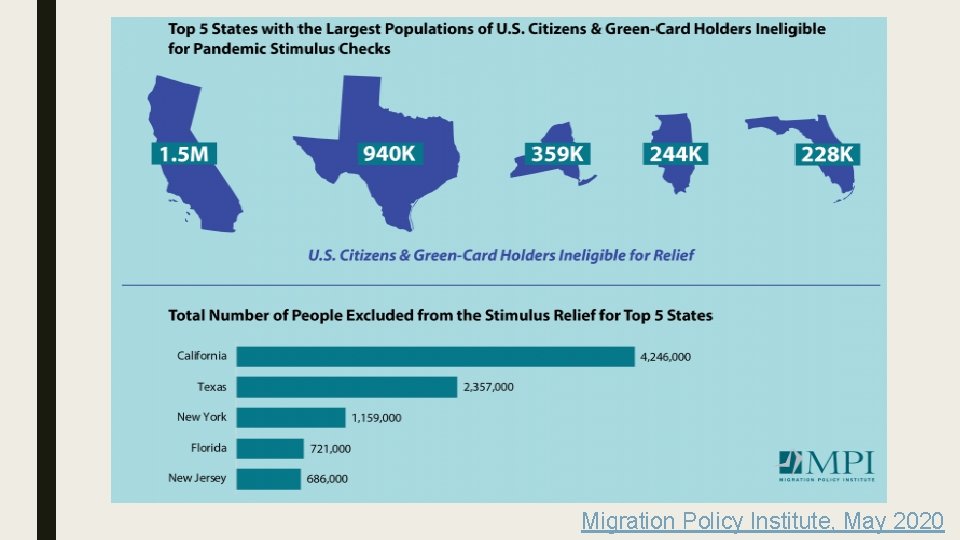
Migration Policy Institute, May 2020
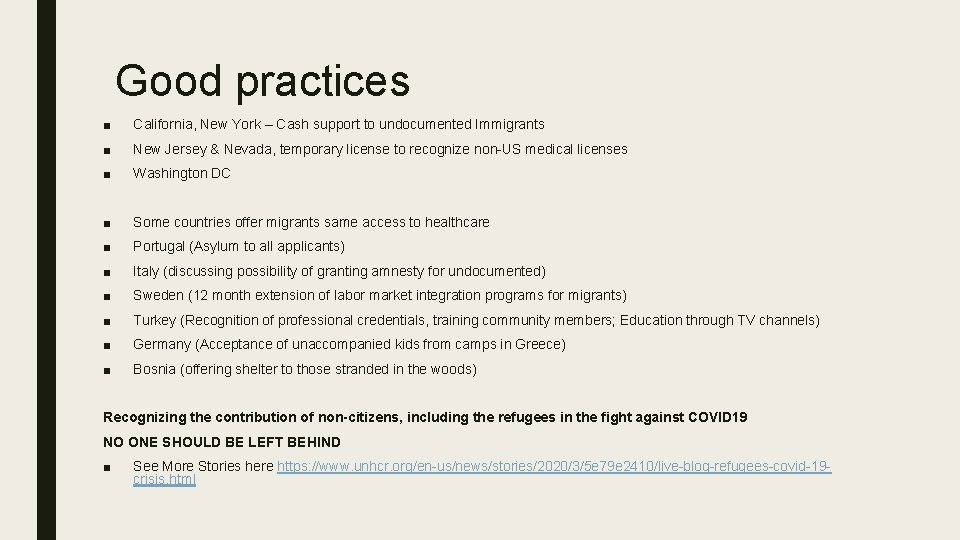
Good practices ■ California, New York – Cash support to undocumented Immigrants ■ New Jersey & Nevada, temporary license to recognize non-US medical licenses ■ Washington DC ■ Some countries offer migrants same access to healthcare ■ Portugal (Asylum to all applicants) ■ Italy (discussing possibility of granting amnesty for undocumented) ■ Sweden (12 month extension of labor market integration programs for migrants) ■ Turkey (Recognition of professional credentials, training community members; Education through TV channels) ■ Germany (Acceptance of unaccompanied kids from camps in Greece) ■ Bosnia (offering shelter to those stranded in the woods) Recognizing the contribution of non-citizens, including the refugees in the fight against COVID 19 NO ONE SHOULD BE LEFT BEHIND ■ See More Stories here https: //www. unhcr. org/en-us/news/stories/2020/3/5 e 79 e 2410/live-blog-refugees-covid-19 crisis. html
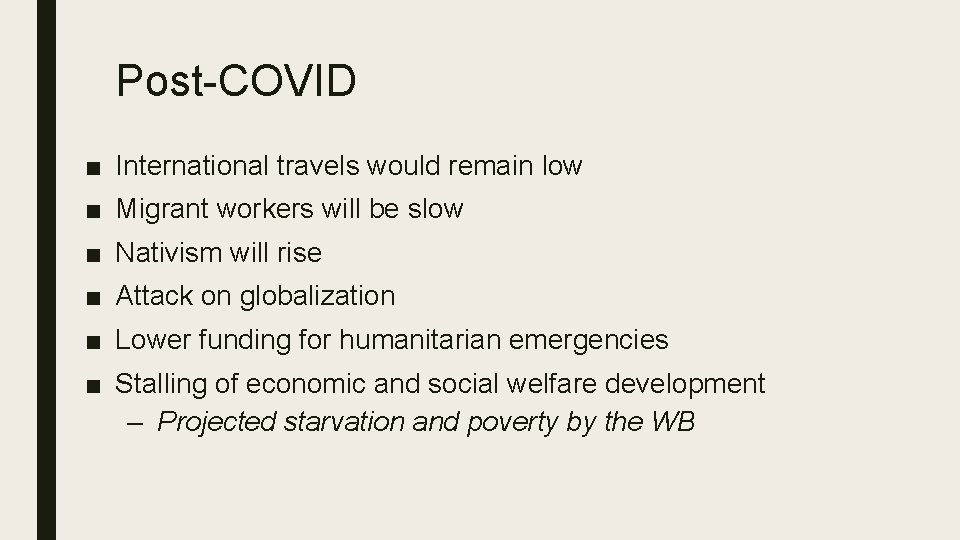
Post-COVID ■ International travels would remain low ■ Migrant workers will be slow ■ Nativism will rise ■ Attack on globalization ■ Lower funding for humanitarian emergencies ■ Stalling of economic and social welfare development – Projected starvation and poverty by the WB
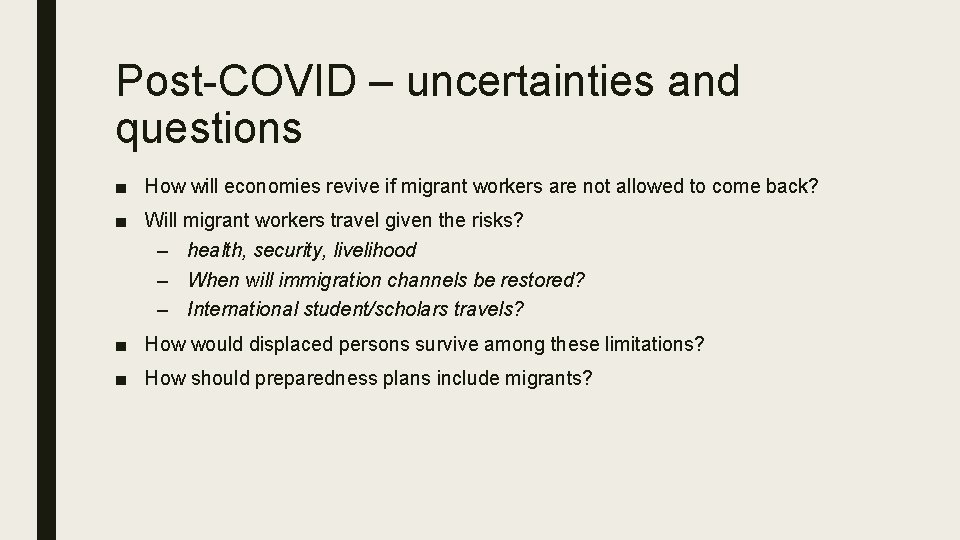
Post-COVID – uncertainties and questions ■ How will economies revive if migrant workers are not allowed to come back? ■ Will migrant workers travel given the risks? – health, security, livelihood – When will immigration channels be restored? – International student/scholars travels? ■ How would displaced persons survive among these limitations? ■ How should preparedness plans include migrants?
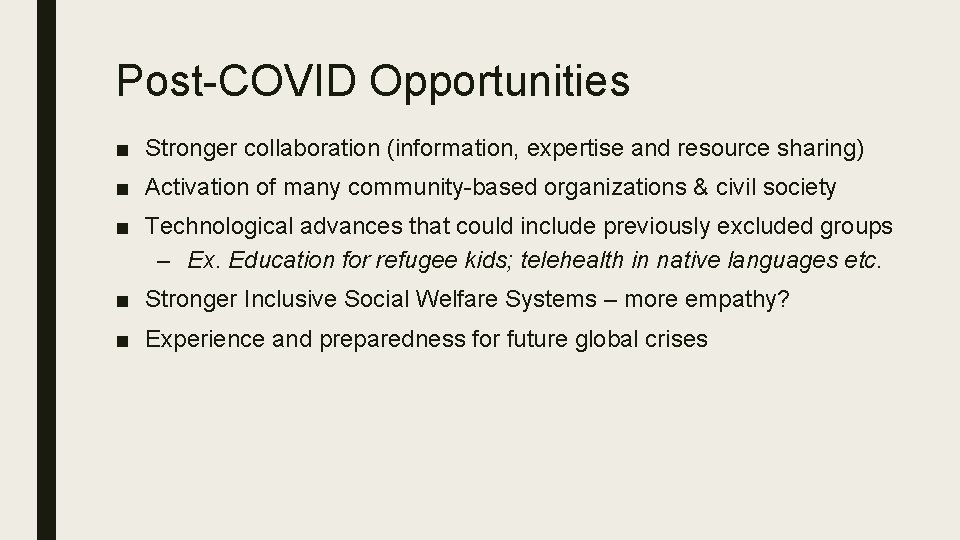
Post-COVID Opportunities ■ Stronger collaboration (information, expertise and resource sharing) ■ Activation of many community-based organizations & civil society ■ Technological advances that could include previously excluded groups – Ex. Education for refugee kids; telehealth in native languages etc. ■ Stronger Inclusive Social Welfare Systems – more empathy? ■ Experience and preparedness for future global crises
Questions?