
Migration and Diasporas Week 19 Ethnicity and Race

- Slides: 18
Migration and Diasporas Week 19 Ethnicity and ‘Race’
Recap • Considered complexity of concepts and terms and the contested and political nature of theories of ‘race’ and racism • Looked at ‘whiteness’ and nationalism and explored the relationship between ethnicity and identity • Looked at slavery as a specific form of migration.
Outline • What are diasporas? • Look at different definitions and usages • Consider the fuzzy boundary between culture and religion
Popular Definitions • The term diaspora is increasingly used by transnational populations themselves • Understood as meaning groups with social, political or economic connections that cross nation-state borders • Originated as a term to describe the Jewish experiences as a displaced and dispersed people – Originally sense of loss
Complex definitions • Vertovec (1999) has identified three distinct meanings in academic usage – Diaspora as a Social Form – Diaspora as a Type of Consciousness – Diaspora as a Mode of Cultural Production
Diaspora as a Social Form • Social Relationship through geography and history – Created through either voluntary or forced migration – Maintaining collective identity – Networks of exchange between places of settlement – Maintaining explicit or implicit ties with home – Inability or unwillingness for assimilation in the host country
Diaspora as a Social Form • Political orientation – Divided loyalties – Collective lobbying • Irish and Jewish lobbying of the US Government • Economic Strategies – Pooling of resources – Provision of services to family, kin and coethnic members
• To what extend do you think the experiences of migration, host and home are the key to understanding the diaspora experience
Diaspora as a Type of Consciousness • Emphasis on identity as fluid not fixed – Diaspora as a state of mind • Sense of identity generated though – Discrimination and exclusion the host country – Positive identification with heritage and/or contemporary world or political forces
Diaspora as a Type of Consciousness • Robin Cohen argues that transnational bonds no longer need cementing through migration but can be created through shared imagination • Constructions of fluid and multiple identities, culture and community with fuzzy rather than fixed boundaries
• Contrast this to the more fixed definition of diaspora as a social form. Which do you think is the better explanation?
Diaspora as a Mode of Cultural Production • Focuses on world-wide flow of cultural objects, images and meanings • Linked to rise of globalisation • Considers heterogeneity and diversity
Diaspora as a Mode of Cultural Production • Considers Creolization – Host cultures are adapted, translated or mixed with others – Fluidity of constructed styles and identities • Diaspora may develop ‘new traditions’ but can also return to ‘original’ or ‘true’ forms
• This idea is the most fluid of them all. It is based on anti-essentialist notions of ethnicity as a choice. • To what extend do you think it explains changes over time?
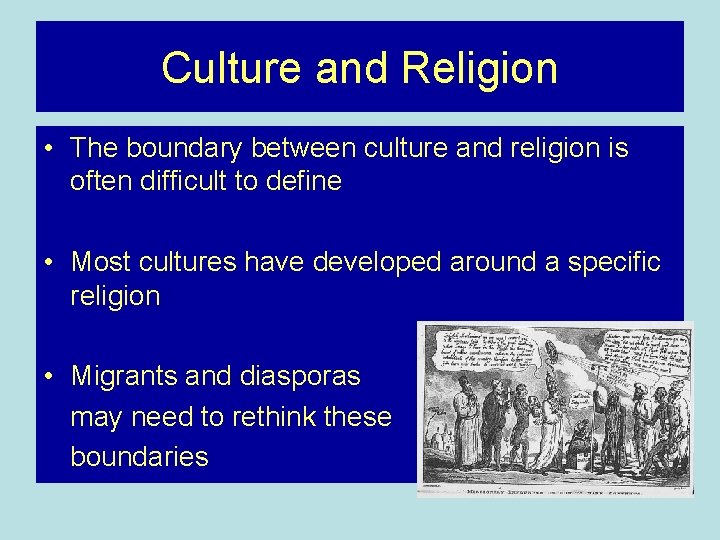
Culture and Religion • The boundary between culture and religion is often difficult to define • Most cultures have developed around a specific religion • Migrants and diasporas may need to rethink these boundaries
Culture and Religion • Ideas about whiteness and Britishness are connected to Christianity – Head of State is Head of Church – Public ceremonies often involve Christian prayers – Particular ways to celebrate Weddings/ Christmas etc • The divide does not need to be considered by white people living in Britain
Culture and Religion • Diasporas may need to consider what is religious and what is cultural in more detail – Are certain forms of dress and family forms cultural or religious? – Are cultural changes more acceptable than religious ones?
Summary • Look at the concept of diaspora in more detail • Considered how cultures can change or merge • Considered the fuzzy boundary between culture and religion