
Migration and Development nomic Agenda UNCTAD Short Courses
- Slides: 61
Migration and Development nomic Agenda UNCTAD Short Courses on Key Issues on the International Eco for Geneva-based Diplomats 2010 Series Geneva, 26 March 2010 UNCTAD Robert Hamwey and Deepali Fernandes Trade Negotiations and Commercial Diplomacy Branch Division on International Trade
UNCTAD Migration & Development Motivations International migration is motivated by various reasons, including employment, humanitarian relief and family reunification. It is a push and pull process. − On the supply side, the main “push factors” include demographics and the lack of adequate employment opportunities at home − The “pull factors” include wage differences and associated labour productivity across markets, as well as perceived quality of life and a stream of income 2
UNCTAD Migration & Development Motivations In some cases, labour requirements are met through mode 4 services trade as intra-corporate transfers within transnational firms and as the movement of labour associated with services supply But more broadly, outside of the services sector, labour requirements are met through workers migrating from lower- to higher-income countries – where wage premiums are greater – resulting in a growing class of economic migrants 3
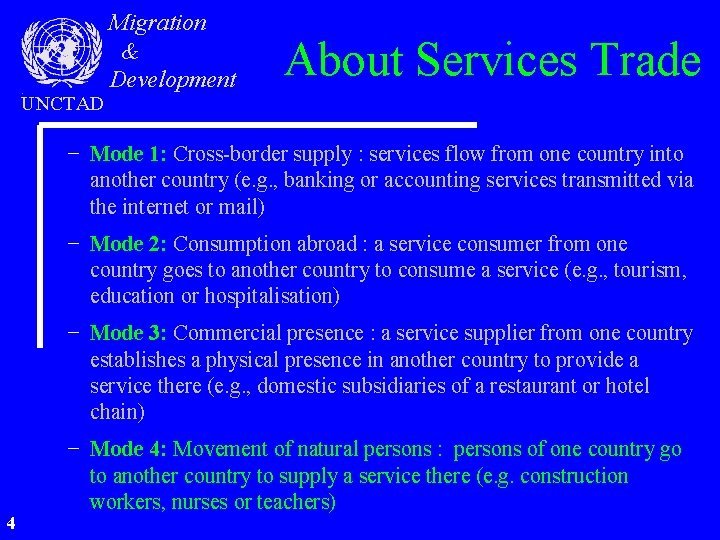
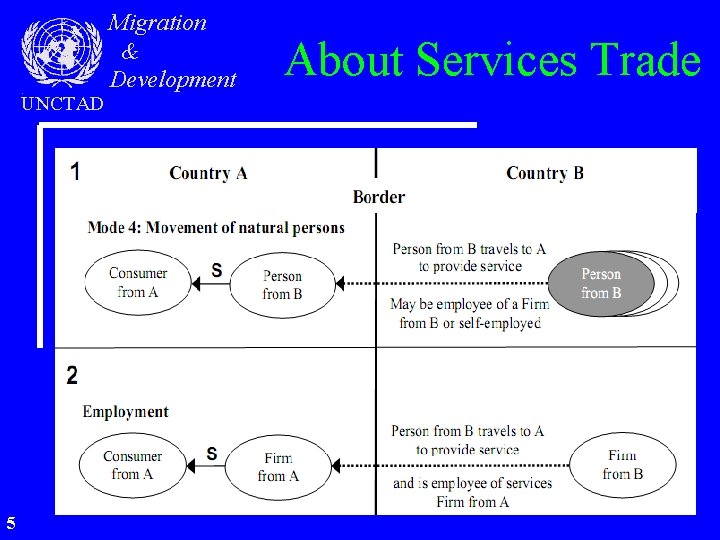
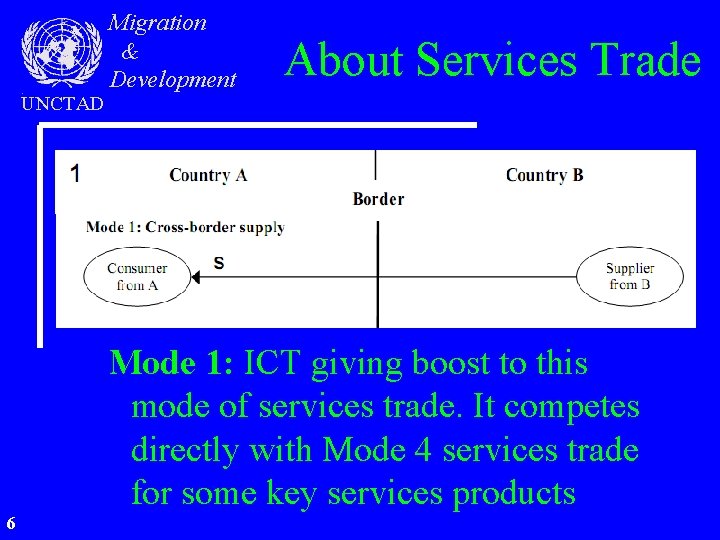
UNCTAD Migration & Development About Services Trade − Mode 1: Cross-border supply : services flow from one country into another country (e. g. , banking or accounting services transmitted via the internet or mail) − Mode 2: Consumption abroad : a service consumer from one country goes to another country to consume a service (e. g. , tourism, education or hospitalisation) − Mode 3: Commercial presence : a service supplier from one country establishes a physical presence in another country to provide a service there (e. g. , domestic subsidiaries of a restaurant or hotel chain) 4 − Mode 4: Movement of natural persons : persons of one country go to another country to supply a service there (e. g. construction workers, nurses or teachers)
UNCTAD 5 Migration & Development About Services Trade
UNCTAD Migration & Development About Services Trade Mode 1: ICT giving boost to this mode of services trade. It competes directly with Mode 4 services trade for some key services products 6
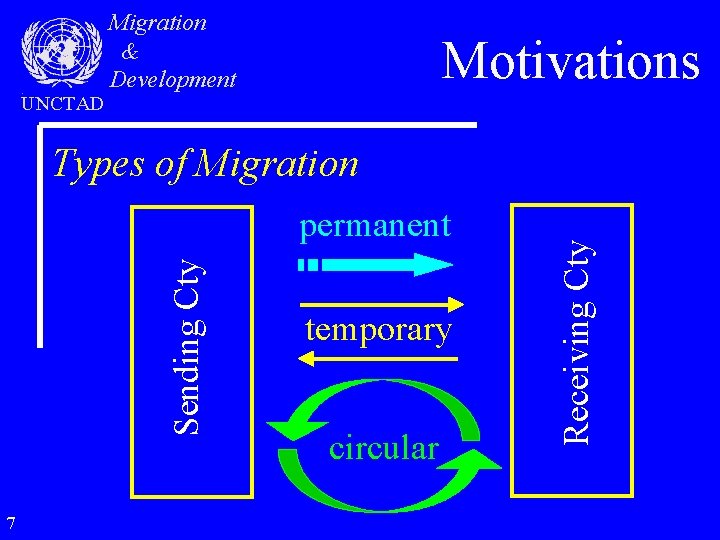
UNCTAD Migration & Development Motivations Sending Cty permanent 7 temporary circular Receiving Cty Types of Migration
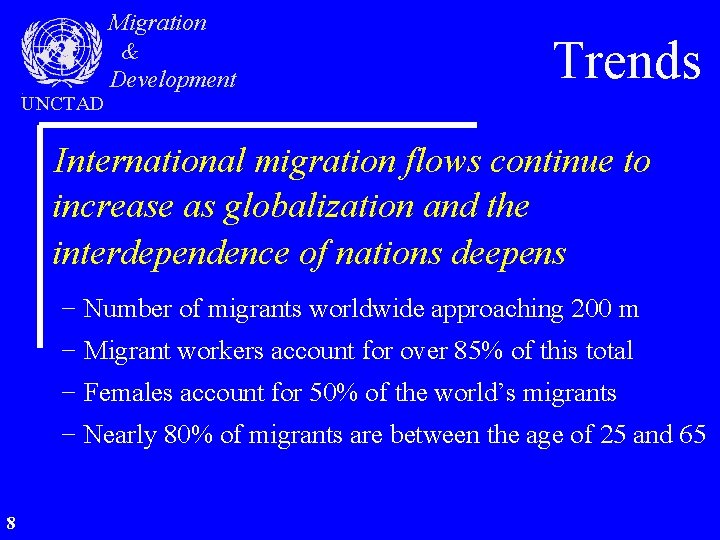
UNCTAD Migration & Development Trends International migration flows continue to increase as globalization and the interdependence of nations deepens − Number of migrants worldwide approaching 200 m − Migrant workers account for over 85% of this total − Females account for 50% of the world’s migrants − Nearly 80% of migrants are between the age of 25 and 65 8
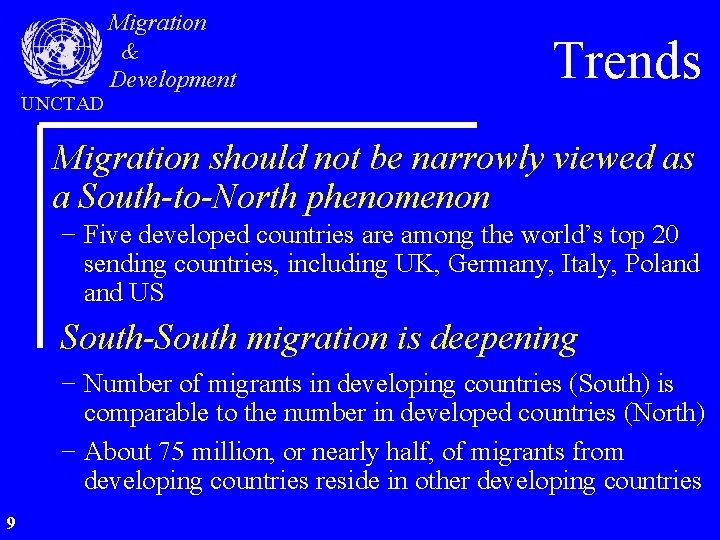
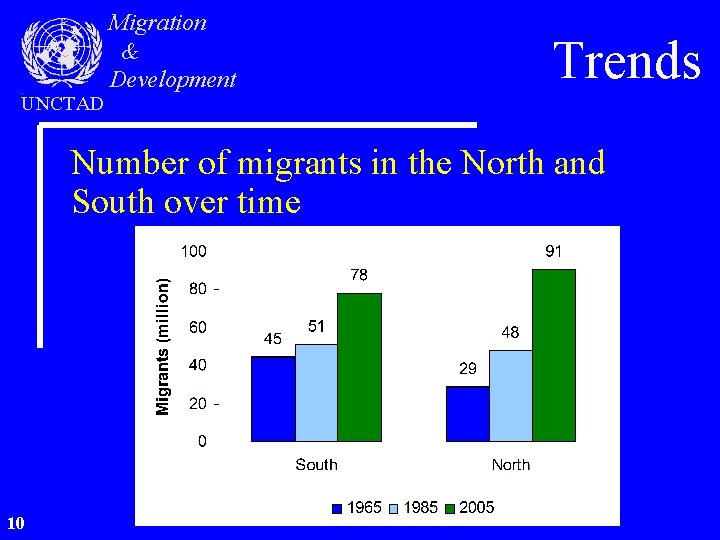
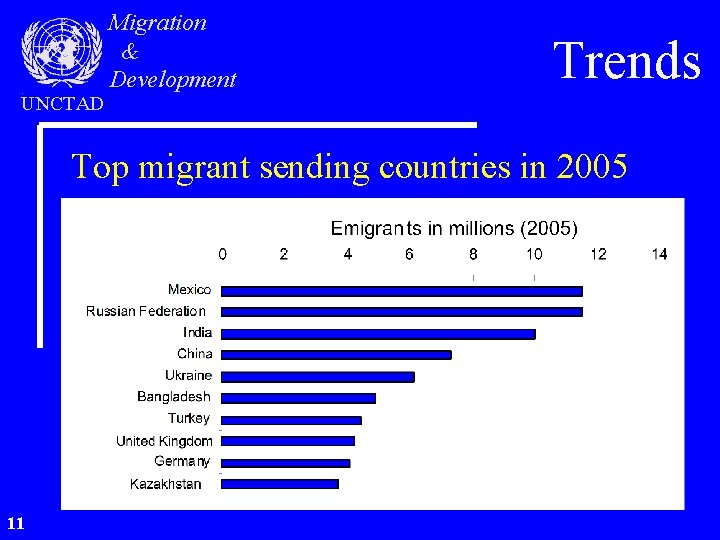
UNCTAD Migration & Development Trends Migration should not be narrowly viewed as a South-to-North phenomenon − Five developed countries are among the world’s top 20 sending countries, including UK, Germany, Italy, Poland US South-South migration is deepening − Number of migrants in developing countries (South) is comparable to the number in developed countries (North) − About 75 million, or nearly half, of migrants from developing countries reside in other developing countries 9
UNCTAD Migration & Development Trends Number of migrants in the North and South over time 10
UNCTAD Migration & Development Trends Top migrant sending countries in 2005 11
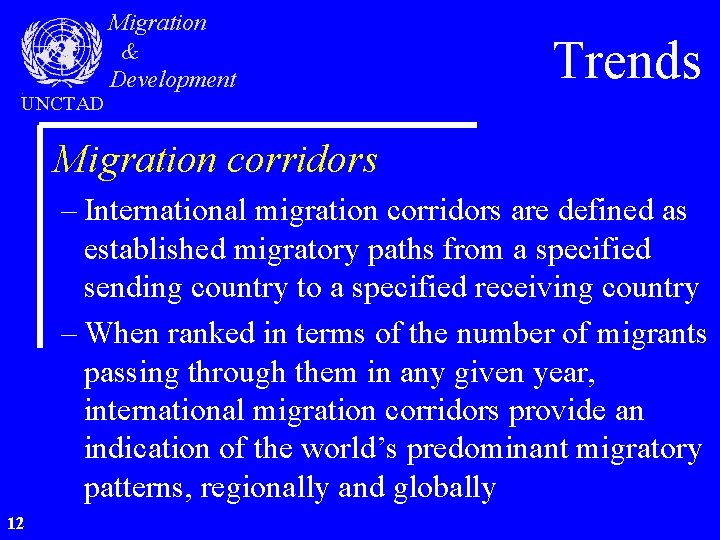
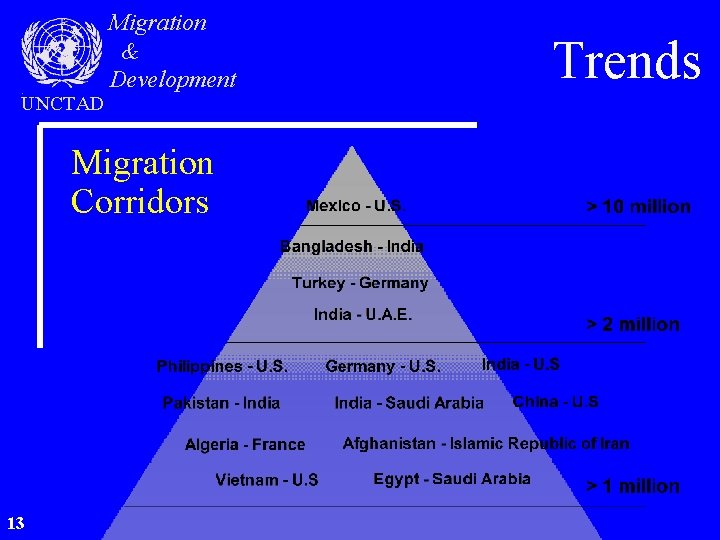
UNCTAD Migration & Development Trends Migration corridors – International migration corridors are defined as established migratory paths from a specified sending country to a specified receiving country – When ranked in terms of the number of migrants passing through them in any given year, international migration corridors provide an indication of the world’s predominant migratory patterns, regionally and globally 12
UNCTAD Migration & Development Migration Corridors 13 Trends
UNCTAD Migration & Development Trends South-South migration 14 – Data show that South–South migration represents an important share of total world migration and that it is accelerating – Economies of many developing countries are growing rapidly and significant wage differentials have developed between neighbouring developing countries and among those in the same region – Geographic proximity and cultural links such as common language are key factors influencing migrants’ choices towards South–South migration
UNCTAD Migration & Development Trends Both permanent and temporary migration occurs. However, available data point towards a trend that mobility patterns are becoming increasingly temporary rather than permanent − OECD data suggest that temporary migrants (2. 5 million in 2006) outnumber permanent migrants three to one − Data also indicate that between 20 and 50 per cent of migrants leave their destination country within five years, most within three years, and that migrants with particularly high or low skill levels are the most likely to leave − There is, however, no indication in this data as to what extent temporary migration is repetitive and circular 15
UNCTAD Migration & Development Trends Gender, age and skill level of migrants − Females account for 50 per cent of the world’s migrants − Most women migrants are engaged in temporary labour migration in the Middle East, East Asia and South-east Asia − While many women accompany or join family members, increasing numbers of female migrants migrate on their own as principal wage earners for themselves and their children 16
UNCTAD Migration & Development Trends Gender, age and skill level of migrants − Women migrants’ families are sometimes able to accompany them but generally remain in their home countries − Cooperative mechanisms to favour family reunification, return migration, etc. thus have an important role to play in ensuring quality care of migrants’ children − Numerous studies indicate that among migrants, women tend to remit more of their income to their families than men do 17
UNCTAD Migration & Development Trends Gender, age and skill level of migrants 18 − OECD data reported by its members provides information on the age distribution of migrants in its member states − Younger migrants, age 15– 24, account for 11 per cent, and older migrants over the age of 65 account for 10 per cent of the migrant population in the OECD countries − The bulk of migrants, 79 per cent, are between the age of 25 and 65
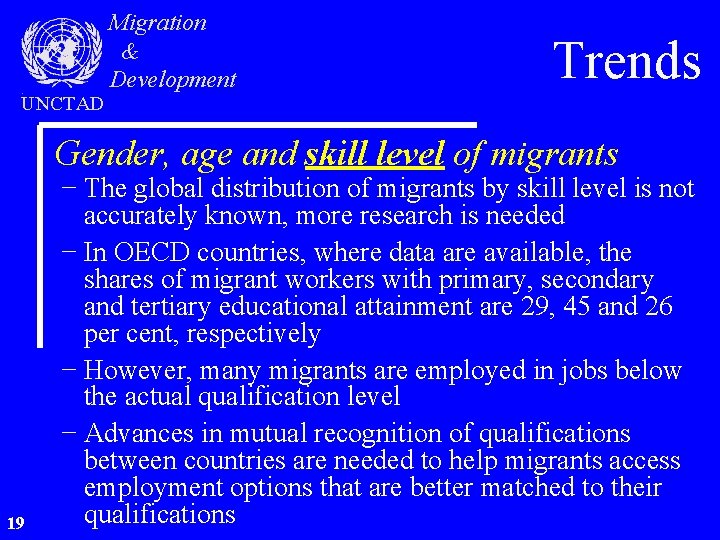
UNCTAD Migration & Development Trends Gender, age and skill level of migrants 19 − The global distribution of migrants by skill level is not accurately known, more research is needed − In OECD countries, where data are available, the shares of migrant workers with primary, secondary and tertiary educational attainment are 29, 45 and 26 per cent, respectively − However, many migrants are employed in jobs below the actual qualification level − Advances in mutual recognition of qualifications between countries are needed to help migrants access employment options that are better matched to their qualifications
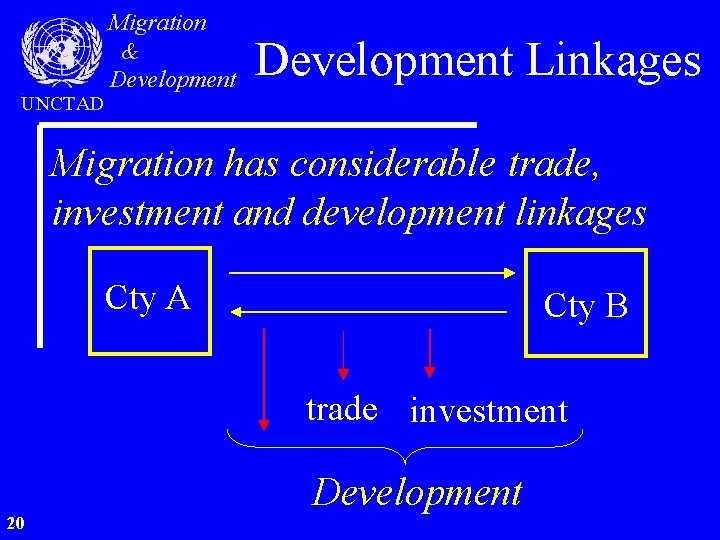
UNCTAD Migration & Development Linkages Migration has considerable trade, investment and development linkages Cty A Cty B trade investment 20 Development
UNCTAD Migration & Development Linkages Temporary migration plays a important role in advancing economic growth and development of both sending and receiving countries However, permanent migration can result in brain drain in sending developing countries 21
UNCTAD Migration & Development Linkages − Benefits flow to both sending and receiving countries − Through labour matching, migration allows workers to move to where they are more productive, thus increasing productivity and output in receiving countries − Two-way transfer of skills and knowledge − Remittances can fuel development in sending countries − Diaspora communities can be an important source of trade, capital, technology and knowledge 22
UNCTAD Migration & Development Linkages Gains in sending countries 23 − Representing one of the largest private sources of external finance for developing countries, remittances are the main transmitter of migration’s development benefits to sending country economies − Remittances flow directly to households widely distributed throughout the economy, they thus have a much broader effect on home country economies than either FDI or official development assistance, where the base of recipients are limited and geographically concentrated. Increased domestic consumption and tax revenue − In providing primarily for household livelihoods, remittances are spent on general consumption items in local communities that contribute to local economies by supporting small businesses
UNCTAD Migration & Development Linkages Gains in sending countries 24 − Temporary migration also provides development gains for sending countries by facilitating skill and technology transfer − Migrant workers returning to their home developing countries are important transmitters of modern knowhow related to manufacturing, provision of services, management skills and knowledge of both external commercial networks and diaspora communities and how to access them − Temporary migration provides sending countries with greater overall development gains than remittances alone
UNCTAD Migration & Development Linkages Gains in receiving countries 25 − Migration responds to real labour needs in receiving countries by fulfilling unmet labour requirements − Migrants bring new scientific, technological and cultural resources to receiving countries, contributing to diversifying/enriching receiving countries’ economic and cultural base − Increased domestic consumption and tax revenue − Remittance flows generate import demand for receiving country exports in sending countries − Migrants contribute to the expansion of global trade with their knowledge of home country markets
UNCTAD Migration & Development Linkages But all is not gold… 26 − Besides the gains of migration, there a number of challenges − Related issues, all of which are discussed amply in the literature, include brain drain, cultural conflicts in receiving countries, human trafficking, economic exploitation of migrants, sending country dependency patterns, delayed growth, etc. − Some sectors are more susceptible to brain drain than others. The health services sector is often considered to be the most affected and the migration of skilled health workers appears to be the starkest and most persistent form of brain drain
UNCTAD Migration & Development Linkages Remittances are a key gain for developing countries 27
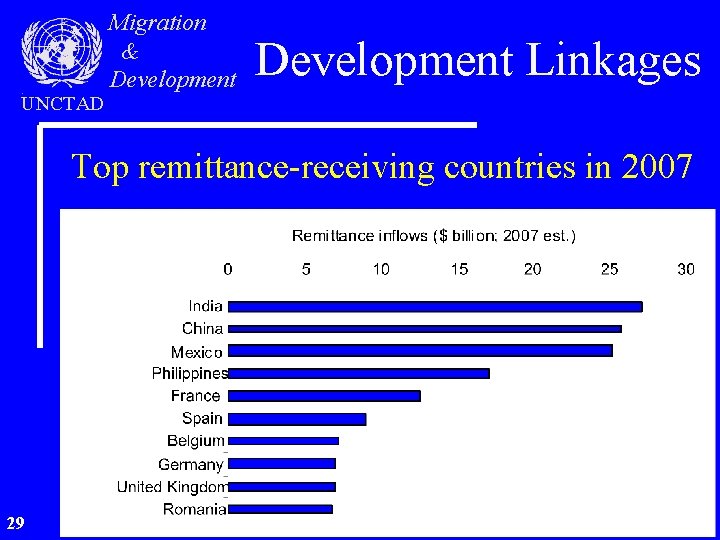
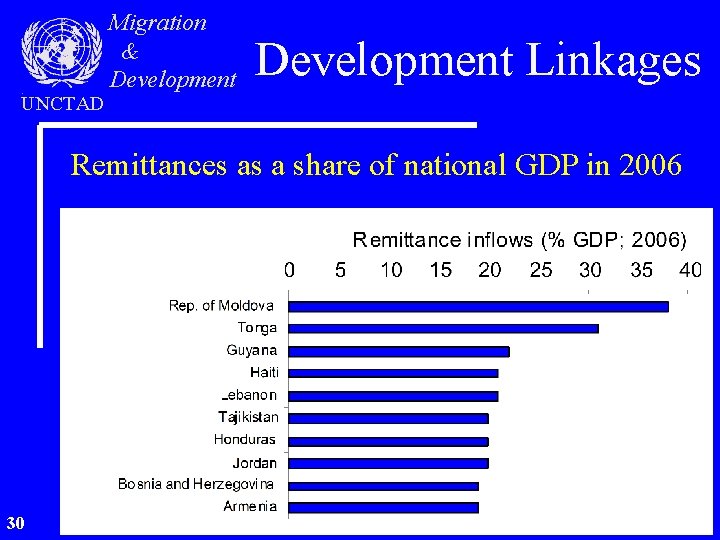
UNCTAD Migration & Development Linkages Remittances : Fuelling development − Remittance flows to developing countries reached $328 b in 2008 – over half the value of FDI inflows ($550 b) and more than twice ODI ($119 b) − Flowing directly to households and widely distributed throughout the economy, remittances can have a much broader effect on home country economies than either FDI or ODA − Spent on construction of homes, healthcare and education, and deposited in financial institutions, remittances generate employment in critical services sectors 28
UNCTAD Migration & Development Linkages Top remittance-receiving countries in 2007 29
UNCTAD Migration & Development Linkages Remittances as a share of national GDP in 2006 30
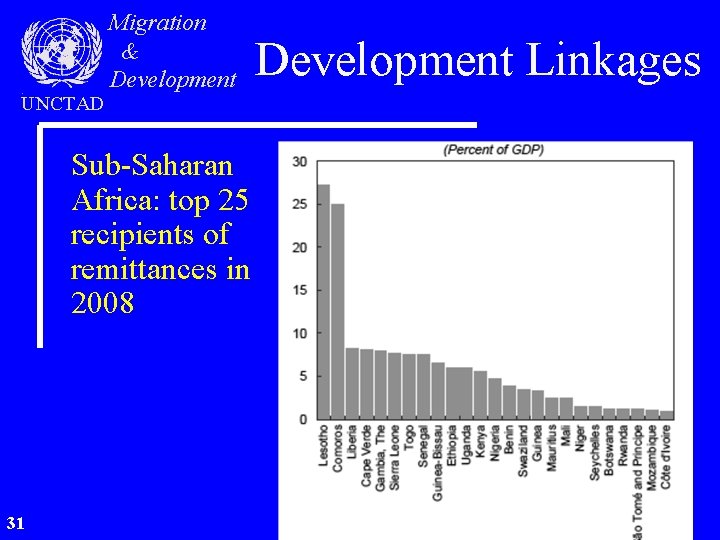
UNCTAD Migration & Development Sub-Saharan Africa: top 25 recipients of remittances in 2008 31 Development Linkages
UNCTAD Migration & Development Financial Crisis Negative impact on migrant workers − Impacts most pronounced in sectors employing a large number of migrant workers such as financial, distribution, construction and tourism services, as well as manufacturing − Reduction of existing and prospective employment opportunities for migrant workers − Remittance flows to developing countries fell in 2009 − Migrant employment and remittances must be carefully monitored so that emerging problems can be effectively addressed 32
UNCTAD Migration & Development Financial Crisis Policy reactions : Are they optimal ? − Some governments have introduced financial incentives to encourage migrant workers to return home − Many have closed-off entry of new migrants through more restrictive policies, including skill-based labour matching procedures − However, migration can be a tool to help resolve to crisis, so more restrictive policies may be retarding, rather than promoting a global recovery 33
UNCTAD Migration & Development Linkages Diaspora : New channels for development − New policies and incentives are enhancing diaspora contributions to development in their countries of origin − Enhancing investment in home country economies − Opening new trade opportunities for home country SMEs, and creating new conduits for receiving country exports − Diaspora return to home countries as economic opportunities emerge with entrepreneurship and essential knowledge and skills 34
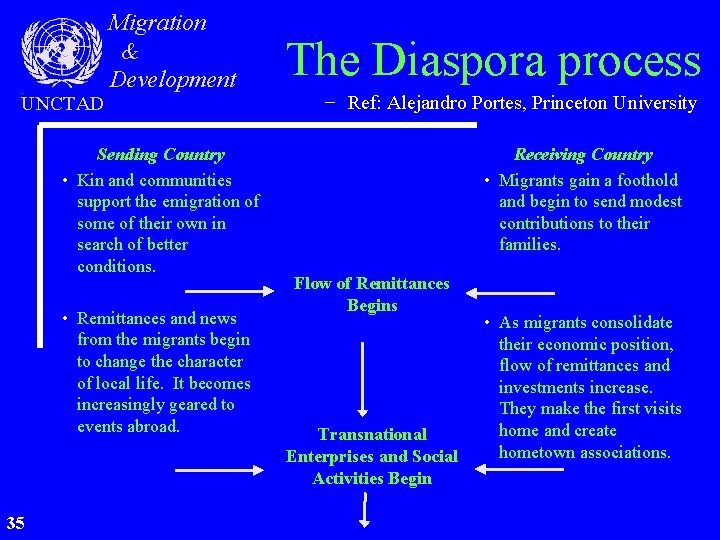
UNCTAD Migration & Development Sending Country • Kin and communities support the emigration of some of their own in search of better conditions. • Remittances and news from the migrants begin to change the character of local life. It becomes increasingly geared to events abroad. 35 The Diaspora process − Ref: Alejandro Portes, Princeton University Receiving Country • Migrants gain a foothold and begin to send modest contributions to their families. Flow of Remittances Begins Transnational Enterprises and Social Activities Begin • As migrants consolidate their economic position, flow of remittances and investments increase. They make the first visits home and create hometown associations.
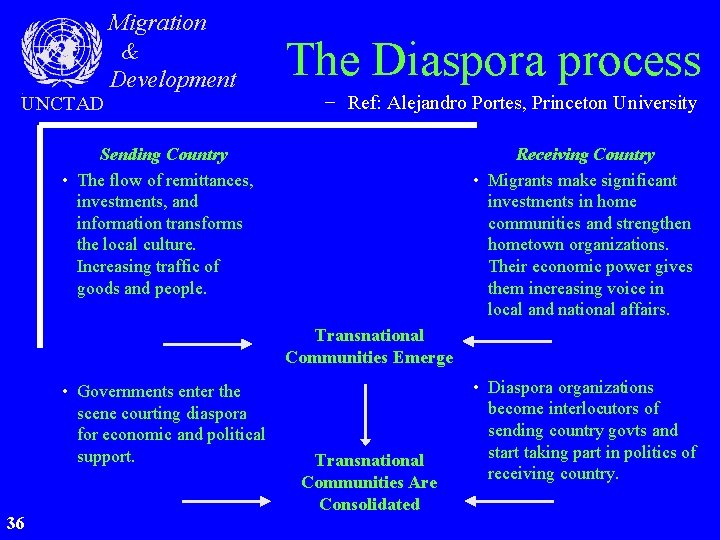
UNCTAD Migration & Development The Diaspora process − Ref: Alejandro Portes, Princeton University Sending Country • The flow of remittances, investments, and information transforms the local culture. Increasing traffic of goods and people. Receiving Country • Migrants make significant investments in home communities and strengthen hometown organizations. Their economic power gives them increasing voice in local and national affairs. Transnational Communities Emerge • Diaspora organizations • Governments enter the scene courting diaspora for economic and political support. 36 Transnational Communities Are Consolidated become interlocutors of sending country govts and start taking part in politics of receiving country.
UNCTAD Migration & Development Linkages Diaspora : New channels for development − Despite their potential, with the exception of the successful networks developed by India and China, relatively few developing countries have established strong links between their economies and their migrant communities in receiving countries − As a result, many trade, investment and development benefits and opportunities associated with diaspora linkages continue to go unrealized 37
UNCTAD Migration & Development Policy Options International Scene − United Nations convened a High-Level Dialogue on International Migration and Development in September 2006; Follow-up by GA in 2008 − Established in 2006, the Global Migration Group (GMG) bringing together heads of IOs, to encourage the adoption of more coherent, comprehensive and better coordinated approaches to the issue of international migration − An informal, voluntary, open, state-led initiative Global Forum on Migration and Development (GFMD) provides a critical vehicle for international dialogue on migration issues (Brussels 2007, Manila 2008, Athens 2009, Mexico 2010) − Regional economic cooperation and trade agreements and bilateral labour agreements address migration 38
UNCTAD Migration & Development Policy Options Improved policy frameworks to enhance migrants´ contributions to development − Policies are changing in most countries, with some relaxing and others restricting their entry policies − Policies must provide the national economy with the right amount of migrant workers with the right skills − Temporary migration has been proposed as one approach to deliver win-win outcomes − Programmes engaging diaspora communities yield multiple benefits 39
UNCTAD Migration & Development Policy Options FDI, migration and outsourcing 40 − Foreign direct investment (FDI) can help reduce migration pressure by enhancing economic growth and supporting employment creation in sending countries − Through the tangible and intangible assets it brings, FDI can offer alternatives to labour movement − While FDI has helped reduce migration pressure in many middle- and upper-income developing countries, a threshold level of domestic development is required for countries to benefit fully from the potential for economic growth, opportunities-enhancement and reduced migration pressure that FDI can provide
UNCTAD Migration & Development Policy Options Circular/Temporary migration − Related policies can generate greater overall development gains for sending countries than remittances alone − Mobility patterns are becoming increasingly temporary rather than permanent – in the OECD countries, temporary migrants outnumber permanent migrants by 3 times and up to 50 percent of migrants return to their home country within 5 years 41 − Frameworks for circular migration based on incentives rather than sanctions can promote mobility and voluntary return
UNCTAD Migration & Development Policy Options Bilateral labour agreements (BLAs) − BLAs formalize arrangements to ensure that migration takes place in accordance with agreed principles and procedures − BLAs govern access to labour markets in order to help guide the migration process towards meeting economic, social and development objectives − Agreements cover areas such as short-term employment, recognition of qualifications and technical and cultural exchange, among others. 42
UNCTAD Migration & Development Policy Options Engaging Diaspora Communities − Many programmes providing incentives for migrants’ return to, and investment in, their home countries have been successful − Home countries can also promote exports of goods and services to their diaspora communities abroad − Home countries can also improve services for communication, information dissemination and networking to their diaspora communities abroad 43
UNCTAD Migration & Development Policy Options In developed countries… − Introduced earlier in Australia, New Zealand Canada, skill -based policies are now being introduced in EU countries − A new EU directive provides more attractive conditions for third-country workers to take up highly qualified employment in the EU by creating a fast-track procedure for an “EU Blue Card” − Since 2000 Spain entered into several bilateral agreements with Bulgaria, Colombia, the Dominican Republic, Ecuador, Poland Romania to help regulate migratory flows and facilitate circular migration 44
UNCTAD Migration & Development Policy Options In developed countries… − In the UK a points-based immigration system has been introduced to ensure prospective migrants with needed skills and contributions gain entry to the United Kingdom for work and study purposes − Sweden reformed its immigration regulation in December 2008 with the aim of establishing an entirely demand-driven system. It offers greater flexibility by allowing Swedish employers to recruit more easily from outside the EU − France has bilateral agreements for the employment of seasonal workers from Morocco, Tunisia − Canada has BLAs with several Caribbean countries 45
UNCTAD Migration & Development Policy Options In developed countries… − Norway launched a project in 2008 aimed at doubling the money donated to development projects by Pakistani diaspora organizations based in Norway in order to support development projects in Pakistan − Switzerland supports diaspora associations with a view to improving remittance channels to developing countries of origin, and undertakes numerous finance sector development projects to help bring savings and investment opportunities to the rural areas of migrant origin to enhance the multiplier effect of remittances 46
UNCTAD Migration & Development Policy Options In developing countries… − India has a comprehensive package of activities and incentives focussed on building stronger links with its diaspora communities, all of which are orchestrated by the new Ministry of Overseas Indian Affairs (MOIA) established in 2004 − In 2008 India launched an Overseas Indian Facilitation Centre, a one-stop shop to help overseas Indians invest in India − In China and Korea, incentive schemes have been introduced to encourage the return of highly skilled diaspora 47
UNCTAD Migration & Development Policy Options In developing countries… 48 − In South America, a series of Mercosur provisions has led its members to liberalize their immigration policies − In Africa, immigration policies are adopting more immigration-friendly frameworks, including in the contexts of regional trade agreements (RTAs) − Cape Verde is attempting to encourage return and reintegration of its relatively large diaspora through an EU– Cape Verde mobility partnership initiative − In the Philippines, the Commission for Filipino Overseas recommends projects, mobilizes donations from the Filipino diaspora, and coordinates with government agencies and local partners for their implementation
UNCTAD Migration & Development Policy Options In developing countries… 49 − Benin developed a National Policy Plan for Beninese abroad, launched in 2001, which establishes a new ministry in charge of relations with Beninese abroad, as well as a national agency of Beninese abroad − In 2002, Colombia unveiled a new programme – Colombia Nos Une” – to facilitate contact and exchange between Colombian diaspora and Colombia − In Mexico, the Foreign Ministry launched the Institute for Mexicans Abroad in 1990 to strengthen the ties with Dispora in areas such as health, education, sports, culture and community organization − In Mali, facilities created by the Government to transfer funds and encourage returns have been identified as conducive to diasporas’ increased involvement in national development
UNCTAD Migration & Development Policy Options In developing countries… 50 − Mexico’s “ 3 x 1 program” “Tres por Uno programme” for migrants of Mexico is a prominent example of home countries’ efforts to promote diaspora community investment in “hometowns” − The programme was initiated in 2002 in response to migrant demands for support to improve their hometowns through the development community projects. − Initially, state and local governments matched migrants’ homeward investments (2 x 1) − Since 1998 the federal Government has also provided matching funds (3 x 1) − From 1992 to 2001, the programme carried out 400 projects, in which migrants invested $5 million (out of total investment of $15 million)
UNCTAD Migration & Development Policy Options In developing countries IGOs and NGOs are also active… 51 − Migrant associations in France, known as Organisations de Solidarité Internationale issues des Migrations or “OSIMs” facilitate technology transfer activities and financing for projects in Francophone Africa, including Benin, Congo, Mali and Senegal − The TOKTEN (Transfer of Knowledge Through Expatriate Nationals) initiative launched by the UNDP in Turkey in 1977 organizes the return of expatriate nationals to their home countries knowledge and skills transfer − Viet Nam took advantage of its large base of expatriate nationals by placing 20 TOKTEN consultants in Viet Nam between 1990 and 1992. Over the next decade, Viet Nam utilized its wide pool of expatriates to build capacity and make much development headway
UNCTAD Migration & Development Trade Policy and Migration This is a very important issue that my colleague Deepali Fernandes will now introduce We will talk about mode 4 services trade, but before we do let’s have a look at some numbers… 52
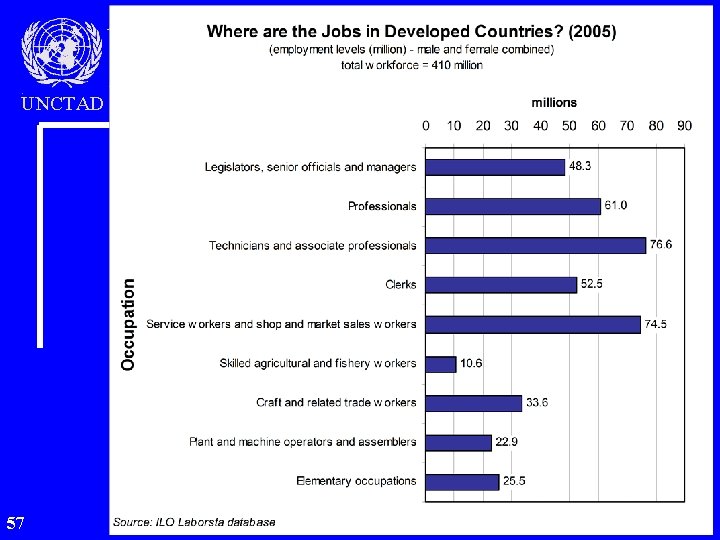
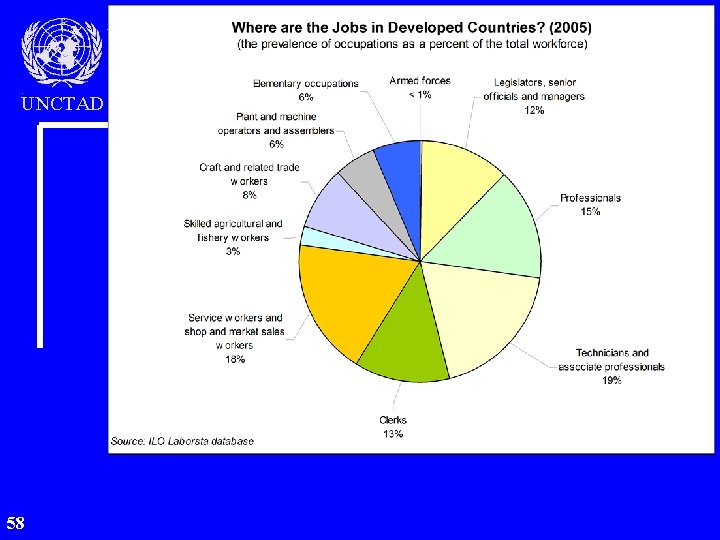
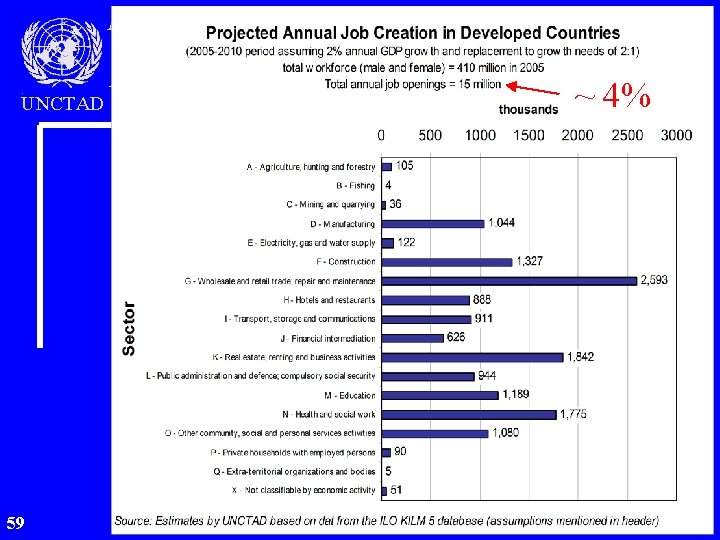
UNCTAD Migration & Development Trade Policy and Migration Notes for the following charts : All figures are for total (combined male and female) employment for persons of age 15 years. Developed countries are the set of OECD 24 countries. Elasticities of labour demand used in projections are for the aggregate agriculture, industry and services sectors, and not based on sub-sector data. Data presented for total employment in each country and sector is for all skill levels. Data for skill levels (i. e. , occupation) for the entire economy is presented. Projections of job openings result from employment growth (growth in the workforce in response to economic growth – i. e. , GDP growth) and the labour replacement needs (the need to replace workers who leave an occupation due to their transfer to other occupations, retirement and other reasons). Projections are approximate and highly sensitive to assumed GDP growth and replacement needs. 53
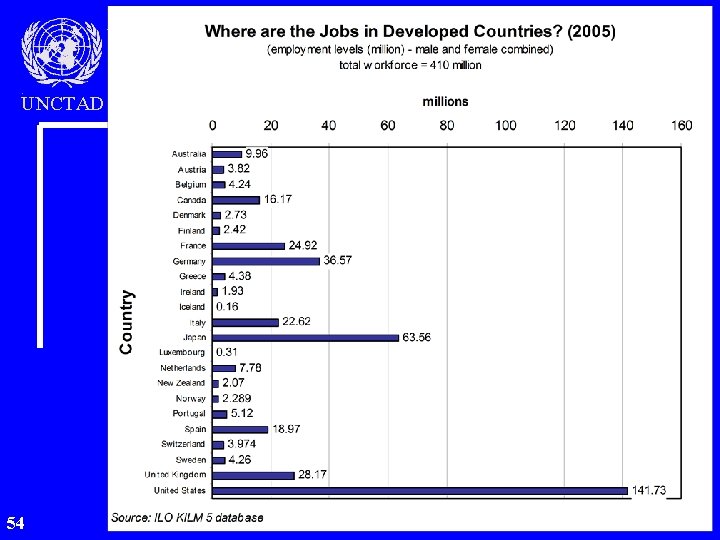
UNCTAD 54 Migration & Development Trade Policy and Migration
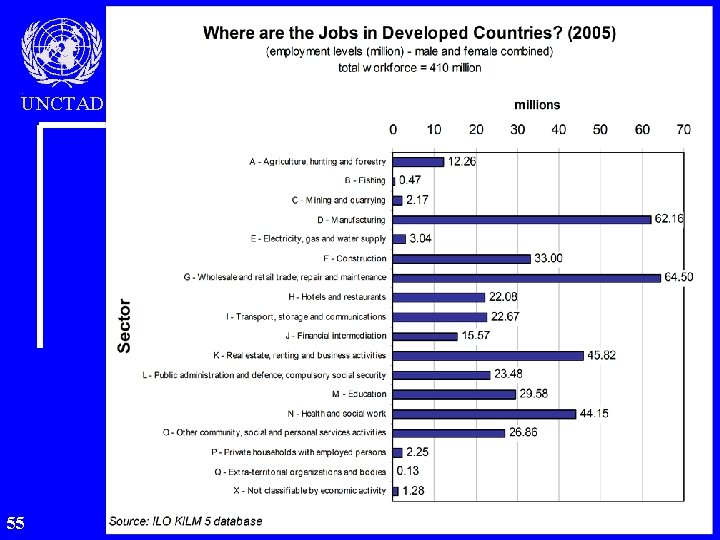
UNCTAD 55 Migration & Development Trade Policy and Migration
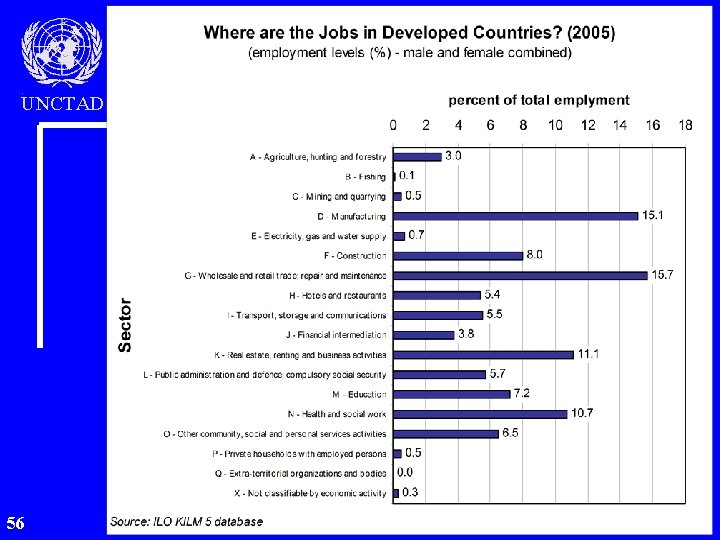
UNCTAD 56 Migration & Development Trade Policy and Migration
UNCTAD 57 Migration & Development Trade Policy and Migration
UNCTAD 58 Migration & Development Trade Policy and Migration
UNCTAD 59 Migration & Development Trade Policy and Migration ~ 4%
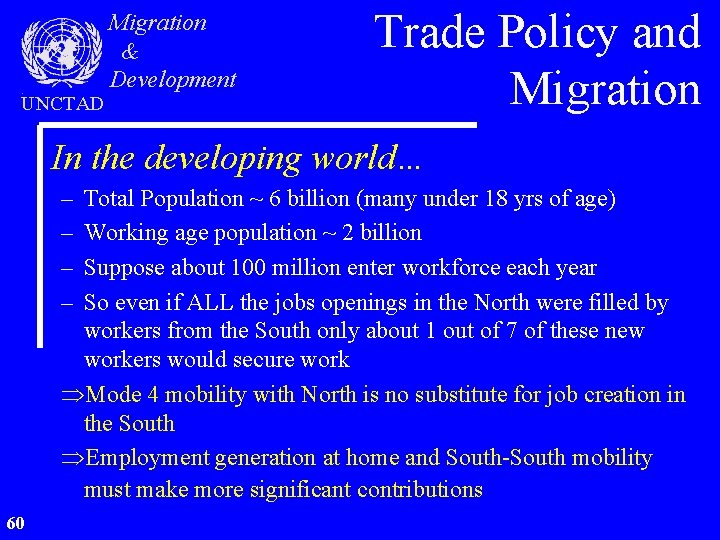
UNCTAD Migration & Development Trade Policy and Migration In the developing world… – – Total Population ~ 6 billion (many under 18 yrs of age) Working age population ~ 2 billion Suppose about 100 million enter workforce each year So even if ALL the jobs openings in the North were filled by workers from the South only about 1 out of 7 of these new workers would secure work ÞMode 4 mobility with North is no substitute for job creation in the South ÞEmployment generation at home and South-South mobility must make more significant contributions 60
UNCTAD Migration & Development Thank you for your attention Email: robert. hamwey@unctad. org 61