
Migration 1 2 3 4 5 6 Short

- Slides: 22
Migration
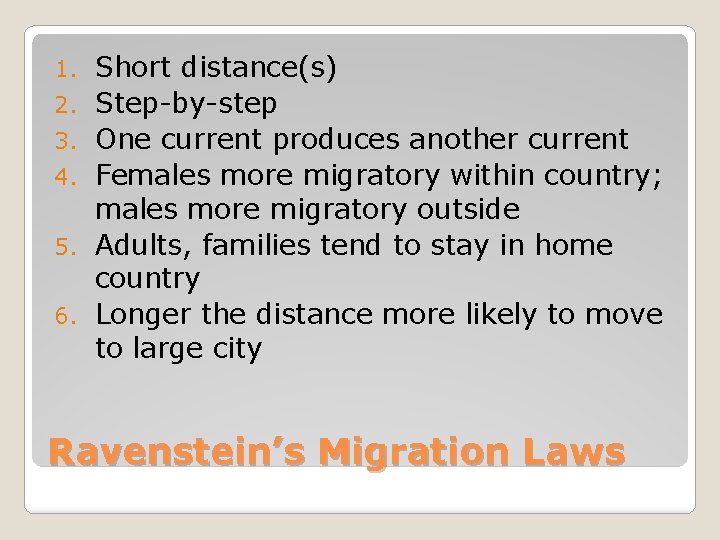
1. 2. 3. 4. 5. 6. Short distance(s) Step-by-step One current produces another current Females more migratory within country; males more migratory outside Adults, families tend to stay in home country Longer the distance more likely to move to large city Ravenstein’s Migration Laws
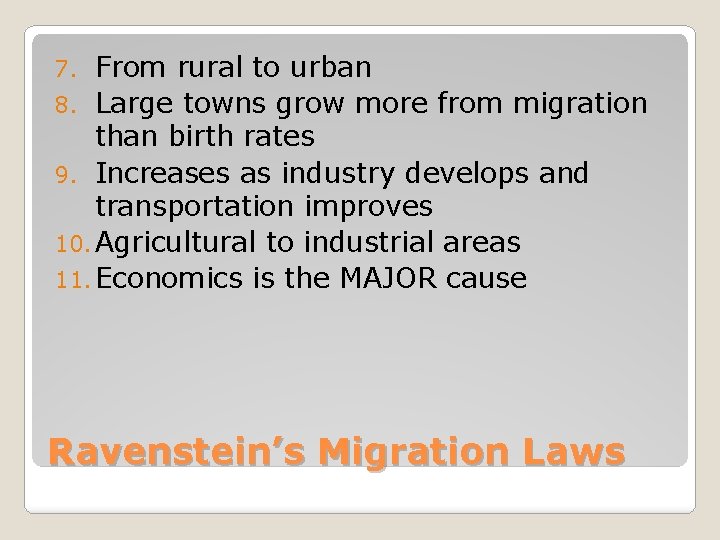
From rural to urban 8. Large towns grow more from migration than birth rates 9. Increases as industry develops and transportation improves 10. Agricultural to industrial areas 11. Economics is the MAJOR cause 7. Ravenstein’s Migration Laws
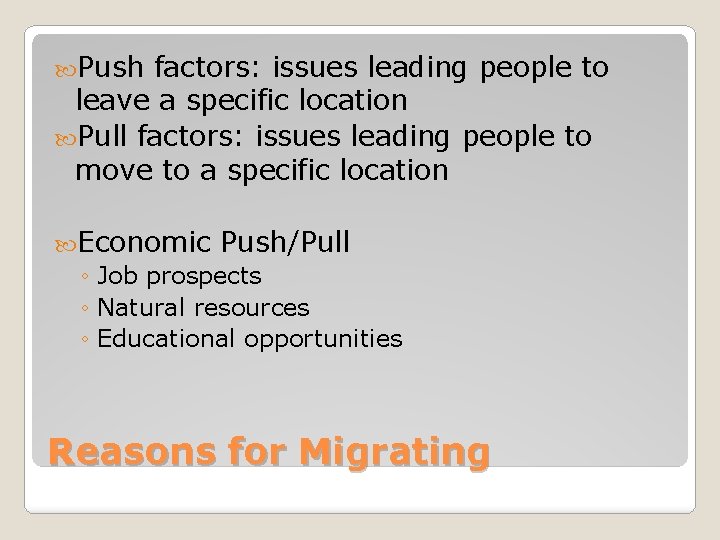
Push factors: issues leading people to leave a specific location Pull factors: issues leading people to move to a specific location Economic Push/Pull ◦ Job prospects ◦ Natural resources ◦ Educational opportunities Reasons for Migrating
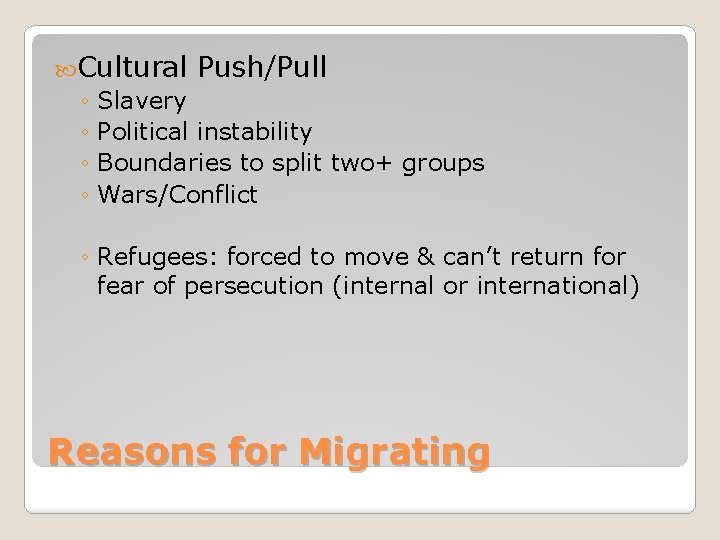
Cultural Push/Pull ◦ Slavery ◦ Political instability ◦ Boundaries to split two+ groups ◦ Wars/Conflict ◦ Refugees: forced to move & can’t return for fear of persecution (internal or international) Reasons for Migrating
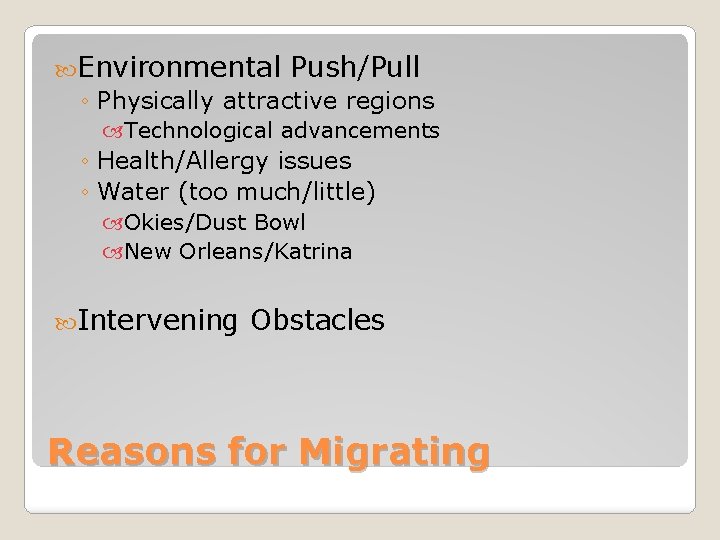
Environmental Push/Pull ◦ Physically attractive regions Technological advancements ◦ Health/Allergy issues ◦ Water (too much/little) Okies/Dust Bowl New Orleans/Katrina Intervening Obstacles Reasons for Migrating
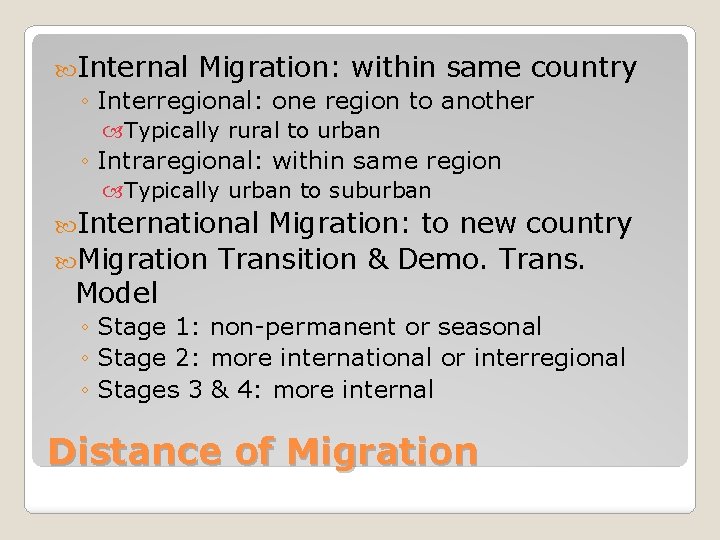
Internal Migration: within same country ◦ Interregional: one region to another Typically rural to urban ◦ Intraregional: within same region Typically urban to suburban International Migration: to new country Migration Transition & Demo. Trans. Model ◦ Stage 1: non-permanent or seasonal ◦ Stage 2: more international or interregional ◦ Stages 3 & 4: more internal Distance of Migration
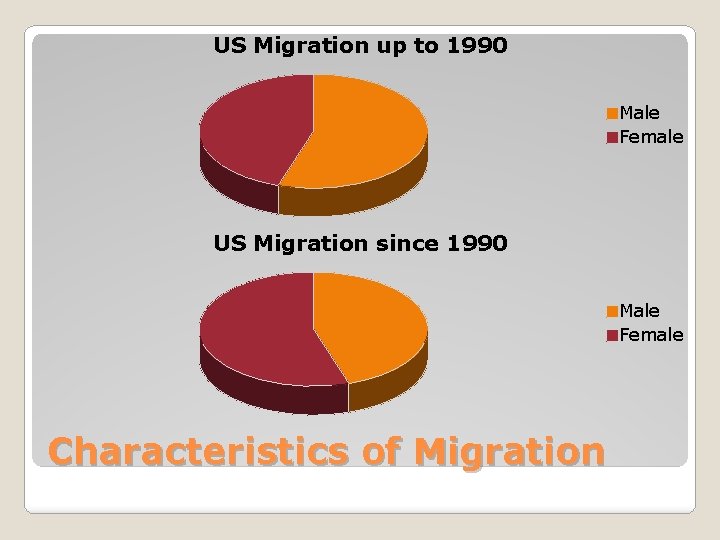
US Migration up to 1990 Male Female US Migration since 1990 Male Female Characteristics of Migration
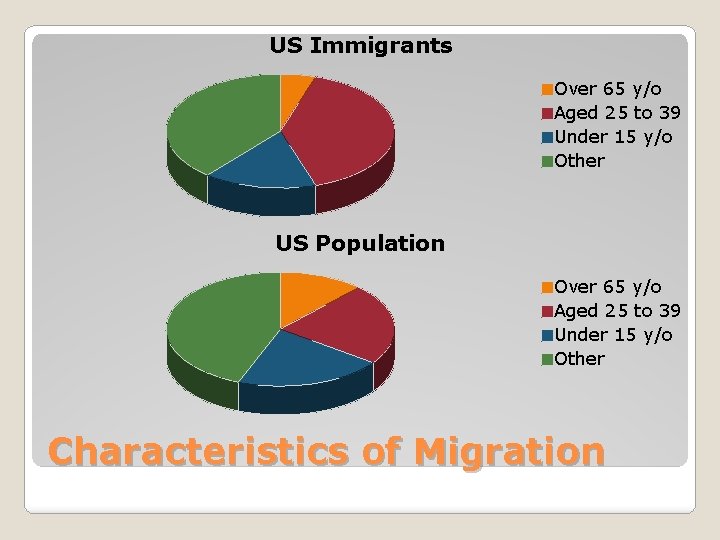
US Immigrants Over 65 y/o Aged 25 to 39 Under 15 y/o Other US Population Over 65 y/o Aged 25 to 39 Under 15 y/o Other Characteristics of Migration
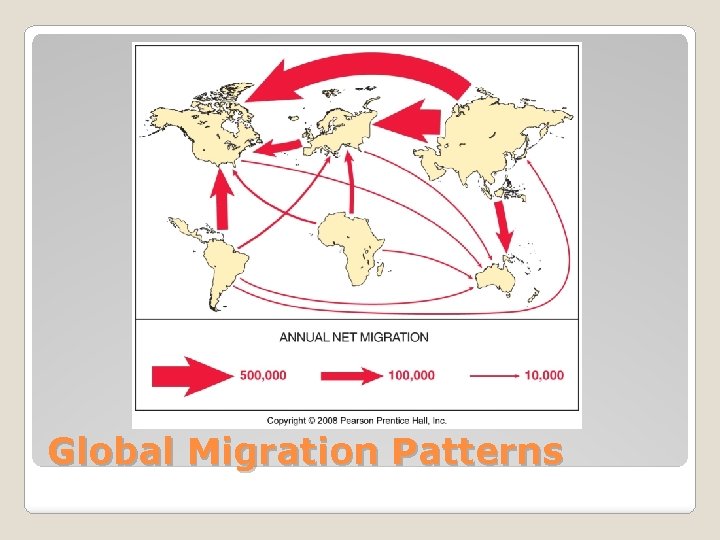
Largest flows: ◦ Asia to Europe ◦ Asia to North America ◦ Latin America to North America Global Migration Patterns
Global Migration Patterns
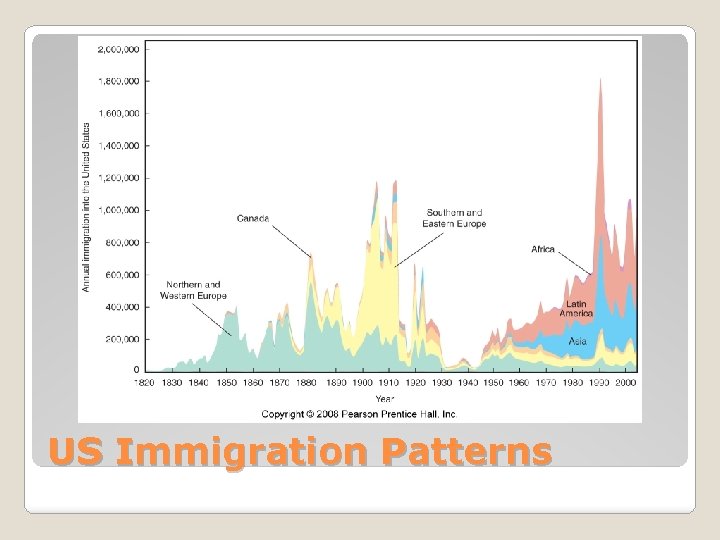
Initial colonization ◦ English/Western Europe and African Mid 1800 s to early 1900 s ◦ German/Irish and East European 1970 s to Present ◦ Latin American and Asian US Immigration Patterns
US Immigration Patterns
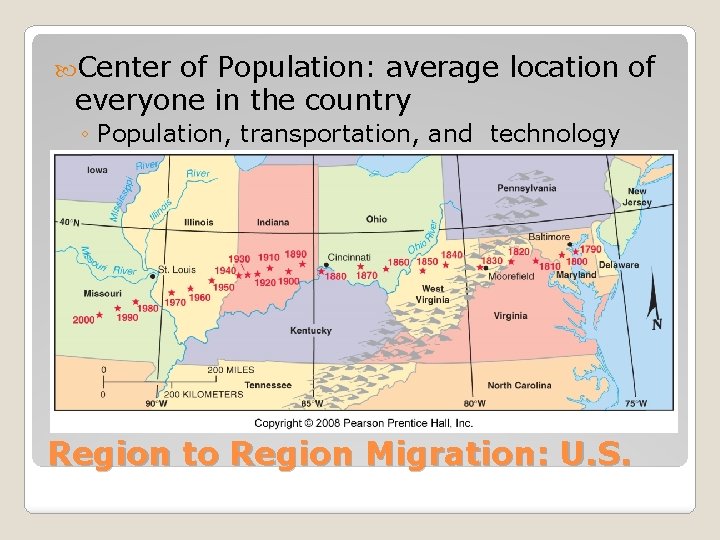
Center of Population: average location of everyone in the country ◦ Population, transportation, and technology Region to Region Migration: U. S.
Est. factories near raw materials rather than existing populations Far North (incl. Siberia) 45% land area but only 2% of population USSR used forced migration and later incentives Komsomol: volunteers on school breaks to help construct projects Today: factories locate wherever Region to Region Migration: Russia
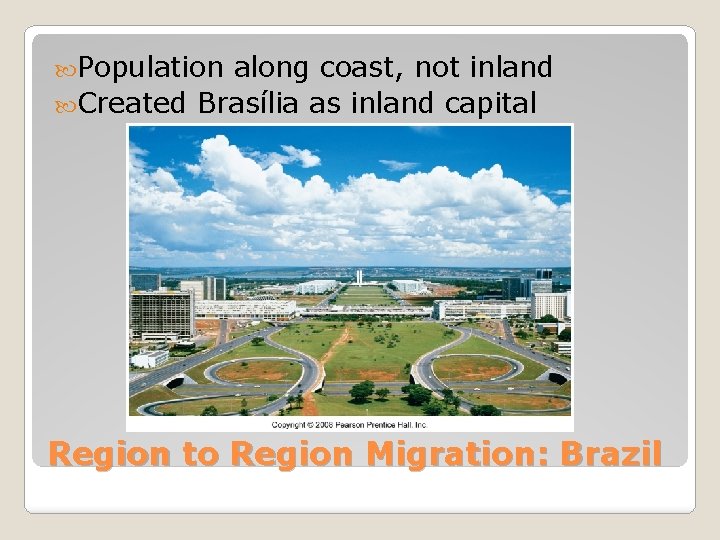
Population along coast, not inland Created Brasília as inland capital Region to Region Migration: Brazil
2/3 of population lived on Java Since 1969, paid 5+ million to move to other islands ◦ 5 acres of land ◦ Materials to build home ◦ Starter seeds ◦ Initial food supplies Little true success Region to Region Migration: Indonesia
Italy: south to north in search of jobs ◦ Unemployment: south 20%, north 5% United Kingdom: north to south ◦ Leaving factory jobs for service jobs Region to Region Migration: Europe
Permit required to migrate to—or even visit—State of Assam ◦ Created during British era ◦ To protect Assamese ethnic minority ◦ Assam borders Bangladesh = international limitations as well Region to Region Migration: India
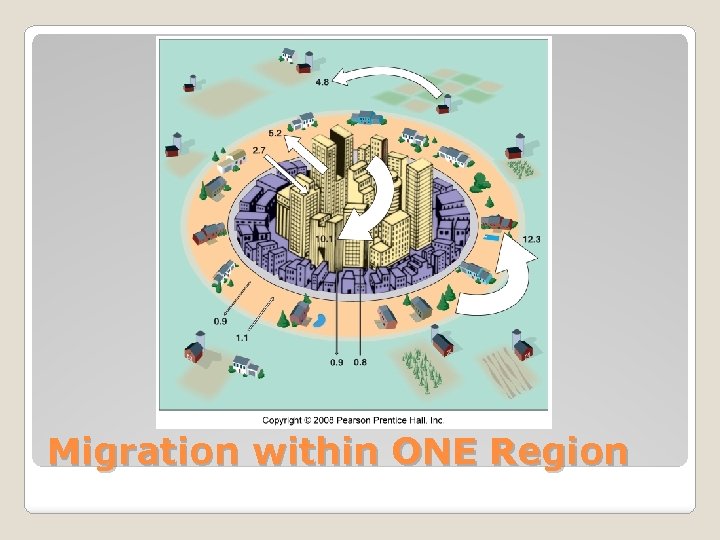
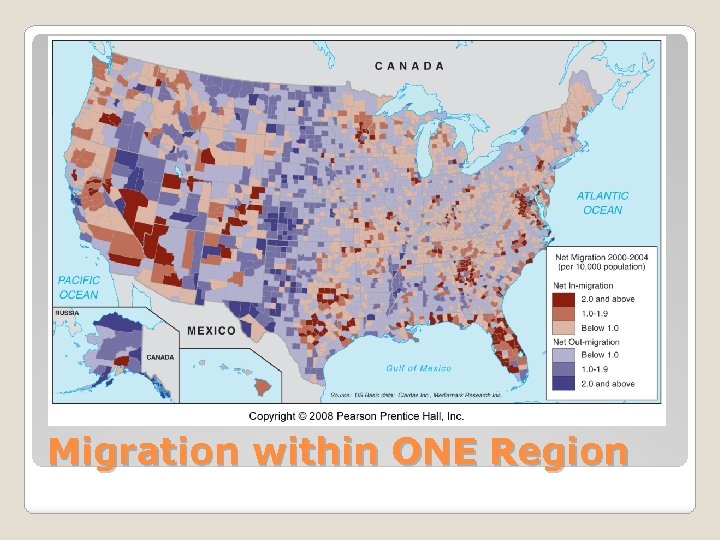
Rural to Urban ◦ U. S. : 1800 -5%, 1920 -50%, Today-75% ◦ Worldwide, 20 million move to urban each year Urban to Suburban ◦ MDC: twice as many move from central city to suburb as from suburb to central city ◦ Not for jobs but for lifestyle Metro to Nonmetro ◦ New trend in MDCs, esp. in retirement ages Migration within ONE Region
Migration within ONE Region
Migration within ONE Region