
Migrating the Core The Evolution of the Backhaul
Migrating the Core The Evolution of the Backhaul Network to Enable Wireless Data Services © 2009 Fujitsu Network Communications
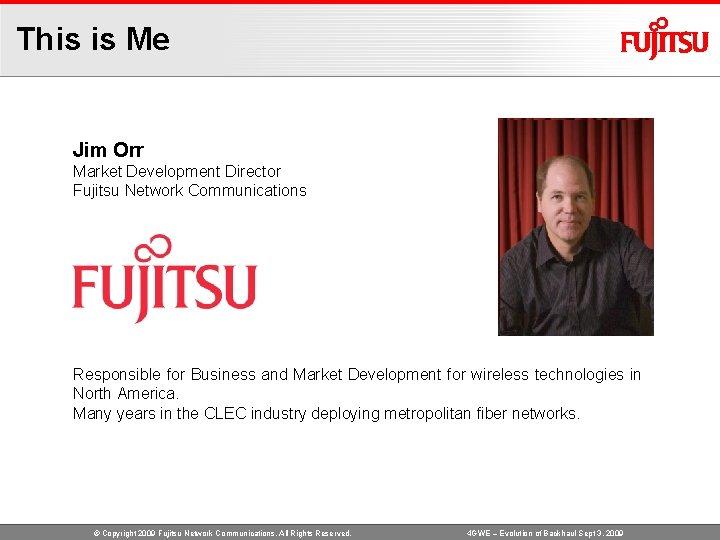
This is Me Jim Orr Market Development Director Fujitsu Network Communications Responsible for Business and Market Development for wireless technologies in North America. Many years in the CLEC industry deploying metropolitan fiber networks. © Copyright 2009 Fujitsu Network Communications. All Rights Reserved. 4 GWE – Evolution of Backhaul Sept 3, 2009
Backhaul – The Boring Part n Backhaul is a necessary evil n Enables revenue, but does not create new revenue (adds to CCPU) © Copyright 2009 Fujitsu Network Communications. All Rights Reserved. 4 GWE – Evolution of Backhaul Sept 3, 2009
Backhaul – There is Not One Answer n Wireless, optical and copper n LECs, CLECs, Cable Cos, Power Companies, etc. n If you as me about a technology, the answer is probably “yes” at least somewhere © Copyright 2009 Fujitsu Network Communications. All Rights Reserved. 4 GWE – Evolution of Backhaul Sept 3, 2009
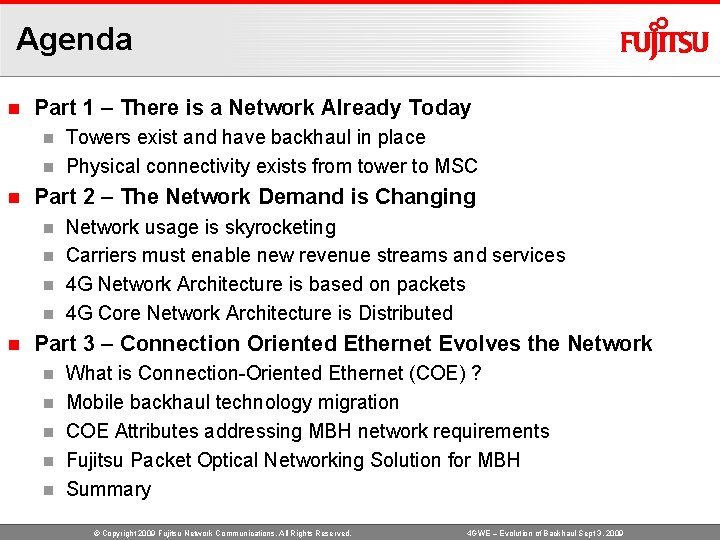
Agenda n Part 1 – There is a Network Already Today Towers exist and have backhaul in place n Physical connectivity exists from tower to MSC n n Part 2 – The Network Demand is Changing Network usage is skyrocketing n Carriers must enable new revenue streams and services n 4 G Network Architecture is based on packets n 4 G Core Network Architecture is Distributed n n Part 3 – Connection Oriented Ethernet Evolves the Network n n n What is Connection-Oriented Ethernet (COE) ? Mobile backhaul technology migration COE Attributes addressing MBH network requirements Fujitsu Packet Optical Networking Solution for MBH Summary © Copyright 2009 Fujitsu Network Communications. All Rights Reserved. 4 GWE – Evolution of Backhaul Sept 3, 2009
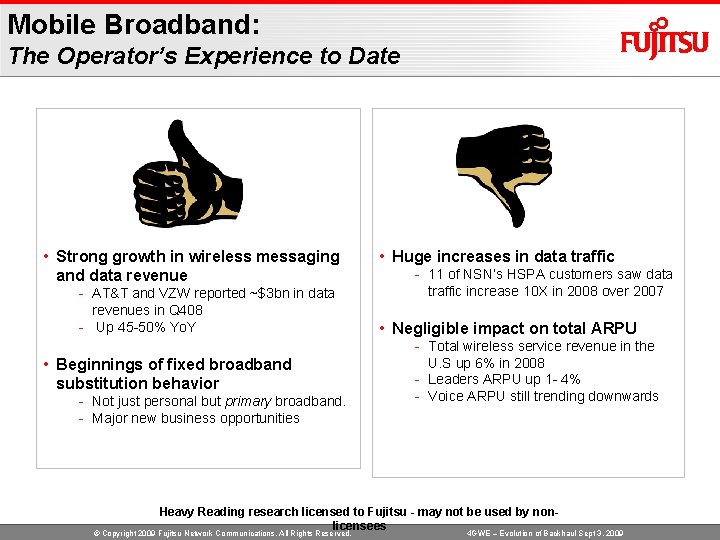
Mobile Broadband: The Operator’s Experience to Date • Strong growth in wireless messaging and data revenue - AT&T and VZW reported ~$3 bn in data revenues in Q 408 - Up 45 -50% Yo. Y • Beginnings of fixed broadband substitution behavior - Not just personal but primary broadband. - Major new business opportunities • Huge increases in data traffic - 11 of NSN’s HSPA customers saw data traffic increase 10 X in 2008 over 2007 • Negligible impact on total ARPU - Total wireless service revenue in the U. S up 6% in 2008 - Leaders ARPU up 1 - 4% - Voice ARPU still trending downwards Heavy Reading research licensed to Fujitsu - may not be used by nonlicensees © Copyright 2009 Fujitsu Network Communications. All Rights Reserved. 4 GWE – Evolution of Backhaul Sept 3, 2009
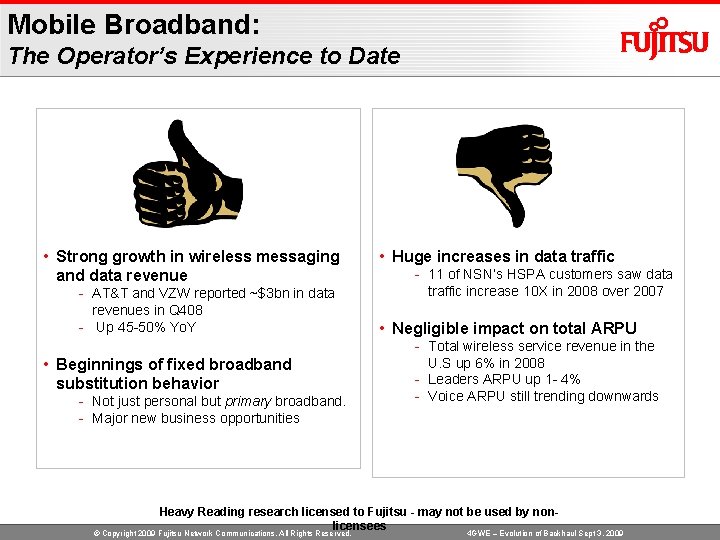
Mobile Broadband: The Operator’s Experience to Date • Strong growth in wireless messaging and data revenue - AT&T and VZW reported ~$3 bn in data revenues in Q 408 - Up 45 -50% Yo. Y • Beginnings of fixed broadband substitution behavior - Not just personal but primary broadband. - Major new business opportunities • Huge increases in data traffic - 11 of NSN’s HSPA customers saw data traffic increase 10 X in 2008 over 2007 • Negligible impact on total ARPU - Total wireless service revenue in the U. S up 6% in 2008 - Leaders ARPU up 1 - 4% - Voice ARPU still trending downwards Heavy Reading research licensed to Fujitsu - may not be used by nonlicensees © Copyright 2009 Fujitsu Network Communications. All Rights Reserved. 4 GWE – Evolution of Backhaul Sept 3, 2009
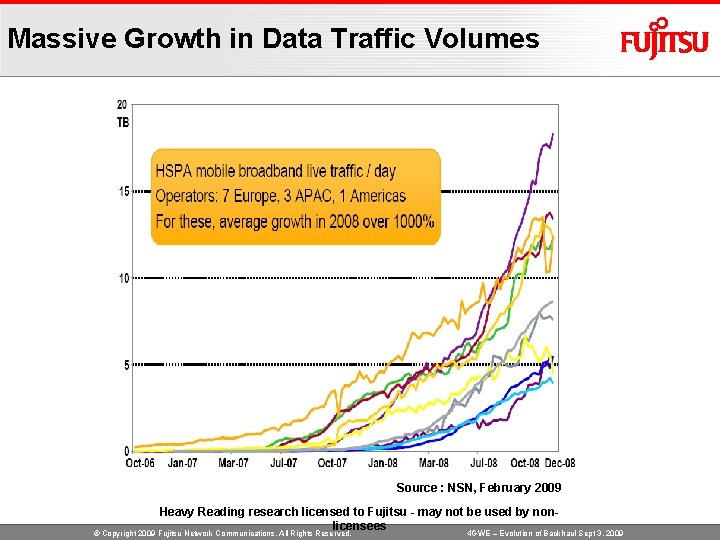
Massive Growth in Data Traffic Volumes Source : NSN, February 2009 Heavy Reading research licensed to Fujitsu - may not be used by nonlicensees © Copyright 2009 Fujitsu Network Communications. All Rights Reserved. 4 GWE – Evolution of Backhaul Sept 3, 2009
Mobile Broadband: In Search of Profitability n Mobile broadband is still in the build-out phase HSPA and EV-DO in 3 rd/4 th year of roll-out n Operators are investing for near term subscriber acquisition and long term transformation of their business models n n Mobile broadband isn’t profitable (yet) In 3 G, voice and data are still mostly discrete network elements n Large majority of new network capex is driven by mobile broadband n If costs are allocated separately to voice and messaging on the one hand, and mobile broadband on the other, mobile broadband isn’t profitable today n Early in the investment cycle, but need to start aligning for profitability n Heavy Reading research licensed to Fujitsu - may not be used by nonlicensees © Copyright 2009 Fujitsu Network Communications. All Rights Reserved. 4 GWE – Evolution of Backhaul Sept 3, 2009
Heavy Reading’s Outlook: 2009 is the year of packet backhaul n Backhaul a key lever in realigning for profitability n Heavy Reading’s packet backhaul forecasts 108, 000 cell sites in live service world-wide by the end of 2009 n 12, 300 in live service in the U. S by the end of 2009 n Forecasts are for packet backhaul in live service at 2 G/3 G cell sites; Wi. MAX sites and ML-PPP implementations excluded n n Still expecting a slow rate at which packet backhaul is turned up to commercial service n Still expect 75% of the world’s cell sites will be served exclusively by TDM backhaul in 2012 Heavy Reading research licensed to Fujitsu - may not be used by nonlicensees © Copyright 2009 Fujitsu Network Communications. All Rights Reserved. 4 GWE – Evolution of Backhaul Sept 3, 2009
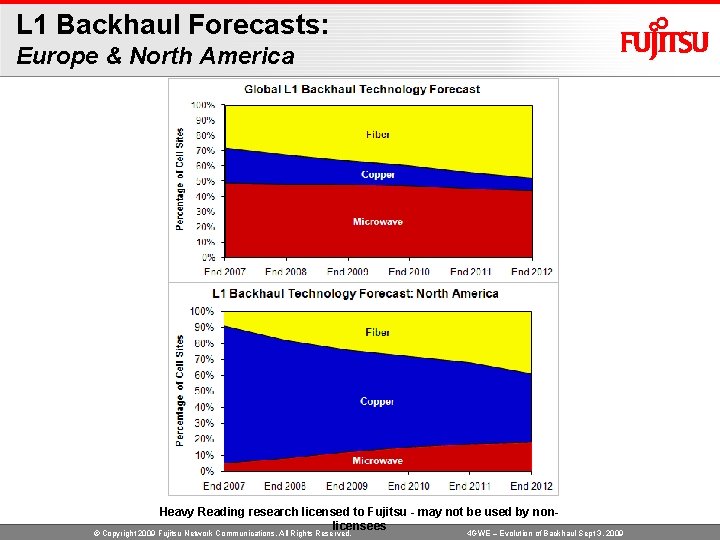
L 1 Backhaul Forecasts: Europe & North America Heavy Reading research licensed to Fujitsu - may not be used by nonlicensees © Copyright 2009 Fujitsu Network Communications. All Rights Reserved. 4 GWE – Evolution of Backhaul Sept 3, 2009
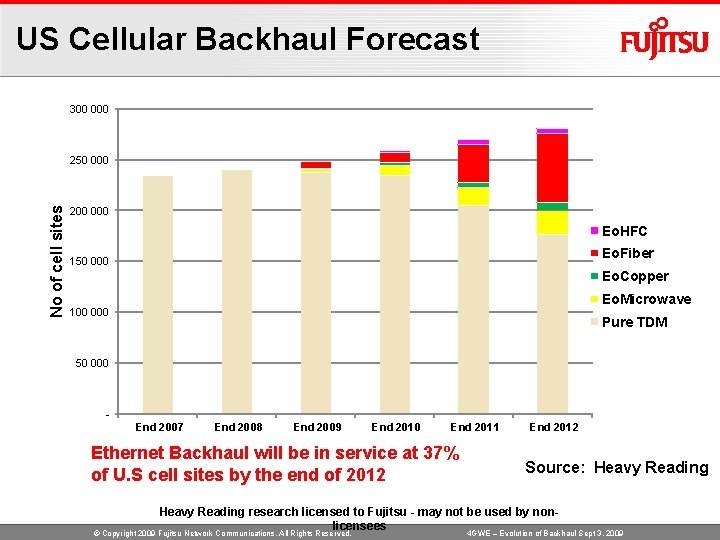
US Cellular Backhaul Forecast 300 000 No of cell sites 250 000 200 000 Eo. HFC Eo. Fiber 150 000 Eo. Copper Eo. Microwave 100 000 Pure TDM 50 000 End 2007 End 2008 End 2009 End 2010 End 2011 Ethernet Backhaul will be in service at 37% of U. S cell sites by the end of 2012 End 2012 Source: Heavy Reading research licensed to Fujitsu - may not be used by nonlicensees © Copyright 2009 Fujitsu Network Communications. All Rights Reserved. 4 GWE – Evolution of Backhaul Sept 3, 2009

Key Backhaul Requirements n Big enough pipe n Correct interfaces n Low latency n Simple n Survivable n Cost effective © Copyright 2009 Fujitsu Network Communications. All Rights Reserved. 4 GWE – Evolution of Backhaul Sept 3, 2009

Wireless Impacts on Backhaul n BIG problem from tower to wire center n Moving from 3 Mb to 100+Mb n Maybe 12 sites/wire center for a total of about 1 Gb n SMALL amount of the traffic after that first wire center n Even small wire centers generate several 10 Gb circuits n Wireless will add 10% at most to the existing network © Copyright 2009 Fujitsu Network Communications. All Rights Reserved. 4 GWE – Evolution of Backhaul Sept 3, 2009
A Backhaul Network Exists n All of these towers are connected to the other components of the network Physical network deployed n Considerable capital value remains on the books n 4 G deployments are not going to generate a total replacement of all of the existing network n Leased facilities exist for the 2 G T 1 s n Average of 7 actual orders to create a T 1 circuit from a cell tower to the MSC n 7 to disconnect n 12 to move a circuit n Large opportunity cost to groom existing T 1 s n © Copyright 2009 Fujitsu Network Communications. All Rights Reserved. 4 GWE – Evolution of Backhaul Sept 3, 2009
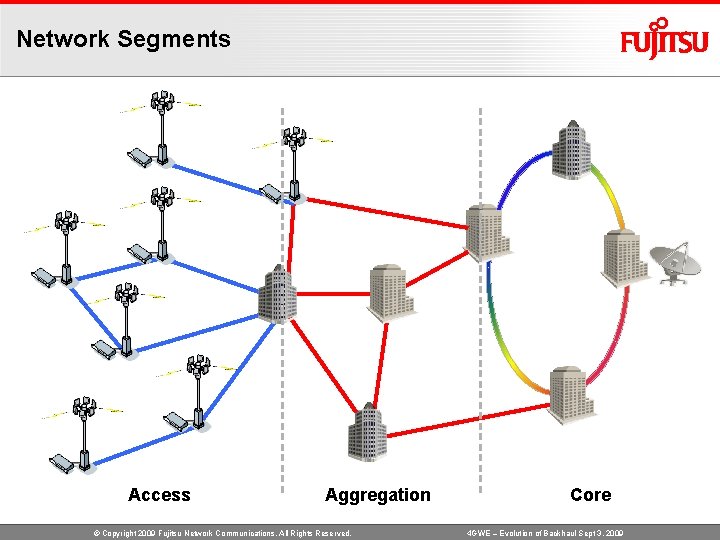
Network Segments Access Aggregation © Copyright 2009 Fujitsu Network Communications. All Rights Reserved. Core 4 GWE – Evolution of Backhaul Sept 3, 2009
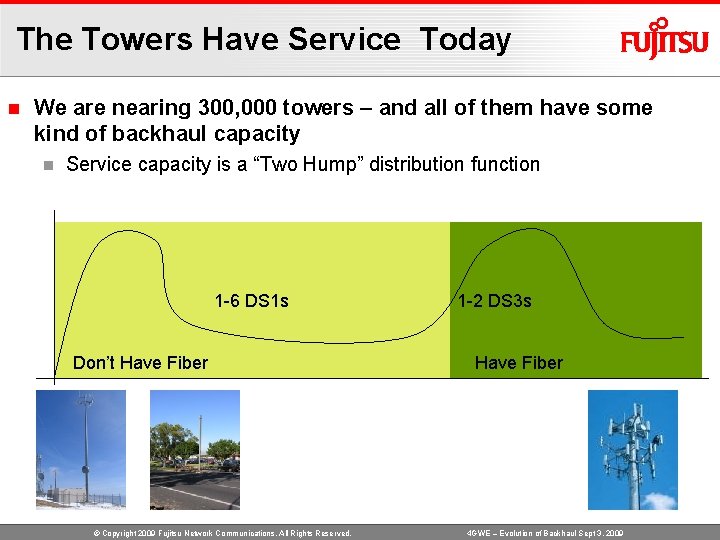
The Towers Have Service Today n We are nearing 300, 000 towers – and all of them have some kind of backhaul capacity n Service capacity is a “Two Hump” distribution function 1 -6 DS 1 s Don’t Have Fiber © Copyright 2009 Fujitsu Network Communications. All Rights Reserved. 1 -2 DS 3 s Have Fiber 4 GWE – Evolution of Backhaul Sept 3, 2009
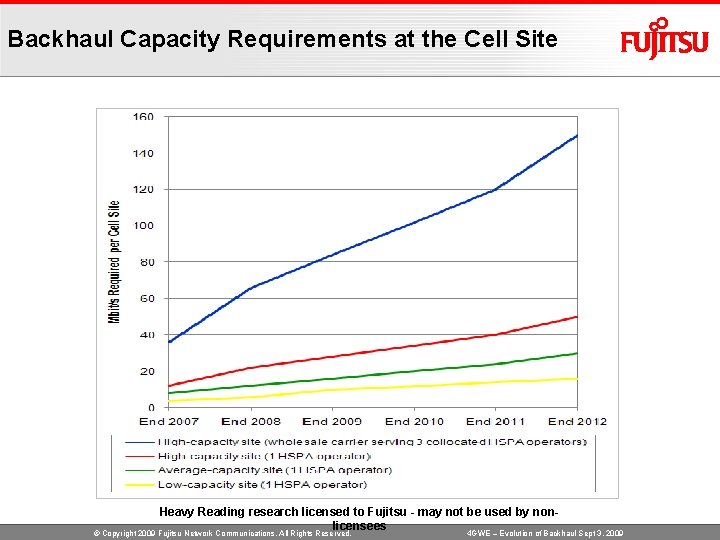
Backhaul Capacity Requirements at the Cell Site Heavy Reading research licensed to Fujitsu - may not be used by nonlicensees © Copyright 2009 Fujitsu Network Communications. All Rights Reserved. 4 GWE – Evolution of Backhaul Sept 3, 2009
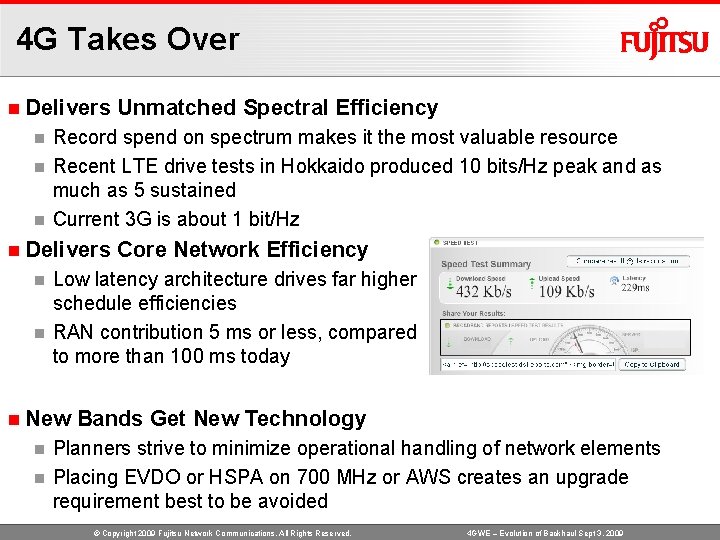
4 G Takes Over n Delivers Unmatched Spectral Efficiency Record spend on spectrum makes it the most valuable resource n Recent LTE drive tests in Hokkaido produced 10 bits/Hz peak and as much as 5 sustained n Current 3 G is about 1 bit/Hz n n Delivers Core Network Efficiency Low latency architecture drives far higher schedule efficiencies n RAN contribution 5 ms or less, compared to more than 100 ms today n n New Bands Get New Technology Planners strive to minimize operational handling of network elements n Placing EVDO or HSPA on 700 MHz or AWS creates an upgrade requirement best to be avoided n © Copyright 2009 Fujitsu Network Communications. All Rights Reserved. 4 GWE – Evolution of Backhaul Sept 3, 2009
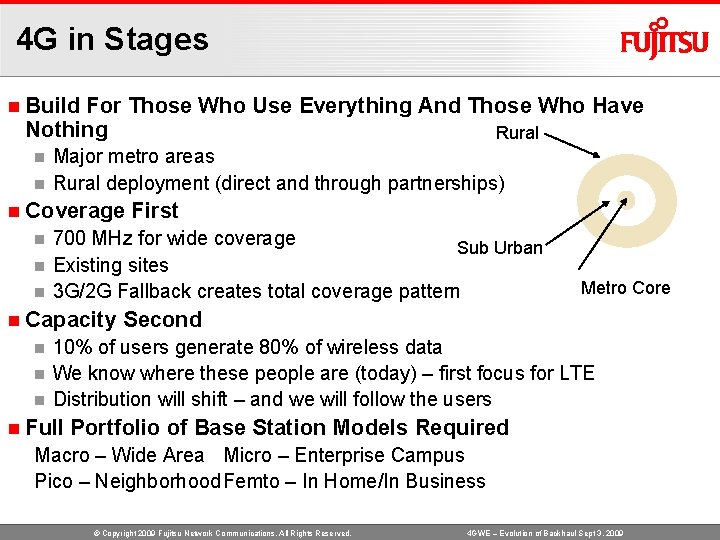
4 G in Stages n Build For Those Who Use Everything And Those Who Have Nothing Rural Major metro areas n Rural deployment (direct and through partnerships) n n Coverage First 700 MHz for wide coverage Sub Urban n Existing sites n 3 G/2 G Fallback creates total coverage pattern n n Capacity Metro Core Second 10% of users generate 80% of wireless data n We know where these people are (today) – first focus for LTE n Distribution will shift – and we will follow the users n n Full Portfolio of Base Station Models Required Macro – Wide Area Micro – Enterprise Campus Pico – Neighborhood Femto – In Home/In Business © Copyright 2009 Fujitsu Network Communications. All Rights Reserved. 4 GWE – Evolution of Backhaul Sept 3, 2009
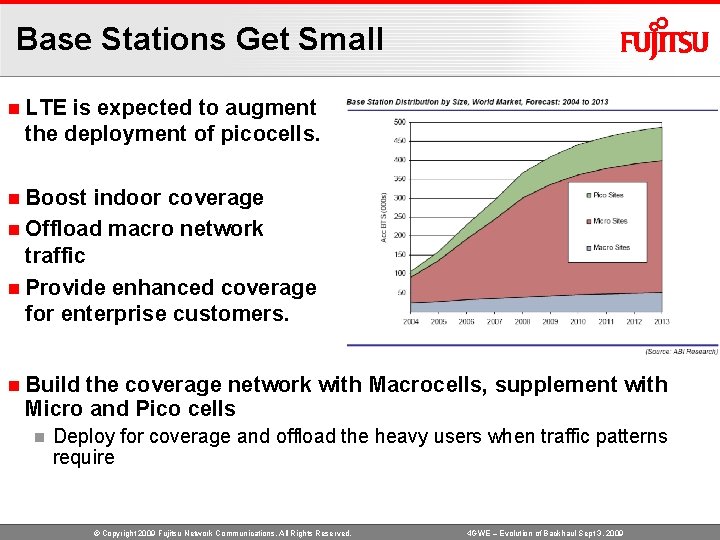
Base Stations Get Small n LTE is expected to augment the deployment of picocells. n Boost indoor coverage n Offload macro network traffic n Provide enhanced coverage for enterprise customers. n Build the coverage network with Macrocells, supplement with Micro and Pico cells n Deploy for coverage and offload the heavy users when traffic patterns require © Copyright 2009 Fujitsu Network Communications. All Rights Reserved. 4 GWE – Evolution of Backhaul Sept 3, 2009
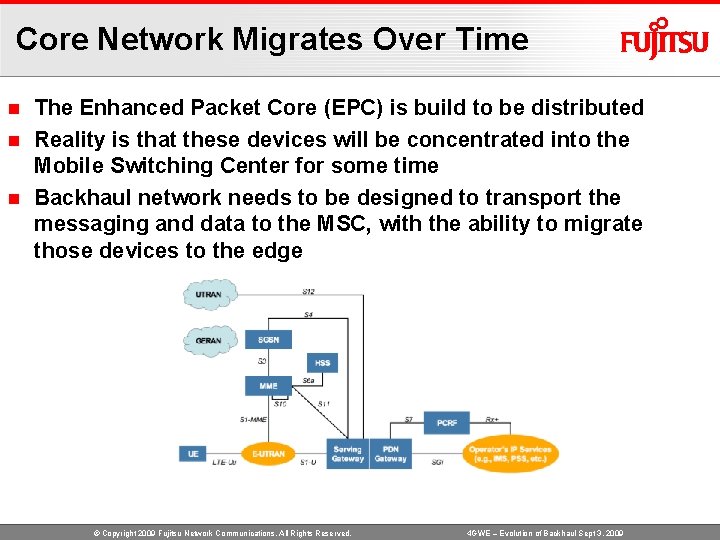
Core Network Migrates Over Time The Enhanced Packet Core (EPC) is build to be distributed n Reality is that these devices will be concentrated into the Mobile Switching Center for some time n Backhaul network needs to be designed to transport the messaging and data to the MSC, with the ability to migrate those devices to the edge n © Copyright 2009 Fujitsu Network Communications. All Rights Reserved. 4 GWE – Evolution of Backhaul Sept 3, 2009
Migrate with Circuit Oriented Ethernet © Copyright 2009 Fujitsu Network Communications. All Rights Reserved. 4 GWE – Evolution of Backhaul Sept 3, 2009
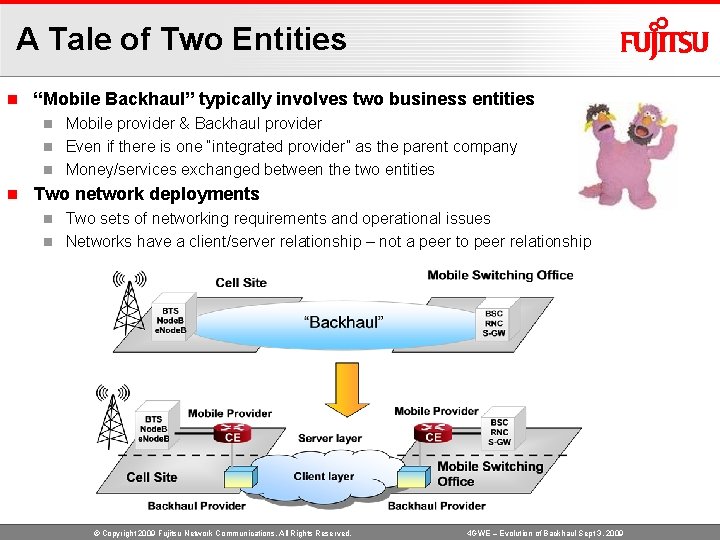
A Tale of Two Entities n “Mobile Backhaul” typically involves two business entities Mobile provider & Backhaul provider n Even if there is one “integrated provider” as the parent company n Money/services exchanged between the two entities n n Two network deployments Two sets of networking requirements and operational issues n Networks have a client/server relationship – not a peer to peer relationship n © Copyright 2009 Fujitsu Network Communications. All Rights Reserved. 4 GWE – Evolution of Backhaul Sept 3, 2009
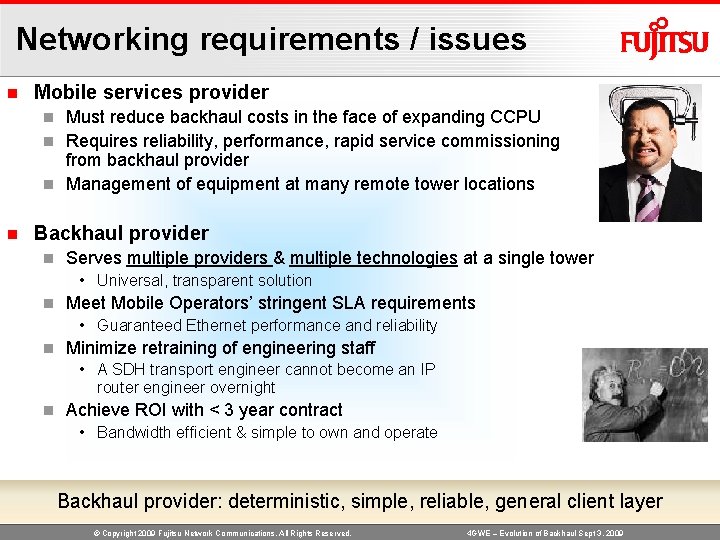
Networking requirements / issues n Mobile services provider Must reduce backhaul costs in the face of expanding CCPU n Requires reliability, performance, rapid service commissioning from backhaul provider n Management of equipment at many remote tower locations n n Backhaul provider n Serves multiple providers & multiple technologies at a single tower • Universal, transparent solution n Meet Mobile Operators’ stringent SLA requirements • Guaranteed Ethernet performance and reliability n Minimize retraining of engineering staff • A SDH transport engineer cannot become an IP router engineer overnight n Achieve ROI with < 3 year contract • Bandwidth efficient & simple to own and operate Backhaul provider: deterministic, simple, reliable, general client layer © Copyright 2009 Fujitsu Network Communications. All Rights Reserved. 4 GWE – Evolution of Backhaul Sept 3, 2009
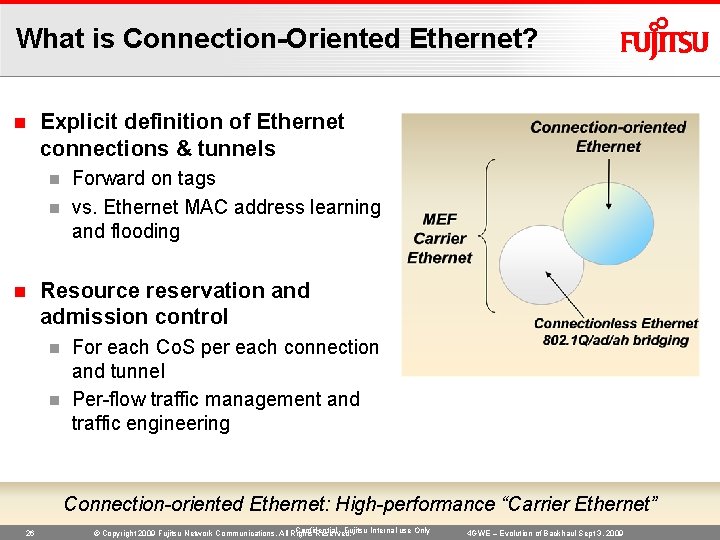
What is Connection-Oriented Ethernet? n Explicit definition of Ethernet connections & tunnels Forward on tags n vs. Ethernet MAC address learning and flooding n n Resource reservation and admission control For each Co. S per each connection and tunnel n Per-flow traffic management and traffic engineering n Connection-oriented Ethernet: High-performance “Carrier Ethernet” 26 Confidential - Fujitsu Internal use Only © Copyright 2009 Fujitsu Network Communications. All Rights Reserved. 4 GWE – Evolution of Backhaul Sept 3, 2009
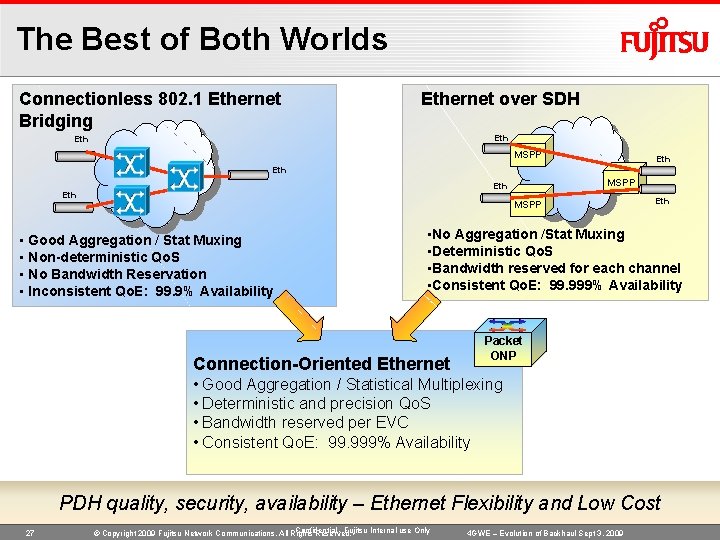
The Best of Both Worlds Connectionless 802. 1 Ethernet Bridging Ethernet over SDH Eth Eth MSPP • Good Aggregation / Stat Muxing • Non-deterministic Qo. S • No Bandwidth Reservation • Inconsistent Qo. E: 99. 9% Availability Eth • No Aggregation /Stat Muxing • Deterministic Qo. S • Bandwidth reserved for each channel • Consistent Qo. E: 99. 999% Availability Connection-Oriented Ethernet Packet ONP • Good Aggregation / Statistical Multiplexing • Deterministic and precision Qo. S • Bandwidth reserved per EVC • Consistent Qo. E: 99. 999% Availability PDH quality, security, availability – Ethernet Flexibility and Low Cost 27 Confidential - Fujitsu Internal use Only © Copyright 2009 Fujitsu Network Communications. All Rights Reserved. 4 GWE – Evolution of Backhaul Sept 3, 2009
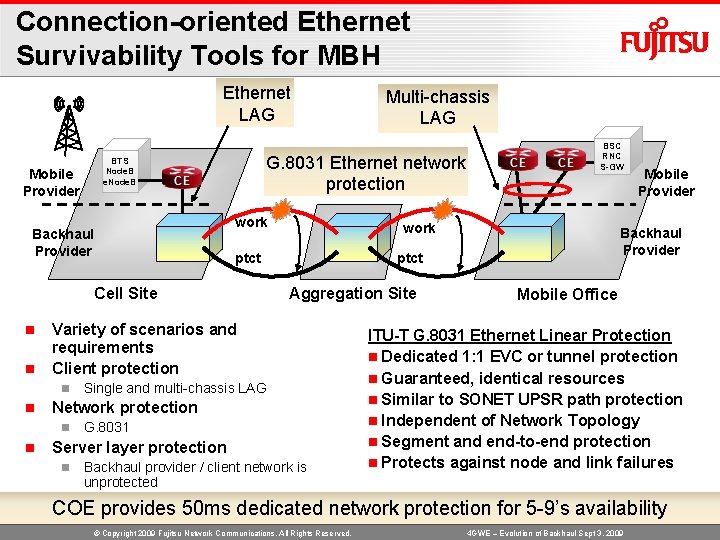
Connection-oriented Ethernet Survivability Tools for MBH Ethernet LAG G. 8031 Ethernet network protection BTS Node. B e. Node. B Mobile Provider work Backhaul Provider n n Single and multi-chassis LAG Network protection n n Aggregation Site G. 8031 Server layer protection n Backhaul provider / client network is unprotected Mobile Provider Backhaul Provider ptct Variety of scenarios and requirements Client protection n BSC RNC S-GW work ptct Cell Site n Multi-chassis LAG Mobile Office ITU-T G. 8031 Ethernet Linear Protection n Dedicated 1: 1 EVC or tunnel protection n Guaranteed, identical resources n Similar to SONET UPSR path protection n Independent of Network Topology n Segment and end-to-end protection n Protects against node and link failures COE provides 50 ms dedicated network protection for 5 -9’s availability © Copyright 2009 Fujitsu Network Communications. All Rights Reserved. 4 GWE – Evolution of Backhaul Sept 3, 2009
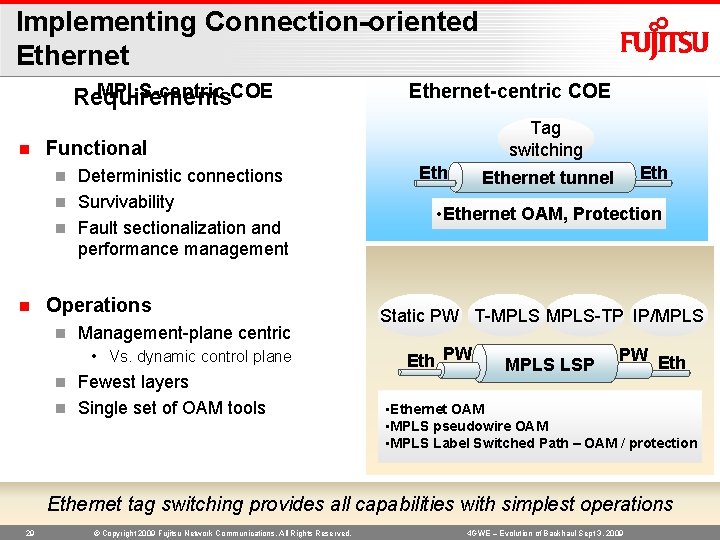
Implementing Connection-oriented Ethernet MPLS-centric COE Requirements n Tag switching Functional Deterministic connections n Survivability n Fault sectionalization and performance management n n Ethernet-centric COE Operations n Management-plane centric • Vs. dynamic control plane Fewest layers n Single set of OAM tools n Eth Ethernet tunnel • Ethernet OAM, Protection Static PW T-MPLS-TP IP/MPLS Eth PW MPLS LSP PW Eth • Ethernet OAM • MPLS pseudowire OAM • MPLS Label Switched Path – OAM / protection Ethernet tag switching provides all capabilities with simplest operations 29 © Copyright 2009 Fujitsu Network Communications. All Rights Reserved. 4 GWE – Evolution of Backhaul Sept 3, 2009
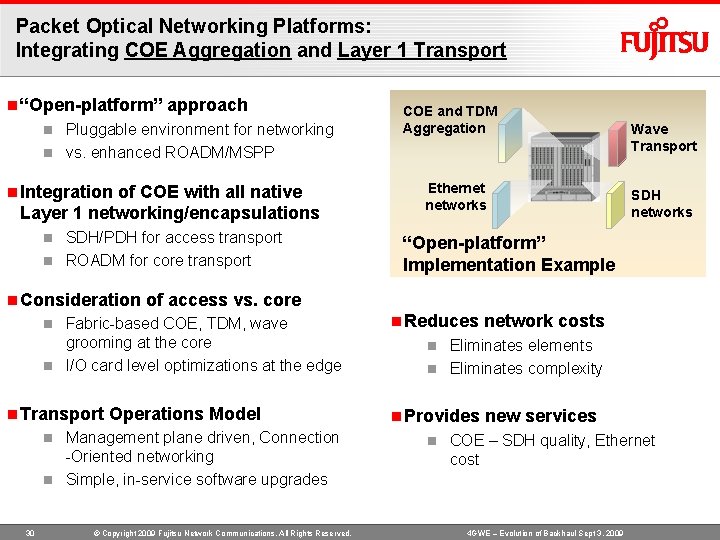
Packet Optical Networking Platforms: Integrating COE Aggregation and Layer 1 Transport n “Open-platform” approach Pluggable environment for networking n vs. enhanced ROADM/MSPP n n Integration of COE with all native Layer 1 networking/encapsulations SDH/PDH for access transport n ROADM for core transport n n Consideration Fabric-based COE, TDM, wave grooming at the core n I/O card level optimizations at the edge Operations Model Management plane driven, Connection -Oriented networking n Simple, in-service software upgrades n 30 Ethernet networks Wave Transport SDH networks “Open-platform” Implementation Example of access vs. core n n Transport COE and TDM Aggregation © Copyright 2009 Fujitsu Network Communications. All Rights Reserved. n Reduces network costs Eliminates elements n Eliminates complexity n n Provides n new services COE – SDH quality, Ethernet cost 4 GWE – Evolution of Backhaul Sept 3, 2009
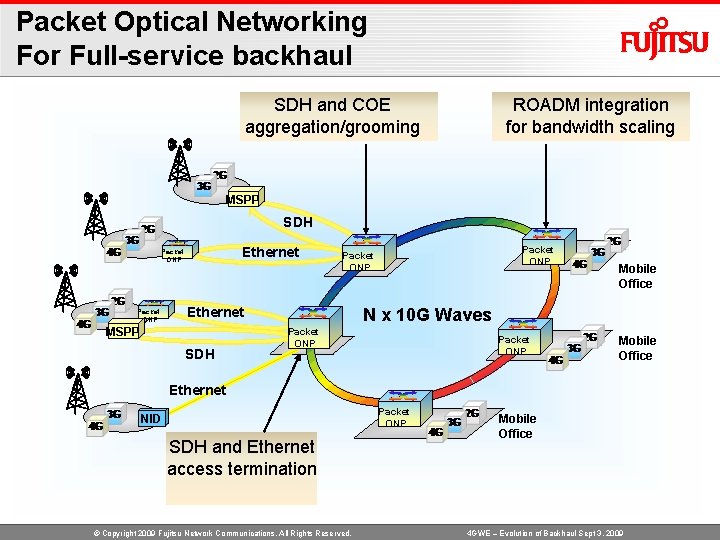
Packet Optical Networking For Full-service backhaul SDH and COE aggregation/grooming ROADM integration for bandwidth scaling MSPP SDH Ethernet Packet ONP Ethernet MSPP SDH Packet ONP Mobile Office N x 10 G Waves Packet ONP Mobile Office Ethernet Packet ONP NID SDH and Ethernet access termination © Copyright 2009 Fujitsu Network Communications. All Rights Reserved. Mobile Office 4 GWE – Evolution of Backhaul Sept 3, 2009
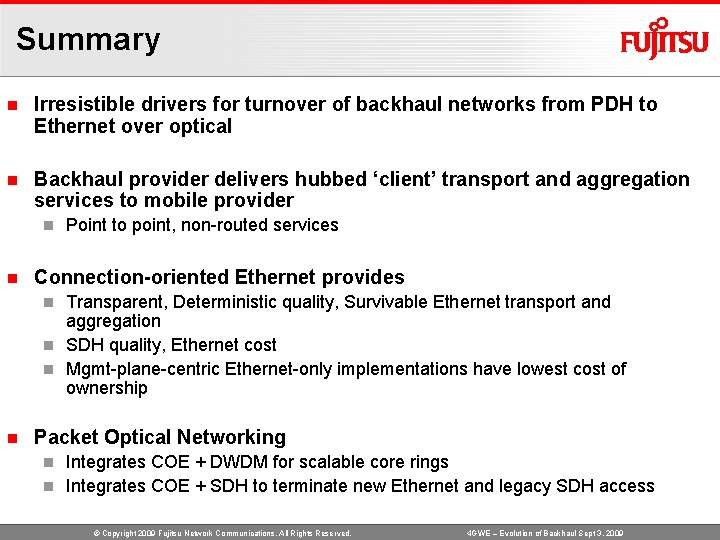
Summary n Irresistible drivers for turnover of backhaul networks from PDH to Ethernet over optical n Backhaul provider delivers hubbed ‘client’ transport and aggregation services to mobile provider n n Point to point, non-routed services Connection-oriented Ethernet provides Transparent, Deterministic quality, Survivable Ethernet transport and aggregation n SDH quality, Ethernet cost n Mgmt-plane-centric Ethernet-only implementations have lowest cost of ownership n n Packet Optical Networking Integrates COE + DWDM for scalable core rings n Integrates COE + SDH to terminate new Ethernet and legacy SDH access n © Copyright 2009 Fujitsu Network Communications. All Rights Reserved. 4 GWE – Evolution of Backhaul Sept 3, 2009
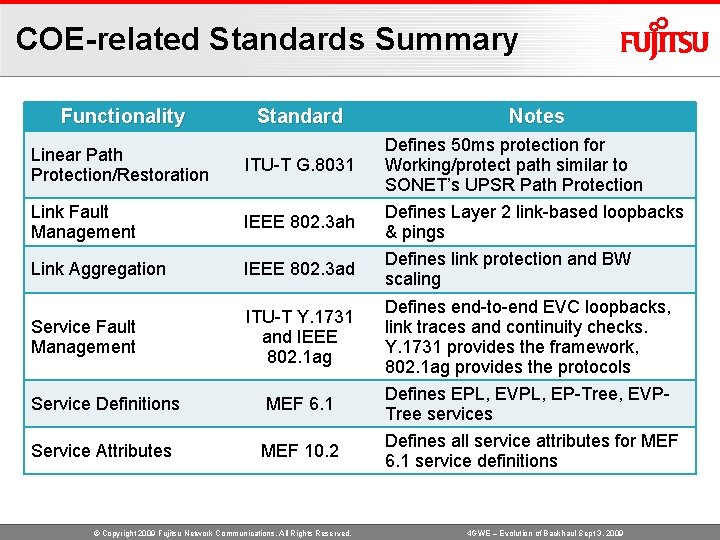
COE-related Standards Summary Functionality Standard Notes Linear Path Protection/Restoration ITU-T G. 8031 Defines 50 ms protection for Working/protect path similar to SONET’s UPSR Path Protection Link Fault Management IEEE 802. 3 ah Defines Layer 2 link-based loopbacks & pings Link Aggregation IEEE 802. 3 ad Defines link protection and BW scaling Service Fault Management ITU-T Y. 1731 and IEEE 802. 1 ag Defines end-to-end EVC loopbacks, link traces and continuity checks. Y. 1731 provides the framework, 802. 1 ag provides the protocols Service Definitions MEF 6. 1 Defines EPL, EVPL, EP-Tree, EVPTree services Service Attributes MEF 10. 2 Defines all service attributes for MEF 6. 1 service definitions © Copyright 2009 Fujitsu Network Communications. All Rights Reserved. 4 GWE – Evolution of Backhaul Sept 3, 2009
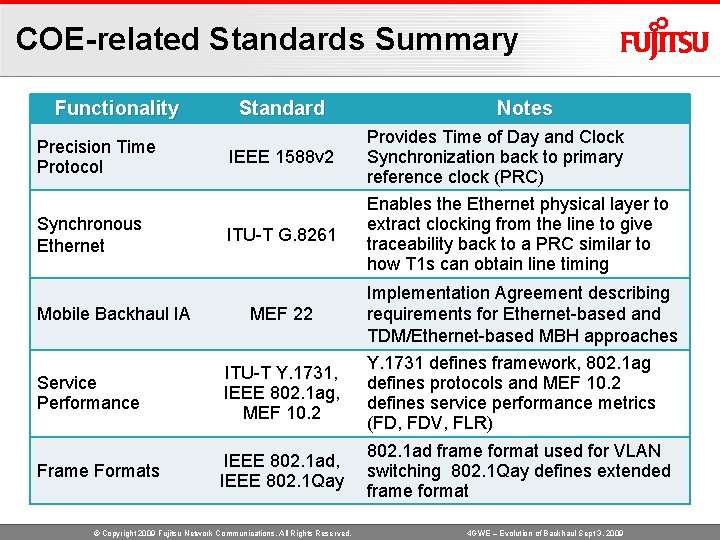
COE-related Standards Summary Functionality Precision Time Protocol Synchronous Ethernet Mobile Backhaul IA Standard Notes IEEE 1588 v 2 Provides Time of Day and Clock Synchronization back to primary reference clock (PRC) ITU-T G. 8261 Enables the Ethernet physical layer to extract clocking from the line to give traceability back to a PRC similar to how T 1 s can obtain line timing MEF 22 Implementation Agreement describing requirements for Ethernet-based and TDM/Ethernet-based MBH approaches Service Performance ITU-T Y. 1731, IEEE 802. 1 ag, MEF 10. 2 Y. 1731 defines framework, 802. 1 ag defines protocols and MEF 10. 2 defines service performance metrics (FD, FDV, FLR) Frame Formats IEEE 802. 1 ad, IEEE 802. 1 Qay 802. 1 ad frame format used for VLAN switching 802. 1 Qay defines extended frame format © Copyright 2009 Fujitsu Network Communications. All Rights Reserved. 4 GWE – Evolution of Backhaul Sept 3, 2009
Q&A © Copyright 2009 Fujitsu Network Communications. All Rights Reserved. 4 GWE – Evolution of Backhaul Sept 3, 2009

© Copyright 2009 Fujitsu Network Communications. All Rights Reserved. 4 GWE – Evolution of Backhaul Sept 3, 2009
What Drives Cell Site Connectivity n Meet Requirements with COE (Connection Oriented Ethernet) Operationally simple n Ethernet connectivity network not where it needs to be, yet n Purely from a connectivity model perspective, all that is required within the backhaul/transport network are simple Layer-2 P 2 P connections between the various elements (e. NBs, MMEs and S-GWs. . ) n n Carriers Planning for 100 Mbps to each cell site Not just the Macro sites n Micro and Pico sites are driven by capacity n Smaller e. Node. B will drive DAS (Distributed Antenna System) to concentrate data traffic n © Copyright 2009 Fujitsu Network Communications. All Rights Reserved. 4 GWE – Evolution of Backhaul Sept 3, 2009
Mobile Backhaul Business Drivers Challenges facing Mobile Operators n Data rate grows with 3 G and beyond but revenue doesn’t follow n n Network Operations n n How do you ensure backhaul network provides uninterrupted service to millions of subscribers served by 50, 000+ cell towers ? What if LTE ubiquity makes it the “mobile Wi-Fi” ? n n n Flat rate data plans Integrated into wide range of devices. Applications run “in the cloud”. Backhaul networks must be ultra available with predictable Qo. S Number of years to upgrade all cell towers with new backhaul technology n Tremendous pressure to make the right choice while achieving ROI/margin objectives Many business issues affect technology selection © Copyright 2009 Fujitsu Network Communications. All Rights Reserved. 4 GWE – Evolution of Backhaul Sept 3, 2009
Challenges facing Mobile Backhaul Providers n Retraining of network operations personnel n n A SONET transport engineer cannot become an IP router engineer overnight Which technology do I pick given the eventual migration to Ethernet for MBH ? Should I use Ethernet with Circuit Emulation? n Should I use an integrated SONET/Ethernet/ROADM packet optical networking approach ? n n < 3 year service contracts with mobile operators n n How can I make an acceptable ROI to meet margins objectives ? How can I meet Mobile Operators’ stringent SLA requirements ? n < 5 ms Delay, < 1 ms Jitter, 3 x 10 -7 Loss, 5 x 9 s Availability Introducing Connection-oriented Ethernet for Mobile Backhaul. . © Copyright 2009 Fujitsu Network Communications. All Rights Reserved. 4 GWE – Evolution of Backhaul Sept 3, 2009
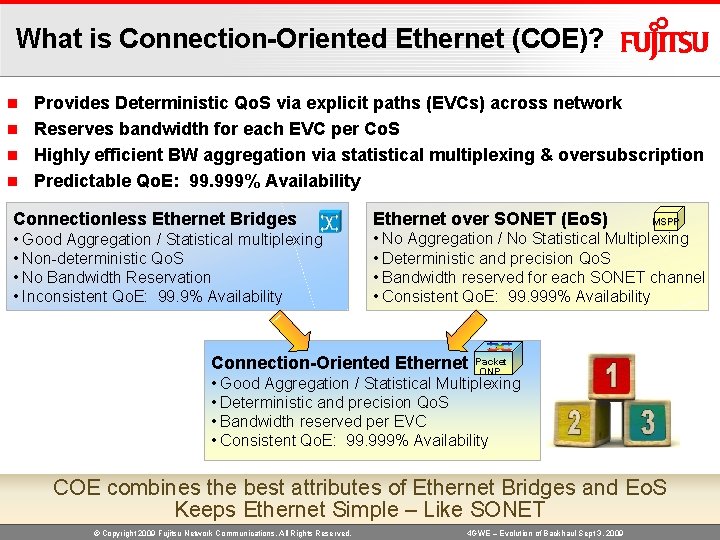
What is Connection-Oriented Ethernet (COE)? Provides Deterministic Qo. S via explicit paths (EVCs) across network n Reserves bandwidth for each EVC per Co. S n Highly efficient BW aggregation via statistical multiplexing & oversubscription n Predictable Qo. E: 99. 999% Availability n Connectionless Ethernet Bridges Ethernet over SONET (Eo. S) • Good Aggregation / Statistical multiplexing • Non-deterministic Qo. S • No Bandwidth Reservation • Inconsistent Qo. E: 99. 9% Availability • No Aggregation / No Statistical Multiplexing • Deterministic and precision Qo. S • Bandwidth reserved for each SONET channel • Consistent Qo. E: 99. 999% Availability Connection-Oriented Ethernet MSPP Packet ONP • Good Aggregation / Statistical Multiplexing • Deterministic and precision Qo. S • Bandwidth reserved per EVC • Consistent Qo. E: 99. 999% Availability COE combines the best attributes of Ethernet Bridges and Eo. S Keeps Ethernet Simple – Like SONET © Copyright 2009 Fujitsu Network Communications. All Rights Reserved. 4 GWE – Evolution of Backhaul Sept 3, 2009
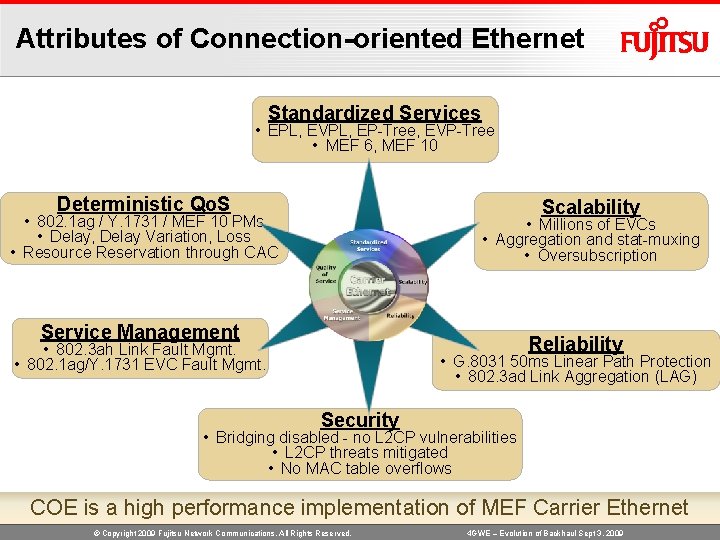
Attributes of Connection-oriented Ethernet Standardized Services • EPL, EVPL, EP-Tree, EVP-Tree • MEF 6, MEF 10 Deterministic Qo. S Scalability • 802. 1 ag / Y. 1731 / MEF 10 PMs • Delay, Delay Variation, Loss • Resource Reservation through CAC • Millions of EVCs • Aggregation and stat-muxing • Oversubscription COE Attributes Service Management Reliability • 802. 3 ah Link Fault Mgmt. • 802. 1 ag/Y. 1731 EVC Fault Mgmt. • G. 8031 50 ms Linear Path Protection • 802. 3 ad Link Aggregation (LAG) Security • Bridging disabled - no L 2 CP vulnerabilities • L 2 CP threats mitigated • No MAC table overflows COE is a high performance implementation of MEF Carrier Ethernet © Copyright 2009 Fujitsu Network Communications. All Rights Reserved. 4 GWE – Evolution of Backhaul Sept 3, 2009
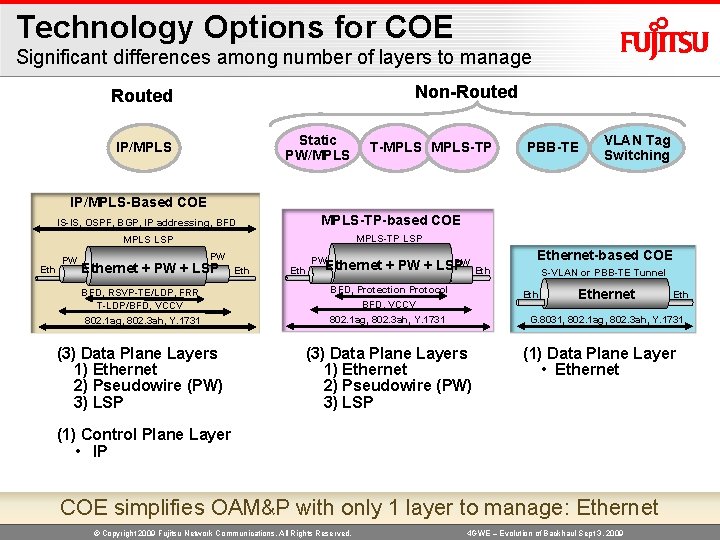
Technology Options for COE Significant differences among number of layers to manage Non-Routed Static PW/MPLS IP/MPLS T-MPLS-TP PBB-TE VLAN Tag Switching IP/MPLS-Based COE Eth IS-IS, OSPF, BGP, IP addressing, BFD MPLS-TP-based COE MPLS LSP MPLS-TP LSP PW PW Ethernet + PW + LSP Eth PW PW Ethernet + PW + LSP BFD, Protection Protocol BFD, VCCV BFD, RSVP-TE/LDP, FRR T-LDP/BFD, VCCV 802. 1 ag, 802. 3 ah, Y. 1731 (3) Data Plane Layers 1) Ethernet 2) Pseudowire (PW) 3) LSP Ethernet-based COE Eth S-VLAN or PBB-TE Tunnel Ethernet G. 8031, 802. 1 ag, 802. 3 ah, Y. 1731 (1) Data Plane Layer • Ethernet (1) Control Plane Layer • IP COE simplifies OAM&P with only 1 layer to manage: Ethernet © Copyright 2009 Fujitsu Network Communications. All Rights Reserved. Eth 4 GWE – Evolution of Backhaul Sept 3, 2009
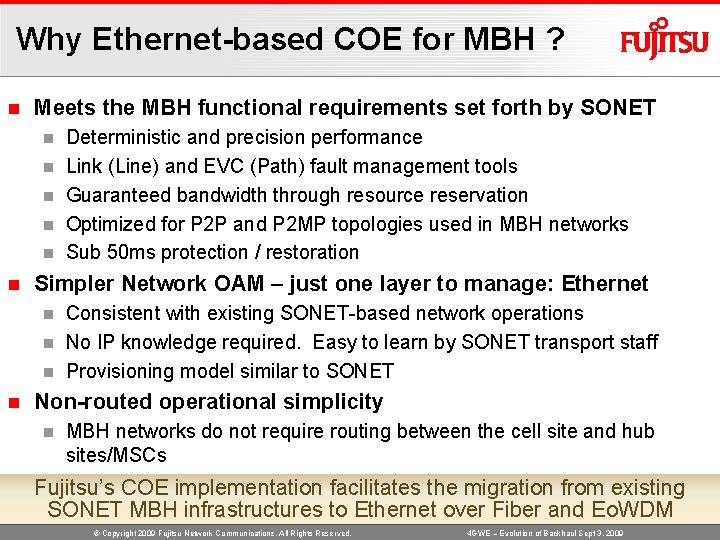
Why Ethernet-based COE for MBH ? n Meets the MBH functional requirements set forth by SONET n n n Deterministic and precision performance Link (Line) and EVC (Path) fault management tools Guaranteed bandwidth through resource reservation Optimized for P 2 P and P 2 MP topologies used in MBH networks Sub 50 ms protection / restoration Simpler Network OAM – just one layer to manage: Ethernet Consistent with existing SONET-based network operations n No IP knowledge required. Easy to learn by SONET transport staff n Provisioning model similar to SONET n n Non-routed operational simplicity MBH networks do not require routing between the cell site and hub sites/MSCs n Higher. COE network element reliability (significantly fewer protocols / simpler Fujitsu’s implementation facilitates the migration from existing SW) MBH infrastructures to Ethernet over Fiber and Eo. WDM SONET n © Copyright 2009 Fujitsu Network Communications. All Rights Reserved. 4 GWE – Evolution of Backhaul Sept 3, 2009
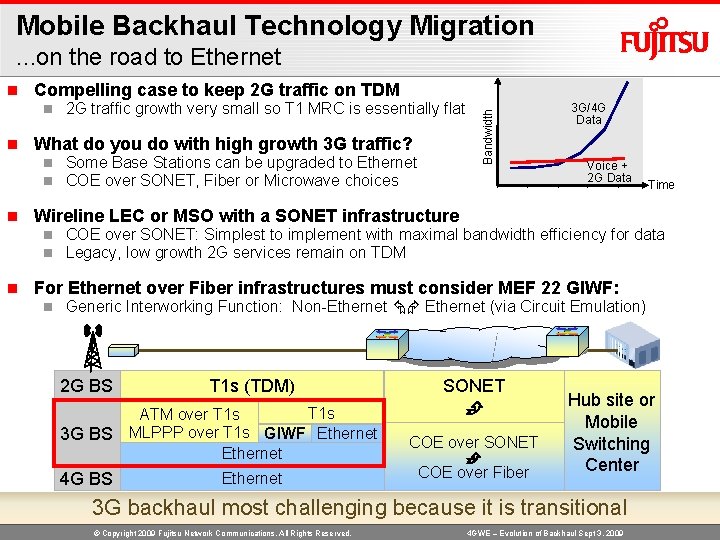
Mobile Backhaul Technology Migration …on Compelling case to keep 2 G traffic on TDM n n What do you do with high growth 3 G traffic? n n n Some Base Stations can be upgraded to Ethernet COE over SONET, Fiber or Microwave choices 3 G/4 G Data Voice + 2 G Data Time Wireline LEC or MSO with a SONET infrastructure n n n 2 G traffic growth very small so T 1 MRC is essentially flat Bandwidth n the road to Ethernet COE over SONET: Simplest to implement with maximal bandwidth efficiency for data Legacy, low growth 2 G services remain on TDM For Ethernet over Fiber infrastructures must consider MEF 22 GIWF: n Generic Interworking Function: Non-Ethernet (via Circuit Emulation) 2 G BS T 1 s (TDM) T 1 s ATM over T 1 s 3 G BS MLPPP over T 1 s GIWF Ethernet 4 G BS Ethernet SONET COE over Fiber Hub site or Mobile Switching Center 3 G backhaul most challenging because it is transitional © Copyright 2009 Fujitsu Network Communications. All Rights Reserved. 4 GWE – Evolution of Backhaul Sept 3, 2009
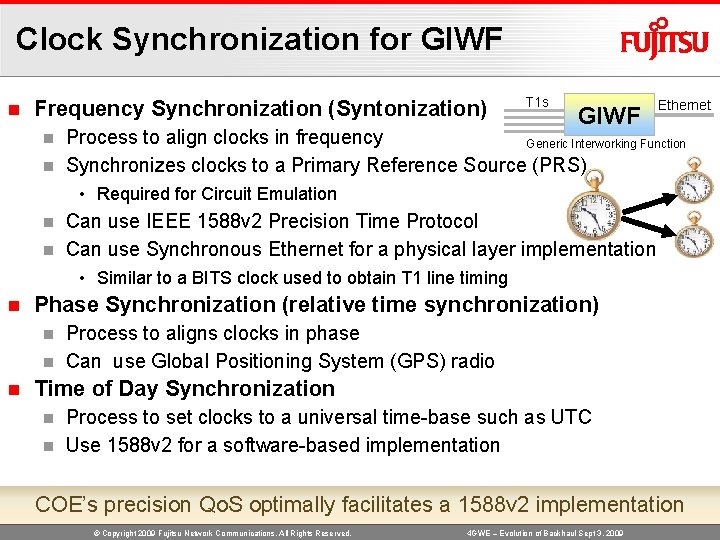
Clock Synchronization for GIWF n Frequency Synchronization (Syntonization) T 1 s GIWF Ethernet Process to align clocks in frequency Generic Interworking Function n Synchronizes clocks to a Primary Reference Source (PRS) n • Required for Circuit Emulation Can use IEEE 1588 v 2 Precision Time Protocol n Can use Synchronous Ethernet for a physical layer implementation n • Similar to a BITS clock used to obtain T 1 line timing n Phase Synchronization (relative time synchronization) Process to aligns clocks in phase n Can use Global Positioning System (GPS) radio n n Time of Day Synchronization Process to set clocks to a universal time-base such as UTC n Use 1588 v 2 for a software-based implementation n COE’s precision Qo. S optimally facilitates a 1588 v 2 implementation © Copyright 2009 Fujitsu Network Communications. All Rights Reserved. 4 GWE – Evolution of Backhaul Sept 3, 2009
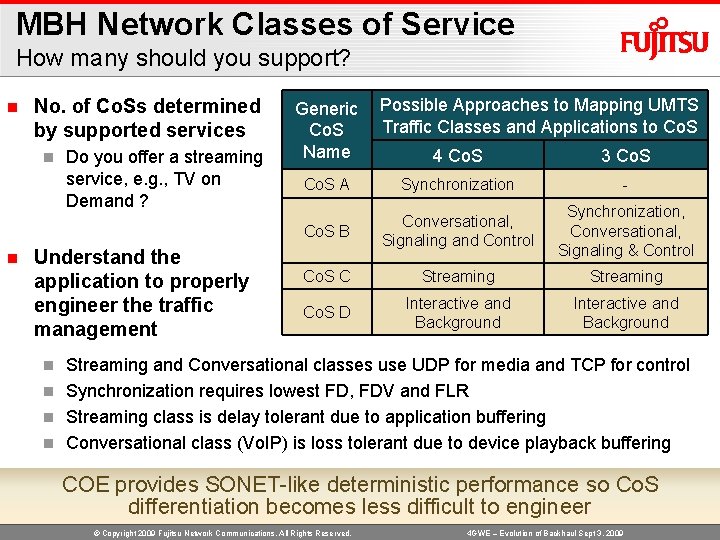
MBH Network Classes of Service How many should you support? n No. of Co. Ss determined by supported services n n Do you offer a streaming service, e. g. , TV on Demand ? Understand the application to properly engineer the traffic management Generic Co. S Name Possible Approaches to Mapping UMTS Traffic Classes and Applications to Co. S 4 Co. S 3 Co. S A Synchronization - Co. S B Conversational, Signaling and Control Synchronization, Conversational, Signaling & Control Co. S C Streaming Co. S D Interactive and Background Streaming and Conversational classes use UDP for media and TCP for control n Synchronization requires lowest FD, FDV and FLR n Streaming class is delay tolerant due to application buffering n Conversational class (Vo. IP) is loss tolerant due to device playback buffering n COE provides SONET-like deterministic performance so Co. S differentiation becomes less difficult to engineer © Copyright 2009 Fujitsu Network Communications. All Rights Reserved. 4 GWE – Evolution of Backhaul Sept 3, 2009
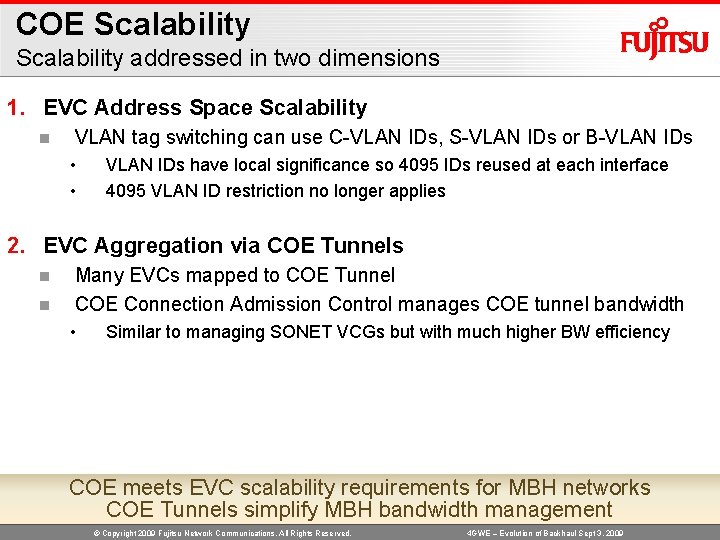
COE Scalability addressed in two dimensions 1. EVC Address Space Scalability n VLAN tag switching can use C-VLAN IDs, S-VLAN IDs or B-VLAN IDs • • VLAN IDs have local significance so 4095 IDs reused at each interface 4095 VLAN ID restriction no longer applies 2. EVC Aggregation via COE Tunnels n n Many EVCs mapped to COE Tunnel COE Connection Admission Control manages COE tunnel bandwidth • Similar to managing SONET VCGs but with much higher BW efficiency COE meets EVC scalability requirements for MBH networks COE Tunnels simplify MBH bandwidth management © Copyright 2009 Fujitsu Network Communications. All Rights Reserved. 4 GWE – Evolution of Backhaul Sept 3, 2009
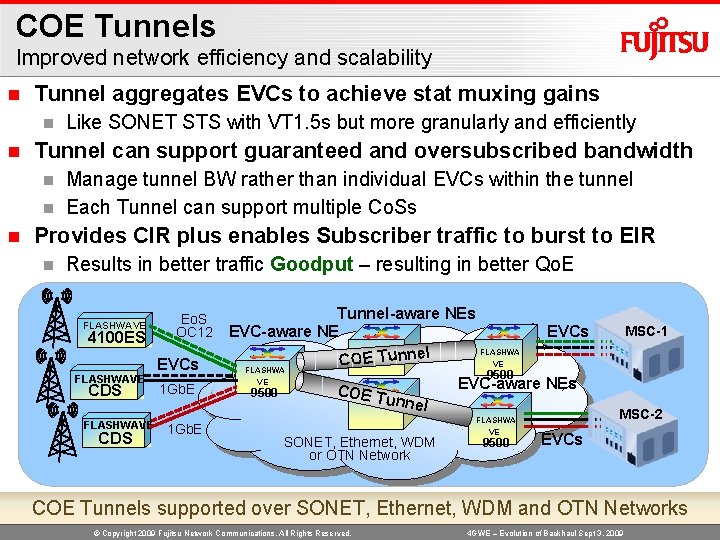
COE Tunnels Improved network efficiency and scalability n Tunnel aggregates EVCs to achieve stat muxing gains n n Like SONET STS with VT 1. 5 s but more granularly and efficiently Tunnel can support guaranteed and oversubscribed bandwidth Manage tunnel BW rather than individual EVCs within the tunnel n Each Tunnel can support multiple Co. Ss n n Provides CIR plus enables Subscriber traffic to burst to EIR n Results in better traffic Goodput – resulting in better Qo. E FLASHWAVE 4100 ES CDS FLASHWAVE CDS Eo. S OC 12 EVCs 1 Gb. E Tunnel-aware NEs EVC-aware NE FLASHWA COE Tunnel VE FLASHWA VE 9500 EVCs MSC-1 9500 COE T unnel SONET, Ethernet, WDM or OTN Network EVC-aware NEs FLASHWA VE 9500 MSC-2 EVCs COE Tunnels supported over SONET, Ethernet, WDM and OTN Networks © Copyright 2009 Fujitsu Network Communications. All Rights Reserved. 4 GWE – Evolution of Backhaul Sept 3, 2009
COE Tools for Network Survivability Meeting MBH networks high availability requirements n IEEE 802. 3 ad Link Aggregation Groups (LAG) For local (link level) diversity and protection n If any fiber or port in LAG fails, other LAG members share the load n n 1+1 equipment protection n n Create LAGs across different cards in a chassis ITU-T G. 8031 Linear Path Protection for EVC path diversity and sub-50 ms path protection n Similar to SONET UPSR path protection n • Simple Provisioning: Setup Working path and Protect path n Independent of Network Topology • Works over Rings, Meshes, Multiple Rings and Linear Topologies Fujitsu’s COE implementation enables ultra high available service Achieved through multiple levels of protection © Copyright 2009 Fujitsu Network Communications. All Rights Reserved. 4 GWE – Evolution of Backhaul Sept 3, 2009
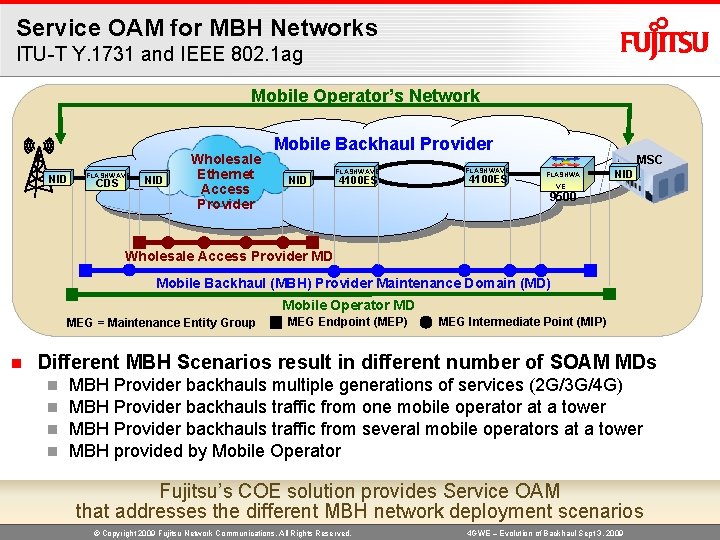
Service OAM for MBH Networks ITU-T Y. 1731 and IEEE 802. 1 ag Mobile Operator’s Network NID FLASHWAVE CDS NID Wholesale Ethernet Access Provider Mobile Backhaul Provider NID FLASHWAVE 4100 ES CDS MSC FLASHWA NID VE 9500 Wholesale Access Provider MD Mobile Backhaul (MBH) Provider Maintenance Domain (MD) Mobile Operator MD MEG = Maintenance Entity Group n MEG Endpoint (MEP) MEG Intermediate Point (MIP) Different MBH Scenarios result in different number of SOAM MDs n n MBH Provider backhauls multiple generations of services (2 G/3 G/4 G) MBH Provider backhauls traffic from one mobile operator at a tower MBH Provider backhauls traffic from several mobile operators at a tower MBH provided by Mobile Operator Fujitsu’s COE solution provides Service OAM that addresses the different MBH network deployment scenarios © Copyright 2009 Fujitsu Network Communications. All Rights Reserved. 4 GWE – Evolution of Backhaul Sept 3, 2009
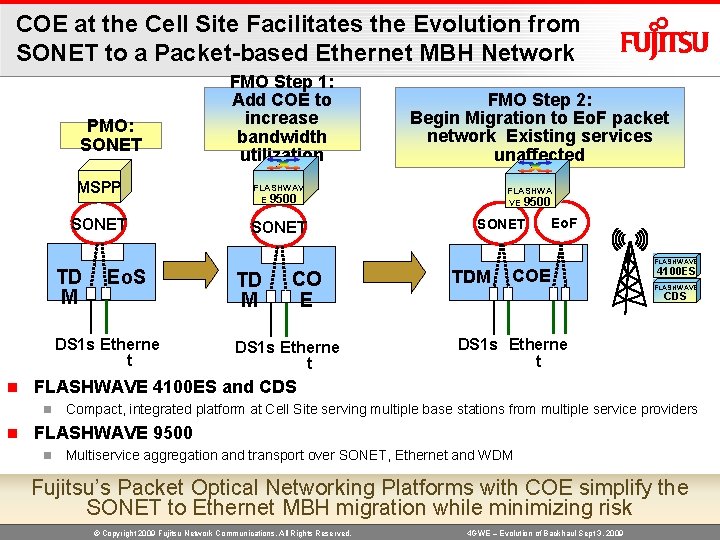
COE at the Cell Site Facilitates the Evolution from SONET to a Packet-based Ethernet MBH Network PMO: SONET MSPP SONET TD M Eo. S DS 1 s Etherne t n FMO Step 2: Begin Migration to Eo. F packet network Existing services unaffected FLASHWAV E 9500 SONET FLASHWA VE 9500 SONET Eo. F FLASHWAVE TD M CO E DS 1 s Etherne t TDM COE 4100 ES CDS FLASHWAVE CDS DS 1 s Etherne t FLASHWAVE 4100 ES and CDS n n FMO Step 1: Add COE to increase bandwidth utilization Compact, integrated platform at Cell Site serving multiple base stations from multiple service providers FLASHWAVE 9500 n Multiservice aggregation and transport over SONET, Ethernet and WDM Fujitsu’s Packet Optical Networking Platforms with COE simplify the SONET to Ethernet MBH migration while minimizing risk © Copyright 2009 Fujitsu Network Communications. All Rights Reserved. 4 GWE – Evolution of Backhaul Sept 3, 2009
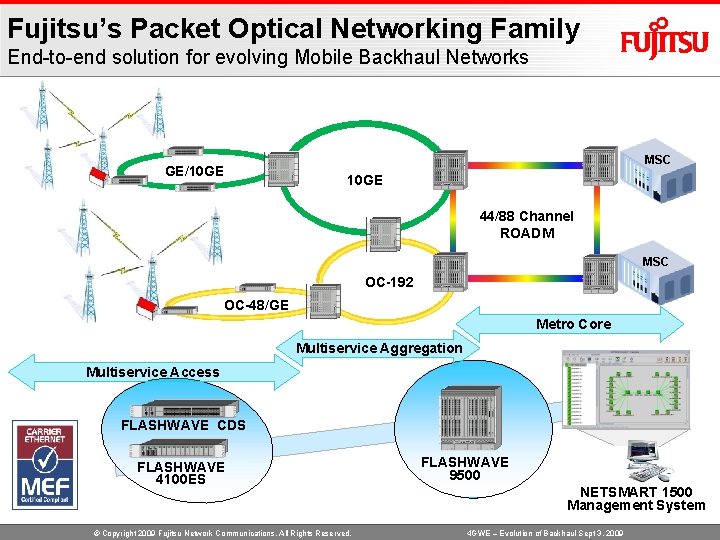
Fujitsu’s Packet Optical Networking Family End-to-end solution for evolving Mobile Backhaul Networks GE/10 GE MSC 10 GE 44/88 Channel ROADM MSC OC-192 OC-48/GE Metro Core Multiservice Aggregation Multiservice Access FLASHWAVE CDS FLASHWAVE 4100 ES © Copyright 2009 Fujitsu Network Communications. All Rights Reserved. FLASHWAVE 9500 NETSMART 1500 Management System 4 GWE – Evolution of Backhaul Sept 3, 2009
Summary n Different Business Drivers and Challenges for Mobile Operators & Mobile Backhaul Providers impact their migration to Ethernet n Connection-Oriented Ethernet (COE) combines the best attributes of Connectionless Ethernet and Ethernet over SONET n COE is a high performance implementation of MEF-defined Carrier Ethernet with a full complement of existing standards n Fujitsu’s Packet Optical Networking Platforms with COE simplify the SONET to Ethernet MBH migration while minimizing risk © Copyright 2009 Fujitsu Network Communications. All Rights Reserved. 4 GWE – Evolution of Backhaul Sept 3, 2009
- Slides: 53