
Migrating Motor Complex MMC and Vomiting Dr Alzoghaibi
Migrating Motor Complex (MMC) and Vomiting Dr. Alzoghaibi
Migrating Motor complex (MMC) • Digestive state: When nutrients are present and digestive process are ongoing • Interdigestive state When the digestion and absorption of nutrients are complete, 2 -3 hrs after a meal
Migrating Motor complex (MMC) § Characteristics & functions: Ø Pattern of motility in the interdigestive state - bursts of electrical & contractile activities are separated by longer quiescent periods - pattern of motility in fasting, conscious & sleep stages - begins at distal stomach to ileum - antral contraction to propel the remaining materials bigger than 7 mm
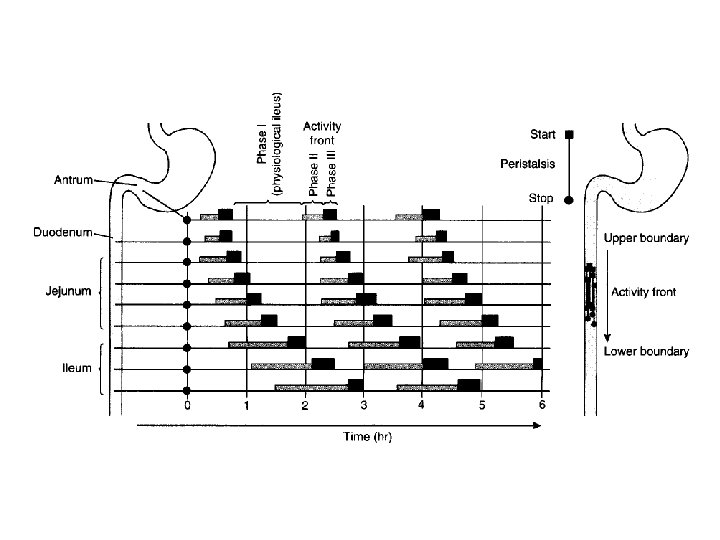
Migrating Motor complex (MMC) • Characteristics & functions (cont): - takes 80 -120 min for one activity front (from antrum to ileum) - 3 -6 cm/min in duodenum - 1 -2 cm/min in ileum • MMC organizer - ENS - CCK & gastrin MMC - motilin MMC
Migrating Motor complex (MMC) • Cycling of the MMC continues until it is ended by the ingestion of food • Termination requires the physical presence of a meal in the upper digestive tract • Vagal efferent signals to ENS interrupt the MMC and initiate mixing motility during ingestion of a meal • After vagus nerves are cut, a large quantity of ingested food is necessary to interrupt the interdigestive motor pattern (MMC), and the interruption is often incomplete • Intravenous feeding does not end the fasting pattern
Migrating Motor complex (MMC) • Adaptive significance of MMC Ø Gallbladder contraction and delivery of bile to the duodenum is coordinated with the onset of MMC in the intraduodenal region Ø Appears also to be a mechanism for cleaning indigestible debris Ø Plays a housekeeper role in preventing the overgrowth of microorganisms that might occur in the small intestine
Peptic Ulcer and Vomiting
Peptic Ulcer • Specific causes of peptic ulcer: Ø Ø Ø Bacterial infection by Helicobacter Pylori Increased secretion of acid-peptic juices Smoking, because of increased nervous stimulation Alcohol, because it tends to break down the mucosal barrier Aspirin, which also has a strong propensity to break down this barrier
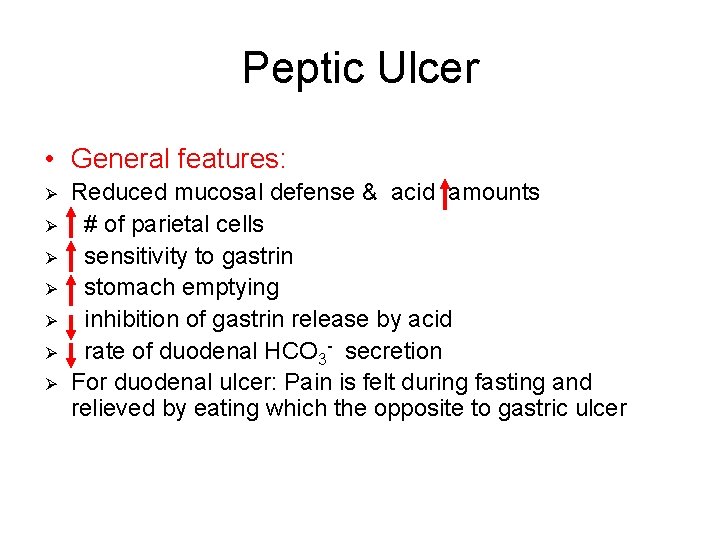
Peptic Ulcer • General features: Ø Ø Ø Ø Reduced mucosal defense & acid amounts # of parietal cells sensitivity to gastrin stomach emptying inhibition of gastrin release by acid rate of duodenal HCO 3 - secretion For duodenal ulcer: Pain is felt during fasting and relieved by eating which the opposite to gastric ulcer
Helicobacter pylori (H. pylori) • Correlation between H. pylori infection and the incidence of gastric and duodenal ulcer (peptic ulcer) • Remove of bacterial infection reduce ulcer recurrence • Mechanism of H. pylori in the genesis of ulcers: v urease ammonia neutralizes acid (protect bacteria) v Ammonia destroys the protective mucosa v H. pylori gastrin secretion v antibiotic is effective in eradication of H. pylori
Vomiting • Expulsion of gastric contents • Preceded by: retching, nausea, sweating, dilation of pupil, heartbeat, dizziness - controlled by vomiting center - different areas have receptors & input to vomiting center: -distention of stomach -tickling back of throat -injury of genitourinary system
Vomiting • The events: 1 - wave of reverse peristalsis (Retroperistalsis) 2 - forced inspiration (abdominal pressure) 3 - forceful abdominal muscles 4 - relaxed pyloric sphincter, stomach and lower esophageal sphincter (LES)
- Slides: 13