
Migrate from legacy ITSM to Service Now Migrate
- Slides: 20
Migrate from legacy ITSM to Service. Now
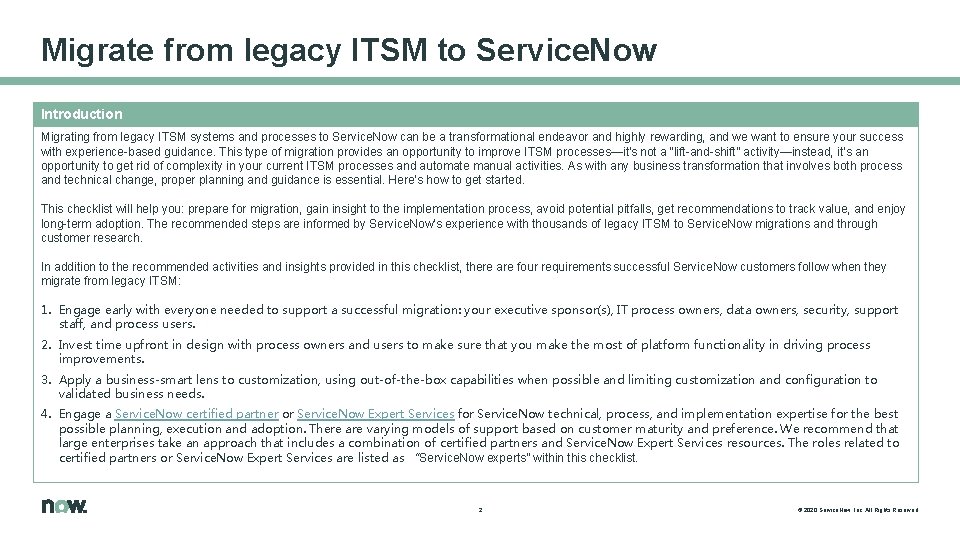
Migrate from legacy ITSM to Service. Now Introduction Migrating from legacy ITSM systems and processes to Service. Now can be a transformational endeavor and highly rewarding, and we want to ensure your success with experience-based guidance. This type of migration provides an opportunity to improve ITSM processes—it’s not a “lift-and-shift” activity—instead, it’s an opportunity to get rid of complexity in your current ITSM processes and automate manual activities. As with any business transformation that involves both process and technical change, proper planning and guidance is essential. Here’s how to get started. This checklist will help you: prepare for migration, gain insight to the implementation process, avoid potential pitfalls, get recommendations to track value, and enjoy long-term adoption. The recommended steps are informed by Service. Now’s experience with thousands of legacy ITSM to Service. Now migrations and through customer research. In addition to the recommended activities and insights provided in this checklist, there are four requirements successful Service. Now customers follow when they migrate from legacy ITSM: 1. Engage early with everyone needed to support a successful migration: your executive sponsor(s), IT process owners, data owners, security, support staff, and process users. 2. Invest time upfront in design with process owners and users to make sure that you make the most of platform functionality in driving process improvements. 3. Apply a business-smart lens to customization, using out-of-the-box capabilities when possible and limiting customization and configuration to validated business needs. 4. Engage a Service. Now certified partner or Service. Now Expert Services for Service. Now technical, process, and implementation expertise for the best possible planning, execution and adoption. There are varying models of support based on customer maturity and preference. We recommend that large enterprises take an approach that includes a combination of certified partners and Service. Now Expert Services resources. The roles related to certified partners or Service. Now Expert Services are listed as “Service. Now experts” within this checklist. 2 © 2020 Service. Now, Inc. All Rights Reserved.
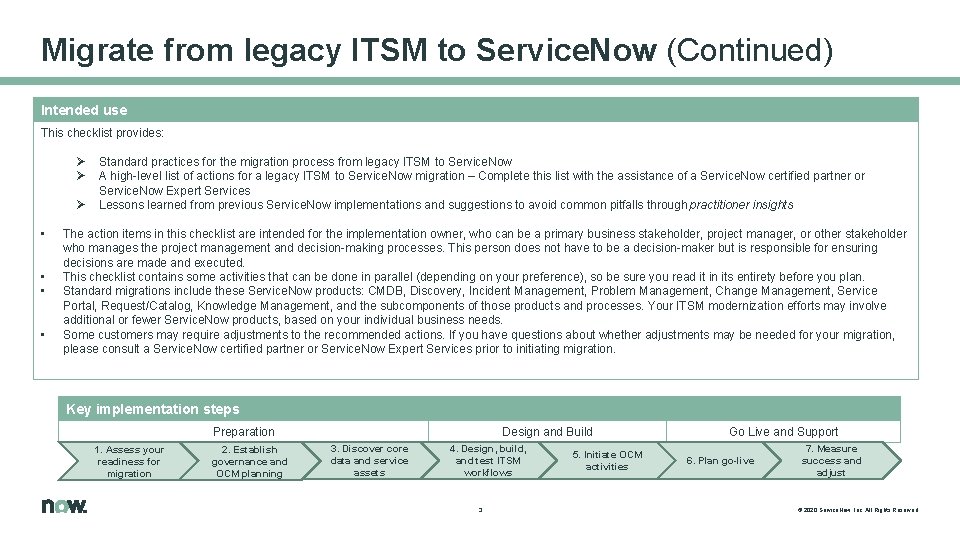
Migrate from legacy ITSM to Service. Now (Continued) Intended use This checklist provides: Ø Ø Ø • • Standard practices for the migration process from legacy ITSM to Service. Now A high-level list of actions for a legacy ITSM to Service. Now migration – Complete this list with the assistance of a Service. Now certified partner or Service. Now Expert Services Lessons learned from previous Service. Now implementations and suggestions to avoid common pitfalls through practitioner insights The action items in this checklist are intended for the implementation owner, who can be a primary business stakeholder, project manager, or other stakeholder who manages the project management and decision-making processes. This person does not have to be a decision-maker but is responsible for ensuring decisions are made and executed. This checklist contains some activities that can be done in parallel (depending on your preference), so be sure you read it in its entirety before you plan. Standard migrations include these Service. Now products: CMDB, Discovery, Incident Management, Problem Management, Change Management, Service Portal, Request/Catalog, Knowledge Management, and the subcomponents of those products and processes. Your ITSM modernization efforts may involve additional or fewer Service. Now products, based on your individual business needs. Some customers may require adjustments to the recommended actions. If you have questions about whether adjustments may be needed for your migration, please consult a Service. Now certified partner or Service. Now Expert Services prior to initiating migration. Key implementation steps Preparation 1. Assess your readiness for migration 2. Establish governance and OCM planning Design and Build 3. Discover core data and service assets 4. Design, build, and test ITSM workflows 3 5. Initiate OCM activities Go Live and Support 6. Plan go-live 7. Measure success and adjust © 2020 Service. Now, Inc. All Rights Reserved.
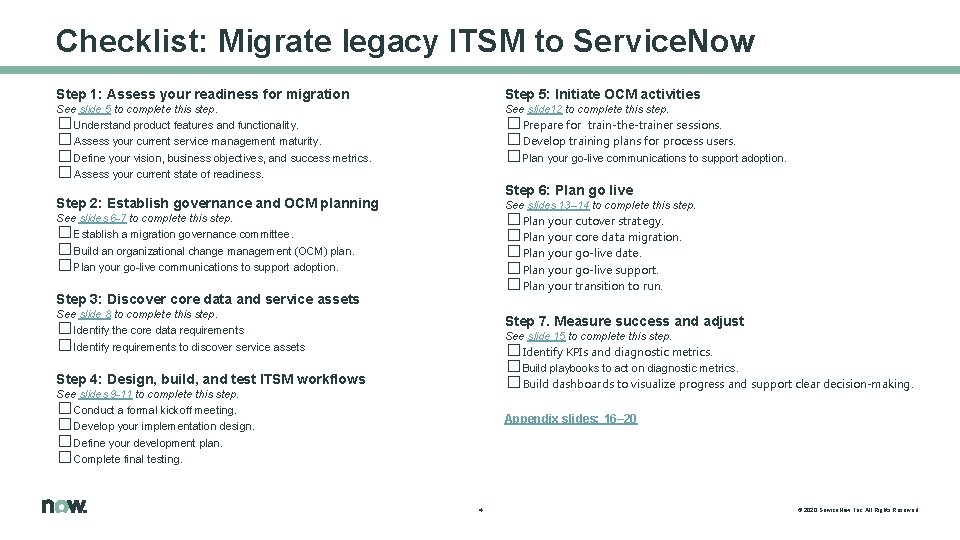
Checklist: Migrate legacy ITSM to Service. Now Step 1: Assess your readiness for migration Step 5: Initiate OCM activities See slide 5 to complete this step. � Understand product features and functionality. � Assess your current service management maturity. � Define your vision, business objectives, and success metrics. � Assess your current state of readiness. See slide 12 to complete this step. � Prepare for train-the-trainer sessions. � Develop training plans for process users. � Plan your go-live communications to support adoption. Step 6: Plan go live Step 2: Establish governance and OCM planning See slides 13– 14 to complete this step. � Plan your cutover strategy. � Plan your core data migration. � Plan your go-live date. � Plan your go-live support. � Plan your transition to run. See slides 6 -7 to complete this step. � Establish a migration governance committee. � Build an organizational change management (OCM) plan. � Plan your go-live communications to support adoption. Step 3: Discover core data and service assets See slide 8 to complete this step. � Identify the core data requirements � Identify requirements to discover service assets Step 7. Measure success and adjust See slide 15 to complete this step. � Identify KPIs and diagnostic metrics. � Build playbooks to act on diagnostic metrics. � Build dashboards to visualize progress and support clear decision-making. Step 4: Design, build, and test ITSM workflows See slides 9 -11 to complete this step. � Conduct a formal kickoff meeting. � Develop your implementation design. � Define your development plan. � Complete final testing. Appendix slides: 16– 20 4 © 2020 Service. Now, Inc. All Rights Reserved.
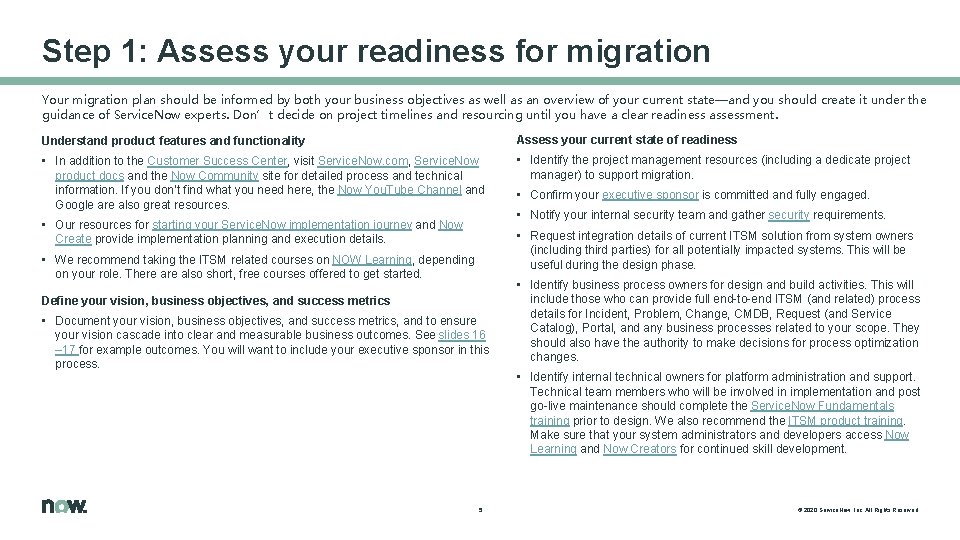
Step 1: Assess your readiness for migration Your migration plan should be informed by both your business objectives as well as an overview of your current state—and you should create it under the guidance of Service. Now experts. Don’t decide on project timelines and resourcing until you have a clear readiness assessment. Understand product features and functionality Assess your current state of readiness • In addition to the Customer Success Center, visit Service. Now. com, Service. Now product docs and the Now Community site for detailed process and technical information. If you don’t find what you need here, the Now You. Tube Channel and Google are also great resources. • Identify the project management resources (including a dedicate project manager) to support migration. • Our resources for starting your Service. Now implementation journey and Now Create provide implementation planning and execution details. • Confirm your executive sponsor is committed and fully engaged. • Notify your internal security team and gather security requirements. • Request integration details of current ITSM solution from system owners (including third parties) for all potentially impacted systems. This will be useful during the design phase. • We recommend taking the ITSM related courses on NOW Learning, depending on your role. There also short, free courses offered to get started. Define your vision, business objectives, and success metrics • Document your vision, business objectives, and success metrics, and to ensure your vision cascade into clear and measurable business outcomes. See slides 16 – 17 for example outcomes. You will want to include your executive sponsor in this process. 5 • Identify business process owners for design and build activities. This will include those who can provide full end-to-end ITSM (and related) process details for Incident, Problem, Change, CMDB, Request (and Service Catalog), Portal, and any business processes related to your scope. They should also have the authority to make decisions for process optimization changes. • Identify internal technical owners for platform administration and support. Technical team members who will be involved in implementation and post go-live maintenance should complete the Service. Now Fundamentals training prior to design. We also recommend the ITSM product training. Make sure that your system administrators and developers access Now Learning and Now Creators for continued skill development. © 2020 Service. Now, Inc. All Rights Reserved.
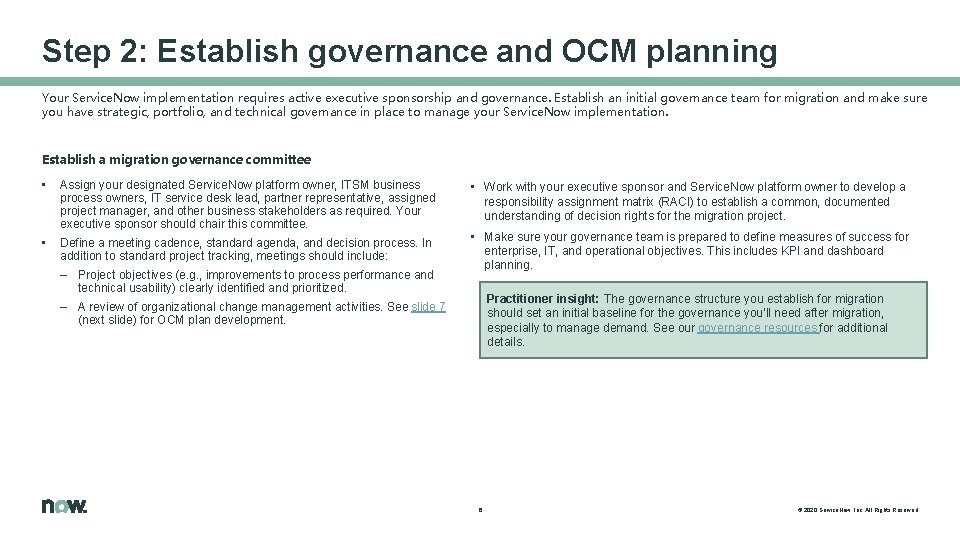
Step 2: Establish governance and OCM planning Your Service. Now implementation requires active executive sponsorship and governance. Establish an initial governance team for migration and make sure you have strategic, portfolio, and technical governance in place to manage your Service. Now implementation. Establish a migration governance committee • Assign your designated Service. Now platform owner, ITSM business process owners, IT service desk lead, partner representative, assigned project manager, and other business stakeholders as required. Your executive sponsor should chair this committee. • Define a meeting cadence, standard agenda, and decision process. In addition to standard project tracking, meetings should include: – Project objectives (e. g. , improvements to process performance and technical usability) clearly identified and prioritized. • Work with your executive sponsor and Service. Now platform owner to develop a responsibility assignment matrix (RACI) to establish a common, documented understanding of decision rights for the migration project. • Make sure your governance team is prepared to define measures of success for enterprise, IT, and operational objectives. This includes KPI and dashboard planning. Practitioner insight: The governance structure you establish for migration should set an initial baseline for the governance you’ll need after migration, especially to manage demand. See our governance resources for additional details. – A review of organizational change management activities. See slide 7 (next slide) for OCM plan development. 6 © 2020 Service. Now, Inc. All Rights Reserved.
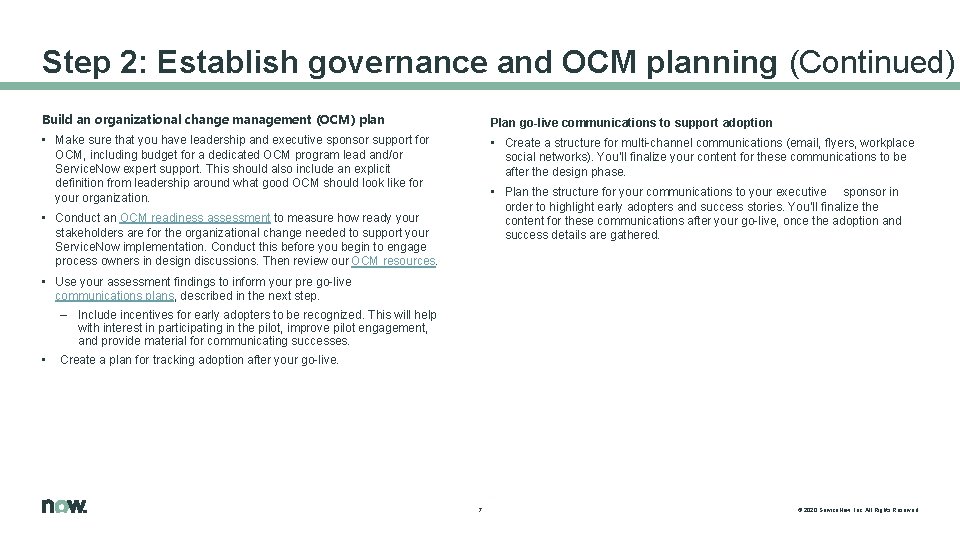
Step 2: Establish governance and OCM planning (Continued) Build an organizational change management (OCM) plan Plan go-live communications to support adoption • Make sure that you have leadership and executive sponsor support for OCM, including budget for a dedicated OCM program lead and/or Service. Now expert support. This should also include an explicit definition from leadership around what good OCM should look like for your organization. • Create a structure for multi-channel communications (email, flyers, workplace social networks). You’ll finalize your content for these communications to be after the design phase. • Plan the structure for your communications to your executive sponsor in order to highlight early adopters and success stories. You’ll finalize the content for these communications after your go-live, once the adoption and success details are gathered. • Conduct an OCM readiness assessment to measure how ready your stakeholders are for the organizational change needed to support your Service. Now implementation. Conduct this before you begin to engage process owners in design discussions. Then review our OCM resources. • Use your assessment findings to inform your pre go-live communications plans, described in the next step. – Include incentives for early adopters to be recognized. This will help with interest in participating in the pilot, improve pilot engagement, and provide material for communicating successes. • Create a plan for tracking adoption after your go-live. 7 © 2020 Service. Now, Inc. All Rights Reserved.
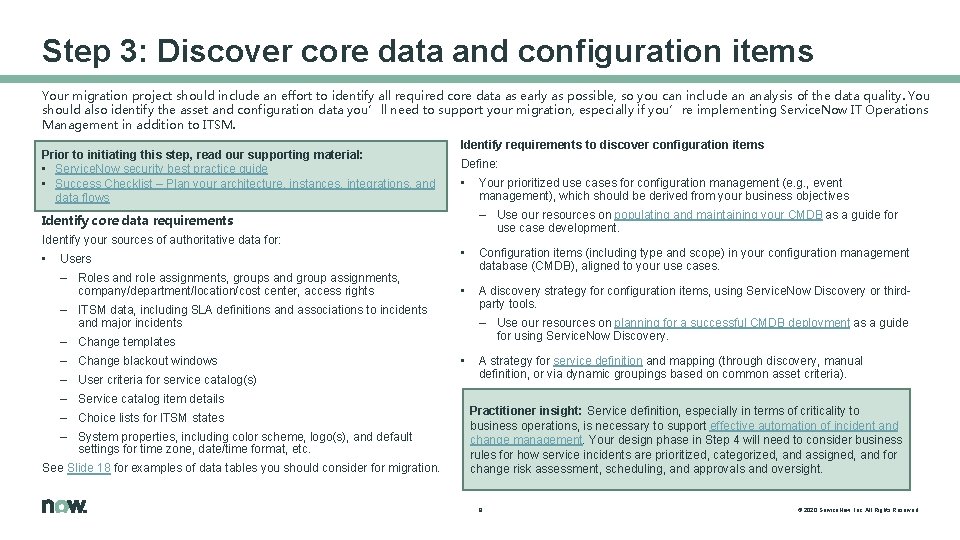
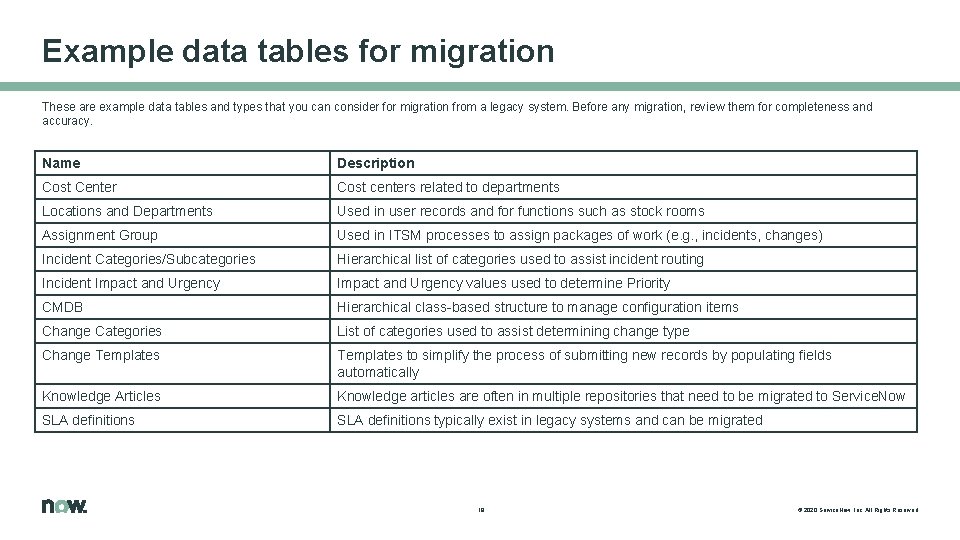
Step 3: Discover core data and configuration items Your migration project should include an effort to identify all required core data as early as possible, so you can include an analysis of the data quality. You should also identify the asset and configuration data you’ll need to support your migration, especially if you’re implementing Service. Now IT Operations Management in addition to ITSM. Prior to initiating this step, read our supporting material: • Service. Now security best practice guide • Success Checklist – Plan your architecture, instances, integrations, and data flows Identify requirements to discover configuration items Define: • – Use our resources on populating and maintaining your CMDB as a guide for use case development. Identify core data requirements Identify your sources of authoritative data for: • Your prioritized use cases for configuration management (e. g. , event management), which should be derived from your business objectives Users • – Roles and role assignments, groups and group assignments, company/department/location/cost center, access rights Configuration items (including type and scope) in your configuration management database (CMDB), aligned to your use cases. • A discovery strategy for configuration items, using Service. Now Discovery or thirdparty tools. – ITSM data, including SLA definitions and associations to incidents and major incidents – Use our resources on planning for a successful CMDB deployment as a guide for using Service. Now Discovery. – Change templates – Change blackout windows – User criteria for service catalog(s) – Service catalog item details – Choice lists for ITSM states – System properties, including color scheme, logo(s), and default settings for time zone, date/time format, etc. See Slide 18 for examples of data tables you should consider for migration. • A strategy for service definition and mapping (through discovery, manual definition, or via dynamic groupings based on common asset criteria). Practitioner insight: Service definition, especially in terms of criticality to business operations, is necessary to support effective automation of incident and change management. Your design phase in Step 4 will need to consider business rules for how service incidents are prioritized, categorized, and assigned, and for change risk assessment, scheduling, and approvals and oversight. 8 © 2020 Service. Now, Inc. All Rights Reserved.
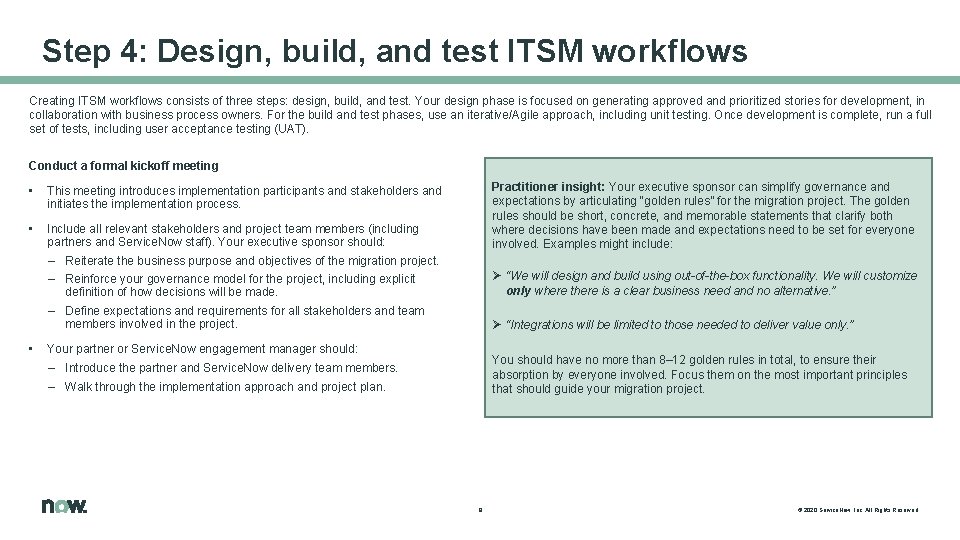
Step 4: Design, build, and test ITSM workflows Creating ITSM workflows consists of three steps: design, build, and test. Your design phase is focused on generating approved and prioritized stories for development, in collaboration with business process owners. For the build and test phases, use an iterative/Agile approach, including unit testing. Once development is complete, run a full set of tests, including user acceptance testing (UAT). Conduct a formal kickoff meeting • This meeting introduces implementation participants and stakeholders and initiates the implementation process. • Include all relevant stakeholders and project team members (including partners and Service. Now staff). Your executive sponsor should: Practitioner insight: Your executive sponsor can simplify governance and expectations by articulating “golden rules” for the migration project. The golden rules should be short, concrete, and memorable statements that clarify both where decisions have been made and expectations need to be set for everyone involved. Examples might include: – Reiterate the business purpose and objectives of the migration project. • – Reinforce your governance model for the project, including explicit definition of how decisions will be made. Ø “We will design and build using out-of-the-box functionality. We will customize only where there is a clear business need and no alternative. ” – Define expectations and requirements for all stakeholders and team members involved in the project. Ø “Integrations will be limited to those needed to deliver value only. ” Your partner or Service. Now engagement manager should: You should have no more than 8– 12 golden rules in total, to ensure their absorption by everyone involved. Focus them on the most important principles that should guide your migration project. – Introduce the partner and Service. Now delivery team members. – Walk through the implementation approach and project plan. 9 © 2020 Service. Now, Inc. All Rights Reserved.
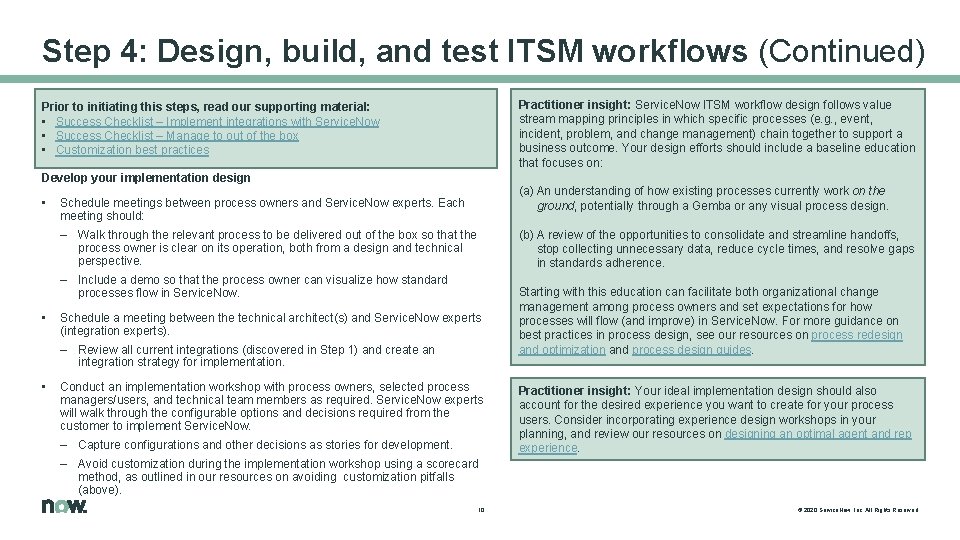
Step 4: Design, build, and test ITSM workflows (Continued) Practitioner insight: Service. Now ITSM workflow design follows value stream mapping principles in which specific processes (e. g. , event, incident, problem, and change management) chain together to support a business outcome. Your design efforts should include a baseline education that focuses on: Prior to initiating this steps, read our supporting material: • Success Checklist – Implement integrations with Service. Now • Success Checklist – Manage to out of the box • Customization best practices Develop your implementation design • (a) An understanding of how existing processes currently work on the ground, potentially through a Gemba or any visual process design. Schedule meetings between process owners and Service. Now experts. Each meeting should: – Walk through the relevant process to be delivered out of the box so that the process owner is clear on its operation, both from a design and technical perspective. – Include a demo so that the process owner can visualize how standard processes flow in Service. Now. • Schedule a meeting between the technical architect(s) and Service. Now experts (integration experts). – Review all current integrations (discovered in Step 1) and create an integration strategy for implementation. • Conduct an implementation workshop with process owners, selected process managers/users, and technical team members as required. Service. Now experts will walk through the configurable options and decisions required from the customer to implement Service. Now. – Capture configurations and other decisions as stories for development. (b) A review of the opportunities to consolidate and streamline handoffs, stop collecting unnecessary data, reduce cycle times, and resolve gaps in standards adherence. Starting with this education can facilitate both organizational change management among process owners and set expectations for how processes will flow (and improve) in Service. Now. For more guidance on best practices in process design, see our resources on process redesign and optimization and process design guides. Practitioner insight: Your ideal implementation design should also account for the desired experience you want to create for your process users. Consider incorporating experience design workshops in your planning, and review our resources on designing an optimal agent and rep experience. – Avoid customization during the implementation workshop using a scorecard method, as outlined in our resources on avoiding customization pitfalls (above). 10 © 2020 Service. Now, Inc. All Rights Reserved.
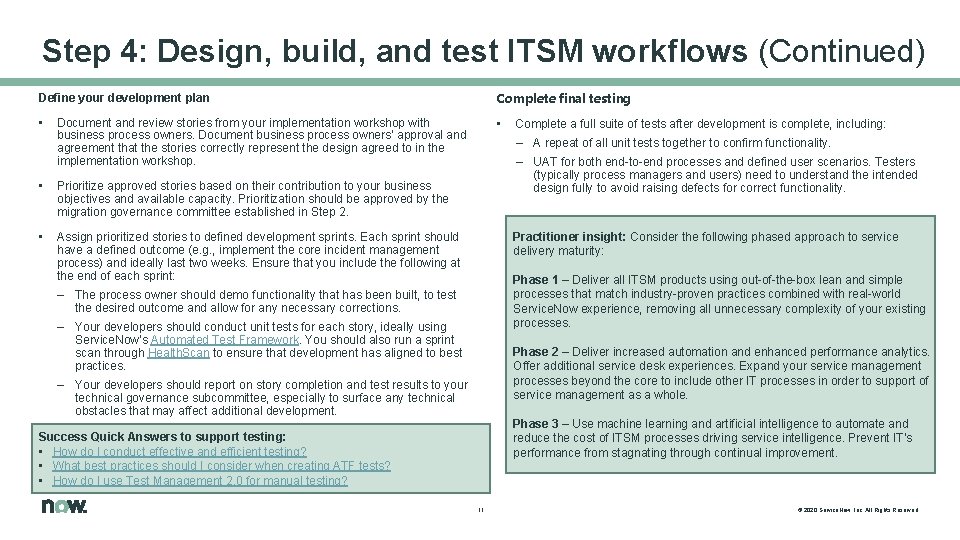
Step 4: Design, build, and test ITSM workflows (Continued) Define your development plan Complete final testing • • Document and review stories from your implementation workshop with business process owners. Document business process owners’ approval and agreement that the stories correctly represent the design agreed to in the implementation workshop. • Prioritize approved stories based on their contribution to your business objectives and available capacity. Prioritization should be approved by the migration governance committee established in Step 2. • Assign prioritized stories to defined development sprints. Each sprint should have a defined outcome (e. g. , implement the core incident management process) and ideally last two weeks. Ensure that you include the following at the end of each sprint: Complete a full suite of tests after development is complete, including: – A repeat of all unit tests together to confirm functionality. – UAT for both end-to-end processes and defined user scenarios. Testers (typically process managers and users) need to understand the intended design fully to avoid raising defects for correct functionality. Practitioner insight: Consider the following phased approach to service delivery maturity: Phase 1 – Deliver all ITSM products using out-of-the-box lean and simple processes that match industry-proven practices combined with real-world Service. Now experience, removing all unnecessary complexity of your existing processes. – The process owner should demo functionality that has been built, to test the desired outcome and allow for any necessary corrections. – Your developers should conduct unit tests for each story, ideally using Service. Now’s Automated Test Framework. You should also run a sprint scan through Health. Scan to ensure that development has aligned to best practices. Phase 2 – Deliver increased automation and enhanced performance analytics. Offer additional service desk experiences. Expand your service management processes beyond the core to include other IT processes in order to support of service management as a whole. – Your developers should report on story completion and test results to your technical governance subcommittee, especially to surface any technical obstacles that may affect additional development. Phase 3 – Use machine learning and artificial intelligence to automate and reduce the cost of ITSM processes driving service intelligence. Prevent IT’s performance from stagnating through continual improvement. Success Quick Answers to support testing: • How do I conduct effective and efficient testing? • What best practices should I consider when creating ATF tests? • How do I use Test Management 2. 0 for manual testing? 11 © 2020 Service. Now, Inc. All Rights Reserved.
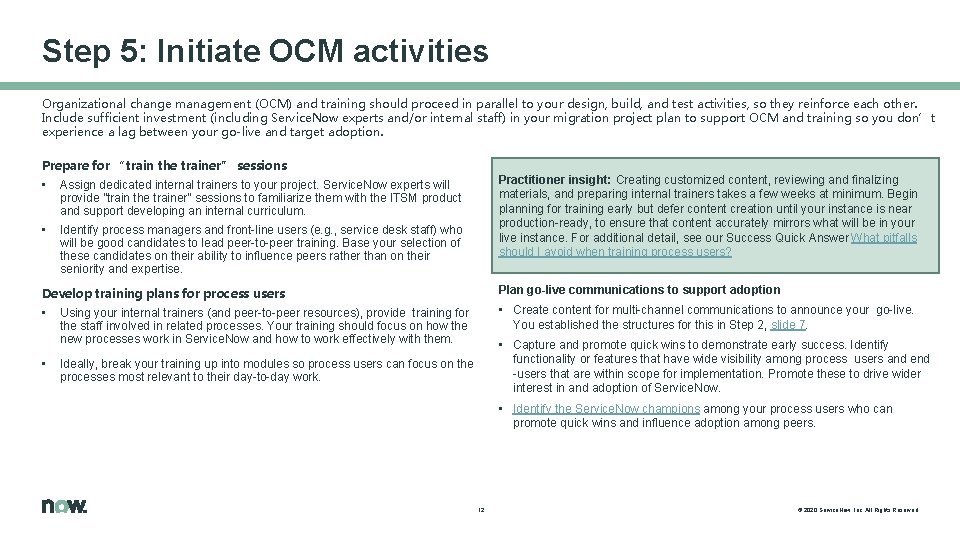
Step 5: Initiate OCM activities Organizational change management (OCM) and training should proceed in parallel to your design, build, and test activities, so they reinforce each other. Include sufficient investment (including Service. Now experts and/or internal staff) in your migration project plan to support OCM and training so you don’t experience a lag between your go-live and target adoption. Prepare for “train the trainer” sessions • Assign dedicated internal trainers to your project. Service. Now experts will provide ”train the trainer” sessions to familiarize them with the ITSM product and support developing an internal curriculum. • Identify process managers and front-line users (e. g. , service desk staff) who will be good candidates to lead peer-to-peer training. Base your selection of these candidates on their ability to influence peers rather than on their seniority and expertise. Practitioner insight: Creating customized content, reviewing and finalizing materials, and preparing internal trainers takes a few weeks at minimum. Begin planning for training early but defer content creation until your instance is near production-ready, to ensure that content accurately mirrors what will be in your live instance. For additional detail, see our Success Quick Answer What pitfalls should I avoid when training process users? Develop training plans for process users Plan go-live communications to support adoption • • Create content for multi-channel communications to announce your go-live. You established the structures for this in Step 2, slide 7. • Using your internal trainers (and peer-to-peer resources), provide training for the staff involved in related processes. Your training should focus on how the new processes work in Service. Now and how to work effectively with them. • Capture and promote quick wins to demonstrate early success. Identify functionality or features that have wide visibility among process users and end -users that are within scope for implementation. Promote these to drive wider interest in and adoption of Service. Now. Ideally, break your training up into modules so process users can focus on the processes most relevant to their day-to-day work. • Identify the Service. Now champions among your process users who can promote quick wins and influence adoption among peers. 12 © 2020 Service. Now, Inc. All Rights Reserved.
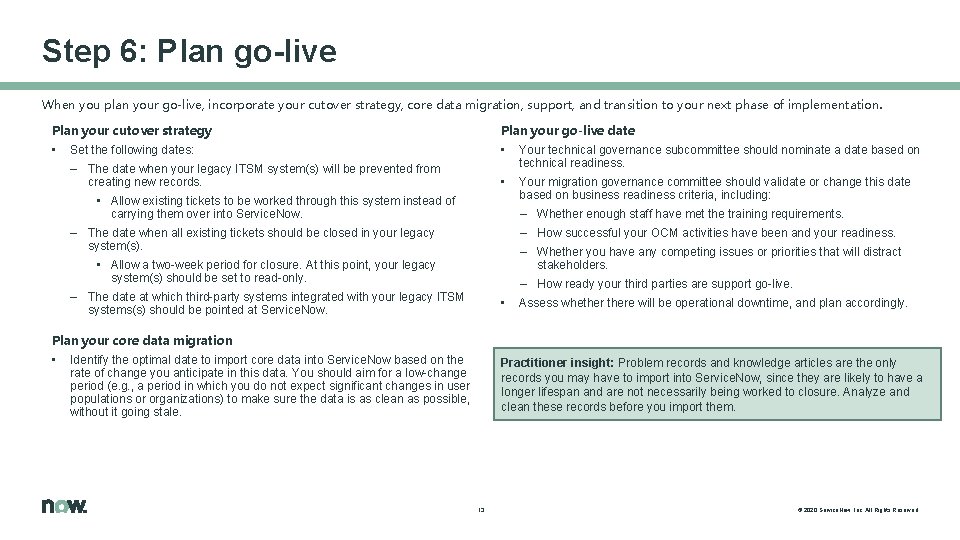
Step 6: Plan go-live When you plan your go-live, incorporate your cutover strategy, core data migration, support, and transition to your next phase of implementation. Plan your cutover strategy Plan your go-live date • Set the following dates: • – The date when your legacy ITSM system(s) will be prevented from creating new records. Your technical governance subcommittee should nominate a date based on technical readiness. • Your migration governance committee should validate or change this date based on business readiness criteria, including: • Allow existing tickets to be worked through this system instead of carrying them over into Service. Now. – Whether enough staff have met the training requirements. – How successful your OCM activities have been and your readiness. – The date when all existing tickets should be closed in your legacy system(s). – Whether you have any competing issues or priorities that will distract stakeholders. • Allow a two-week period for closure. At this point, your legacy system(s) should be set to read-only. – How ready your third parties are support go-live. – The date at which third-party systems integrated with your legacy ITSM systems(s) should be pointed at Service. Now. • Assess whethere will be operational downtime, and plan accordingly. Plan your core data migration • Identify the optimal date to import core data into Service. Now based on the rate of change you anticipate in this data. You should aim for a low-change period (e. g. , a period in which you do not expect significant changes in user populations or organizations) to make sure the data is as clean as possible, without it going stale. Practitioner insight: Problem records and knowledge articles are the only records you may have to import into Service. Now, since they are likely to have a longer lifespan and are not necessarily being worked to closure. Analyze and clean these records before you import them. 13 © 2020 Service. Now, Inc. All Rights Reserved.
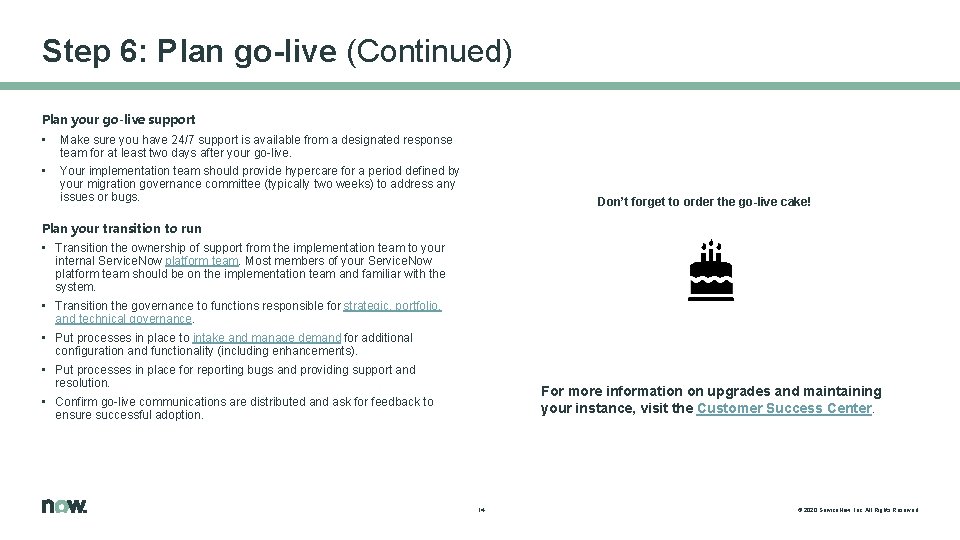
Step 6: Plan go-live (Continued) Plan your go-live support • Make sure you have 24/7 support is available from a designated response team for at least two days after your go-live. • Your implementation team should provide hypercare for a period defined by your migration governance committee (typically two weeks) to address any issues or bugs. Don’t forget to order the go-live cake! Plan your transition to run • Transition the ownership of support from the implementation team to your internal Service. Now platform team. Most members of your Service. Now platform team should be on the implementation team and familiar with the system. • Transition the governance to functions responsible for strategic, portfolio, and technical governance. • Put processes in place to intake and manage demand for additional configuration and functionality (including enhancements). • Put processes in place for reporting bugs and providing support and resolution. For more information on upgrades and maintaining your instance, visit the Customer Success Center. • Confirm go-live communications are distributed and ask for feedback to ensure successful adoption. 14 © 2020 Service. Now, Inc. All Rights Reserved.
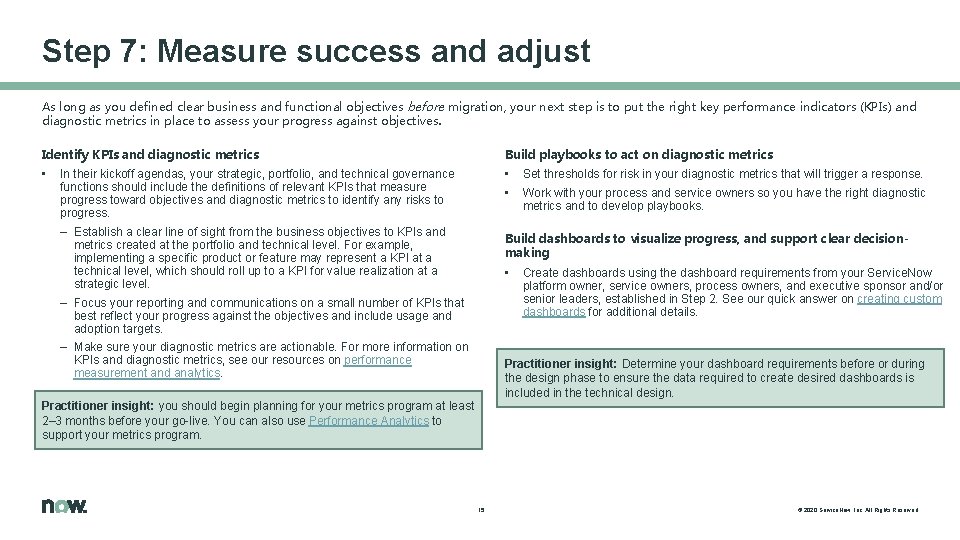
Step 7: Measure success and adjust As long as you defined clear business and functional objectives before migration, your next step is to put the right key performance indicators (KPIs) and diagnostic metrics in place to assess your progress against objectives. Identify KPIs and diagnostic metrics Build playbooks to act on diagnostic metrics • In their kickoff agendas, your strategic, portfolio, and technical governance functions should include the definitions of relevant KPIs that measure progress toward objectives and diagnostic metrics to identify any risks to progress. • Set thresholds for risk in your diagnostic metrics that will trigger a response. • Work with your process and service owners so you have the right diagnostic metrics and to develop playbooks. – Establish a clear line of sight from the business objectives to KPIs and metrics created at the portfolio and technical level. For example, implementing a specific product or feature may represent a KPI at a technical level, which should roll up to a KPI for value realization at a strategic level. Build dashboards to visualize progress, and support clear decisionmaking • – Focus your reporting and communications on a small number of KPIs that best reflect your progress against the objectives and include usage and adoption targets. – Make sure your diagnostic metrics are actionable. For more information on KPIs and diagnostic metrics, see our resources on performance measurement and analytics. Create dashboards using the dashboard requirements from your Service. Now platform owner, service owners, process owners, and executive sponsor and/or senior leaders, established in Step 2. See our quick answer on creating custom dashboards for additional details. Practitioner insight: Determine your dashboard requirements before or during the design phase to ensure the data required to create desired dashboards is included in the technical design. Practitioner insight: you should begin planning for your metrics program at least – Success Playbook. 2– 3 months before your go-live. You can also use Performance Analytics to support your metrics program. 15 © 2020 Service. Now, Inc. All Rights Reserved.
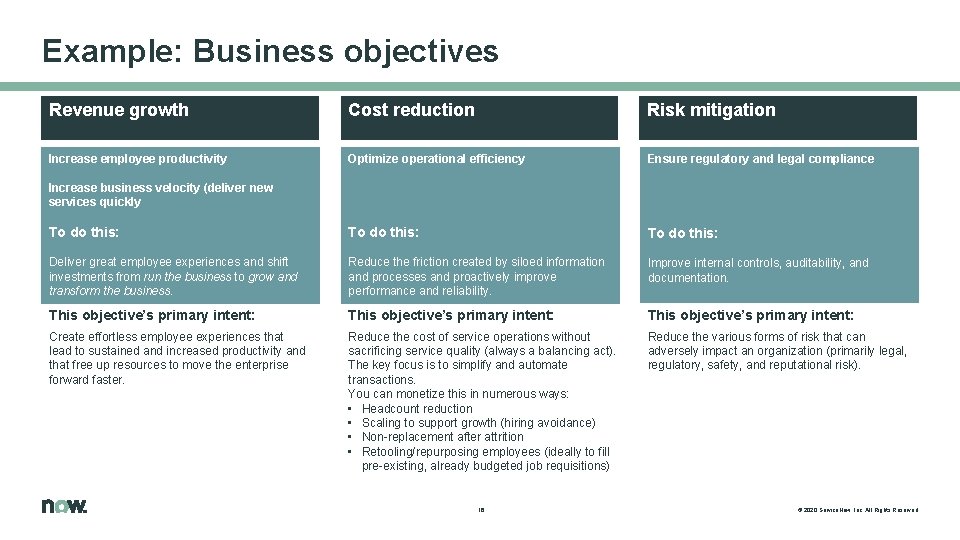
Example: Business objectives Revenue growth Cost reduction Risk mitigation Increase employee productivity Optimize operational efficiency Ensure regulatory and legal compliance To do this: Deliver great employee experiences and shift investments from run the business to grow and transform the business. Reduce the friction created by siloed information and processes and proactively improve performance and reliability. Improve internal controls, auditability, and documentation. This objective’s primary intent: Create effortless employee experiences that lead to sustained and increased productivity and that free up resources to move the enterprise forward faster. Reduce the cost of service operations without sacrificing service quality (always a balancing act). The key focus is to simplify and automate transactions. You can monetize this in numerous ways: • Headcount reduction • Scaling to support growth (hiring avoidance) • Non-replacement after attrition • Retooling/repurposing employees (ideally to fill pre-existing, already budgeted job requisitions) Reduce the various forms of risk that can adversely impact an organization (primarily legal, regulatory, safety, and reputational risk). Increase business velocity (deliver new services quickly 16 © 2020 Service. Now, Inc. All Rights Reserved.
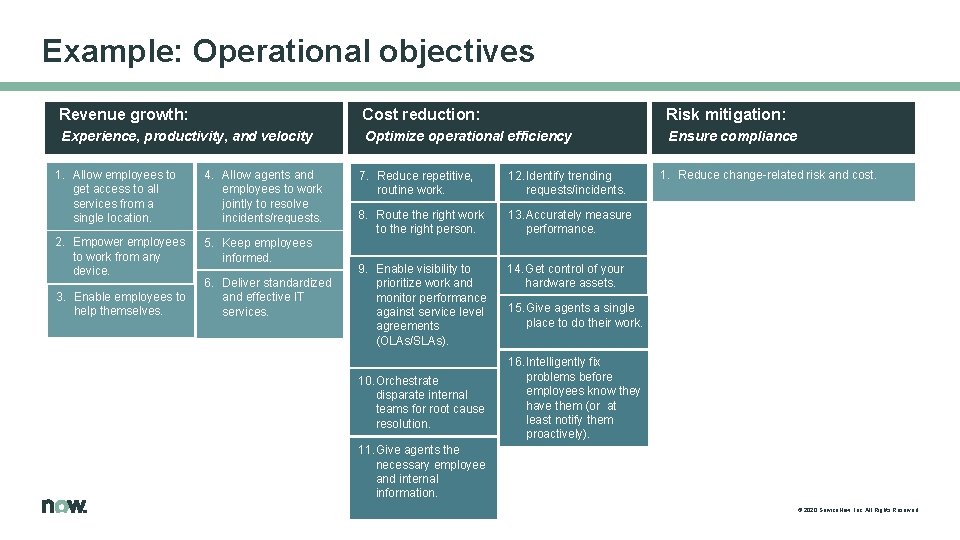
Example: Operational objectives • Revenue growth: Experience, productivity, and velocity 1. Allow employees to get access to all services from a single location. 4. Allow agents and employees to work jointly to resolve incidents/requests. 2. Empower employees to work from any device. 5. Keep employees informed. 3. Enable employees to help themselves. • Risk mitigation: • Cost reduction: 6. Deliver standardized and effective IT services. Optimize operational efficiency 7. Reduce repetitive, routine work. 12. Identify trending requests/incidents. 8. Route the right work to the right person. 13. Accurately measure performance. 9. Enable visibility to prioritize work and monitor performance against service level agreements (OLAs/SLAs). 14. Get control of your hardware assets. 10. Orchestrate disparate internal teams for root cause resolution. Ensure compliance 1. Reduce change-related risk and cost. 15. Give agents a single place to do their work. 16. Intelligently fix problems before employees know they have them (or at least notify them proactively). 11. Give agents the necessary employee and internal information. 17 © 2020 Service. Now, Inc. All Rights Reserved.
Example data tables for migration These are example data tables and types that you can consider for migration from a legacy system. Before any migration, review them for completeness and accuracy. Name Description Cost Center Cost centers related to departments Locations and Departments Used in user records and for functions such as stock rooms Assignment Group Used in ITSM processes to assign packages of work (e. g. , incidents, changes) Incident Categories/Subcategories Hierarchical list of categories used to assist incident routing Incident Impact and Urgency values used to determine Priority CMDB Hierarchical class-based structure to manage configuration items Change Categories List of categories used to assist determining change type Change Templates to simplify the process of submitting new records by populating fields automatically Knowledge Articles Knowledge articles are often in multiple repositories that need to be migrated to Service. Now SLA definitions typically exist in legacy systems and can be migrated 18 © 2020 Service. Now, Inc. All Rights Reserved.
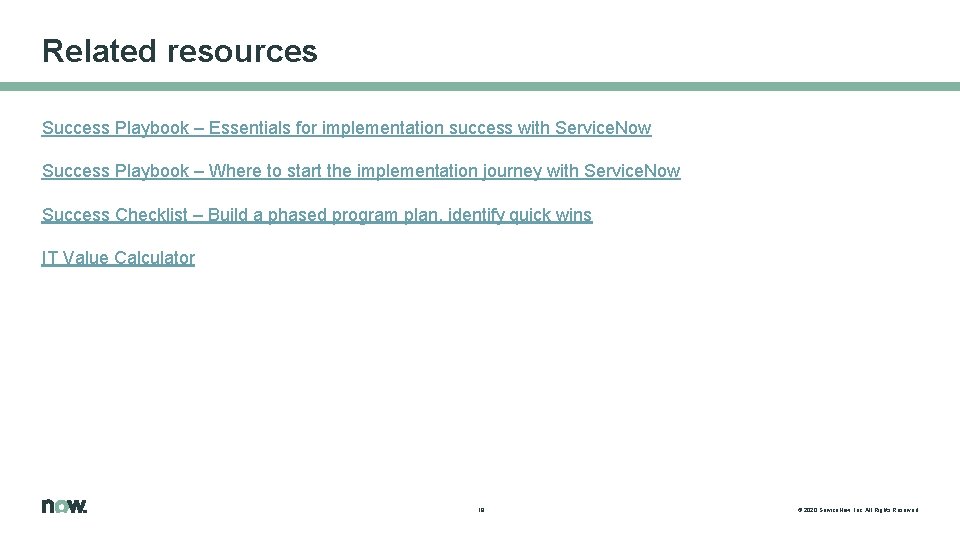
Related resources Success Playbook – Essentials for implementation success with Service. Now Success Playbook – Where to start the implementation journey with Service. Now Success Checklist – Build a phased program plan, identify quick wins IT Value Calculator 19 © 2020 Service. Now, Inc. All Rights Reserved.
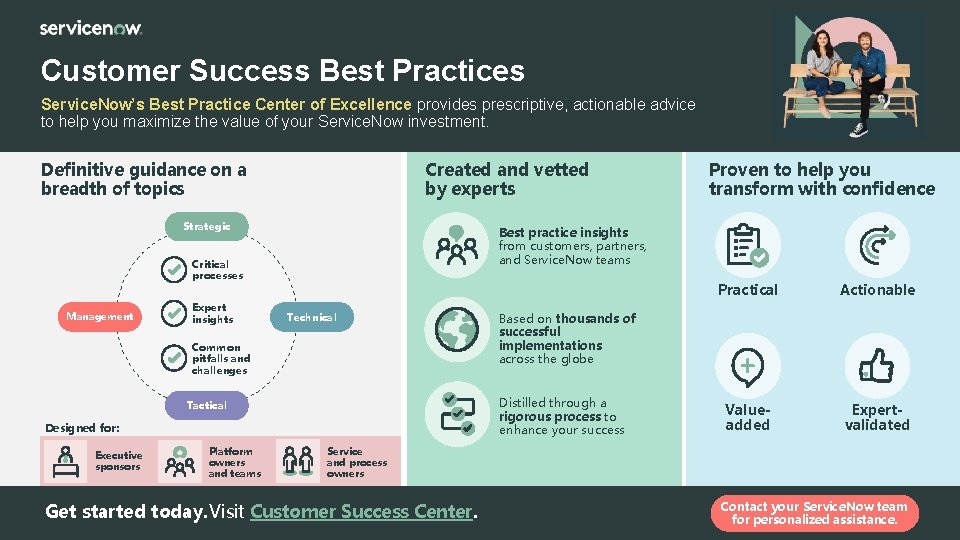
Customer Success Best Practices Service. Now’s Best Practice Center of Excellence provides prescriptive, actionable advice to help you maximize the value of your Service. Now investment. Definitive guidance on a breadth of topics Created and vetted by experts Strategic Best practice insights from customers, partners, and Service. Now teams Critical processes Management Expert insights Distilled through a rigorous process to enhance your success Tactical Designed for: Platform owners and teams Practical Actionable Valueadded Expertvalidated Based on thousands of successful implementations across the globe Technical Common pitfalls and challenges Executive sponsors Proven to help you transform with confidence Service and process owners Get started today. Visit Customer Success Center. 20 Contact your Service. Now team for personalized assistance. © 2020 Service. Now, Inc. All Rights Reserved.