
Migrant Bilingual Education Updates FOR SCHOOL YEAR 2017

Migrant & Bilingual Education Updates FOR SCHOOL YEAR 2017 -18 OCTOBER 20, 2017 1 Migrant & Bilingual Ed Updates by the Office of Superintendent of Public Instruction is licensed under a Creative Commons Attribution 4. 0 International License.
AGENDA • Terry Garrett Introduction • ESSA Implementation • Title I/LAP • Highly Capable • Bilingual Program Updates • ELPA 21 • Migrant Program Updates 2

Welcome Terry Garrett – State Director Migrant and Bilingual Education Programs Terry brings a wealth of experience and leadership to the Migrant and Bilingual Education Programs of Washington State. Her career spans experience as a teacher and Department Head at the secondary level to regional migrant director in Texas, and ID&R regional coordinator in Colorado. She has had international experience teaching in Honduras. She received her Bachelor of Arts in English/Journalism from Lamar University (TX) and Master of Arts in Teaching of Languages from University of Southern Mississippi through a study abroad program in Morelia, Michoacán, Mexico. She obtained a Teaching English as a Foreign Language certificate in Guadalajara, Mexico. For the past seven years, Terry has been the program director for Migrant Education and Title III language instruction with the Delaware Department of Education. On the national level, Terry is past president of National Council of State Title III Directors and an honorary advisor. She was the National Association for State Directors of Migrant Education Eastern Stream Representative, and a member and former board member of the Interstate Migrant Education Council. Terry also was very involved in state level committees and organizations including Delaware’s Commission on Hispanic Affairs and English Language Learners Teachers and Advocates association. 3
ESSA Implementation • Washington’s plan submitted September 18 • Department of Ed will review Washington’s plan within 120 days • Link to Washington’s ESSA website • Plan can be accessed on this site • ESSA Webinars posted on this site • District Resources, Updates, and more! • Plan goes into effect in the 2017 -2018 School year • Additional webinars coming, including an EL Accountability Webinar 4
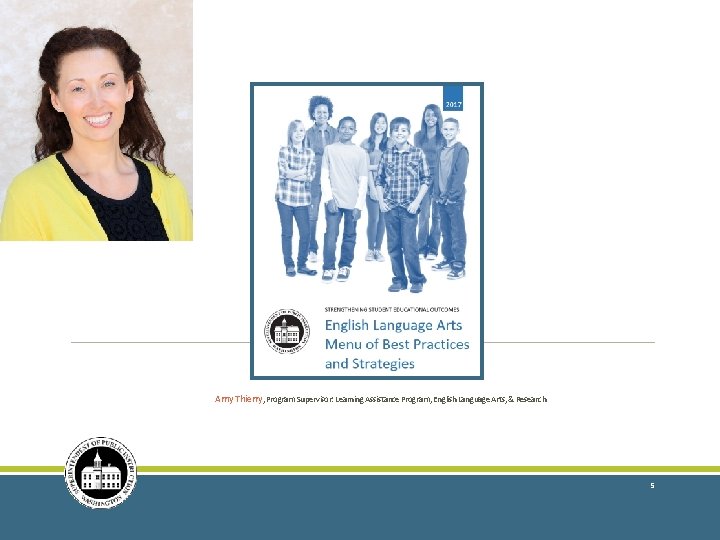
Amy Thierry, Program Supervisor: Learning Assistance Program, English Language Arts, & Research 5

Focus on Students 6
The menus were created to guide schools and districts as they strengthen student educational outcomes. 7
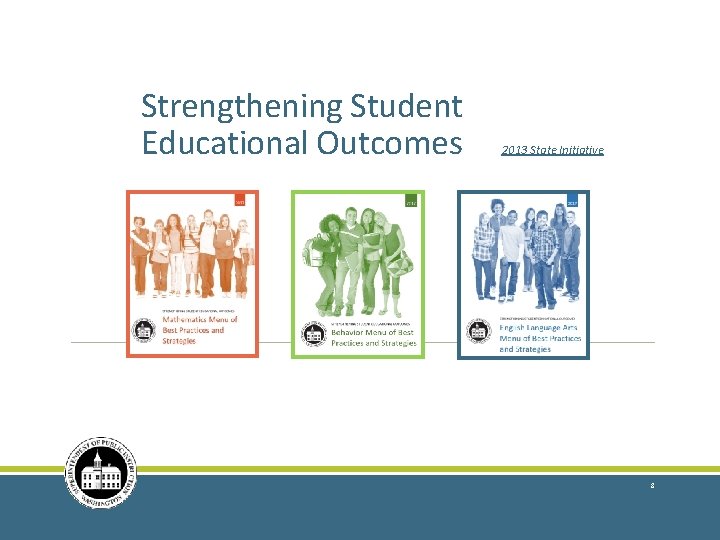
Strengthening Student Educational Outcomes 2013 State Initiative 8
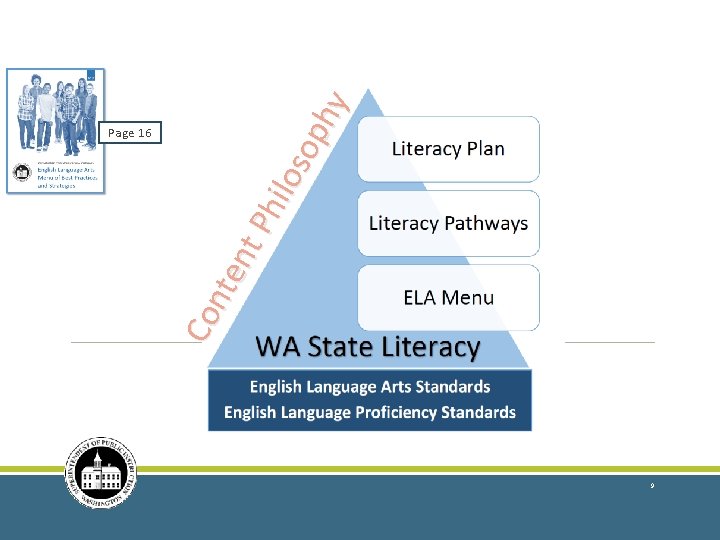
Co n te nt Ph i lo s op hy Page 16 9
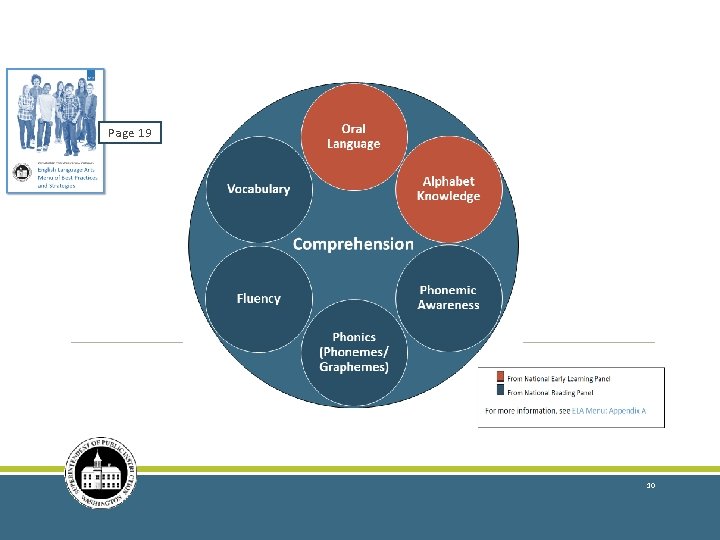
Page 19 10
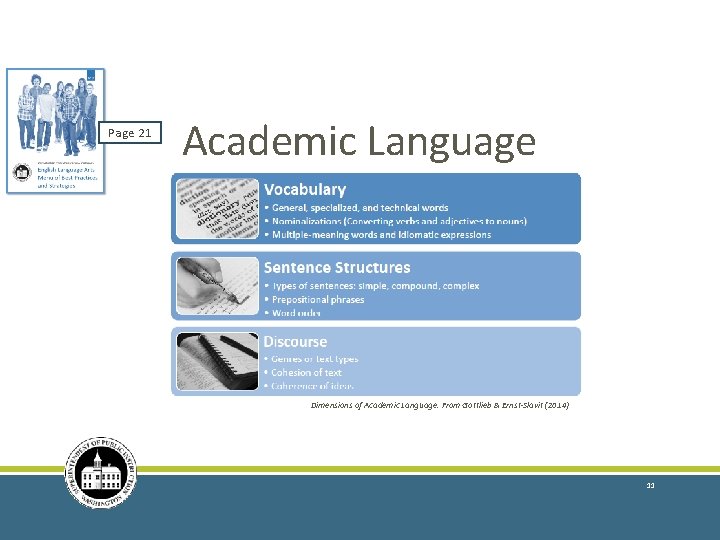
Page 21 Academic Language Dimensions of Academic Language. From Gottlieb & Ernst-Slavit (2014) 11
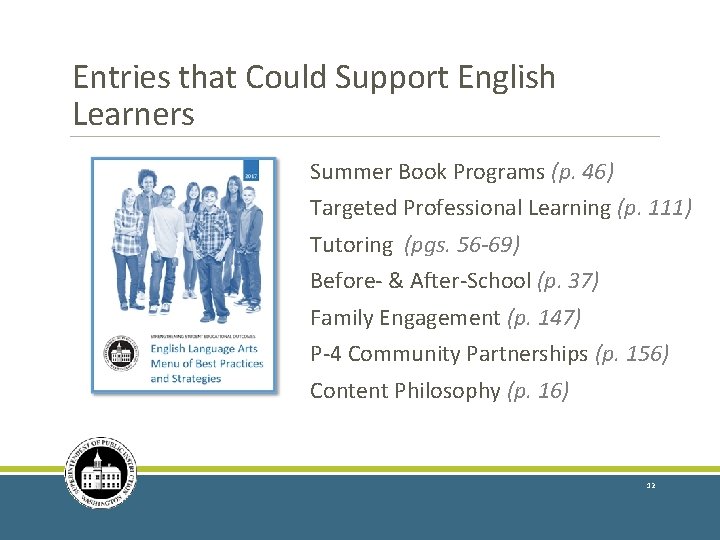
Entries that Could Support English Learners Summer Book Programs (p. 46) Targeted Professional Learning (p. 111) Tutoring (pgs. 56 -69) Before- & After-School (p. 37) Family Engagement (p. 147) P-4 Community Partnerships (p. 156) Content Philosophy (p. 16) 12
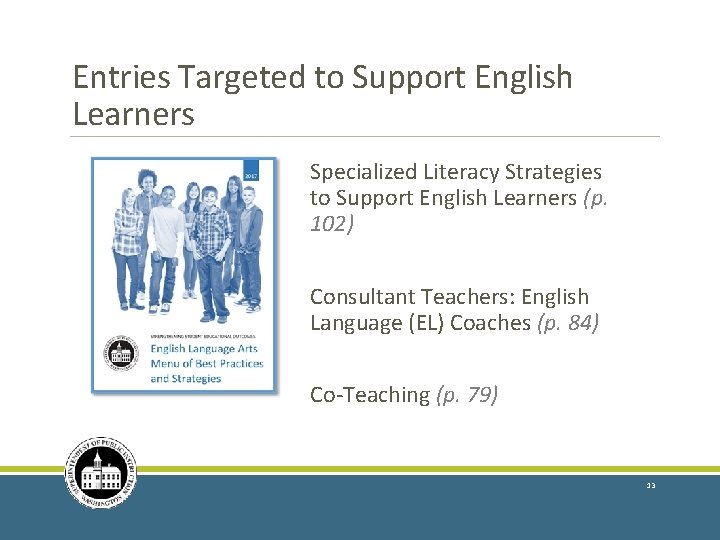
Entries Targeted to Support English Learners Specialized Literacy Strategies to Support English Learners (p. 102) Consultant Teachers: English Language (EL) Coaches (p. 84) Co-Teaching (p. 79) 13
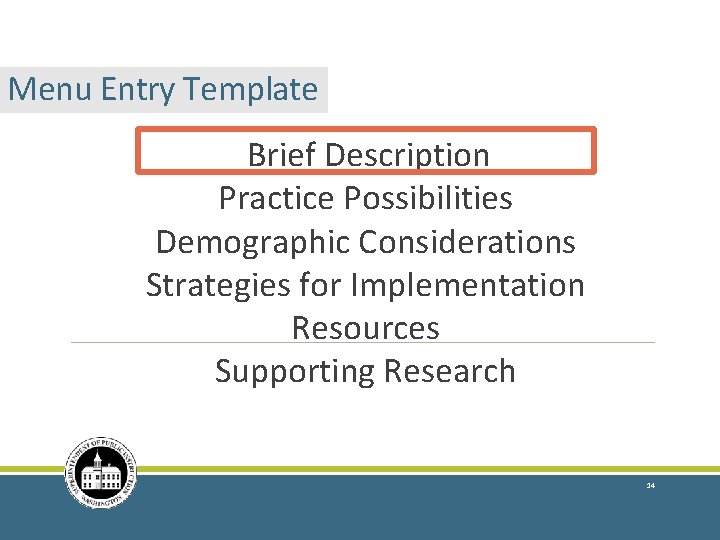
Menu Entry Template Brief Description Practice Possibilities Demographic Considerations Strategies for Implementation Resources Supporting Research 14
15
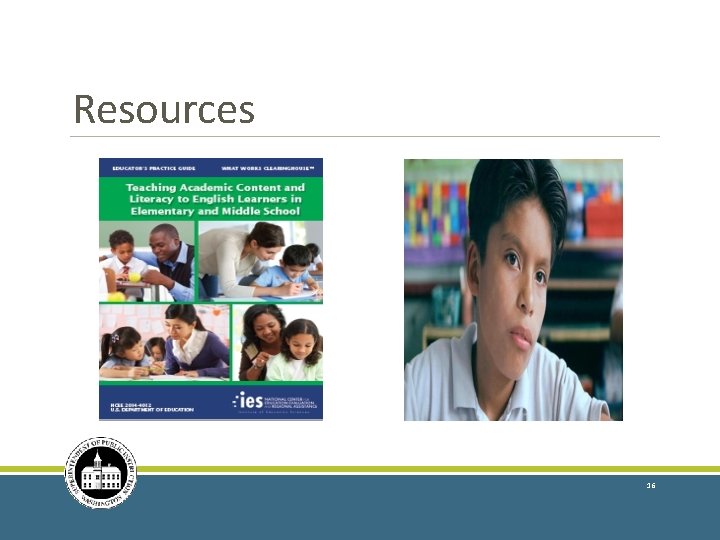
Resources 16
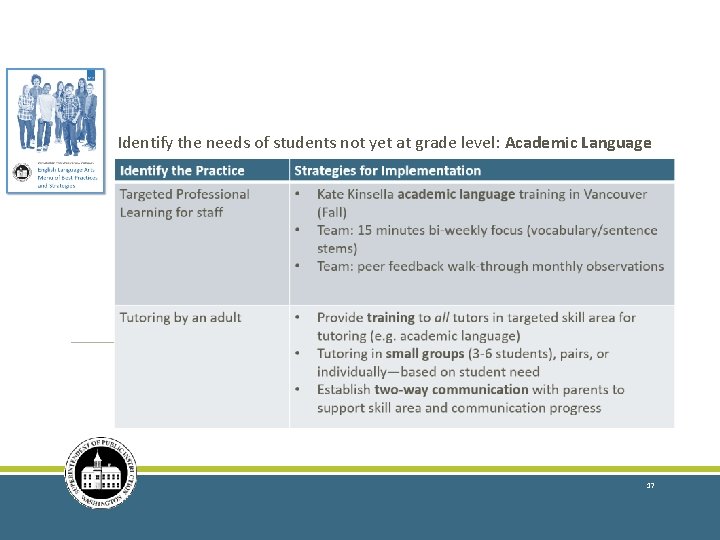
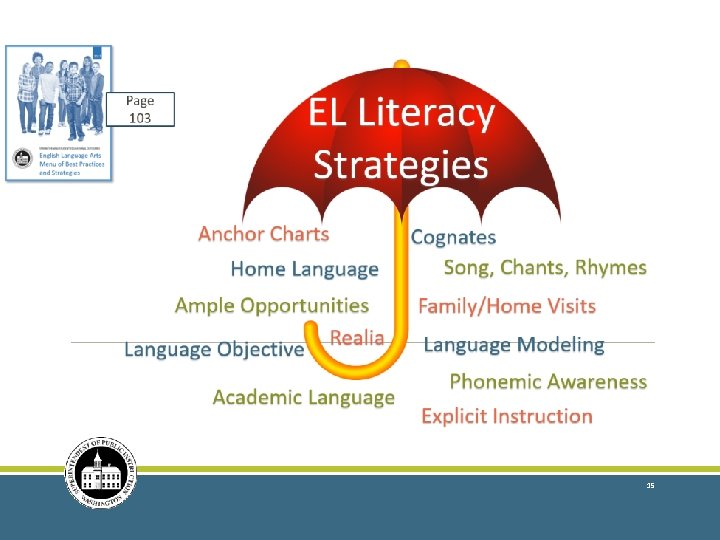
Identify the needs of students not yet at grade level: Academic Language 17
Ask: How can the LAP team partner with you to support EL students? Do you have examples of the strategies in action? If so, can you share them with us? Do you have implementation anecdotes that can help guide/inspire other educators? 18
Equity and Access for All Highly Capable Students Migrant and Bilingual Education Program Updates October 20, 2017 OFFICE OF SUPERINTENDENT OF PUBLIC INSTRUCTION JODY HESS, PROGRAM SUPERVISOR JASON MILLER, PROGRAM SUPERVISOR 19
Changes in State Law ENGROSSED HOUSE BILL 2242, SECTION 412 20
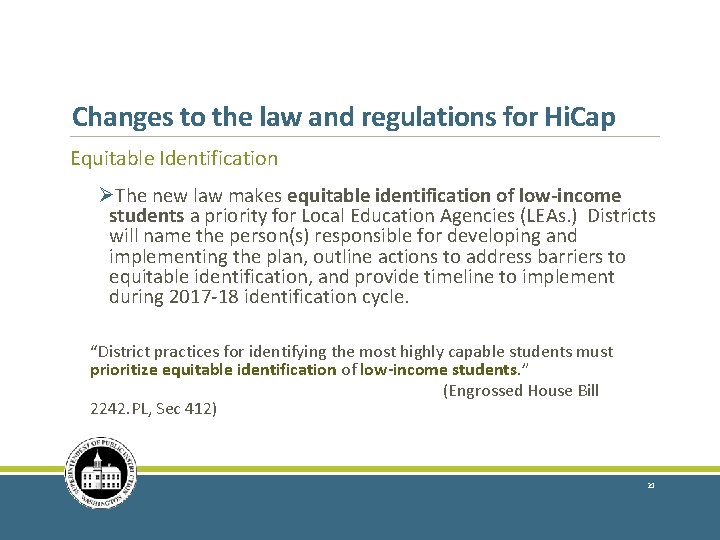
Changes to the law and regulations for Hi. Cap Equitable Identification ØThe new law makes equitable identification of low-income students a priority for Local Education Agencies (LEAs. ) Districts will name the person(s) responsible for developing and implementing the plan, outline actions to address barriers to equitable identification, and provide timeline to implement during 2017 -18 identification cycle. “District practices for identifying the most highly capable students must prioritize equitable identification of low-income students. ” (Engrossed House Bill 2242. PL, Sec 412) 21
Definition of Terms Prioritize: emphasize, treat as more important than other things ØDistricts must plan and implement change in practice and procedure during the identification cycle this school year to serve students next year. ØIn other words, put this at the top of your “to do” list for 2017 -18 school year. 22
Definition of Terms Equitable identification: fair, unbiased, free from favoritism ØTreating all students the same is not equitable access. Relying mostly on standardized test data is not equitable access. ØIt does not value data that can be important to recognize and support potential in underserved subgroups. ØAuthentic performance assessment can uncover ability. 23
Definition of Terms Low-income students: According to the law, students who are eligible for free or reduced-price meal program are low-income. ØHowever, individually identifiable eligibility for free or reduced-priced lunch is subject to federal privacy regulations. 24
Definition of Terms ØSo, how can schools address this directive without individually profiling students? ØBy identifying and removing systemic barriers in current practices; ØBy understanding that ability is dynamic and develops over time; ØBy recognizing that certain observable traits of ability cross cultural boundaries and may successfully identify diverse students, including low -income. 25
Form Package 217 new page 7 (continued) LEAs may have systemic barriers to identifying low-income students, such as: ØLimited communication about referral process, ØTesting outside school day, ØReliance on standardized testing only, ØNo routine review of existing data, ØCommunication in English only, Ø“Cut off” scores on standardized tests, ØLack of information by school front office staff. 26
Form Package 217 new page 7 (continued) Possible actions to reduce barriers to identifying low-income students: ØUniversal screening ØReview Wa. KIDS and Smarter Balanced assessment data ØTest during school day in home school ØLook for “Twice Exceptional” students (students with IEPs who are Highly Capable in content area) ØTrain staff and solicit referrals from them ØUse alternative assessments for English Learners ØConsider all new students by including referral information in enrollment packets ØReach out to families by informed native language speaker 27
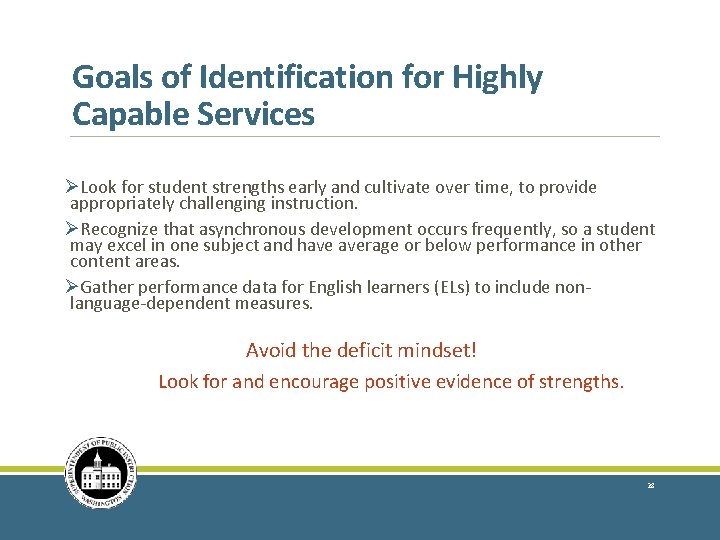
Goals of Identification for Highly Capable Services ØLook for student strengths early and cultivate over time, to provide appropriately challenging instruction. ØRecognize that asynchronous development occurs frequently, so a student may excel in one subject and have average or below performance in other content areas. ØGather performance data for English learners (ELs) to include nonlanguage-dependent measures. Avoid the deficit mindset! Look for and encourage positive evidence of strengths. 28
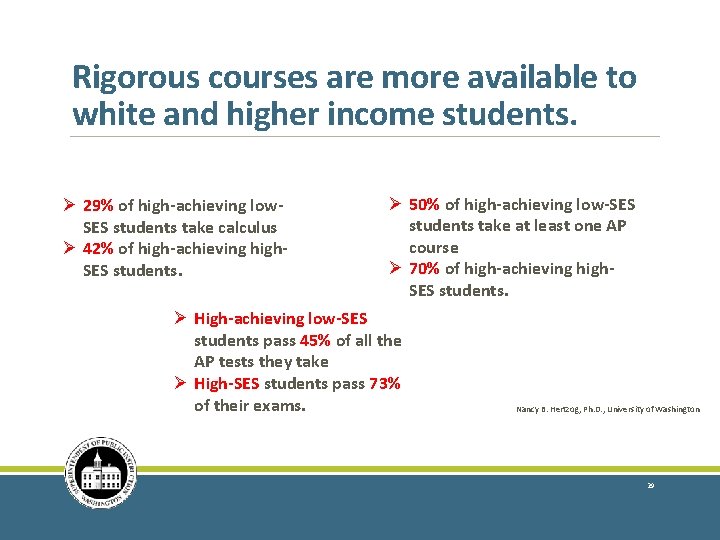
Rigorous courses are more available to white and higher income students. Ø 29% of high-achieving low. SES students take calculus Ø 42% of high-achieving high. SES students. Ø 50% of high-achieving low-SES students take at least one AP course Ø 70% of high-achieving high. SES students. Ø High-achieving low-SES students pass 45% of all the AP tests they take Ø High-SES students pass 73% of their exams. Nancy B. Hertzog, Ph. D. , University of Washington 29

U. S. Department of Justice Civil Rights Division U. S. Department of Education Office for Civil Rights DEAR COLLEAGUE LETTER: ENGLISH LEARNER S TUDE NTS AND LIMIT ED ENG LIS H PR OFICIENT PARENTS 30
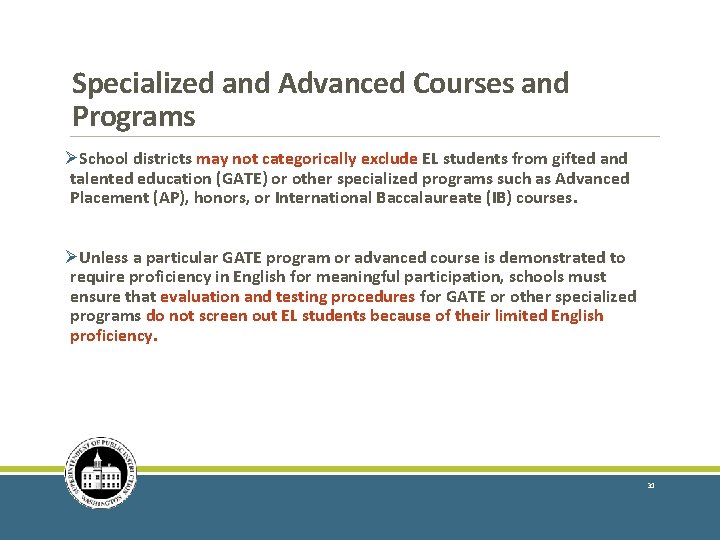
Specialized and Advanced Courses and Programs ØSchool districts may not categorically exclude EL students from gifted and talented education (GATE) or other specialized programs such as Advanced Placement (AP), honors, or International Baccalaureate (IB) courses. ØUnless a particular GATE program or advanced course is demonstrated to require proficiency in English for meaningful participation, schools must ensure that evaluation and testing procedures for GATE or other specialized programs do not screen out EL students because of their limited English proficiency. 31

Resources for Finding High Potential among Culturally, Linguistically and Economically Diverse Students 32
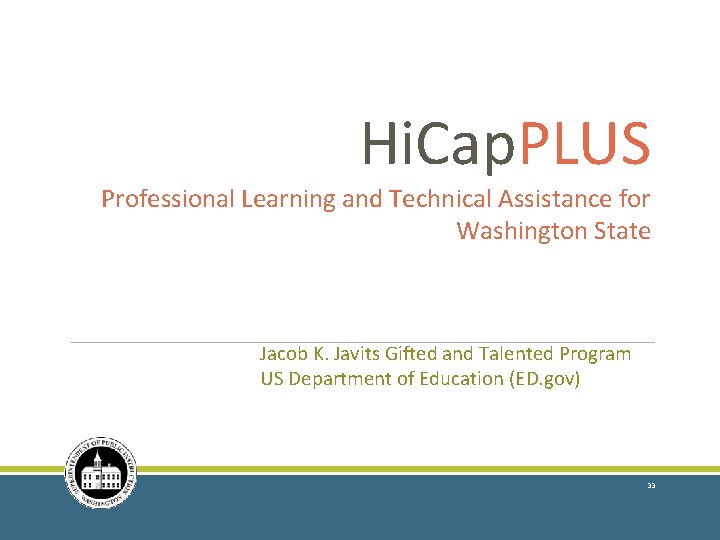
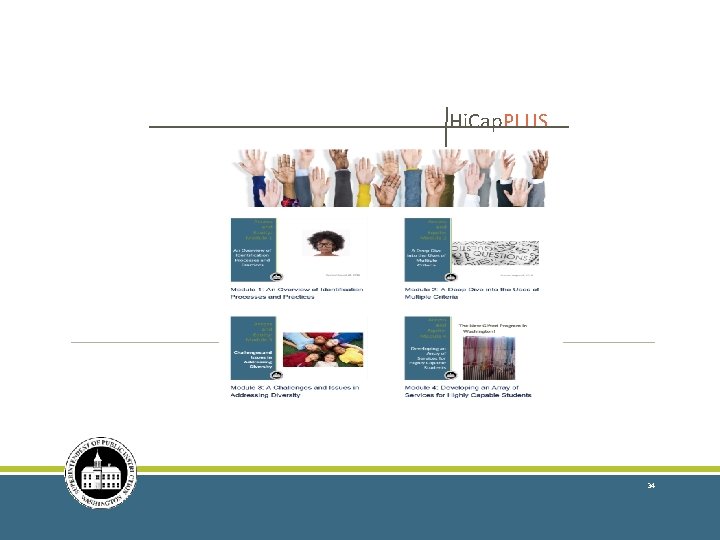
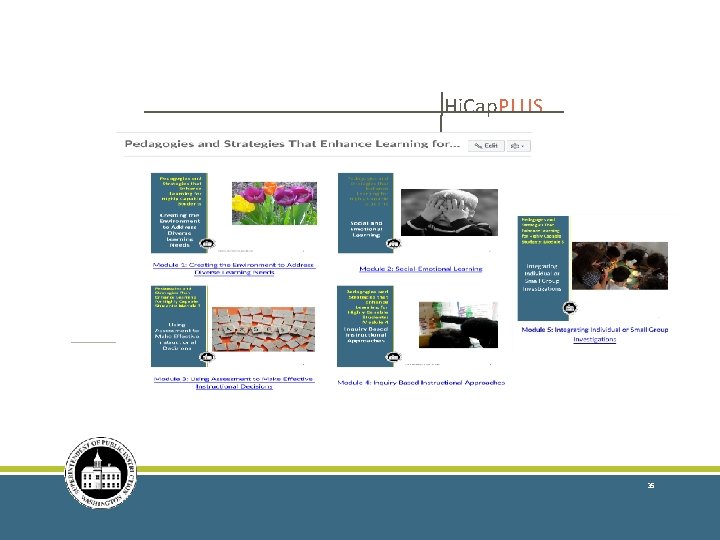
Hi. Cap. PLUS Professional Learning and Technical Assistance for Washington State Jacob K. Javits Gifted and Talented Program US Department of Education (ED. gov) 33
Hi. Cap. PLUS 34
Hi. Cap. PLUS 35
Articles on research-based strategies to increase identification of diverse Highly Capable students (Module 1, Access and Equity) Beyond the Gifted Stereotype, Carolyn M. Callahan http: //educationalleader. com/subtopicintro/read/ASCD_334_1. pdf Can Universal Screening Increase the Representation of Low-Income and Minority Students in Gifted Education? David Card, Laura Giuliano https: //www. ncbi. nlm. nih. gov/pmc/articles/PMC 5137751/ Unlocking Emergent Talent: Supporting High Achievement of Low-Income, High-Ability Students, Paula Olszewski-Kubilius and Jane Clarenbach http: //files. eric. ed. gov/fulltext/ED 537321. pdf 36
Big Ideas – Mind Shifts ØShift from identifying gifted to identifying children who need advanced learning. ØShift from gifted program to services for advanced learners. ØFocus on teaching and creating classrooms that challenge children – Instruction matters to develop talent. Nancy B. Hertzog, Ph. D. , University of Washington 37
Thanks for joining us. ? Questions Email us! We are collecting FAQs to answer. 38
Contact Us CALL US JODY HESS, PROGRAM SUPERVISOR JODY. HESS@K 12. WA. US 360 -725 -6171 JASON MILLER, PROGRAM SUPERVISOR JASON. MILLER@K 12. WA. US 360 -725 -6232 39
Bilingual Program Updates ◦ Guideline Updates ◦ Immigrant and Native Americans ◦ Identification and Exited Students ◦ Transferability Reminder ◦ Endorsement Requirement Reminder ◦ PESB Retooling Scholarship Reminder ◦ Possible Eligible, Not Reported (PENR) Timeline and Report ◦ Immigrant Competitive Grant ◦ Consolidated Program Review Trainings ◦ Upcoming EL-Related Professional Learning Opportunities ◦ Recent CEDARS and LEP Application Webinar 40
Guidelines Updates Immigrant and Native Americans • Citations have been updated in the Immigrant, Native American, Identification, Family Engagement, and Private School Guidelines, e. g. : from Title IX to Title VIII. • Immigrant guidelines – Changed from a “ 2% increase” to a “significant increase” • Immigrant guidelines – Added “Recruitment of, and support for personnel…” from “support for personnel…” • Added “Identification, development, and acquisition of curricular materials” • Conformed the guidelines to match a CEDARS change: “Element B 34 – Number of Months Non US Attendance in School” (required for students whose birth country is not the United States) • Native American Guidelines – Changed “Limited English Proficient” to “English learner”. 41
Guidelines Updates Identification and Exited Students • Changed “placement test” to “screener” • Changed “What language did your child first learn to speak? ” to “What language did your child learn first? ” (The guidelines were changed to match our state’s home language survey from November 2016. ) • Changed “Levels 1, 2, 3, and 4” to match the ELPA scores of “Emerging, Progressing, and Proficient. ” • Upcoming: We will add information on reclassification of English Learners to the “Exited Students Guidelines”. 42
Transferability Reminder • Districts may transfer Title II or Title IV funding into Title III. • Districts may not transfer Title III funding into Title II or Title IV (or any other Title program). • Talk with your program and fiscal staff about how you can take advantage of transferability for next year. 43
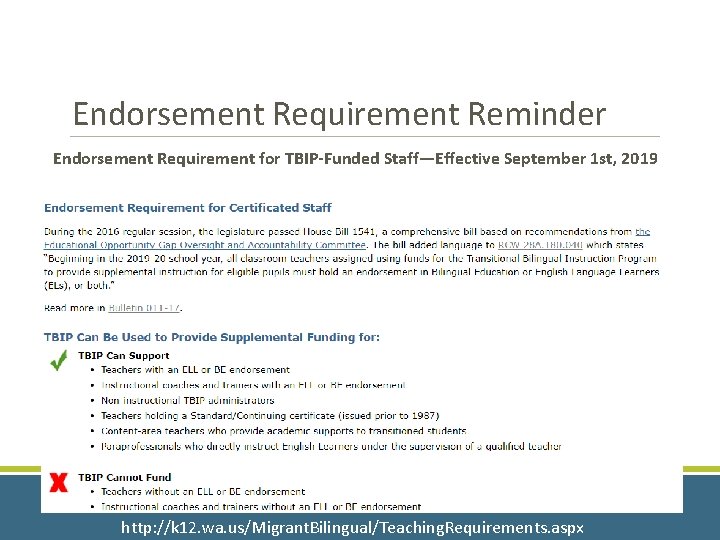
Endorsement Requirement Reminder Endorsement Requirement for TBIP-Funded Staff—Effective September 1 st, 2019 44 http: //k 12. wa. us/Migrant. Bilingual/Teaching. Requirements. aspx
PESB Retooling Scholarship Reminder The $3, 000 scholarship is available for teachers wishing to add an endorsement in English Language Learner or Bilingual Education. The teachers must be: 1) Certified 2) Employed 3) Willing to take one of the pathways that is detailed on the PESB site 4) Not have an existing service obligation. For application requirements, please visit the PESB site. Title III funds may be used to help pay for teachers to become endorsed in English Language Learner or Bilingual Education. 45 http: //pathway. pesb. wa. gov/current-educators/educator-retooling
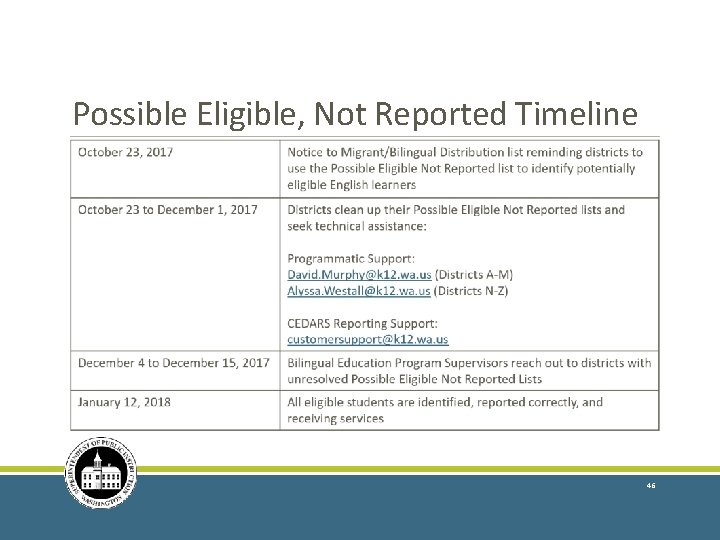
Possible Eligible, Not Reported Timeline 46
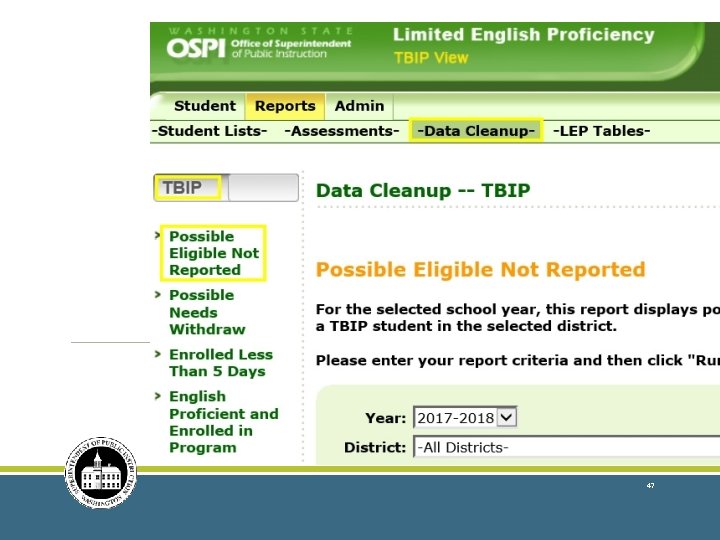
47
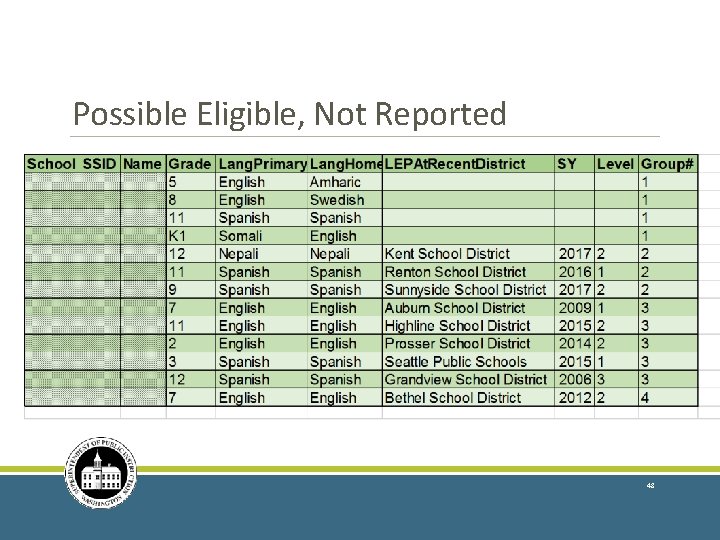
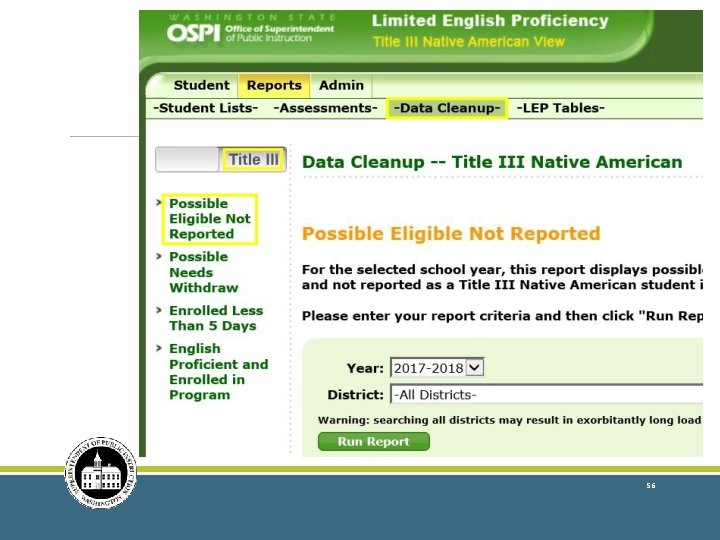
Possible Eligible, Not Reported 48
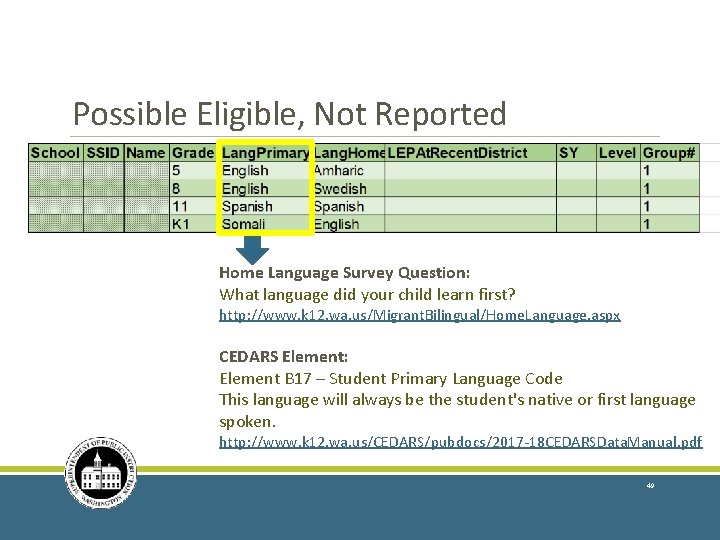
Possible Eligible, Not Reported Home Language Survey Question: What language did your child learn first? http: //www. k 12. wa. us/Migrant. Bilingual/Home. Language. aspx CEDARS Element: Element B 17 – Student Primary Language Code This language will always be the student's native or first language spoken. http: //www. k 12. wa. us/CEDARS/pubdocs/2017 -18 CEDARSData. Manual. pdf 49
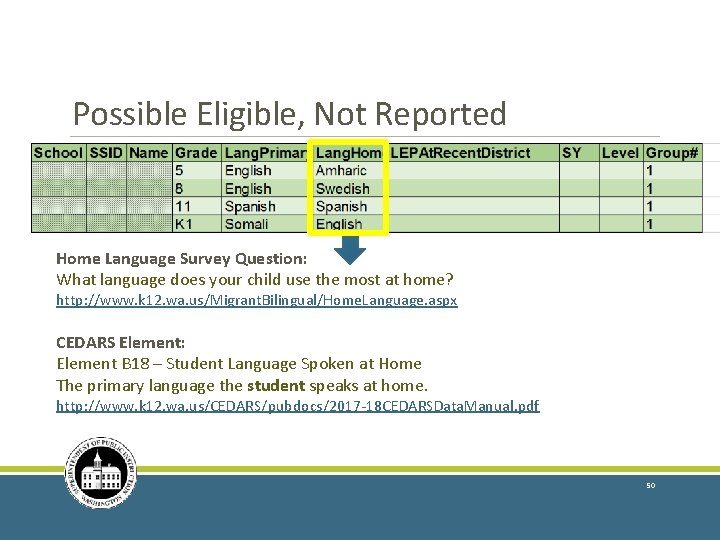
Possible Eligible, Not Reported Home Language Survey Question: What language does your child use the most at home? http: //www. k 12. wa. us/Migrant. Bilingual/Home. Language. aspx CEDARS Element: Element B 18 – Student Language Spoken at Home The primary language the student speaks at home. http: //www. k 12. wa. us/CEDARS/pubdocs/2017 -18 CEDARSData. Manual. pdf 50
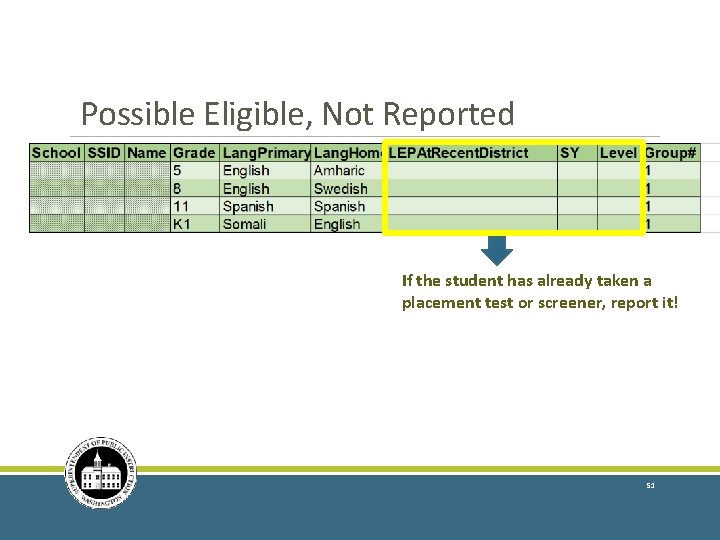
Possible Eligible, Not Reported If the student has already taken a placement test or screener, report it! 51
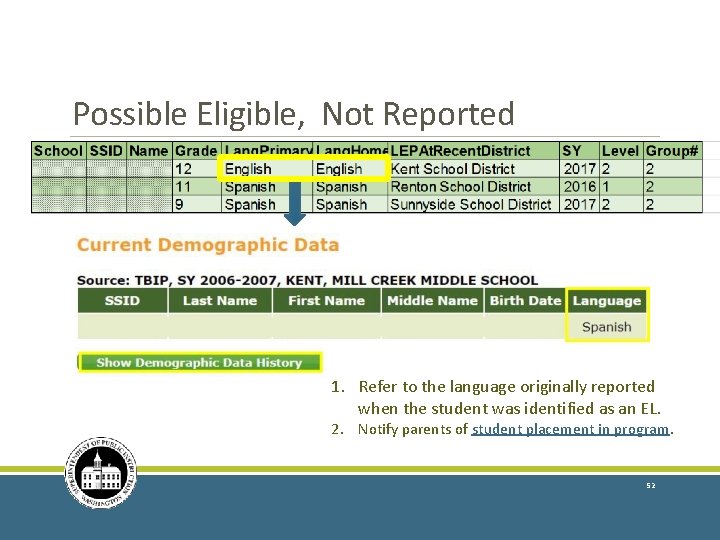
Possible Eligible, Not Reported 1. Refer to the language originally reported when the student was identified as an EL. 2. Notify parents of student placement in program. 52
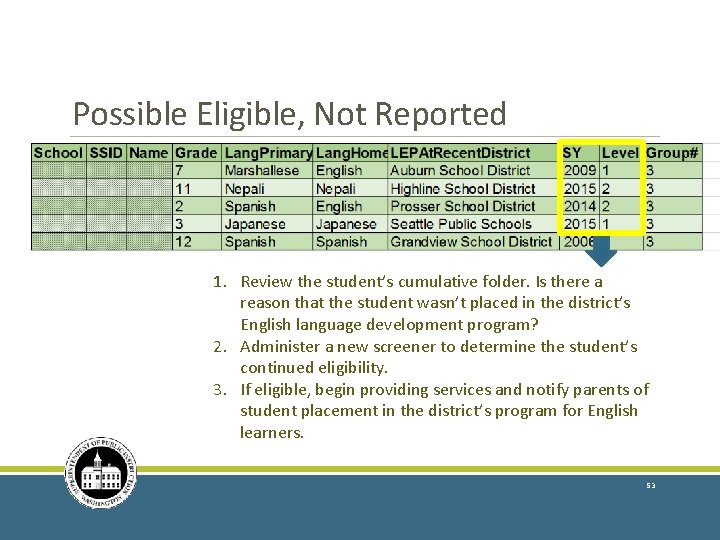
Possible Eligible, Not Reported 1. Review the student’s cumulative folder. Is there a reason that the student wasn’t placed in the district’s English language development program? 2. Administer a new screener to determine the student’s continued eligibility. 3. If eligible, begin providing services and notify parents of student placement in the district’s program for English learners. 53
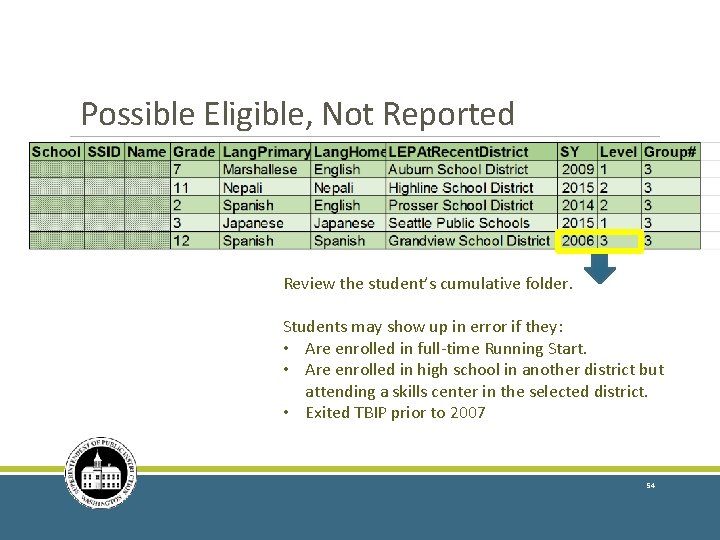
Possible Eligible, Not Reported Review the student’s cumulative folder. Students may show up in error if they: • Are enrolled in full-time Running Start. • Are enrolled in high school in another district but attending a skills center in the selected district. • Exited TBIP prior to 2007 54
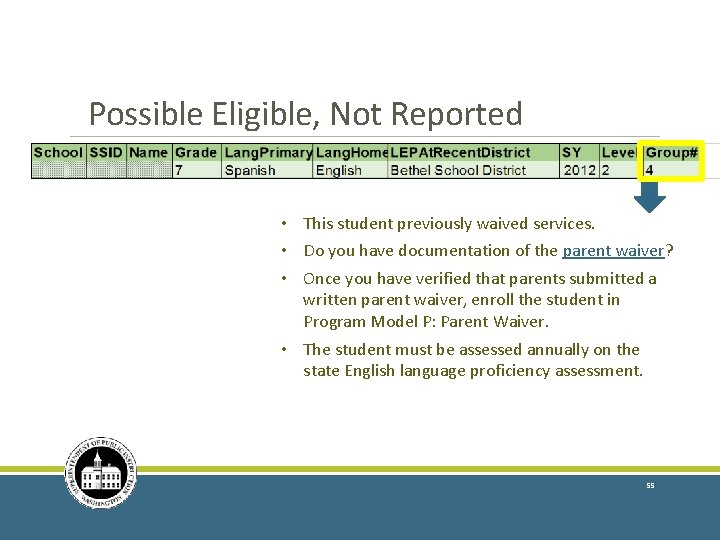
Possible Eligible, Not Reported • This student previously waived services. • Do you have documentation of the parent waiver? • Once you have verified that parents submitted a written parent waiver, enroll the student in Program Model P: Parent Waiver. • The student must be assessed annually on the state English language proficiency assessment. 55
56
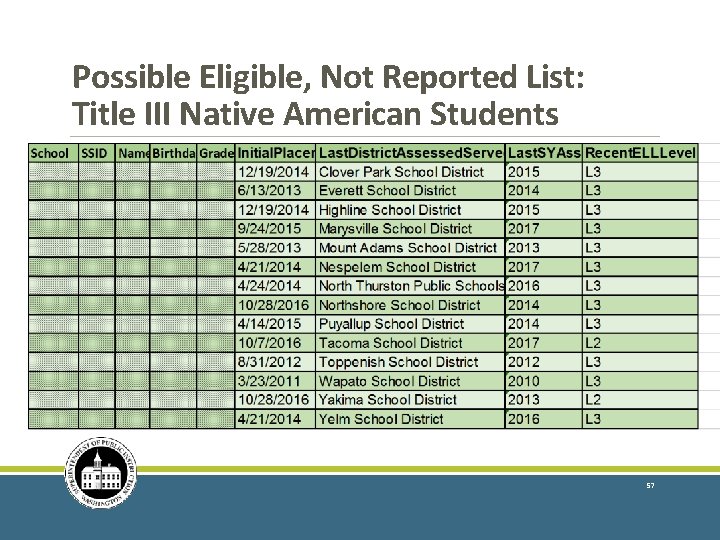
Possible Eligible, Not Reported List: Title III Native American Students 57
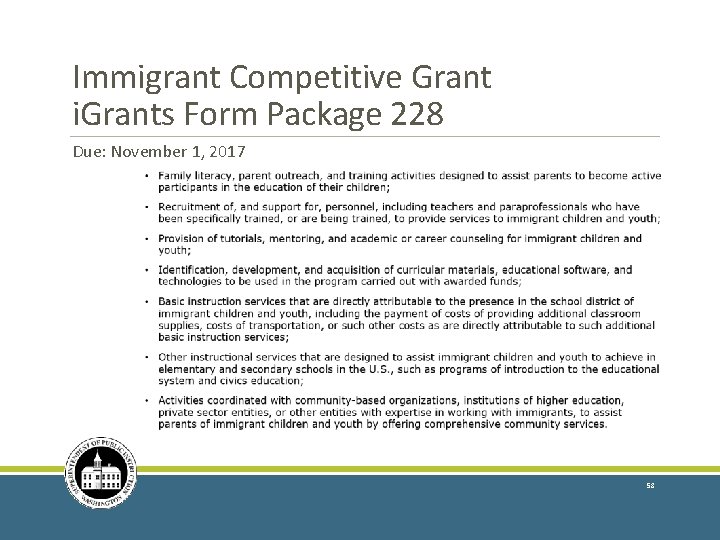
Immigrant Competitive Grant i. Grants Form Package 228 Due: November 1, 2017 58
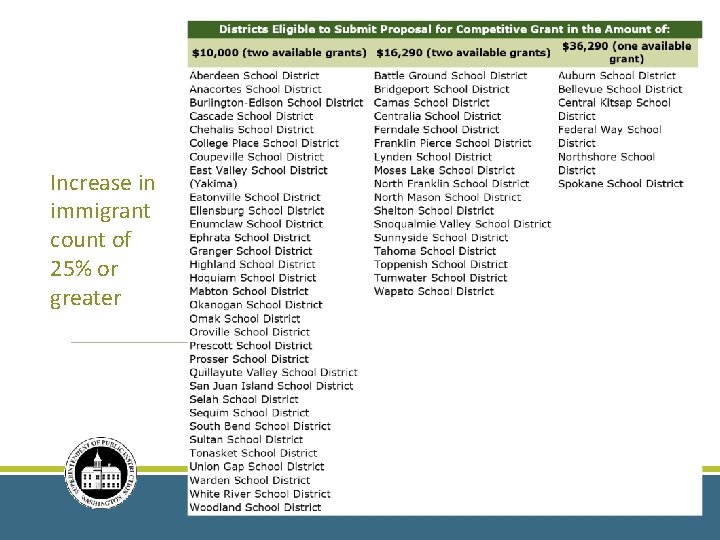
Increase in immigrant count of 25% or greater 59
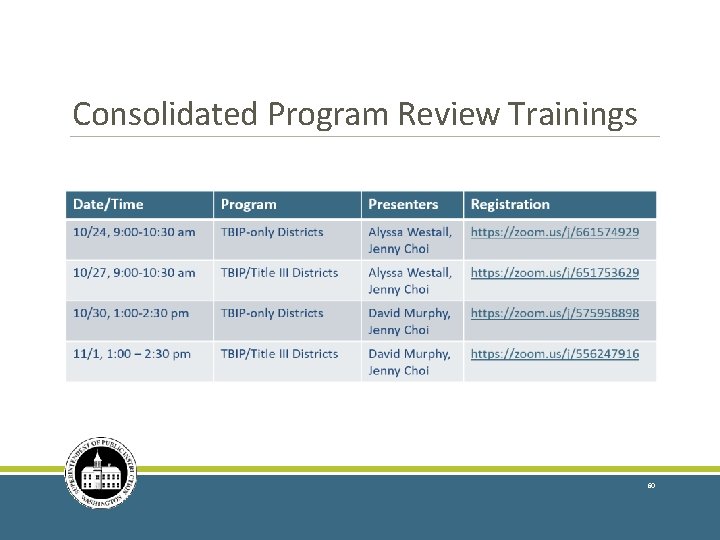
Consolidated Program Review Trainings 60
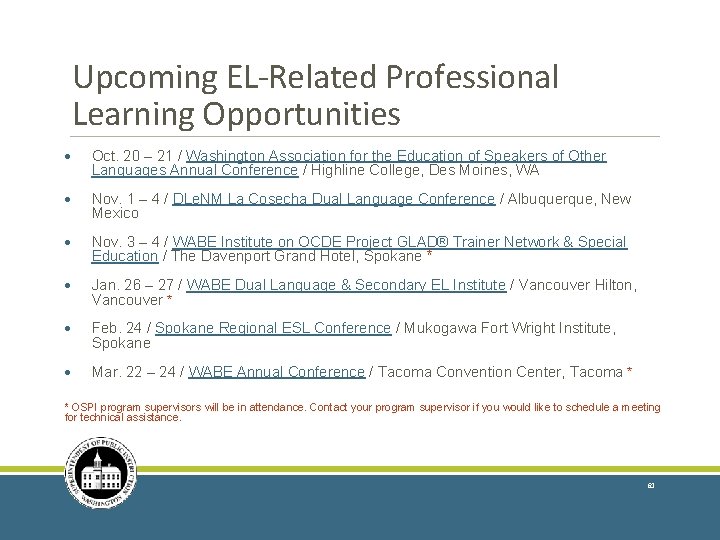
Upcoming EL-Related Professional Learning Opportunities Oct. 20 – 21 / Washington Association for the Education of Speakers of Other Languages Annual Conference / Highline College, Des Moines, WA Nov. 1 – 4 / DLe. NM La Cosecha Dual Language Conference / Albuquerque, New Mexico Nov. 3 – 4 / WABE Institute on OCDE Project GLAD® Trainer Network & Special Education / The Davenport Grand Hotel, Spokane * Jan. 26 – 27 / WABE Dual Language & Secondary EL Institute / Vancouver Hilton, Vancouver * Feb. 24 / Spokane Regional ESL Conference / Mukogawa Fort Wright Institute, Spokane Mar. 22 – 24 / WABE Annual Conference / Tacoma Convention Center, Tacoma * * OSPI program supervisors will be in attendance. Contact your program supervisor if you would like to schedule a meeting for technical assistance. 61
CEDARS and LEP Application Recent Webinar (held 10/12/2017) ◦ ◦ Hosted by OSPI staff from: Bilingual Program, Student Information and Customer Support Covered basic CEDARS reporting and helpful reports in the LEP Application Link to Power. Point: Statewide Informational Webinar: LEP Application and File J Future webinars 62
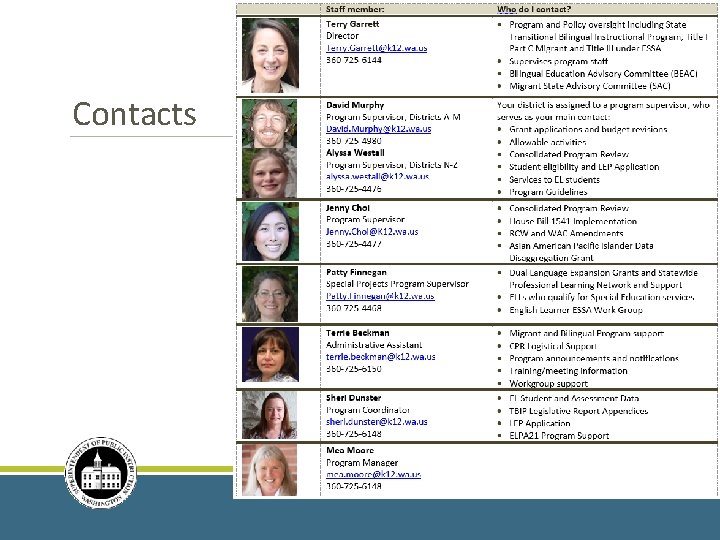
Contacts 63
ELPA 21 Updates LESLIE HUFF, PH. D. ELPA COORDINATOR 64
Surveys In the spring, many of you took the time to provide OSPI with feedback about your experiences with the ELPA 21 assessment. We have heard your feedback and are working to integrate what we can as permitted. Below are some of the things we are working on as a result of your feedback on the surveys in the spring: 1. 2. 3. 4. Revising the score reports with particular emphasis on what is going home to families. Adopting a new alternate assessment for ELs with significant cognitive challenges. More timely communication. Test format and length 65
ALT Assessment for ELs with Significant Cognitive Disabilities In an effort to comply with federal regulations, OSPI has opted to implement the WIDA Alt ACCESS for ELs assessment for those ELs with significant cognitive disabilities. We plan to implement this new assessment in spring of 2018 The WIDA Alt ACCESS will require collaboration among (at a minimum) EL, Special Education, and Assessment divisions in schools and districts. We anticipate training for this assessment, and a calendar will be forthcoming. More information will soon be available through the ELPA 21 list serve. 66
Screener Survey The screener survey is currently open for feedback until October 31. We are looking for participation from anyone who has been involved in the ELAP 21, especially those at the district level. (NOTE: if you are at the district level, please mark one of the two district level options as your “role” so you can access the district-level questions on the survey). Survey link: http: //www. surveygizmo. com/s 3/3828209/ELPA 21 -Screener-Post-Administration. Survey 67
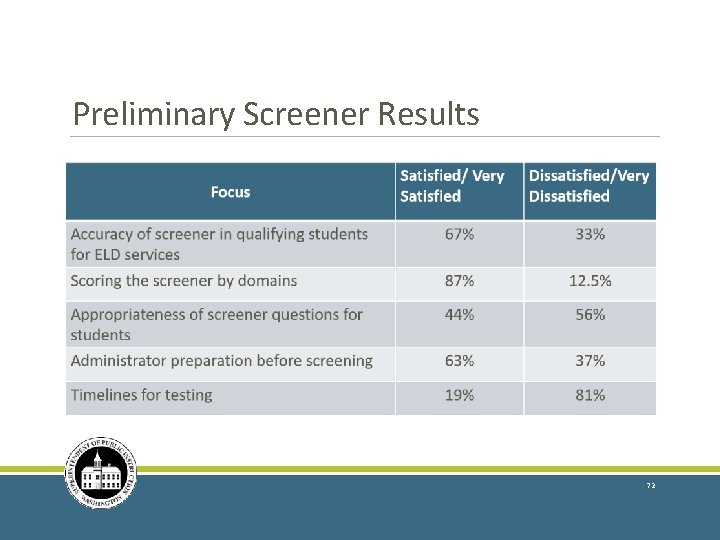
Preliminary Screener Survey Results Your feedback during the screener process is already contributing to discussions for future development including: ◦ Shortening the practice section ◦ Developing a way to generate a score report for students who are non-responsive to test items. ◦ Adjusting timelines to accommodate spring screening of kindergarten students. We will continue to review the survey responses to inform future decision-making, but we have some preliminary results today. 68
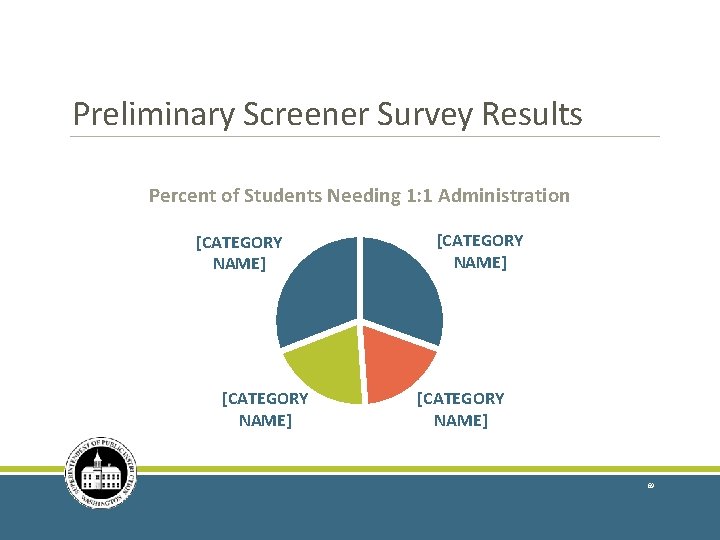
Preliminary Screener Survey Results Percent of Students Needing 1: 1 Administration [CATEGORY NAME] 69
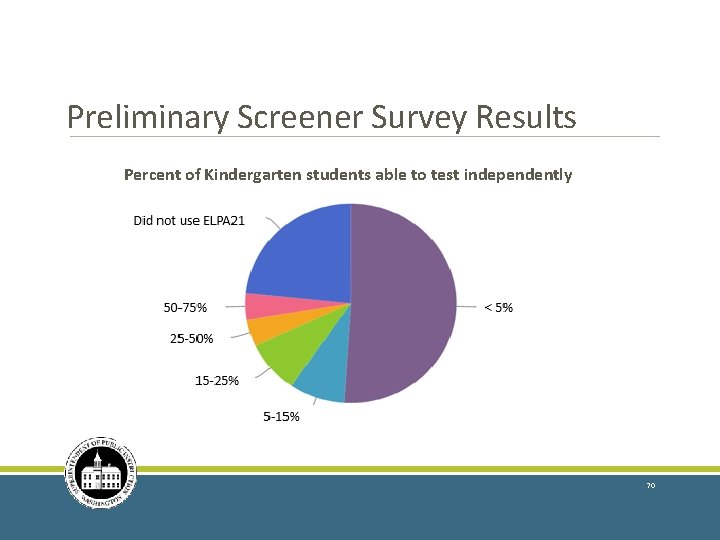
Preliminary Screener Survey Results Percent of Kindergarten students able to test independently 70
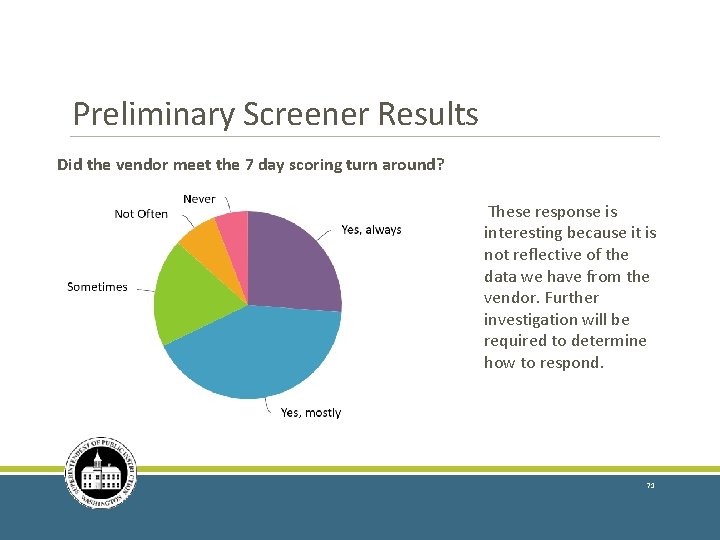
Preliminary Screener Results Did the vendor meet the 7 day scoring turn around? These response is interesting because it is not reflective of the data we have from the vendor. Further investigation will be required to determine how to respond. 71
Preliminary Screener Results 72
Screener Survey All of the information from the screener responses presented here today are preliminary. The screener is open for another two weeks if you would like to contribute your experiences. Greater exploration is needed on the more lengthy responses from the survey. All responses will be read and coded to better understand the experiences and needs of the field. Remember to respond to the survey and share the link broadly with all district colleagues involved in the first administration of the ELPA 21 screener. Survey link: http: //www. surveygizmo. com/s 3/3828209/ELPA 21 -Screener-Post-Administration-Survey Thank you for your time and effort 73
- Slides: 73