
Migraine Pathophysiology An Update BASH Teaching Meeting Hull
Migraine Pathophysiology An Update BASH Teaching Meeting Hull 22 January 2009 Professor Peter J. Goadsby Peter. Goadsby@headache. ucsf. edu Department of Neurology
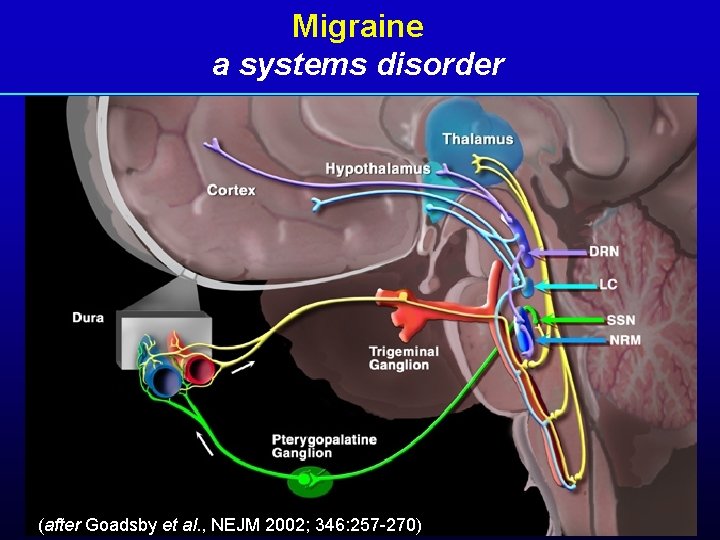
Migraine a systems disorder (after Goadsby et al. , NEJM 2002; 346: 257 -270)
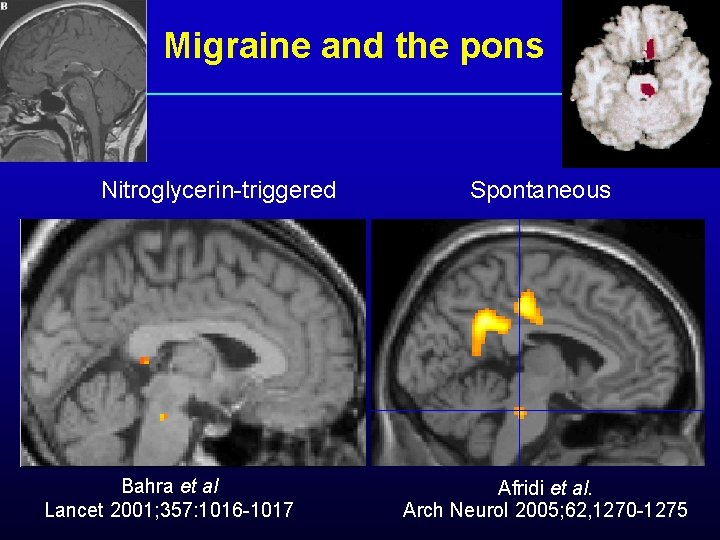
Migraine and the pons Nitroglycerin-triggered Bahra et al Lancet 2001; 357: 1016 -1017 Spontaneous Afridi et al. Arch Neurol 2005; 62, 1270 -1275
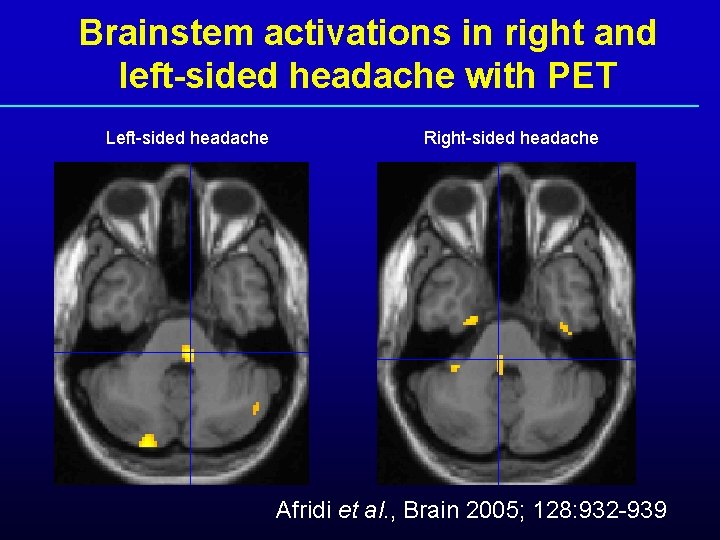
Brainstem activations in right and left-sided headache with PET Left-sided headache Right-sided headache Afridi et al. , Brain 2005; 128: 932 -939
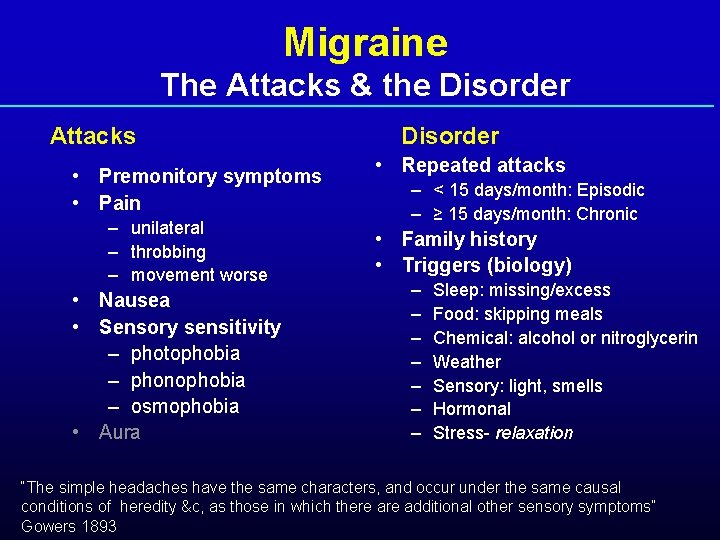
Migraine The Attacks & the Disorder Attacks • Premonitory symptoms • Pain – unilateral – throbbing – movement worse • Nausea • Sensory sensitivity – photophobia – phonophobia – osmophobia • Aura Disorder • Repeated attacks – < 15 days/month: Episodic – ≥ 15 days/month: Chronic • Family history • Triggers (biology) – – – – Sleep: missing/excess Food: skipping meals Chemical: alcohol or nitroglycerin Weather Sensory: light, smells Hormonal Stress- relaxation “The simple headaches have the same characters, and occur under the same causal conditions of heredity &c, as those in which there additional other sensory symptoms” Gowers 1893

Migraine Classification Feature full headache Throbbing, unilateral, photophobia, phonophobia, movement effect Is there Medication Overuse? Analgesics ten days or more per month Episodic Migraine with aura Is there headache on 15 days or more per month? Chronic Migraine (15+ days/month) Migraine without aura
Migraine Pathophysiolgy- Update • Genetics • Pain mechanisms • Treatment
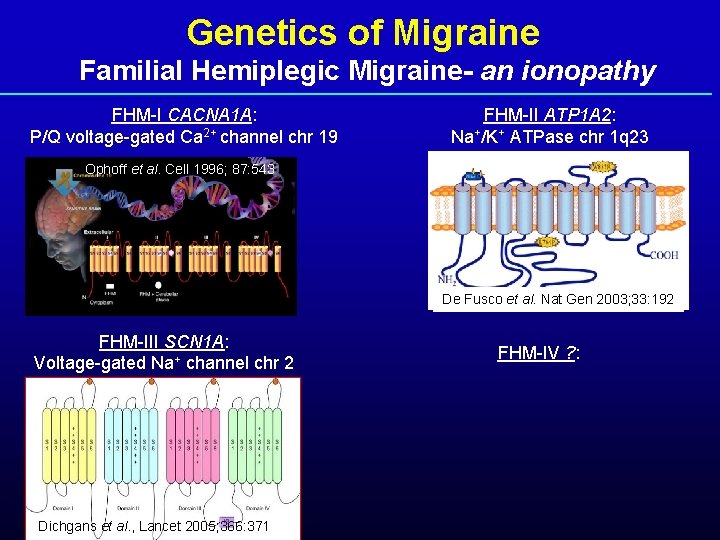
Genetics of Migraine Familial Hemiplegic Migraine- an ionopathy FHM-I CACNA 1 A: P/Q voltage-gated Ca 2+ channel chr 19 FHM-II ATP 1 A 2: Na+/K+ ATPase chr 1 q 23 Ophoff et al. Cell 1996; 87: 543 De Fusco et al. Nat Gen 2003; 33: 192 FHM-III SCN 1 A: Voltage-gated Na+ channel chr 2 Dichgans et al. , Lancet 2005; 366: 371 FHM-IV ? :
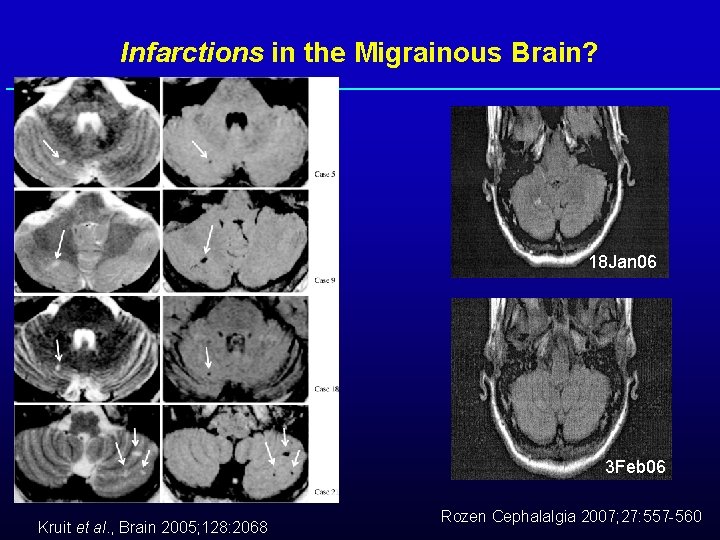
Infarctions in the Migrainous Brain? 18 Jan 06 3 Feb 06 Kruit et al. , Brain 2005; 128: 2068 Rozen Cephalalgia 2007; 27: 557 -560

Migraine aura Silberstein et al. , Headache in Clinical Practice 2 nd Ed 2002
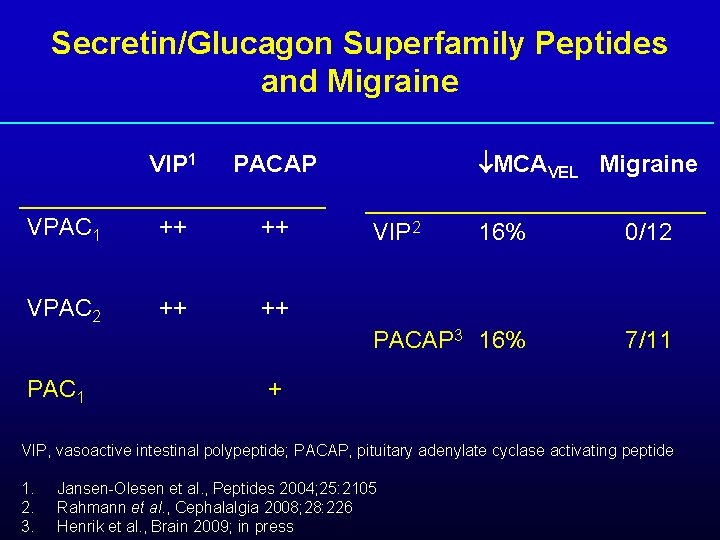
Secretin/Glucagon Superfamily Peptides and Migraine VIP 1 PACAP VPAC 1 ++ ++ VPAC 2 ++ ++ PAC 1 MCAVEL Migraine VIP 2 16% 0/12 PACAP 3 16% 7/11 + VIP, vasoactive intestinal polypeptide; PACAP, pituitary adenylate cyclase activating peptide 1. 2. 3. Jansen-Olesen et al. , Peptides 2004; 25: 2105 Rahmann et al. , Cephalalgia 2008; 28: 226 Henrik et al. , Brain 2009; in press
Migraine Pathophysiolgy- Update • Genetics • Disease mechanisms ØPremonitory symptoms – The neck – Allodynia – Medication overuse • Treatment
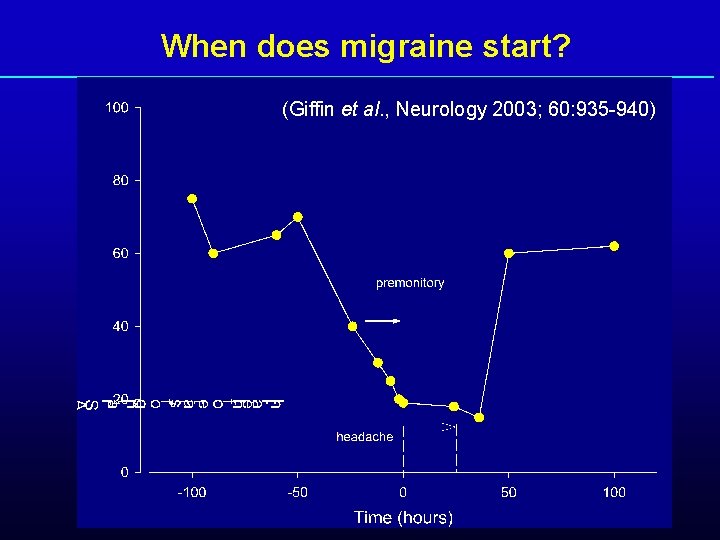
When does migraine start? (Giffin et al. , Neurology 2003; 60: 935 -940)

% patients Are there Phases of a Migraine Attack? (Giffin et al. , Neurology 2003; 60: 935 -940)

Dose-dependent dopaminergic modulation of trigeminocervical complex neurons MMA: middle meningeal artery D 1 Dopamine Neu. N D 2 Bergerot et al. Ann Neurol 2007; 61: 251 -262
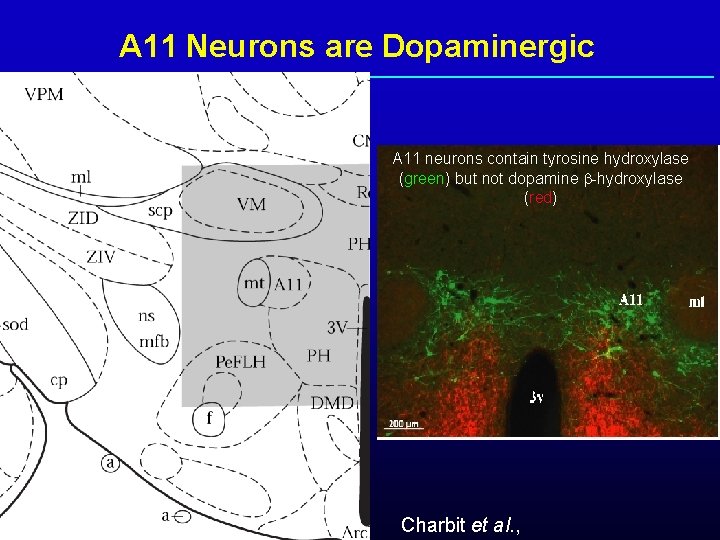
A 11 Neurons are Dopaminergic A 11 neurons contain tyrosine hydroxylase (green) but not dopamine b-hydroxylase (red) Charbit et al. ,
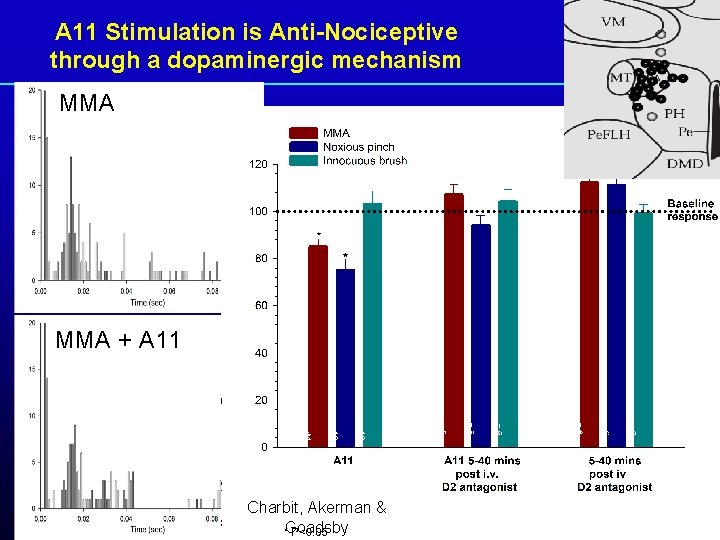
A 11 Stimulation is Anti-Nociceptive through a dopaminergic mechanism MMA + A 11 Charbit, Akerman & Goadsby
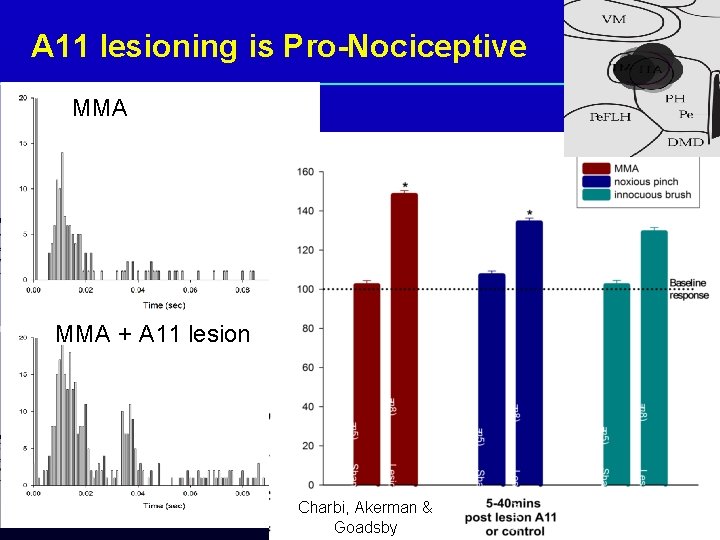
A 11 lesioning is Pro-Nociceptive MMA + A 11 lesion Charbi, Akerman & Goadsby
Migraine Pathophysiolgy- Update • Genetics • Disease mechanisms – Premonitory symptoms ØThe neck – Allodynia – Medication overuse • Treatment
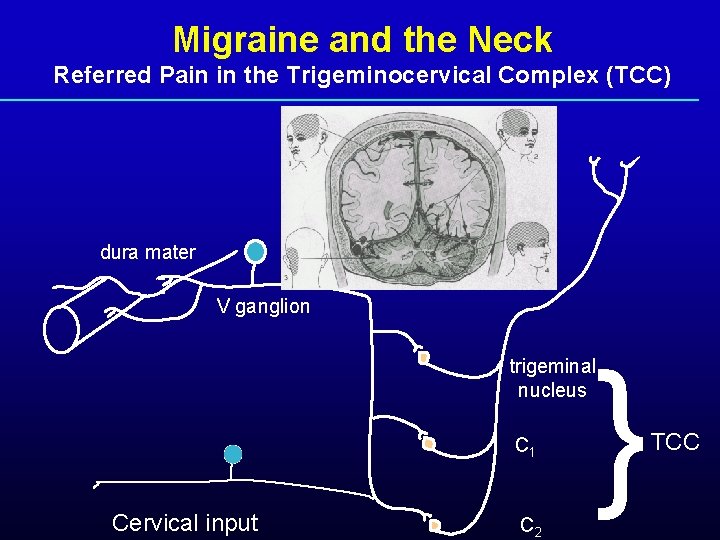
Migraine and the Neck Referred Pain in the Trigeminocervical Complex (TCC) dura mater V ganglion } trigeminal nucleus C 1 Cervical input C 2 TCC
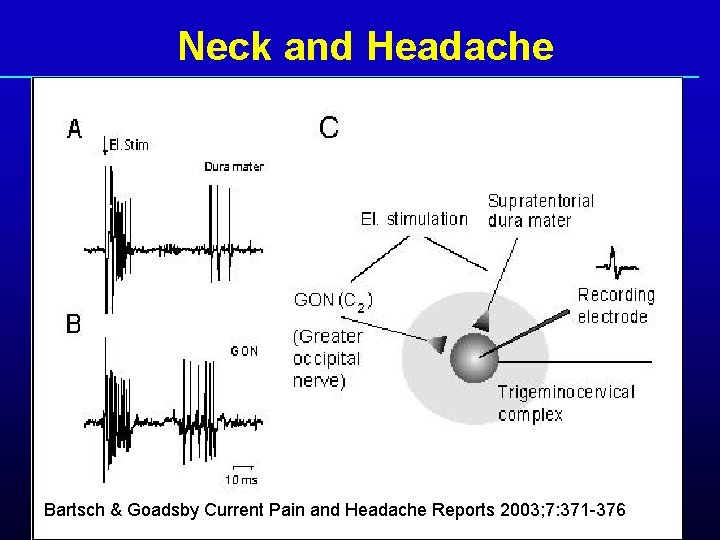
Neck and Headache Bartsch & Goadsby Current Pain and Headache Reports 2003; 7: 371 -376
Migraine Pathophysiolgy- Update • Genetics • Disease mechanisms – Premonitory symptoms – The neck ØAllodynia – Medication overuse • Treatment
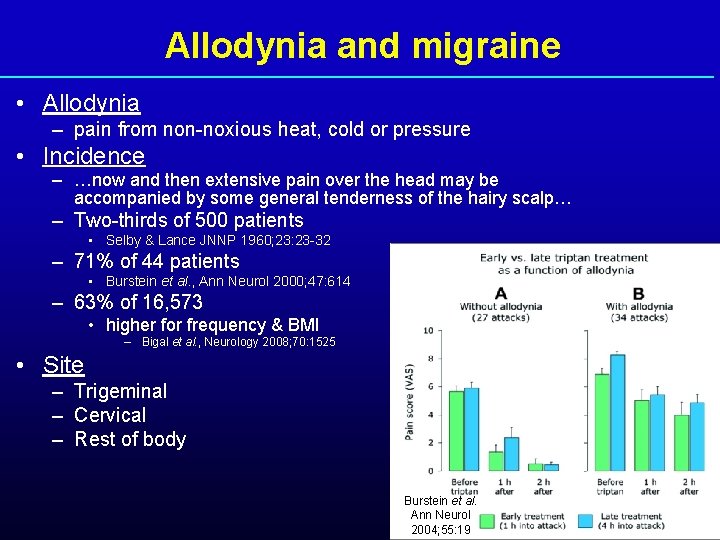
Allodynia and migraine • Allodynia – pain from non-noxious heat, cold or pressure • Incidence – …now and then extensive pain over the head may be accompanied by some general tenderness of the hairy scalp… – Two-thirds of 500 patients • Selby & Lance JNNP 1960; 23: 23 -32 – 71% of 44 patients • Burstein et al. , Ann Neurol 2000; 47: 614 – 63% of 16, 573 • higher for frequency & BMI – Bigal et al. , Neurology 2008; 70: 1525 • Site – Trigeminal – Cervical – Rest of body Burstein et al. Ann Neurol 2004; 55: 19
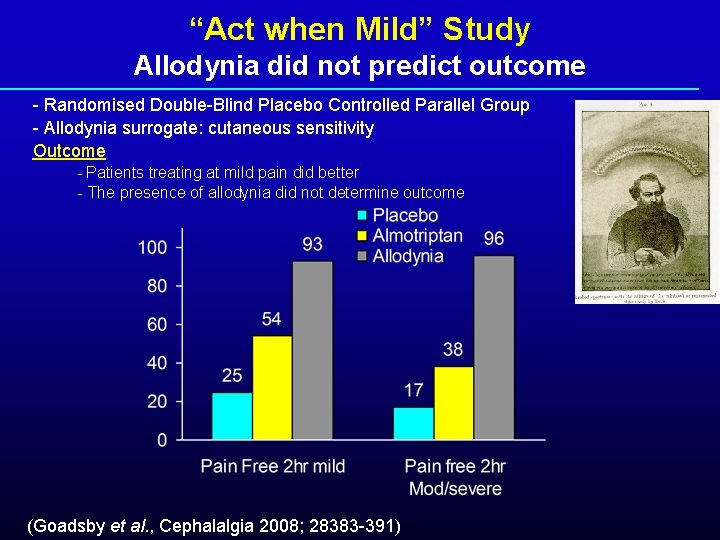
“Act when Mild” Study Allodynia did not predict outcome - Randomised Double-Blind Placebo Controlled Parallel Group - Allodynia surrogate: cutaneous sensitivity Outcome - Patients treating at mild pain did better - The presence of allodynia did not determine outcome (Goadsby et al. , Cephalalgia 2008; 28383 -391)
Migraine Pathophysiolgy- Update • Genetics • Disease mechanisms – Premonitory symptoms – The neck – Allodynia ØMedication overuse • Treatment
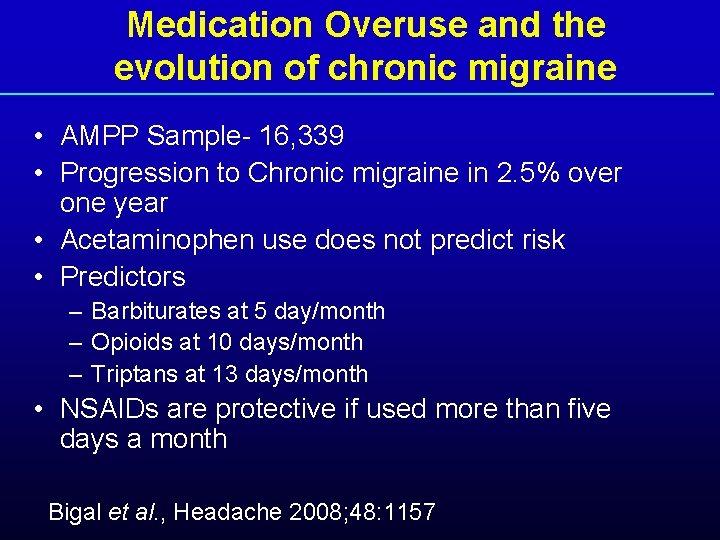
Medication Overuse and the evolution of chronic migraine • AMPP Sample- 16, 339 • Progression to Chronic migraine in 2. 5% over one year • Acetaminophen use does not predict risk • Predictors – Barbiturates at 5 day/month – Opioids at 10 days/month – Triptans at 13 days/month • NSAIDs are protective if used more than five days a month Bigal et al. , Headache 2008; 48: 1157
Migraine Pathophysiolgy- Update • Genetics • Disease mechanisms – Premonitory symptoms – The neck – Allodynia – Medication overuse • Treatment

Trigeminovascular System & Migraine (Goadsby et al. , NEJM 2002; 346: 257 -270)
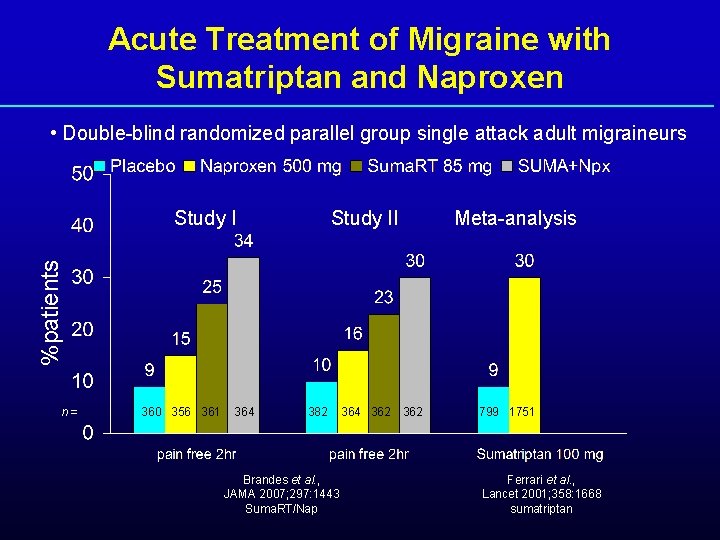
Acute Treatment of Migraine with Sumatriptan and Naproxen • Double-blind randomized parallel group single attack adult migraineurs Study II Meta-analysis %patients Study I n= 360 356 361 364 382 Brandes et al. , JAMA 2007; 297: 1443 Suma. RT/Nap 364 362 799 1751 Ferrari et al. , Lancet 2001; 358: 1668 sumatriptan
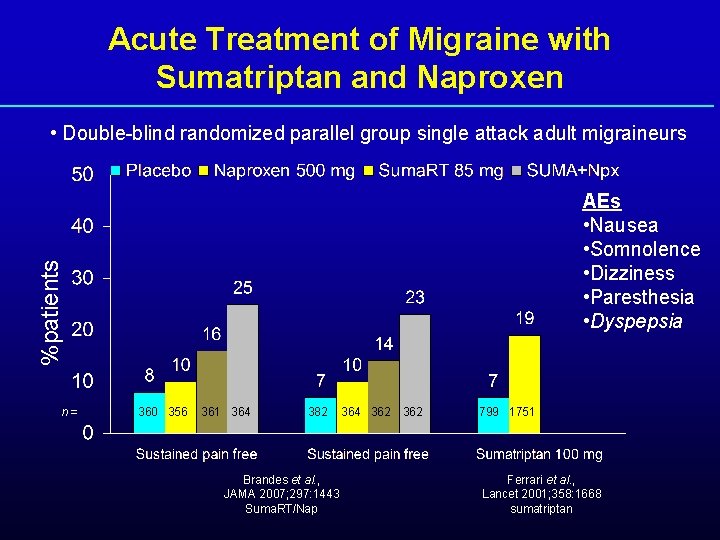
Acute Treatment of Migraine with Sumatriptan and Naproxen • Double-blind randomized parallel group single attack adult migraineurs %patients AEs • Nausea • Somnolence • Dizziness • Paresthesia • Dyspepsia n= 360 356 361 364 382 Brandes et al. , JAMA 2007; 297: 1443 Suma. RT/Nap 364 362 799 1751 Ferrari et al. , Lancet 2001; 358: 1668 sumatriptan
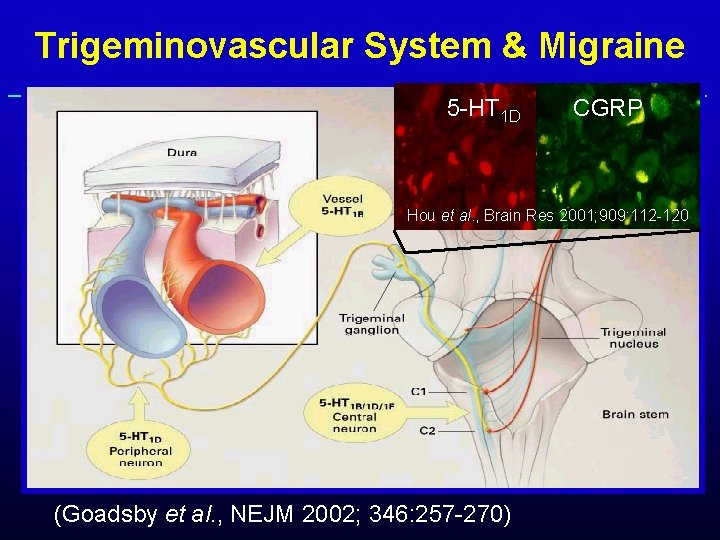
Trigeminovascular System & Migraine 5 -HT 1 D CGRP Hou et al. , Brain Res 2001; 909: 112 -120 (Goadsby et al. , NEJM 2002; 346: 257 -270)
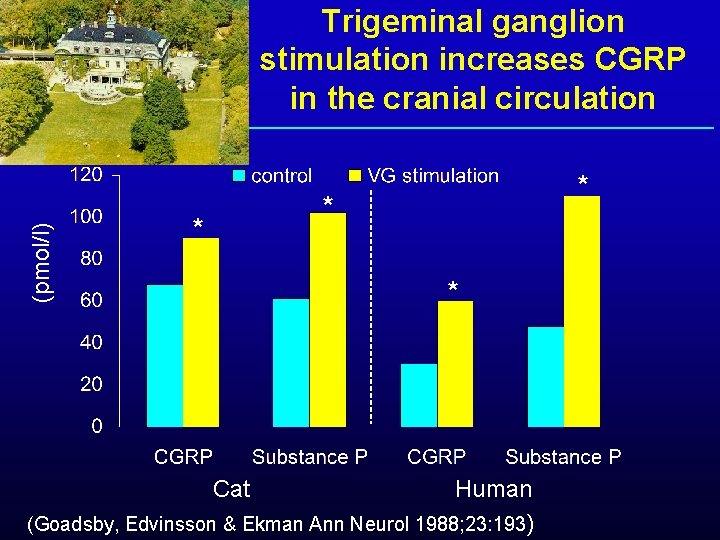
(pmol/l) Trigeminal ganglion stimulation increases CGRP in the cranial circulation * * Cat Human (Goadsby, Edvinsson & Ekman Ann Neurol 1988; 23: 193)
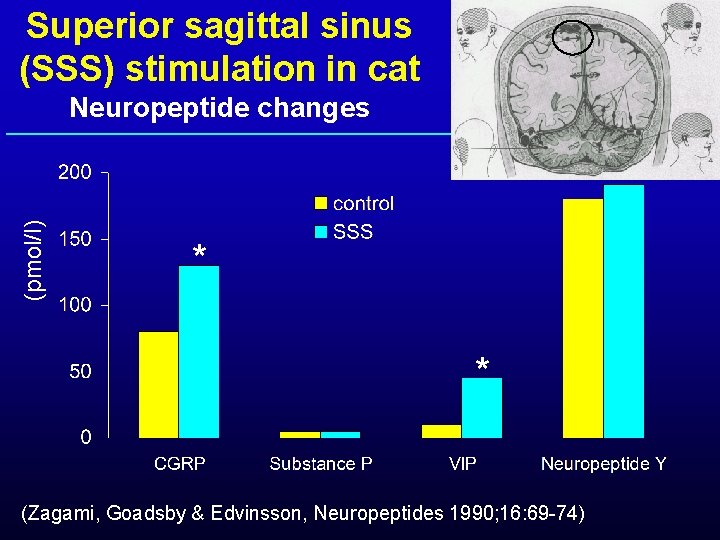
Superior sagittal sinus (SSS) stimulation in cat (pmol/l) Neuropeptide changes * * (Zagami, Goadsby & Edvinsson, Neuropeptides 1990; 16: 69 -74)
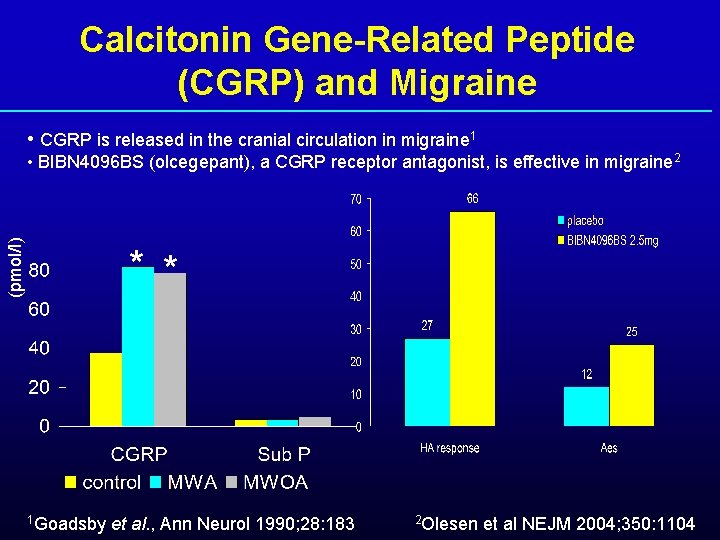
Calcitonin Gene-Related Peptide (CGRP) and Migraine • CGRP is released in the cranial circulation in migraine 1 (pmol/l) • BIBN 4096 BS (olcegepant), a CGRP receptor antagonist, is effective in migraine 2 * * 1 Goadsby et al. , Ann Neurol 1990; 28: 183 2 Olesen et al NEJM 2004; 350: 1104
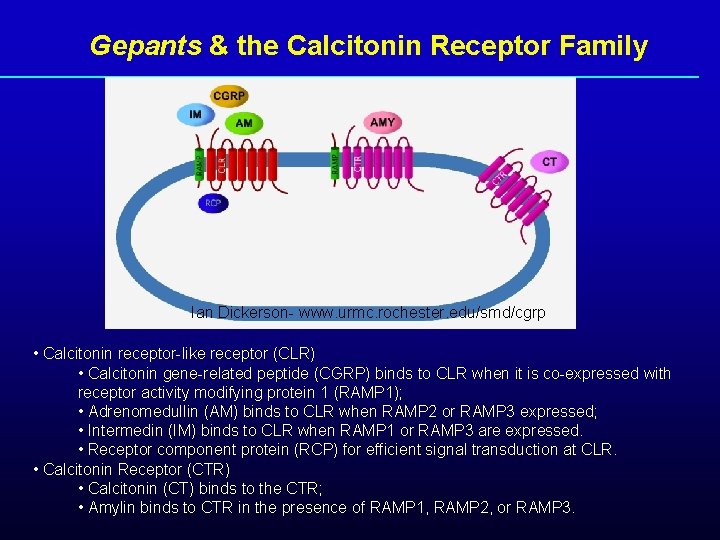
Gepants & the Calcitonin Receptor Family Ian Dickerson- www. urmc. rochester. edu/smd/cgrp • Calcitonin receptor-like receptor (CLR) • Calcitonin gene-related peptide (CGRP) binds to CLR when it is co-expressed with receptor activity modifying protein 1 (RAMP 1); • Adrenomedullin (AM) binds to CLR when RAMP 2 or RAMP 3 expressed; • Intermedin (IM) binds to CLR when RAMP 1 or RAMP 3 are expressed. • Receptor component protein (RCP) for efficient signal transduction at CLR. • Calcitonin Receptor (CTR) • Calcitonin (CT) binds to the CTR; • Amylin binds to CTR in the presence of RAMP 1, RAMP 2, or RAMP 3.
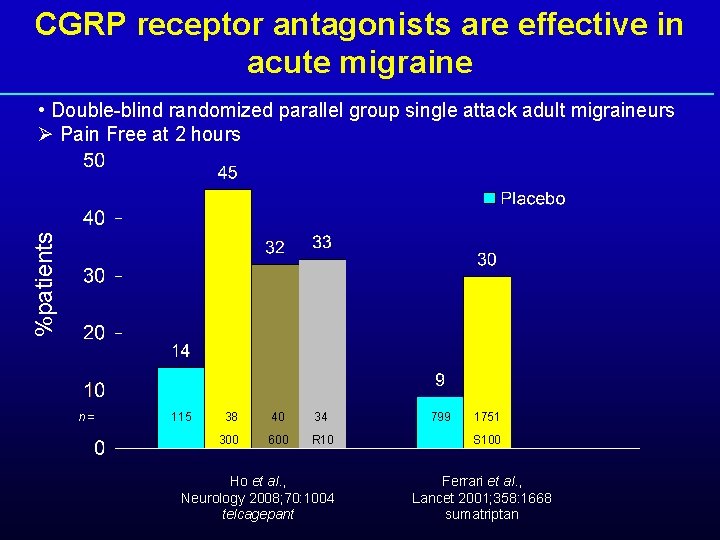
CGRP receptor antagonists are effective in acute migraine %patients • Double-blind randomized parallel group single attack adult migraineurs Ø Pain Free at 2 hours n= 115 38 40 34 300 600 R 10 Ho et al. , Neurology 2008; 70: 1004 telcagepant 799 1751 S 100 Ferrari et al. , Lancet 2001; 358: 1668 sumatriptan
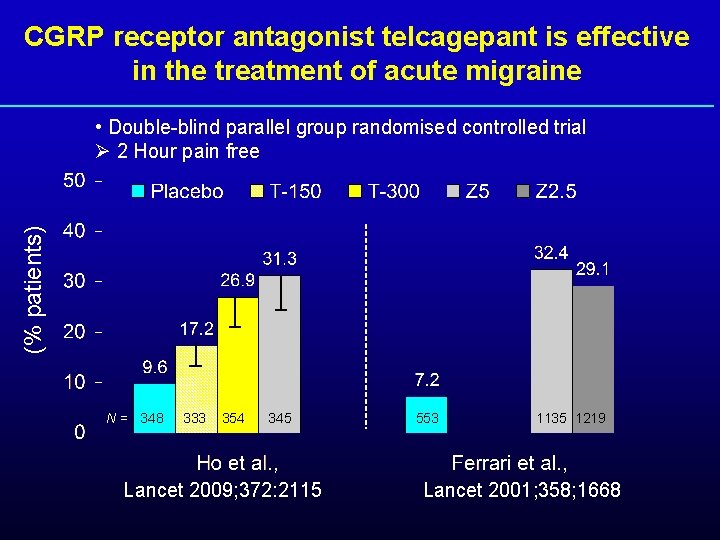
CGRP receptor antagonist telcagepant is effective in the treatment of acute migraine (% patients) • Double-blind parallel group randomised controlled trial Ø 2 Hour pain free N = 348 333 354 345 Lancet 2009; 372: 2115 553 1135 1219 Lancet 2001; 358; 1668
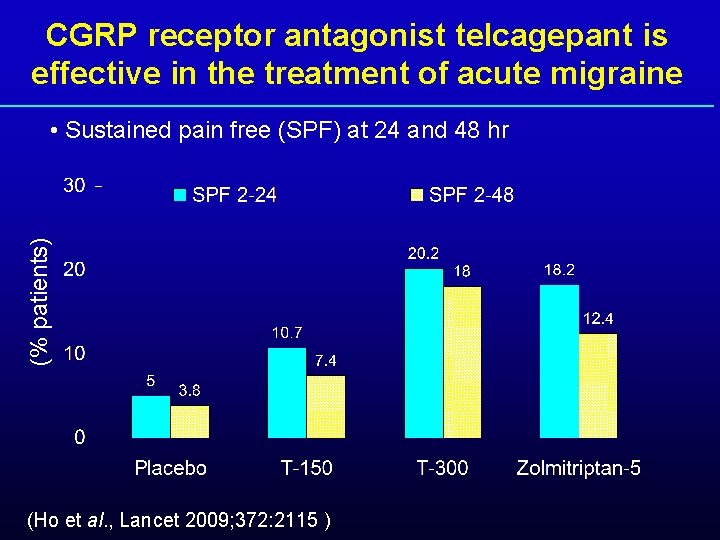
CGRP receptor antagonist telcagepant is effective in the treatment of acute migraine (% patients) • Sustained pain free (SPF) at 24 and 48 hr (Ho et al. , Lancet 2009; 372: 2115 )
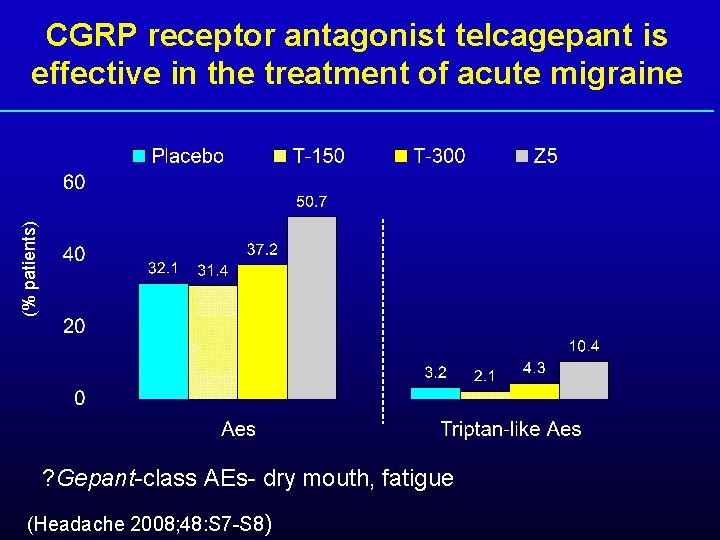
(% patients) CGRP receptor antagonist telcagepant is effective in the treatment of acute migraine ? Gepant-class AEs- dry mouth, fatigue (Headache 2008; 48: S 7 -S 8)
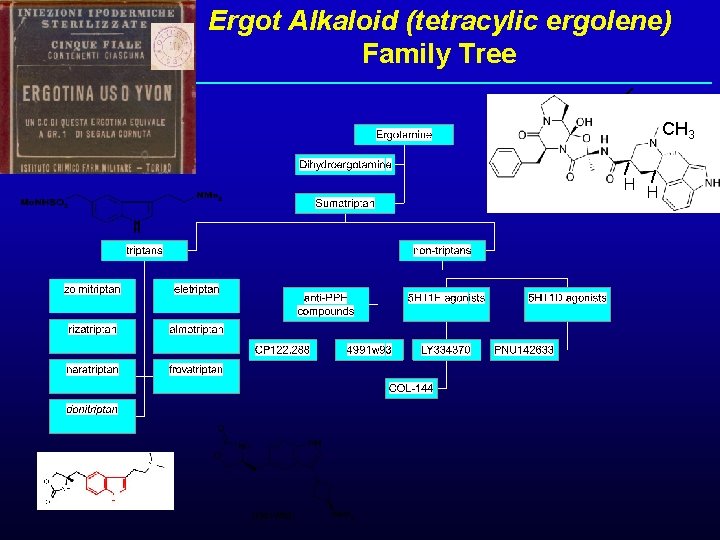
Ergot Alkaloid (tetracylic ergolene) Family Tree CH 3 H H
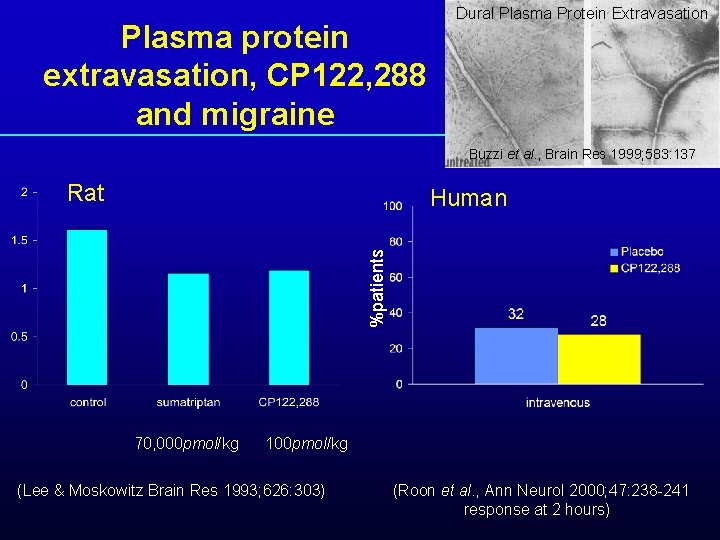
Plasma protein extravasation, CP 122, 288 and migraine Dural Plasma Protein Extravasation Buzzi et al. , Brain Res 1999; 583: 137 Rat %patients Human 70, 000 pmol/kg 100 pmol/kg (Lee & Moskowitz Brain Res 1993; 626: 303) (Roon et al. , Ann Neurol 2000; 47: 238 -241 response at 2 hours)
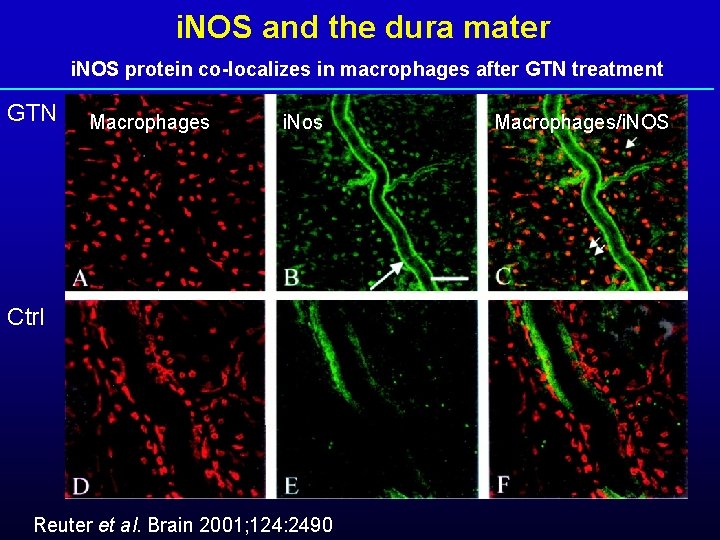
i. NOS and the dura mater i. NOS protein co-localizes in macrophages after GTN treatment GTN Macrophages i. Nos Ctrl Reuter et al. Brain 2001; 124: 2490 Macrophages/i. NOS
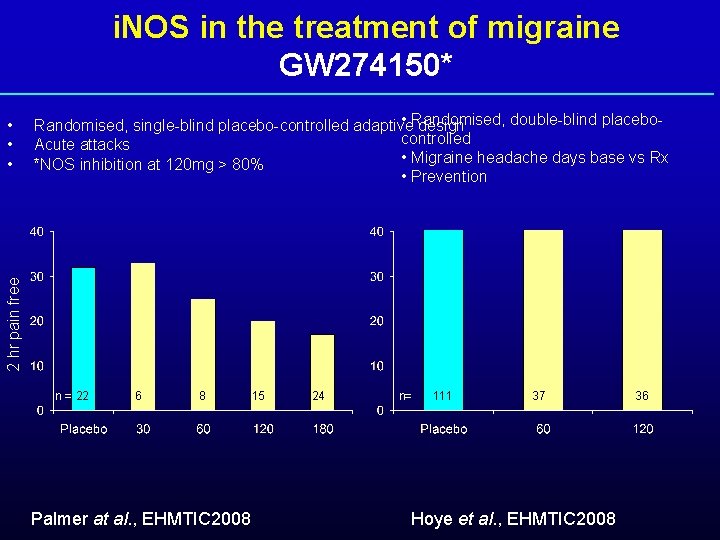
i. NOS in the treatment of migraine GW 274150* • Randomised, double-blind placebo. Randomised, single-blind placebo-controlled adaptive design controlled Acute attacks • Migraine headache days base vs Rx *NOS inhibition at 120 mg > 80% • Prevention 2 hr pain free • • • n = 22 6 8 Palmer at al. , EHMTIC 2008 15 24 n= 111 37 Hoye et al. , EHMTIC 2008 36
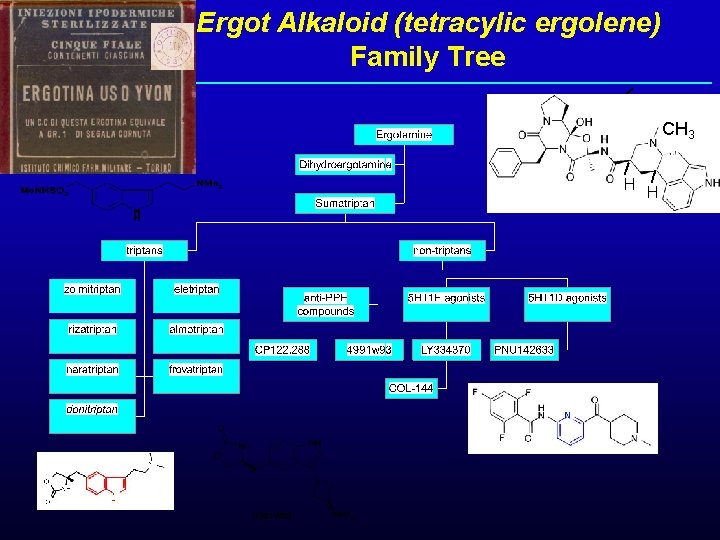
Ergot Alkaloid (tetracylic ergolene) Family Tree CH 3 H H
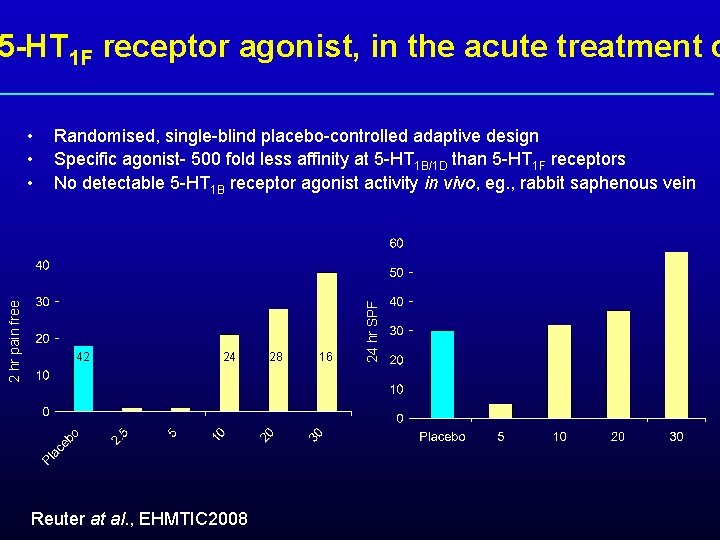
5 -HT 1 F receptor agonist, in the acute treatment o Randomised, single-blind placebo-controlled adaptive design Specific agonist- 500 fold less affinity at 5 -HT 1 B/1 D than 5 -HT 1 F receptors No detectable 5 -HT 1 B receptor agonist activity in vivo, eg. , rabbit saphenous vein 42 24 Reuter at al. , EHMTIC 2008 28 16 24 hr SPF 2 hr pain free • • •
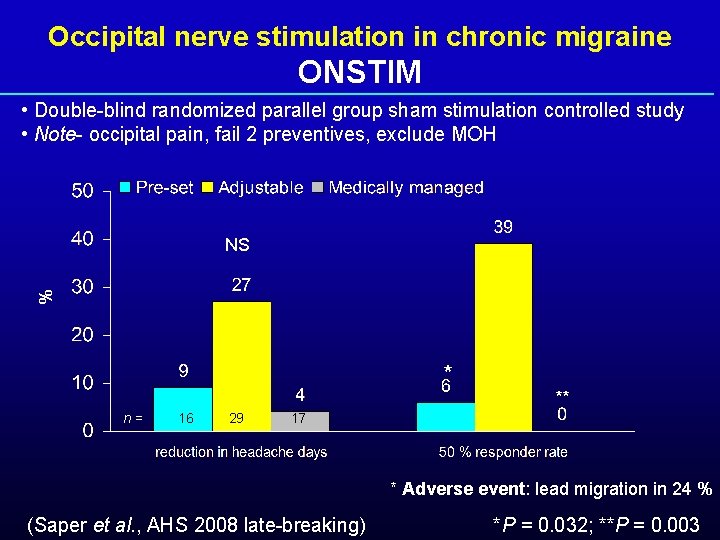
Occipital nerve stimulation in chronic migraine ONSTIM • Double-blind randomized parallel group sham stimulation controlled study • Note- occipital pain, fail 2 preventives, exclude MOH % NS * ** n= 16 29 17 * Adverse event: lead migration in 24 % (Saper et al. , AHS 2008 late-breaking) *P = 0. 032; **P = 0. 003
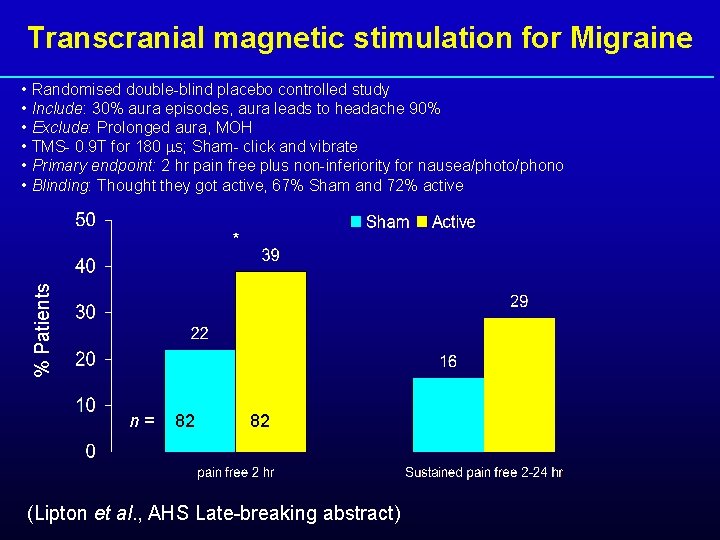
Transcranial magnetic stimulation for Migraine • Randomised double-blind placebo controlled study • Include: 30% aura episodes, aura leads to headache 90% • Exclude: Prolonged aura, MOH • TMS- 0. 9 T for 180 ms; Sham- click and vibrate • Primary endpoint: 2 hr pain free plus non-inferiority for nausea/photo/phono • Blinding: Thought they got active, 67% Sham and 72% active % Patients * n= 82 82 (Lipton et al. , AHS Late-breaking abstract)
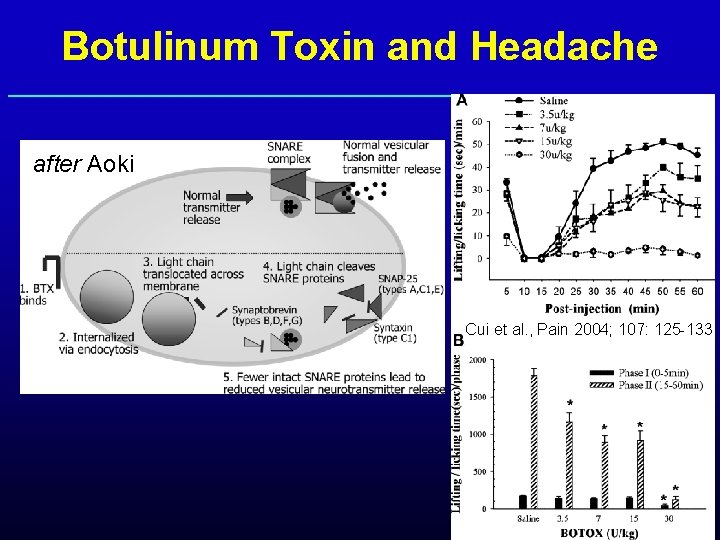
Botulinum Toxin and Headache after Aoki Cui et al. , Pain 2004; 107: 125 -133
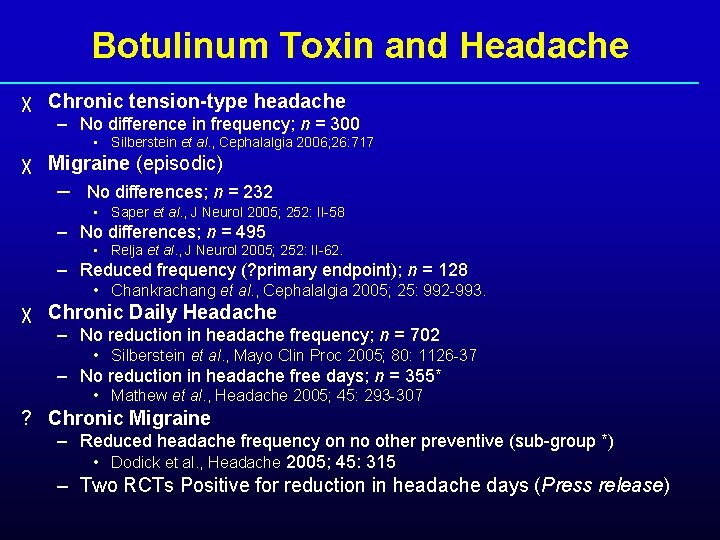
Botulinum Toxin and Headache χ Chronic tension-type headache – No difference in frequency; n = 300 • Silberstein et al. , Cephalalgia 2006; 26: 717 χ Migraine (episodic) – No differences; n = 232 • Saper et al. , J Neurol 2005; 252: II-58 – No differences; n = 495 • Relja et al. , J Neurol 2005; 252: II-62. – Reduced frequency (? primary endpoint); n = 128 • Chankrachang et al. , Cephalalgia 2005; 25: 992 -993. χ Chronic Daily Headache – No reduction in headache frequency; n = 702 • Silberstein et al. , Mayo Clin Proc 2005; 80: 1126 -37 – No reduction in headache free days; n = 355* • Mathew et al. , Headache 2005; 45: 293 -307 ? Chronic Migraine – Reduced headache frequency on no other preventive (sub-group *) • Dodick et al. , Headache 2005; 45: 315 – Two RCTs Positive for reduction in headache days (Press release)
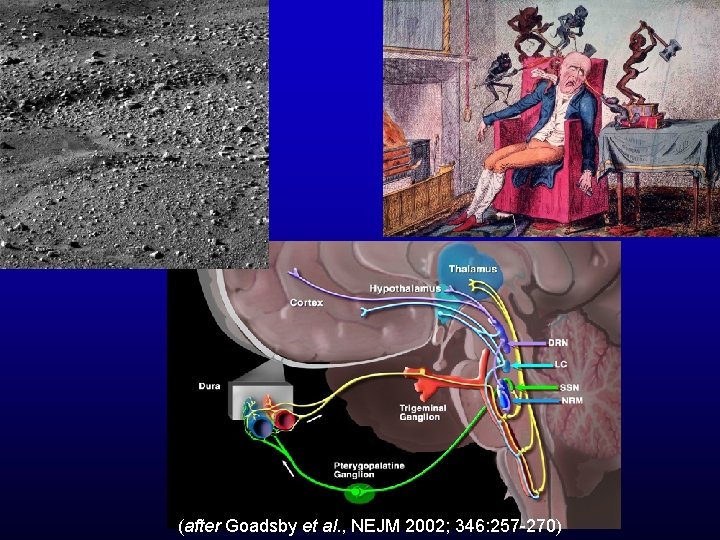
(after Goadsby et al. , NEJM 2002; 346: 257 -270)
- Slides: 50