
Mifepristone Administration in Labor Induction for IUFD and
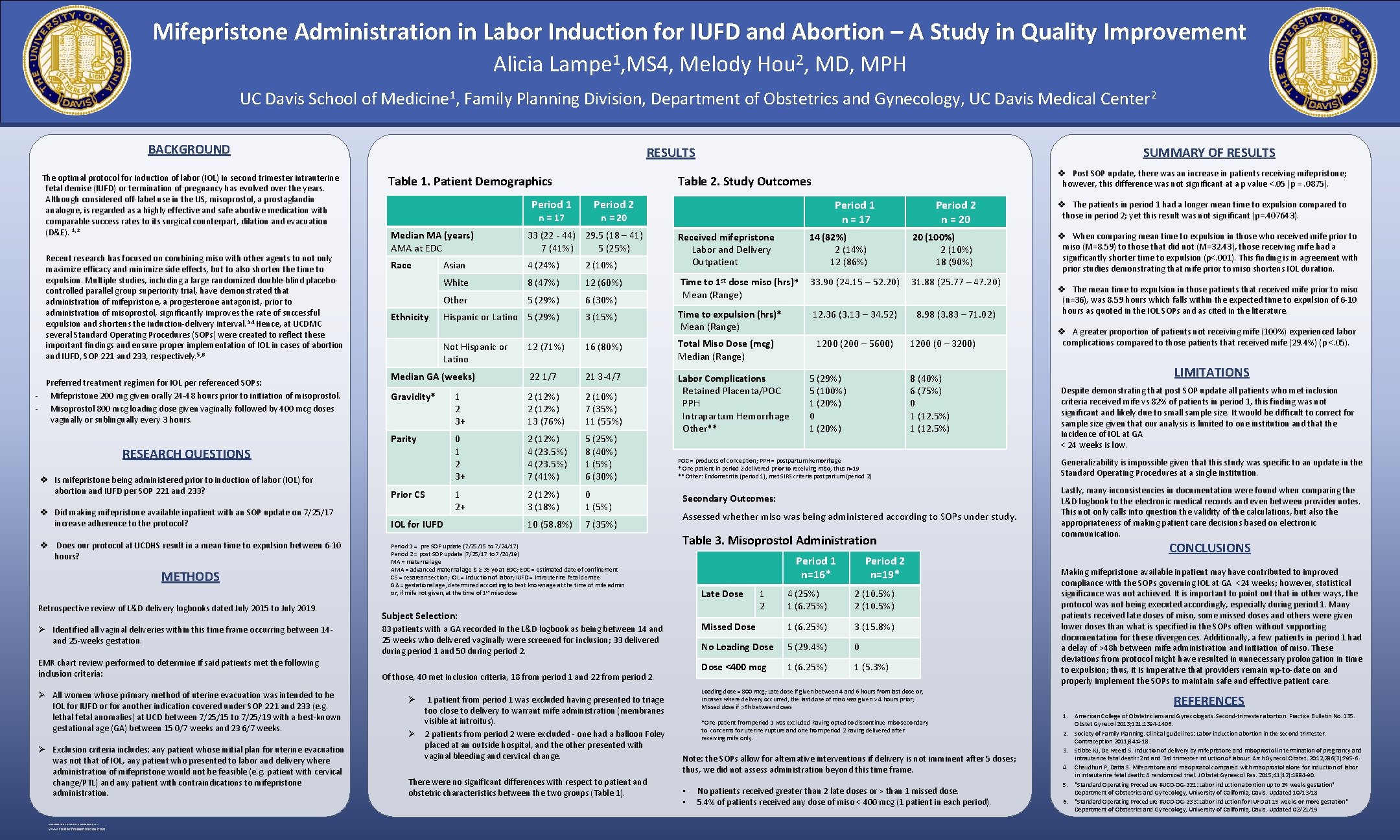
Mifepristone Administration in Labor Induction for IUFD and Abortion – A Study in Quality Improvement Alicia Lampe 1, MS 4, Melody Hou 2, MD, MPH UC Davis School of Medicine 1, Family Planning Division, Department of Obstetrics and Gynecology, UC Davis Medical Center 2 BACKGROUND The optimal protocol for induction of labor (IOL) in second trimester intrauterine fetal demise (IUFD) or termination of pregnancy has evolved over the years. Although considered off-label use in the US, misoprostol, a prostaglandin analogue, is regarded as a highly effective and safe abortive medication with comparable success rates to its surgical counterpart, dilation and evacuation (D&E). 1, 2 Recent research has focused on combining miso with other agents to not only maximize efficacy and minimize side effects, but to also shorten the time to expulsion. Multiple studies, including a large randomized double-blind placebocontrolled parallel group superiority trial, have demonstrated that administration of mifepristone, a progesterone antagonist, prior to administration of misoprostol, significantly improves the rate of successful expulsion and shortens the induction-delivery interval. 3. 4 Hence, at UCDMC several Standard Operating Procedures (SOPs) were created to reflect these important findings and ensure proper implementation of IOL in cases of abortion and IUFD, SOP 221 and 233, respectively. 5, 6 Preferred treatment regimen for IOL per referenced SOPs: - Mifepristone 200 mg given orally 24 -48 hours prior to initiation of misoprostol. - Misoprostol 800 mcg loading dose given vaginally followed by 400 mcg doses vaginally or sublingually every 3 hours. RESEARCH QUESTIONS Table 1. Patient Demographics Period 1 n = 17 Asian 4 (24%) 2 (10%) White 8 (47%) 12 (60%) Other 5 (29%) 6 (30%) Hispanic or Latino 5 (29%) 3 (15%) Ø Identified all vaginal deliveries within this time frame occurring between 14 and 25 -weeks gestation. EMR chart review performed to determine if said patients met the following inclusion criteria: Ø All women whose primary method of uterine evacuation was intended to be IOL for IUFD or for another indication covered under SOP 221 and 233 (e. g. lethal fetal anomalies) at UCD between 7/25/15 to 7/25/19 with a best-known gestational age (GA) between 15 0/7 weeks and 23 6/7 weeks. Ø Exclusion criteria includes: any patient whose initial plan for uterine evacuation was not that of IOL, any patient who presented to labor and delivery where administration of mifepristone would not be feasible (e. g. patient with cervical change/PTL) and any patient with contraindications to mifepristone administration. RESEARCH POSTER PRESENTATION DESIGN © 2012 www. Poster. Presentations. com 14 (82%) 2 (14%) 12 (86%) 20 (100%) 2 (10%) 18 (90%) Time to 1 st dose miso (hrs)* Mean (Range) 33. 90 (24. 15 – 52. 20) 31. 88 (25. 77 – 47. 20) Time to expulsion (hrs)* Mean (Range) 12. 36 (3. 13 – 34. 52) 8. 98 (3. 83 – 71. 02) 16 (80%) Total Miso Dose (mcg) Median (Range) Median GA (weeks) 22 1/7 21 3 -4/7 Gravidity* 1 2 3+ 2 (12%) 13 (76%) 2 (10%) 7 (35%) 11 (55%) Parity 0 1 2 3+ 2 (12%) 4 (23. 5%) 7 (41%) 5 (25%) 8 (40%) 1 (5%) 6 (30%) Labor Complications Retained Placenta/POC PPH Intrapartum Hemorrhage Other** 1 2+ 2 (12%) 3 (18%) 0 1 (5%) 10 (58. 8%) 7 (35%) IOL for IUFD Period 1 = pre SOP update (7/25/15 to 7/24/17) Period 2 = post SOP update (7/25/17 to 7/24/19) MA = maternal age AMA = advanced maternal age is ≥ 35 yo at EDC; EDC = estimated date of confinement CS = cesarean section; IOL = induction of labor; IUFD = intrauterine fetal demise GA = gestational age, determined according to best known age at the time of mife admin or, if mife not given, at the time of 1 st miso dose There were no significant differences with respect to patient and obstetric characteristics between the two groups (Table 1). 8 (40%) 6 (75%) 0 1 (12. 5%) Assessed whether miso was being administered according to SOPs under study. Table 3. Misoprostol Administration Period 1 n=16* Late Dose Of those, 40 met inclusion criteria, 18 from period 1 and 22 from period 2. Ø 5 (29%) 5 (100%) 1 (20%) 0 1 (20%) 1200 (0 – 3200) Secondary Outcomes: 83 patients with a GA recorded in the L&D logbook as being between 14 and 25 weeks who delivered vaginally were screened for inclusion; 33 delivered during period 1 and 50 during period 2. 1 patient from period 1 was excluded having presented to triage too close to delivery to warrant mife administration (membranes visible at introitus). 2 patients from period 2 were excluded - one had a balloon Foley placed at an outside hospital, and the other presented with vaginal bleeding and cervical change. 1200 (200 – 5600) POC = products of conception; PPH = postpartum hemorrhage * One patient in period 2 delivered prior to receiving miso, thus n=19 ** Other: Endometritis (period 1), met SIRS criteria postpartum (period 2) Subject Selection: Ø Period 2 n = 20 Received mifepristone Labor and Delivery Outpatient 12 (71%) Not Hispanic or Latino v Did making mifepristone available inpatient with an SOP update on 7/25/17 increase adherence to the protocol? Retrospective review of L&D delivery logbooks dated July 2015 to July 2019. Period 1 n = 17 n = 20 Race Prior CS METHODS Period 2 33 (22 - 44) 29. 5 (18 – 41) 7 (41%) 5 (25%) Ethnicity v Post SOP update, there was an increase in patients receiving mifepristone; however, this difference was not significant at a p value <. 05 (p =. 0875). Table 2. Study Outcomes Median MA (years) AMA at EDC v Is mifepristone being administered prior to induction of labor (IOL) for abortion and IUFD per SOP 221 and 233? v Does our protocol at UCDHS result in a mean time to expulsion between 6 -10 hours? SUMMARY OF RESULTS 1 2 Period 2 n=19* 4 (25%) 1 (6. 25%) 2 (10. 5%) Missed Dose 1 (6. 25%) 3 (15. 8%) No Loading Dose 5 (29. 4%) 0 Dose <400 mcg 1 (6. 25%) 1 (5. 3%) Loading dose = 800 mcg; Late dose if given between 4 and 6 hours from last dose or, in cases where delivery occurred, the last dose of miso was given > 4 hours prior; Missed dose if >6 h between doses *One patient from period 1 was excluded having opted to discontinue miso secondary to concerns for uterine rupture and one from period 2 having delivered after receiving mife only. Note: the SOPs allow for alternative interventions if delivery is not imminent after 5 doses; thus, we did not assess administration beyond this time frame. • • No patients received greater than 2 late doses or > than 1 missed dose. 5. 4% of patients received any dose of miso < 400 mcg (1 patient in each period). v The patients in period 1 had a longer mean time to expulsion compared to those in period 2; yet this result was not significant (p=. 407643). v When comparing mean time to expulsion in those who received mife prior to miso (M=8. 59) to those that did not (M=32. 43), those receiving mife had a significantly shorter time to expulsion (p<. 001). This finding is in agreement with prior studies demonstrating that mife prior to miso shortens IOL duration. v The mean time to expulsion in those patients that received mife prior to miso (n=36), was 8. 59 hours which falls within the expected time to expulsion of 6 -10 hours as quoted in the IOL SOPs and as cited in the literature. v A greater proportion of patients not receiving mife (100%) experienced labor complications compared to those patients that received mife (29. 4%) (p <. 05). LIMITATIONS Despite demonstrating that post SOP update all patients who met inclusion criteria received mife vs 82% of patients in period 1, this finding was not significant and likely due to small sample size. It would be difficult to correct for sample size given that our analysis is limited to one institution and that the incidence of IOL at GA < 24 weeks is low. Generalizability is impossible given that this study was specific to an update in the Standard Operating Procedures at a single institution. Lastly, many inconsistencies in documentation were found when comparing the L&D logbook to the electronic medical records and even between provider notes. This not only calls into question the validity of the calculations, but also the appropriateness of making patient care decisions based on electronic communication. CONCLUSIONS Making mifepristone available inpatient may have contributed to improved compliance with the SOPs governing IOL at GA <24 weeks; however, statistical significance was not achieved. It is important to point out that in other ways, the protocol was not being executed accordingly, especially during period 1. Many patients received late doses of miso, some missed doses and others were given lower doses than what is specified in the SOPs often without supporting documentation for these divergences. Additionally, a few patients in period 1 had a delay of >48 h between mife administration and initiation of miso. These deviations from protocol might have resulted in unnecessary prolongation in time to expulsion; thus, it is imperative that providers remain up-to-date on and properly implement the SOPs to maintain safe and effective patient care. REFERENCES 1. American College of Obstetricians and Gynecologists. Second-trimester abortion. Practice Bulletin No. 135. Obstet Gynecol 2013; 121: 1394 -1406. 2. Society of Family Planning. Clinical guidelines: Labor induction abortion in the second trimester. Contraception 2011; 84: 4 -18. 3. Stibbe KJ, De weerd S. Induction of delivery by mifepristone and misoprostol in termination of pregnancy and intrauterine fetal death: 2 nd and 3 rd trimester induction of labour. Arch Gynecol Obstet. 2012; 286(3): 795 -6. 4. Chaudhuri P, Datta S. Mifepristone and misoprostol compared with misoprostol alone for induction of labor in intrauterine fetal death: A randomized trial. J Obstet Gynaecol Res. 2015; 41(12): 1884 -90. 5. "Standard Operating Procedure #UCD-OG-221: Labor induction abortion up to 24 weeks gestation" Department of Obstetrics and Gynecology, University of California, Davis. Updated 10/13/18 6. "Standard Operating Procedure #UCD-OG-233: Labor induction for IUFD at 15 weeks or more gestation" Department of Obstetrics and Gynecology, University of California, Davis. Updated 02/21/19
- Slides: 1