
Midterm Solutions Instructor Scott Kristjanson CMPT 135 SFU
- Slides: 11
Midterm Solutions Instructor: Scott Kristjanson CMPT 135 SFU Surrey, Spring 2016
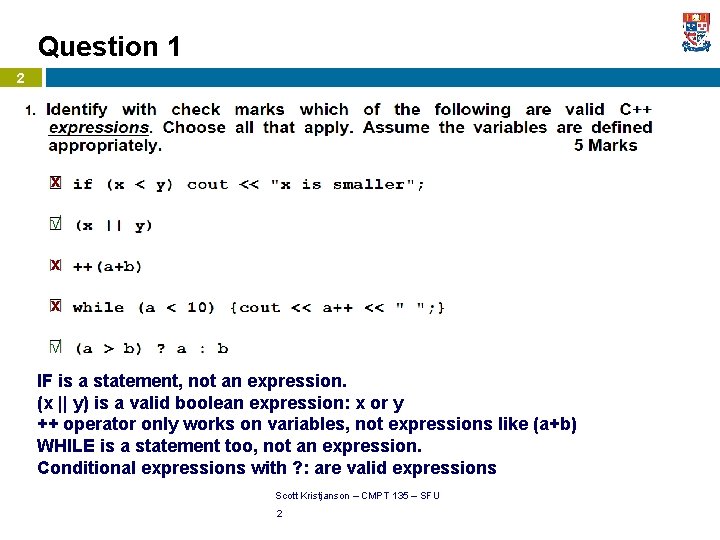
Question 1 2 x √ x x √ IF is a statement, not an expression. (x || y) is a valid boolean expression: x or y ++ operator only works on variables, not expressions like (a+b) WHILE is a statement too, not an expression. Conditional expressions with ? : are valid expressions Scott Kristjanson – CMPT 135 – SFU 2
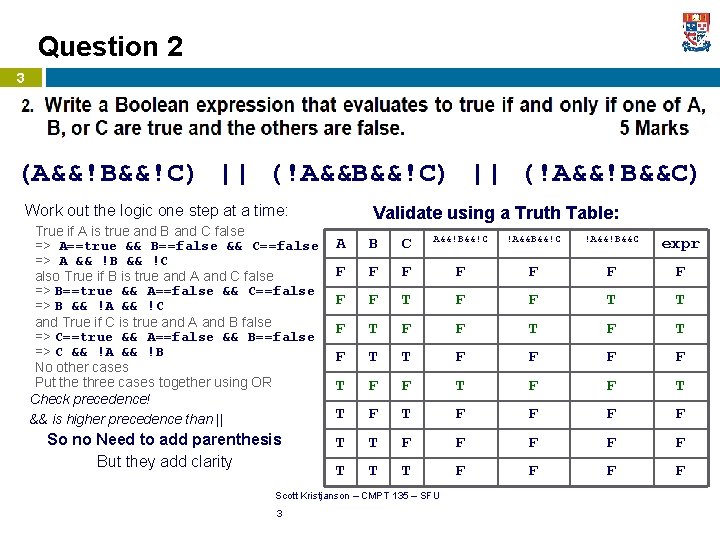
Question 2 3 (A&&!B&&!C) A&&!B&&!C || (!A&&B&&!C) !A&&B&&!C || (!A&&!B&&C) Work out the logic one step at a time: True if A is true and B and C false => A==true && B==false && C==false => A && !B && !C also True if B is true and A and C false => B==true && A==false && C==false => B && !A && !C and True if C is true and A and B false => C==true && A==false && B==false => C && !A && !B No other cases Put the three cases together using OR Check precedence! && is higher precedence than || So no Need to add parenthesis But they add clarity Validate using a Truth Table: A B C A&&!B&&!C !A&&!B&&C expr F F F F F T T F F T F T T F F T T F F F F T T T F F Scott Kristjanson – CMPT 135 – SFU 3
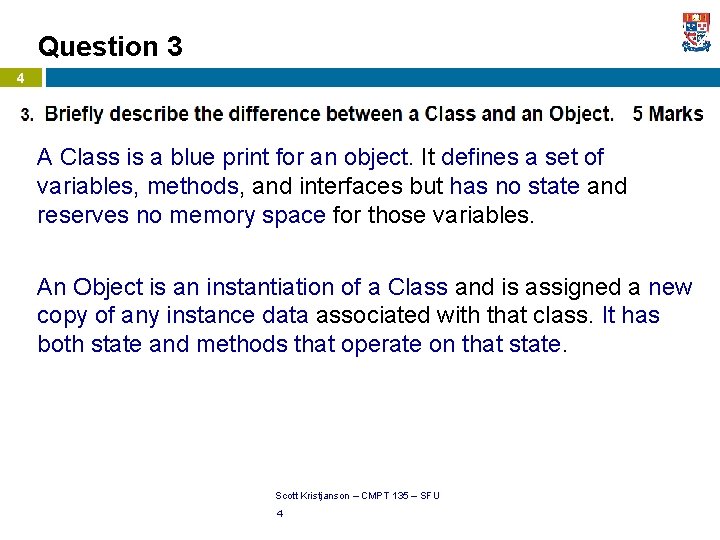
Question 3 4 A Class is a blue print for an object. It defines a set of variables, methods, and interfaces but has no state and reserves no memory space for those variables. An Object is an instantiation of a Class and is assigned a new copy of any instance data associated with that class. It has both state and methods that operate on that state. Scott Kristjanson – CMPT 135 – SFU 4
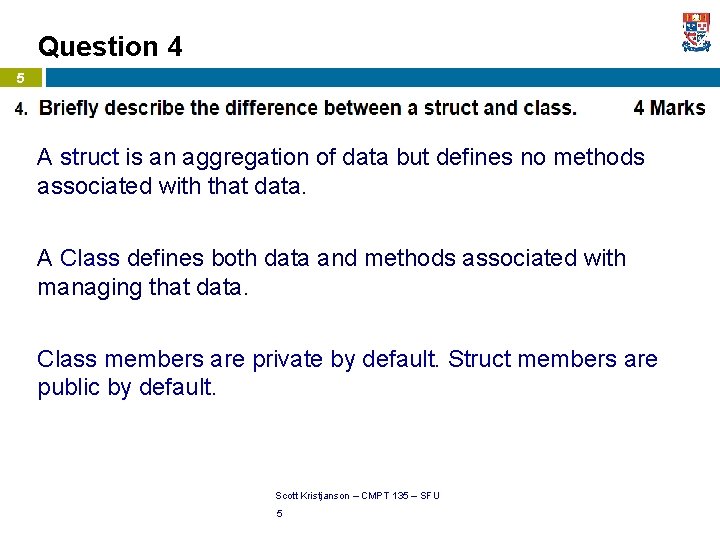
Question 4 5 A struct is an aggregation of data but defines no methods associated with that data. A Class defines both data and methods associated with managing that data. Class members are private by default. Struct members are public by default. Scott Kristjanson – CMPT 135 – SFU 5
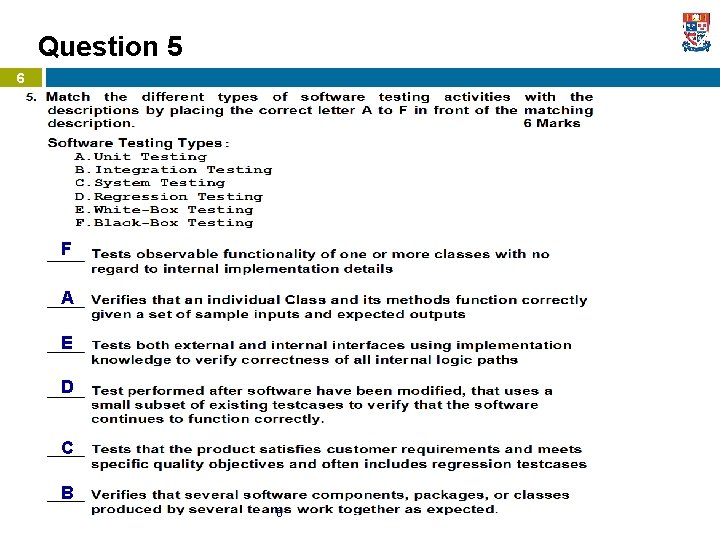
Question 5 6 F A E D C B Scott Kristjanson – CMPT 135 – SFU 6
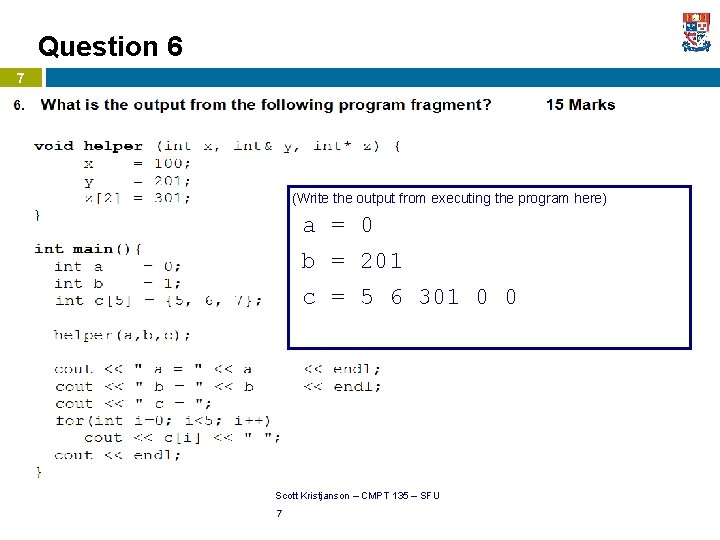
Question 6 7 (Write the output from executing the program here) a = 0 b = 201 c = 5 6 301 0 0 Scott Kristjanson – CMPT 135 – SFU 7
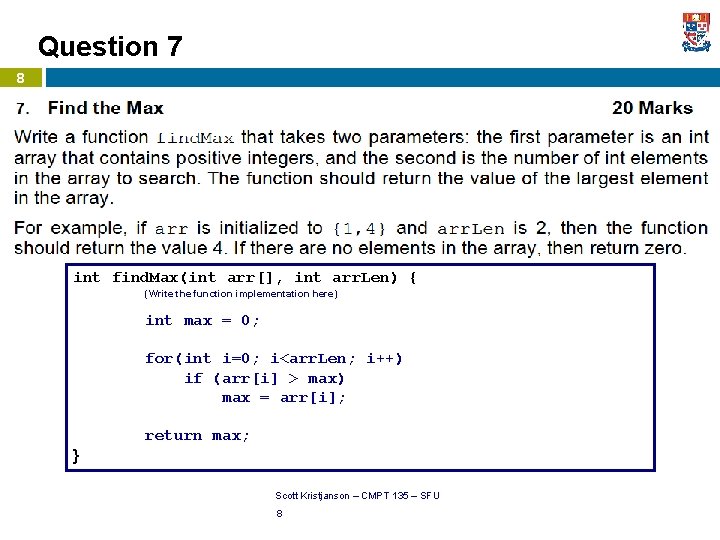
Question 7 8 int find. Max(int arr[], int arr. Len) { (Write the function implementation here) int max = 0; for(int i=0; i<arr. Len; i++) if (arr[i] > max) max = arr[i]; return max; } Scott Kristjanson – CMPT 135 – SFU 8
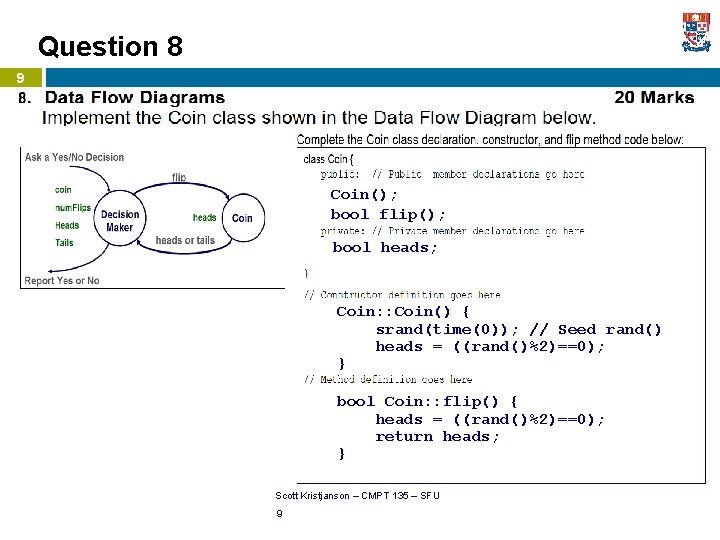
Question 8 9 Coin(); bool flip(); bool heads; Coin: : Coin() { srand(time(0)); // Seed rand() heads = ((rand()%2)==0); } bool Coin: : flip() { heads = ((rand()%2)==0); return heads; } Scott Kristjanson – CMPT 135 – SFU 9
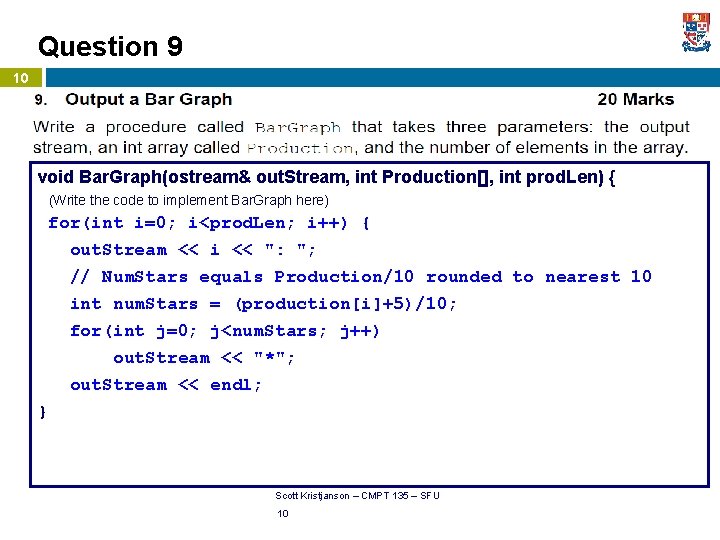
Question 9 10 void Bar. Graph(ostream& out. Stream, int Production[], int prod. Len) { (Write the code to implement Bar. Graph here) for(int i=0; i<prod. Len; i++) { out. Stream << i << ": "; // Num. Stars equals Production/10 rounded to nearest 10 int num. Stars = (production[i]+5)/10; for(int j=0; j<num. Stars; j++) out. Stream << "*"; out. Stream << endl; } Scott Kristjanson – CMPT 135 – SFU 10
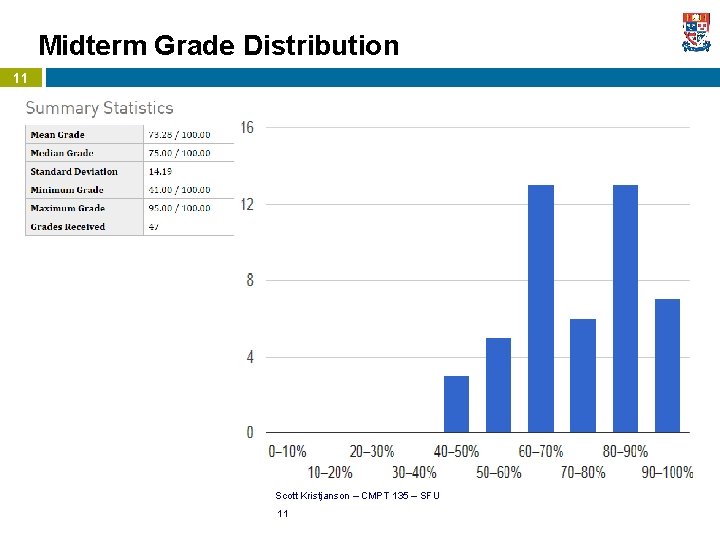
Midterm Grade Distribution 11 Scott Kristjanson – CMPT 135 – SFU 11