
MIDTERM NA Bio 108 Systematic Biology With Emphasis

MIDTERM NA!! Bio 108 Systematic Biology With Emphasis on Taxonomy
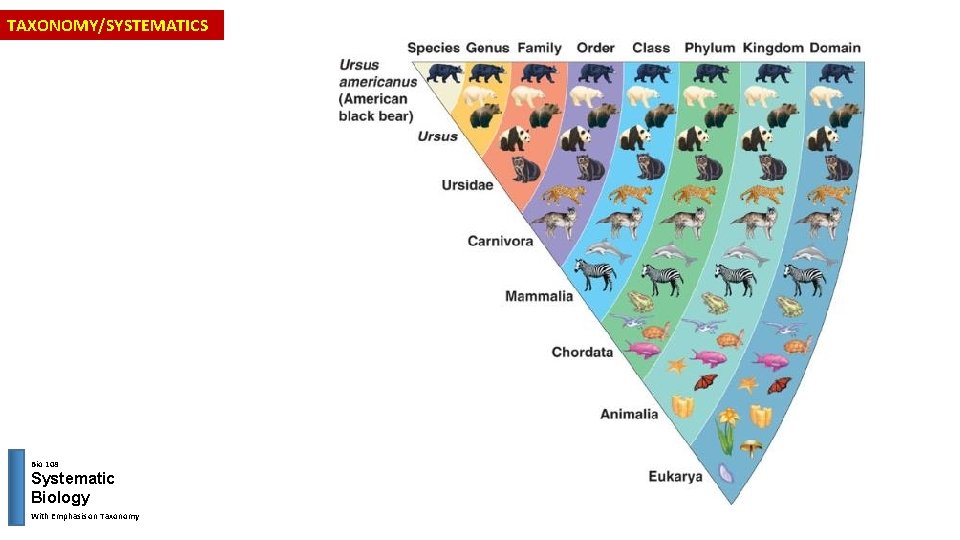
TAXONOMY/SYSTEMATICS Taxonomy: What is a Taxon? As we're already aware, taxon is a generic term used to describe a group of organisms that has been classified together at any given taxonomic level (phylum, order, family, etc. ), but without specifying that level. The Three Aspects of a Taxon 1. The taxon's name For example, the name of the taxon containing all domestic dogs is Canis familiaris. The order to which all dogs belong (along with a host of other flesh-eating mammals with specialized cutting teeth called carnassials) is Carnivora. Bio 108 Systematic Biology With Emphasis on Taxonomy
TAXONOMY/SYSTEMATICS 2. The taxon's rank For example, the taxon Mammalia is assigned the taxonomic rank of Class. The taxon's rank has no true biological significance. It serves only to help the biologist locate the taxon within the hierarchy. The relative rank of a given organism within its larger and smaller groupings is more relevant than the rank itself, which is subject to change. For example, it's important to know that all members of Felis are classified within the larger taxon "Carnivora, " and that all carnivores are classified within the still larger taxon "Mammalia. " It's less important to struggle to recall that "Carnivora" is an order and "Mammalia, " is a class (especially since those ranks can change with new data). Bio 108 Systematic Biology With Emphasis on Taxonomy
TAXONOMY/SYSTEMATICS 2. The taxon's rank Note that there are taxonomic ranks above and below the commonly recognized ones. For example, there may be several subphyla within a phylum, each of which contains related classes. There may be super- ranks, infra- ranks, and even variety under subspecies (as in botanical nomenclature). Many institutions now use a rankless system for publication. In this system, a taxon is described only by its name, with rank being tacitly understood. An author using this system will write "Mammalia" rather than "Class Mammalia" to avoid confusion as the ranks shift and change along with new information. Finally, know that species is the only taxonomic rank with any biological significance. All the others are human constructs meant to help us keep track of evolutionary relationships. Bio 108 Systematic Biology With Emphasis on Taxonomy
TAXONOMY/SYSTEMATICS 3. The taxon's content All the students in this class are members of the genus Homo and the species Homo sapiens. This is the biologically relevant aspect of the taxon. By grouping specific individuals within a single species, related species within a single genus, related genera within a single family and so on, the systematist tells us which organisms are believed to be most closely related to one another, in terms of common evolutionary ancestry. Bio 108 Systematic Biology With Emphasis on Taxonomy
TAXONOMY/SYSTEMATICS Classification and Levels of Taxonomy classification: the ordering of organisms into groups based on their relationships alpha taxonomy - the describing and naming of species beta taxonomy - arranging species into a system of higher classification (genus through Kingdom and Domain) gamma taxonomy - study of the biological aspects of species, such as intraspecific variation and the actual mechanisms of speciation. Bio 108 Systematic Biology With Emphasis on Taxonomy
TAXONOMY/SYSTEMATICS Bio 108 Systematic Biology With Emphasis on Taxonomy

TAXONOMY/SYSTEMATICS SCIENTIFIC NAMES? Bio 108 Systematic Biology With Emphasis on Taxonomy
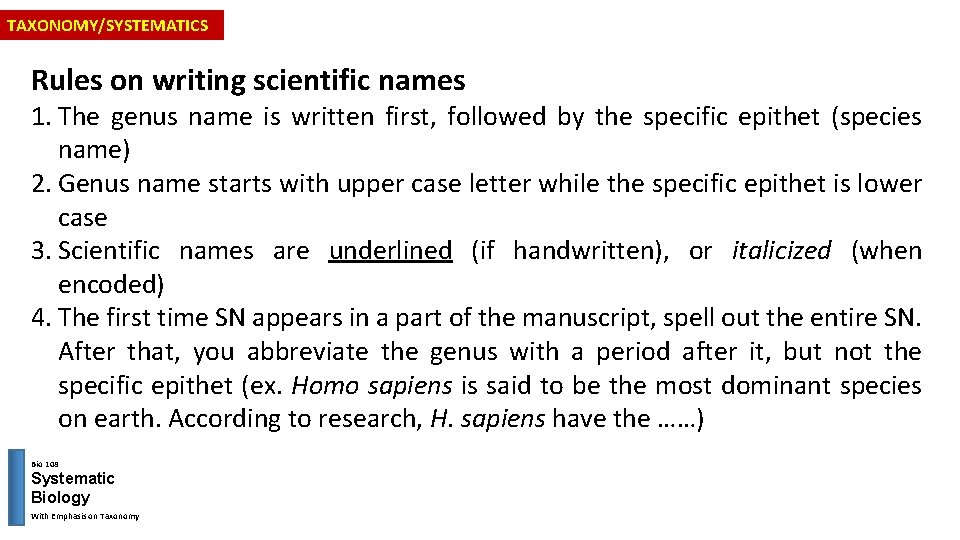
TAXONOMY/SYSTEMATICS Rules on writing scientific names 1. The genus name is written first, followed by the specific epithet (species name) 2. Genus name starts with upper case letter while the specific epithet is lower case 3. Scientific names are underlined (if handwritten), or italicized (when encoded) 4. The first time SN appears in a part of the manuscript, spell out the entire SN. After that, you abbreviate the genus with a period after it, but not the specific epithet (ex. Homo sapiens is said to be the most dominant species on earth. According to research, H. sapiens have the ……) Bio 108 Systematic Biology With Emphasis on Taxonomy
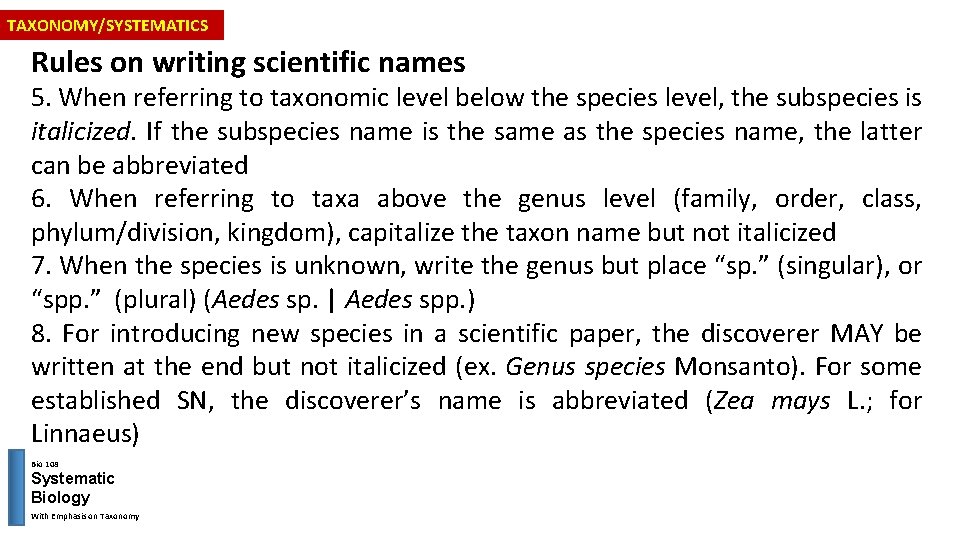
TAXONOMY/SYSTEMATICS Rules on writing scientific names 5. When referring to taxonomic level below the species level, the subspecies is italicized. If the subspecies name is the same as the species name, the latter can be abbreviated 6. When referring to taxa above the genus level (family, order, class, phylum/division, kingdom), capitalize the taxon name but not italicized 7. When the species is unknown, write the genus but place “sp. ” (singular), or “spp. ” (plural) (Aedes sp. | Aedes spp. ) 8. For introducing new species in a scientific paper, the discoverer MAY be written at the end but not italicized (ex. Genus species Monsanto). For some established SN, the discoverer’s name is abbreviated (Zea mays L. ; for Linnaeus) Bio 108 Systematic Biology With Emphasis on Taxonomy
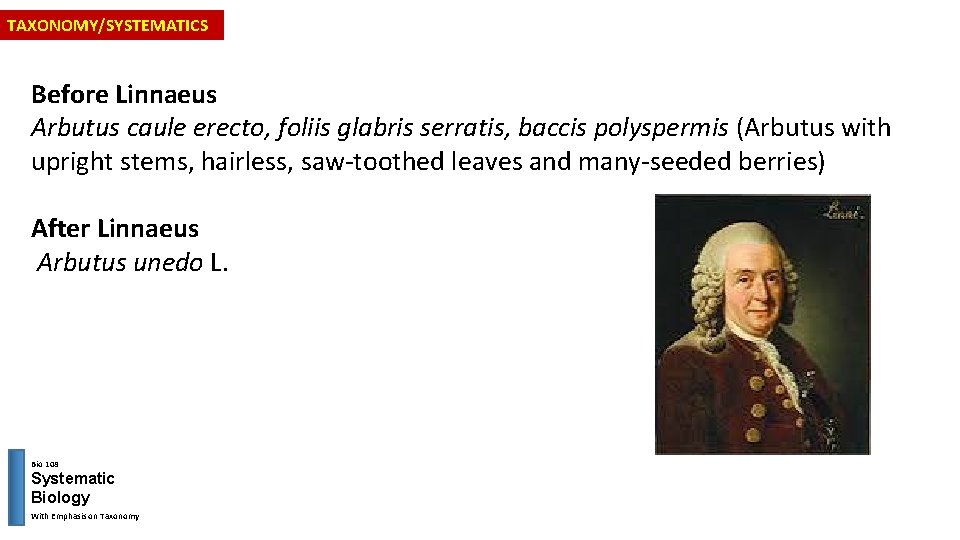
TAXONOMY/SYSTEMATICS Before Linnaeus Arbutus caule erecto, foliis glabris serratis, baccis polyspermis (Arbutus with upright stems, hairless, saw-toothed leaves and many-seeded berries) After Linnaeus Arbutus unedo L. Bio 108 Systematic Biology With Emphasis on Taxonomy

TAXONOMY/SYSTEMATICS Can we just simply give scientific names? Any names we like? Bio 108 Systematic Biology With Emphasis on Taxonomy

TAXONOMY/SYSTEMATICS Cebu Landmarks have names Bio 108 Systematic Biology With Emphasis on Taxonomy
TAXONOMY/SYSTEMATICS Things to consider when giving scientific names: a. Must follow the guidelines of the International Code of Zoological Nomenclature (ICZN) b. Must not be offensive (Linnaeus once gave a scientific name to humiliate his enemy) c. Must be logical (to describe the identity of the organism and its relationship to other closely related species) (Rosa alba – white rose | ) d. You might use the traditional Latin description, place, names to honor other people (or yourself if you are egocentric), behavior, physical characteristics, endemicity, or some Hollywood characters or movies! e. SN are subject to change and some can have synonyms Bio 108 Systematic Biology With Emphasis on Taxonomy
TAXONOMY/SYSTEMATICS Latin description: Bio 108 Systematic Biology With Emphasis on Taxonomy arthro – joints australis – southern Brachy – short Calvus - bald Canis – dogs cephalo – head Dactylo – finger/toes Erectus – upright Erythro – red Familiaris – domestic/common Proto – first Pterus – wings Reptans – crawling/creeping Rex - king Rufus – red Sapiens – wise Sinensis – from China
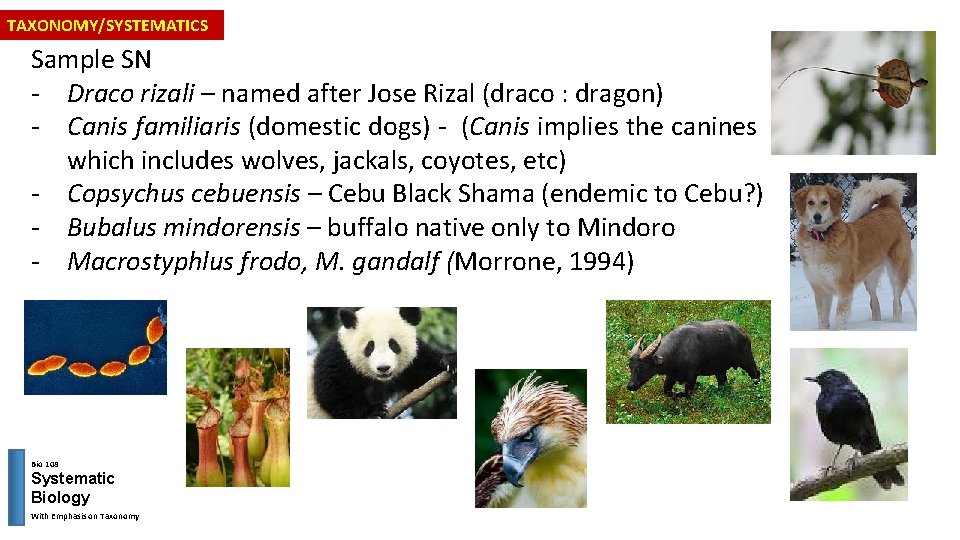
TAXONOMY/SYSTEMATICS Sample SN - Draco rizali – named after Jose Rizal (draco : dragon) - Canis familiaris (domestic dogs) - (Canis implies the canines which includes wolves, jackals, coyotes, etc) - Copsychus cebuensis – Cebu Black Shama (endemic to Cebu? ) - Bubalus mindorensis – buffalo native only to Mindoro - Macrostyphlus frodo, M. gandalf (Morrone, 1994) Bio 108 Systematic Biology With Emphasis on Taxonomy
TAXONOMY/SYSTEMATICS Disadvantages of using common names: - Lack of clarity | when talking about ant, there are thousands of different ant species - Misleading | a jellyfish is not a fish, and a sea horse is not a horse! - Illogical | no scientific basis in providing the names (why do you think the word ‘bayabas’ come from? ) - An organism can have different common names from one place to another, making it non-universal | (what do you think is the ‘other’ common name of “iro” in the different parts of the world? Bio 108 Systematic Biology With Emphasis on Taxonomy

- Slides: 18