
Midterm Exam 06 Exercise 2 Atomic Shared Memory
![The majority algorithm [ABD 95] • All reads and writes complete in a single](https://slidetodoc.com/presentation_image_h2/e2d4e293c22f095fbc765542c761d24e/image-12.jpg "The majority algorithm [ABD 95] • All reads and writes complete in a single")
![Solution • In the following slides we modify the majority algorithm of [ABD 95]](https://slidetodoc.com/presentation_image_h2/e2d4e293c22f095fbc765542c761d24e/image-14.jpg "Solution • In the following slides we modify the majority algorithm of [ABD 95]")
- Slides: 24
Midterm Exam 06: Exercise 2 Atomic Shared Memory
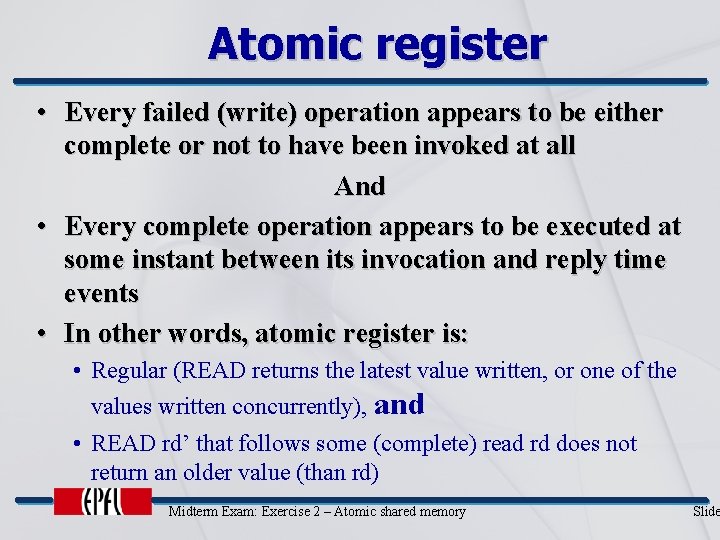
Atomic register • Every failed (write) operation appears to be either complete or not to have been invoked at all And • Every complete operation appears to be executed at some instant between its invocation and reply time events • In other words, atomic register is: • Regular (READ returns the latest value written, or one of the values written concurrently), and • READ rd’ that follows some (complete) read rd does not return an older value (than rd) Midterm Exam: Exercise 2 – Atomic shared memory Slide
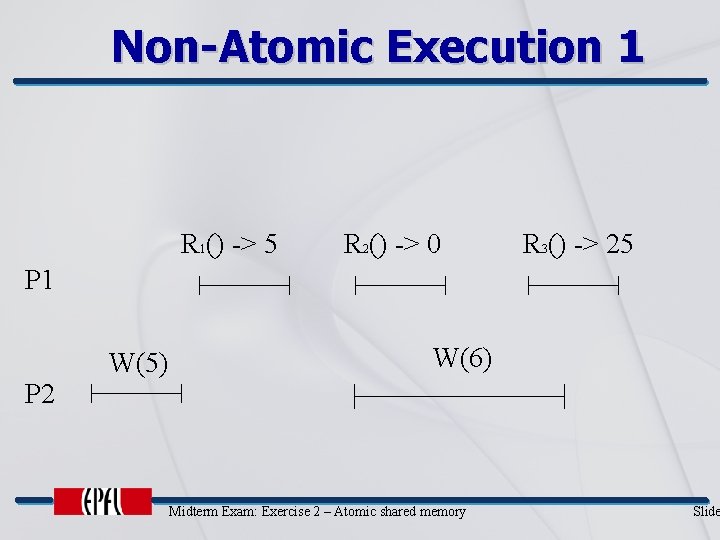
Non-Atomic Execution 1 R 1() -> 5 R 2() -> 0 R 3() -> 25 P 1 P 2 W(5) W(6) Midterm Exam: Exercise 2 – Atomic shared memory Slide
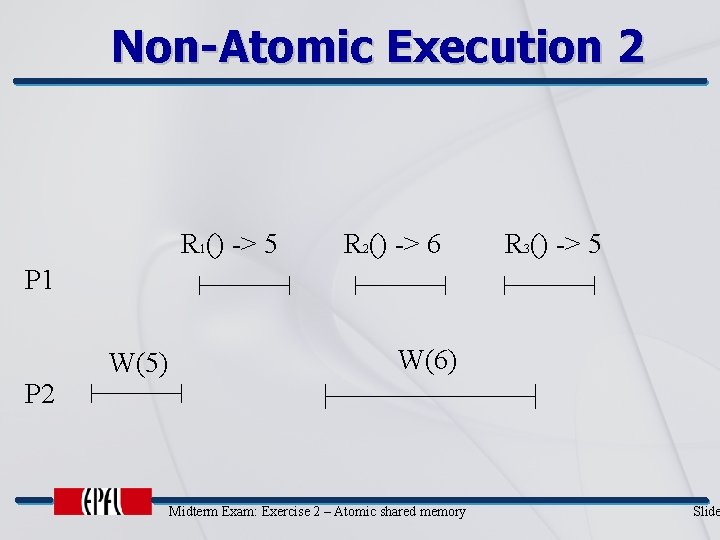
Non-Atomic Execution 2 R 1() -> 5 R 2() -> 6 R 3() -> 5 P 1 P 2 W(5) W(6) Midterm Exam: Exercise 2 – Atomic shared memory Slide
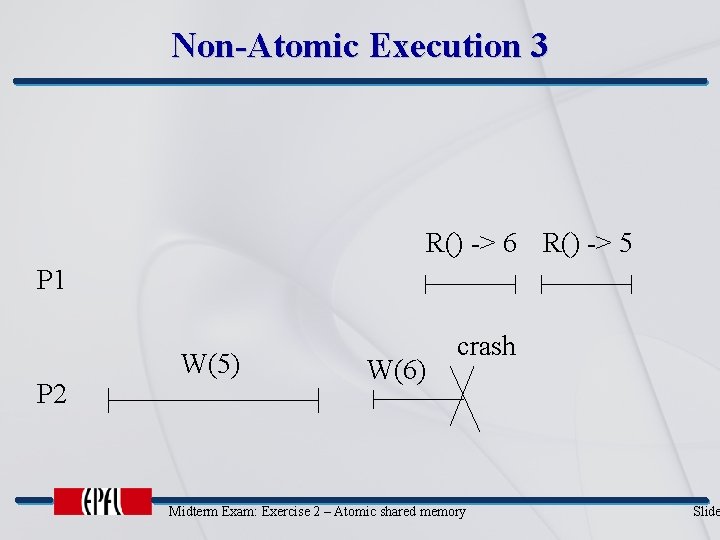
Non-Atomic Execution 3 R() -> 6 R() -> 5 P 1 P 2 W(5) W(6) crash Midterm Exam: Exercise 2 – Atomic shared memory Slide
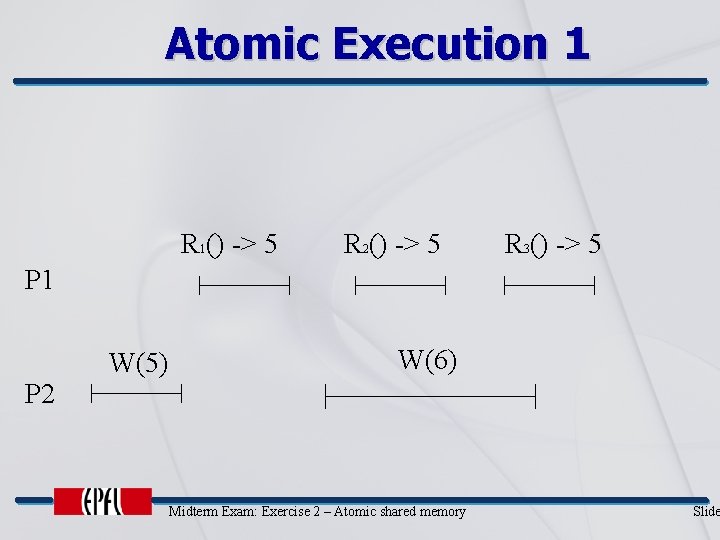
Atomic Execution 1 R 1() -> 5 R 2() -> 5 R 3() -> 5 P 1 P 2 W(5) W(6) Midterm Exam: Exercise 2 – Atomic shared memory Slide
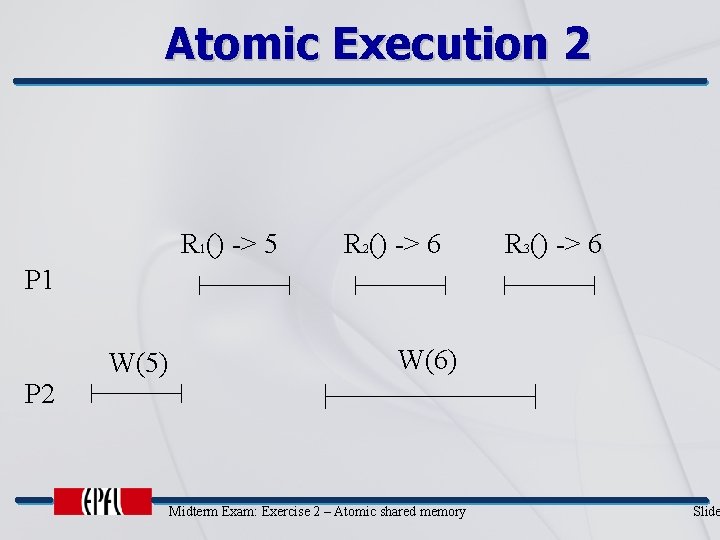
Atomic Execution 2 R 1() -> 5 R 2() -> 6 R 3() -> 6 P 1 P 2 W(5) W(6) Midterm Exam: Exercise 2 – Atomic shared memory Slide
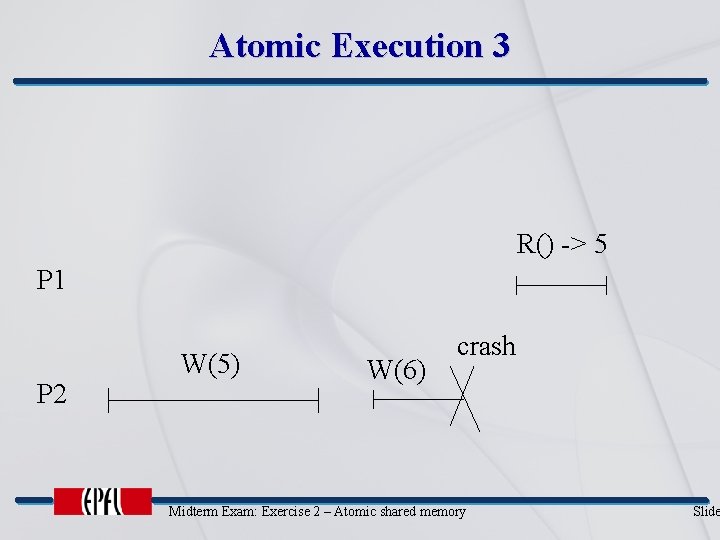
Atomic Execution 3 R() -> 5 P 1 P 2 W(5) W(6) crash Midterm Exam: Exercise 2 – Atomic shared memory Slide
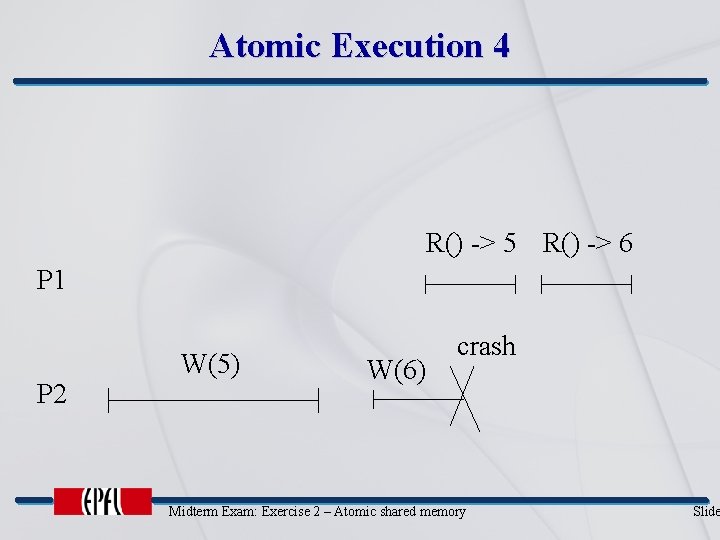
Atomic Execution 4 R() -> 5 R() -> 6 P 1 P 2 W(5) W(6) crash Midterm Exam: Exercise 2 – Atomic shared memory Slide
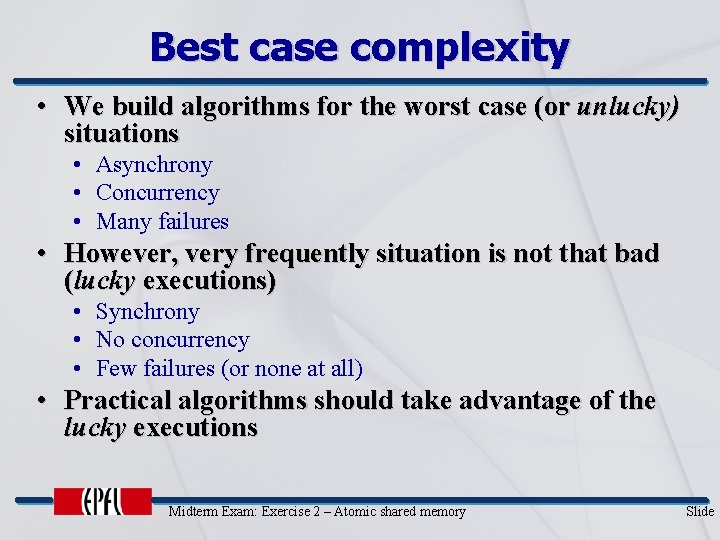
Best case complexity • We build algorithms for the worst case (or unlucky) situations • Asynchrony • Concurrency • Many failures • However, very frequently situation is not that bad (lucky executions) • Synchrony • No concurrency • Few failures (or none at all) • Practical algorithms should take advantage of the lucky executions Midterm Exam: Exercise 2 – Atomic shared memory Slide 1
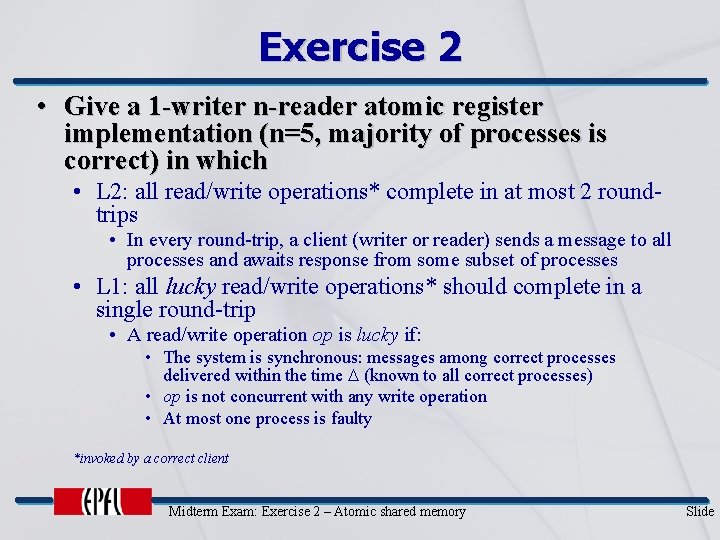
Exercise 2 • Give a 1 -writer n-reader atomic register implementation (n=5, majority of processes is correct) in which • L 2: all read/write operations* complete in at most 2 roundtrips • In every round-trip, a client (writer or reader) sends a message to all processes and awaits response from some subset of processes • L 1: all lucky read/write operations* should complete in a single round-trip • A read/write operation op is lucky if: • The system is synchronous: messages among correct processes delivered within the time (known to all correct processes) • op is not concurrent with any write operation • At most one process is faulty *invoked by a correct client Midterm Exam: Exercise 2 – Atomic shared memory Slide 1
The majority algorithm [ABD 95] • All reads and writes complete in a single round-trip • A client sends a message to all processes and waits for response from a majority • However, this algorithm implements only regular register (not atomic) • To make the algorithm atomic: • readers impose a value with a highest timestamp to a majority of processes (requires a second round-trip) Midterm Exam: Exercise 2 – Atomic shared memory Slide 1
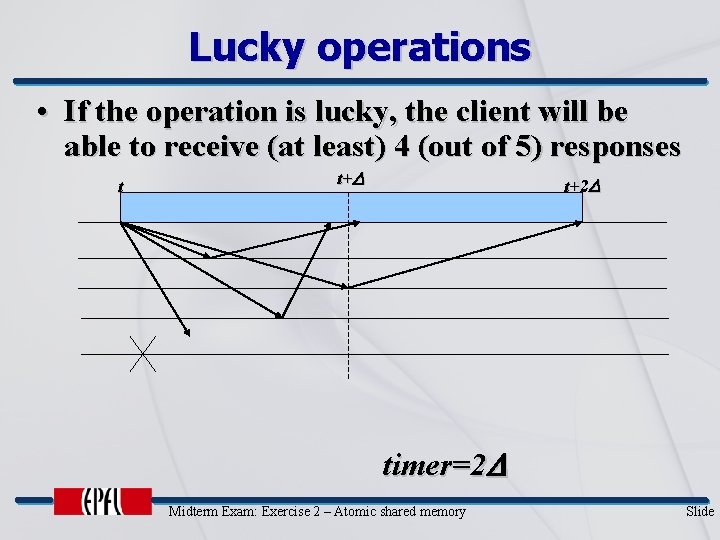
Lucky operations • If the operation is lucky, the client will be able to receive (at least) 4 (out of 5) responses t t+ t+2 timer=2 Midterm Exam: Exercise 2 – Atomic shared memory Slide 1
Solution • In the following slides we modify the majority algorithm of [ABD 95] • [ABD 95] is given in slides 30 -32, Regular Register Algorithms lecture notes – in Shared Memory part 2 Midterm Exam: Exercise 2 – Atomic shared memory Slide 1
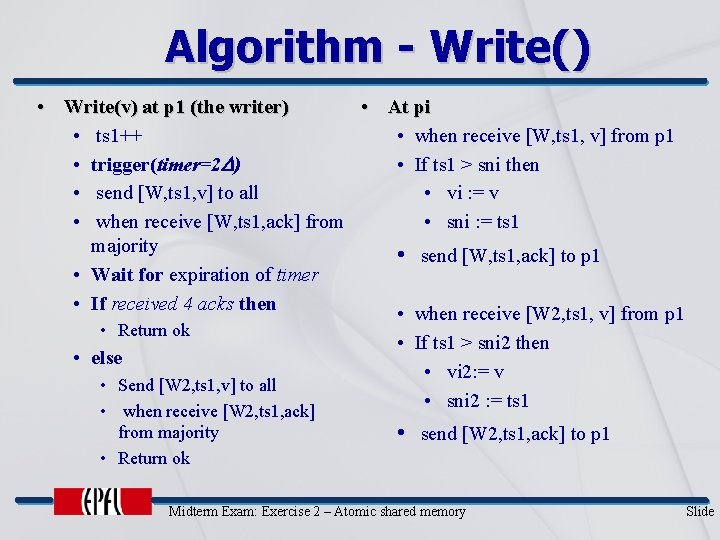
Algorithm - Write() • Write(v) at p 1 (the writer) • At pi • ts 1++ • when receive [W, ts 1, v] from p 1 • trigger(timer=2 ) • If ts 1 > sni then • send [W, ts 1, v] to all • vi : = v • when receive [W, ts 1, ack] from • sni : = ts 1 majority • send [W, ts 1, ack] to p 1 • Wait for expiration of timer • If received 4 acks then • when receive [W 2, ts 1, v] from p 1 • Return ok • If ts 1 > sni 2 then • else • vi 2: = v • Send [W 2, ts 1, v] to all • sni 2 : = ts 1 • when receive [W 2, ts 1, ack] from majority • Return ok • send [W 2, ts 1, ack] to p 1 Midterm Exam: Exercise 2 – Atomic shared memory Slide 1
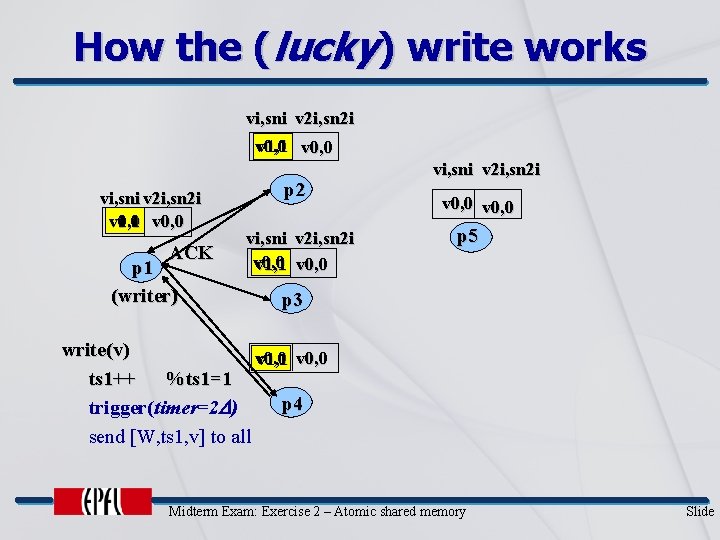
How the (lucky) write works vi, sni v 2 i, sn 2 i v 0, 0 v 1, 1 v 0, 0 vi, sni v 2 i, sn 2 i v 1, 1 v 0, 0 ACK p 1 (writer) p 2 vi, sni v 2 i, sn 2 i v 0, 0 v 1, 1 v 0, 0 vi, sni v 2 i, sn 2 i v 0, 0 p 5 p 3 write(v) v 0, 0 v 1, 1 v 0, 0 ts 1++ %ts 1=1 p 4 trigger(timer=2 ) send [W, ts 1, v] to all Midterm Exam: Exercise 2 – Atomic shared memory Slide 1
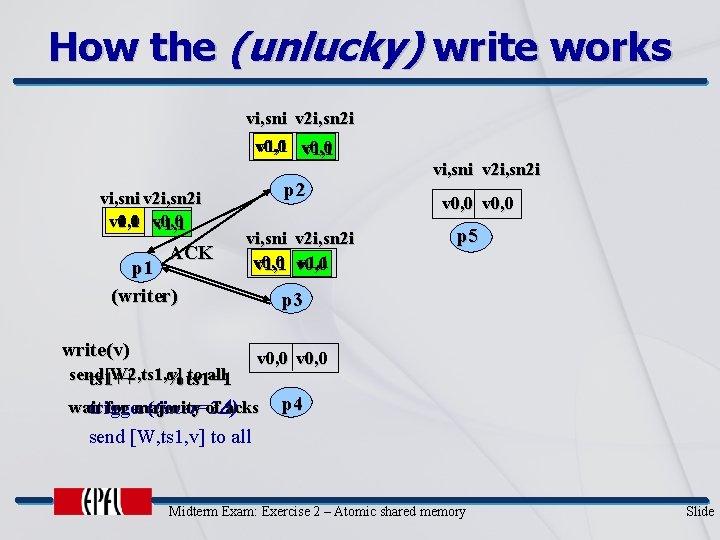
How the (unlucky) write works vi, sni v 2 i, sn 2 i v 0, 0 v 1, 1 vi, sni v 2 i, sn 2 i v 1, 1 v 0, 0 v 1, 1 ACK p 1 (writer) p 2 vi, sni v 2 i, sn 2 i v 0, 0 v 1, 1 v 0, 0 vi, sni v 2 i, sn 2 i v 0, 0 p 5 p 3 write(v) v 0, 0 send[W 2, ts 1, v] to all ts 1++ %ts 1=1 p 4 wait for majority of acks trigger(timer=2 ) send [W, ts 1, v] to all Midterm Exam: Exercise 2 – Atomic shared memory Slide 1
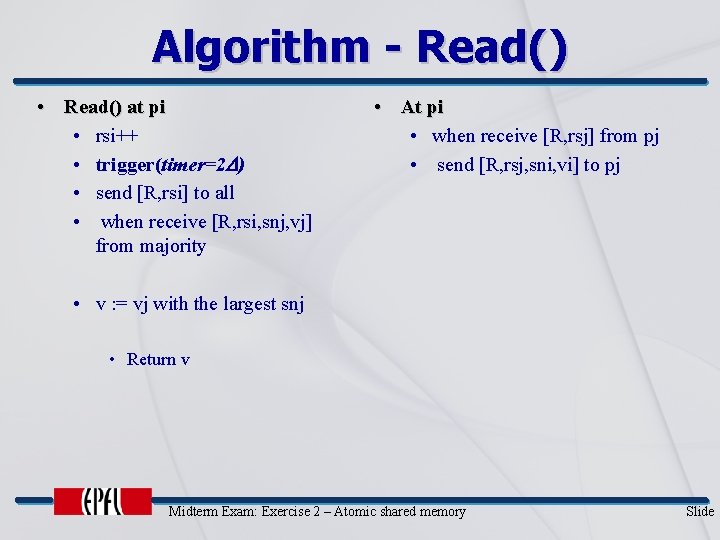
Algorithm - Read() • Read() at pi • rsi++ • trigger(timer=2 ) • send [R, rsi] to all • when receive [R, rsi, snj, vj] from majority • At pi • when receive [R, rsj] from pj • send [R, rsj, sni, vi] to pj • v : = vj with the largest snj • Return v Midterm Exam: Exercise 2 – Atomic shared memory Slide 1
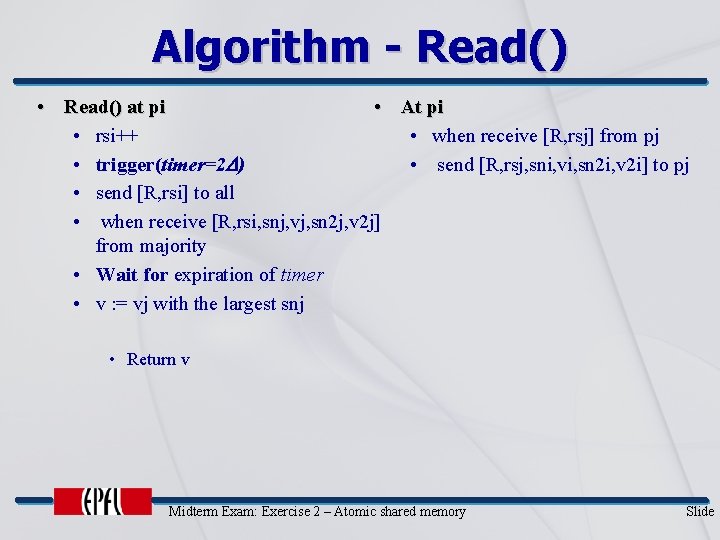
Algorithm - Read() • Read() at pi • At pi • rsi++ • when receive [R, rsj] from pj • trigger(timer=2 ) • send [R, rsj, sni, vi, sn 2 i, v 2 i] to pj • send [R, rsi] to all • when receive [R, rsi, snj, vj, sn 2 j, v 2 j] from majority • Wait for expiration of timer • v : = vj with the largest snj • Return v Midterm Exam: Exercise 2 – Atomic shared memory Slide 1
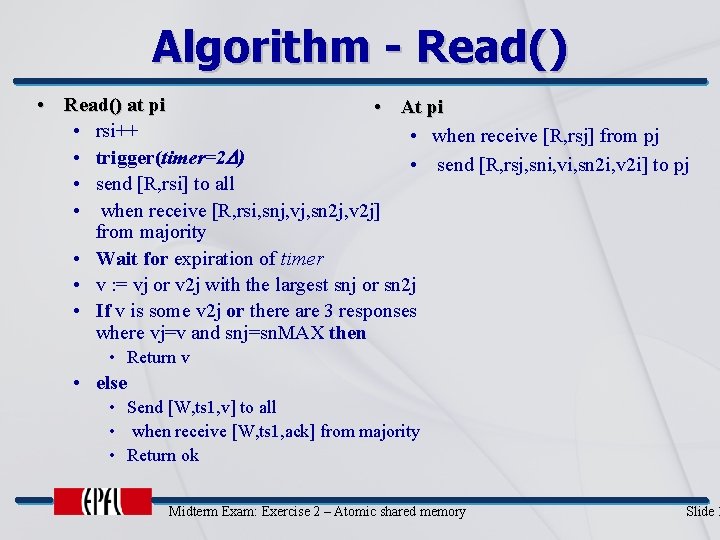
Algorithm - Read() • Read() at pi • At pi • rsi++ • when receive [R, rsj] from pj • trigger(timer=2 ) • send [R, rsj, sni, vi, sn 2 i, v 2 i] to pj • send [R, rsi] to all • when receive [R, rsi, snj, vj, sn 2 j, v 2 j] from majority • Wait for expiration of timer • v : = vj or v 2 j with the largest snj or sn 2 j • If v is some v 2 j or there are 3 responses where vj=v and snj=sn. MAX then • Return v • else • Send [W, ts 1, v] to all • when receive [W, ts 1, ack] from majority • Return ok Midterm Exam: Exercise 2 – Atomic shared memory Slide 2
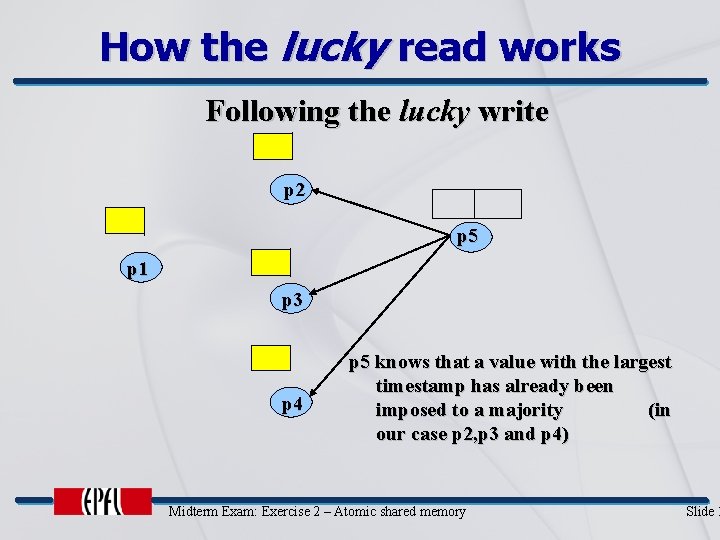
How the lucky read works Following the lucky write p 2 p 5 p 1 p 3 p 4 p 5 knows that a value with the largest timestamp has already been imposed to a majority (in our case p 2, p 3 and p 4) Midterm Exam: Exercise 2 – Atomic shared memory Slide 2
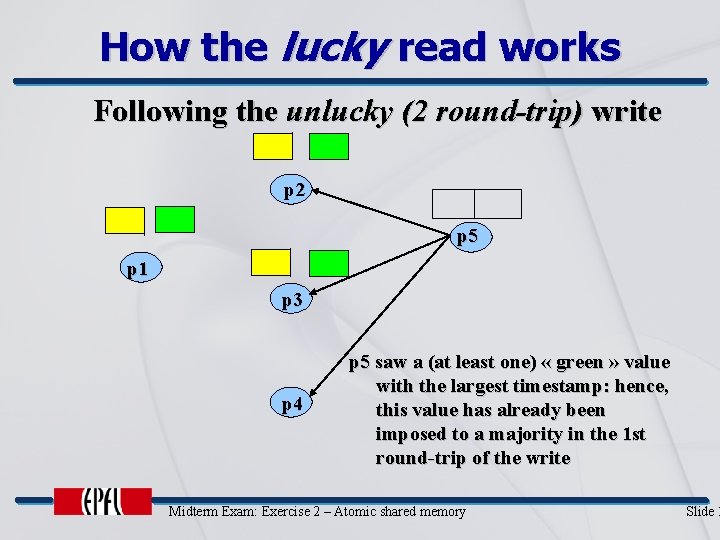
How the lucky read works Following the unlucky (2 round-trip) write p 2 p 5 p 1 p 3 p 4 p 5 saw a (at least one) « green » value with the largest timestamp: hence, this value has already been imposed to a majority in the 1 st round-trip of the write Midterm Exam: Exercise 2 – Atomic shared memory Slide 2
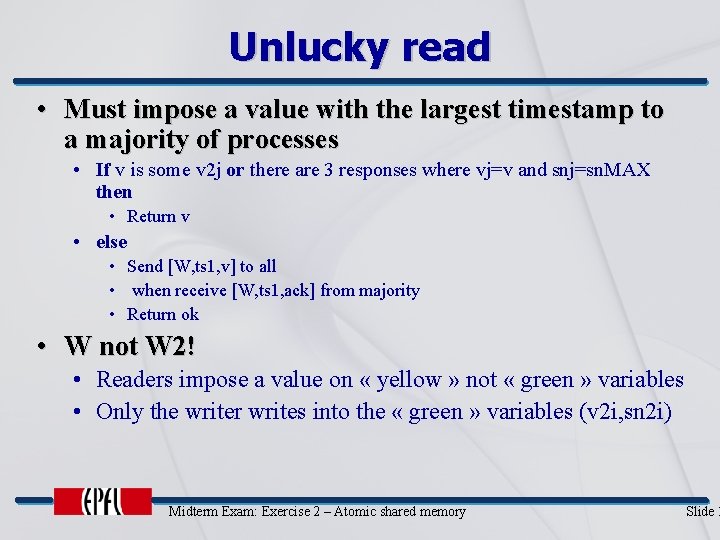
Unlucky read • Must impose a value with the largest timestamp to a majority of processes • If v is some v 2 j or there are 3 responses where vj=v and snj=sn. MAX then • Return v • else • Send [W, ts 1, v] to all • when receive [W, ts 1, ack] from majority • Return ok • W not W 2! • Readers impose a value on « yellow » not « green » variables • Only the writer writes into the « green » variables (v 2 i, sn 2 i) Midterm Exam: Exercise 2 – Atomic shared memory Slide 2
An offline exercise • Try to rigorously prove correctness of this algorithm • Proving correctness may appear on the final exam Midterm Exam: Exercise 2 – Atomic shared memory Slide 2