
Midshaft Femur Shaft Fracture Always Antegrade Nailing Brent
Midshaft Femur Shaft Fracture: Always Antegrade Nailing Brent L. Norris Clinical Associate Professor Chairman, OSU Orthopaedic Surgery Training Program Oklahoma State University Co-Director, Orthopaedic Trauma Fellowship University of Oklahoma Tulsa, OK
Disclosures • AAOS • AONA: • Depuy/Synthes • Acumed • Wishbone Medical • Endeavor Ortho • ORI Program Committee Member Fellowship grant support Consultant Principle
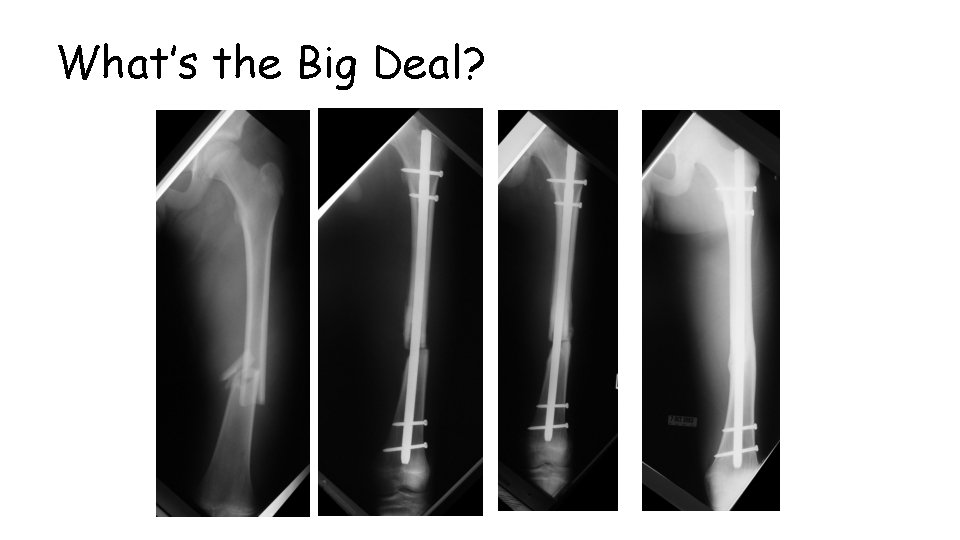
What’s the Big Deal?

Thank You!
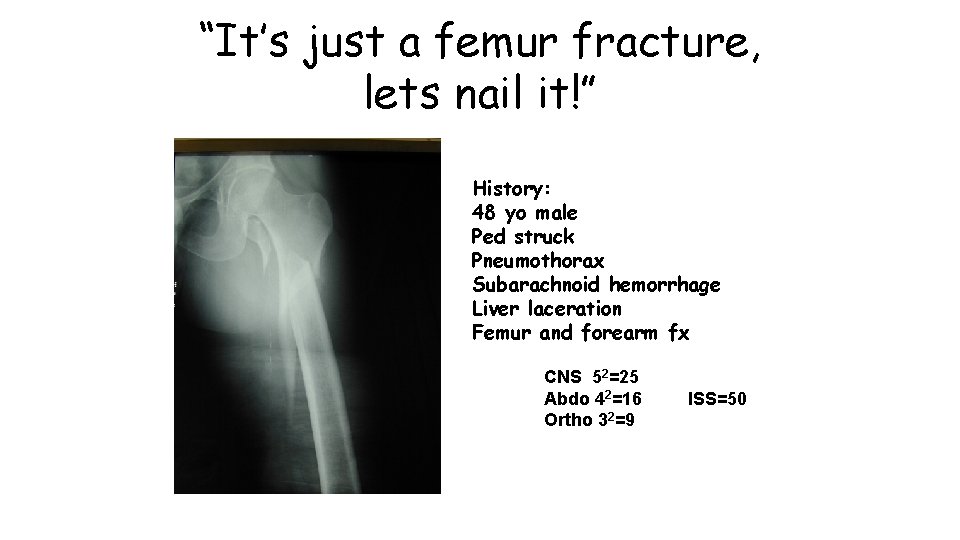
“It’s just a femur fracture, lets nail it!” History: 48 yo male Ped struck Pneumothorax Subarachnoid hemorrhage Liver laceration Femur and forearm fx CNS 52=25 Abdo 42=16 Ortho 32=9 ISS=50
Types of Fixation • IM Nails • Plates and Screws • External Fixation USUALLY IM NAILS BUT SOMETIMES ALL THE ABOVE
Concerns associated with IM Femoral Nailing Late 1990’s • Antegrade vs retrograde • Trochanteric vs piriformis • Reamed vs unreamed • Timing of fixation • Early verses delayed • Extending the indications of IM femoral nailing

Antegrade Femoral Nailing Piriformis fossa starting point Trochanteric starting point
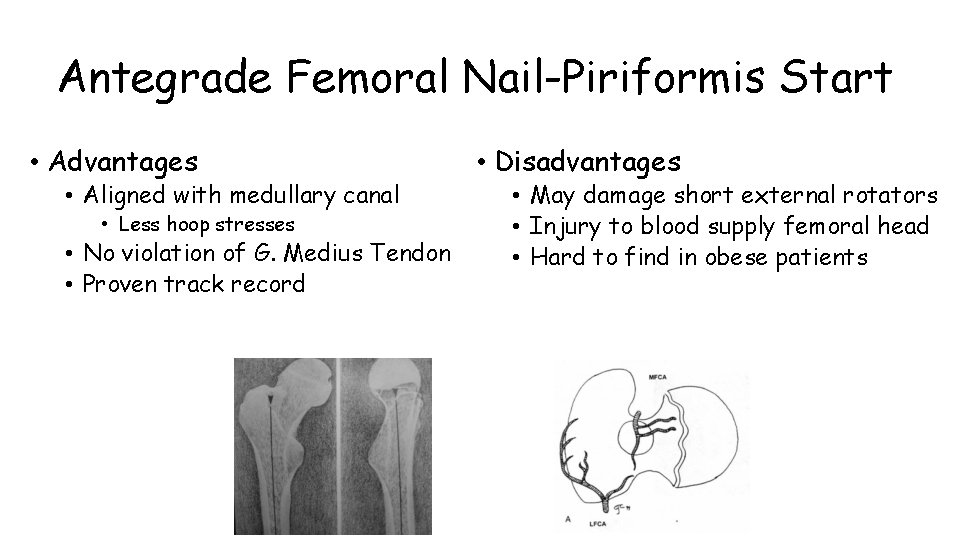
Antegrade Femoral Nail-Piriformis Start • Advantages • Aligned with medullary canal • Less hoop stresses • No violation of G. Medius Tendon • Proven track record • Disadvantages • May damage short external rotators • Injury to blood supply femoral head • Hard to find in obese patients
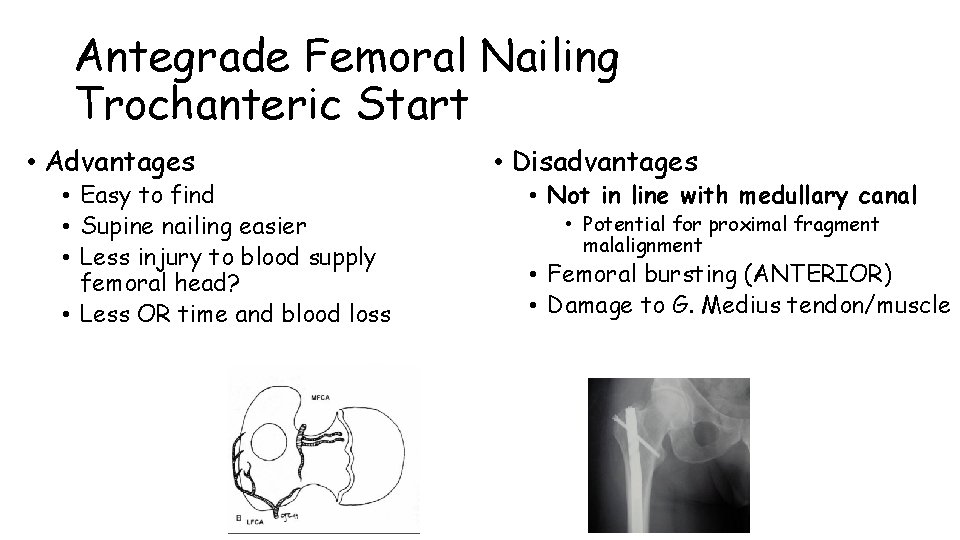
Antegrade Femoral Nailing Trochanteric Start • Advantages • Easy to find • Supine nailing easier • Less injury to blood supply femoral head? • Less OR time and blood loss • Disadvantages • Not in line with medullary canal • Potential for proximal fragment malalignment • Femoral bursting (ANTERIOR) • Damage to G. Medius tendon/muscle
Antegrade Femoral Nail Insertion Forces Depend Upon • Nail Geometry/Characteristics • Curvature of femur • Entry portal • Piriformis/Trochanteric • Size of the canal • Size of the proximal fragment
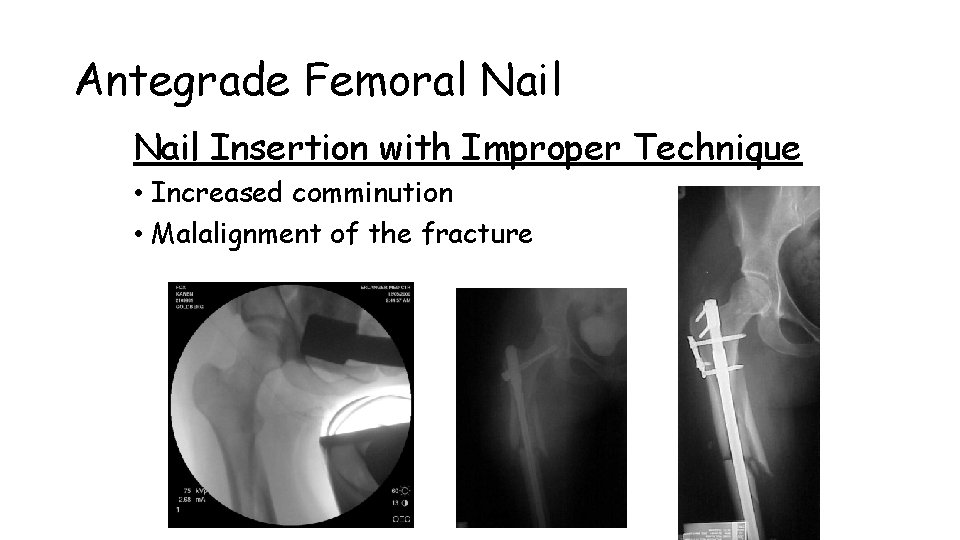
Antegrade Femoral Nail Insertion with Improper Technique • Increased comminution • Malalignment of the fracture

Advances in IM Nailing • IM Reaming • Flexible reamers • Nail Geometry. Metallurgy • Cannulatioin, radius of curvature, interlocking options • SS, Ti, C • Extending Nailing Indications • Nailing metaphyseal, articular injuries
Intramedullary Reaming • Technique used to enlarge an already existing hole • Technique • Cannulated system • Front cutting (initial reaming) • Side cutting • Over ream by 1 mm to 1. 5 mm • Prevents “longitudinal jamming”
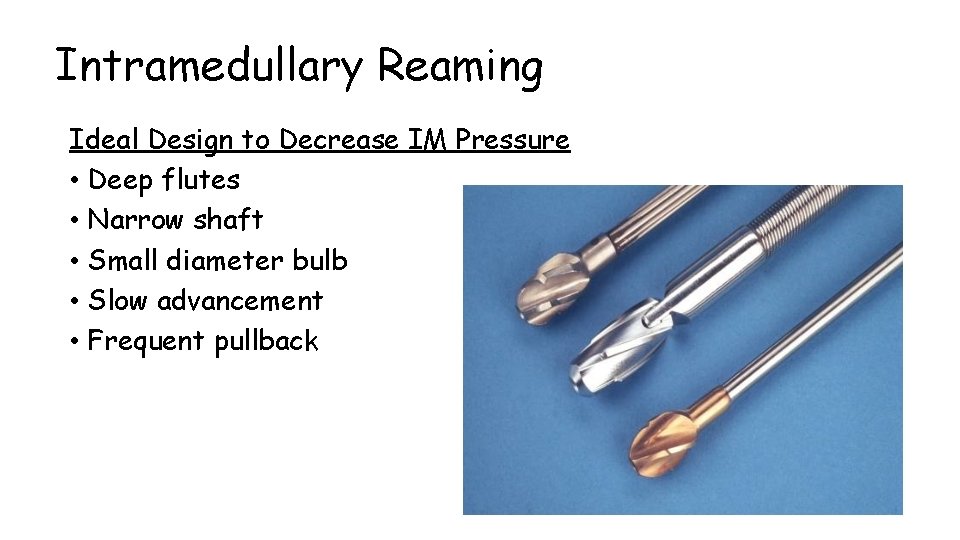
Intramedullary Reaming Ideal Design to Decrease IM Pressure • Deep flutes • Narrow shaft • Small diameter bulb • Slow advancement • Frequent pullback
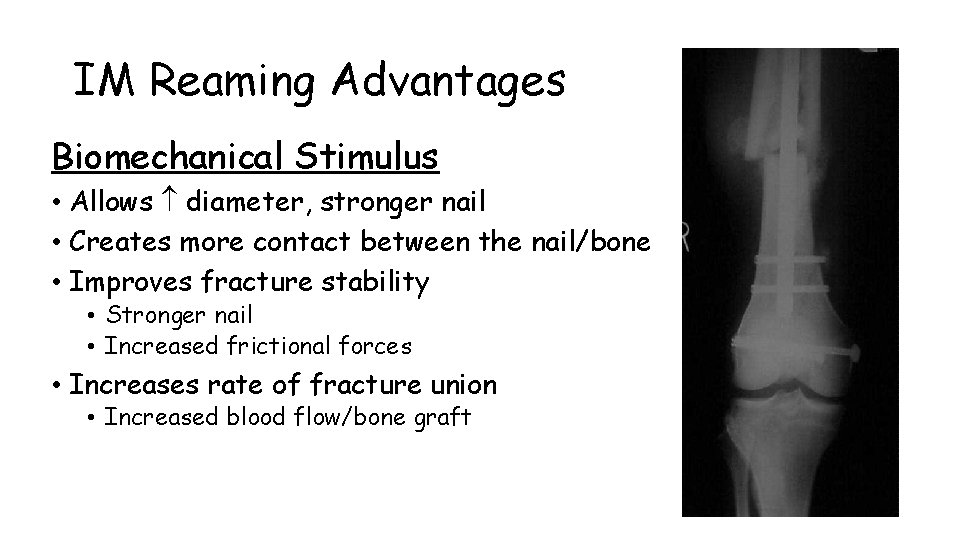
IM Reaming Advantages Biomechanical Stimulus • Allows diameter, stronger nail • Creates more contact between the nail/bone • Improves fracture stability • Stronger nail • Increased frictional forces • Increases rate of fracture union • Increased blood flow/bone graft
IM Reaming Disadvantages Risks to blood supply • Intramedullary blood supply is injured • Possible necrosis of diaphyseal bone • Reaming plus insertion of tight fitting nail can injure 70% of cortical bone vascularity • Vascularity begins reconstitution at 2 -3 wks • Nearly complete restoration at 8 weeks • May increase risk for infection (early on) Causes long term cortical remodeling* • Increased cortical thinning • Increased cortical porosity
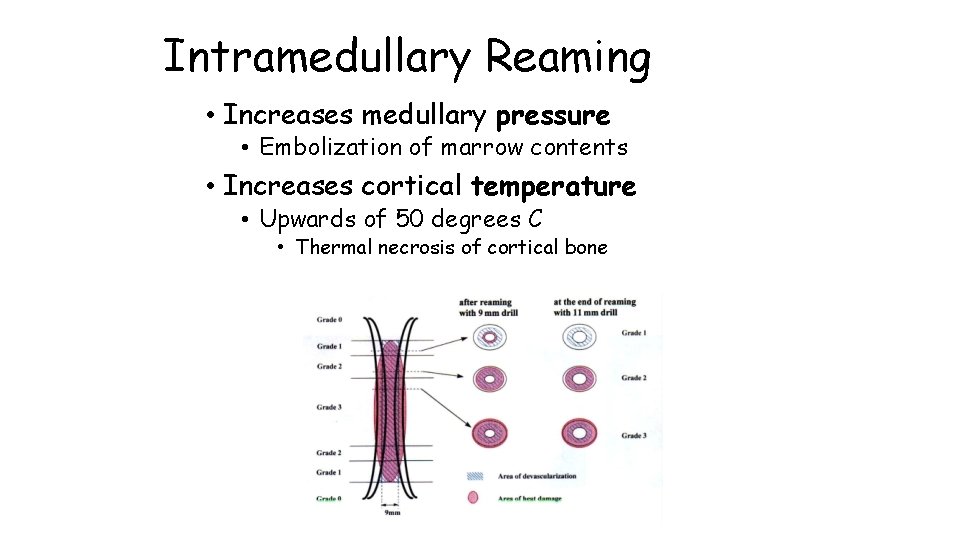
Intramedullary Reaming • Increases medullary pressure • Embolization of marrow contents • Increases cortical temperature • Upwards of 50 degrees C • Thermal necrosis of cortical bone
Reamed vs Unreamed • Reamed Nailing • Longer operating time • Increased blood loss • Fewer complications • Increased pulmonary dysfunction in lung injured patients* • Unreamed Nailing • Smaller nails leading to increased nail/screw failures ? ? • Increased nonunions ? ? • Indicated in some polytrauma
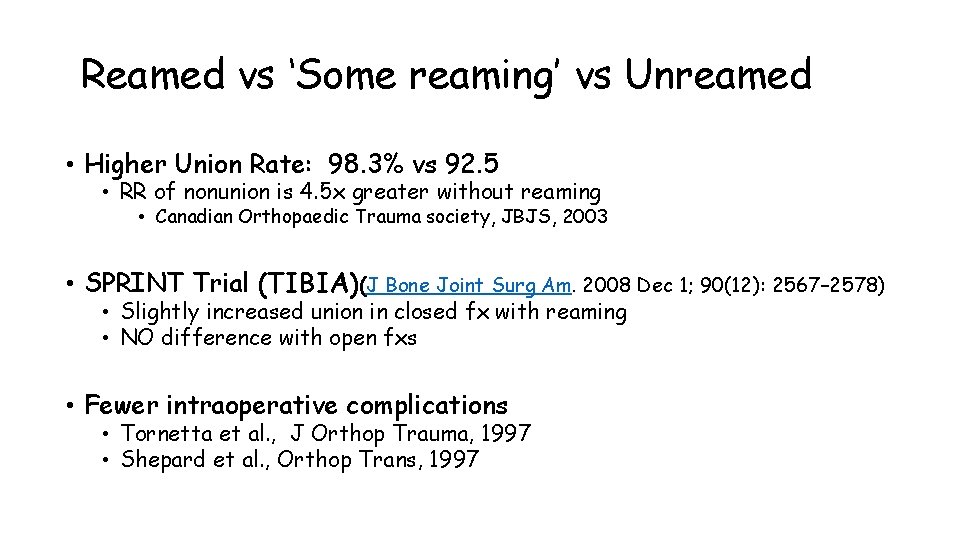
Reamed vs ‘Some reaming’ vs Unreamed • Higher Union Rate: 98. 3% vs 92. 5 • RR of nonunion is 4. 5 x greater without reaming • Canadian Orthopaedic Trauma society, JBJS, 2003 • SPRINT Trial (TIBIA)(J Bone Joint Surg Am. 2008 Dec 1; 90(12): 2567– 2578) • Slightly increased union in closed fx with reaming • NO difference with open fxs • Fewer intraoperative complications • Tornetta et al. , J Orthop Trauma, 1997 • Shepard et al. , Orthop Trans, 1997
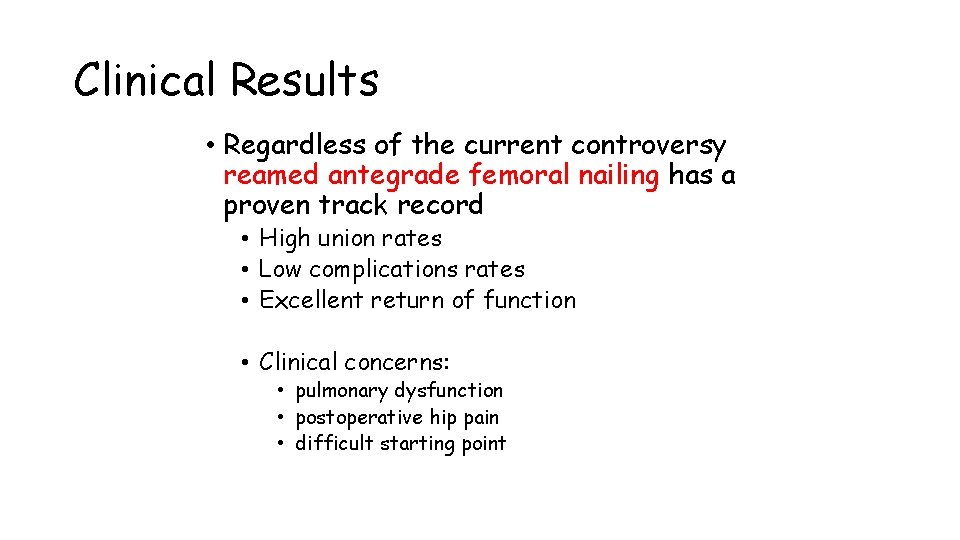
Clinical Results • Regardless of the current controversy reamed antegrade femoral nailing has a proven track record • High union rates • Low complications rates • Excellent return of function • Clinical concerns: • pulmonary dysfunction • postoperative hip pain • difficult starting point
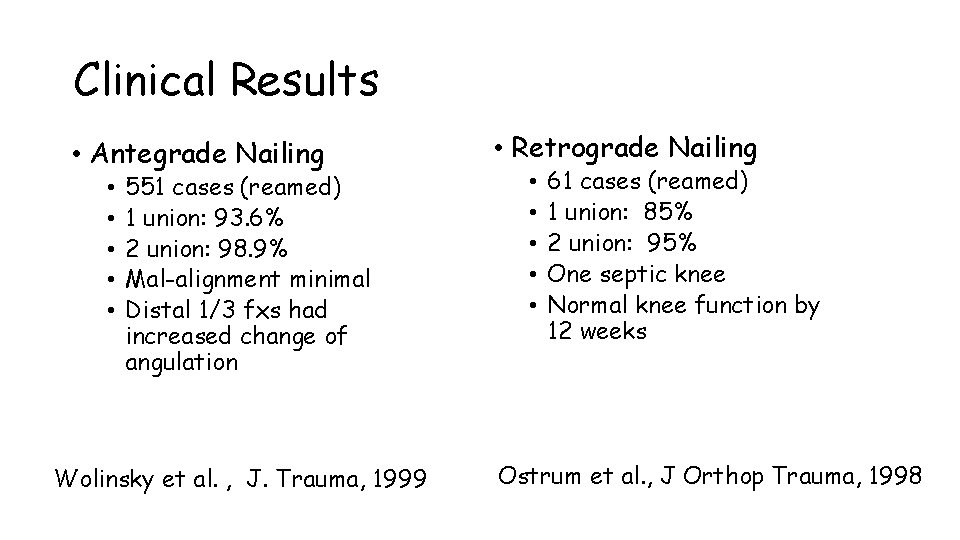
Clinical Results • Antegrade Nailing • • • 551 cases (reamed) 1 union: 93. 6% 2 union: 98. 9% Mal-alignment minimal Distal 1/3 fxs had increased change of angulation Wolinsky et al. , J. Trauma, 1999 • Retrograde Nailing • • • 61 cases (reamed) 1 union: 85% 2 union: 95% One septic knee Normal knee function by 12 weeks Ostrum et al. , J Orthop Trauma, 1998
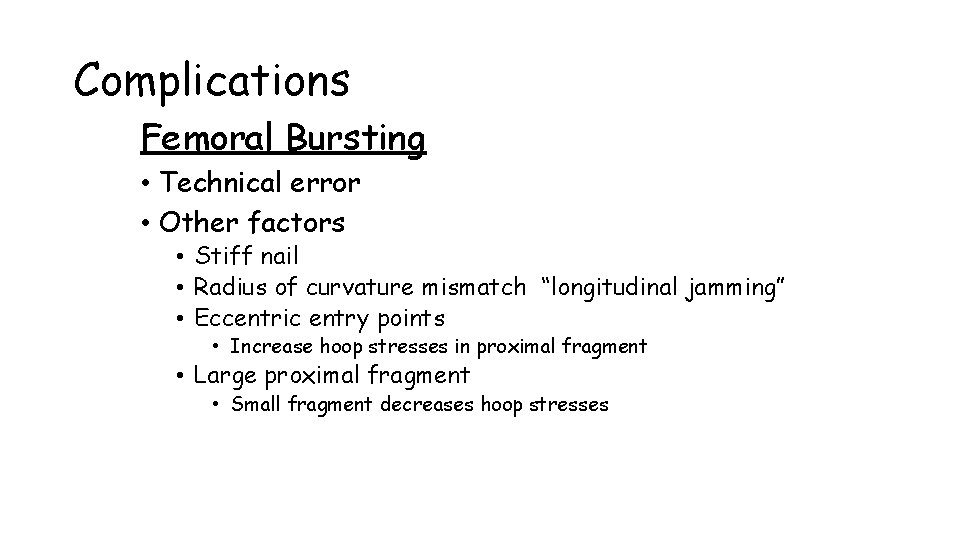
Complications Femoral Bursting • Technical error • Other factors • Stiff nail • Radius of curvature mismatch “longitudinal jamming” • Eccentric entry points • Increase hoop stresses in proximal fragment • Large proximal fragment • Small fragment decreases hoop stresses
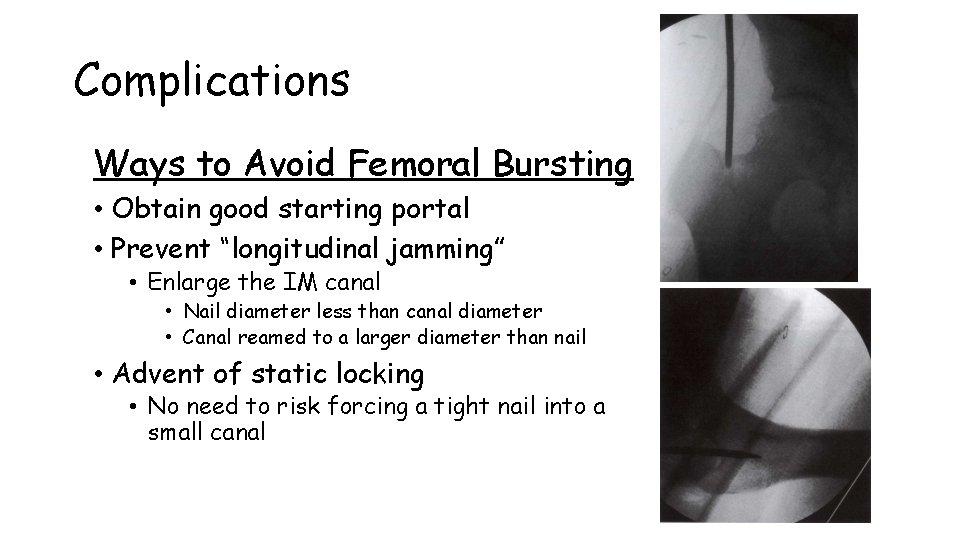
Complications Ways to Avoid Femoral Bursting • Obtain good starting portal • Prevent “longitudinal jamming” • Enlarge the IM canal • Nail diameter less than canal diameter • Canal reamed to a larger diameter than nail • Advent of static locking • No need to risk forcing a tight nail into a small canal
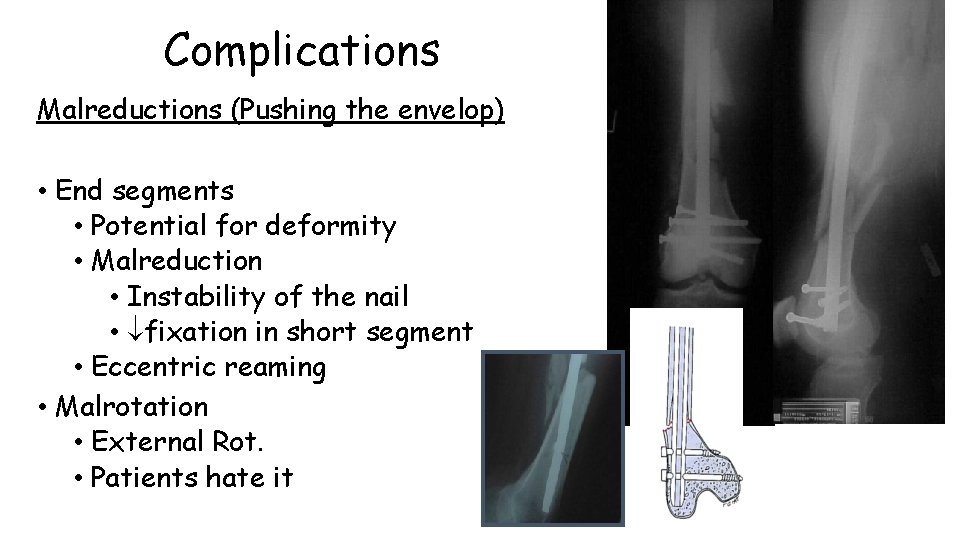
Complications Malreductions (Pushing the envelop) • End segments • Potential for deformity • Malreduction • Instability of the nail • fixation in short segment • Eccentric reaming • Malrotation • External Rot. • Patients hate it
Complications • Deep IM infection • Prominent HW • HW requiring removal • Hip pain • Knee pain • Need for secondary surgery for union
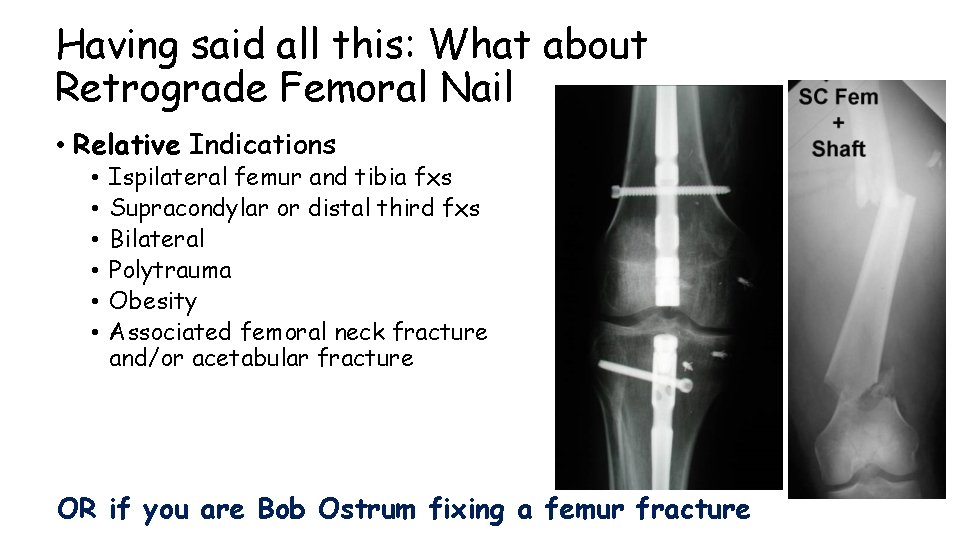
Having said all this: What about Retrograde Femoral Nail • Relative Indications • • • Ispilateral femur and tibia fxs Supracondylar or distal third fxs Bilateral Polytrauma Obesity Associated femoral neck fracture and/or acetabular fracture OR if you are Bob Ostrum fixing a femur fracture
Summary • Intramedullary nail is the BEST method of fixation for femoral shaft fractures • ANTEGRADE nailing tried and tested • Interlocking extends indications for treatment • Proximal and distal segments • Can be technically demanding • Many nail options therefore need a good preoperative plan • IM Reaming • Advantages • Improves Biomechanics, Improves Insertion Ease, Stimulates Healing • Disadvantages (REAL and must be remembered) • Pulmonary Injury, Increase Necrosis, Devitalized Bone, Cortical Remodeling
Antegrade vs Retrograde The femur shaft fx does not know or care what direction you place the IM Nail… But the hip and the knee surely do!
Thank You
- Slides: 30